
Why Experienced Salinas Owners Stop Managing Their Own Properties
Direct Answer: Most experienced Salinas owners stop self-managing when the legal exposure, time cost, and tenant problems outweigh whatever they’re saving in management fees.
Most Salinas property owners who start self-managing do it for one reason: they don’t want to pay a management fee. That’s understandable. But the owners who’ve been at it for three, five, or ten years tend to reach the same conclusion — the fee isn’t the expensive part.
Monterey County’s rental market has grown significantly more complex over the past few years. Between AB 1482 rent caps, the City of Salinas Residential Rental Registration Ordinance (Ord. 2663) passed in 2024, and the standard weight of California landlord-tenant law, self-managing a rental here is no longer something you can wing. The paperwork alone has changed.
This article focuses on the two or three things that actually push experienced owners over the edge — not every possible reason, but the real ones. If you’ve been managing your own property and wondering whether it still makes sense, this is worth reading.
The Legal Complexity That Catches Self-Managing Owners Off Guard
California is one of the most tenant-protective states in the country. That’s not a criticism — it’s just the reality of managing property here, and experienced owners know it.
What’s changed recently is the pace of that regulation. The City of Salinas Rental Registration Ordinance, which took effect in 2024, requires landlords operating within city limits to register their rental units and maintain compliance with local habitability standards. Missing this registration doesn’t just mean a fine — it can affect your ability to collect rent.
And that’s on top of existing state law. AB 1482, California’s Tenant Protection Act, caps annual rent increases at 5% plus local CPI for most properties built before 2007. It also limits the legal reasons you can remove a tenant — a concept called just cause for eviction. Getting either of these wrong, even accidentally, can expose you to significant liability.
Self-managing owners frequently run into problems in these areas:
- Applying a rent increase that exceeds the AB 1482 cap
- Serving a notice that doesn’t meet California’s strict formatting requirements
- Failing to provide required disclosures at lease signing (lead paint, Megan’s Law, military ordinance, etc.)
- Missing the Salinas registration renewal window
For a deeper look at how mid-lease law changes affect your rental obligations, it’s worth understanding that the rules can shift even on an existing tenancy. That’s not something most self-managing owners are tracking in real time.

The Hidden Time Cost Most Owners Underestimate
When owners calculate the cost of self-management, they usually think about the management fee they’re avoiding. What they rarely calculate is their own time — and what that time actually costs.
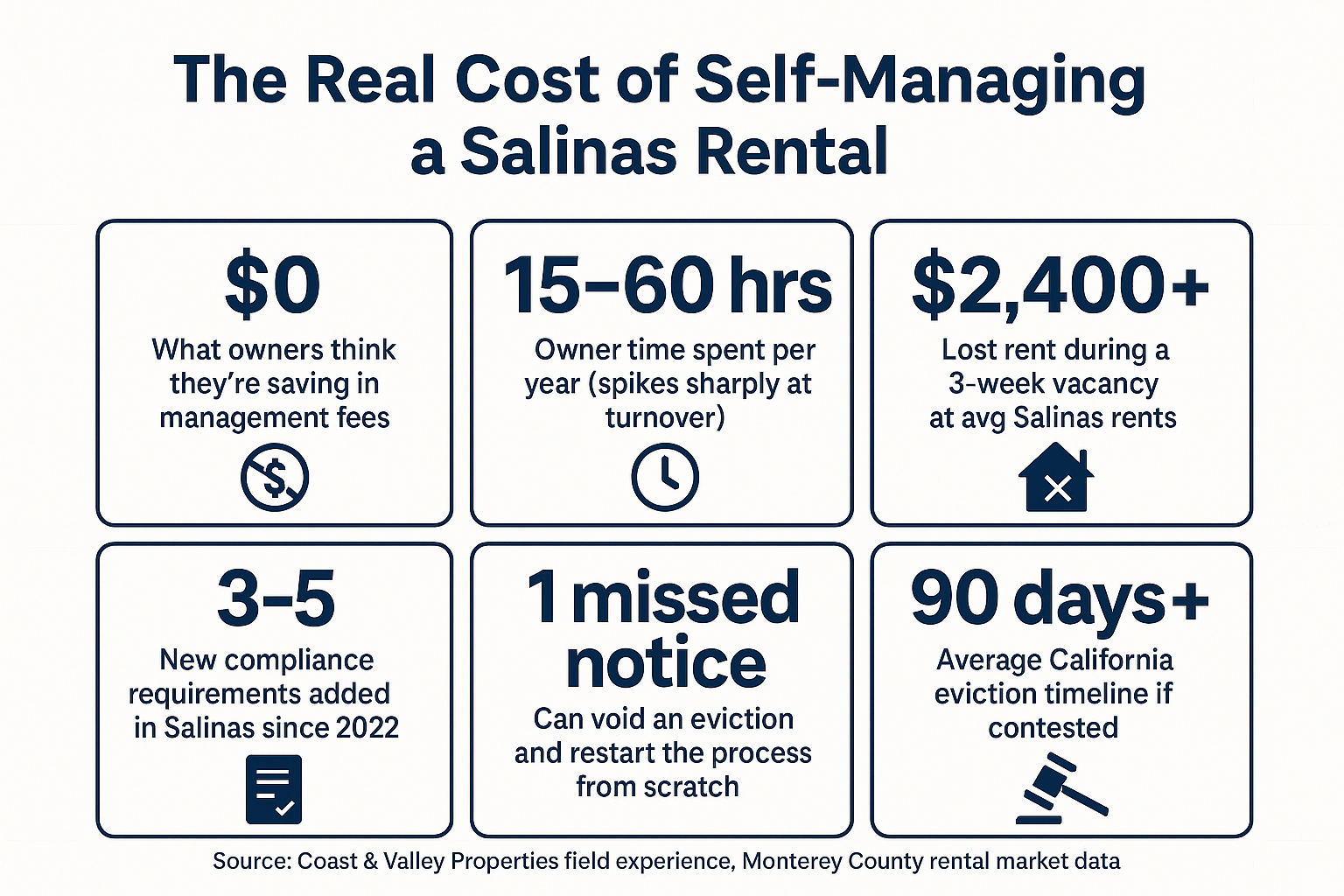
A single-family rental in Salinas generates, on average, somewhere between 15 and 30 hours of owner time per year during a stable tenancy. That number spikes sharply during a turnover: advertising the vacancy, fielding calls, showing the property, screening applicants, preparing the lease, doing the move-in inspection, and coordinating any repair work between tenants.
A realistic turnover cycle in the Salinas market can easily consume 40 to 60 hours of owner time. And if the unit sits vacant for even three weeks between tenants at an average rent of $2,200 to $2,600 per month, you’ve already absorbed more in lost rent than most management fees would have cost for the year.
The hidden workload behind managing a single rental home breaks this down in more detail — but the short version is that most owners are working for free, or close to it, once you account for their time honestly.
The owners who stick with self-management longest tend to be retired or otherwise available during business hours. For anyone with a full-time job or a family, the math gets uncomfortable quickly.
What Self-Managing a Salinas Rental Actually Costs Per Year
This infographic breaks down the real annual cost of self-management — in time, money, and legal exposure — compared to what most owners assume.
The Tenant Problem That Finally Changes the Calculation
For most experienced owners, the turning point isn’t a legal fine or an accountant’s warning. It’s a bad tenant experience — and the realization of how much damage a single poorly screened tenant can do.
In California, once a tenant is in place, removing them is a legal process. Even a tenant who stops paying rent cannot be removed without proper notice, proper service, and — if they contest it — a court proceeding. In Monterey County, a contested eviction can take 90 days or more from notice to lock change. During that window, you’re absorbing lost rent, legal fees, and often damage repair costs.
The difference between a tenant who stays four years and pays on time versus one who lasts eight months and leaves with $8,000 to $15,000 in damages and unpaid rent almost always comes down to screening. Not just a credit check, but how the application process is structured, what questions get asked, what references actually say, and how experienced the screener is at reading the picture those pieces form together.
The difference between a good tenant and a great one starts before move-in — and that process is harder to do well when you’re not doing it every week. A professional screening system, run by someone who reviews dozens of applications a year, catches things a self-managing owner with one vacancy every few years is more likely to miss.
Many of the owners we speak with can trace their decision to stop self-managing to one specific tenant story. The fee they were saving was never the issue — they just needed that lesson to see it clearly.
Self-Managing vs. Professional Management: Where the Real Differences Show Up
This isn’t a feature list — it’s a look at where the two approaches produce different outcomes in the Monterey County market.
| Area | Self-Managing Owner | Professional Management |
|---|---|---|
| Compliance tracking | Owner responsible for monitoring law changes | Tracked continuously; lease updates applied proactively |
| Salinas rental registration | Owner must self-register and renew | Managed as part of full-service oversight |
| Tenant screening | Varies — typically one vacancy every few years | Standardized process run on every applicant |
| Rent increase timing | Often missed or applied incorrectly under AB 1482 | Calculated and documented per state requirements |
| Maintenance response | Dependent on owner availability | Coordinated through vetted vendor network, 24/7 emergency line |
| Eviction process | Owner must hire attorney, manage timeline | Handled or directly coordinated by experienced broker |
What Experienced Owners Say They Wish They’d Known Earlier
When owners who’ve made the switch look back, a few things come up consistently.
First, they underestimated how much California law would change over a five-year window. AB 1482 was passed in 2019. The Salinas registration ordinance came in 2024. Owners who were self-managing comfortably in 2018 were managing a meaningfully different legal landscape by 2025 — and not all of them knew it.
Second, they didn’t have a reliable vendor network. When a water heater fails at a Salinas property on a Friday evening, the owner who has a trusted plumber’s direct line is in a very different position than the one calling around to whoever answers. Response time protects the property and the tenant relationship.
Third — and this one surprises people — they underestimated how much they’d benefit from having a licensed broker between them and their tenant. When a tenant raises a habitability concern, or hints at a legal complaint, having a professional fielding that communication matters. It changes the tone and the outcome.
For owners considering what a property management company actually does day to day, the answer goes well beyond rent collection and maintenance calls.
Frequently Asked Questions About Stopping Self-Management in Salinas
At what point does self-managing stop making financial sense?
For most Salinas owners, the math shifts when you factor in the time cost of a vacancy, the risk exposure from a compliance mistake, or the actual cost of a bad tenant situation. A management fee that runs 8–12% of collected rent often costs less than a single eviction or a month of vacancy. The calculation is different for every owner, but it’s rarely as simple as ‘I’m saving X per month.’
Do I have to register my rental property with the City of Salinas?
Yes. The City of Salinas Residential Rental Registration Ordinance (Ord. 2663), effective 2024, requires landlords with rental units within city limits to register. Failure to register can affect your legal standing as a landlord. The requirements are separate from any state-level compliance obligations under California law.
Can I switch to professional management mid-lease?
Yes — and it’s more common than people expect. A tenant doesn’t need to sign a new lease for management to transfer. The owner simply executes a management agreement, the management company introduces itself to the tenant in writing, and rent payments redirect to the new account. The transition is handled carefully so the tenant relationship stays intact.
What happens to my tenant relationships when I bring in a manager?
Good tenants rarely mind the change — they get a professional point of contact who responds faster and handles maintenance more efficiently. The communication style matters more than the structure. A well-run management company keeps the relationship professional and responsive, which most tenants prefer over the variability of dealing directly with an individual owner.
Is it harder to self-manage a multi-unit property than a single-family home?
Considerably harder. With multiple units, you’re managing staggered lease renewals, multiple maintenance streams, and the interpersonal dynamics between tenants. California’s just cause eviction rules under AB 1482 apply to most multi-unit buildings, and compliance across multiple units multiplies the documentation burden. How multi-unit owners in Monterey County stay legally compliant covers this in more depth.
Thinking About Making the Switch?
If you’re an owner in Salinas, Monterey, Carmel, or anywhere across Monterey County who’s been managing your own property and wondering whether there’s a better way, Coast & Valley Properties is worth a conversation. We’ve worked with owners who managed successfully for years before deciding the legal complexity or the time burden finally tipped the scale — and we can give you an honest picture of what professional management would actually look like for your specific property. Reach us at (831) 757-1270 or through the contact form at coastandvalleypm.com.