Triple Net Leases in Monterey County: What the ‘NNN’ Actually Means for Owners
Direct Answer: A triple net lease makes the tenant responsible for property taxes, insurance, and maintenance costs — not just base rent. It gives owners more predictable income, but the lease language determines whether that protection actually holds.
I get asked about triple net leases regularly from commercial property owners across Salinas and the Monterey Peninsula — and most of the time, the question isn’t ‘what is it?’ so much as ‘is it actually as good as it sounds?’ That skepticism is healthy. The NNN structure has real advantages for owners, but it also comes with real risks that a basic definition doesn’t prepare you for.
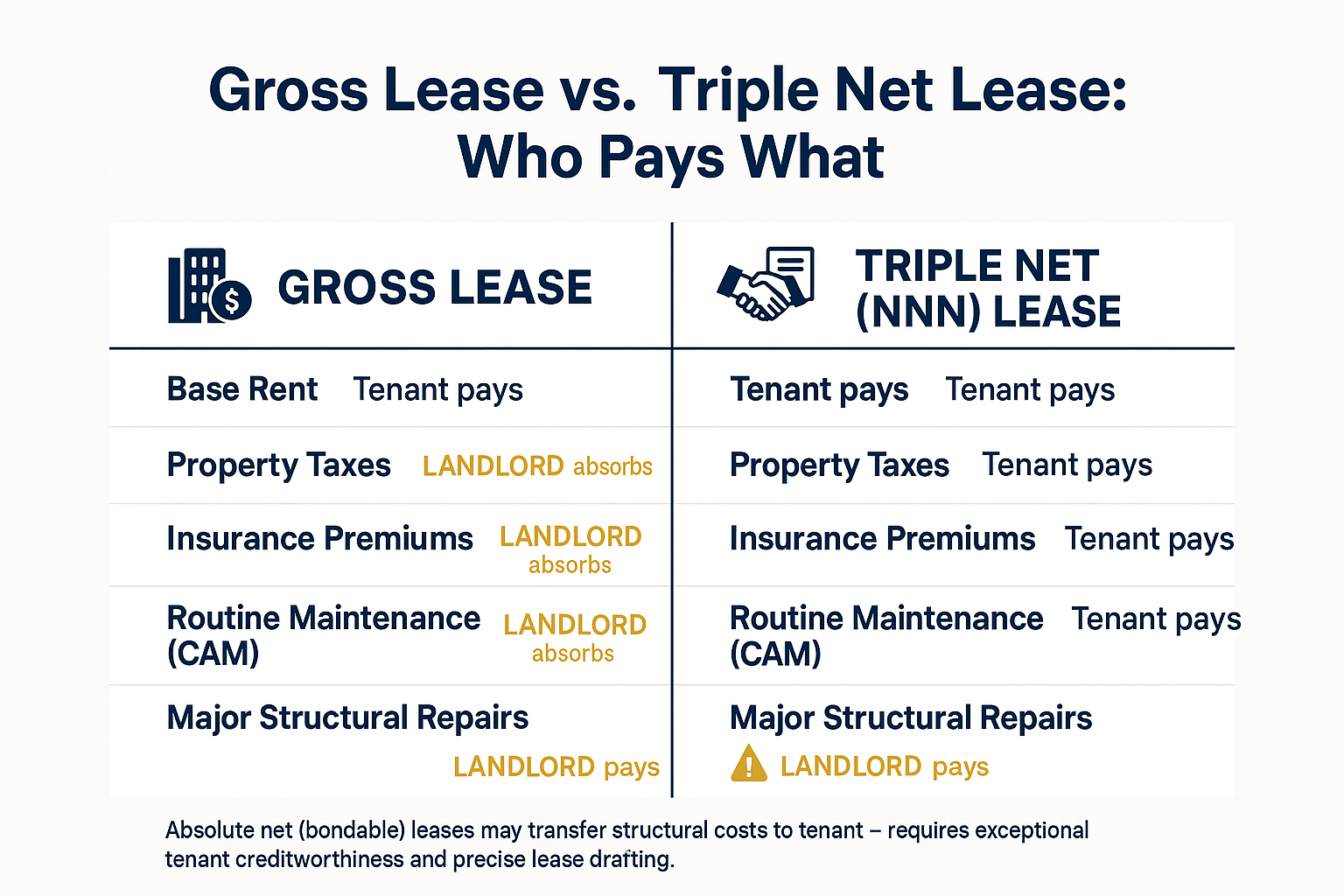
In a standard gross lease, you as the landlord collect rent and absorb the property’s variable costs — taxes, insurance premiums, maintenance bills — out of that income. In a triple net lease, the tenant takes on those three expense categories on top of base rent. For owners in Monterey County, where California property taxes can jump with reassessments and insurance premiums have climbed sharply over the past few years, shifting those costs to the tenant is genuinely appealing.
But the value of that structure lives entirely in the lease document itself. What I want to walk through here isn’t just the definition — it’s the practical questions you need to answer before signing one, and the places where NNN arrangements in this market go wrong.
What the Three ‘Nets’ Actually Cover
The three expenses in a triple net lease are:
- Property taxes — the tenant pays their proportionate share of the real estate tax bill, including increases from Proposition 13 reassessments or supplemental tax bills
- Property insurance premiums — the tenant covers their share of the building’s hazard, liability, and sometimes umbrella insurance costs
- Maintenance and common area costs (CAM) — the tenant is responsible for upkeep of the space and, in multi-tenant buildings, a proportionate share of shared areas
In a gross lease, you’d collect a higher base rent to cover all three. In an NNN arrangement, the base rent is lower — sometimes significantly lower — because the tenant is absorbing those variable costs directly. The owner’s income becomes more predictable because you’re not at the mercy of a bad insurance renewal year or a county tax reassessment eating into your net.
For a commercial property in Salinas or Monterey, this structure can make a real difference. California insurance premiums for commercial properties have risen in many cases by 20–40% over the past three years, and Monterey County’s assessed property values in desirable corridors have climbed steadily. Transferring those variables to the tenant isn’t just a preference — it’s a meaningful financial protection.

The Biggest Misconception: ‘NNN Means Hands-Off’
This is where I see commercial owners get tripped up more than anywhere else. A triple net lease does not make you a passive owner. In a standard NNN arrangement, the tenant handles day-to-day maintenance and their proportionate operating costs — but major structural components typically remain the landlord’s responsibility.
That means:
- Roof replacement — if the roof fails, you’re likely writing the check
- Foundation repairs — structural issues are almost always on the owner
- HVAC system replacement — depending on how the lease defines ‘capital repairs,’ a full system replacement may fall to you
- Building envelope repairs — exterior walls, structural supports, major plumbing systems
There is a more extreme version called an absolute net lease (sometimes called a ‘bondable’ lease) that can transfer even these structural costs to the tenant. But that structure requires a very creditworthy tenant — think a national pharmacy or a well-capitalized franchise — and extremely precise lease drafting. Most commercial properties in Salinas, Monterey, or Pacific Grove are not going to attract a tenant with that kind of balance sheet.
The practical takeaway: even in a well-structured NNN lease, build a capital reserve for major structural items. Don’t assume the ‘triple net’ label means you’ll never spend money on the building again.
Why Lease Language Matters More Than the Label
I can’t stress this enough: two leases can both be called ‘triple net’ and operate completely differently in practice. The label is not the protection — the definitions inside the document are.
Common problems I’ve seen in vaguely drafted NNN leases:
- CAM definitions that are too broad — if the lease doesn’t specify exactly what qualifies as a common area maintenance expense, disputes are almost inevitable. A tenant who disputes a landscaping invoice or a parking lot reseal can tie up collections for months.
- Tax pass-through language that doesn’t address increases — the lease should spell out how tax reassessments, supplemental bills, or new county assessments are handled. California’s Proposition 19 changed inheritance and transfer rules in ways that can trigger reassessments on commercial transfers — if that’s not addressed in the lease, you may end up absorbing an increase you thought you’d passed through.
- Insurance reconciliation procedures — who collects documentation? What happens if the tenant’s coverage lapses? The lease needs to answer these questions before they become problems.
A vaguely drafted NNN lease can create disputes that cost you far more in legal fees and lost rent than you ever saved by structuring it that way. For owners managing commercial properties, this is one area where staying legally current in a changing regulatory environment pays for itself.
Gross Lease vs. Triple Net Lease: Who Pays What
This comparison shows how costs are divided between landlord and tenant under each lease structure.
Vetting a Commercial Tenant for a Long-Term NNN Commitment
Screening a commercial NNN tenant is a very different process from screening a residential renter. You’re not just confirming someone can pay next month’s rent — you’re assessing whether a business can sustain a multi-year financial obligation that includes taxes, insurance, and maintenance on top of base rent.
The financial documents that actually tell you something meaningful:
- Two to three years of business tax returns — these show real profitability, not projected income
- Business financial statements (P&L and balance sheet) — a profit-and-loss statement shows operating margins; a balance sheet shows whether the business carries significant debt
- Bank statements (three to six months minimum) — cash reserves matter; a business that’s profitable on paper but cash-starved can miss payments quickly when an NNN expense spike hits
- Personal financial statement from business principals — especially important for small businesses where the owner’s personal financial stability is intertwined with the company’s
- Commercial credit report — services like Dun & Bradstreet provide business credit profiles that go beyond a personal FICO score
- Landlord references from prior commercial tenancies — how a business treated its last landlord tells you more than a credit score
This vetting process takes longer than a residential screen, and it should. A five-year NNN lease with a tenant who turns out to be financially fragile is a significantly worse outcome than a vacant property while you find the right fit. As we’ve written before, the difference between a good tenant and a great one starts before move-in — and that principle applies on the commercial side too, just with higher stakes.
What to Request from a Commercial NNN Tenant Applicant
These are the core financial documents and what each one actually tells you about a prospective tenant’s ability to handle a long-term NNN obligation.
| Document | What It Shows | Why It Matters for NNN |
|---|---|---|
| Business tax returns (2-3 yrs) | Actual net income over time | Reveals real profitability vs. projected numbers |
| P&L and balance sheet | Operating margins and debt load | Shows whether the business can absorb variable NNN costs |
| Bank statements (3-6 months) | Cash flow and reserves | A cash-poor business fails fast when expenses spike |
| Personal financial statement | Owner’s personal financial stability | Critical for small businesses where owner = business |
| Commercial credit report | Business credit history and payment patterns | Goes beyond personal FICO — specific to business obligations |
| Prior landlord references | How they treated the last property and lease | Past commercial behavior predicts future performance |
Setting Base Rent When Taxes and Insurance Are Being Passed Through
One question commercial owners in this market often wrestle with: if the tenant is covering taxes and insurance, how do you set a fair base rent?
The short answer is that base rent in an NNN lease should reflect current market rates for comparable NNN spaces — not a gross lease rate with expenses subtracted. These are different markets, and conflating them leads to either underpricing the space or asking a tenant to pay effective gross-lease rates while also covering operating expenses.
For Monterey County commercial properties, the variables that influence base rent in an NNN context include:
- Property type and use — retail, medical office, and light industrial each have distinct market rent ranges in this area
- Location within the county — a Cannery Row-adjacent commercial space trades at very different rates than a property along North Main Street in Salinas
- Tenant improvement allowances — if you’re contributing to buildout costs, that’s often reflected in a slightly higher base rent or a longer initial term
- Lease term length — longer commitments typically support lower base rent; shorter terms justify a premium
Getting the base rent conversation right matters beyond the first year. Because property value in California is tied to income performance, an underpriced commercial lease can affect the property’s appraised value for years.
Frequently Asked Questions About Triple Net Leases in Monterey County
Does a triple net lease mean I never have to pay for repairs?
No — and this is the most common misconception. In a standard NNN lease, the tenant handles routine maintenance and their share of operating costs. But major structural repairs — roof replacement, foundation work, HVAC system replacement — typically remain the landlord’s responsibility unless the lease is specifically drafted to say otherwise. An absolute net lease can transfer structural costs to the tenant, but that requires an exceptionally creditworthy tenant and very precise language.
How is a triple net lease different from a modified gross lease?
In a modified gross lease, some expenses are split between landlord and tenant — often the landlord covers taxes and insurance while the tenant handles utilities and interior maintenance. In a triple net lease, the tenant absorbs all three major variable expense categories. The modified gross structure is a middle ground, and it’s worth knowing that both are negotiable — the label matters less than what the document actually assigns to each party.
What financial documents should I ask a commercial tenant to provide?
At minimum: two to three years of business tax returns, a current P&L and balance sheet, three to six months of bank statements, and a commercial credit report. For small businesses, a personal financial statement from the principals is also important. Commercial tenant vetting takes longer than residential screening — that’s appropriate given the multi-year financial commitment involved.
Can California property tax increases be passed through to the tenant in a NNN lease?
Yes, but only if the lease says so clearly. The pass-through language needs to specify how supplemental tax bills, reassessments, and increases triggered by property transfers are handled. Without that language, you may find yourself absorbing a tax increase you expected to pass through. This is one reason California-specific lease review matters more here than in states with simpler tax structures.
Is a triple net lease the right structure for every commercial property?
Not necessarily. The NNN structure works best when the tenant is financially strong, the lease term is long enough to justify lower base rent, and both parties have the legal representation to draft the expense definitions clearly. For smaller commercial spaces with shorter-term tenants, a modified gross or full gross lease may actually be simpler to administer and less prone to disputes.
Questions About a Commercial Property in Monterey County?
If you own a commercial property in Salinas, Monterey, or the surrounding area and you’re working through a lease structure decision, Coast & Valley Properties is available to talk through what we’re seeing in the local market. Reach us by phone at (831) 757-1270 or through the contact form at coastandvalleypm.com — we’re happy to have a straightforward conversation about your situation before any decisions are made.