Your Monterey County Property Was an Airbnb. Now What?
Direct Answer: Transitioning a former Airbnb to a long-term rental in Monterey County means preparing the property, repricing it for the residential market, and understanding that California tenant law is a completely different framework than short-term guest management.
We’ve heard from a number of property owners in the past year asking a version of the same question: what do I do now that the short-term rental landscape in Monterey County has shifted? Some reached out after the county’s inland ordinance took effect in October 2024. Others contacted us after the Board of Supervisors voted in January 2026 to move toward banning STRs in residential zones, a vote that passed 3 to 2 before the Planning Commission later rejected the broader ban. Either way, the regulatory environment for vacation rentals in unincorporated Monterey County is no longer stable, and owners are looking at their options.
One inquiry that stuck with me came from an owner who included a link to her Airbnb listing when she asked about long-term management. She wanted to know her unfurnished rent rate, but she was still thinking about her property through the lens of nightly guests and cleaning turnover. That framing is completely understandable, but it’s also where a lot of owners run into trouble when they start this transition.
Turning a former Airbnb into a long-term residential rental in Monterey County involves three things most owners underestimate: getting the property ready, pricing it correctly for the residential market, and understanding that California tenant law operates nothing like short-term rental management. I want to walk through each of those honestly.
What the Property Itself Needs Before a Tenant Moves In
A property that has been running as a vacation rental is set up for guests, not residents. That distinction matters more than it sounds.
Furnishings, linens, small kitchen appliances, and decorative items that worked fine for a three-night stay are not necessarily appropriate for someone moving in for 12 months or longer. Before a lease is signed, the owner needs to make a clear decision about what stays and what goes. A furnished long-term rental is a different product than an unfurnished one, and the rent rate reflects that difference.
Beyond furnishings, a property that has cycled through frequent short-term guests often has wear patterns that don’t show up the same way in a property that’s had one household living in it. Think about:
- High-traffic flooring in entryways and kitchens
- Interior paint that has absorbed more use than its age suggests
- Small appliances and fixtures that have been handled by dozens of different people
- Bedding, towels, and soft goods that need to be either removed or replaced to a residential standard
This is not a reason to panic, it’s a reason to do a thorough walkthrough before listing. California’s warranty of habitability applies from the first day of a residential tenancy. The property needs to meet that standard before anyone moves in, and it needs to stay there throughout the lease.
One practical note: if you are transitioning from furnished to unfurnished, storage or removal of furniture takes more planning than most owners expect, especially if the property is a larger home in Carmel or Pacific Grove where the furnishings themselves may be high value.
The Pricing Comparison Owners Get Wrong
Almost every owner making this transition asks the same pricing question: what will I get in monthly rent compared to what I was earning on Airbnb?
That is the wrong comparison. The right comparison is annualized net revenue, what the property actually produced after platform fees, cleaning costs between stays, vacancy, and the real time cost of managing constant turnover.
Vacation rentals price by the night, but they also carry vacancy baked into the economics. A property that books well in summer on the Monterey Peninsula can sit idle during slower months. A long-term residential tenant, by contrast, pays the same amount every month for 12 months or longer, and a well-screened tenant significantly reduces the chance of mid-lease problems.
For context on what the residential market looks like right now: the Salinas Valley was averaging around $2,006 per month as of early 2026, which runs roughly 23 percent above the national average according to publicly available rental market data. Coastal Peninsula communities, Monterey, Pacific Grove, Carmel, run meaningfully higher than that. But those are averages. The actual rent estimate for a specific property depends on size, condition, location within the county, whether it is furnished or unfurnished, and how the current market is moving in that submarket.
I’d be skeptical of any estimate that comes from a national average or an algorithm that doesn’t account for the difference between a property near Cannery Row in Monterey and one in Gonzales. Those are different markets with different tenant pools, different demand patterns, and different seasonal dynamics. If you want a realistic number, it needs to come from someone who actually tracks both.
For owners thinking through the self-management question that often comes up at this stage, this breakdown of when self-managing a Salinas rental stops making sense is worth reading before you decide.
Short-Term Guest vs. Long-Term Tenant: Key Differences
The distinction between hosting a short-term guest and managing a residential tenancy affects almost every decision you make. Here is a side-by-side look at the most important differences for a Monterey County property owner.
| Category | Short-Term Guest (STR) | Long-Term Residential Tenant |
|---|---|---|
| Legal relationship | License agreement, no tenancy rights | Lease agreement, full California tenant rights from day one |
| Entry by owner | Owner can access anytime as host | 24-hour written notice required in most circumstances under California law |
| Pricing structure | Per night; vacancy is expected | Per month; stability over a 12+ month term |
| Eviction process | Guest overstay handled as trespass | Formal California unlawful detainer process required |
| AB 1482 coverage | Does not apply to STR guests | Applies to qualifying properties, limits rent increases and requires just cause after 12 months |
| Turnover cost | Cleaning and restocking after each stay | Typically once at end of tenancy, with security deposit accounting |
| Regulatory permits (Monterey County) | STR permit required; ongoing compliance uncertain | Standard residential lease; Salinas Rental Registration may apply |
California Tenant Law Is Not a Variation on the Airbnb Model
This is the part I want to be direct about, because it is where I see the most potential for serious problems.
When you host a short-term guest, that person has a license to occupy the property, not a tenancy. They have no eviction process to go through if something goes wrong. You can change the terms of their stay, decline to rebook them, or remove them from the platform without navigating California landlord-tenant law.
A long-term residential tenant is a completely different situation from the first day they move in. They have rights under California law that attach immediately and grow stronger over time. After 12 months of continuous occupancy, just-cause eviction protections apply regardless of whether the property is covered by AB 1482. And if the property does fall under AB 1482, which covers most residential properties in California built before 2005, subject to specific exemptions, rent increases are capped and owner entry rights are tightly regulated.
Owners who manage a long-term tenant the way they managed vacation guests, entering without proper notice, adjusting occupancy terms informally, or expecting easy turnover at the end of a lease, are going to encounter the California unlawful detainer process, and it moves slowly and at significant cost. Understanding how tenant screening works before placement is one of the best things you can do to reduce that risk from the start.
The California Courts’ self-help landlord-tenant resources provide a plain-language overview of residential tenancy law if you want to understand the framework before making any decisions.
For owners transitioning from STR management in coastal communities specifically, the article on renting out a home in Pacific Grove covers some of the Peninsula-specific nuances worth knowing.
The STR-to-Long-Term Rental Transition: What to Tackle First
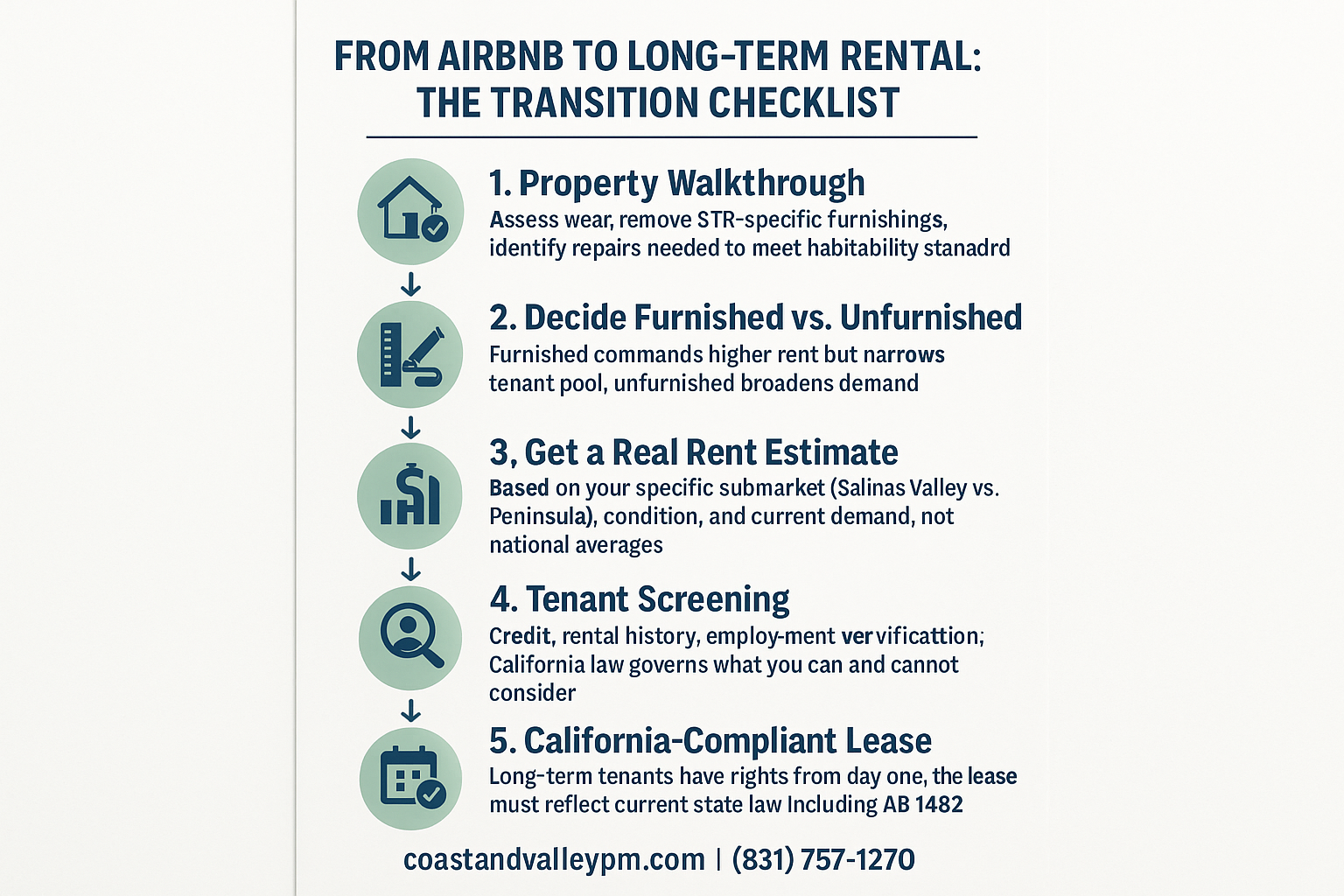
The transition from a vacation rental to a residential tenancy involves decisions in a specific order. This flow summarizes the key steps most Monterey County owners need to work through.
Frequently Asked Questions About Transitioning a Former STR to a Long-Term Rental
Can I still rent my property furnished as a long-term rental?
Yes, and in some submarkets it actually makes sense. Furnished long-term rentals tend to attract corporate relocations, traveling professionals, and similar tenants who are willing to pay a premium for a move-in-ready home. The tradeoff is a somewhat narrower tenant pool. The rent difference between furnished and unfurnished varies significantly by property and location, a furnished home in Monterey near the Naval Postgraduate School draws a very different tenant than the same setup in Salinas. Getting a realistic estimate for both scenarios before you decide is worth the time.
What happens to my STR permit now that I’m switching to long-term?
Once you are operating as a long-term residential rental, your STR permit is no longer relevant to the property’s operation. But if your property is in the City of Salinas, check whether the Salinas Residential Rental Registration Ordinance (City Ord. 2663, 2024) applies, most residential rentals in the city need to be registered. Requirements vary by jurisdiction, so confirm with the relevant local authority for your specific address.
How do I know if my property is covered by AB 1482?
AB 1482 covers most California residential rental properties built before January 1, 2005, with some exceptions, including single-family homes where the owner has provided proper written notice, and certain condos. If your property is covered, rent increases are capped at 5% plus local CPI, and just-cause eviction requirements apply after 12 months of tenancy. If you are unsure whether your property is exempt, that question belongs in a conversation with a licensed California broker or attorney before you sign a lease.
What is the realistic rent I should expect compared to my Airbnb income?
The honest answer is: it depends on what your Airbnb income actually netted after platform fees, cleaning, vacancy, and your own time. Gross nightly rates look attractive until you annualize the real numbers. The Salinas Valley residential market averaged around $2,006 per month in early 2026. Peninsula markets run higher. But the more useful number is the estimate for your specific property in its specific condition, not a county-wide average. We provide those estimates as part of our consultation process.
Do I need to do anything special to the property before placing a long-term tenant?
At minimum, the property needs to meet California’s warranty of habitability standard, working heat, plumbing, weatherproofing, functioning appliances if they are included in the lease, and no conditions that threaten health or safety. Beyond that baseline, a property coming out of STR use often needs a more careful walkthrough than a typical turnover, because short-term guest traffic creates wear patterns that are easy to miss. Doing that assessment before listing, not after a tenant is already in place, protects you and sets the tenancy up correctly.
Ready to Talk Through What Your Property Looks Like as a Long-Term Rental?
If you are an owner in Monterey County who has been running a vacation rental and is now weighing the transition, we are happy to have that conversation. Coast & Valley Properties manages long-term residential tenancies throughout the county, from Carmel and Pacific Grove to Salinas, Gonzales, and South County, and we can give you a realistic rent estimate and a clear picture of what the placement process actually involves for your specific property. Reach us at (831) 757-1270 or through the contact form at coastandvalleypm.com.