California’s Security Deposit Rules Changed in 2026. Here’s What Shifted.
Direct Answer: Assembly Bill 414, effective January 1, 2026, requires California landlords to document property condition with dated before-and-after photos to support any deposit deductions, and tightens the timeline and paperwork for returning deposits or providing itemized deductions.
Security deposit disputes have always been one of the most common friction points between landlords and tenants in California. And for owners in Monterey County, that friction just got sharper. Assembly Bill 414, which took effect January 1, 2026, rewrites the expectations around move-out documentation in ways that catch a lot of self-managing owners off guard.
The core shift is this: documenting property condition is no longer a best practice, it’s the legal framework your deductions now have to stand on. If you can’t back a charge with dated, specific photographic evidence from both ends of the tenancy, defending that deduction in a dispute becomes significantly harder.
I want to walk through what actually changed, what it means in practice, and where owners are most exposed right now, particularly those managing properties in Salinas, Carmel, Pacific Grove, or anywhere else in the county without a formal inspection process.
What AB 414 Actually Requires
Under AB 414, California landlords are now expected to have before-and-after photos that directly support any deduction taken from a security deposit. This isn’t a vague recommendation. It’s the evidentiary standard the law expects you to meet if a dispute goes to small claims court or escalates further.
The law also tightens the timeline and documentation requirements for returning deposits or providing itemized deductions. California already required landlords to return a deposit or deliver an itemized statement within 21 days of move-out. AB 414 builds on that by making the quality of your documentation a factor in how courts evaluate those deductions.
What that means practically:
- Itemized deductions need to be supported by dated photographs that tie directly to the charge
- Generic claims like “cleaning” or “paint touch-up” without visual evidence from move-in and move-out are easier for a tenant to dispute
- Handwritten walk-through notes or verbal agreements at move-out no longer carry the weight they once might have
A dispute that was a gray area before 2026 is cleaner to litigate now. And without a proper documentation record, owners lose.
For more context on the broader set of California law changes affecting Monterey County landlords this year, see our breakdown of what new California landlord laws mean for Monterey County owners in 2026.
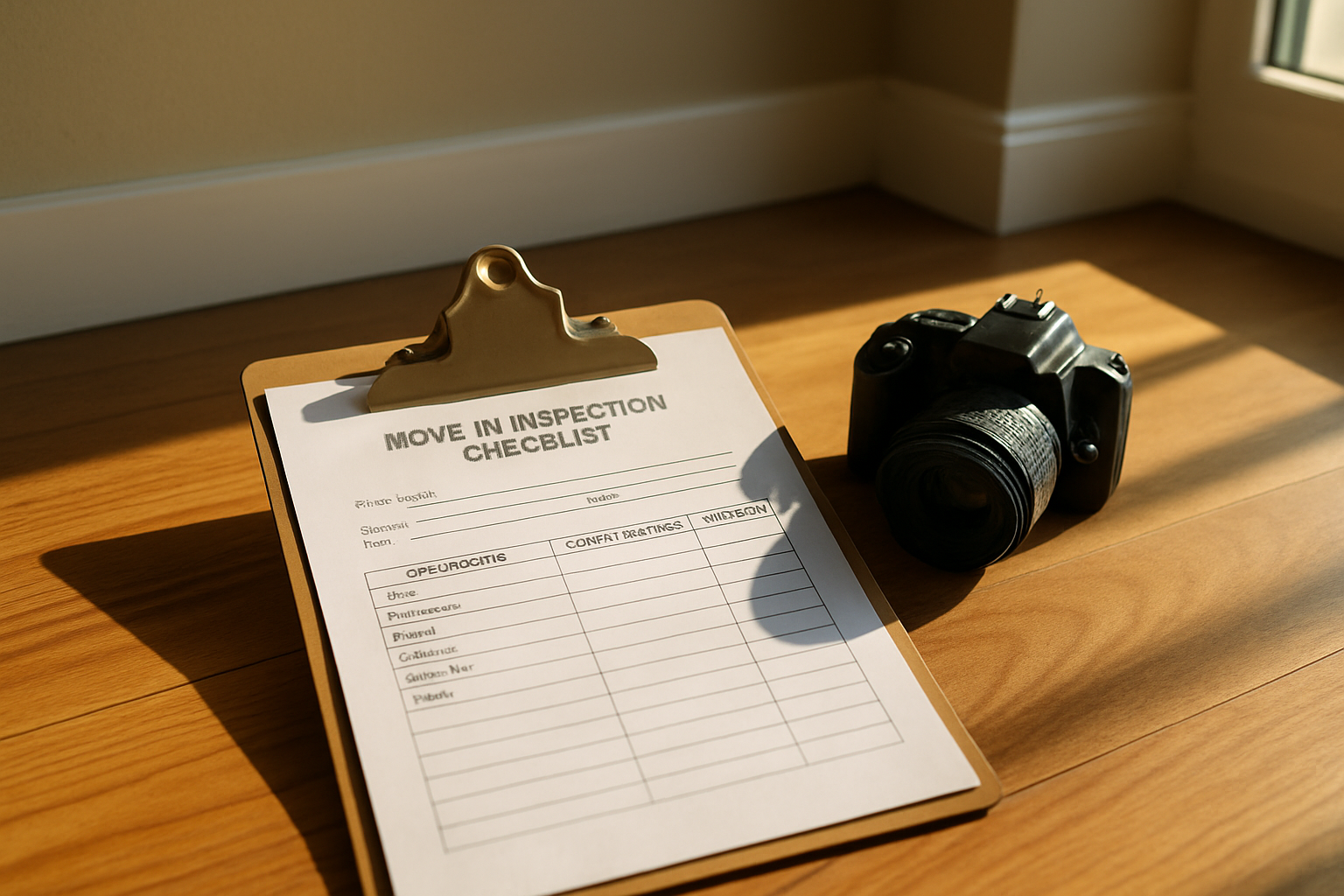
The Kinds of Disputes This Law Was Designed to Address
I’ve seen this play out in reviews and owner conversations more times than I can count. Tenants describe deductions for paint touch-ups that ran several hundred dollars, charges for cleaning a fireplace that was never used, fees for items that were documented as damaged or worn in the original move-in photos. Under the old framework, those disputes were messy and often settled on whoever had better records or more patience.
Under AB 414, the owner’s photographic record from move-in either supports the deduction or it doesn’t. If you charged for paint damage but your move-in photos show the wall was already scuffed, you’ve handed a tenant everything they need in small claims court.
This is the part of the law that matters most for owners who’ve been doing informal walk-throughs, jotting a few notes, maybe taking some phone photos without a systematic process. That approach created liability before 2026. It creates even more exposure now.
The California Courts Self-Help Center is a resource tenants increasingly use to understand their rights around deposit disputes, which tells you something about the environment owners are operating in.
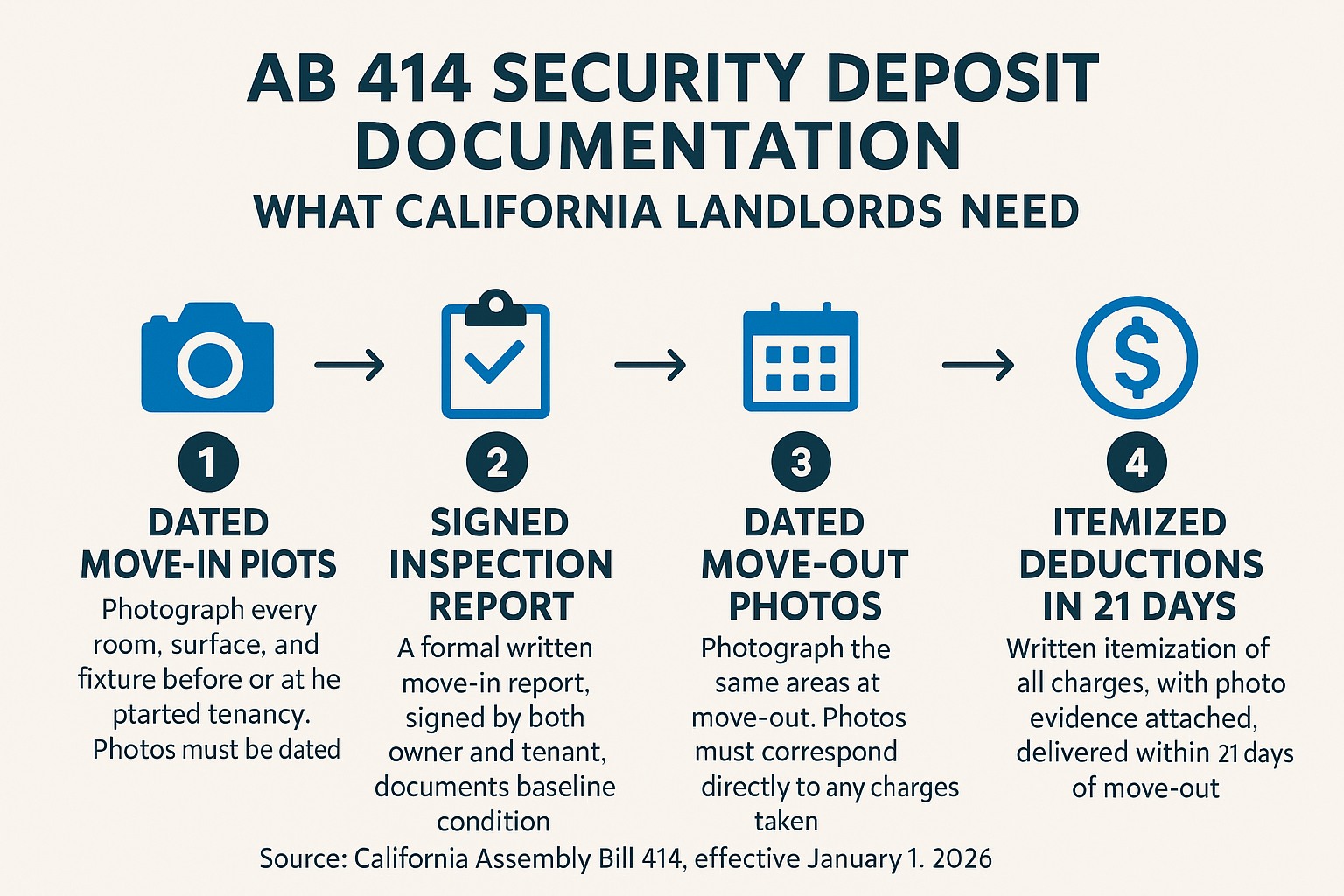
The AB 414 Documentation Standard at a Glance
This infographic walks through the four documentation requirements California landlords now need to meet under AB 414 to protect deposit deductions.
Before and After AB 414: What Changed for Landlords
This table shows the practical difference in what California landlords were expected to do before and after AB 414 took effect.
| Documentation Area | Before AB 414 | After AB 414 (Jan 1, 2026) |
|---|---|---|
| Move-in photos | Strongly recommended, not required | Expected to support any deduction taken |
| Move-out photos | Optional for most owners | Must tie directly to specific itemized charges |
| Inspection report format | Handwritten notes were common | Formal, dated reports carry far more legal weight |
| Itemized deductions | Required within 21 days | Required within 21 days, now more scrutinized in disputes |
| Burden in disputes | Often split or ambiguous | Owner without photo evidence is at a clear disadvantage |
The Problem With Properties Already Under Lease
Here’s the part that doesn’t get enough attention: AB 414 doesn’t only matter for your next lease-up. It matters for tenants currently in place.
If you have a long-term tenant, someone who’s been in your Salinas or Pacific Grove property for four or five years, there’s a real chance the move-in documentation from that tenancy doesn’t meet the standard the law now expects. The photos may not exist at all, or they may be undated snapshots that don’t correspond to a formal inspection report.
When that tenancy ends, you’ll be in a deposit dispute with documentation that was assembled before 2026 under looser expectations. That’s a gap worth closing before the lease terminates.
The right moment to reset the inspection process is the next lease renewal or lease-up cycle. Use that transition to establish a new baseline with dated photos and a signed inspection report. You can’t retroactively improve move-in documentation, but you can make sure the move-out side is thorough.
Owners considering whether this complexity is worth managing alone might find our piece on when self-managing a Salinas rental stops making sense worth reading, it covers exactly this kind of compounding regulatory burden.
What a Proper Inspection Process Actually Looks Like
A move-in inspection that holds up under AB 414 isn’t complicated, but it does need to be systematic. Here’s what that looks like in practice:
- Photograph every room at move-in, including ceilings, floors, walls, windows, and fixtures
- Date-stamp all photos, cloud storage with automatic metadata works, as does any photo system that records a timestamp
- Document existing damage in writing and have the tenant sign the inspection report before they take possession
- Repeat the same scope at move-out, photographing the same areas so deductions can be directly tied to a comparison
- Keep records for the full term plus the time period during which a dispute could be filed
The inspection itself should happen with enough time before move-in and move-out that photos can’t be questioned as staged or selective. And the written report needs to be specific, not “good condition” but an actual description of the baseline.
For owners managing multi-unit properties in Salinas, doing this consistently across every unit adds up fast. That’s where the difference between an informal system and a documented process starts showing up in your exposure.
We conduct formal move-in and move-out inspections with photos as part of the standard management process for every property we oversee. It’s not something we do because it’s legally required now, we’ve been doing it this way because it protects owners. AB 414 just made it clearer why that matters.
Frequently Asked Questions About California’s Updated Security Deposit Rules
Does AB 414 change how much a landlord can charge for a security deposit?
No. AB 414 focuses on documentation and accounting requirements at the end of a tenancy, not on deposit amounts. California already capped security deposits at one month’s rent for unfurnished units under AB 12, which took effect in 2024. AB 414 deals with how you handle the deposit when the tenant moves out.
If my tenant has been in place for years and I have no move-in photos, what can I do now?
You can’t go back and create move-in documentation that doesn’t exist. What you can do is be very thorough at move-out, photograph everything, document what’s normal wear and tear versus actual damage, and be conservative about which deductions you pursue. Without move-in photos to establish baseline condition, any deduction for wear-type damage will be difficult to defend. The next tenancy is the time to start fresh with a proper inspection process from day one.
What counts as normal wear and tear versus damage under California law?
California law distinguishes between normal wear and tear, which a landlord cannot charge for, and actual damage caused by the tenant. Normal wear and tear includes things like minor scuffs on walls, carpet wear from regular use, and small nail holes. Damage includes stains, broken fixtures, unauthorized alterations, and anything beyond what reasonable use would cause. The tricky part is that this line is often argued in small claims court, which is exactly why dated before-and-after photos matter so much under AB 414, they let a judge see the baseline.
Does the 21-day rule for returning deposits change under AB 414?
The 21-day deadline to return the deposit or deliver a written itemized statement remains the same. What AB 414 changes is the evidentiary standard behind those itemized deductions. Courts now expect that any charge you list can be backed by photographic documentation from both move-in and move-out.
Does this apply to commercial properties as well?
AB 414 applies to residential tenancies. Commercial leases are governed by different rules and typically handled through the lease terms negotiated between the parties. If you own commercial property in Monterey County, the deposit and move-out process will be dictated largely by your lease agreement rather than this statute.
Want to Know If Your Current Inspection Process Holds Up?
If you own rental property in Monterey County and you’re not sure whether your move-in and move-out documentation meets the standard AB 414 now expects, that’s worth a conversation before your next tenant transition. Coast & Valley Properties handles formal property inspections with photo documentation as part of full-service residential management across Salinas, Carmel, Pacific Grove, and the surrounding area. You can reach us at (831) 757-1270 or through the contact form at coastandvalleypm.com.