Your Monterey County Lease Requires Renters Insurance. Who Checks?
Direct Answer: A renters insurance clause only works if someone verifies it. Coverage should be confirmed before keys are released, again at lease renewal, and any time the tenant switches carriers.
Almost every lease I read in Monterey County has a renters insurance clause in it. Far fewer have an actual person behind that clause, checking that a policy exists and stays active.
That gap stays invisible until something goes wrong. A supply line lets go in a Pacific Grove bungalow, a tenant’s belongings are soaked, and suddenly everyone is looking at a sentence in a document nobody ever followed up on.
I want to walk through three things: where coverage should actually get confirmed, what a tenant’s policy handles that yours does not, and how a quiet mid-lease lapse turns a wet February into an argument.
Requiring Renters Insurance on a Rental Property Is a Process, Not a Paragraph
A requirement nobody verifies is just a sentence in a document. The lease language is the easy part, and most owners handle it fine. The follow-up is where things fall apart.
I see the evidence of that gap constantly. Over the past several months, tenants have come through our website chat mid move-in asking things like “where is the link to sign up for renters insurance” and “what email address do I send my proof of renters insurance to.”
Those are not confused people. Those are tenants trying to comply at the exact moment the policy is supposed to be confirmed, and finding no clear path to do it.
There are three points where coverage should be checked, and they are not optional:
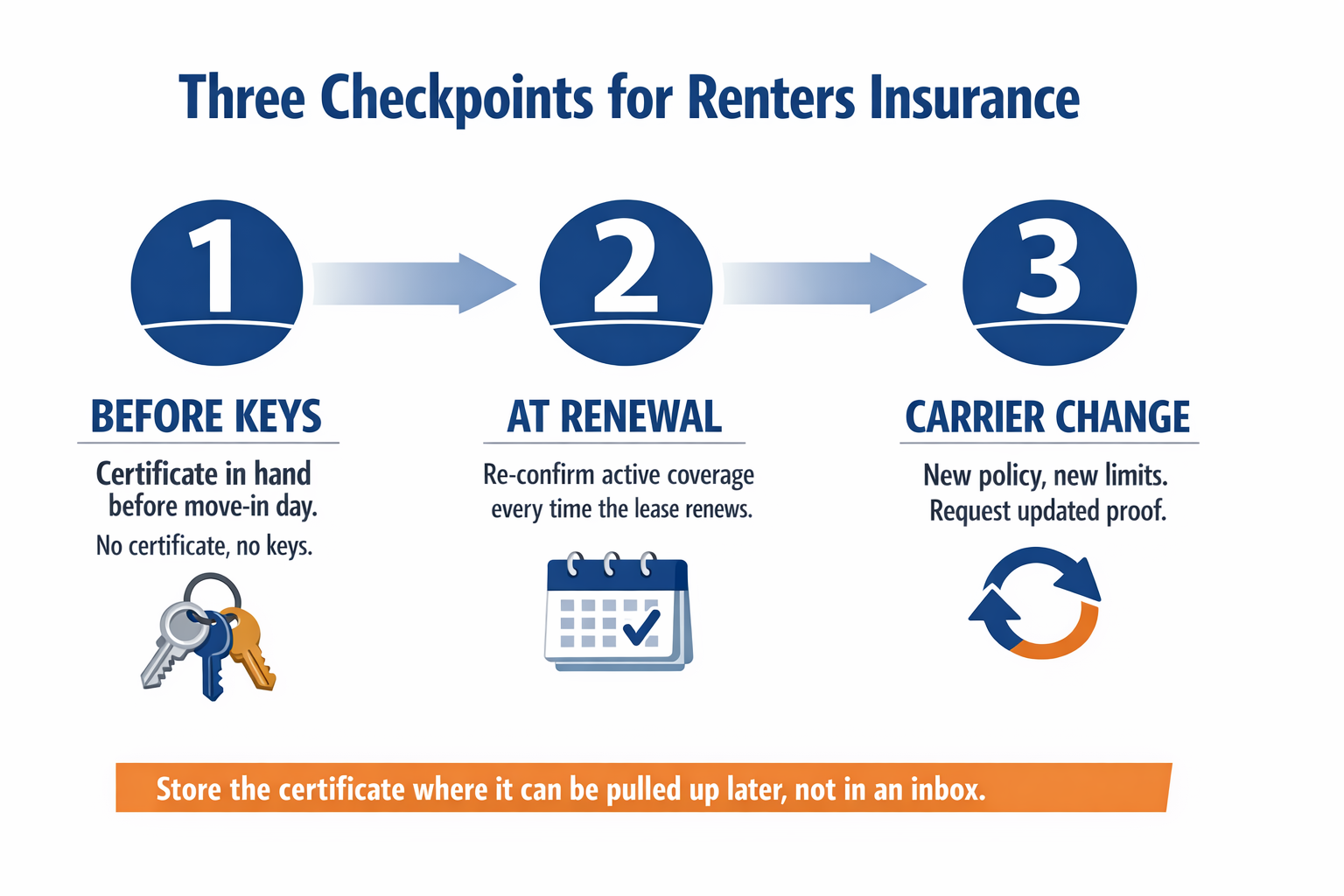
- Before keys are released. Not after move-in, not “send it over when you get settled.” The certificate comes in first, or the keys wait.
- At lease renewal. A policy that existed last January tells you nothing about this January.
- Any time the tenant changes carriers. People shop insurance. The new policy may have different limits, or there may be a gap between the two.
If no one owns those three checkpoints, the clause is decoration.

What a Tenant’s Policy Covers, and What Yours Does Not
Most owners I talk with assume one policy quietly covers the other. It does not.
Your landlord policy is built around the building and your liability as the owner. The factors behind what that costs on the Central Coast are their own conversation, and I wrote about what drives landlord insurance cost in this region separately.
A tenant’s policy sits on the other side of the line. In general terms, it is built to respond to:
- The tenant’s personal belongings, furniture, clothes, electronics, the things your policy was never meant to replace
- Tenant liability for damage they cause, the overflowing washer, the unattended candle, the bathtub left running
- Temporary living costs if the unit becomes unlivable while repairs happen
Picture a real one. A tenant in a Pacific Grove bungalow overloads a washer, the hose backs up overnight, and the floors buckle in the hallway. Their ruined couch and rugs sit on their policy. The damaged flooring is where their liability coverage is supposed to step in before your policy does.
No tenant policy means that whole conversation lands on you. And the cost of simply holding a rental in California has climbed hard in recent years, insurance in particular, which changes the math on quietly absorbing a loss someone else’s policy should have handled.
I never quote premium or deductible numbers to owners. Those belong to your carrier, and they vary by property, claims history, and coverage choices.
Who Typically Pays for What After a Loss
This is a general picture, not a coverage opinion. Every policy reads differently, and your carrier is the only one who can tell you how yours responds.
| What Happened | Usually the Tenant’s Policy | Usually the Owner’s Policy |
|---|---|---|
| Tenant’s furniture and clothing ruined by a leak | Yes, personal property coverage | No |
| Hallway flooring damaged by tenant’s overflowing washer | Often, through tenant liability | Possibly, if no tenant coverage exists |
| Roof fails in a storm and water enters the unit | Tenant’s belongings only | Yes, the structure |
| Tenant needs a hotel while repairs are done | Often, temporary living costs | No |
| Aging pipe behind a wall gives out | Tenant’s belongings only | Yes, the structure and repair |
The Three Points Where Coverage Gets Confirmed
Here is the verification rhythm I use on managed properties, laid out simply.
The Mid-Lease Lapse Nobody Notices
Policies drop for ordinary reasons. A card expires. A tenant switches carriers and the new policy starts eleven days after the old one ended. Someone cancels to save money during a tight month.
Nobody finds out until there is a claim. And a certificate emailed once to an individual inbox has no renewal trigger behind it, no reminder, no second look.
That is the part self-managing owners underestimate, especially owners who travel, live out of the area, or hold several doors. Tracking certificate dates across properties is its own small job.
Here is how owners and managers typically stay informed:
- Ask to be listed on the policy as an interested party, so the carrier notifies you when coverage changes or ends
- Store the certificate somewhere you can pull it up later, like an owner portal rather than a mailbox you have to dig through
- Re-check at every lease renewal, as part of the same conversation where you are already reviewing whether to renew, raise, or re-list
The real question was never whether the lease says it. It is who owns the follow-up.
A Wet Winter Turns Paperwork Into a Phone Call
Forecasters have been pointing toward a wet pattern for California this winter, with above normal precipitation favored from December through February. NOAA’s Climate Prediction Center has already documented atmospheric rivers driving above normal precipitation and flooding across the state.
Our market has two very different versions of that risk. On the Peninsula, it is wind-driven rain against Carmel and Pacific Grove homes, salt air working on everything metal, and a roof that has been sitting under the marine layer all year. In the valley, properties near the river carry genuine flood exposure.
What happens after a leak follows a predictable script. Water comes in, the tenant’s belongings are wet, and the tenant calls the owner first. Every time I have seen an uninsured tenant in that spot, they turn to the person holding the building.
This is also the season when the difference between a structural problem and a tenant-caused one gets blurry fast. I covered the judgment calls on that in pieces about walking a rental before the first storm and mildew on a Carmel rental wall.
How the Clause Gets Explained at Signing
An unclear insurance requirement is a dispute waiting for a trigger. Read enough public tenant reviews in this market and you see the same shape over and over: arguments over damage, repair responsibility, and move-out charges, with tenants saying they were never given clear documentation of what was fixed or why.
That same documentation gap is exactly what makes an uninsured loss escalate into a standoff.
So I explain the clause at lease signing in plain language, and I frame it for the tenant, not for me. Your policy protects your things. If a pipe fails and your laptop and your bed are ruined, this is what replaces them. If your washer floods the hallway, this is what stands between you and a bill.
A tenant who understands it that way keeps the policy active. A tenant who reads it as one more fee lets it lapse the first month money gets tight.
That simple difference is often what separates a quiet tenancy from a February phone call that turns into a fight. Owners weighing whether this kind of follow-up is worth doing themselves may find it useful to think about when self-managing stops making sense.
Frequently Asked Questions About Requiring Renters Insurance
Can I require renters insurance on a rental property in Monterey County?
It is standard practice in this market, and the requirement lives in your lease language. How the clause is worded and enforced is worth reviewing with your own attorney or broker before you write it in.
How much coverage should I ask a tenant to carry?
Owners commonly set a liability minimum and leave personal property limits up to the tenant. I do not put numbers on it in writing, because the right figure depends on your property and your own coverage. Your insurance professional is the right person to set that floor.
What do I do if a tenant’s policy lapses in the middle of the lease?
First, find out whether it lapsed or simply changed carriers. Then request current proof in writing and give a clear deadline. If you were listed on the policy as an interested party, you would have heard from the carrier before the tenant ever told you, which is the whole argument for doing it that way.
Does a tenant’s renters insurance replace the security deposit?
No. They do different jobs. A deposit covers a narrow set of move-out issues, while a tenant policy responds to their belongings and their liability for damage they cause. Having one does not make the other unnecessary.
Where should the certificate actually be stored?
Somewhere you can pull it up a year later without searching an email thread. A document portal tied to the property beats an inbox, especially if you own more than one rental or someone else handles the day-to-day.
Thinking About Who Owns the Follow-Up on Your Rental?
Insurance coordination is part of what we handle for the owners we work with across the Monterey Peninsula, and owner documents live in a portal you can open any time instead of sitting in somebody’s inbox. If you would rather not track certificate dates yourself, you are welcome to ask how that part works at Coast & Valley Properties by calling (831) 757-1270 or using the contact form at coastandvalleypm.com. Questions about pricing are best answered in a direct conversation about your property.