
What Your Accountant Asks For at Tax Time on a Salinas Rental
The email almost always shows up in the last week of January. Your accountant wants last year's rental numbers, and wants them before the office gets buried in February.
If you handed your Salinas or Monterey Peninsula rental to a manager sometime in the past couple of years, your first reaction is probably a small jolt of panic. Where does any of that paperwork actually live?
I get calls like that every winter. So here is the plain version: what your manager already has sitting in one place, what you still have to produce yourself, and the handful of spots where a year's records usually leak.
What Your Property Manager Already Has on File
When a property is under full management, the year's money story is already written down. Every dollar of rent that came in, every repair paid out, every management fee, and every disbursement sent to your bank sits in your owner portal, available any hour of the day.
That usually covers:
- Rent collected month by month, including partial payments and any late fees
- Maintenance and repair costs paid from your account
- Management fees and leasing costs
- Bills paid on your behalf, which on a managed Monterey County property can include mortgage, utilities, insurance, and property taxes
- Disbursements sent to you, by check or direct deposit
Here is the part worth saying out loud. The single most common thing I see from owners in January is not a missing document, it is a login problem. One owner wrote in unsure whether a portal account had ever been set up, then could not get a password reset email to arrive.
If that is you, call the office before you start rebuilding anything by hand. A two minute reset beats a weekend of guesswork, and the whole year is usually already in there waiting.
The Short Pile You Still Have to Produce
Even under full management, a few documents never touch our office because they live in your name. This list is shorter than most owners expect, and it is the same every year.
- Mortgage interest statement from your lender, if the loan is in your name and you pay it directly
- Property tax records, unless those payments run through the management account
- Insurance premiums you paid directly to your carrier
- Out-of-pocket purchases for the property: a replacement appliance you bought yourself, a trip to a Salinas hardware store, mileage if your accountant asks for it
- Purchase or refinance paperwork, if the property changed hands or the loan changed during the year
The trap is the out-of-pocket pile. Peninsula owners in particular tend to handle a few small things themselves, especially on a Pacific Grove or Carmel property they visit anyway, and then forget those receipts exist by the following January.
A shoebox works fine. A photo of each receipt dropped in one phone album works better. The IRS guide to residential rental property is a reasonable place to see the general categories, though what counts and how it is treated is your accountant's call, not yours and not mine.

Repair Records Are Where the Year Gets Messy
A line item that just reads "repair, $2,800" helps nobody. Come March, you will not remember what it was, and your accountant cannot treat it correctly without asking you three questions you can't answer.
A useful repair record has five things:
- Date the work was done
- Vendor name, the actual company that did it
- Scope of work in plain words: what was replaced, repaired, or installed
- Amount paid
- Which property it belongs to, which matters a lot if you hold more than one
Photos help too. One of the most consistent requests I see from owners is proof that work actually happened. A Salinas owner once wrote in asking whether a side fence had been finished and whether an overgrown front tree had been trimmed, and added that they would appreciate some pictures of the completed work.
That is a fair ask, and it doubles as a tax record. A dated photo of a new water heater next to the invoice removes any question later about what the money bought. If you want the fuller picture on how work gets authorized and verified, we covered who approves a repair and how you know it got done separately.
Deciding how a given job is treated on the return is your accountant's job. Yours is handing over records that are complete.
Who Holds What: A Quick Split
Before you start hunting, sort the year into two piles. One is already assembled for you. The other is on you.
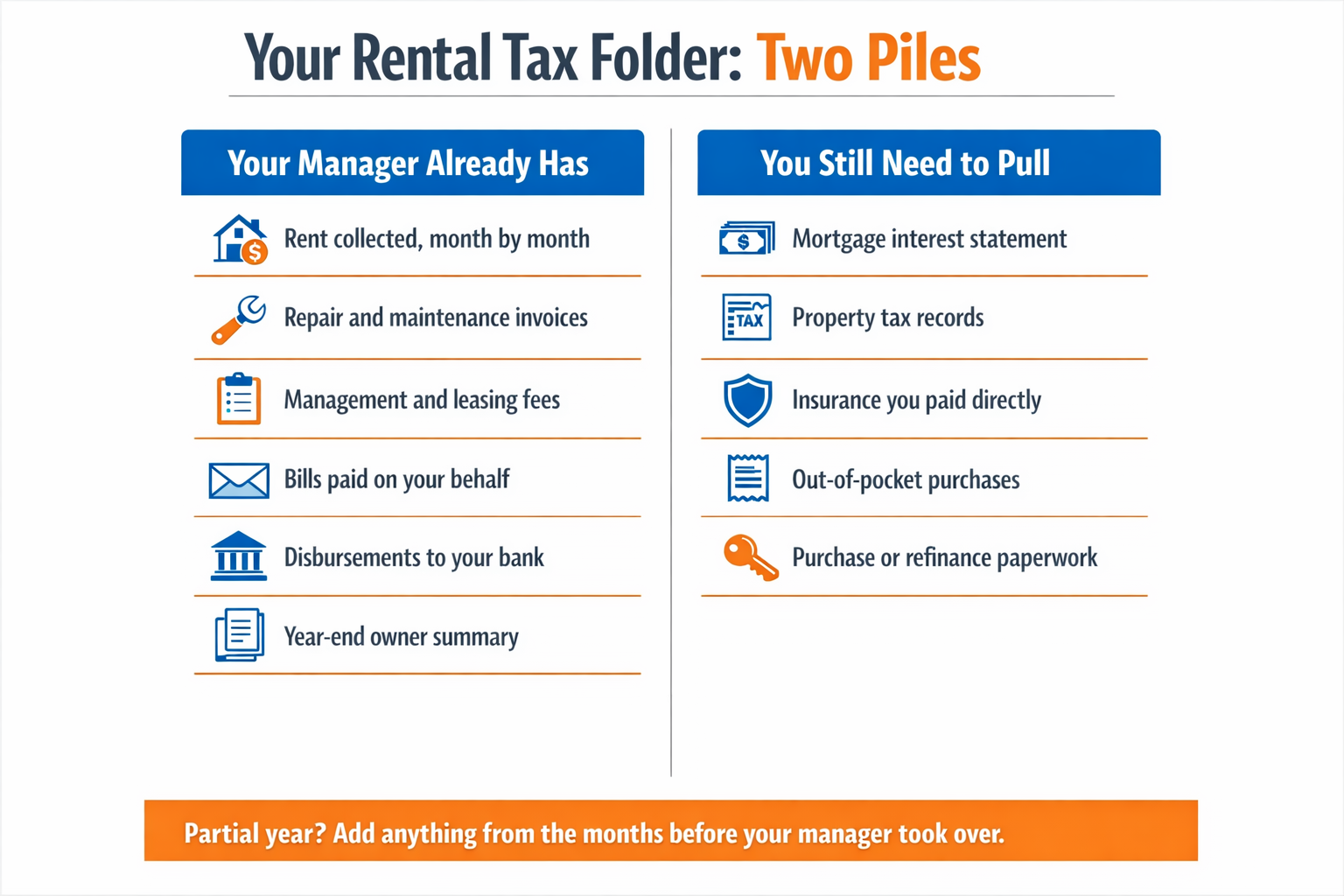
Where Each Document Usually Lives
This is the quick reference I give owners who are assembling their first year of records under management.
| Document | Who typically holds it | Where to find it |
|---|---|---|
| Rent collected by month | Property manager | Owner portal, financial reports |
| Repair and vendor invoices | Property manager | Owner portal, maintenance records |
| Management and leasing fees | Property manager | Monthly statements |
| Mortgage interest statement | Owner | Lender's annual mailing or online account |
| Property tax records | Owner or manager | County records, or manager if bills run through the account |
| Insurance premiums | Owner | Carrier statements, unless paid through the account |
| Out-of-pocket purchases | Owner | Personal receipts, card statements |
The Partial Year Is Always the Hard One
Full years are easy. The ugly tax year is the one where management changed hands in the middle of it.
I see three versions of this constantly in Monterey County:
- The owner who self-managed until June, then left the state and handed off the house
- The owner who finished a rehab in Gonzales or Salinas in the fall and put it on the market in October
- The owner who switched firms mid-year and now holds two sets of statements that do not line up
In every one of those, somebody assumes the manager has the whole year. Nobody has the whole year. We have our months, and you have yours.
The handoff month is where records leak, and it is almost always the same four places:
- Security deposits you collected yourself before the transfer
- Rent that landed in your personal account in the months you were still managing
- Invoices you paid directly to vendors before we took over
- The last utility bills in your name, which often trail by a cycle or two
If you remodeled units and held them vacant for part of the year, that stretch has its own paper trail of vendor payments and carrying costs. Pull those together while you still remember them. Owners who reach the point where self-managing stops making sense usually make the switch mid-year, which is exactly why that first tax season takes the most work.
Money That Moved Is Not the Same as Money You Earned
This one trips up careful people. An owner totals twelve months of deposits in their checking account, compares it to the statement total, and the two numbers do not match.
They are not supposed to. A managed account carries far more traffic than rent in and fees out, especially when we are paying bills on your behalf.
Things that move through the account without being income to you:
- Held security deposits, which are the tenant's money until they aren't
- Reserve balances kept on hand for maintenance
- Prepaid rent collected in one year for a month in the next
- Bills paid on your behalf, which lower what gets disbursed without lowering what you collected
A year-end owner summary exists so nobody has to guess which is which. It separates what came in, what went out, what was held, and what was sent to you. If the mechanics of the monthly cycle are still fuzzy, here is how rent money moves from your tenant to your bank account.
Commercial Owners Have a Heavier Year End
If you own commercial property in Monterey or Salinas, January tends to land hard. Fiscal year end, tenant billing, and lease renewals all arrive in the same few weeks.
Before you call your accountant, you should already be holding:
- Monthly balance sheets and income statements for the full year
- General ledger detail
- Accounts payable detail, vendor by vendor
- Bank and CD reconciliations for every month
- 1099 preparation for vendors paid during the year
- Lease documents and any amendments signed during the year
Two of those take the longest to rebuild if nobody kept them through the year: vendor payment records and monthly reconciliations. Reconstructing twelve months of vendor activity from bank statements in February is a genuinely bad week.
On our commercial accounts we also work directly with the owner's accountant during audits and returns, which cuts down the back-and-forth considerably. If your year end also involves pass-through charges, CAM reconciliation season is worth reading before the statements go out.
The Real Test Is How Fast You Can Get a Document
Tax season is a decent stress test for management. Not because of the paperwork itself, but because of how long it takes to get an answer when you have a question about your own statement.
An owner portal that runs year round means the records are not something anyone has to dig up. They are already there, in one place, at two in the morning in February if that is when you are working.
And when the portal does not answer it, a person should. One reviewer put it simply: "I like their office staff; they're very friendly, and they answer any questions quickly!" That afternoon-not-next-week response is the part owners actually feel in January.
Frequently Asked Questions About Rental Tax Documents
Does my property manager file my taxes for me?
No. We produce the records and financial reports, your accountant files the return. Deciding how a given expense is treated is a tax question, and it belongs with your CPA.
I can't log into my owner portal. What now?
Call the office rather than rebuilding the year by hand. We can confirm whether an account exists, reset access, or send the year-end reports directly. This is one of the most common January calls we get, so nobody is going to think it's a strange question.
I self-managed for part of last year. Who has those months?
You do. We can only report the months we managed. For the earlier part of the year, pull together the rent you collected personally, any deposits you still hold, vendor invoices you paid yourself, and the utility bills that were still in your name.
Why doesn't my bank deposit total match the statement total?
Because deposits are not the same as income. Held security deposits, maintenance reserves, prepaid rent, and any bills we paid on your behalf all move through the account without being money you earned. The year-end summary separates them.
How long should I keep rental records?
Longer than you think, especially anything tied to improvements, purchase, or sale of the property. Ask your accountant for the retention window they want. Digital copies in the portal make this easier, since nothing depends on a filing cabinet in a garage in Pacific Grove staying dry.
Questions About Your Own Year-End Statements?
We have been keeping owner records for Monterey County property owners since 2009, broker owner led and based out of Salinas, with financials available in the owner portal year round. If you are putting together last year's numbers and something on your statement does not read clearly, you are welcome to reach the office at (831) 757-1270 or through the contact form at coastandvalleypm.com.

Maximize Deductions with 7 Tax-Saving Strategies for Commercial Property Owners

Being a commercial property owner comes with its own set of financial responsibilities, including taxes. However, with a strategic approach and the right knowledge, you can maximize deductions and save on your tax bill. In this article, we will explore seven effective tax-saving strategies specifically tailored for owners of commercial properties.
Understanding the Basics of Commercial Property Tax
Before diving into the tax-saving strategies, it's important to have a good grasp of the basics of commercial property tax. Commercial property tax is a levy imposed by local governments on owners of commercial properties based on the assessed value of the property. Understanding how this tax works is crucial for implementing effective tax-saving strategies.
Commercial property tax is a significant expense for property owners, and having a solid understanding of how it is calculated can help you make informed financial decisions. The assessed value of a commercial property is determined by local assessors who evaluate the property's market value, taking into account factors such as location, size, and condition. This assessed value is then multiplied by the mill rate, which is the rate used to calculate the property tax owed.
The Importance of Tax Planning for Commercial Property Owners
Effective planning is essential for commercial property owners when it comes to taxes. By carefully reviewing your financial situation, property assessment, and applicable tax laws, you can identify opportunities to minimize your tax liability and maximize your deductions. Engaging the services of a qualified tax professional can greatly help in devising a tax plan tailored to your specific circumstances.
Tax planning is not a one-time task but an ongoing process that should be revisited regularly to ensure that you are taking advantage of all available tax-saving opportunities. Changes in tax laws, property values, and your financial situation can all impact the effectiveness of your tax plan, making regular reviews crucial for optimizing your tax strategy.
Key Terms in Commercial Property Taxation
Before exploring the tax-saving strategies in detail, it's important to familiarize yourself with key terms related to commercial property taxation. Some of these terms include assessed value, mill rate, tax exemptions, and abatement. Understanding these terms will help you navigate the tax landscape better and make informed decisions.
Assessed value is the value assigned to a property for tax purposes and is used as the basis for calculating property taxes. The mill rate, on the other hand, is the rate per thousand dollars of assessed value that is used to calculate the property tax due. Tax exemptions and abatements are incentives provided by local governments to reduce the tax burden on certain properties, such as historic buildings or properties used for charitable purposes.
The Role of Depreciation in Tax Savings
Depreciation is an essential concept that commercial property owners should be well-versed in, as it plays a crucial role in tax savings. Depreciation allows you to deduct the costs of acquiring and improving your property over time, rather than all at once. This can significantly reduce your taxable income and increase your deductions, resulting in substantial tax savings.
Understanding the nuances of depreciation can empower property owners to make informed financial decisions and optimize their tax liabilities. By leveraging depreciation strategies effectively, property owners can not only save on taxes but also enhance their overall financial position.
How Depreciation Works in Commercial Real Estate
In commercial real estate, depreciation is typically calculated over a 39-year period for non-residential properties and 27.5 years for residential rental properties. The depreciation deduction is spread out evenly over this period, allowing you to deduct a portion of the property's value each year. This systematic approach to depreciation provides a steady stream of tax savings over the long term.
Depreciation can also reflect the actual wear and tear of a property over time, aligning tax deductions with the property's decreasing value. This not only benefits property owners from a tax perspective but also ensures a fair representation of the property's economic reality.
Maximize Deductions through Accelerated Depreciation
Accelerated depreciation is a strategy that allows you to front-load your depreciation deductions, thereby maximizing your tax savings in the earlier years of property ownership. By using methods such as bonus depreciation and Section 179 expensing, you can deduct a significant portion of the property's value in the first year. This can provide immediate tax benefits and help free up cash flow for further property investments.
Property owners can strategically utilize accelerated depreciation to optimize their tax planning, improve cash flow, and reinvest in their properties for long-term growth. By understanding the benefits of accelerated depreciation, owners can take advantage of valuable tax incentives and enhance their property investment strategies.
Exploring Cost Segregation Studies
Cost segregation studies are a valuable tool for commercial property owners looking to maximize their deductions. These studies involve the identification and reclassification of certain building components into shorter recovery periods, such as five, seven, or fifteen years, rather than the standard 27.5 or 39 years for depreciation purposes. This allows for accelerated deductions and significant tax savings.
When delving into the world of cost segregation studies, it's essential to understand the intricate details involved in the process. Each component of a commercial property is carefully evaluated to determine its proper classification for depreciation purposes. This meticulous examination can uncover hidden opportunities for tax savings that may have been previously overlooked. By conducting a thorough cost segregation study, property owners can unlock the full potential of their tax benefits.
The Benefits of Cost Segregation
Cost segregation offers numerous benefits beyond accelerated deductions. By segregating the costs of different components of your commercial property, you gain a better understanding of the building's true value. This information can be used for insurance purposes, financial reporting, and even potential future sales. Cost segregation studies can result in increased cash flow, as tax savings can be reinvested into your property or other ventures.
The insights gained from a comprehensive cost segregation study can provide strategic advantages for property owners. Understanding the specific depreciation timelines of various building components can inform decisions regarding maintenance, renovations, and overall asset management. This knowledge empowers property owners to make informed choices that optimize their financial position and long-term investment strategies.
Implementing Cost Segregation in Your Tax Strategy
To implement cost segregation effectively, it is crucial to engage the services of a qualified professional with expertise in this area. They will conduct a detailed study of your property and identify components that can be reclassified for accelerated depreciation. This not only ensures compliance with applicable tax laws but also maximizes your tax savings while minimizing potential audit risks.
Working hand in hand with a knowledgeable specialist in cost segregation can streamline the process and provide peace of mind for property owners. Their expertise and experience in navigating the complexities of tax regulations ensure that every opportunity for savings is leveraged to its fullest extent. By incorporating cost segregation into your overall tax strategy, you can position yourself for long-term financial success and enhanced profitability in the realm of commercial property ownership.
Utilizing the 1031 Exchange for Tax Deferral
The 1031 exchange, also known as a like-kind exchange, is a powerful tax-deferral strategy available to commercial property owners. By selling a property and reinvesting the proceeds into a similar property, you can defer capital gains taxes. This allows you to keep more of your investment capital working for you and potentially grow your wealth further.
The Basics of a 1031 Exchange
A 1031 exchange involves the sale of a commercial property and the subsequent purchase of another property that is of "like-kind." The term "like-kind" is broad and encompasses a variety of property types, as long as they are held for productive use in a trade or business or for investment purposes. When executed correctly, a 1031 exchange can provide substantial tax deferral benefits.
Strategic Use of 1031 Exchanges in Commercial Real Estate
Commercial property owners can strategically use 1031 exchanges to their advantage. By continually reinvesting in like-kind properties, you can defer taxes indefinitely, potentially accumulating a substantial real estate portfolio while deferring capital gains obligations. It's important to work with a qualified intermediary to ensure compliance with IRS regulations and maximize the benefits of this tax-saving strategy.
Capitalizing on Opportunity Zone Investments
Opportunity zones are designated areas that provide tax benefits to investors who choose to invest in economically distressed communities. Commercial property owners can utilize this tax-saving strategy to not only reduce their tax bill but also make a positive impact on communities in need of revitalization.
Understanding Opportunity Zones
Opportunity zones were established as part of the Tax Cuts and Jobs Act of 2017 to encourage investment in underserved areas. These zones offer attractive tax incentives, including the deferral of capital gains, partial reduction of capital gains taxes, and potential tax-free growth on qualified investments. Understanding the intricacies of opportunity zones can help you make informed investment decisions.
Tax Advantages of Investing in Opportunity Zones
Investing in opportunity zones can provide significant tax advantages. By investing capital gains into a qualified opportunity zone fund, you can defer taxes on those gains until 2026 or until you sell your investment, whichever comes first. Additionally, if you hold the investment for at least ten years, any future appreciation on that investment will be tax-free. This can be a powerful tool for growing your wealth while minimizing your tax liability.
Implementing these seven tax-saving strategies can provide commercial property owners with substantial savings and increased cash flow. By understanding the basics of commercial property tax, depreciating assets effectively, utilizing cost segregation studies, strategically executing 1031 exchanges, and capitalizing on opportunity zone investments, you can maximize deductions and optimize your tax position. Remember, it's always wise to consult with a qualified tax professional to ensure compliance and take full advantage of the available tax benefits.