
Understanding Tenant Rights in California: What Every Landlord Should Know
If you own a high-end rental property anywhere in Monterey County, from Salinas to Pebble Beach, you know it's a significant investment. But the key to protecting that investment isn't just collecting rent—it's having a deep understanding of tenant rights in California. For busy investors and luxury homeowners, navigating this complex legal landscape is crucial for maximizing ROI and avoiding costly mistakes.
This guide provides clear, actionable insights to help you manage your property with professional precision, ensuring both your asset and your peace of mind are protected.
Mastering California Tenant Law in Monterey County
Owning a luxury rental in areas like Pacific Grove or the Salinas Valley is a major financial commitment. Protecting it requires a firm handle on the laws that govern the landlord-tenant relationship. In California, these regulations are notoriously detailed and often favor the tenant, making it surprisingly easy for even the most well-meaning landlords to slip up.
Whether it’s meeting habitability standards in a Carmel cottage or sending proper rent increase notices for a home in King City, full compliance is non-negotiable. For busy professionals, keeping up with these evolving rules can feel like a full-time job. This is where a proactive approach and local expertise become invaluable.
To help you manage your property effectively, here's a look at the key legal areas California landlords must master.
California Landlord Compliance at a Glance
| Compliance Area | Key Requirement | Common Landlord Mistake |
|---|---|---|
| Habitability | Provide a safe, livable unit with basics like plumbing, heat, and structural integrity. | Ignoring minor repair requests that escalate into major habitability claims. |
| Tenant Privacy | Give 24-hour written notice before entering a unit, except in emergencies. | Showing up unannounced for routine inspections or non-urgent repairs. |
| Security Deposits | Return the deposit (or an itemized list of deductions) within 21 days of move-out. | Missing the 21-day deadline or failing to provide detailed receipts for deductions. |
| Eviction Process | Follow the strict legal "unlawful detainer" process to remove a tenant. | Changing the locks or shutting off utilities ("self-help" eviction), which is illegal. |
Each of these areas is packed with detailed rules. A mistake in any one of them can lead to significant legal and financial consequences, threatening the return on your investment.

Core Areas of Landlord Compliance
Successfully managing a premium rental in the Salinas Valley or coastal communities boils down to mastering a few key legal areas. Each comes with specific duties for you and potential penalties for non-compliance. Let's break them down.
- Ensuring a Habitable Property: California law requires all rental units to be safe and livable. This "implied warranty of habitability" covers everything from working plumbing and heating to ensuring the property is free from hazards. We explore this in our guide to the warranty of habitability in California.
- Respecting Tenant Privacy: You cannot enter a tenant's unit without proper notice. Except for true emergencies, you must provide written notice—typically 24 hours—before entry. This protects the tenant's right to quiet enjoyment of their home.
- Handling Security Deposits Correctly: The state has strict rules for security deposits. Once a tenant moves out, you have 21 days to either return the full deposit or send an itemized statement explaining any deductions, complete with receipts.
- Following Proper Eviction Procedures: If you need to remove a tenant, you must follow a precise legal process. "Self-help" evictions—like changing the locks or shutting off utilities—are illegal and will result in serious legal and financial penalties.
On a related note, landlords should also be aware of common tenant modifications, like using removable wallpaper for apartments, and make sure the lease agreement clearly outlines what is and isn’t allowed.
Understanding these core rights and responsibilities is the foundation of a professional, legally sound rental business. This knowledge not only shields you from liability but also helps foster positive tenant relationships, leading to longer tenancies and fewer vacancies for your high-end property.
The Core Protections Tenants Have in California
California law provides a strong framework of rights for tenants. Understanding these protections is the first step toward building a professional and legally sound rental business. For owners of high-end properties in areas like Salinas or Monterey, knowing these rules isn't just about compliance—it's about protecting your investment and fostering a respectful, stable tenancy.
These rights are the legal bedrock of the landlord-tenant relationship in this state. The most fundamental right is the implied warranty of habitability. This is a legal promise that your rental property will always be safe and livable. It covers essentials like functioning plumbing, reliable heat, secure doors and windows, and a home free from pests. For coastal properties in the Monterey Bay Area, this also means proactively managing moisture to prevent mold.
Another cornerstone is the right to privacy. You can't just show up unannounced. California law requires "reasonable" written notice before entering a tenant's home, defined as at least 24 hours. This notice must state the date, approximate time, and reason for entry. The only exception is a true emergency, like a fire or major flood.

Key Areas of Tenant Protection
Beyond a livable home and privacy, California law specifies several other critical protections. As a landlord, mastering these is non-negotiable to avoid common legal tripwires and protect your investment.
Here are the primary protections every landlord should have on their radar:
- Limits on Security Deposits: State law strictly regulates how much you can charge for a security deposit. These caps prevent landlords from demanding excessive upfront costs.
- Rules for Rent Increases: You can't raise the rent on a whim. State and sometimes local laws dictate how much and how often you can increase rent, along with how you must notify your tenants.
- Protection Against Retaliation: It is illegal to punish a tenant for exercising a legal right, like requesting a necessary repair. Retaliation could include raising their rent, reducing services, or trying to evict them.
- Fair Housing Rights: All tenants are protected from discrimination based on race, religion, gender, disability, familial status, and other protected classes.
These protections create clear boundaries and duties. For a deeper look into balancing these legal obligations, check out our detailed guide on landlord responsibilities vs. tenant duties.
Security Deposits and Entry Notices
Security deposits are a frequent source of disputes, which is why California’s rules are so specific. State law caps security deposits at no more than two months’ rent for unfurnished units and three months’ rent for furnished ones.
After a tenant moves out, you have exactly 21 calendar days to either return their deposit in full or provide an itemized statement of deductions with receipts. Miss that deadline, and you could forfeit the entire deposit and face additional penalties. This underscores the importance of meticulous record-keeping.
Managing every detail—from providing proper 24-hour entry notices to processing security deposit returns with precision—demands constant attention. For busy investors with properties in South County towns like Soledad or King City, this is where a professional partner like Coast & Valley becomes invaluable. We handle the complex web of compliance so you can focus on your investment's return.
Navigating California's Rent and Eviction Laws
The rules around rent increases and evictions are some of the most complex—and strictly enforced—in California. For anyone owning property in Salinas, Monterey, or South County towns like Soledad and Gonzales, a single misstep here can be incredibly costly. This is where many DIY landlords make expensive mistakes. The law is precise, and there's little room for error when serving notices or calculating rent increases.
Understanding Rent Increase Limits
The California Tenant Protection Act (AB 1482) is a landmark law every landlord must understand. It puts a statewide cap on annual rent increases, preventing sudden, massive price hikes. This provides financial predictability for both you and your tenant.
The Act caps annual rent increases at 5% plus the local consumer price index (CPI), but never to exceed a total of 10%. Even if inflation is high, that 10% is a hard ceiling. This law doesn't cover all properties; newer buildings (constructed within the last 15 years) and most single-family homes not owned by a corporation are generally exempt.
The Two Types of Just Cause Eviction
For most properties covered by AB 1482, you now need a legally recognized "just cause" to end a tenancy. These reasons fall into two categories, each with its own rules and notice requirements.
1. At-Fault Just Cause
This occurs when the tenant has clearly violated the lease agreement. These are the most common reasons to start the eviction process and include:
- Failing to pay rent.
- Causing significant damage to the property.
- Conducting illegal activity on the premises.
- Breaking a major term of the lease.
For these situations, the notice period is often shorter, such as a 3-Day Notice to Pay Rent or Quit.
2. No-Fault Just Cause
This category applies when the tenant has done nothing wrong, but the landlord needs to reclaim the property for specific, legally-defined reasons, such as:
- The owner or their direct family member plans to move in.
- The landlord is planning a substantial remodel that requires the unit to be vacant.
- The owner is taking the property off the rental market.
In no-fault eviction cases, landlords are typically required to provide a relocation assistance payment, often equal to one month's rent, because the tenant is being displaced through no fault of their own.
This visual breaks down the essential steps for staying compliant with California's tricky rent and eviction laws.
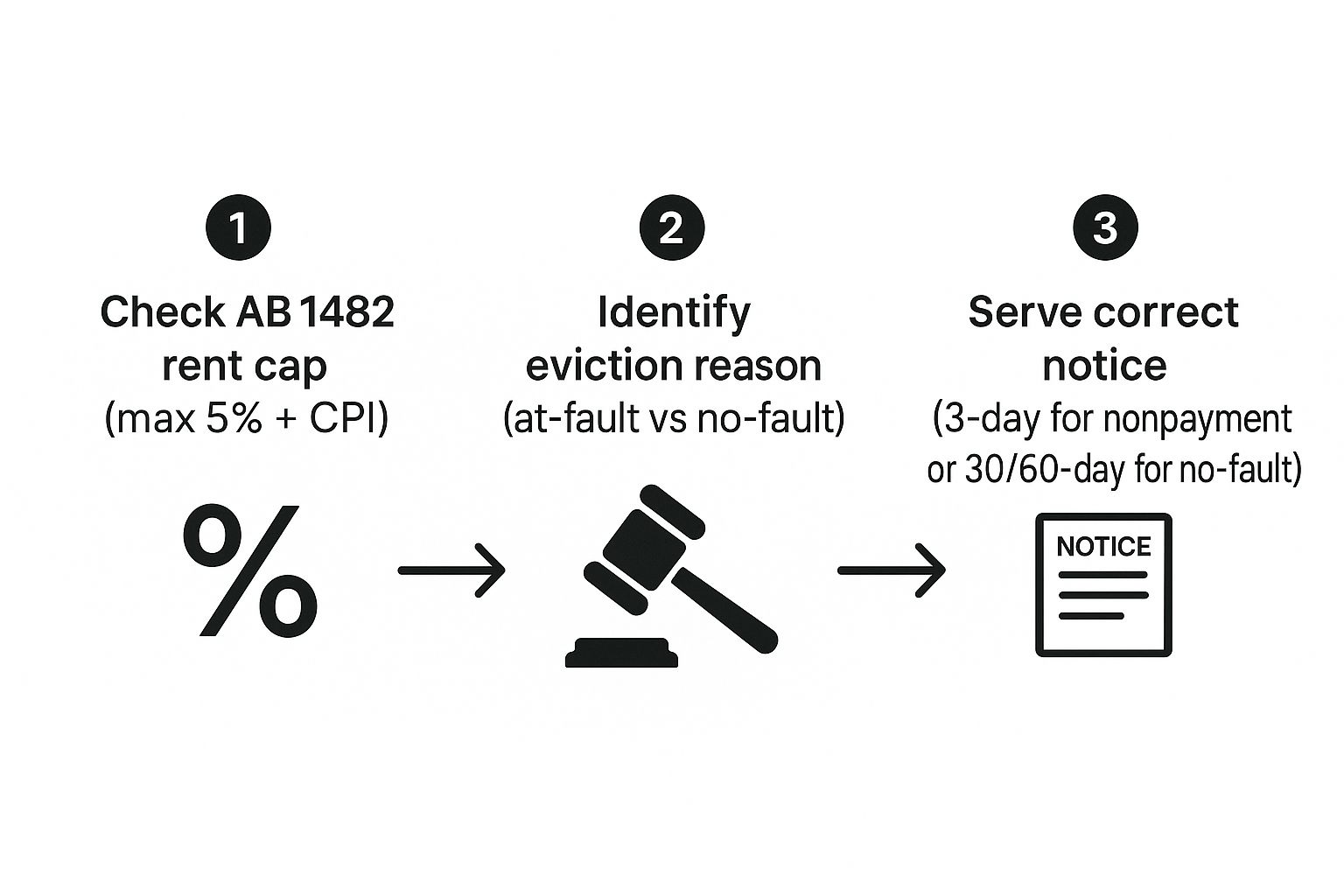
As the infographic shows, it starts with ensuring compliance with rent caps. From there, you must correctly identify the legal reason for eviction and serve the proper notice. A simple mistake, like giving 29 days' notice instead of 30, can get your entire eviction case thrown out of court, forcing you to start over and wasting valuable time and money. To see just how detailed this procedure is, read our complete guide to the eviction process in California.
Common Legal Mistakes Monterey County Landlords Make
Even the most well-intentioned landlords can find themselves in legal trouble. California’s landlord-tenant laws are complex, and in the Monterey County market, a simple mistake can quickly escalate into a dispute, hefty fines, or a failed eviction. Knowing the common pitfalls is the first step to protecting your investment.
One of the most frequent errors is the mishandling of security deposits. The law is clear: you have 21 calendar days after a tenant moves out to either return their deposit or provide a detailed, itemized statement of deductions with receipts. A common mistake is deducting for "normal wear and tear," like faded paint or minor scuffs on the floor, which is illegal and can lead to significant financial penalties.
Another major tripwire is serving incorrect or incomplete notices. Whether it's for a rent increase, a 24-hour notice to enter, or a notice to end a tenancy, the law has strict requirements for content and delivery. A small mistake, like a wrong date or missing information, can make the notice legally invalid.
Failing To Provide Required Disclosures
Before a tenant signs the lease, you have a legal obligation to provide several written disclosures. Overlooking these isn't just bad practice; it can invalidate the lease and expose you to liability. This is an especially common oversight for DIY landlords with older, historic properties found in areas like Pacific Grove.
Key required disclosures include:
- Lead-Based Paint Disclosure: If your property was built before 1978, you must give tenants an EPA-approved pamphlet and disclose any known lead paint hazards. Our guide walks through the specific requirements for the lead paint disclosure in California.
- Pest Control Information: If you use a regular pest control service, you must give the tenant a copy of the notice provided by the pest control company.
- Demolition Permits: If you've applied for a permit to demolish the rental unit, you must inform a prospective tenant before accepting any money.
These are not suggestions—they are legal mandates designed to protect tenant health and safety.

Misunderstanding New Tenant Protections
Landlord-tenant law is constantly changing. A critical mistake is failing to keep up with new legislation that adds more protections for tenants and new responsibilities for landlords. For example, recent laws have expanded tenant rights around credit reporting and the eviction process. Staying on top of these changes is essential for compliance.
Key Takeaway: The most common legal stumbles—from mishandling security deposits to ignoring new laws—almost always result from a lack of current, detailed knowledge. These aren't just procedural errors; they come with real financial and legal consequences that put your property at risk.
At Coast & Valley, our team, led by Salinas native Amy Salmina, makes it our business to stay ahead of these legal shifts. We use standardized, compliant procedures for every property we manage, from Salinas to King City, ensuring your investment is always shielded from these common but costly mistakes.
How Professional Management Reduces Your Legal Risk
For a busy investor with high-end properties in Monterey County, keeping up with California's shifting tenant laws is a full-time job. A single misstep can quickly become a costly legal issue. This is where professional property management becomes a powerful shield for your investment.
A firm like Coast & Valley doesn't just manage your property; we manage your risk. Our approach is built on proven, standardized systems that ensure full legal compliance at every stage, protecting your ROI.
Proactive Compliance Through Standardized Procedures
Inconsistency is a major liability for DIY landlords. Handling similar situations differently can open the door to claims of discrimination. Professional management eliminates this risk by implementing standardized, legally-vetted procedures for every critical task.
This systematic approach ensures every action we take is fair, consistent, and meticulously documented, creating a powerful defense against potential disputes.
Our process includes:
- Legally Compliant Tenant Screening: We adhere to a rigorous, uniform screening process for every applicant, following fair housing laws to find high-quality tenants without exposing you to discrimination claims.
- Ironclad Lease Agreements: We use attorney-reviewed lease agreements that are constantly updated to reflect the latest changes in California and local Salinas ordinances, closing loopholes found in generic templates.
- Formalized Maintenance Tracking: Every maintenance request is logged through our secure online portal, creating a time-stamped record of the issue and our response to prove timely action in any habitability disputes.
- Meticulous Security Deposit Handling: We follow a strict protocol for move-in and move-out inspections, ensuring the 21-day deadline is always met and all deductions are documented with receipts to protect you from financial penalties.
Staying Ahead of Legislative Changes
California's rental laws evolve every year. "I didn't know" is not a valid defense in court. For an investor, tracking these legislative updates—from statewide bills to local ordinances in the Salinas Valley—is nearly impossible.
Our team, led by Salinas native Amy Salmina, is deeply connected to the local real estate community. This gives us frontline insights into upcoming legal changes, allowing us to adapt our practices proactively. This foresight is a cornerstone of how we protect our clients' assets.
We don't just follow the law; we anticipate where it's headed. This involves ongoing training for our staff and regular consultations with legal experts specializing in California landlord-tenant law. It’s how we ensure your property is always managed according to the most current regulations.
The Power of Professional Documentation and Communication
Many landlord-tenant disputes start with miscommunication or a lack of clear records. Professional management establishes a firewall of clear, documented communication between you and the tenant, which is essential for preserving a professional relationship and mitigating risk.
Every important interaction is handled formally and in writing. This creates a clear paper trail that can de-escalate potential conflicts. Tenants appreciate the transparency, and owners gain peace of mind knowing every detail is managed with professional precision.
Ultimately, professional management is a vital strategy for asset protection. It transforms the complex challenge of understanding tenant rights in California from your burden into our professional responsibility.
Ready to shield your investment from legal risk? Explore our full-service property management solutions to see how we protect high-end properties throughout the Monterey Bay Area.
Landlord FAQs: Answering Your Toughest Tenant Questions
When you own high-end rental properties in Monterey County, navigating California's tenant laws can feel like a tightrope walk. To protect your investment, you need clear, straightforward answers to common questions.
Here are some of the most pressing questions we hear from landlords in Salinas, Monterey, and the surrounding areas.
What Repairs Am I Actually Required to Make in My Salinas Rental?
This is non-negotiable. In California, every lease includes an "implied warranty of habitability," a promise that your property is safe and livable. This covers essentials, not cosmetic updates.
Legally, you are responsible for:
- Effective weatherproofing (a solid roof and secure windows)
- Working plumbing, gas, and electrical systems
- A reliable source of hot and cold water
- A functional heating system
- Clean, safe grounds free from pests and garbage
In coastal communities like Monterey and Pacific Grove, this is especially critical for preventing mold. If a tenant reports a major issue, like a broken heater in winter, you have a "reasonable" time to fix it. Delaying can empower the tenant to withhold rent or hire their own contractor and deduct the cost from their payment.
Can I Say No to a Service Animal if I Have a Strict No-Pets Policy?
No. Under fair housing laws, service animals and emotional support animals (ESAs) are not considered pets. They are seen as a medical necessity, like a wheelchair. Your "no-pets" policy does not apply. You cannot charge a pet deposit or monthly pet rent for a legitimate assistance animal.
You can, however, ask for reliable documentation, like a letter from a licensed healthcare professional, confirming the tenant's need for the animal. Once verified, you must approve the request. The tenant is still 100% responsible for any damage the animal causes. Getting this wrong can lead to a fair housing complaint, so professional guidance is key.
What If I Miss the 21-Day Security Deposit Deadline?
Missing this deadline is one of the most expensive mistakes a California landlord can make. You have exactly 21 calendar days after a tenant moves out to either return their security deposit or provide a detailed, itemized statement of deductions.
If you fail to do this, you could lose the right to keep any of the deposit. If a judge finds you withheld the deposit in "bad faith" (intentionally and without a valid reason), the penalties can be severe. You could be forced to pay the tenant the entire deposit back, plus up to twice that amount in damages.
For instance, a simple oversight on a $4,000 security deposit could turn into a massive $12,000 judgment against you, wiping out months of profit.
This is why a rock-solid, automated process is essential. Professional managers live by these deadlines, ensuring every deduction is documented to protect our clients from harsh financial penalties.
How Should I Handle a Tenant Screening Application?
Your screening process is your best defense against future problems, but it's also a minefield of fair housing laws. You have the right to thoroughly vet applicants and charge an application fee to cover your costs, but that fee is capped by law (around $65 as of 2024).
You must give applicants an itemized receipt for the fee and refund any portion not spent on the screening. Most importantly, you must apply your screening criteria—like credit score and income requirements—identically to every applicant. This consistency is your best protection against discrimination claims.
For a deeper dive into creating a compliant process, check out our guide on how to screen potential tenants. Getting this right from the start sets the stage for a successful tenancy.