Salinas Rent Control Goes to Voters in November: What Owners Need to Know Before Then
Direct Answer: All four Salinas rental ordinances remain fully enforceable through at least November 3, 2026. Owners cannot operate as if they are already repealed, violations carry real legal and financial consequences.
If you own rental property in Salinas, you have probably heard that the rent ordinances are heading to voters in November. The City Council voted in September 2025 to place the repeal of all four local rental ordinances on the November 3, 2026 general election ballot. And I understand why some owners are treating that as a signal to relax.
But that framing is the wrong one. Every one of those ordinances is still fully in effect today, and they will remain so until voters decide otherwise, if they decide otherwise. Acting as though the rules are already gone is one of the more expensive mistakes a Salinas landlord can make right now.
This article is not about the politics of rent control. It is about what owners with covered properties should actually be doing between now and Election Day, regardless of which outcome they are hoping for.
The Four Ordinances That Are Still the Law in Salinas
The City Council placed four separate ordinances on the ballot. Each one has its own requirements, and each one carries its own compliance obligations until voters act. Here is what each one actually does:
- Rent Stabilization Ordinance (Ord. No. 2681): Caps annual rent increases at 75% of the local CPI change or 2.75%, whichever is less, for covered multi-family properties built before February 1, 1995.
- Residential Rental Registration Ordinance (Ord. No. 2663): Requires all covered landlords to register their units through the City of Salinas Rental Registry portal and pay annual fees of $45 per unit for non-stabilized properties or $170 per unit for stabilized ones.
- Tenant Protection and Just Cause Eviction Ordinance: Restricts the grounds on which a landlord can terminate a tenancy, requiring documented just cause for evictions of covered tenants.
- Tenant Anti-Harassment Ordinance: Prohibits landlords from using intimidation, unauthorized entry, interference with services, or other conduct designed to pressure tenants into leaving.
Not every Salinas property is covered by all four. Costa-Hawkins exemptions remove single-family homes and condominiums from rent stabilization, as do units built after February 1, 1995. But the registration requirement and the anti-harassment provisions cast a wider net. If you are unsure whether your specific units fall under the stabilization cap, that is worth clarifying with a qualified California real estate attorney before you act on any assumption.
For a broader look at how California law layers on top of local rules, our article on what new California landlord laws mean for Monterey County owners in 2026 covers the state-level picture.

Why the Penalty Structure Demands Serious Attention
Some owners I have spoken with are aware that the rules exist but underestimate what a violation actually costs. The Rent Stabilization Ordinance is not just a policy guideline, it has teeth.
A landlord who overcharges rent on a covered unit can face:
- Statutory damages of up to three times the amount of the overcharged rent
- Misdemeanor exposure under California law
- Attorney fee liability if the tenant prevails in a legal action
That last point matters more than people realize. Even a modest rent overcharge on a single unit, compounded across several months of tenancy, can generate a damages claim that far exceeds whatever the landlord collected. And the owner pays the tenant’s legal fees on top of that if they lose.
The takeaway is simple: operating outside the ordinance while a repeal vote is pending is not a gray area. The law applies fully today, and enforcement has not paused while the political process plays out.
For owners managing multiple Salinas units, staying current on this alone is a significant administrative burden. We have heard from several portfolio owners who describe the compliance layer as one of the main reasons self-management has become unmanageable. That pattern matches what we see in practice. The article on why experienced Salinas owners stop managing their own properties gets into that in more depth.
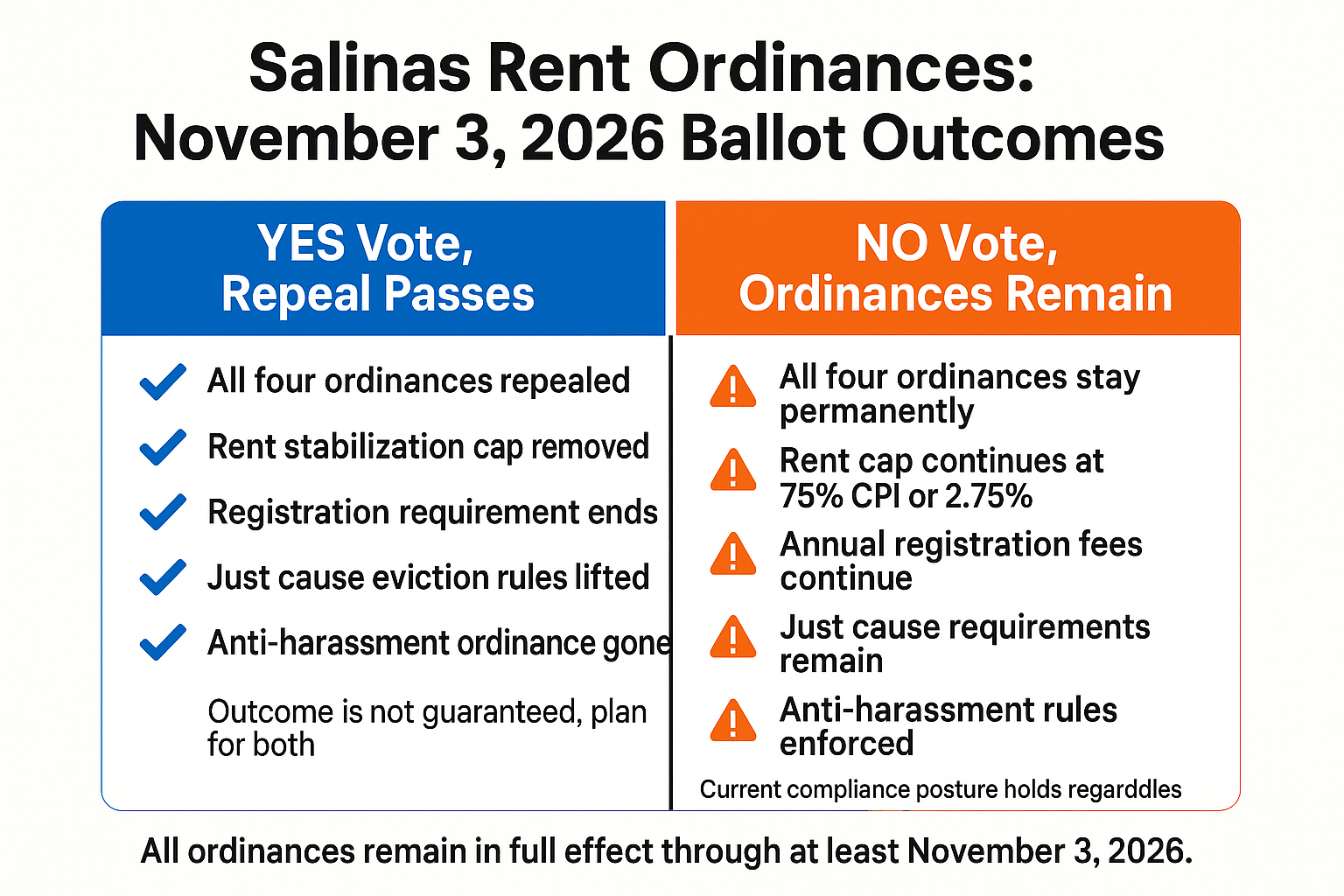
Two Outcomes After November 3, 2026
The ballot result produces one of two clean scenarios. Here is how each one plays out for covered property owners.
What Owners Should Be Doing Right Now, Regardless of How They Vote
The November result is genuinely uncertain. That uncertainty is exactly why your compliance posture today needs to hold up under both outcomes, not just the one you prefer.
Here is what I recommend owners with covered Salinas properties focus on between now and Election Day:
Verify your registration status. The $170 per unit annual fee for stabilized properties is not optional, and late or missing registration creates a paper trail that works against you. Log into the City of Salinas Rental Registry portal and confirm your filings are current.
Calculate any rent increases carefully. The stabilization cap is tied to a specific CPI formula. Do not estimate, calculate it, document it, and keep a written record of how you arrived at the number. If you have a rent increase pending or planned, get the math right before you issue any notice.
Build a documentation habit now. Whether voters repeal the ordinances or not, detailed records protect you. Keep written records of:
- All rent payments received and the dates they were collected
- Any notices issued to tenants and the method of delivery
- Maintenance requests and how each one was resolved
- Any communications that could touch on just cause grounds
If the repeal passes in November, your records from 2026 will still matter for any tenancy that was active before the vote. If the repeal fails, your records are your defense. Either way, documentation costs nothing and protects everything.
For a clear picture of how compliance obligations stack up when you manage more than one unit, the article on how multi-unit owners in Monterey County stay legally compliant walks through the layered requirements in practical terms.
Salinas Rental Ordinances at a Glance: Who Is Covered and What It Costs
This is a quick reference for the four ordinances currently in effect. Coverage depends on property type and build date, confirm your specific situation with a qualified California real estate attorney.
| Ordinance | Who It Covers | Key Requirement | Penalty Exposure |
|---|---|---|---|
| Rent Stabilization (Ord. 2681) | Multi-family built before Feb 1, 1995 (Costa-Hawkins exemptions apply) | Cap increases at 75% CPI or 2.75%, whichever is less | Up to 3x overcharged rent, misdemeanor, attorney fees |
| Rental Registration (Ord. 2663) | Most covered rental units in Salinas | $45/unit/year (non-stabilized) or $170/unit/year (stabilized) | Non-compliance creates enforcement and legal exposure |
| Just Cause Eviction Ordinance | Covered tenants in stabilized and qualifying units | Must document qualifying just cause to terminate tenancy | Invalid eviction, tenant legal claims, damages |
| Tenant Anti-Harassment Ordinance | All covered rental properties | Prohibits pressure tactics, unauthorized entry, service interference | Civil liability, damages, attorney fee exposure |
Frequently Asked Questions About the Salinas Rent Control Ballot
Can I raise rent on my Salinas rental unit right now while the repeal vote is pending?
Yes, but only within the limits the ordinance allows. The stabilization cap is still in effect. If your unit is covered, any increase above the formula limit, 75% of the local CPI change or 2.75%, whichever is less, puts you in violation, regardless of the pending ballot measure. Calculate carefully and document how you arrived at the number.
My property was built after 1994. Does any of this apply to me?
The rent stabilization cap likely does not apply to you under Costa-Hawkins, which exempts units built after February 1, 1995, along with single-family homes and condos. But the registration requirement, the just cause eviction ordinance, and the anti-harassment ordinance may still apply depending on your property type. Do not assume a Costa-Hawkins exemption covers all four ordinances, they operate independently.
What happens if voters approve the repeal in November?
If voters pass a YES on the repeal, all four ordinances are gone. Rent stabilization ends, registration fees go away, and just cause eviction requirements are lifted. But leases and tenancies that were active before the vote may still carry obligations rooted in the period when the rules applied. That is why documentation throughout 2026 matters even if you expect the repeal to pass.
What happens if voters reject the repeal?
A NO vote means all four ordinances stay in place permanently. Nothing changes structurally, you continue operating under the same rules that exist today. Owners who have maintained good records and consistent compliance will be in the strongest position.
I own several Salinas units and the registration and compliance work is becoming too much to manage. Is that common?
Very common. Several multi-unit owners who have contacted us described exactly that situation, managing everything on their own was working until the compliance layer added up. Registration filings, CPI-based rent calculations, just cause documentation, and lease management across multiple units is a substantial ongoing workload. It is one of the main reasons portfolio owners seek professional management support.
Where can I confirm the official status of the ordinances and the ballot measure?
The City of Salinas Housing and Community Development page is the authoritative source. It confirms that all four ordinances remain in effect and provides the Rental Registry portal for registration and fee payment.
The Compliance Work Does Not Pause for Election Season
I want to be direct about something I see repeatedly in conversations with Salinas owners: there is a tendency to treat a ballot measure as a kind of informal suspension of the rules it targets. That is not how California law works.
The ordinances were passed by the City Council. They remain in force until voters act, and even after the vote, the period before Election Day will still have happened. Rent overcharges from 2026 do not disappear because a repeal passed in November. Evictions without documented just cause during 2026 are still vulnerable to legal challenge. The compliance record you build between now and November 3 is a real legal asset, or a real liability, depending on how carefully you have been operating.
For owners who have been self-managing and are feeling the weight of this compliance layer, the article on what Salinas property owners get wrong about self-managing covers the broader pattern honestly. And if you are thinking about what professional management actually handles on a day-to-day basis, what full-service property management actually covers is a practical breakdown.
Tracking ordinance status, calculating compliant rent increases, maintaining registration filings, and keeping documentation current are exactly the kinds of ongoing tasks that a local property manager handles as a matter of routine, not as a crisis response, but as standard operating procedure. That is what staying ahead of a regulatory environment like Salinas actually looks like in practice.
Questions About How These Ordinances Affect Your Salinas Properties?
Coast & Valley Properties has been working alongside Monterey County owners since 2009, and staying current on Salinas regulatory changes is part of what we do every day. If you own covered rental units in Salinas and want to talk through your current compliance posture, we are available to help. Reach us at (831) 757-1270 or through the contact form at coastandvalleypm.com.