Leasing Your Monterey Home to a Company for Employee Housing
Direct Answer: When a company leases your home for staff, the business is the tenant and employees are named occupants. That changes screening, guaranty terms, occupancy language, and end of lease accounting.
A company calls about your home in Monterey, Carmel, or Salinas. They want a 12 month lease for their staff, they say the business will pay the rent, and they ask if you are open to it.
Most owners I talk to want to say yes. Then they realize they have no idea how that lease should be written, who they are actually screening, or what happens when the employee living there gets reassigned.
Two real inquiries got me writing this. One owner asked whether we handle corporate rentals. A business contact asked what financial documents make sense for a company lease of a residential home. Both questions come from the same gap, so here are the answers I give on the phone.
Do you handle corporate rentals? And is that the same as a short-term rental?
Long term leases to employers are a normal part of both residential and commercial property management in Monterey County. A company signs a lease, houses its own staff in the home for months at a time, and pays rent like any other tenant.
That is a very different arrangement from renting by the night or the week. Owners across the Monterey Peninsula have been treating that line much more carefully in recent years, and for good reason.
A few plain distinctions:
- Nightly and weekly stays involve constant turnover, marketing to travelers, and local rules that vary by city and by unincorporated area.
- A company lease is one signed agreement, one paying entity, and a fixed term.
- Furnished does not automatically mean short term. Plenty of long leases come furnished.
We do not manage vacation or nightly rentals, so I will not pretend to advise on that path. If your property used to run that way, this walkthrough on converting a former Airbnb covers the shift. And check with your own counsel about your specific parcel, since the answer is not the same everywhere in the county.
Who is the tenant when a company signs?
The entity is the tenant. The employees living in the home are named occupants, not parties to the lease. That single fact changes several clauses.
What I want spelled out in writing:
- Occupancy language that allows staff rotation, with a cap on how many people may live there and a requirement that the company notify us in writing before anyone moves in or out.
- A named responsible contact at the company, usually an HR or operations manager, with a direct phone number and a backup.
- Damage responsibility resting with the company, not with whoever happened to be sleeping in the back bedroom.
- A clear statement that occupants gain no separate tenancy rights of their own.
Mid term employee changes are the part owners forget. When the engineer or the site supervisor moves on, the lease does not end. The company swaps in the next person, and a good lease already describes how that swap gets documented, including an interim condition check with photos.
This is also where knowing who handles what between a landlord and a manager saves headaches, because there are now three parties in the conversation instead of two.

What financial verification makes sense for a business tenant?
You cannot run a credit report on a company the way you run one on a person, so the paperwork looks different. Here is the package I like to see before signing anything.
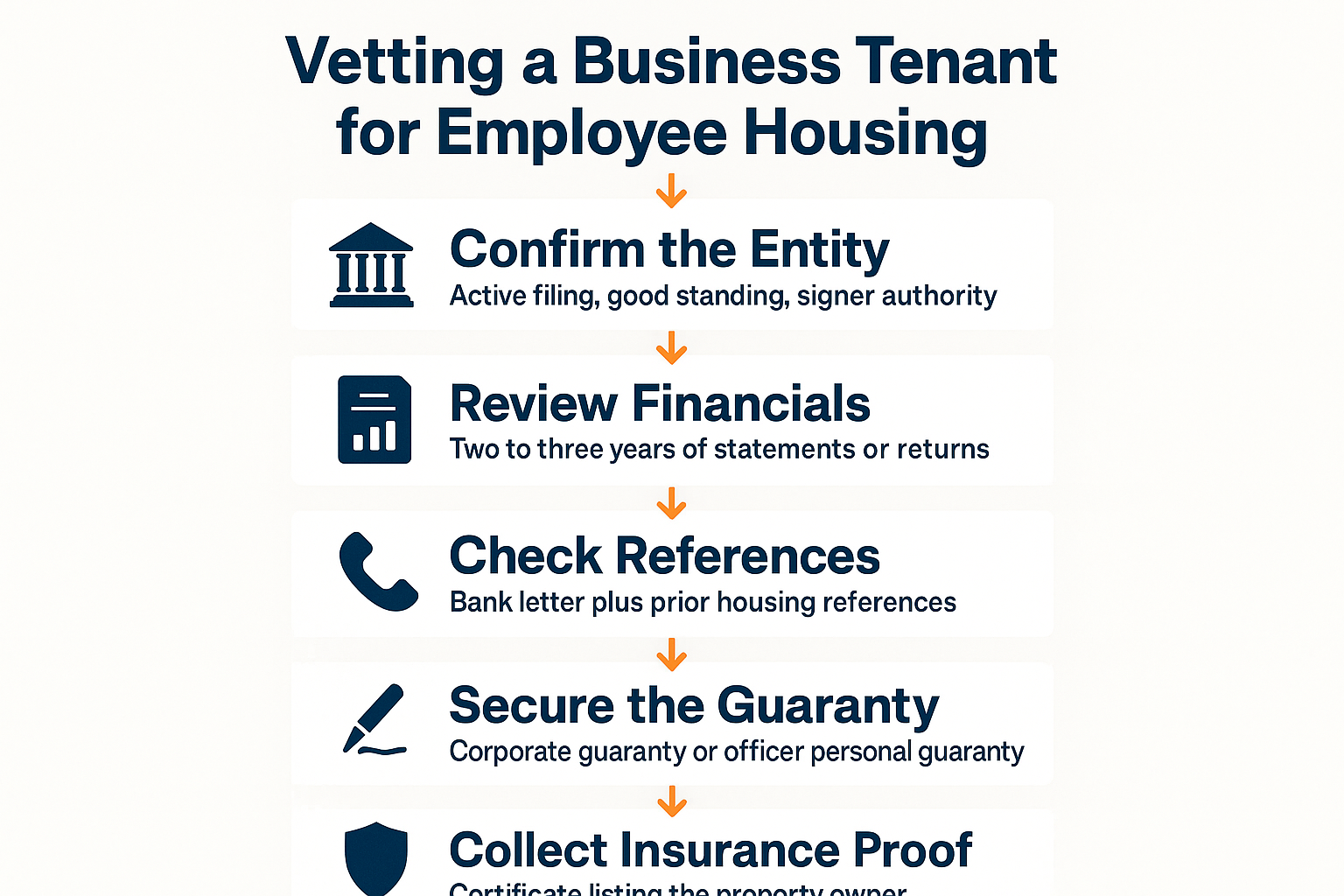
- Entity filings and good standing. Confirm the business exists, is active, and that the person signing has authority. California filings are public and searchable through the Secretary of State business search.
- Two or three years of financials or tax returns. For a private company, reviewed statements are usually the realistic ask.
- Bank references and a current bank letter confirming the operating relationship.
- An officer signature, and where warranted, a corporate guaranty.
- Proof of insurance with the owner listed, plus confirmation of what the policy actually covers in a leased home.
- References from prior housing arrangements, which tell you more than the financials do.
Size drives the outcome. A hospital system or a large grower can often hand you a corporate guaranty without blinking. A three year old company usually cannot, and that is when a personal guaranty from an officer or a larger security position enters the conversation.
A smaller company is not automatically a bad tenant. It just means the protection has to come from somewhere else.
The verification sequence I follow
This is the order I work through when a business wants to lease a residential home for staff.
Furnished or unfurnished, and why the inventory list matters most
Employers placing traveling staff in Monterey and Salinas very often want the home furnished. Their person is flying in for four months and is not shipping a couch.
Furnished changes the paperwork more than owners expect. You now need an itemized inventory with photos, room by room, down to the number of dining chairs and the make of the coffee maker.
You also need written standards for the things that wear out fast:
- Linens, towels, and pillows, with a stated replacement expectation at end of term.
- Small appliances and cookware, listed individually with condition noted.
- Electronics, patio furniture, and anything with a serial number.
- Consumables the company replaces on its own dime.
The inventory list is the single most useful document in a furnished corporate lease. It is what turns an end of lease disagreement into a line item accounting conversation instead of a memory contest.
I would rather spend three hours photographing a furnished home before move in than three weeks arguing about a missing set of flatware after move out.
Standard residential tenancy vs. company employee housing lease
Same house, two very different agreements. This is where the differences show up in practice.
| Item | Standard residential lease | Company employee housing lease |
|---|---|---|
| Who signs | Individual adults as tenants | The business entity, signed by an officer |
| Who lives there | The people who signed | Named employees as occupants, subject to rotation |
| Screening focus | Credit, rental history, employment | Entity standing, financials, bank and housing references |
| Backup for rent | Deposit, sometimes a cosigner | Corporate guaranty or officer personal guaranty |
| Furnishings | Usually unfurnished | Often furnished with an itemized inventory |
| Mid term change | Lease assignment or new lease | Occupant swap documented under the same lease |
| End of term | Deposit accounting | Deposit plus inventory reconciliation |
Who is actually renting this way on the Central Coast?
The demand here is real, but it is lumpy. It follows project calendars, not the usual spring and summer moving season.
What I see most often around Monterey County:
- Ag industry management during season, with supervisors placed in Salinas, Gonzales, and Greenfield.
- Hospital and hospitality staffing, including traveling clinical staff and rotating management.
- Defense and language institute related placements around Monterey, often with predictable term lengths.
- Construction supervisors on multi month projects, where the lease ends when the job does.
Because the timing is driven by work, not by school calendars, lease length is a negotiation rather than a default. Some employers want nine months. Some want a two year term with a break option. Others renew three times in a row and stay four years.
That is not a bad thing, but it changes how you price and how you plan vacancy. Rent for these leases is set by condition, location, furnishing level, and term, so any number I threw out here would be a guess. A walkthrough and a current market analysis is the only honest way to land on a figure.
Why one roof matters for this particular lease
A corporate housing lease sits between residential and commercial. The property is a home, but the tenant is a business, and the document borrows from both worlds.
Most residential-only firms in this area have never drafted one. Most commercial firms do not manage single family homes. Handling both service lines under one roof is what makes this workable, because the same team that understands commercial landlord responsibilities is the team inspecting the house and coordinating the vendors.
And whatever the tenant is, the lease still has to hold up under California’s rental rules, which shift often enough that keeping current is part of the job. Before you sign anything, it is worth reading what a management agreement actually says so you know where the responsibility for that work sits.
Frequently Asked Questions About Company Leases for Employee Housing
How long are these leases usually?
Most land somewhere between six and twenty four months, and the term tends to match a project or a staffing cycle rather than a calendar year. I have seen nine month construction terms renew twice and turn into a three year tenancy.
What happens if the employee living there leaves halfway through the lease?
Nothing happens to the lease. The company is still the tenant and still owes the rent. The employee moving out should trigger written notice, a documented occupant change, and an interim condition check with photos, which is why that clause needs to be in the lease from day one.
Is it reasonable to ask a small company for a personal guaranty?
Yes, and it is common. A large employer can usually offer a corporate guaranty backed by real financials. A newer or smaller company often cannot, so a personal guaranty from an officer or a larger security position is the fair trade for taking on that risk.
Can I charge more for a corporate lease?
Sometimes, particularly when the home is furnished and the term is shorter than a standard year. But furnished leases also carry replacement costs, deeper turnover work, and more detailed accounting, so the higher number is not all upside. Pricing depends on the property, so it takes a walkthrough and current market data to answer honestly.
Do I need different insurance for this?
Talk to your carrier before you sign. A business tenant, furnished contents, and rotating occupants are all facts your insurer will want to know about, and you should also ask the company for a certificate listing you as the property owner.
Thinking through a company lease on your Monterey County property?
Every one of these leases looks a little different depending on the employer, the term, and whether the home goes out furnished. Coast & Valley Properties handles both residential and commercial management across Monterey County, and we are glad to walk through the questions above with an owner who is weighing one of these offers. The office number is (831) 757-1270 if you want a conversation about how your property fits.