How Much Should You Hear From Your Property Manager in a Normal Month?
Direct Answer: At minimum, expect a monthly financial statement without asking, an annual inspection report with photos, and a reply to routine questions within one to two business days.
Most owners do not reach out to me because a repair went badly. They reach out because they have no idea whether it happened at all.
We hear a version of this constantly. One Salinas owner asked whether the fence on the left side of her property had been finished and whether the overgrown tree out front had been trimmed. Months later she asked the exact same two questions, and added one line: “I would appreciate some pictures of the completed work.”
That is the gap no service page ever addresses. Everyone tells you what management includes before you sign. Almost nobody tells you what should land in your inbox afterward without you chasing it.
What a Normal Month Should Actually Look Like
The baseline is simple, and it does not change much whether you own one house in Pacific Grove or four doors in Salinas.
Every single month, you should receive a statement. It shows rent collected, expenses paid, and what was disbursed to you, with a running ledger you can follow line by line. If a month goes by with no statement and no explanation, that is not a small thing.
Then there are the items that arrive less often but matter just as much:
- An annual inspection report with photos so you can see condition, not just read about it
- A market rent review before each renewal, so the renewal decision is based on what the block is actually renting for
- A year-end financial package your accountant can work from without calling anyone
- Notice of anything unusual as it happens, not buried in next month’s numbers
This is not just my opinion about good service. The national association for residential property managers holds members to regular communication with the owner and written reports on an agreed schedule. That is a fair standard to hold any manager to, and a fair thing to raise if it is not happening.

What Arrives Automatically, and What You Will Always Have to Ask For
A lot of owner frustration comes from an unclear line between the two. Some reporting is pushed to you on a schedule. Some of it exists, but sits in a file until you request it.
A finished-work photo is the classic example. Photos of completed repairs are usually taken, but they are not always attached to the statement, so the owner sees a $640 line item for fence repair and nothing else. If seeing the work matters to you, say so at the start and it becomes part of the routine.
The same goes for vendor bids. On a non-emergency job, you can ask to see the estimates before anything is approved. That is a reasonable request, and it also tells you something about how full-service management actually works day to day.
Owner Reporting: Frequency and Who Starts It
Here is a rough benchmark you can hold your current arrangement against.
| What You Receive | How Often | Automatic or On Request |
|---|---|---|
| Monthly owner statement with ledger | Monthly | Automatic |
| Funds disbursed to your account | Monthly | Automatic |
| Maintenance and repair notice above your approval limit | As it happens | Automatic |
| Annual inspection report with photos | Yearly | Automatic |
| Market rent review before renewal | Before each renewal | Automatic |
| Year-end financial package for your accountant | Yearly | Automatic |
| Photos of a specific completed repair | Per job | Usually on request |
| Copies of vendor bids on non-emergency work | Per job | On request |
| Paid invoices and lease documents | Anytime | Portal or on request |
Your Owner Portal Is Only Useful If You Are Actually Set Up
Around-the-clock portal access is one of the more useful things to come out of this industry in the last fifteen years, and it is also the biggest blind spot on most Monterey County management websites. Owners are told a portal exists. Very few are told what should be sitting inside it.
A good owner portal holds:
- Monthly and historical statements going back through your whole relationship
- Paid invoices attached to the expenses on those statements
- Lease documents and signed addenda
- Inspection reports with the photos included
- Maintenance history by property, so you can see what has already been replaced
But none of that helps if the login never worked. An owner in Gonzales wrote in saying he could not remember whether he had ever set up an account, tried a password reset, and never got the email. That is a five-minute onboarding gap, and it can leave an owner feeling in the dark for the better part of a year.
So test it in week one. Log in, pull last month’s statement, open an invoice, and confirm you can find the lease. If any of those three fail, fix it before you have a real question.
How Long Is Too Long to Wait?
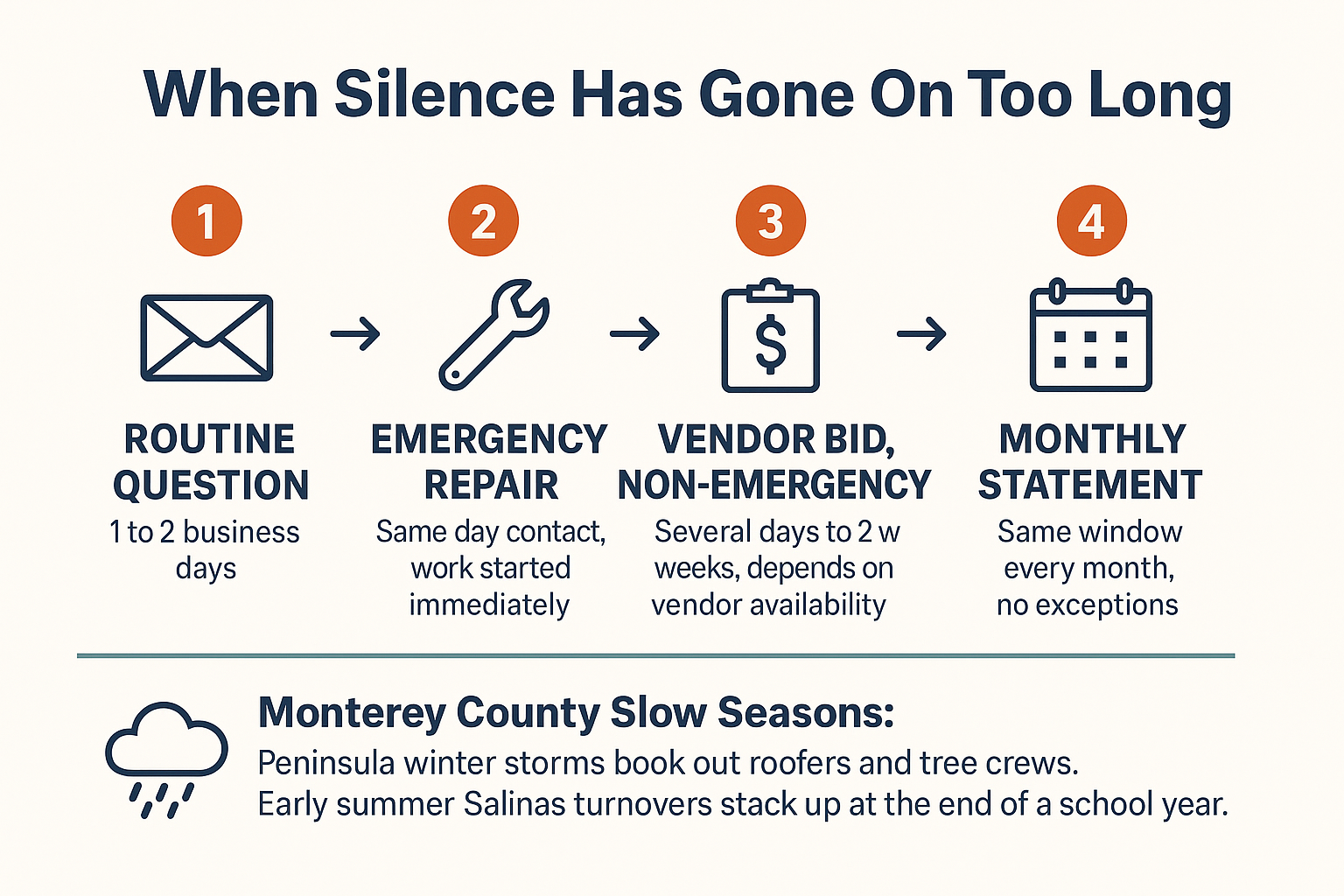
Response time depends heavily on what you asked for. Here is a practical way to judge whether silence has gone on too long.
Set the Triggers Before You Need Them
This is separate from the contract. What the agreement says and how the working relationship runs day to day are two different conversations, and the second one rarely gets had.
The fix is to define your triggers in writing at the start. Two numbers and one short list will cover most of it.
First, the dollar amount above which a repair needs your approval. Set it too low and you will get pinged about every faucet washer. Set it too high and you will read about a $3,000 job after it is done.
Second, the events that should generate a phone call rather than a line item on next month’s statement:
- A tenant falling behind on rent
- A notice to vacate
- An insurance claim of any size
- A repair that turns out to be significantly bigger than the original estimate
- Anything involving habitability or safety
An owner who puts those in writing at the start almost never ends up wondering about a fence for three months. If you are still deciding how much authority to hand over, it is worth reading through what a management agreement actually says alongside this.
If You Do Not Live Here Anymore, the Reporting Is the Property
A large share of Monterey County rentals are now held by people who moved to the Bay Area or out of state and kept the house instead of selling. Inherited homes in Salinas and Pacific Grove often end up the same way.
When you cannot drive down Highway 68 and look at the place yourself, the written record is your view of the asset. That changes how much weight the reporting carries.
Here is a habit I recommend to every out-of-area owner. Pick one month each fall and do a simple review:
- Read the last twelve statements in a row, not one at a time
- Compare total maintenance spend against what was actually reported to you during the year
- Confirm inspection photos exist for that year and that you can open them
It takes maybe forty minutes. It also surfaces a communication problem while it is still a communication problem, before it becomes a deferred-repair problem. Owners who go through this exercise often come to the same conclusion as the ones who stop managing their own properties: the value is in knowing, not guessing.
Frequently Asked Questions About Owner Reporting and Communication
Is it unreasonable to ask for photos of every completed repair?
Not at all, especially for anything structural, exterior, or over a few hundred dollars. Ask for it at the start so it becomes part of the routine instead of a special favor each time. For small things like a replaced filter, a line on the statement is usually enough.
How long should a vendor bid take in Monterey County?
Longer than most owners expect, and it swings by season. During Peninsula storm season, roofers and tree crews get booked out for weeks, and around the end of the school year Salinas turnovers stack up and everyone is busy at once. A few days to two weeks is normal for non-emergency work. What is not normal is hearing nothing about the delay.
My manager only contacts me when something is wrong. Is that a red flag?
By itself, no. Quiet months are usually good months. But you should still be receiving a monthly statement, an annual inspection report, and a rent review before renewal without asking. If those are missing and the only contact is bad news, that is worth raising.
Does more frequent reporting cost more?
Reporting is generally part of standard management rather than an add-on, though what is included varies quite a bit between firms in this area. Pricing depends on property type, unit count, and the scope of services involved, so the honest answer is to ask directly during a consultation rather than trust a number you read online.
What should I do first if I think I am being kept in the dark?
Put your questions in one written message with a date on it and ask for a written reply. That creates a record, and it usually gets faster results than a phone call. If two clear written requests go unanswered, you have your answer about the relationship.
Want to Compare Your Current Reporting Against This?
We have run this from a Main Street office in Salinas since 2009, and we are broker-owner led, so an owner with a question about a statement is talking to someone who knows the property rather than a rotating queue at a national brand. That is paired with an owner portal for statements, invoices, and inspection reports, plus membership in the national association for residential property managers. If you want to talk through what normal reporting should look like for your Monterey County property, we are reachable at (831) 757-1270 or through the contact form at coastandvalleypm.com.