Trash, Trees, and Parking: When Neighbors Complain About Your Monterey Area Rental
Direct Answer: Verify the complaint yourself before acting, talk to the tenant directly, then put a dated written notice in the file referencing the lease. Document every step, every time it happens.
The complaint almost never comes from your tenant. It comes from the person next door, and it usually lands somewhere other than your inbox first.
They look up who manages the property, or they track down an owner’s phone number, and they write. Not angry, most of the time. Just expecting somebody to do something, soon.
After years of fielding these across Monterey County, I can tell you they sort into three buckets almost every time: trash, vegetation, and parking. Below is what each one really is underneath, who usually pays to fix it, and the order I work through a complaint so it ends instead of escalating.
The Trash Complaint Comes In Friendly and Still Needs a Fast Answer
Here is the tone these arrive in. A neighbor of one Salinas property we manage wrote in to say the tenants were “leaving garbage outside of their receptacle” and that “the animals are getting into it.” Then they added that the tenants were “in general nice people but not sure about some of their choices.”
That is the typical temperature. Polite, a little apologetic, and fully expecting action.
What I have learned is that an overflowing bin is often not a tenant attitude problem at all. Before anyone gets a notice, I want to know:
- How many cans are on the account versus how many people actually live there
- Whether the service day lines up with when the household generates the most waste
- Whether a recent move-in or move-out dumped a one-time pile at the curb
- Whether the bin area has a gate, a latch, or any defense against raccoons and crows
At a lot of older properties the answer is simply that one can was sized for a different household. Adding service is a small monthly cost and it solves the complaint permanently. Writing a tenant up for a problem the property created just buys you a resentful resident and the same bin on its side next week.
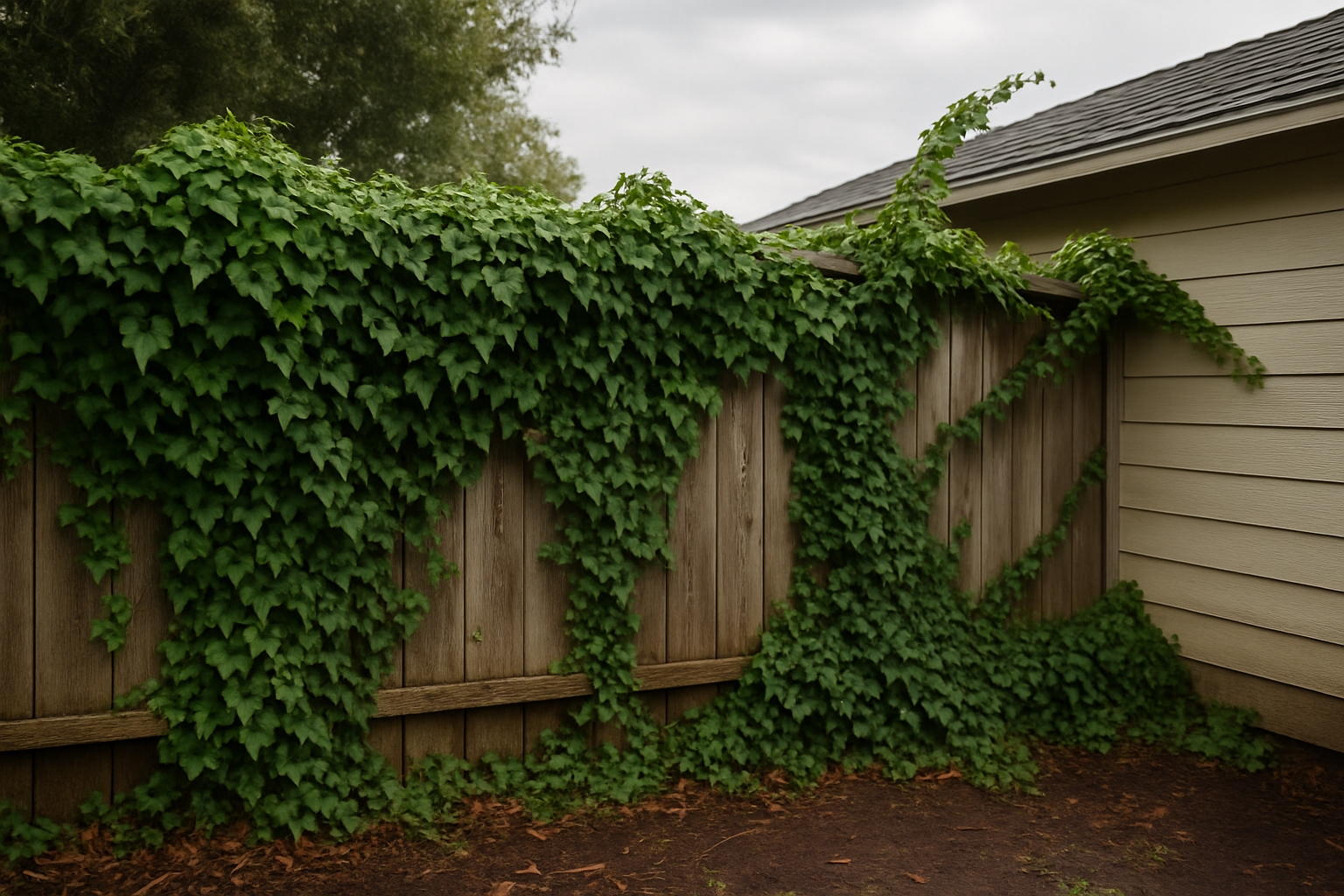
Ivy and Tree Limbs: A Maintenance Bill Wearing a Neighbor Dispute Costume
The second recurring type is vegetation. One adjacent owner wrote to us about ivy from a managed property that had swallowed the shared back fence and was working its way toward her garage roof and into her yard.
She framed it as a favor. Handle it now, she said, and avoid a roof problem later. She was right.
This is the part owners get wrong most often: vegetation is almost always the owner’s cost, not the tenant’s. Mowing and weeding are housekeeping. Ivy eating a fence, a limb hanging over a neighbor’s garage, roots lifting a shared walkway, those are structural upkeep on your asset.
And the clock on these is seasonal. Once the Central Coast wet season starts, a limb that was merely annoying in October becomes a saturated, wind loaded liability in January. In years when forecasters point toward a wetter than normal winter, the gap between a scheduled trim and an emergency call gets expensive fast.
So when a neighbor flags a limb in the fall, they have done you a genuine favor. An owner living three hours away would not have seen it until something came down. This is exactly the kind of thing we look for when walking a property before the first storm.
Parking Causes More Neighbor Friction Than Anything Else at Small Multi-Units
At four to twelve unit properties around Salinas, parking generates more complaints than trash and trees combined. One public review of a property we manage put it plainly: neighbors with “like 3 cars for one apartment” or “blocking you from getting out.”
The same handful of patterns repeat:
- One unit with three or four vehicles quietly absorbing the lot
- Residents blocked in by a car parked across a shared driveway
- A tenant or guest told verbally they could park somewhere, then finding the car towed
- Enforcement that lands on one vehicle and skips another, which residents notice immediately
The practical fix is unglamorous. Assigned spaces written into the lease, one rule applied identically to every resident, and a documented warning step before anything is touched.
Towing ends a parking problem and starts a much longer one. It generates a furious resident, a furious guest, and a public review that prospective tenants will read for years. I have seen a single tow cost an owner more in vacancy and reputation than a decade of parking stickers would have. If you are adding units, this is one of the things that changes as you add doors.
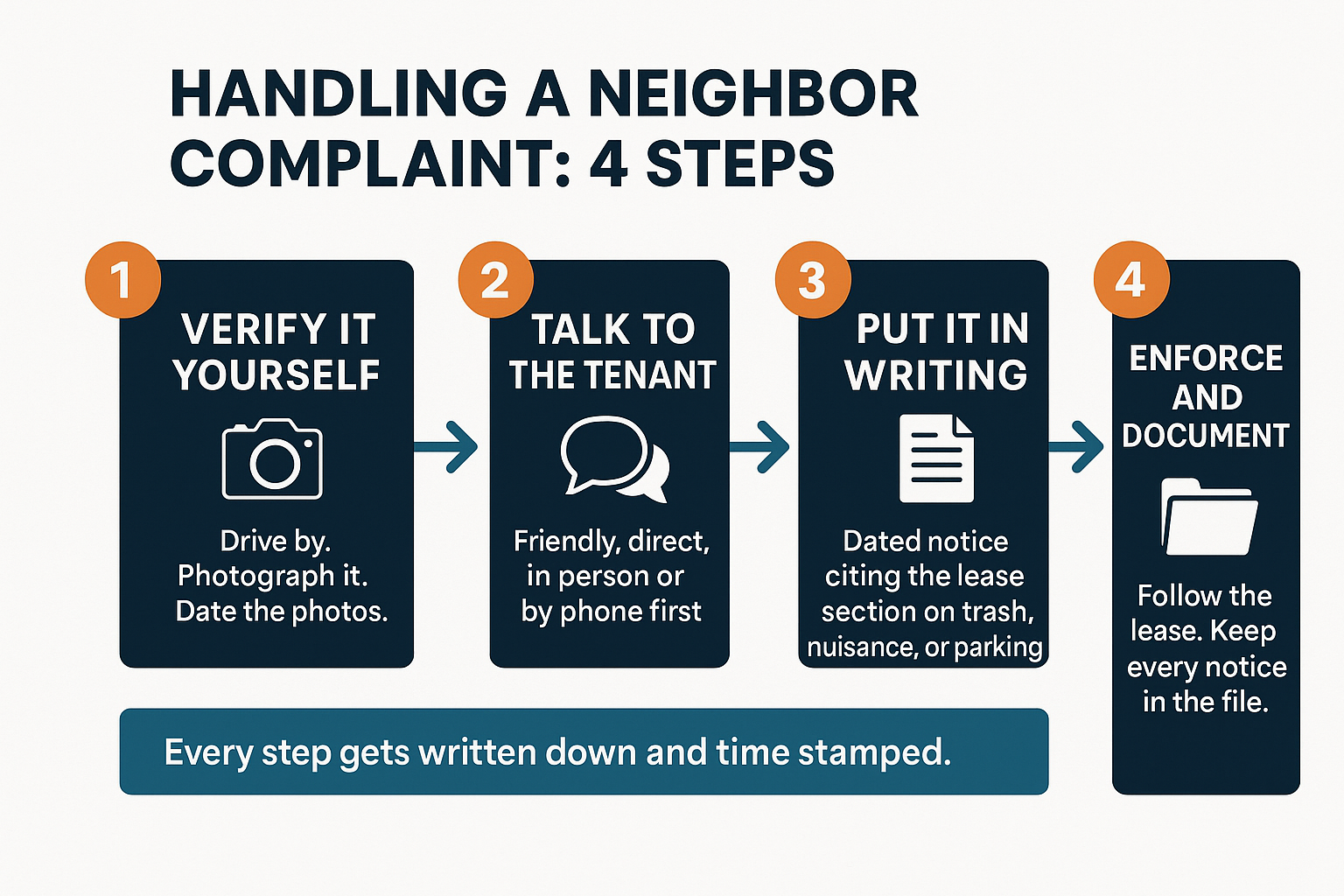
The Four Step Ladder I Use on Every Complaint
Most owners either overreact or freeze. This is the sequence that keeps a complaint from turning into a dispute you cannot document later.
Why Documentation Is the Whole Point
Every step on that ladder gets written down with a date on it. That is not bureaucracy for its own sake.
A single complaint proves nothing. A pattern of dated, written notices is what separates a defensible position from a he said, she said conversation at the end of a tenancy.
I also verify independently before anything else happens. One neighbor’s word is a starting point, not a finding. I have driven out to confirm a “constant” trash problem and found one bag from a move-out, and I have driven out expecting nothing and found a situation worse than described.
The friendly direct contact in step two resolves more than people expect. Most tenants had no idea the bin was feeding the neighborhood wildlife, or that the space they have used for eight months belongs to unit three.
Who Usually Pays, and What I Check First
A quick reference for the complaints that come in most often around Monterey County.
| Complaint | Usually whose cost | What I check first |
|---|---|---|
| Trash outside the bin | Tenant behavior, unless the service is undersized | Can count versus household size, pickup day, photos of the bin area |
| Ivy, hedges, overhanging limbs | Owner, as structural upkeep | Where growth crosses the line, contact with fence or roof |
| Blocked driveway, extra vehicles | Tenant behavior, a lease issue | Assigned spaces in writing, vehicles per unit |
| Noise or late night activity | Tenant behavior | Dates and times, whether more than one neighbor reports it |
| Leaning or failing fence | Often shared, frequently the owner | Photos from both sides, whether it is now a safety problem |
Calling the Neighbor Back Yourself Usually Makes It Worse
I understand the instinct. It is your property and somebody just told you your tenants are behaving badly on it.
But owners are emotionally invested in a way a third party is not. Neighbors also escalate differently when they sense they are dealing with an individual rather than a process, because an individual can be pressured and a process cannot.
The bigger risk is the off the cuff promise. You tell the neighbor you will have the ivy gone by the weekend, or that the car will be moved today, and now you have created an obligation your tenant never agreed to.
A third party absorbs the complaint, verifies it, applies the same standard to every resident, and keeps you out of a dispute between two people who still have to live next to each other.
This matters most for owners who inherited a property or moved away. They often learn about a problem only when a neighbor finally tracks down their phone number, and by then it has been building for months. If that sounds familiar, it may be a sign that self-managing has stopped making sense.
The Same Complaint Sounds Different Depending on the Street
Geography changes the tone, not the remedy.
In older Salinas neighborhoods with street parking, shared driveways, and alley collection, the flashpoints are cans left out past pickup and vehicles blocking access. Neighbors there tend to give you a little room, because everybody’s bins and cars are in everybody’s way sometimes.
On the Peninsula and in Carmel, lots are tighter and streets are narrower. A single overgrown hedge changes a neighbor’s view or pushes water somewhere it was not going before.
The same complaint arrives with a very different tone and a much lower tolerance for delay. The fix is identical. The expected response time is not, and knowing which street you are standing on is part of knowing a neighborhood well enough to manage in it.
Frequently Asked Questions About Neighbor Complaints
Can I charge the tenant for trimming the ivy or the tree?
Generally no. Vegetation that threatens a fence, roof, or property line is structural upkeep, which sits with the owner. Routine mowing and weeding can sit with the tenant if the lease says so clearly.
A neighbor keeps calling about my tenant’s cars. Can I just have them towed?
You can, and it is usually the wrong first move. Towing ends one problem and starts a longer one that often includes a public review future applicants will read. Assigned spaces in writing and a documented warning step solve far more parking problems than a tow truck does.
What if the neighbor is exaggerating or has a grudge?
That happens, which is exactly why verification is step one. I would rather drive by and find nothing than send a tenant a notice based on a single phone call. If photos and a site visit do not support the complaint, nothing goes in the tenant’s file.
How quickly should a complaint get a response?
Acknowledge it the same day, verify within a day or two, and have a plan the neighbor can hear. Most people calm down the moment they learn a real person looked at it.
Does one neighbor complaint hurt my property value or future rent?
One does not. A pattern does. Neighborhoods talk, applicants ask about the street, and a property known for overflowing bins and blocked driveways shows up in how long it sits vacant.
Questions about a complaint at your Monterey County rental?
Complaints about the properties we manage come to a local office on Main Street in Salinas, staffed by people who can drive out the same afternoon and see whether the trash is really out, the ivy is really over the fence, or the car is really in the wrong space. Annual inspections and an established local vendor network mean the tree trim or fence repair that resolves a neighbor issue gets scheduled rather than debated. We have been doing this in Monterey County since 2009, and owners who want to talk through a specific situation are welcome to reach us at (831) 757-1270.