Written Pet Policy Required With Every Rental Application April 1, 2027
Direct Answer: Starting April 1, 2027, California residential landlords and their agents must keep a written pet policy and provide it with rental applications and applicable digital ads under SB 1296.
Most owners I talk with on the Peninsula have a pet policy. It just lives in their head, or in a sentence buried on page nine of a lease, or in a note they give the showing agent. That stops working on April 1, 2027.
Governor Newsom signed SB 1296, the Pet Policy Transparency Act, on September 30, 2026. It adds Section 1942.7.5 to the California Civil Code and puts pet policies in writing, up front, before anyone pays an application fee.
I want to walk through what the law actually asks for, where the money risk sits, and what I would rewrite across a Monterey County portfolio between now and spring 2027.
What the California pet policy disclosure law for landlords, SB 1296, actually requires
The bill was authored by Senator María Elena Durazo and signed on September 30, 2026. Beginning April 1, 2027, every residential landlord and their agent must maintain a written pet policy or pet addendum.
According to the California Apartment Association’s summary of the change, housing providers must supply their written pet policies with rental applications and applicable digital advertisements. The requirements apply to policies that allow, restrict, or prohibit pets.
Read that last part twice. A blanket no-pets rule is still a policy, and it still has to be written down and handed over.
Coverage reporting from Mortgage Professional America on October 6, 2026 described the same three obligations owners need to plan around:
- A written pet policy or pet addendum kept on file for each property
- That policy posted on the property website and in the digital ads you control
- That policy included with each rental application
The Michelson Center for Public Policy, which backed the bill, framed the goal as renters getting pet policy information before they apply rather than after. Whatever you think of the policy reasoning, the operational takeaway for owners is the same: the disclosure moves to the front of the process.
The refund trigger is where this costs you money
Here is the part that turns a paperwork rule into a dollar figure. If the pet policy is not disclosed before an application fee is collected, and the applicant turns out to be ineligible or withdraws because of that policy, the fee has to go back.
Application fees in our area are not enormous on their own. Based on what we see locally, screening fees commonly land somewhere in the $40 to $60 range per adult applicant, and the state caps what can be charged, so confirm your current number before you print anything.
Multiply that across a portfolio. An owner with six units turning over in a single leasing season, with three or four applicants per unit, is suddenly managing refunds, bookkeeping entries, and a few irritated people who feel misled.
The reputational cost is worse than the refund. We already see reviews in this market where renters accuse management companies of caring more about application fees than about filling units. A no pets rule discovered after someone pays is exactly the complaint that produces that review.

What I would audit across a Monterey County portfolio
The failure point is almost never the policy itself. It is the drift between documents. Your Carmel listing says one thing, your Salinas listing says another, and the lease you have used since 2019 says something else entirely.
Here is the sweep I would run on every property you own:
- Every active and archived digital listing you control, including your own site, so the written policy appears with the ad
- The application packet itself, so the policy travels with the application rather than arriving at lease signing
- The pet addendum, checked for whether it matches what the ad promised about breed, weight, number of animals, and fees
- Showing scripts, so whoever is standing in the driveway in Pacific Grove is saying the same thing the paperwork says
- Your insurance file, since some carriers maintain their own animal restrictions that need to line up with what you advertise
That last one surprises people. We have seen owners advertise a pet-friendly unit only to find their coverage says otherwise, which is one more reason landlord insurance on the Central Coast is worth reviewing on the same pass.
If you own multiple properties with different rules, write a separate policy per property. One portfolio-wide document that quietly does not apply to half your units is the version that creates a dispute.
Document by document: what changes before April 1, 2027
This is the checklist I work from. Every row should be done and consistent before your spring 2027 listings go live.
| Document | What changes | Who usually owns it |
|---|---|---|
| Digital listing or ad you control | Written pet policy appears with the advertisement | Owner or listing agent |
| Property website page | Policy posted and kept current per property | Owner or manager |
| Rental application packet | Policy included with each application, before any fee is collected | Owner or manager |
| Pet addendum | Terms match the ad exactly: species, size, count, deposits, fees | Owner or manager |
| Lease template | Addendum referenced and attached rather than buried in a clause | Owner or attorney |
| Fee handling process | A documented refund path when the policy was not disclosed first | Bookkeeping |
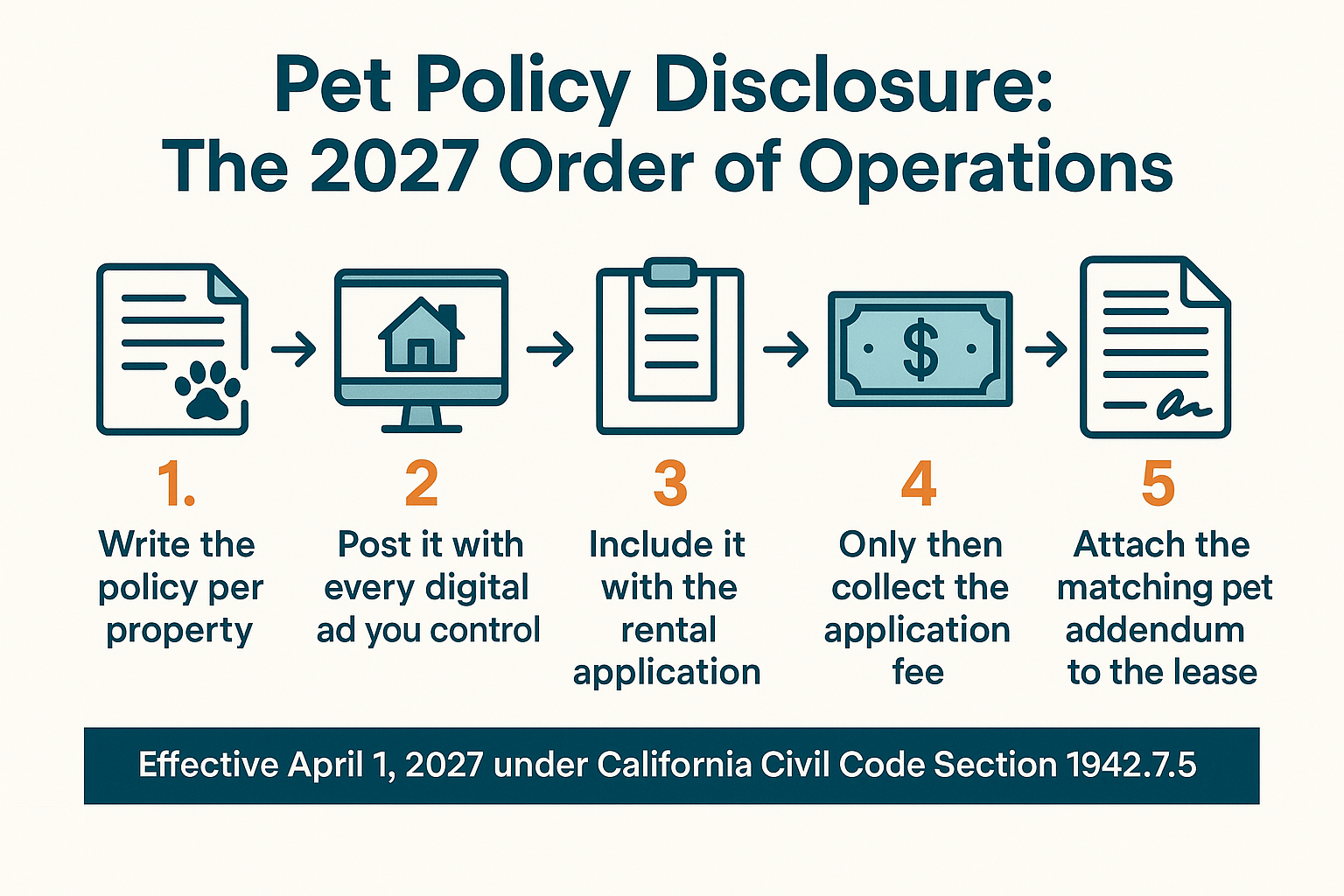
The order of operations for a 2027-ready application
The sequence matters more than the wording. Disclosure has to land before money changes hands.
Why this hits Peninsula owners a little differently
Two things make this more awkward here than in a large apartment market.
First, a lot of our owners never advertise the same way twice. An estate in Pebble Beach gets leased quietly, a Pacific Grove bungalow goes on a portal, and an inherited duplex in Salinas gets a sign in the window. Three listings, three habits, and now one written standard that has to apply to all of them.
Second, owners of higher-value homes tend to make judgment calls in the moment. A small dog is fine, two large dogs are not, and a cat depends on the flooring. That is a defensible position, but after April 2027 it has to exist on paper before anyone applies rather than in a conversation after you meet the applicant.
Write the exceptions in. If you allow pets with conditions, say what the conditions are. Vague policies invite the same arguments vague disclosures always have, which is a pattern we also see with lead paint disclosure on older California rentals.
One more point worth keeping separate in your head: service animals and assistance animals are handled under fair housing rules, not pet rules. A written pet policy does not change those obligations, and it should not read as though it does.
What to do between now and spring
You have time, which is exactly why most owners will do nothing until March 2027 and then rush it.
I would pace it this way:
- This quarter: decide the actual policy for each property, in writing, including the conditions and any pet rent or deposit terms
- Winter: update the application packet and the pet addendum so they match word for word
- Before April 1, 2027: sweep every digital listing and property page you control, and brief anyone who shows your units
If you self-manage one or two units, this is a weekend of work. If you hold a small portfolio across Monterey, Carmel, and the valley, it is the kind of task that keeps getting pushed, which is one of the quiet reasons self-managing eventually stops penciling out for owners with several properties.
It also stacks on top of everything else that landed recently. If you have not read through what the newer California landlord laws mean for Monterey County owners, do that pass at the same time so you are only touching your documents once.
Frequently Asked Questions About the 2027 Pet Policy Disclosure Rule
Does SB 1296 force me to allow pets in my rental?
No. The requirements apply to policies that allow, restrict, or prohibit pets. You can keep a no-pets policy. You just have to put it in writing and hand it over with the application and applicable digital ads starting April 1, 2027.
What happens if I collect an application fee without disclosing the policy?
If the policy was not disclosed before the fee was collected, and the applicant is ineligible or withdraws because of that policy, the fee has to be refunded. Practically, that means your disclosure step has to sit in front of your payment step in the process, not after it.
Does this apply to listings on third-party rental portals?
The law reaches applicable digital advertisements and the ads you control. Portals vary in how they handle attachments and field limits, so I would plan to state the policy in the ad body itself and keep the full written policy with the application. Confirm the specifics with your attorney before April 2027.
Do I need to redo leases for tenants who are already in place?
The disclosure obligation is aimed at prospective applicants. That said, if a current tenant has a pet and there is no signed addendum in the file, renewal is a sensible time to fix it. Undocumented pets are a common source of deposit fights at move-out.
I only own one rental. Is this really a big deal?
It is a small task done once. Write the policy, attach it to your application, put it in your ad, and keep a copy. The owners who get burned will be the ones advertising restrictions they never disclosed and then collecting fees on them.
Getting your documents ready before April 2027
If you own rentals in Pacific Grove, Monterey, Pebble Beach, Carmel, or the valley and you would rather not sort through every listing and application packet yourself, our team at Coast & Valley Properties handles that kind of document work as part of day-to-day management. We are happy to talk through what your properties need. You can reach the office at (831) 757-1270 or through the contact form at coastandvalleypm.com.