The Difference Between a Local Firm and a National Name in Monterey
Direct Answer: A local property manager knows Monterey County’s specific laws, neighborhoods, and vendors firsthand. A national firm applies a standardized system that wasn’t built for this market.
When you’re deciding who should manage a rental property in Salinas, Carmel, or Pacific Grove, the choice often comes down to a familiar national brand versus a local firm you may not have heard of. The national name feels safe — they have a website, a 1-800 number, and offices in every state. But that’s exactly the problem.
Monterey County is one of California’s most complex rental markets. Between AB 1482, the City of Salinas Rental Registration Ordinance (Ord. 2663), and rent control nuances that vary block by block, this isn’t a market where a one-size-fits-all approach holds up.
This article breaks down the two most important places where local and national firms actually diverge — not in their marketing language, but in day-to-day decisions that affect your property, your tenants, and your legal exposure.
What ‘Local Knowledge’ Actually Means in This Market
Every property management firm — national or local — claims to know your market. But there’s a difference between having an office in Monterey County and actually understanding it.
A manager who works this market daily knows that a single-family home in North Salinas rents at a meaningfully different rate than the same square footage near Natividad Road or in the South Salinas neighborhoods closer to Highway 68. They know which pockets of the Salinas Valley have higher turnover patterns. They know the vendors who actually show up — and the ones who don’t.
National firms typically assign your property to a regional portfolio manager who may oversee 50 to 150 doors across multiple counties. That manager isn’t driving your street to assess a maintenance complaint. They’re routing requests through a ticketing system and working from averages, not specifics.
For owners with properties in Carmel or Pacific Grove — where homes can carry significant value and tenant expectations are high — that difference isn’t minor. As we’ve covered before, what makes a property manager truly local goes far deeper than a local area code.
Local knowledge also applies to compliance. The City of Salinas Residential Rental Registration Ordinance went into effect in 2024 and requires annual registration of rental units, with fees and inspection timelines that national systems weren’t built to track. A firm headquartered in Salinas doesn’t need to look that up.

How California Compliance Separates the Two Models
California landlord-tenant law is genuinely difficult. It changes often, and Monterey County adds its own layer on top of state requirements. This is where the structural difference between local and national firms becomes most visible.
National property management companies typically use standardized lease templates and compliance checklists built for the broadest possible California applicability. That’s fine — until a local ordinance creates a requirement the template doesn’t address.
Here’s what a property owner in Monterey County is actually navigating:
- AB 1482 (Tenant Protection Act) — caps annual rent increases at 5% plus local CPI and restricts certain evictions for covered properties
- City of Salinas Ord. 2663 — requires rental registration, annual fees, and compliance documentation for properties within city limits
- Lead paint disclosure requirements — mandatory for pre-1978 properties, with specific documentation that must accompany every lease
- California warranty of habitability — creates ongoing maintenance obligations with real legal exposure if ignored
- Security deposit accounting rules — require itemized returns within 21 days of move-out, with penalties for non-compliance
A national firm’s compliance team may catch the state-level items. But what happens to your rental when California law changes mid-lease often depends on whether your manager is watching Sacramento and City Hall simultaneously — or just running last year’s checklist.
A locally rooted firm with a licensed California broker at the helm handles these as routine. They’re not escalating to a corporate compliance department in another state.
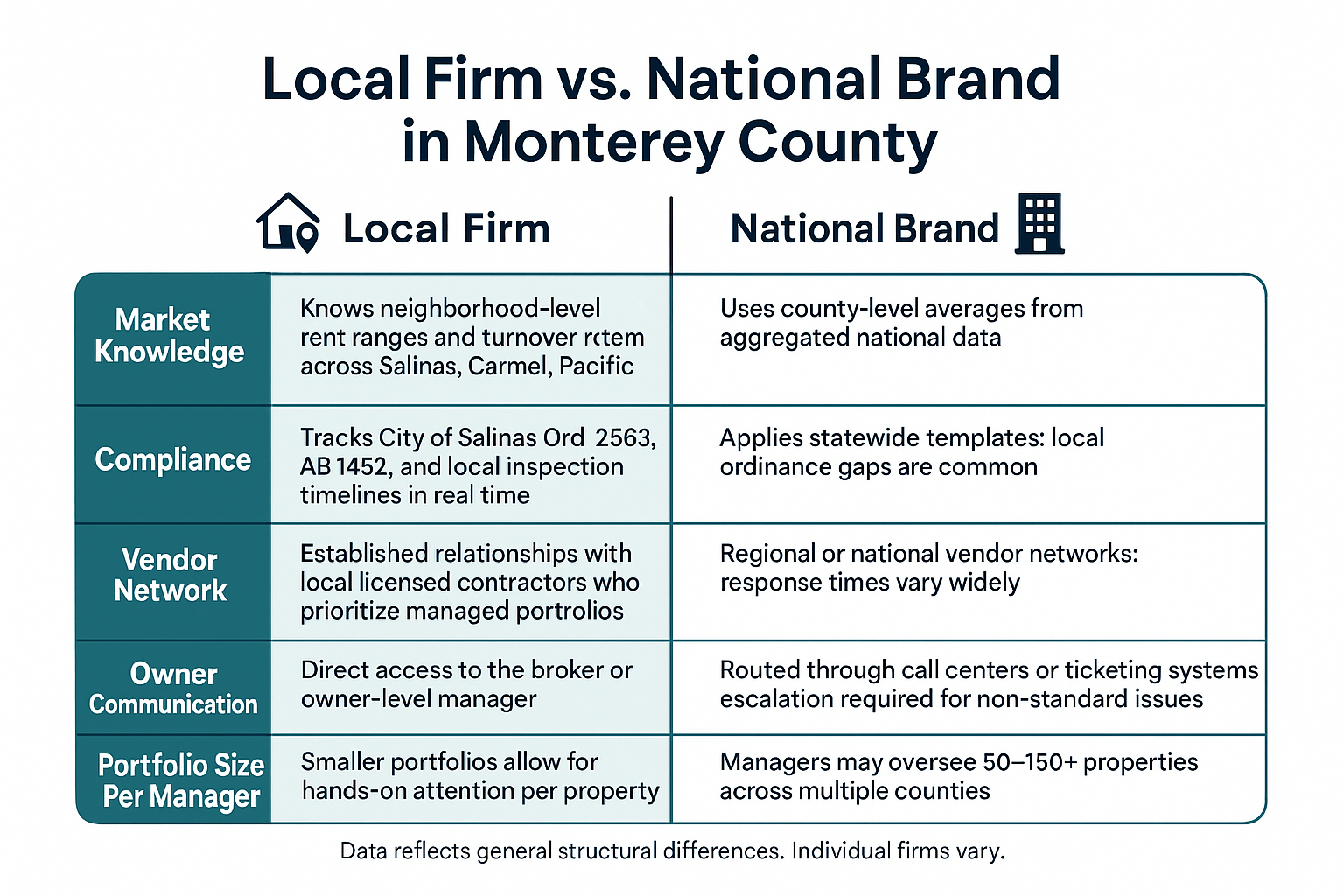
Local Firm vs. National Brand: Where It Actually Matters
This comparison covers the key operational differences that affect your property’s performance and compliance in Monterey County.
The Vendor Problem Nobody Talks About
One of the least discussed differences between local and national firms is how maintenance gets handled — specifically, who shows up when something breaks.
National firms often work with preferred vendor networks. On paper, this looks like efficiency. In practice, it means a plumber or HVAC technician who covers a three-county territory may take 3 to 5 business days to schedule a non-emergency repair. In the meantime, your tenant is waiting, and California’s habitability clock is running.
A local firm with years of relationships in Monterey County has already sorted through the vendors. They know which electrician calls back the same day, which roofer does honest work in the Salinas Valley, and which general contractor handles Pacific Grove’s older housing stock without cutting corners. Those relationships get built over years — they don’t transfer from a national brand’s preferred vendor list.
This matters financially, too. When a single missed inspection becomes a six-figure problem, the difference is almost always a delayed response, not a complicated legal question. Fast, trusted vendors close that gap.
For multi-unit owners, the vendor gap compounds quickly. If you have 6 or 8 units in Salinas and a national firm is routing your maintenance tickets through a regional queue, you’re not getting the same service level as an owner who’s managed by a firm with direct lines to local trades.
How Decisions Get Made: Local vs. National
The table below shows how common property management decisions are typically handled depending on firm structure.
| Decision Type | Local Firm | National Brand |
|---|---|---|
| Rent pricing adjustment | Based on current local comps, manager’s direct market knowledge | Based on algorithmic rent analysis from aggregated regional data |
| Lease compliance question | Handled by licensed broker with California-specific training | Routed to corporate compliance team; response time varies |
| Emergency maintenance at 10 PM | Local after-hours contact with established vendor relationships | National hotline dispatches from a regional vendor network |
| Tenant dispute or notice | Manager familiar with local court system and Monterey County procedures | Standardized process; may not reflect local judicial preferences |
| Owner financial reporting | Customized reports with local context; direct conversation available | Standardized portal reports; explanations require a support ticket |
What You’re Really Paying For When You Choose Local
Property owners sometimes assume a national firm offers more value simply because of brand recognition or technology. And it’s true — most large national firms have polished owner portals, automated rent collection, and slick onboarding.
But technology doesn’t file a proper notice with the Monterey County Superior Court. It doesn’t spot a lease clause that conflicts with a 2024 City of Salinas ordinance. And it doesn’t call the right plumber at 9 PM on a Tuesday.
What a local firm offers isn’t nostalgia — it’s accountability. When the broker-owner of a Salinas-based firm is personally involved in your portfolio, the decision-making structure is completely different. There’s no corporate buffer between a problem and the person responsible for fixing it.
For property owners evaluating what full-service property management actually covers, the honest answer is: the service list matters less than whether the firm behind it can actually execute in your specific market. A firm that knows Monterey County’s rental ecosystem — its regulations, its neighborhoods, its vendors, its courts — simply has fewer gaps.
Frequently Asked Questions About Local vs. National Property Management in Monterey
Isn’t a national firm safer because they have more resources and legal backing?
Larger firms do have legal departments, but those departments are built around California-wide compliance, not Monterey County-specific ordinances. The City of Salinas Rental Registration Ordinance, for example, is a local requirement that national templates may not address correctly. Resources don’t help if the system isn’t calibrated for your market.
How do I know if a local firm actually has the capacity to manage my property well?
Ask directly: How many units does each manager in your firm currently oversee? A local boutique firm keeping portfolios under a manageable number per manager is a meaningful quality indicator. Also ask whether the broker-owner is actively involved in day-to-day decisions — or whether they’ve stepped back from operations.
Does it matter whether my property manager is a licensed California real estate broker?
Yes. In California, property managers who collect rent or negotiate leases on behalf of others must hold an active real estate broker or salesperson license under a broker. A licensed broker has passed state-mandated examinations and is subject to DRE oversight. That matters when legal questions arise.
What about technology — don’t national firms have better portals and tools?
Many local firms now use the same platforms — AppFolio, Buildium, and similar systems — that national brands run on. The technology gap that existed ten years ago has largely closed. What a local firm adds on top of those tools is the judgment and market knowledge to interpret what the reports actually mean for your specific property.
I inherited a property in Salinas and I live out of state. Does a local firm make more sense for me?
Almost always yes. Out-of-state owners are the exact clients who benefit most from a locally embedded manager. You need someone who can physically inspect the property, respond to emergencies without a multi-day delay, and make compliance decisions in real time. Why experienced Salinas owners stop managing their own properties covers this in more detail — but for an out-of-state owner, the case is even stronger.
Want to Talk Through What’s Right for Your Property?
Coast & Valley Properties has managed residential and commercial rental properties across Monterey County since 2009, with a licensed broker involved in every portfolio. If you own property in Salinas, Monterey, Carmel, Pacific Grove, or anywhere in the surrounding area and you want a straightforward conversation about what professional local management looks like, call us at (831) 757-1270 or reach out through coastandvalleypm.com.