Managing a Multi-Unit Property in Salinas: What Changes as You Add Doors
Direct Answer: Managing a multi-unit rental in Salinas introduces a different layer of city ordinances, financial complexity, and coordination demands that simply don’t apply to a single-family rental — and most owners hit a tipping point faster than they expect.
There’s a version of residential property management in Salinas that one person can handle with a good calendar and some discipline. One rental home, one lease, one tenant relationship. I’ve seen plenty of owners do it reasonably well for years.
But I’ve also watched those same owners call us in a different state of mind entirely once they’ve added a second unit, then a third, then a fourth. The calls start sounding the same: “I have several rental units across Salinas and managing everything on my own has become genuinely unmanageable.” That’s not a complaint about any one thing — it’s a description of a system that stopped scaling.
This article is about what actually changes as you add doors in Salinas — the regulations that kick in at the multi-unit level, the coordination demands that stack up fast, and the financial picture that gets hard to see clearly when you’re running it yourself.
The Regulatory Picture Shifts Under Your Feet
One of the most common misconceptions I encounter is the owner who has heard of AB 1482 — California’s statewide Tenant Protection Act — and assumes that’s the only rent control framework they need to worry about. For a lot of Salinas multi-unit owners, that’s wrong.
Salinas has its own Rent Stabilization Ordinance (Ord. 2681), and it generally applies to multi-family dwellings built before February 1, 1995. Given the age of Salinas’s rental housing stock — a significant portion of which predates that cutoff — this affects more owners than you’d think. And the rent cap under the local ordinance is 2.75%, which is separate from and can differ from what AB 1482 would allow in a given year.
So if you own a four-unit building in Salinas and it was built in 1980, you’re not operating under AB 1482’s just-cause eviction and rent increase rules. You’re operating under the city ordinance, which has its own notice requirements, its own allowable increase schedule, and its own compliance obligations.
How do you figure out which rules govern your specific property? Start with the year it was built, then check the property type. The California Department of Housing and Community Development maintains guidance on state-level tenant protections, and Salinas city staff can confirm local ordinance applicability for your specific parcel. But the honest answer is that this determination is not always obvious — and getting it wrong can expose you to penalties that far exceed whatever you saved by figuring it out yourself.
For more on how the local ordinance landscape is evolving, see Salinas’ Rent Ordinances Are Going to Voters — What Owners Need to Know Now.
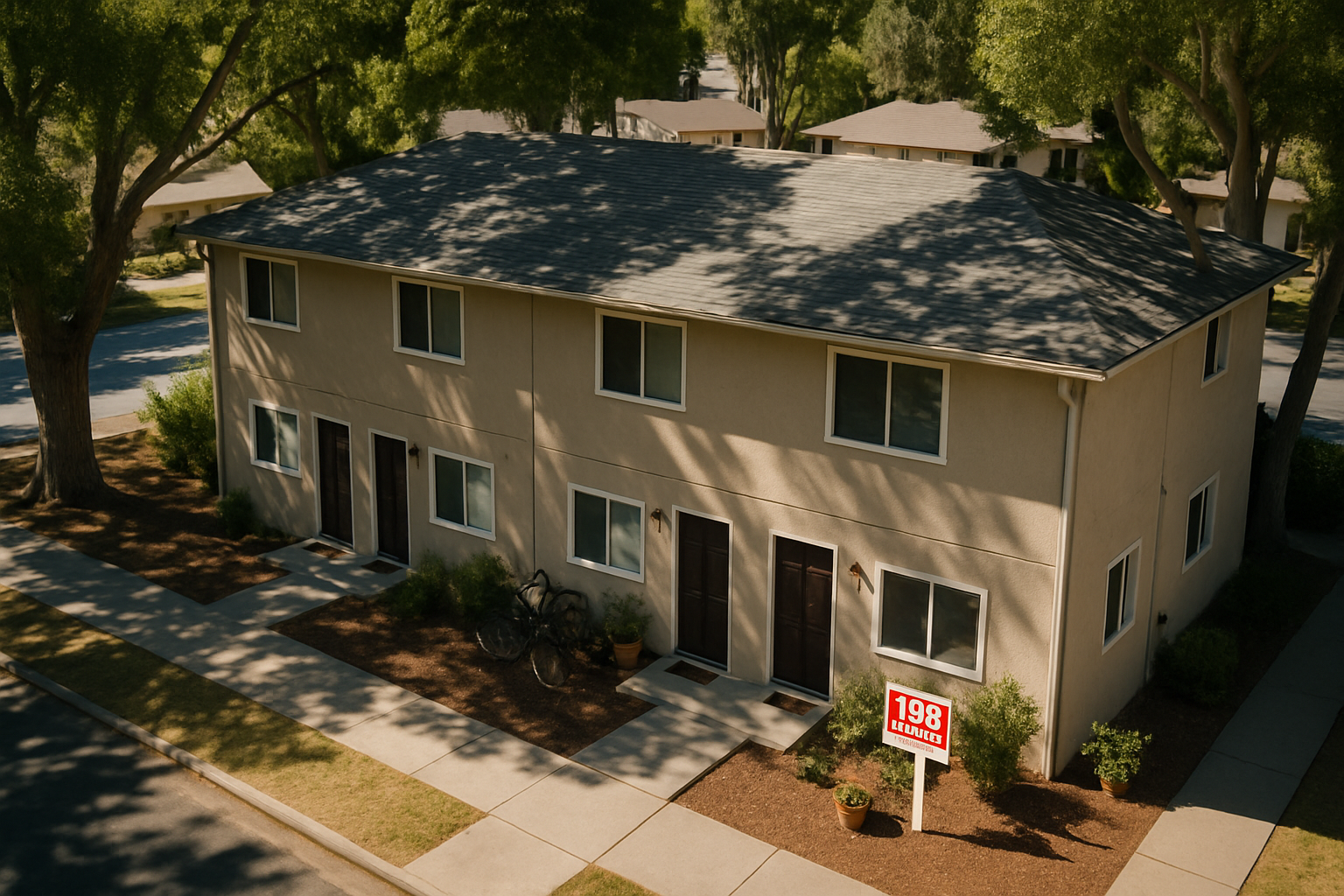
The Tipping Point Most Owners Hit Around Four Units
A single-family rental has one lease renewal date. One maintenance relationship. One set of utility bills. When something breaks, you call one contractor and you’re done.
Add three more units to that building and none of that math holds anymore. Lease renewals happen on different dates. Maintenance requests stack up across units, often at the same time. If one tenant is late on rent, the other three still need their rent collected and their requests answered. The building doesn’t pause because one unit has a problem.
I’ve seen this described clearly by owners who reach out to us: someone managing four to six units in Salinas who says they are approaching the point where the volume of coordination is genuinely getting away from them. It’s not laziness — it’s physics. The administrative load of four units isn’t four times the load of one. It’s more like eight times, because everything overlaps.
For a deeper look at where that workload actually comes from, The Hidden Workload Behind Managing a Single Rental Home breaks it down unit by unit — and the math gets significantly less comfortable once you multiply it.
The specific situations that tend to push owners past the tipping point:
- Multiple lease end dates that don’t align, forcing ongoing turnover management year-round
- Overlapping maintenance requests from different tenants hitting the same week
- One vacant unit while the rest of the building keeps running — rent still needs collecting, inspections still need to happen
- Compliance deadlines — notice periods, annual inspections, registration renewals — that are easy to miss when you’re managing on a spreadsheet
We recently heard from an owner with a fully remodeled, vacant four-unit building in Salinas. On paper that sounds like an ideal situation — move-in ready units, no current tenant complications. In practice, it meant pricing all four units competitively at the same time, sequencing showings efficiently so units weren’t sitting empty for weeks while applications processed, and getting four leases signed on a coordinated timeline. That’s a job, not an errand.
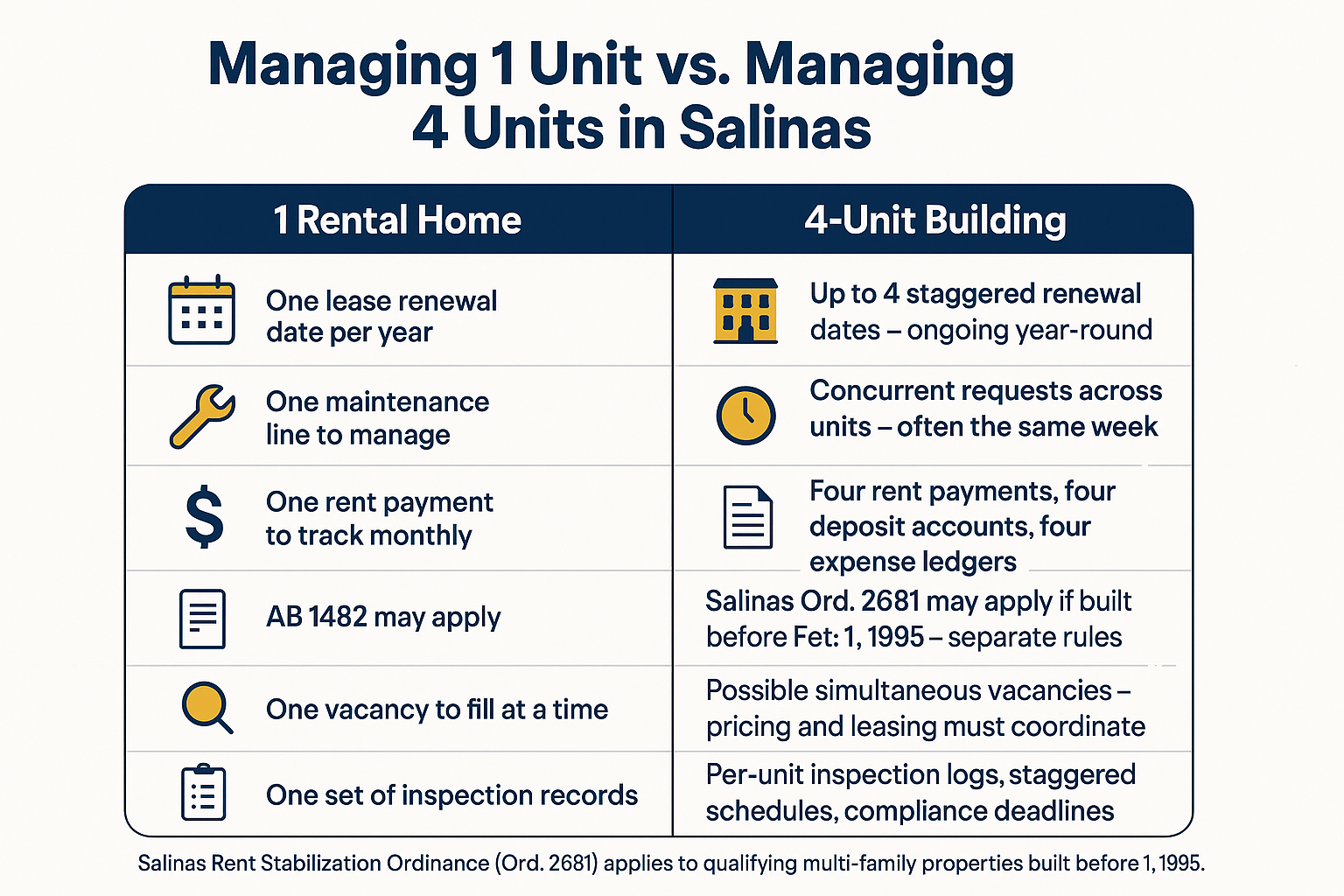
Single-Family vs. Multi-Unit: What Actually Changes
This comparison shows the management demands that shift — and multiply — when an owner moves from one rental home to a four-unit property in Salinas.
Why Financial Reporting Gets Messy Fast
This is the area where I see the most self-managing multi-unit owners get into trouble — not with tenants, not with compliance, but with their own books.
When you have one rental, it’s not hard to track income and expenses. One checking account, one deposit, one repair invoice. But four units means four sets of maintenance invoices — and when a plumber fixes something in Unit 2 and you pay from a shared account, that expense needs to be attributed to the right unit for your taxes, your insurance claims, and your own understanding of which units are actually profitable.
Most self-managing owners I talk to are running this on spreadsheets. Some are running it on memory. Both approaches tend to break down somewhere between year one and year three, usually around tax time when the accountant starts asking questions.
Security deposit accounting is another place where this gets complicated. California law is specific about how deposits must be handled, itemized, and returned. When you have four units with staggered move-outs, keeping that straight without a dedicated system is harder than it sounds. One missed deadline or improperly itemized deduction can expose you to a claim for twice the deposit amount under California Civil Code.
Technology that consolidates financial reporting across multiple units — real-time owner portals, per-unit expense tracking, monthly consolidated statements — matters far more at the four-unit level than it does with a single home. It’s the difference between knowing how your portfolio is performing and guessing.
For a broader look at what that compliance picture looks like across a multi-unit portfolio, How Multi-Unit Owners in Monterey County Stay Legally Compliant covers the full scope.
Which Rules Typically Apply to Your Salinas Multi-Unit Property
The regulatory framework for a multi-unit property in Salinas depends on when it was built, how many units it has, and whether it falls under city or state jurisdiction. This table gives a general starting point — always verify with city staff or a licensed broker for your specific parcel.
| Property Type | Year Built | Framework That Likely Applies | Key Implication |
|---|---|---|---|
| Multi-family (2+ units) | Before Feb 1, 1995 | Salinas Rent Stabilization Ord. 2681 | 2.75% rent cap, local compliance rules |
| Multi-family (2+ units) | Feb 1, 1995 or later | AB 1482 (if not exempt) | 5% + CPI cap, just-cause eviction rules |
| Single-family home | Any | AB 1482 (if not owner-occupied) | State rules apply, no local ordinance overlay |
| All rentals in Salinas | Any | City Ord. 2663 (Rental Registration) | Annual registration required regardless of unit count |
| Pre-1978 construction | Before 1978 | Federal lead paint disclosure law | Written disclosure required before any lease |
What the Transition to Professional Management Actually Looks Like
A lot of owners I talk to have been managing their own properties for years and are weighing whether to hand that off. The hesitation is usually the same: they worry about losing visibility, losing control, or paying for a service that doesn’t actually change how the property runs.
What I’ve found is that the owners who wait the longest to make the transition are the ones who most clearly describe what they were missing. The ones who come to us with four or six units in Salinas aren’t usually complaining about one bad thing — they’re describing a slow accumulation of tasks that never quite got done on time, compliance details they weren’t sure about, and a sense that they were always one maintenance emergency away from a real problem.
The process of transitioning to a property manager is more straightforward than most owners expect. Switching to a Property Manager in Salinas: What the Process Actually Looks Like walks through exactly what happens — from the initial handoff of tenant records to how existing leases are handled mid-term.
For multi-unit owners specifically, that transition also means getting financial records consolidated, having per-unit inspections documented properly, and establishing a maintenance coordination system that doesn’t run through the owner’s personal cell phone. Those aren’t small things. But they’re also not complicated once the right systems are in place.
Frequently Asked Questions About Multi-Unit Property Management in Salinas
Does the Salinas Rent Stabilization Ordinance apply to my four-unit building?
It depends on when your building was built. Salinas Ord. 2681 generally applies to multi-family dwellings built before February 1, 1995. If your building meets that threshold, the city’s 2.75% rent cap and local compliance rules apply — not just AB 1482’s statewide framework. The distinction matters significantly for how and when you can raise rents. Check your property’s build date and confirm with Salinas city staff or a licensed local broker before assuming which rules govern you.
I have four vacant remodeled units. Can I just price them all the same and list them at once?
You can, but it’s usually not the right approach. Units in the same building often appeal to slightly different tenant profiles depending on floor level, exposure, or layout. Pricing all four identically without a market analysis risks leaving money on the table or extending vacancy. Sequencing showings also matters — running four simultaneous applications creates a bottleneck, while a staggered approach lets you move efficiently from application to lease to move-in without units sitting empty mid-process.
How should I track maintenance expenses across multiple units for taxes?
Each unit should have its own expense ledger — separate from the others and from any building-wide shared costs. When a repair affects one unit specifically, it gets attributed there. When it affects the whole building (roof, common area, shared systems), it gets recorded as a property-wide expense. Most self-managing owners running spreadsheets blur this line over time, which creates real problems at tax time. A dedicated owner portal that logs expenses by unit automatically is significantly more reliable than manual tracking.
What is the Salinas Residential Rental Registration Ordinance and does it apply to multi-unit properties?
City Ord. 2663, which took effect in 2024, requires rental property owners in Salinas to register their units with the city. This applies regardless of property type or unit count — single-family and multi-unit owners alike are subject to it. Failure to register can affect your ability to collect rent and expose you to fines. For more on how 2024 and 2025 law changes affect Salinas owners, What New California Landlord Laws Mean for Monterey County Owners in 2026 covers the details.
At what point does it make financial sense to hire a property manager for a multi-unit building?
There’s no universal answer, but the math tends to shift meaningfully around three to four units. Below that, a disciplined owner can often absorb the coordination themselves. Above it, the time cost of self-management — handling maintenance calls, processing applications, tracking compliance deadlines, reconciling financials — starts to exceed the management fee in real hours, even before you account for the liability exposure of doing any of it wrong. Most owners who reach that point describe it less as a financial calculation and more as a clarity about how they want to spend their time.
Thinking About How Your Portfolio Is Actually Running?
If you’re managing multiple units in Salinas and starting to feel that tipping point, we’re familiar with exactly what that looks like. Coast & Valley Properties works with multi-unit owners across Monterey County — from Salinas and Carmel to South County — and we’re happy to talk through what professional management would mean for your specific situation. You can reach us at (831) 757-1270 or through the contact form at coastandvalleypm.com.