Tenant Placement vs. Full Management: Which One Fits Where You Are
Most owners who reach out to us are not asking which company to hire. They are asking a simpler question: how much of this do I actually want to hand off?
One homeowner in Salinas told us they were moving out of state in a few months and wanted a rent estimate. Another owner with a condo in Soledad just wanted to know "how to go about it." Those two people need very different arrangements, even though they filled out the same form.
So let me lay out the real difference between a tenant placement only service vs full management in California, what each one leaves on your plate, and how Monterey County's local rules push that decision one way or the other.
What tenant placement only actually covers
Tenant placement, sometimes called leasing-only service, is front-loaded work. A manager markets the home, shows it, screens applicants, negotiates and signs the lease, then hands the property back to you.
Here is what that typically includes on our side:
- Consultation and a rent recommendation based on current local comps
- Marketing and advertising the listing
- Unlimited showings
- In-house screening: credit, rental history, employment verification
- Owner review of applications before any decision is made
- Lease execution and negotiation
- Move-in evaluation with photos
- Collection of the security deposit and first month's rent
- The original document package handed over to you
After that, you own the day-to-day. Rent collection, the 11 p.m. water heater call, annual inspections, notices, rent increase math, deposit accounting at move-out. All of it.
Placement works well for a specific kind of owner. You live nearby, you have time during business hours, and you already know how California's tenant screening rules and habitability standards work in practice.
One thing owners often miss: the legal obligations do not soften just because a professional wrote the lease. Just cause eviction protections, habitability duties, and notice requirements apply to you as the landlord from day one forward.

What full management picks up that placement does not
Full management includes everything in placement, then keeps going for as long as you own the property. That ongoing piece is where the real workload lives.
On our full management side, that means:
- Monthly rent collection and all resident communication
- Maintenance coordination and supervision of the work
- 24/7 emergency availability
- Annual property inspections and an annual market analysis
- Financial reporting through a secure owner portal
- Bill payment, including mortgage, utilities, insurance, and property taxes
- Compliance monitoring as California rules change
That last item is the one owners underestimate most. Our region has layers of rules that a self-managing owner has to track alone.
AB 1482, the Tenant Protection Act, caps annual rent increases for covered properties and requires just cause for most terminations. You can read the full bill text on the California Legislature's site, though applying it correctly to a specific property is the harder part.
The City of Salinas Residential Rental Registration Ordinance (City Ord. 2663, adopted 2024) adds a registration obligation on top of state law. Miss a deadline while you are living in Boise, and you may not find out until it becomes a problem.
Our first year is an annual contract, then it moves to month-to-month. We also cover what full-service management includes and what it does not in more detail elsewhere, because the term gets used loosely across the industry.
Side by side: placement versus full management
This is the clearest way I can show where the work sits after the lease is signed.
| Responsibility | Tenant Placement Only | Full Management |
|---|---|---|
| Marketing and showings | Manager | Manager |
| Credit and background screening | Manager | Manager |
| Lease negotiation and signing | Manager | Manager |
| Move-in evaluation with photos | Manager | Manager |
| Monthly rent collection | Owner | Manager |
| Maintenance calls and vendor coordination | Owner | Manager |
| After-hours emergencies | Owner | Manager (24/7) |
| Annual inspections | Owner | Manager |
| Rent increase notices and AB 1482 caps | Owner | Manager |
| Salinas rental registration tracking | Owner | Manager |
| Financial reporting and 1099 records | Owner | Manager |
| Bill payment (mortgage, utilities, taxes) | Owner | Available |
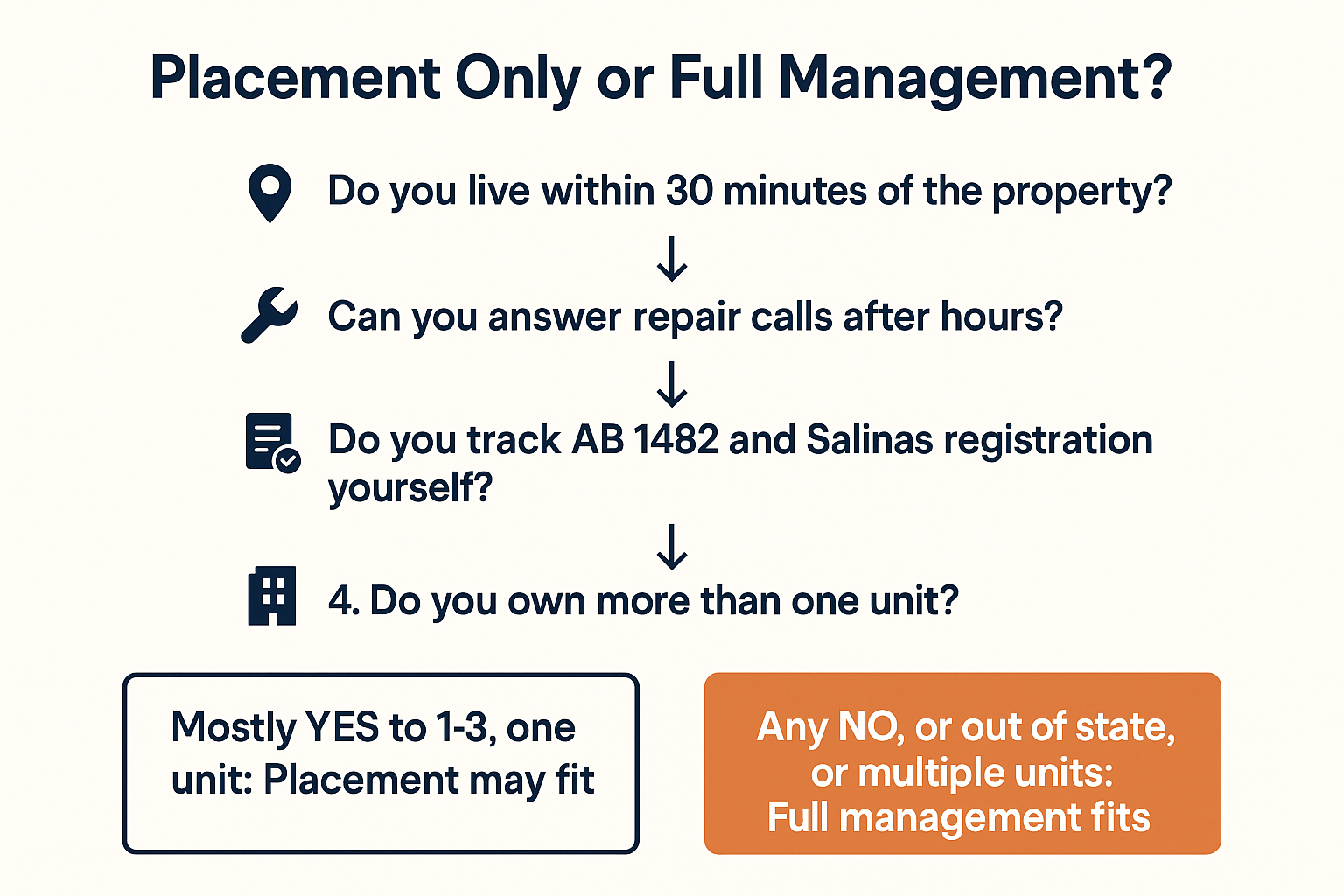
A quick way to sort yourself into the right service
Four questions get most owners to an answer in about a minute.
The two situations that decide it for most owners
In practice, two facts settle this more than anything else: where you live and how many doors you own.
An owner leaving California is almost always a full management situation. Distance turns small problems into expensive ones. A slow leak that a local owner catches on a Saturday drive-by becomes a subfloor replacement when nobody looks at the property for eight months.
Multiple units push the same direction. We hear from owners across Salinas who tell us that as their portfolio grew, handling everything themselves became too demanding. Four units means four lease dates, four rent increase calculations, four sets of inspection notices.
Small multi-unit buildings carry their own layer of rules too. I wrote separately about where compliance gets complicated on small Salinas apartment buildings, and that piece exists because the questions kept repeating.
Placement makes real sense in narrower cases. A retiree in Pacific Grove renting out a single home three blocks away, who is comfortable with notices and has a plumber they trust, may only need help finding the right resident.
On pricing, I will be straight with you: we do not publish fee amounts, because the right structure depends on property type, unit count, and which services you actually need. Placement is generally structured differently from ongoing monthly management. A conversation and a walkthrough get you a real number instead of a guess.
The hybrid question nobody asks until month six
Here is the scenario I see repeat. An owner uses placement, feels good about it, and then six months later the maintenance calls and the rent follow-ups wear them down.
They want to switch to full management. Whether that is simple depends entirely on the agreement they signed.
Ask before you sign:
- Can placement convert to full management mid-tenancy?
- Does converting require a brand new contract or an addendum?
- Is any portion of the placement fee credited?
- Who holds the security deposit after the switch?
- Does the manager inherit the existing lease as written?
With us, an owner can add residential management after a placement. Some firms require you to start over from scratch, which is worth knowing on day one rather than month six.
This is also why I tell owners to actually read what a management agreement says before signing anything. Termination terms, maintenance approval limits, and conversion language matter more than the headline fee.
Frequently Asked Questions About Placement vs. Full Management
If I use tenant placement only, am I still on the hook for California compliance?
Yes. You are the landlord. Habitability duties, just cause requirements under AB 1482 where it applies, lead paint disclosure on pre-1978 homes, and Salinas rental registration all remain your responsibility once the manager hands the property back.
I'm moving out of state in a few months. Is placement ever enough?
Rarely, in my experience. Someone local needs the authority to approve a repair, meet a vendor, and respond at 2 a.m. Distance is the single strongest argument for full management.
Do you manage short-term or vacation rentals?
No. We handle long-term residential and commercial management only. Monterey County's Short-Term Rental Ordinance took effect in October 2024, and short-term operation sits outside what we do.
How much rent should I expect for my property?
That comes from a walkthrough, not a formula. A licensed agent visits the property for a 45 minute to one hour meeting, walks it, reviews condition and amenities, and gives you a rent range plus any upgrades worth making first.
Does placement include a guarantee if the tenant does not work out?
Screening reduces risk, it does not remove it. What matters more is the depth of the screening itself, credit, rental history, and employment verification, plus a documented move-in evaluation with photos so there is a clear record from day one.
Still deciding which structure fits your property?
If you own a rental in Salinas, Monterey, Carmel, Pacific Grove, or anywhere across Monterey County, the honest answer usually comes out of a walkthrough and a conversation about your situation. Coast & Valley Properties handles both leasing-only placements and ongoing residential and commercial management, and we are happy to talk through which one matches where you are right now. You can reach our office at (831) 757-1270 or through the contact form at coastandvalleypm.com.

California's Security Deposit Rules Changed in 2026. Here's What Shifted.
Security deposit disputes have always been one of the most common friction points between landlords and tenants in California. And for owners in Monterey County, that friction just got sharper. Assembly Bill 414, which took effect January 1, 2026, rewrites the expectations around move-out documentation in ways that catch a lot of self-managing owners off guard.
The core shift is this: documenting property condition is no longer a best practice, it's the legal framework your deductions now have to stand on. If you can't back a charge with dated, specific photographic evidence from both ends of the tenancy, defending that deduction in a dispute becomes significantly harder.
I want to walk through what actually changed, what it means in practice, and where owners are most exposed right now, particularly those managing properties in Salinas, Carmel, Pacific Grove, or anywhere else in the county without a formal inspection process.
What AB 414 Actually Requires
Under AB 414, California landlords are now expected to have before-and-after photos that directly support any deduction taken from a security deposit. This isn't a vague recommendation. It's the evidentiary standard the law expects you to meet if a dispute goes to small claims court or escalates further.
The law also tightens the timeline and documentation requirements for returning deposits or providing itemized deductions. California already required landlords to return a deposit or deliver an itemized statement within 21 days of move-out. AB 414 builds on that by making the quality of your documentation a factor in how courts evaluate those deductions.
What that means practically:
- Itemized deductions need to be supported by dated photographs that tie directly to the charge
- Generic claims like "cleaning" or "paint touch-up" without visual evidence from move-in and move-out are easier for a tenant to dispute
- Handwritten walk-through notes or verbal agreements at move-out no longer carry the weight they once might have
A dispute that was a gray area before 2026 is cleaner to litigate now. And without a proper documentation record, owners lose.
For more context on the broader set of California law changes affecting Monterey County landlords this year, see our breakdown of what new California landlord laws mean for Monterey County owners in 2026.

The Kinds of Disputes This Law Was Designed to Address
I've seen this play out in reviews and owner conversations more times than I can count. Tenants describe deductions for paint touch-ups that ran several hundred dollars, charges for cleaning a fireplace that was never used, fees for items that were documented as damaged or worn in the original move-in photos. Under the old framework, those disputes were messy and often settled on whoever had better records or more patience.
Under AB 414, the owner's photographic record from move-in either supports the deduction or it doesn't. If you charged for paint damage but your move-in photos show the wall was already scuffed, you've handed a tenant everything they need in small claims court.
This is the part of the law that matters most for owners who've been doing informal walk-throughs, jotting a few notes, maybe taking some phone photos without a systematic process. That approach created liability before 2026. It creates even more exposure now.
The California Courts Self-Help Center is a resource tenants increasingly use to understand their rights around deposit disputes, which tells you something about the environment owners are operating in.
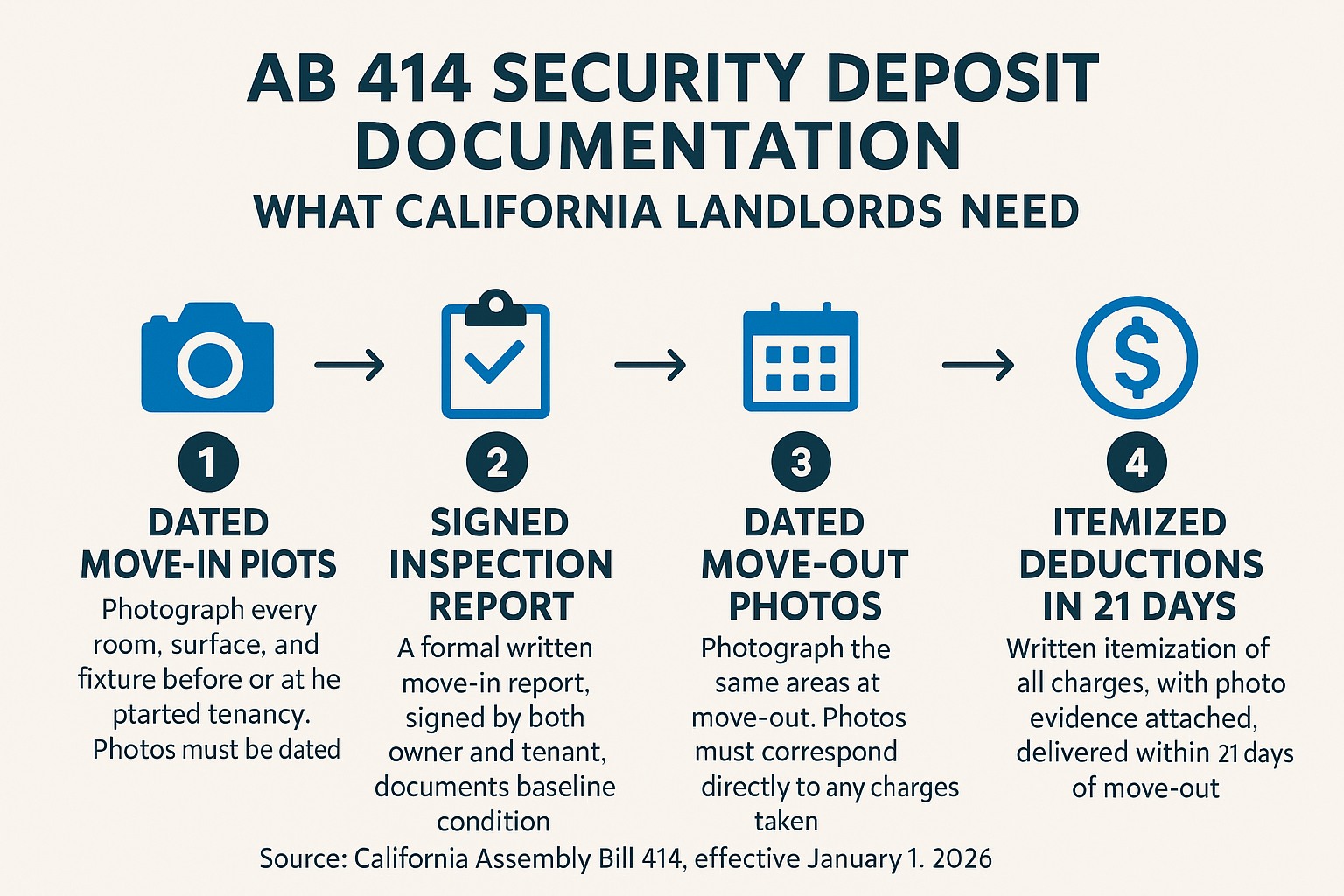
The AB 414 Documentation Standard at a Glance
This infographic walks through the four documentation requirements California landlords now need to meet under AB 414 to protect deposit deductions.
Before and After AB 414: What Changed for Landlords
This table shows the practical difference in what California landlords were expected to do before and after AB 414 took effect.
| Documentation Area | Before AB 414 | After AB 414 (Jan 1, 2026) |
|---|---|---|
| Move-in photos | Strongly recommended, not required | Expected to support any deduction taken |
| Move-out photos | Optional for most owners | Must tie directly to specific itemized charges |
| Inspection report format | Handwritten notes were common | Formal, dated reports carry far more legal weight |
| Itemized deductions | Required within 21 days | Required within 21 days, now more scrutinized in disputes |
| Burden in disputes | Often split or ambiguous | Owner without photo evidence is at a clear disadvantage |
The Problem With Properties Already Under Lease
Here's the part that doesn't get enough attention: AB 414 doesn't only matter for your next lease-up. It matters for tenants currently in place.
If you have a long-term tenant, someone who's been in your Salinas or Pacific Grove property for four or five years, there's a real chance the move-in documentation from that tenancy doesn't meet the standard the law now expects. The photos may not exist at all, or they may be undated snapshots that don't correspond to a formal inspection report.
When that tenancy ends, you'll be in a deposit dispute with documentation that was assembled before 2026 under looser expectations. That's a gap worth closing before the lease terminates.
The right moment to reset the inspection process is the next lease renewal or lease-up cycle. Use that transition to establish a new baseline with dated photos and a signed inspection report. You can't retroactively improve move-in documentation, but you can make sure the move-out side is thorough.
Owners considering whether this complexity is worth managing alone might find our piece on when self-managing a Salinas rental stops making sense worth reading, it covers exactly this kind of compounding regulatory burden.
What a Proper Inspection Process Actually Looks Like
A move-in inspection that holds up under AB 414 isn't complicated, but it does need to be systematic. Here's what that looks like in practice:
- Photograph every room at move-in, including ceilings, floors, walls, windows, and fixtures
- Date-stamp all photos, cloud storage with automatic metadata works, as does any photo system that records a timestamp
- Document existing damage in writing and have the tenant sign the inspection report before they take possession
- Repeat the same scope at move-out, photographing the same areas so deductions can be directly tied to a comparison
- Keep records for the full term plus the time period during which a dispute could be filed
The inspection itself should happen with enough time before move-in and move-out that photos can't be questioned as staged or selective. And the written report needs to be specific, not "good condition" but an actual description of the baseline.
For owners managing multi-unit properties in Salinas, doing this consistently across every unit adds up fast. That's where the difference between an informal system and a documented process starts showing up in your exposure.
We conduct formal move-in and move-out inspections with photos as part of the standard management process for every property we oversee. It's not something we do because it's legally required now, we've been doing it this way because it protects owners. AB 414 just made it clearer why that matters.
Frequently Asked Questions About California's Updated Security Deposit Rules
Does AB 414 change how much a landlord can charge for a security deposit?
No. AB 414 focuses on documentation and accounting requirements at the end of a tenancy, not on deposit amounts. California already capped security deposits at one month's rent for unfurnished units under AB 12, which took effect in 2024. AB 414 deals with how you handle the deposit when the tenant moves out.
If my tenant has been in place for years and I have no move-in photos, what can I do now?
You can't go back and create move-in documentation that doesn't exist. What you can do is be very thorough at move-out, photograph everything, document what's normal wear and tear versus actual damage, and be conservative about which deductions you pursue. Without move-in photos to establish baseline condition, any deduction for wear-type damage will be difficult to defend. The next tenancy is the time to start fresh with a proper inspection process from day one.
What counts as normal wear and tear versus damage under California law?
California law distinguishes between normal wear and tear, which a landlord cannot charge for, and actual damage caused by the tenant. Normal wear and tear includes things like minor scuffs on walls, carpet wear from regular use, and small nail holes. Damage includes stains, broken fixtures, unauthorized alterations, and anything beyond what reasonable use would cause. The tricky part is that this line is often argued in small claims court, which is exactly why dated before-and-after photos matter so much under AB 414, they let a judge see the baseline.
Does the 21-day rule for returning deposits change under AB 414?
The 21-day deadline to return the deposit or deliver a written itemized statement remains the same. What AB 414 changes is the evidentiary standard behind those itemized deductions. Courts now expect that any charge you list can be backed by photographic documentation from both move-in and move-out.
Does this apply to commercial properties as well?
AB 414 applies to residential tenancies. Commercial leases are governed by different rules and typically handled through the lease terms negotiated between the parties. If you own commercial property in Monterey County, the deposit and move-out process will be dictated largely by your lease agreement rather than this statute.
Want to Know If Your Current Inspection Process Holds Up?
If you own rental property in Monterey County and you're not sure whether your move-in and move-out documentation meets the standard AB 414 now expects, that's worth a conversation before your next tenant transition. Coast & Valley Properties handles formal property inspections with photo documentation as part of full-service residential management across Salinas, Carmel, Pacific Grove, and the surrounding area. You can reach us at (831) 757-1270 or through the contact form at coastandvalleypm.com.

Owning a Rental in Salinas Valley's South County: What Owners Should Know
When most people picture Monterey County rental property, they picture Carmel, Pacific Grove, or downtown Monterey. But the Salinas Valley runs well south of the city of Salinas, and owners in Gonzales, Soledad, Greenfield, and King City are managing a genuinely different market.
I've worked with owners across this corridor, and the honest truth is that South County is one of the most underserved rental markets in the county when it comes to professional management. The properties are real, the compliance obligations are real, and the risks are real. What's thin is the local expertise.
This article focuses on three things that matter most for South County owners: how the rental market actually works down here, what California compliance requires regardless of your city or zip code, and what vendor access actually looks like the further south you go.
The South County Rental Market Is Not the Peninsula
Owners who set rent in Gonzales or Soledad the same way they would in Pacific Grove are working with the wrong mental model. The dynamics are different, and pricing mistakes in either direction are costly.
The typical rental stock in South County runs toward smaller single-family homes and modest multi-unit buildings, not the larger estates or renovated Victorians you find closer to the coast. Tenant demand in these communities draws heavily from agricultural and food-processing employment, which has real seasonal patterns. That is different from seasonal vacation demand on the Peninsula, and it affects turnover in ways that surprise owners who are new to the area.
Proximity to Highway 101 and the Salinas job market also shapes demand. Many tenants in Gonzales or Greenfield are working families who commute north, and that commute distance is a factor in how long they stay and what they will pay. An owner who doesn't understand these local forces will either price above the market and sit vacant, or price below it and lock in a below-market rent for the life of the tenancy.
We had two separate owners reach out from Gonzales within a few months of each other. One was nearly finished rehabbing a property and wanted someone to assess it before listing. The other had a family member who had already brought us on for a nearby rental and wanted the same. That kind of referral pattern within a small community tells you something important: in South County, local reputation travels fast, and there is far less noise from a crowded field of property managers competing for your attention.

AB 1482 Applies Here Too, Even Outside Salinas City Limits
One of the most common misconceptions I run into with South County owners is the idea that because they are outside the City of Salinas, they are outside the local compliance picture. That is partially true and mostly misleading.
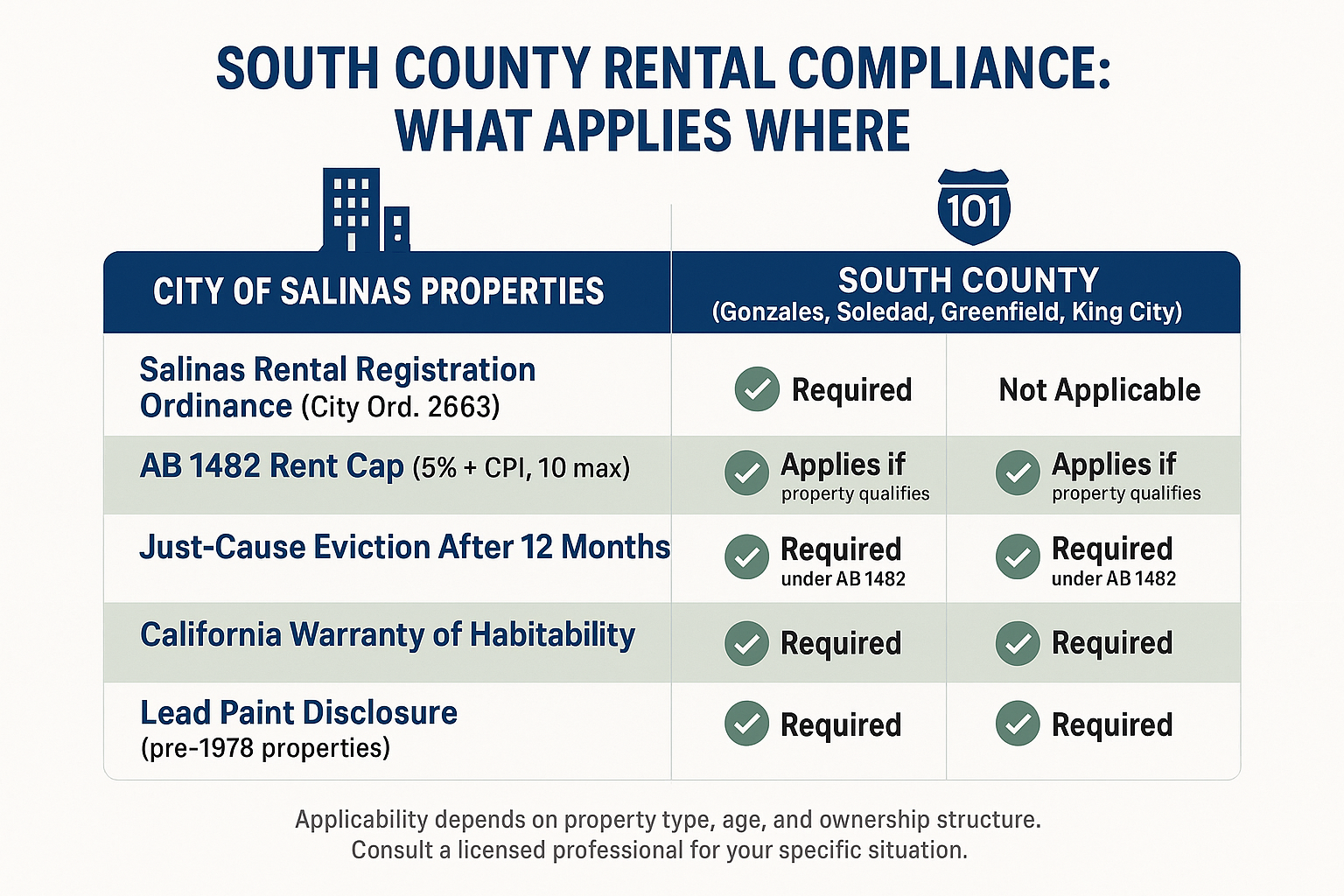
Properties in unincorporated Monterey County or in incorporated cities like Gonzales, Soledad, Greenfield, or King City are outside the Salinas Residential Rental Registration Ordinance (City Ord. 2663, 2024). That specific registration requirement does not follow you south. But California's AB 1482 Tenant Protection Act does, and it applies based on property type and age, not city boundaries.
Under AB 1482, if your property qualifies:
- Annual rent increases are capped at 5% plus local CPI, with a 10% maximum
- After 12 months of tenancy, you must have just-cause grounds to end the tenancy
- Certain exemptions apply, including single-family homes where the owner has provided proper written notice, and properties built within the last 15 years
An owner who has not confirmed whether their South County property is covered, and who is calculating allowable rent increases on a gut feeling, is carrying legal exposure that is straightforward to avoid with the right oversight. You can review the California Legislature's official AB 1482 guidance to understand the statutory language, but applying it correctly to a specific property is a different matter.
Beyond AB 1482, California's warranty of habitability applies everywhere in the state. That means functional heating, weatherproof structure, working plumbing, and adequate security, the same standards as any Monterey Peninsula property. Location does not create exceptions to habitability law.
And if your South County property was built before 1978, federal lead paint disclosure requirements apply at lease signing. That obligation does not care what county you are in.
South County Compliance Snapshot: What Applies Where
This reference shows which regulatory requirements apply to rental properties in South County Salinas Valley communities versus properties inside the City of Salinas.
South County at a Glance: Market Factors by City
These are the key demand factors and practical considerations I think about when advising owners in each South County community.
| City | Primary Tenant Demand Drivers | Key Owner Consideration |
|---|---|---|
| Gonzales | Agricultural employment, Highway 101 commuters | Referral-driven rental market; limited manager competition |
| Soledad | Food processing, corrections industry, working families | Tenant pool is stable but sensitive to employment cycles |
| Greenfield | Agriculture, proximity to King City and Salinas | Smaller rental stock; pricing precision matters more here |
| King City | South Salinas Valley ag employment, service sector | Vendor access is most constrained here; distance adds cost |
The Vendor Problem No One Talks About
Of all the challenges I hear from South County owners, the one that catches people off guard most often is vendor access. And it is a genuinely different problem than what owners closer to Salinas or Monterey face.
A broken water heater in King City requires a plumber who will actually drive to King City, has a reasonable service window, and charges a rate that reflects the work rather than the distance. Owners managing these properties remotely, and that is very common in South County, where owners may live in the Bay Area or elsewhere in California, often end up in emergency situations paying premium rates to whoever is available.
The same problem applies to HVAC and landscaping. The further south you go along the valley, the thinner the contractor pool gets. A property manager with existing vendor relationships in the South County corridor is not a convenience, it is a practical protection against the kind of emergency repair bill that erases months of rental income in a single call.
This is part of why what makes a property manager truly local matters so much more in markets like Gonzales or Soledad than it does in a denser urban market. National or regional firms with no presence south of Salinas are not going to have a vetted plumber on call for King City. A locally rooted firm that has leased and managed properties in this corridor will.
For owners who are also weighing whether to keep managing on their own, the vendor coordination burden is often the deciding factor. When self-managing stops making sense is a question worth sitting with honestly if you are handling South County maintenance calls from two hours away.
Frequently Asked Questions About South County Rental Ownership
Does the Salinas Residential Rental Registration Ordinance apply to my property in Gonzales or Soledad?
No. The Salinas Residential Rental Registration Ordinance (City Ord. 2663, 2024) applies only to properties within the City of Salinas. If your rental is in Gonzales, Soledad, Greenfield, or King City, that specific registration requirement does not apply. But AB 1482 and California habitability standards still do, depending on your property type and age.
How do I know if my South County rental is covered by AB 1482?
AB 1482 covers most residential rental properties in California that are more than 15 years old and not specifically exempted. Single-family homes and condos may be exempt if the owner has provided the required written notice in the lease. The best way to confirm coverage for your specific property is to speak with a licensed property manager or real estate attorney familiar with California landlord-tenant law.
Tenant turnover seems higher in my Gonzales rental than I expected. Is that normal?
It can be. Tenant demand in South County communities like Gonzales is tied in part to agricultural and food-processing employment cycles, which are seasonal. That is structurally different from the Peninsula, where tenant turnover is driven by different forces. Understanding those local patterns helps with rent pricing, lease timing, and how you market the property between tenancies.
Why is it so hard to find vendors willing to service my rental in King City?
Distance is the main factor. Many licensed contractors based in Salinas or Monterey charge travel premiums or limit their service radius, which effectively excludes King City and parts of South County. Owners who have not built relationships with vendors already working in that corridor end up paying emergency rates or waiting longer for service. An established local property management firm with South County vendor relationships resolves this before a repair turns into a crisis.
I'm thinking about hiring a property manager for my South County rental. What should I look for?
The most important thing is whether they have actually managed properties in your specific community, not just in Salinas or Monterey. Ask whether they have existing vendor relationships in the South County corridor, how they handle after-hours emergencies for properties at that distance, and what their experience is with AB 1482 compliance for properties in smaller agricultural communities. A firm that cannot answer those questions specifically probably does not have meaningful South County experience. What a property management agreement actually says is also worth reviewing before you sign anything.
Have Questions About Your South County Rental?
We work with property owners throughout the Salinas Valley corridor, including Gonzales, Soledad, Greenfield, and King City, and we understand the market conditions and compliance picture specific to these communities. If you own a rental in South County and want to talk through your situation, Coast & Valley Properties is reachable at (831) 757-1270 or through the contact form at coastandvalleypm.com.
Your Monterey County Property Was an Airbnb. Now What?
We've heard from a number of property owners in the past year asking a version of the same question: what do I do now that the short-term rental landscape in Monterey County has shifted? Some reached out after the county's inland ordinance took effect in October 2024. Others contacted us after the Board of Supervisors voted in January 2026 to move toward banning STRs in residential zones, a vote that passed 3 to 2 before the Planning Commission later rejected the broader ban. Either way, the regulatory environment for vacation rentals in unincorporated Monterey County is no longer stable, and owners are looking at their options.
One inquiry that stuck with me came from an owner who included a link to her Airbnb listing when she asked about long-term management. She wanted to know her unfurnished rent rate, but she was still thinking about her property through the lens of nightly guests and cleaning turnover. That framing is completely understandable, but it's also where a lot of owners run into trouble when they start this transition.
Turning a former Airbnb into a long-term residential rental in Monterey County involves three things most owners underestimate: getting the property ready, pricing it correctly for the residential market, and understanding that California tenant law operates nothing like short-term rental management. I want to walk through each of those honestly.
What the Property Itself Needs Before a Tenant Moves In
A property that has been running as a vacation rental is set up for guests, not residents. That distinction matters more than it sounds.
Furnishings, linens, small kitchen appliances, and decorative items that worked fine for a three-night stay are not necessarily appropriate for someone moving in for 12 months or longer. Before a lease is signed, the owner needs to make a clear decision about what stays and what goes. A furnished long-term rental is a different product than an unfurnished one, and the rent rate reflects that difference.
Beyond furnishings, a property that has cycled through frequent short-term guests often has wear patterns that don't show up the same way in a property that's had one household living in it. Think about:
- High-traffic flooring in entryways and kitchens
- Interior paint that has absorbed more use than its age suggests
- Small appliances and fixtures that have been handled by dozens of different people
- Bedding, towels, and soft goods that need to be either removed or replaced to a residential standard
This is not a reason to panic, it's a reason to do a thorough walkthrough before listing. California's warranty of habitability applies from the first day of a residential tenancy. The property needs to meet that standard before anyone moves in, and it needs to stay there throughout the lease.
One practical note: if you are transitioning from furnished to unfurnished, storage or removal of furniture takes more planning than most owners expect, especially if the property is a larger home in Carmel or Pacific Grove where the furnishings themselves may be high value.
The Pricing Comparison Owners Get Wrong
Almost every owner making this transition asks the same pricing question: what will I get in monthly rent compared to what I was earning on Airbnb?
That is the wrong comparison. The right comparison is annualized net revenue, what the property actually produced after platform fees, cleaning costs between stays, vacancy, and the real time cost of managing constant turnover.
Vacation rentals price by the night, but they also carry vacancy baked into the economics. A property that books well in summer on the Monterey Peninsula can sit idle during slower months. A long-term residential tenant, by contrast, pays the same amount every month for 12 months or longer, and a well-screened tenant significantly reduces the chance of mid-lease problems.
For context on what the residential market looks like right now: the Salinas Valley was averaging around $2,006 per month as of early 2026, which runs roughly 23 percent above the national average according to publicly available rental market data. Coastal Peninsula communities, Monterey, Pacific Grove, Carmel, run meaningfully higher than that. But those are averages. The actual rent estimate for a specific property depends on size, condition, location within the county, whether it is furnished or unfurnished, and how the current market is moving in that submarket.
I'd be skeptical of any estimate that comes from a national average or an algorithm that doesn't account for the difference between a property near Cannery Row in Monterey and one in Gonzales. Those are different markets with different tenant pools, different demand patterns, and different seasonal dynamics. If you want a realistic number, it needs to come from someone who actually tracks both.
For owners thinking through the self-management question that often comes up at this stage, this breakdown of when self-managing a Salinas rental stops making sense is worth reading before you decide.
Short-Term Guest vs. Long-Term Tenant: Key Differences
The distinction between hosting a short-term guest and managing a residential tenancy affects almost every decision you make. Here is a side-by-side look at the most important differences for a Monterey County property owner.
| Category | Short-Term Guest (STR) | Long-Term Residential Tenant |
|---|---|---|
| Legal relationship | License agreement, no tenancy rights | Lease agreement, full California tenant rights from day one |
| Entry by owner | Owner can access anytime as host | 24-hour written notice required in most circumstances under California law |
| Pricing structure | Per night; vacancy is expected | Per month; stability over a 12+ month term |
| Eviction process | Guest overstay handled as trespass | Formal California unlawful detainer process required |
| AB 1482 coverage | Does not apply to STR guests | Applies to qualifying properties, limits rent increases and requires just cause after 12 months |
| Turnover cost | Cleaning and restocking after each stay | Typically once at end of tenancy, with security deposit accounting |
| Regulatory permits (Monterey County) | STR permit required; ongoing compliance uncertain | Standard residential lease; Salinas Rental Registration may apply |
California Tenant Law Is Not a Variation on the Airbnb Model
This is the part I want to be direct about, because it is where I see the most potential for serious problems.
When you host a short-term guest, that person has a license to occupy the property, not a tenancy. They have no eviction process to go through if something goes wrong. You can change the terms of their stay, decline to rebook them, or remove them from the platform without navigating California landlord-tenant law.
A long-term residential tenant is a completely different situation from the first day they move in. They have rights under California law that attach immediately and grow stronger over time. After 12 months of continuous occupancy, just-cause eviction protections apply regardless of whether the property is covered by AB 1482. And if the property does fall under AB 1482, which covers most residential properties in California built before 2005, subject to specific exemptions, rent increases are capped and owner entry rights are tightly regulated.
Owners who manage a long-term tenant the way they managed vacation guests, entering without proper notice, adjusting occupancy terms informally, or expecting easy turnover at the end of a lease, are going to encounter the California unlawful detainer process, and it moves slowly and at significant cost. Understanding how tenant screening works before placement is one of the best things you can do to reduce that risk from the start.
The California Courts' self-help landlord-tenant resources provide a plain-language overview of residential tenancy law if you want to understand the framework before making any decisions.
For owners transitioning from STR management in coastal communities specifically, the article on renting out a home in Pacific Grove covers some of the Peninsula-specific nuances worth knowing.
The STR-to-Long-Term Rental Transition: What to Tackle First
The transition from a vacation rental to a residential tenancy involves decisions in a specific order. This flow summarizes the key steps most Monterey County owners need to work through.
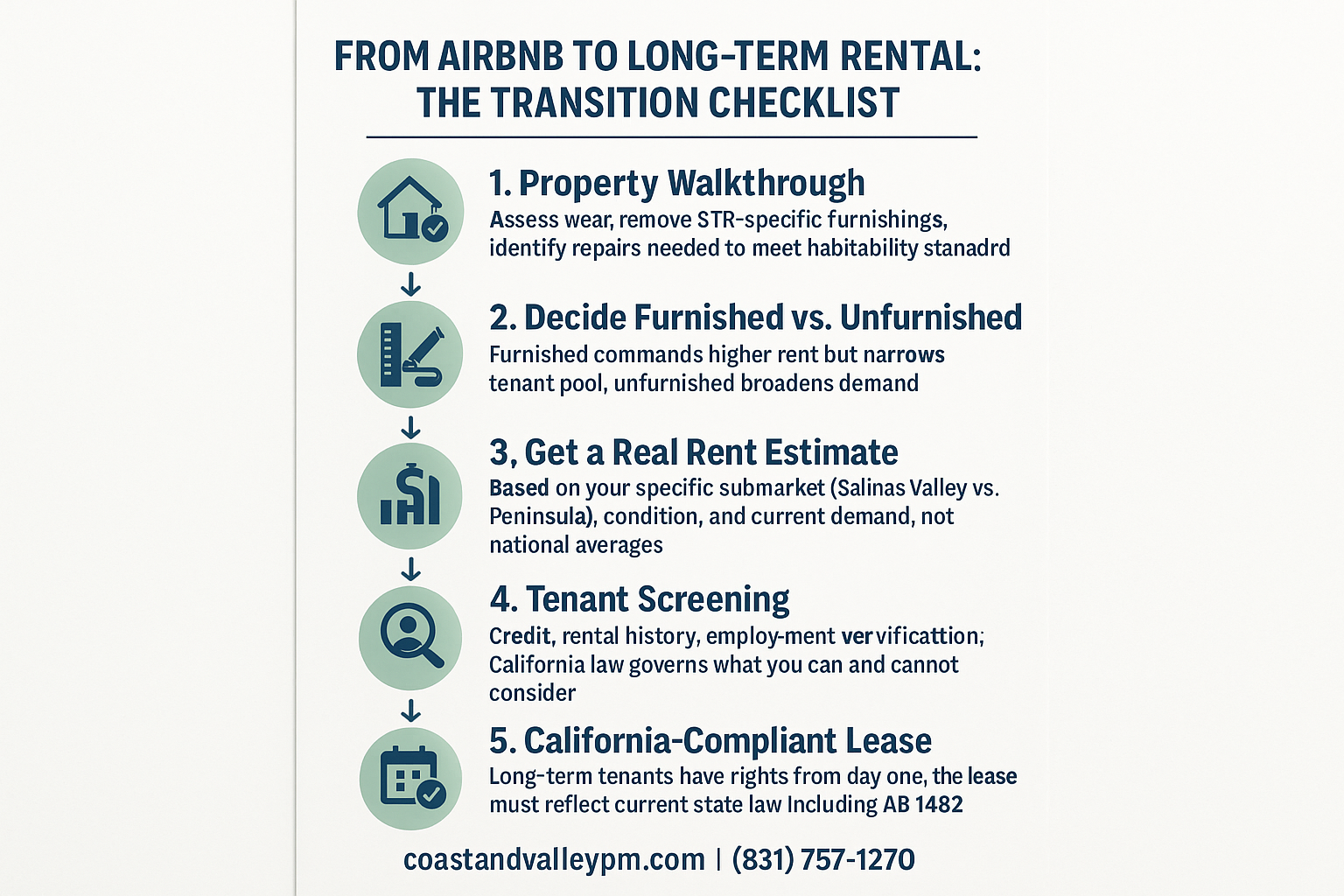
Frequently Asked Questions About Transitioning a Former STR to a Long-Term Rental
Can I still rent my property furnished as a long-term rental?
Yes, and in some submarkets it actually makes sense. Furnished long-term rentals tend to attract corporate relocations, traveling professionals, and similar tenants who are willing to pay a premium for a move-in-ready home. The tradeoff is a somewhat narrower tenant pool. The rent difference between furnished and unfurnished varies significantly by property and location, a furnished home in Monterey near the Naval Postgraduate School draws a very different tenant than the same setup in Salinas. Getting a realistic estimate for both scenarios before you decide is worth the time.
What happens to my STR permit now that I'm switching to long-term?
Once you are operating as a long-term residential rental, your STR permit is no longer relevant to the property's operation. But if your property is in the City of Salinas, check whether the Salinas Residential Rental Registration Ordinance (City Ord. 2663, 2024) applies, most residential rentals in the city need to be registered. Requirements vary by jurisdiction, so confirm with the relevant local authority for your specific address.
How do I know if my property is covered by AB 1482?
AB 1482 covers most California residential rental properties built before January 1, 2005, with some exceptions, including single-family homes where the owner has provided proper written notice, and certain condos. If your property is covered, rent increases are capped at 5% plus local CPI, and just-cause eviction requirements apply after 12 months of tenancy. If you are unsure whether your property is exempt, that question belongs in a conversation with a licensed California broker or attorney before you sign a lease.
What is the realistic rent I should expect compared to my Airbnb income?
The honest answer is: it depends on what your Airbnb income actually netted after platform fees, cleaning, vacancy, and your own time. Gross nightly rates look attractive until you annualize the real numbers. The Salinas Valley residential market averaged around $2,006 per month in early 2026. Peninsula markets run higher. But the more useful number is the estimate for your specific property in its specific condition, not a county-wide average. We provide those estimates as part of our consultation process.
Do I need to do anything special to the property before placing a long-term tenant?
At minimum, the property needs to meet California's warranty of habitability standard, working heat, plumbing, weatherproofing, functioning appliances if they are included in the lease, and no conditions that threaten health or safety. Beyond that baseline, a property coming out of STR use often needs a more careful walkthrough than a typical turnover, because short-term guest traffic creates wear patterns that are easy to miss. Doing that assessment before listing, not after a tenant is already in place, protects you and sets the tenancy up correctly.
Ready to Talk Through What Your Property Looks Like as a Long-Term Rental?
If you are an owner in Monterey County who has been running a vacation rental and is now weighing the transition, we are happy to have that conversation. Coast & Valley Properties manages long-term residential tenancies throughout the county, from Carmel and Pacific Grove to Salinas, Gonzales, and South County, and we can give you a realistic rent estimate and a clear picture of what the placement process actually involves for your specific property. Reach us at (831) 757-1270 or through the contact form at coastandvalleypm.com.

How Tenant Screening Works in California, and Where Owners Get It Wrong
Tenant quality is the single variable that most determines how a Monterey County rental performs over time. I've seen a well-screened tenant in a modest Salinas property cause far fewer problems than a poorly screened one in a high-value Pacific Grove home. The property itself matters less than who is living in it.
What surprises a lot of owners is that tenant screening in California isn't just a judgment call. It operates inside a legal framework that has specific requirements, and applying that framework inconsistently creates exposure that goes well beyond one bad tenancy. California's AB 2493, which took effect in 2024, added new obligations around application processing order and fee handling that many self-managing owners don't know exist.
This article walks through what a lawful, defensible screening process actually looks like, where the recurring mistakes happen, and why documentation at this stage protects you in every dispute that comes later. If you're managing a rental near CSUMB, Fort Ord, or in Pacific Grove where competition for good units can be intense, this process matters even more.
What California Law Actually Requires Before You Accept or Deny
Before I get into criteria, the process itself has a legal shape in California. Under AB 2493, landlords are required to process applications in the order they are received. That sounds simple, but it has real consequences.
If a qualified applicant applies first and you skip to a later one you prefer for reasons you can't document, you've created a problem. The first applicant may have legal recourse, and the reason you skipped them matters enormously from a fair housing standpoint.
The law also limits when you can retain an application fee. If you're not going to process an application because the unit is already rented, or because you've stopped accepting applications, you generally have to return the fee. Keeping it without processing is not allowed.
What this means practically:
- Timestamp every application the moment it comes in
- Process them in order, and keep a written record showing you did
- If you reject a qualified first applicant in favor of a later one, you need a documented, non-discriminatory reason on file
- Return fees promptly when an application is not processed
Owners managing high-demand rentals in Pacific Grove or near the Monterey Peninsula benefit most from having this locked down before a vacancy hits the market. Demand can move fast there, and the pressure to choose quickly is exactly when process discipline matters most.

What Consistent Screening Criteria Actually Look Like
Here is where I see owners get into the most trouble. They screen loosely, applying different standards to different applicants without realizing that inconsistency is its own legal risk, separate from AB 2493.
Fair housing law in California prohibits discrimination based on protected class status. If you set a credit score threshold of 650 for one applicant and waive it for another without a documented, non-discriminatory reason, you've opened a fair housing exposure. It doesn't matter if your intent was innocent. What matters is what the file shows.
The way to protect yourself is simple in concept, harder in practice: write your screening criteria down before you market the property, and apply them identically to every applicant.
A defensible set of criteria typically includes:
- Credit history, pick a minimum score and apply it consistently
- Income verification, the California standard is income of at least three times the monthly rent; ask for pay stubs, tax returns, or employer letters
- Background check, criminal history review within the limits California law allows
- Rental history, prior landlord references and payment track record
Each criterion needs to be applied the same way, every time. If an exception is made, it needs to be documented with a reason that has nothing to do with protected class status. This isn't just good practice. It's what protects you if a denied applicant files a complaint. For owners managing multiple units across Salinas, this kind of written policy is even more important because the volume of applications means inconsistency is harder to catch.
A Complete Screening File: What Every Application Should Include
A thorough move-in file is the foundation of every dispute that may arise later. This breakdown shows what belongs in it and why each piece matters.
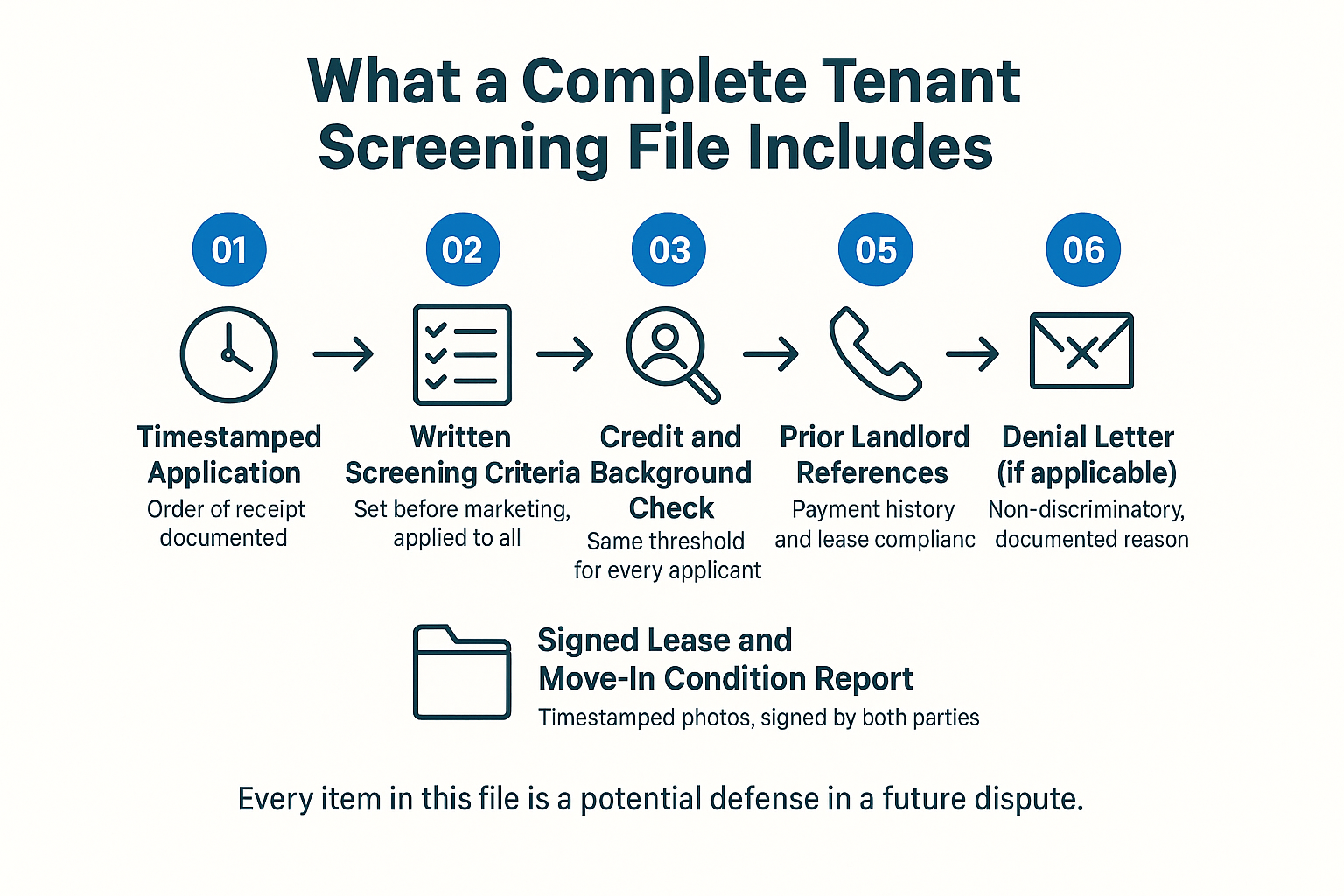
When the Applicant Is a Company, Not a Person
One question that comes up more than people might expect involves commercial leases with a residential component. We've heard from owners with properties used for employee housing, situations where the lease is signed by a business entity rather than an individual tenant.
This changes what verification looks like. The documents you'd ask for from a corporate tenant are not the same as what you'd ask for from an individual applicant.
For a corporate entity taking on a residential property for employee housing, a reasonable verification package generally includes:
- Financial statements from the business, typically two to three years
- Evidence of operating history, how long has the entity been active and in good standing
- Confirmation of signing authority, documentation that the person executing the lease actually has authority to bind the company
- A personal guarantee from a principal may also be appropriate, depending on the entity's size and financial history
This is a genuinely different situation from standard tenant screening, and it sits at the edge of where residential landlord-tenant law and commercial lease law overlap. For a deeper look at what California commercial landlord responsibilities look like in practice, this breakdown covers the owner side of that equation.
If you're navigating a lease structure like this, it's worth getting professional guidance before you execute anything.
Residential vs. Corporate Tenant: How Verification Differs
The documents you collect depend heavily on who is signing the lease. Here's a side-by-side look at what each situation typically calls for.
| Verification Item | Individual Residential Applicant | Corporate Entity (Employee Housing) |
|---|---|---|
| Credit check | Personal credit report | Business credit report or D&B |
| Income / financial proof | Pay stubs or tax returns (3x rent) | Business financial statements (2-3 yrs) |
| Identity confirmation | Government-issued ID | Entity formation documents / EIN |
| Signing authority | Not applicable | Board resolution or operating agreement |
| Rental history | Prior landlord references | Prior commercial lease references |
| Personal guarantee | Not typically required | Often appropriate for smaller entities |
| Background check | Standard criminal and eviction check | Background on guarantor or key principals |
Why the Move-In File Is as Important as the Screening Itself
I want to be direct about something: screening well and documenting poorly is almost as bad as not screening at all. The file you build at move-in is what protects you in every dispute that follows, deposit deductions, lease enforcement, property damage claims.
One of the most consistent themes in disputes between landlords and tenants is what the property looked like on day one. If you don't have a timestamped, photographic condition report signed by both parties at move-in, you are relying on memory. Memory doesn't hold up in small claims court.
A complete move-in file includes:
- Timestamped application with all supporting documents
- Your written screening criteria (showing they were set before marketing)
- A denial letter, if applicable, with a documented non-discriminatory reason
- The signed lease
- A detailed property condition report with photos, signed by the tenant at move-in
That last item is where a lot of self-managing owners cut corners. They do a walkthrough, note a few things, and don't get a tenant signature. When move-out comes and there's a dispute over a damaged wall or a missing appliance, the owner has no baseline to reference.
For owners who've already found that documentation gaps create problems, this look at what the move-in process should accomplish covers why the relationship between owner and tenant is shaped well before anyone turns over a key.
California's Department of Consumer Affairs also publishes plain-language guidance on landlord and tenant rights at entry and move-out that's worth reading if you want to understand what the state expects from both sides.
Frequently Asked Questions About Tenant Screening in Monterey County
Can I charge an application fee in California, and how much is reasonable?
Yes, California allows landlords to charge an application fee to cover the cost of screening. The amount is tied to the actual cost of the credit and background check, and California law caps it based on a CPI-adjusted figure that changes annually. As of recent years, the cap has hovered around $30 to $60, but you should confirm the current year's limit before listing a property. Under AB 2493, you also have to return the fee if you don't actually process the application.
What if two strong applications come in for the same unit at the same time?
This is where timestamps matter. Under AB 2493, the first qualified applicant in line has priority. If you pass on them in favor of a later applicant, you need a documented, non-discriminatory reason. The cleaner approach is to process the first complete application fully before opening the second. In high-demand areas near Monterey or Pacific Grove, this sequence needs to be locked in before a vacancy goes live.
Do I have to give a reason when I deny an applicant?
California requires you to provide an adverse action notice when you deny an applicant based on information from a credit report. That notice must tell the applicant which reporting agency was used so they can request a copy. Beyond credit-based denials, it's good practice to document your reason in writing regardless, because it protects you if a fair housing complaint follows.
Can I use a higher income requirement for a higher-rent property?
Yes, the three-times-rent income threshold is a guideline, not a legal maximum. You can set a higher threshold if you apply it consistently to all applicants for that unit. What you cannot do is use a different threshold for different applicants on the same property without a documented, non-discriminatory reason.
What happens if I screen someone and later find out I made a fair housing mistake?
Fair housing complaints in California can result in significant financial exposure, including damages, attorney's fees, and civil penalties. The California Department of Fair Employment and Housing investigates complaints, and the process can be lengthy and costly even if you believe you acted in good faith. Consistent written criteria, applied identically to every applicant, are your best protection.
Is the screening process different for properties in Salinas versus Carmel or Pacific Grove?
The state law requirements are the same across Monterey County. But local demand patterns differ, and that changes how fast you need your process ready. Rentals near CSUMB or Fort Ord can generate multiple applications quickly. Properties in Carmel or Pebble Beach tend to draw fewer applications but often from applicants with more complex financial profiles. Having your criteria written and ready before marketing, regardless of location, keeps you protected either way.
Want a Second Set of Eyes on Your Screening Process?
If you're managing a rental in Salinas, Pacific Grove, Carmel, or anywhere across Monterey County and you're not confident your screening process is legally defensible, it's worth a conversation. Coast & Valley Properties has been handling tenant placement and full residential management in this market since 2009, and we've seen what happens when documentation gaps surface at the worst possible time. Reach us at (831) 757-1270 or through the contact form at coastandvalleypm.com.
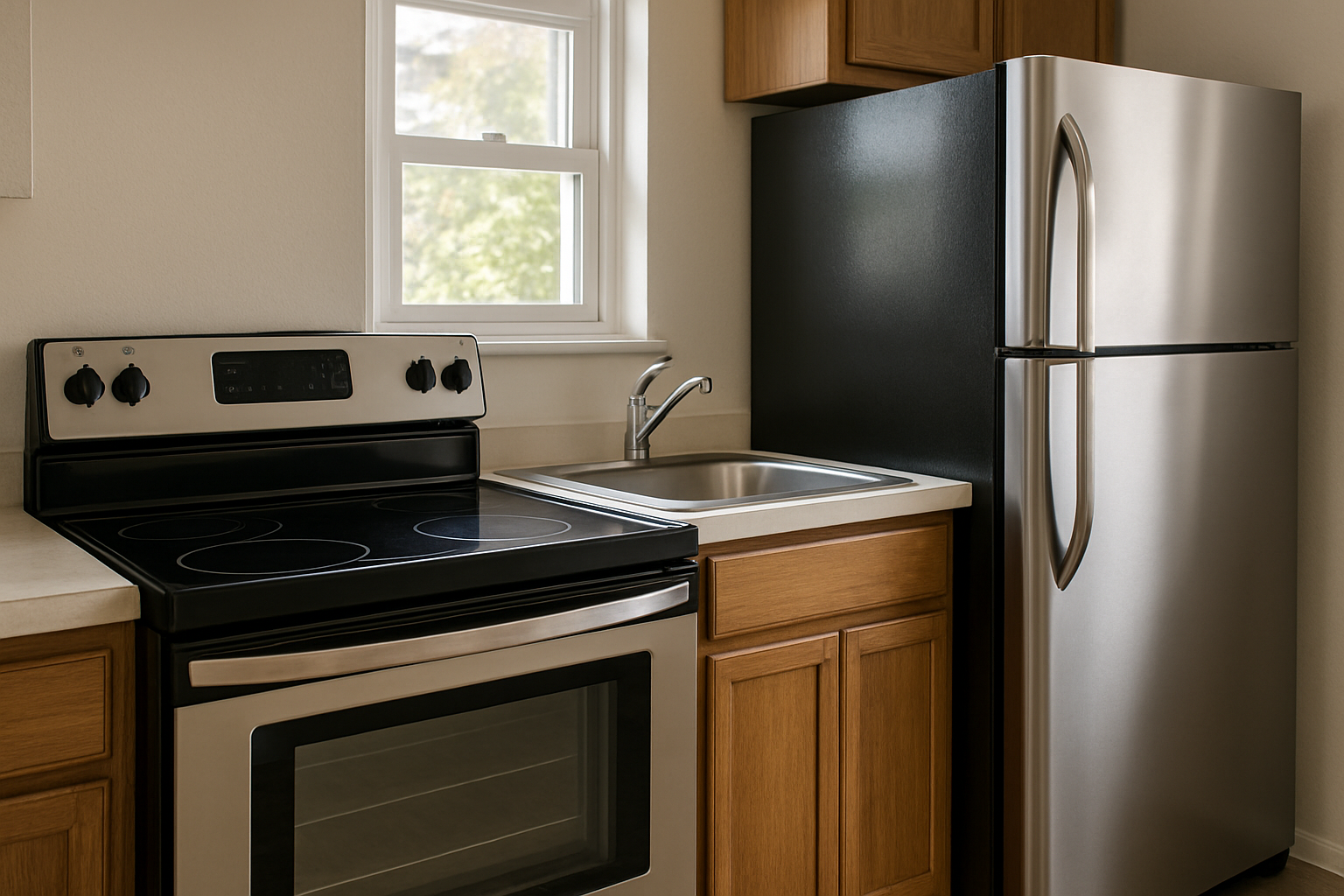
California Now Requires a Stove and Refrigerator in Every Rental: What the New Law Means for Owners
For years, whether a landlord had to provide a stove or refrigerator in a California rental was genuinely unclear. Many owners, especially those with older units or long-term tenants who brought their own appliances, treated the question as optional. That gray area is gone.
California AB 628, signed in October 2025, adds a working stove and refrigerator to the state's legal definition of a habitable unit under Civil Code Section 1941.1. For leases entered, amended, or renewed on or after January 1, 2026, a missing or broken appliance is not just a maintenance complaint, it is a habitability violation with real legal consequences.
For property owners in Monterey County, from multi-unit buildings in Salinas to furnished homes in Carmel-by-the-Sea, this change affects how you write leases, schedule appliance maintenance, and think about renewal timing. I want to walk through the parts of this law that actually matter for local owners, because several of them are easy to misread.
What Counts as a Habitability Violation Now
Before AB 628, California's warranty of habitability covered things like weatherproofing, plumbing, heating, and electrical systems. Appliances were largely outside that framework unless a lease specifically promised them. You can read a plain-language breakdown of the broader habitability standard in our guide on California's Warranty of Habitability.
Under the new law, a stove or refrigerator that is missing, non-functional, or subject to an active recall is treated the same as a broken heater. That matters because the legal remedies available to tenants are the same:
- Rent withholding until the condition is corrected
- Repair and deduct remedies (tenant fixes it and deducts cost from rent)
- Code enforcement complaints and municipal inspection triggers
- Constructive eviction claims in serious cases
The standard applies to single-family homes, condos, duplexes, and small multi-family properties alike. And it applies regardless of what your current lease says, once a qualifying lease event occurs.
The Staggered Rollout Most Owners Are Getting Wrong
This is the piece I hear the most confusion about. Existing fixed-term leases signed before January 1, 2026 are not immediately affected. The requirement does not reach back into an active lease and change your obligations overnight.
But the moment that lease is renewed, extended, or amended, the new standard applies. And for month-to-month tenancies, which renew automatically every 30 days, compliance is effectively immediate starting January 1, 2026.
For owners with more than one unit, this means your compliance timeline is unit-by-unit, not portfolio-wide. A four-unit building in Salinas where one tenant is on a fixed lease expiring in March, another is month-to-month, and two units are vacant creates four different compliance trigger dates. Missing the trigger at renewal exposes you to the same habitability liability as if you had never addressed the issue at all.
If you manage multiple properties and don't have a well-organized lease renewal calendar, now is the time to build one. This is exactly the kind of detail that falls through the cracks in self-managed portfolios. Managing a multi-unit property in Salinas gets more legally complex as you add units, and AB 628 is a good example of why.
The Refrigerator Opt-Out, and Why the Stove Has No Equivalent
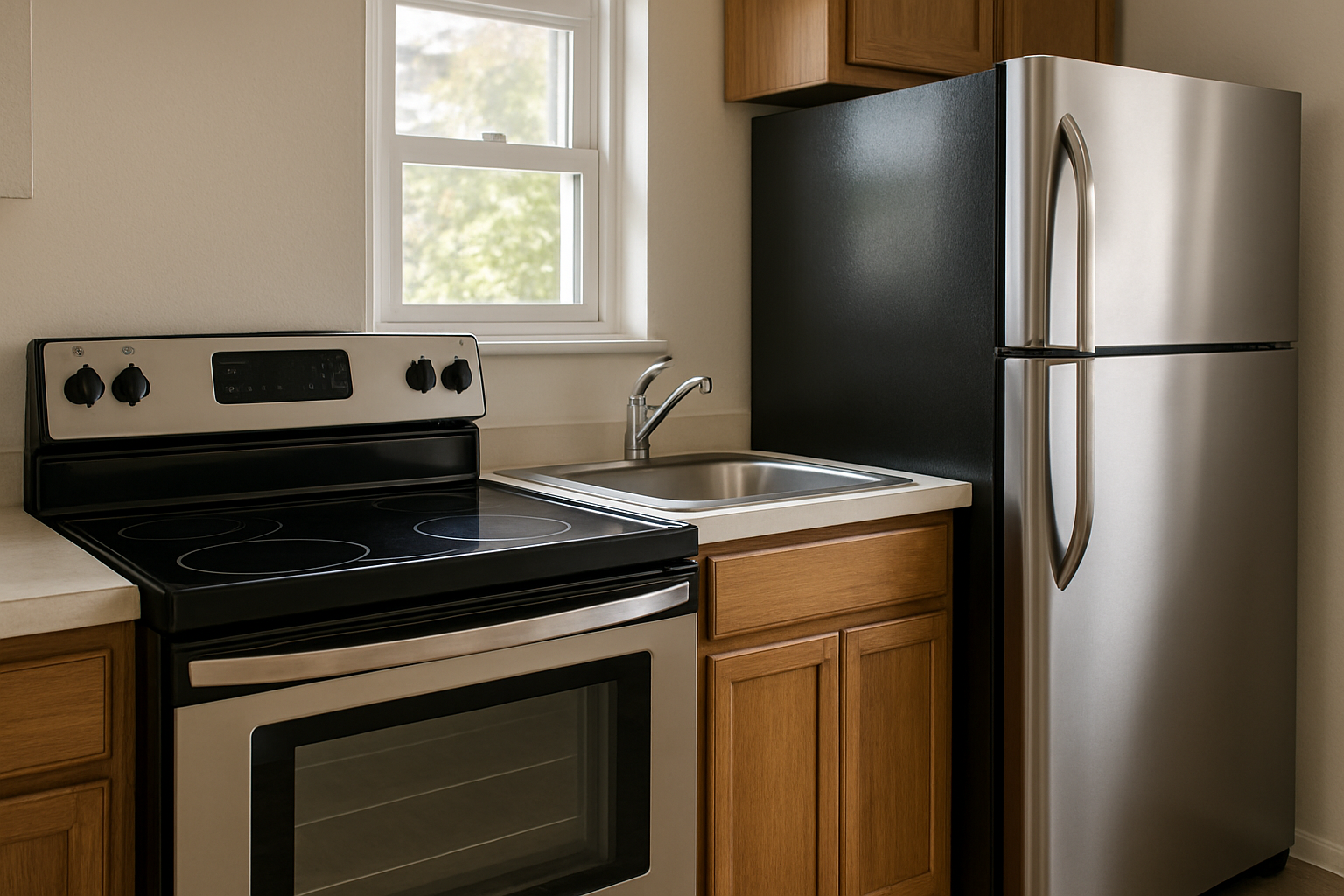
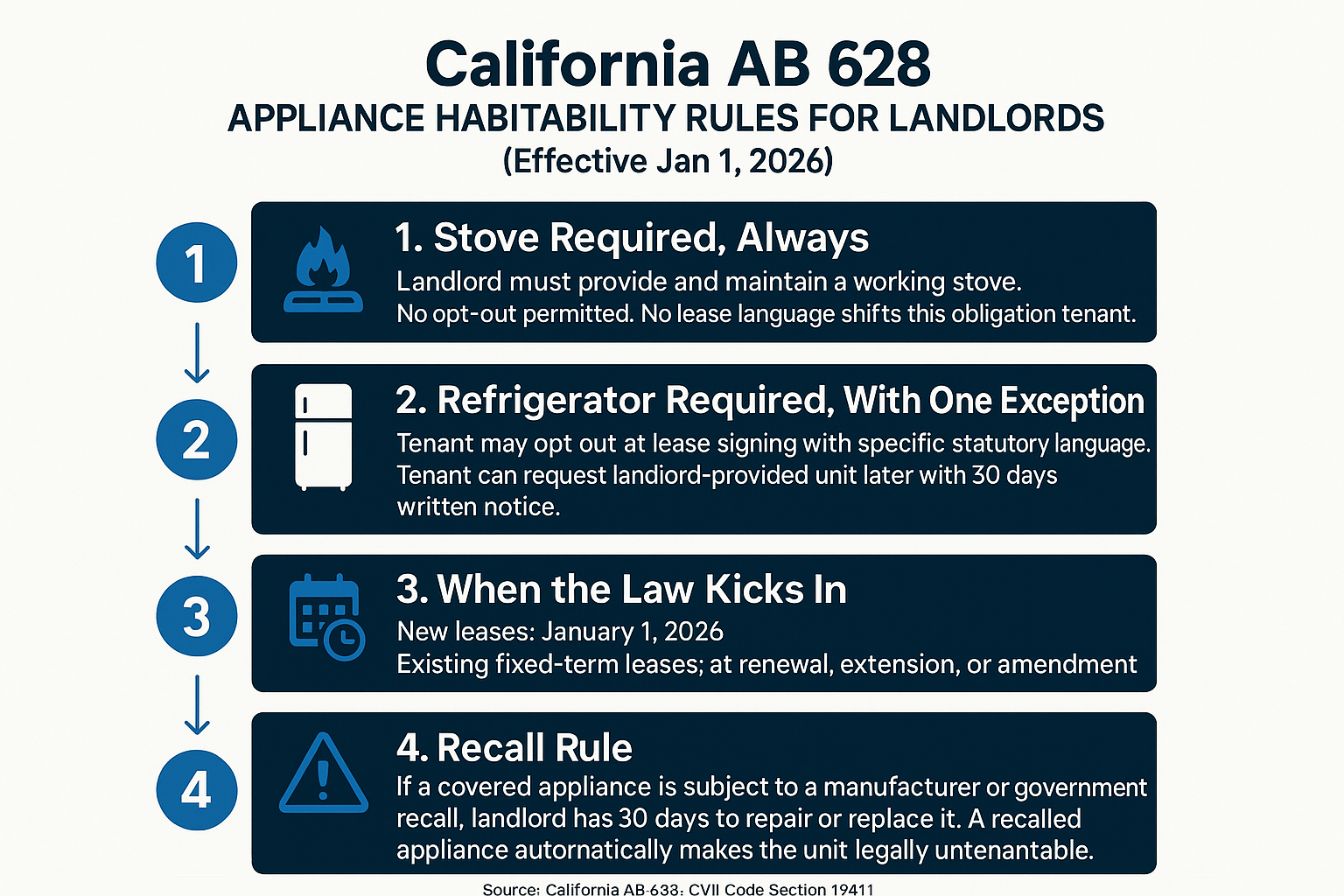
AB 628 includes one meaningful flexibility, and it applies only to the refrigerator. A tenant may voluntarily agree at lease signing to provide their own refrigerator, but only if the lease contains specific statutory language to that effect.
Even with that agreement in place, the tenant retains the right to request a landlord-provided refrigerator later, with 30 days written notice. Once that notice is given, the owner's obligation to provide and maintain a refrigerator kicks in at the next renewal.
The stove has no equivalent flexibility. There is no opt-out for stoves. No lease language, no tenant agreement, no verbal understanding shifts that obligation to the tenant. The landlord must provide and maintain a working stove for the life of the tenancy, full stop.
For owners in Carmel-by-the-Sea who rent furnished homes and may have assumed that appliances were simply a courtesy rather than a legal requirement, this distinction is important. If you are relying on a tenant's own refrigerator and do not have compliant opt-out language in the lease, that arrangement has no legal backing under the new law.
AB 628 at a Glance: What Owners Need to Know
This summary covers the key obligations, the one opt-out, and the recall rule under California AB 628.
The Recall Rule Most Owners Haven't Heard About
This part of AB 628 doesn't get much attention, but it's practically significant. If a stove or refrigerator under your responsibility is subject to a manufacturer or government product recall, you have 30 days after notification to repair or replace it.
A recalled appliance is automatically considered incapable of safely serving its purpose under the law. That means the unit is legally untenantable for the duration of the violation, the same standard applied to a missing appliance from day one.
Most owners don't have a process for monitoring appliance recalls. Reacting when a tenant complains is no longer enough. The U.S. Consumer Product Safety Commission maintains a searchable database of active recalls, including major appliances. Bookmarking it and checking it annually during inspections is a reasonable starting point.
For owners who rely on a professional manager to coordinate annual property inspections, this kind of proactive check fits naturally into that process. But if you're self-managing, it's a step you'll need to add intentionally.
AB 628 Obligations by Appliance and Scenario
Here is a quick reference for the most common situations Monterey County owners will face under the new law.
| Scenario | Stove Required? | Refrigerator Required? |
|---|---|---|
| New lease signed after Jan 1, 2026 | Yes, no exceptions | Yes, unless opt-out language is in lease |
| Existing fixed-term lease (no renewal yet) | Not yet, triggered at renewal | Not yet, triggered at renewal |
| Month-to-month tenancy as of Jan 1, 2026 | Yes, effectively immediate | Yes, unless compliant opt-out exists |
| Tenant has their own fridge, no opt-out language | N/A | Owner obligation still applies at renewal |
| Appliance under active manufacturer recall | Must repair or replace within 30 days | Must repair or replace within 30 days |
What This Means Practically for Monterey County Owners
I've spoken with owners across Salinas and the Peninsula who are in genuinely different situations under this law, and the compliance path looks different for each of them.
An owner with a multi-unit building in Salinas where several long-term tenants brought their own refrigerators years ago needs to pull every lease and check for compliant opt-out language. If that language isn't there, the next renewal on each of those units triggers the obligation. Unit by unit, not all at once.
A Carmel-by-the-Sea owner renting a furnished home needs to verify that both appliances are in working order and documented in the move-in inspection. If the refrigerator or stove fails mid-lease after a renewal date, responding promptly is now a legal obligation, not just a courtesy.
And any owner who hasn't touched their lease template since before 2026 should have an attorney or experienced property manager review it before the next signing. Lease language that worked fine under the old framework may be missing the statutory opt-out wording the law requires, or may even conflict with the new standard.
This is also a good moment to revisit how you're tracking what happens when California law changes mid-lease, because AB 628 is not likely to be the last change in this direction. For a broader look at the regulatory shifts affecting Monterey County owners this year, our summary of new California landlord laws for 2026 is worth reading alongside this one.
Frequently Asked Questions About AB 628 and California Appliance Habitability
Does AB 628 apply to my existing tenants right now?
It depends on how your tenancy is structured. If your tenant is on a fixed-term lease signed before January 1, 2026, you are not immediately required to comply, but the requirement kicks in the moment that lease is renewed, extended, or amended in any way. If your tenant is month-to-month, the law effectively applied starting January 1, 2026, since those tenancies renew every 30 days.
What if my tenant has always used their own refrigerator and we never had anything in writing?
Without compliant statutory opt-out language in the lease, that informal arrangement has no legal protection under AB 628. At the next qualifying lease event, your obligation to provide and maintain a refrigerator applies. Have an attorney review your lease before the next renewal.
Can I write a lease that makes the tenant responsible for stove maintenance?
No. There is no opt-out for stoves under AB 628. The obligation to provide and maintain a working stove rests entirely with the landlord and cannot be shifted to the tenant by any lease agreement.
What happens if the appliance breaks mid-lease?
Once the law applies to a lease, a broken stove or refrigerator is a habitability violation. Tenants have the right to withhold rent, use repair-and-deduct remedies, or file a complaint with code enforcement until the condition is corrected. Prompt response is both a legal requirement and a practical protection for the owner.
Where can I find the actual text of AB 628?
The official statutory language and full bill history are available on the California Legislative Information page for AB 628. It's the authoritative source for the exact wording of the Civil Code Section 1941.1 amendments.
Does this law affect commercial properties?
AB 628 amends the residential habitability statute. Commercial leases in California operate under a different legal framework. If you own commercial property in Monterey County, see our breakdown of what California commercial landlords are actually responsible for for a clearer picture of how those obligations compare.
Questions About How AB 628 Affects Your Monterey County Property?
Tracking lease renewal dates, updating lease language, and staying current with California's changing habitability standards is exactly the kind of work that falls through the cracks in self-managed portfolios. If you own rental property in Salinas, Carmel, Pacific Grove, or anywhere across Monterey County and want to talk through what AB 628 means for your specific leases, Coast & Valley Properties is available to help. Reach us at (831) 757-1270 or through the contact form at coastandvalleypm.com.

Salinas Rent Control Goes to Voters in November: What Owners Need to Know Before Then
If you own rental property in Salinas, you have probably heard that the rent ordinances are heading to voters in November. The City Council voted in September 2025 to place the repeal of all four local rental ordinances on the November 3, 2026 general election ballot. And I understand why some owners are treating that as a signal to relax.
But that framing is the wrong one. Every one of those ordinances is still fully in effect today, and they will remain so until voters decide otherwise, if they decide otherwise. Acting as though the rules are already gone is one of the more expensive mistakes a Salinas landlord can make right now.
This article is not about the politics of rent control. It is about what owners with covered properties should actually be doing between now and Election Day, regardless of which outcome they are hoping for.
The Four Ordinances That Are Still the Law in Salinas
The City Council placed four separate ordinances on the ballot. Each one has its own requirements, and each one carries its own compliance obligations until voters act. Here is what each one actually does:
- Rent Stabilization Ordinance (Ord. No. 2681): Caps annual rent increases at 75% of the local CPI change or 2.75%, whichever is less, for covered multi-family properties built before February 1, 1995.
- Residential Rental Registration Ordinance (Ord. No. 2663): Requires all covered landlords to register their units through the City of Salinas Rental Registry portal and pay annual fees of $45 per unit for non-stabilized properties or $170 per unit for stabilized ones.
- Tenant Protection and Just Cause Eviction Ordinance: Restricts the grounds on which a landlord can terminate a tenancy, requiring documented just cause for evictions of covered tenants.
- Tenant Anti-Harassment Ordinance: Prohibits landlords from using intimidation, unauthorized entry, interference with services, or other conduct designed to pressure tenants into leaving.
Not every Salinas property is covered by all four. Costa-Hawkins exemptions remove single-family homes and condominiums from rent stabilization, as do units built after February 1, 1995. But the registration requirement and the anti-harassment provisions cast a wider net. If you are unsure whether your specific units fall under the stabilization cap, that is worth clarifying with a qualified California real estate attorney before you act on any assumption.
For a broader look at how California law layers on top of local rules, our article on what new California landlord laws mean for Monterey County owners in 2026 covers the state-level picture.

Why the Penalty Structure Demands Serious Attention
Some owners I have spoken with are aware that the rules exist but underestimate what a violation actually costs. The Rent Stabilization Ordinance is not just a policy guideline, it has teeth.
A landlord who overcharges rent on a covered unit can face:
- Statutory damages of up to three times the amount of the overcharged rent
- Misdemeanor exposure under California law
- Attorney fee liability if the tenant prevails in a legal action
That last point matters more than people realize. Even a modest rent overcharge on a single unit, compounded across several months of tenancy, can generate a damages claim that far exceeds whatever the landlord collected. And the owner pays the tenant's legal fees on top of that if they lose.
The takeaway is simple: operating outside the ordinance while a repeal vote is pending is not a gray area. The law applies fully today, and enforcement has not paused while the political process plays out.
For owners managing multiple Salinas units, staying current on this alone is a significant administrative burden. We have heard from several portfolio owners who describe the compliance layer as one of the main reasons self-management has become unmanageable. That pattern matches what we see in practice. The article on why experienced Salinas owners stop managing their own properties gets into that in more depth.
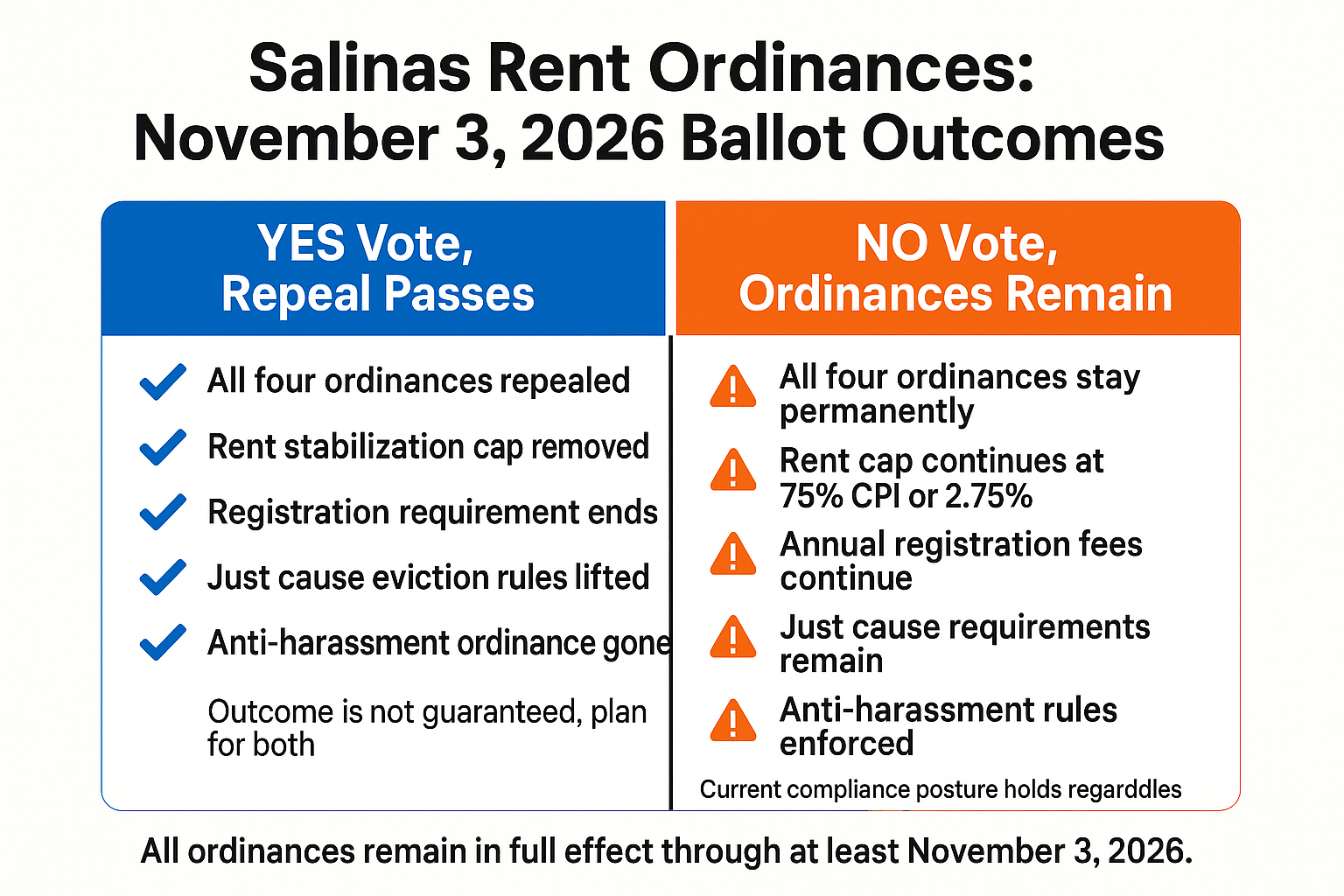
Two Outcomes After November 3, 2026
The ballot result produces one of two clean scenarios. Here is how each one plays out for covered property owners.
What Owners Should Be Doing Right Now, Regardless of How They Vote
The November result is genuinely uncertain. That uncertainty is exactly why your compliance posture today needs to hold up under both outcomes, not just the one you prefer.
Here is what I recommend owners with covered Salinas properties focus on between now and Election Day:
Verify your registration status. The $170 per unit annual fee for stabilized properties is not optional, and late or missing registration creates a paper trail that works against you. Log into the City of Salinas Rental Registry portal and confirm your filings are current.
Calculate any rent increases carefully. The stabilization cap is tied to a specific CPI formula. Do not estimate, calculate it, document it, and keep a written record of how you arrived at the number. If you have a rent increase pending or planned, get the math right before you issue any notice.
Build a documentation habit now. Whether voters repeal the ordinances or not, detailed records protect you. Keep written records of:
- All rent payments received and the dates they were collected
- Any notices issued to tenants and the method of delivery
- Maintenance requests and how each one was resolved
- Any communications that could touch on just cause grounds
If the repeal passes in November, your records from 2026 will still matter for any tenancy that was active before the vote. If the repeal fails, your records are your defense. Either way, documentation costs nothing and protects everything.
For a clear picture of how compliance obligations stack up when you manage more than one unit, the article on how multi-unit owners in Monterey County stay legally compliant walks through the layered requirements in practical terms.
Salinas Rental Ordinances at a Glance: Who Is Covered and What It Costs
This is a quick reference for the four ordinances currently in effect. Coverage depends on property type and build date, confirm your specific situation with a qualified California real estate attorney.
| Ordinance | Who It Covers | Key Requirement | Penalty Exposure |
|---|---|---|---|
| Rent Stabilization (Ord. 2681) | Multi-family built before Feb 1, 1995 (Costa-Hawkins exemptions apply) | Cap increases at 75% CPI or 2.75%, whichever is less | Up to 3x overcharged rent, misdemeanor, attorney fees |
| Rental Registration (Ord. 2663) | Most covered rental units in Salinas | $45/unit/year (non-stabilized) or $170/unit/year (stabilized) | Non-compliance creates enforcement and legal exposure |
| Just Cause Eviction Ordinance | Covered tenants in stabilized and qualifying units | Must document qualifying just cause to terminate tenancy | Invalid eviction, tenant legal claims, damages |
| Tenant Anti-Harassment Ordinance | All covered rental properties | Prohibits pressure tactics, unauthorized entry, service interference | Civil liability, damages, attorney fee exposure |
Frequently Asked Questions About the Salinas Rent Control Ballot
Can I raise rent on my Salinas rental unit right now while the repeal vote is pending?
Yes, but only within the limits the ordinance allows. The stabilization cap is still in effect. If your unit is covered, any increase above the formula limit, 75% of the local CPI change or 2.75%, whichever is less, puts you in violation, regardless of the pending ballot measure. Calculate carefully and document how you arrived at the number.
My property was built after 1994. Does any of this apply to me?
The rent stabilization cap likely does not apply to you under Costa-Hawkins, which exempts units built after February 1, 1995, along with single-family homes and condos. But the registration requirement, the just cause eviction ordinance, and the anti-harassment ordinance may still apply depending on your property type. Do not assume a Costa-Hawkins exemption covers all four ordinances, they operate independently.
What happens if voters approve the repeal in November?
If voters pass a YES on the repeal, all four ordinances are gone. Rent stabilization ends, registration fees go away, and just cause eviction requirements are lifted. But leases and tenancies that were active before the vote may still carry obligations rooted in the period when the rules applied. That is why documentation throughout 2026 matters even if you expect the repeal to pass.
What happens if voters reject the repeal?
A NO vote means all four ordinances stay in place permanently. Nothing changes structurally, you continue operating under the same rules that exist today. Owners who have maintained good records and consistent compliance will be in the strongest position.
I own several Salinas units and the registration and compliance work is becoming too much to manage. Is that common?
Very common. Several multi-unit owners who have contacted us described exactly that situation, managing everything on their own was working until the compliance layer added up. Registration filings, CPI-based rent calculations, just cause documentation, and lease management across multiple units is a substantial ongoing workload. It is one of the main reasons portfolio owners seek professional management support.
Where can I confirm the official status of the ordinances and the ballot measure?
The City of Salinas Housing and Community Development page is the authoritative source. It confirms that all four ordinances remain in effect and provides the Rental Registry portal for registration and fee payment.
The Compliance Work Does Not Pause for Election Season
I want to be direct about something I see repeatedly in conversations with Salinas owners: there is a tendency to treat a ballot measure as a kind of informal suspension of the rules it targets. That is not how California law works.
The ordinances were passed by the City Council. They remain in force until voters act, and even after the vote, the period before Election Day will still have happened. Rent overcharges from 2026 do not disappear because a repeal passed in November. Evictions without documented just cause during 2026 are still vulnerable to legal challenge. The compliance record you build between now and November 3 is a real legal asset, or a real liability, depending on how carefully you have been operating.
For owners who have been self-managing and are feeling the weight of this compliance layer, the article on what Salinas property owners get wrong about self-managing covers the broader pattern honestly. And if you are thinking about what professional management actually handles on a day-to-day basis, what full-service property management actually covers is a practical breakdown.
Tracking ordinance status, calculating compliant rent increases, maintaining registration filings, and keeping documentation current are exactly the kinds of ongoing tasks that a local property manager handles as a matter of routine, not as a crisis response, but as standard operating procedure. That is what staying ahead of a regulatory environment like Salinas actually looks like in practice.
Questions About How These Ordinances Affect Your Salinas Properties?
Coast & Valley Properties has been working alongside Monterey County owners since 2009, and staying current on Salinas regulatory changes is part of what we do every day. If you own covered rental units in Salinas and want to talk through your current compliance posture, we are available to help. Reach us at (831) 757-1270 or through the contact form at coastandvalleypm.com.
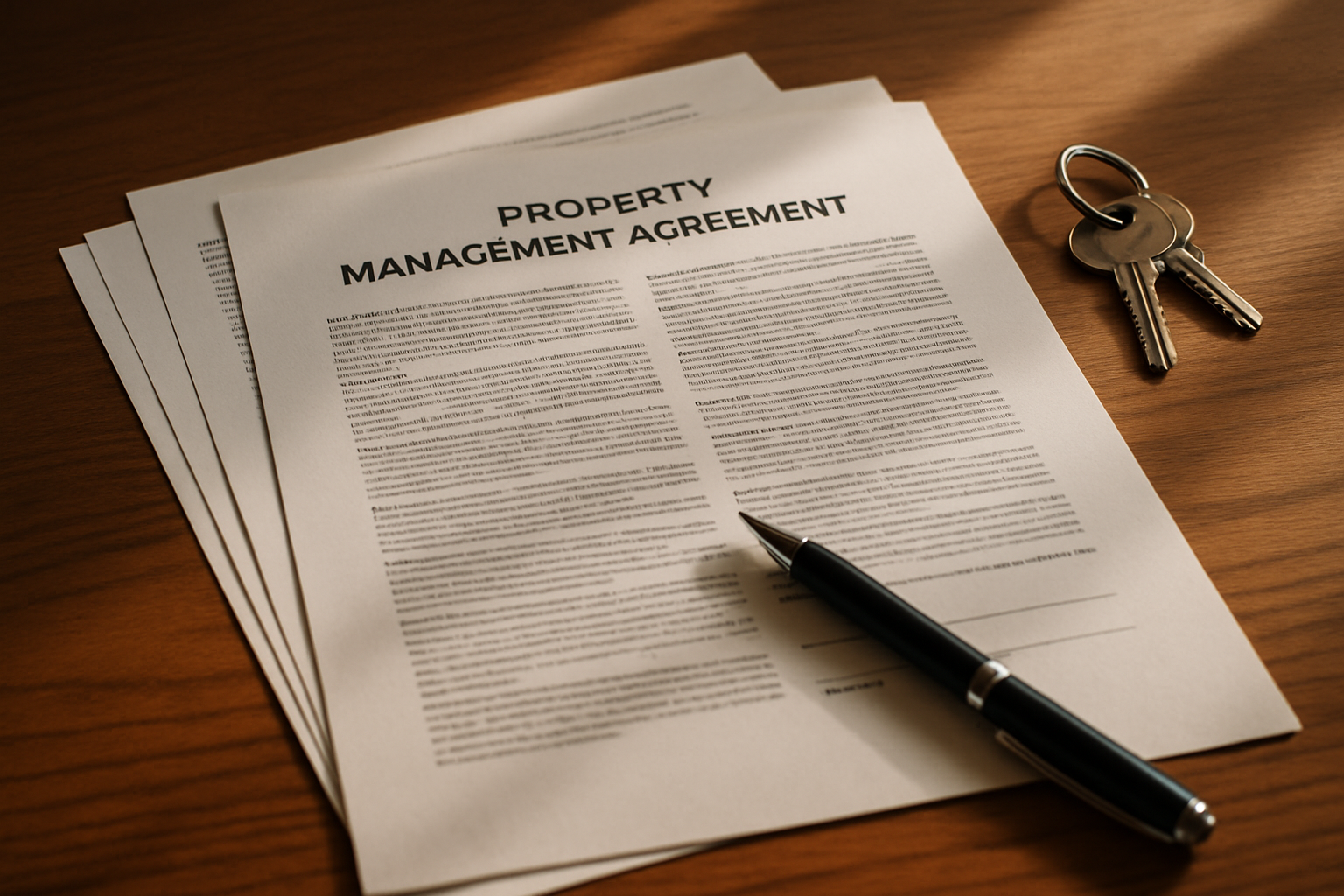
What a Property Management Agreement Actually Says, and What to Look For
A surprising number of property owners in Monterey County reach out to us already knowing the question they want answered. It isn't about vacancy rates or maintenance vendors. It's this: what exactly am I signing? Several owners who've contacted us recently asked specifically about fee structure and management agreement terms before they were willing to move forward, and I think that's exactly the right instinct.
A property management agreement is the legal contract that governs everything between you and the firm you hire. It defines what services you're actually getting, how compensation is calculated, how much authority the manager has to spend your money, and what happens if you need to walk away. Most owners sign it once and assume it's standard. But the details inside vary enormously between firms, and the gaps almost always surface at the worst possible moment.
This article breaks down the three sections of a management agreement that matter most to owners in Salinas, Monterey, Carmel, and the surrounding communities. I'm not going to cover every clause. I'm going to focus on the parts that actually determine whether your experience with a manager will be what you expected, or a frustrating surprise.
The Services Section: Where Most Agreements Fall Short
The services section is where a management agreement either earns your confidence or quietly sets you up for disappointment. And it's the section that varies the most between firms.
A vague services clause, something like "full-service residential management" without defining what that means, sounds complete. But I've seen owners discover real gaps when an emergency comes up and the agreement doesn't actually require the manager to handle it. The question worth asking is: what, exactly, is included?
A well-written agreement should spell out each of the following as included services, not optional add-ons:
- Tenant marketing and listing across major rental platforms
- Tenant screening, including credit, background, and rental history checks
- Lease negotiation and execution
- Rent collection and owner disbursements
- Maintenance coordination with licensed vendors
- Routine property inspections on a defined schedule
- 24/7 emergency response for tenant issues
- Financial reporting, including monthly statements and year-end summaries
- Bill payment, including mortgage, HOA fees, and utilities if applicable
If any of those are listed as optional or priced separately, that changes the real cost picture. The article on what full-service property management actually covers goes deeper on this, and it's worth reading before you sign anything.
One specific thing I look for: does the agreement describe the inspection schedule explicitly? A missed inspection can create liability that far outweighs the cost of managing the property in the first place. When a single missed inspection becomes a six-figure problem explains exactly why that matters.
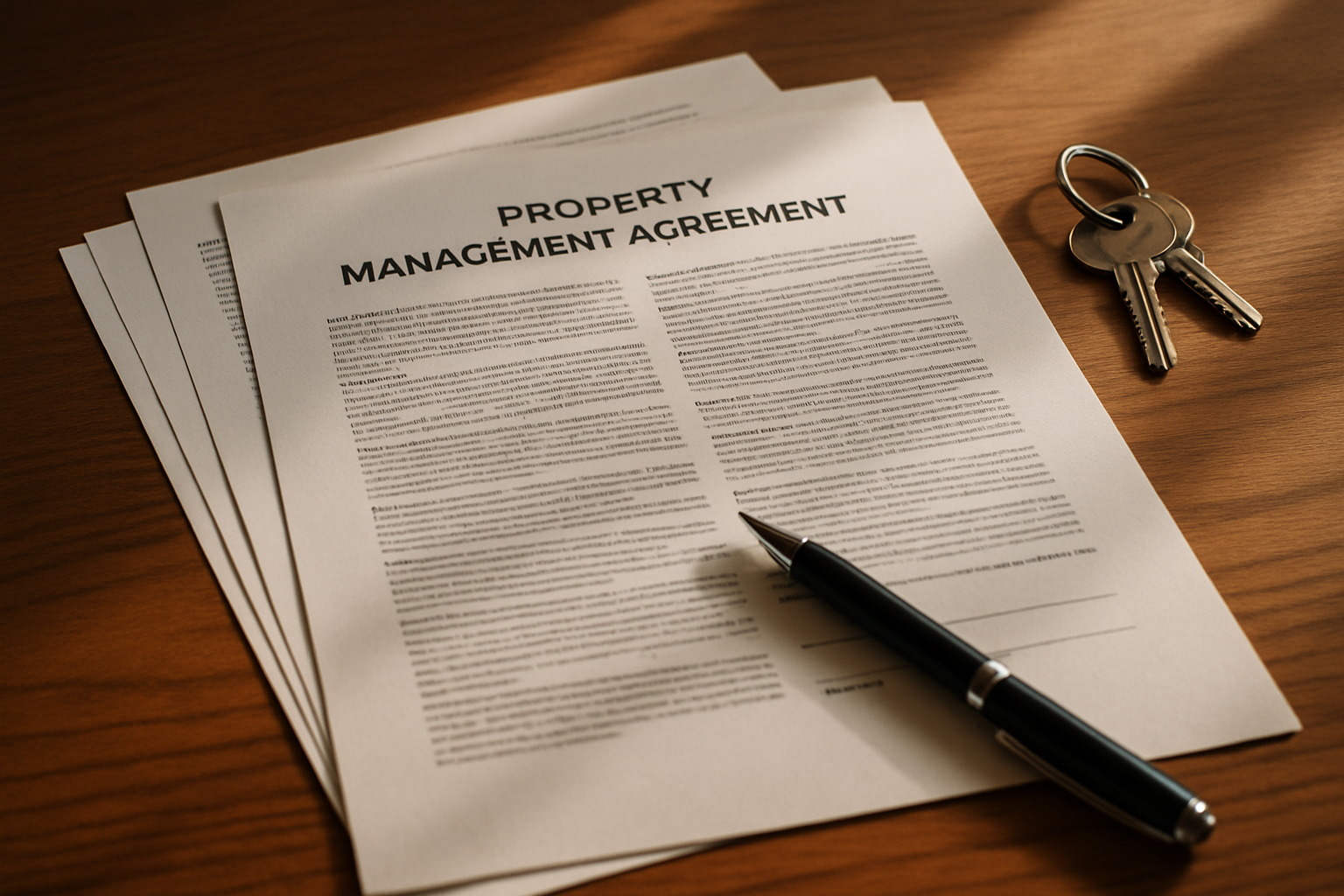
Compensation Terms: The Headline Rate Isn't the Whole Story
Most owners compare firms by their management percentage. That number matters, but it is rarely the full picture of what you'll actually pay.
Residential property management fees in California commonly run as a percentage of collected rent, typically somewhere in the 8-12% range depending on the firm, property type, and scope of services. Some firms use a flat monthly fee instead, and others use a hybrid of the two. What varies most, and where the real differences show up, are the additional fees layered on top.
Here are the compensation items most agreements include beyond the base rate:
- Leasing fee: charged when a new tenant is placed, often equivalent to one month's rent or a partial month. This is a real cost, and it compounds if tenant turnover is frequent.
- Lease renewal fee: some firms charge a flat fee each time an existing tenant's lease is renewed. Others don't. Worth asking.
- Maintenance markup: some agreements allow the manager to mark up the cost of vendor invoices by a percentage. It may be 10%, it may be more. The agreement should state this clearly.
- Vacancy fee: some agreements require a minimum monthly fee even when the unit sits empty. Others charge nothing during a vacancy. This is a meaningful distinction for owners of single-family homes.
When you're comparing two firms, don't compare the management percentage alone. Add up the realistic total over 12 months, including a leasing fee if you're starting with a vacant unit. That gives you a real cost comparison. The California Department of Real Estate requires that all management fees be disclosed in writing, so if a firm is vague about any of these in the agreement, that's a signal worth taking seriously. You can review the DRE's guidance on property management disclosures directly if you want to understand what the law requires.
For owners evaluating a multi-unit property, the fee structure question gets more layered. Managing a multi-unit property in Salinas walks through how the economics shift as the property grows.
Common Management Agreement Fee Types at a Glance
Different management agreements bundle these fees differently. Use this as a checklist when reviewing any agreement.
| Fee Type | What It Covers | What to Clarify |
|---|---|---|
| Base management fee | Monthly oversight of the property | Is it % of collected rent or flat? What if the unit is vacant? |
| Leasing fee | Finding and placing a new tenant | Is it a full month's rent, partial, or flat fee? |
| Lease renewal fee | Processing a lease renewal for an existing tenant | Charged every renewal or only year one? |
| Maintenance markup | Surcharge on vendor invoices | What percentage? Is it disclosed per invoice? |
| Early termination fee | Penalty for ending the agreement before term | How much? Does it apply mid-tenancy? |
How the Four Key Sections of a Management Agreement Work Together
This overview shows what each major section of a property management agreement actually controls, and what questions to ask before you sign.
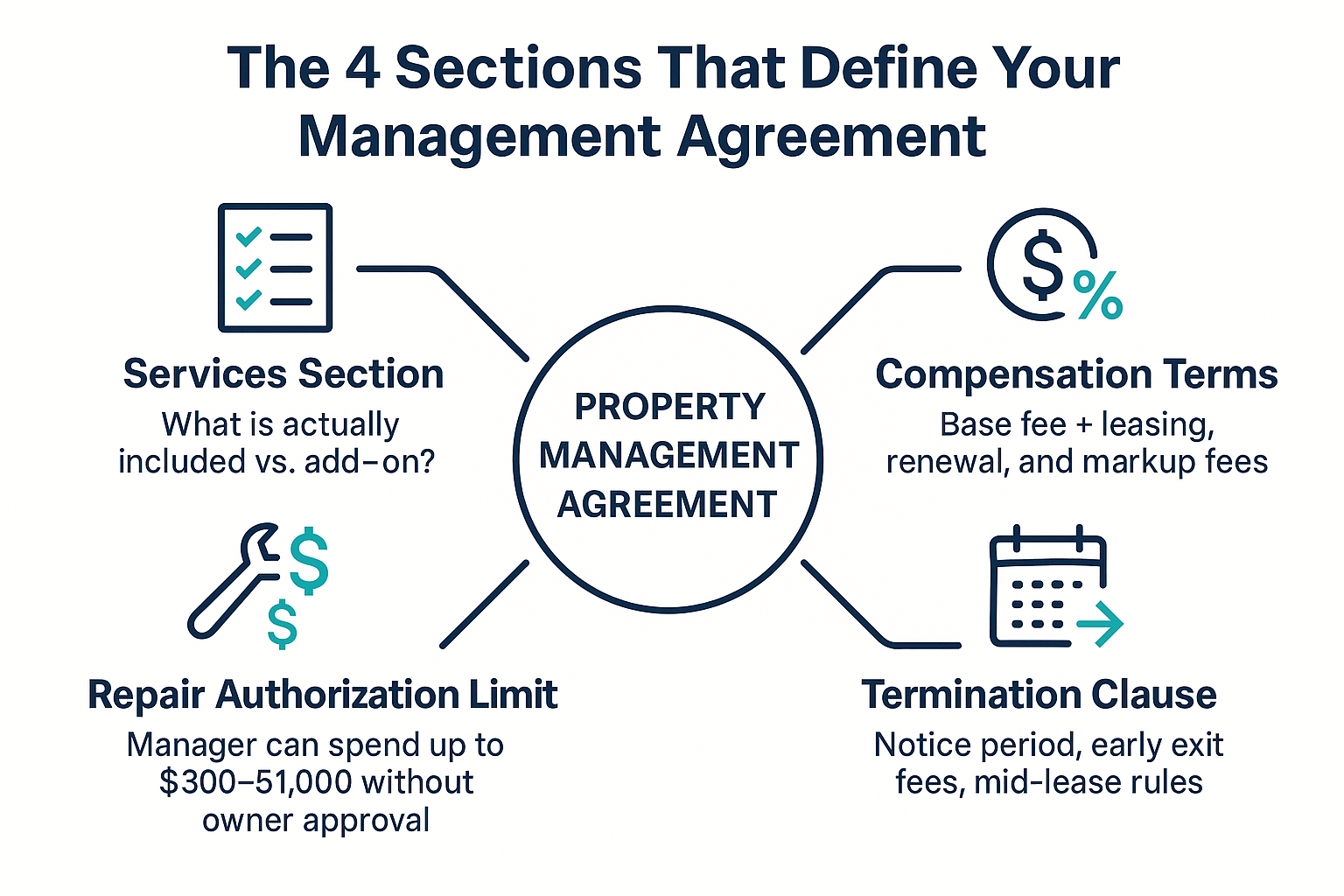
Repair Authorization and Termination: The Two Clauses Owners Overlook
These two sections sit near the back of most agreements. Most owners skim them. I'd argue they deserve more attention than the fee schedule.
Repair authorization defines how much money a manager can spend on maintenance without calling you first. This threshold is commonly somewhere between $300 and $1,000 depending on the firm and property type. For a hands-off owner who doesn't want to field calls about a broken faucet, a higher threshold with good documentation requirements is reasonable. For an owner who wants to approve every expenditure above a modest amount, negotiating a lower limit upfront is worth doing.
What matters as much as the dollar amount is what the agreement says about documentation. Does the manager have to provide invoices for every repair? Are you notified after the fact when something is handled under the threshold? An agreement that allows discretionary spending without requiring any written record is a gap worth closing before you sign.
Termination clauses are the section I see owners most surprised by, usually when their situation has changed and they want to end the relationship. Some agreements require 30 to 60 days' written notice with no penalty. Others include fees for ending mid-lease or during an active tenancy. A few lock owners into the full initial term regardless.
I've also spoken with owners who wanted a placement-only arrangement, meaning they want a manager to find and screen a tenant, handle the lease, and then step back from ongoing management. Some agreements accommodate this as a defined service scope. Others don't offer it at all. If that's what you need, confirm it is written into the agreement explicitly, not just promised verbally.
If you're thinking about switching firms mid-stream, or coming from self-management for the first time, switching to a property manager in Salinas explains what that transition actually looks like in practice.
How California Law Shapes What a Management Agreement Must Include
A management agreement in Monterey County doesn't exist in a vacuum. California law creates specific obligations that affect what any firm managing property here is required to do, and what must be reflected in writing.
Under California's Business and Professions Code, a property manager acting on behalf of an owner must be a licensed real estate broker or operate under one. The agreement itself is a brokerage contract, which means certain disclosures and fiduciary duties apply. If you're evaluating a firm, confirm that the broker of record is identified in the agreement by name and license number.
The agreement also needs to align with California's AB 1482 Tenant Protection Act if your property qualifies. AB 1482 caps annual rent increases and restricts the reasons an owner can terminate a tenancy for properties that fall under its scope. If your manager doesn't account for that in how they draft leases and notices, that's a compliance risk that lands on you, not them. What new California landlord laws mean for Monterey County owners in 2026 covers the current landscape clearly.
The City of Salinas also enacted its Residential Rental Registration Ordinance (City Ord. 2663) in 2024, which adds a registration requirement for rental properties within city limits. A management agreement with a firm that operates primarily in Salinas should either include compliance tracking for this registration or clearly state that it's the owner's responsibility.
Frequently Asked Questions About Property Management Agreements
Can I negotiate the terms of a management agreement, or is it take-it-or-leave-it?
Most agreements have negotiable elements, particularly the repair authorization threshold, the notice period for termination, and sometimes the leasing fee structure. A firm that refuses to discuss any terms at all is worth a second look. That said, core fee structures are usually fixed, what you're more likely to negotiate is the scope of services and the conditions around exiting the agreement.
What happens to my management agreement if I decide to sell the property?
Most agreements include a clause that addresses this. Some terminate automatically upon a sale closing. Others require written notice to the manager within a defined window before closing. A few include a fee if the manager helped the property reach the market condition that made a sale possible. Read this clause before you list, not after.
Is the management fee charged even when my unit is vacant?
It depends entirely on the agreement. Some firms charge a reduced fee or no fee during a vacancy. Others charge a minimum monthly fee regardless. This is one of the most important questions to ask before you sign, especially if you own a single-family home where a vacancy of even one month represents meaningful lost income.
What is a leasing fee and how is it different from the monthly management fee?
The monthly management fee covers ongoing oversight of the property while a tenant is in place. The leasing fee is a separate, one-time charge triggered when a new tenant is placed. It typically covers marketing, showings, screening, and lease execution. It is commonly priced at one month's rent or a percentage of it, and it applies each time a new tenant moves in, so tenant turnover directly affects how often you pay it.
Do I need a lawyer to review a property management agreement before signing?
You don't legally have to, but for a high-value property or a multi-unit portfolio, having a California real estate attorney review the termination clause and compensation schedule is a reasonable step. At minimum, read every section yourself before signing, especially anything related to fees, repair authorization, and the conditions for ending the relationship.
What should I do if a management agreement lists services that don't match what was promised verbally?
Ask for it in writing before signing. Verbal commitments that contradict the written agreement are almost impossible to enforce in California. If a firm promises 24/7 emergency response, quarterly inspections, or a specific fee cap, and none of that appears in the contract, request an addendum. If they decline, that tells you something important.
Ready to Review What a Management Agreement Should Look Like?
If you're evaluating property management options in Monterey County and want to understand exactly what you'd be signing before you commit, we're glad to walk through it with you. Coast & Valley Properties serves property owners across Salinas, Monterey, Carmel, Pacific Grove, and South County communities, and we're happy to answer specific questions about how our agreements are structured. Reach us by phone at (831) 757-1270 or through the contact form at coastandvalleypm.com.
What California Commercial Landlords Are Actually Responsible For
One of the most common assumptions I hear from property owners moving into commercial leasing for the first time is that the rules are simpler on the commercial side. No AB 1482 rent caps. No warranty of habitability. No just cause eviction requirement. And that part is true, California commercial leases are far less regulated than residential ones.
But 'less regulated' does not mean 'no obligations.' Commercial landlords in Monterey County carry real legal exposure, and the specific shape of that exposure depends heavily on how a lease is written and what condition the space is in when a tenant takes possession.
I want to walk through the parts that actually matter, not a comprehensive list of every possible issue, but the two or three areas where I've seen owners get into real trouble.
What the Law Actually Requires at Lease Commencement
California does not extend its residential habitability standard to commercial tenants. But that does not mean you can hand a tenant keys to a space with broken HVAC, faulty electrical, or structural problems and call it their problem.
If conditions were misrepresented at signing, or if those conditions create a genuine safety hazard, the owner faces significant liability, even in a commercial context. California courts have held commercial landlords accountable under fraud and misrepresentation theories when a space was leased as move-in ready and clearly was not.
The area I watch most closely for older buildings in Salinas and Monterey is ADA accessibility compliance. Under the Americans with Disabilities Act and California's companion law, building owners, not tenants, are generally responsible for accessibility in common areas and for structural barriers that predated the tenancy. Many of the older commercial buildings along Main Street in Salinas or in downtown Monterey were built well before modern accessibility standards existed. Owners who have not done a recent assessment are carrying more exposure than they realize.
According to the U.S. Access Board, commercial property owners are responsible for accessible routes, restroom compliance, and entrance accessibility, and those obligations do not transfer to a tenant simply because the lease says so.
How the Lease Structure Defines Who Pays for What
This is where I spend the most time with commercial property owners, because the lease type determines almost everything about an owner's ongoing financial obligations.
Under a standard gross lease, the landlord covers most operating costs, property taxes, insurance, utilities, and maintenance. The tenant pays a flat rent and lets the owner handle the rest. Simple, but it concentrates cost risk on the owner side.
A modified gross lease splits those costs in some agreed-upon way. An NNN (triple net) lease pushes most operating expenses to the tenant, taxes, insurance, and maintenance, but that shift has limits that owners frequently misunderstand. You can read a full breakdown of how NNN structures work in Monterey County in our article on Triple Net Leases in Monterey County: What the 'NNN' Actually Means for Owners.
Here is the line that matters most: even in a triple net lease, capital expenditures typically stay with the landlord. That includes:
- Roof replacement
- Foundation repairs
- Major HVAC system replacement
- Structural envelope work
- Parking lot resurfacing (depending on lease language)
A tenant in an NNN lease might be responsible for HVAC servicing and filter changes. But when the unit fails entirely and needs full replacement, that cost often falls back on the owner, unless the lease says otherwise with very specific language.
This distinction between routine maintenance (tenant) and capital expenditures (landlord) is the single most common source of commercial lease disputes I see. And it gets resolved by what the lease actually says, not by what either party assumed when they signed.
Commercial Lease Types: Who Pays for What
This comparison shows how landlord vs. tenant cost responsibility shifts across the three main commercial lease structures used in California.
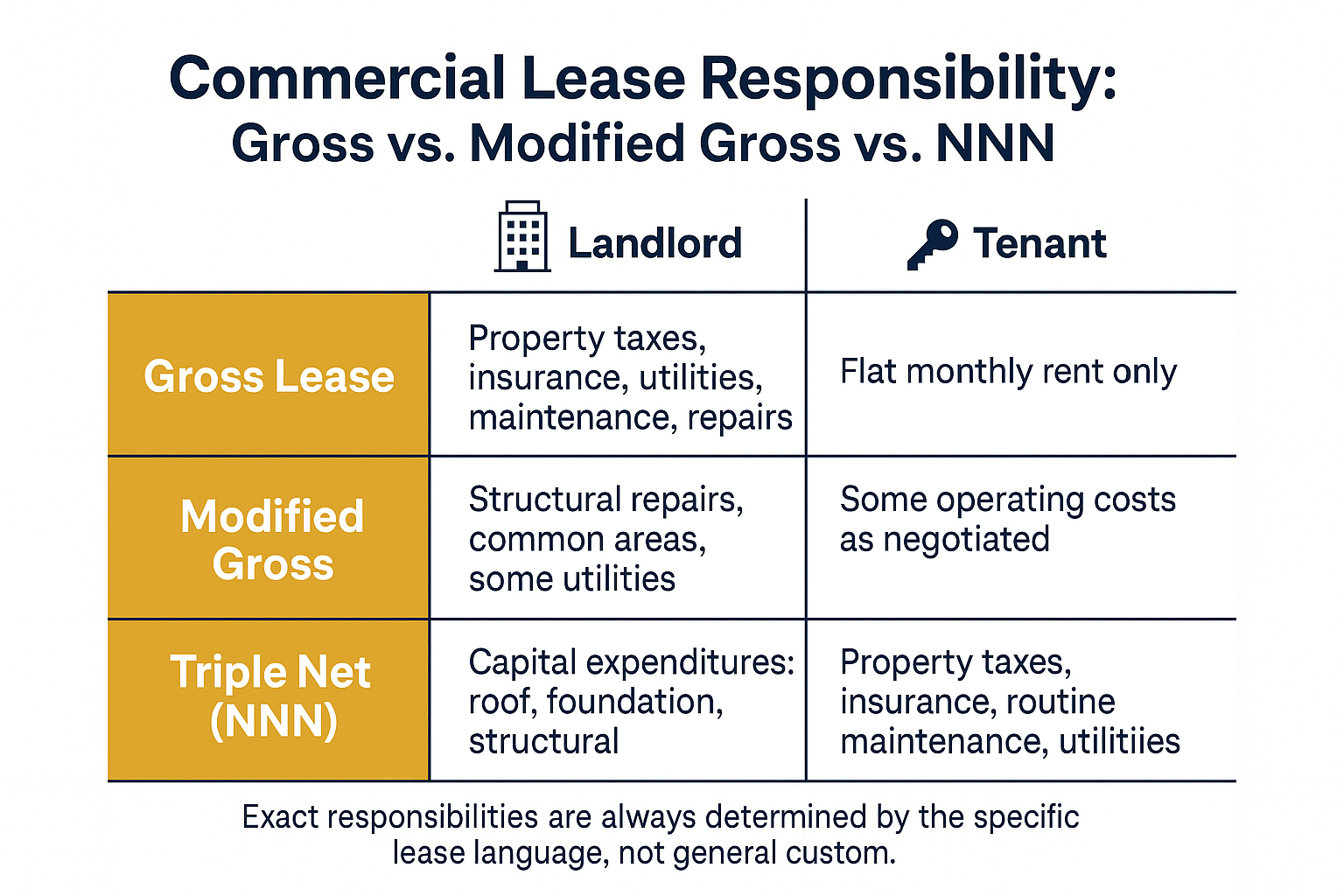
The Ongoing Obligations Most Commercial Owners Underestimate
Signing a tenant and collecting rent is only the beginning. The ongoing administrative side of commercial property ownership is where solo owners often run into the most friction.
A commercial tenant with a well-drafted lease and a good attorney will hold you to every term, every CAM reconciliation deadline, every insurance certificate requirement, every maintenance notice period. I've watched owners get caught flat-footed in disputes simply because they weren't tracking the compliance details over a multi-year lease term.
The ongoing responsibilities that create the most friction include:
- CAM charge reconciliation, Common area maintenance charges must be calculated and reconciled annually in most commercial leases. Errors or delays expose the owner to tenant disputes and potential lease termination claims.
- Insurance certificate verification, Most commercial leases require tenants to carry liability insurance and name the owner as an additional insured. Owners who stop verifying this annually are often uninsured in practice without knowing it.
- Lease compliance tracking, Rent escalation clauses, permitted use restrictions, renewal option deadlines, and tenant improvement obligations all have dates attached. Missing one can forfeit a right or trigger a default.
- Vendor coordination for common areas, Landscaping, parking lot lighting, exterior maintenance, and shared mechanical systems need ongoing management regardless of lease structure.
This is the kind of work that feels manageable when a lease is first signed and becomes genuinely burdensome in year three or four of a five-year term. Owners who are also managing residential portfolios, which come with their own compliance demands, as we cover in our article on how multi-unit owners in Monterey County stay legally compliant, often find the combined workload is what pushes them toward professional management.
Common Commercial Landlord Obligations by Lease Type
This table summarizes the most common landlord obligations in California commercial leases and how they typically vary based on lease structure. These are general patterns, actual responsibility is always defined by the specific lease agreement.
| Obligation | Gross Lease | NNN Lease |
|---|---|---|
| Roof replacement | Landlord | Landlord (typically) |
| HVAC routine service | Landlord | Tenant |
| HVAC full replacement | Landlord | Negotiated, often Landlord |
| Property taxes | Landlord | Tenant |
| Liability insurance (building) | Landlord | Landlord |
| Tenant liability insurance | Tenant | Tenant |
| Common area maintenance | Landlord | Shared, billed via CAM |
| ADA structural compliance | Landlord | Landlord |
| Interior repairs | Landlord | Tenant |
| Parking lot resurfacing | Landlord | Negotiated |
Why the Original Lease Language Matters More Than Anything Else
Everything I've described above is subject to modification by the specific language in the lease. That is both the advantage and the danger of commercial leasing in California.
Residential landlord-tenant law in California creates a floor of protections that cannot be waived by contract, the warranty of habitability, for example, exists regardless of what a lease says. Commercial law does not work that way. The parties are assumed to be sophisticated enough to negotiate their own terms, and courts will generally hold both sides to whatever the contract says.
That cuts both ways. A well-drafted commercial lease that clearly defines maintenance responsibility, capital expenditure thresholds, CAM calculation methods, and insurance requirements protects the owner as much as the tenant. A vague or template lease that leaves those terms ambiguous creates disputes that get resolved in court, which is far more expensive than the lease drafting ever was.
For commercial owners in Salinas managing properties alongside residential units, the compliance picture is already complicated. California landlord law is not static, new rules affecting landlords have been a consistent pattern in recent years, as we break down in our overview of what new California landlord laws mean for Monterey County owners in 2026. Commercial leases sit outside most of those changes, but the owners themselves often do not.
Frequently Asked Questions About California Commercial Landlord Responsibilities
Does California's warranty of habitability apply to commercial rentals?
No. The warranty of habitability is a residential standard under California Civil Code Section 1941. It does not apply to commercial leases. But that does not mean a commercial landlord can deliver a space in any condition, misrepresentation, safety hazards, and ADA violations are still grounds for liability.
Who is responsible for ADA compliance in a California commercial building?
Generally, the building owner is responsible for ADA compliance in common areas, entrances, and for removing structural barriers that predate the tenancy. A lease cannot simply transfer this obligation to the tenant, courts and regulators treat it as an owner responsibility tied to the physical building. This is a real exposure point for older commercial properties in Salinas and Monterey.
In a triple net lease, is the landlord ever responsible for maintenance?
Yes. Capital expenditures, things like roof replacement, foundation repairs, and full HVAC system replacement, typically remain the landlord's responsibility even in an NNN lease. The tenant covers routine maintenance and operating costs, but major structural or system-level replacements usually come back to the owner. The exact line depends entirely on the specific lease language.
What happens if I miss a CAM reconciliation deadline?
It depends on what your lease says, but missing a CAM reconciliation deadline can forfeit your right to collect that year's adjustment, open you to a tenant dispute, or in some leases trigger a default claim. Commercial tenants with experienced counsel will know their rights and enforce them. Tracking these deadlines proactively is part of what makes professional lease management worth the cost.
Do California's AB 1482 rent caps apply to commercial properties?
No. AB 1482 applies only to residential rental units. Commercial rents in California are not subject to any statewide rent control, increases are governed entirely by the lease terms the parties agreed to.
I own both residential and commercial rentals in Salinas, do I need to manage them the same way?
The compliance frameworks are completely different. Residential properties in Salinas now carry obligations under the City Ord. 2663 Residential Rental Registration Ordinance, AB 1482, and California's habitability statutes. Commercial properties are governed almost entirely by the lease and general contract law. Many owners find that managing both types of properties simultaneously, especially across multiple units, is where professional management becomes genuinely practical. You can read more about what changes as a residential portfolio grows in our piece on managing a multi-unit property in Salinas.
Managing a Commercial Property in Monterey County?
If you own commercial property in Salinas, Monterey, or the surrounding area and want a clearer picture of what your lease actually obligates you to do, Coast & Valley Properties is available to talk through what we see in this market. Reach us by phone at (831) 757-1270 or through the contact form at coastandvalleypm.com.

Renting Out a Home in Pacific Grove: What Makes the Peninsula Different
I get calls and form submissions from Pacific Grove and Carmel property owners more than most people might expect. One contact that stands out: a homeowner in Carmel-by-the-Sea reached out asking to meet in person at their home to talk through long-term rental management. That kind of inquiry tells me a lot. These owners are not looking for a transactional vendor, they are looking for someone who actually understands what they own.
Pacific Grove is a genuinely different rental market than Salinas or even Monterey. It is small, geographically constrained, and very short on inventory. The homes that define the city's character, the Victorian cottages, the craftsman bungalows, the older beach-adjacent houses, are the same ones that make property management in Pacific Grove more complicated than the rental rates alone would suggest.
If you own a home in PG and you are thinking about renting it out, there are a few things worth understanding before you post a listing or sign a lease. The rental income potential is real. But so are the compliance obligations, the maintenance realities, and the tenant expectations that come with this market.
Why Pacific Grove Rents High, and What That Actually Demands of Owners
Pacific Grove sits at the northern tip of the Monterey Peninsula, hemmed in by the ocean on two sides and neighboring cities on the others. There is almost no room left to build. Coastal zoning restrictions limit new development, and the city's footprint has been effectively fixed for decades. That constraint keeps rental inventory tight year-round.
The result is that well-maintained homes in PG typically rent well above the Salinas Valley average. Depending on the size, condition, and location of a property, monthly rents for single-family homes can vary considerably, but owners in this market are generally not competing with Salinas pricing. They are serving a different renter profile: working professionals, researchers at MBARI or the Monterey Bay Aquarium, faculty at CSUMB, and others who are willing to pay more for quality housing in a desirable location.
But that higher rent ceiling comes with a higher expectations ceiling. Tenants paying premium rents on the Peninsula expect:
- A property that is genuinely well-maintained before they move in
- Responsive maintenance throughout the lease
- A management process that is professional from start to finish
- Clear lease terms and consistent communication
Owners in this market are generally not comparing management firms on price alone, and their tenants are not either. What separates a local property manager from a national firm comes into sharp focus in a market like Pacific Grove, where the details matter more than the brochure.

The Compliance Reality Behind Pacific Grove's Older Homes
This is the part that catches some owners off guard. The aesthetic appeal of a vintage Pacific Grove home is real. The legal obligations attached to it are equally real.
Many of the most desirable properties in PG were built before 1978. That date triggers federal lead paint disclosure requirements that apply to every residential rental, regardless of how charming the property is or how long the owner has lived there. Sellers and landlords are required to disclose known lead-based paint hazards and provide tenants with the EPA's approved informational pamphlet before any lease is signed. Skipping this step is not a minor oversight, it carries federal penalties.
Beyond lead paint, older coastal homes in Pacific Grove frequently come with:
- Single-pane windows that may affect habitability in certain conditions and definitely affect tenant comfort
- Aging plumbing, galvanized pipes in particular are common in homes from the 1940s through 1960s, and they corrode from the inside out
- Electrical systems that predate modern load requirements, sometimes without grounding or with fuse panels that have not been updated
- Foundation concerns tied to the Pacific Grove climate and coastal soil conditions
None of these disqualify a property from being rented. But they do require honest assessment and proactive maintenance planning. California's warranty of habitability applies to every residential rental in the state, regardless of the property's age, character, or rental price. A landlord cannot contract around it, and a beautiful Victorian cottage is held to the same habitability standard as a 2020 apartment building.
I have seen what happens when owners find out about these obligations after a tenant has already moved in. It is far less expensive, financially and legally, to address them before the lease is signed.
Pre-Lease Compliance Checklist for Older Pacific Grove Rentals
This checklist covers the core compliance steps owners of pre-1978 Pacific Grove homes should complete before placing a tenant.
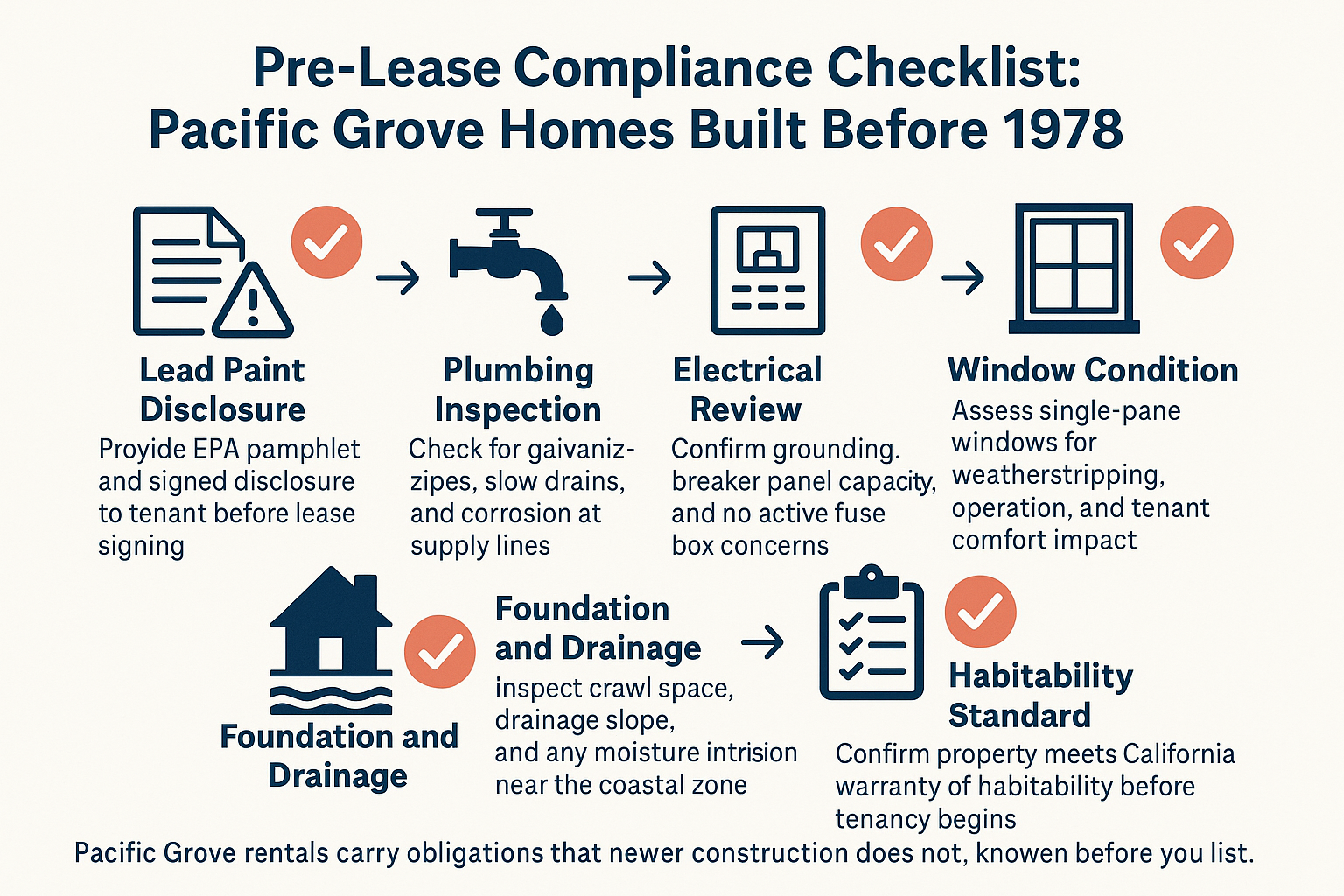
Long-Term Rentals vs. Short-Term Platforms: A Question I Hear Often
One question I field from Peninsula homeowners fairly regularly: what would my property rent for furnished versus unfurnished, and how does that compare to what I see on short-term platforms?
It is a fair question, and the honest answer has two parts.
First, the long-term rental market on the Monterey Peninsula is strong. Qualified tenants in this market, the kinds who stay for two or three years, pay on time, and treat the property well, are actively looking for housing and will pay for a well-managed, well-maintained home. Furnished long-term rentals can attract a premium in some cases, particularly for professionals relocating to the area for work. The specific number depends on the property, but Pacific Grove rents are meaningfully higher than comparable square footage in Salinas.
Second, and this is important: we manage long-term residential rentals only. We do not manage vacation rentals or short-term rentals on platforms like Airbnb or VRBO. I mention this because some owners contact us after running a property as a short-term rental and assume any management firm handles both. We do not. That is a deliberate choice, long-term tenancy management is its own specialized work, and it is what we know well.
For owners considering the long-term path, the practical advantages are worth understanding:
- Consistent monthly income without the occupancy variability of short-term platforms
- Longer tenant relationships, which reduce turnover cost and wear on the property
- Simpler compliance picture, short-term rentals in Monterey County now fall under an October 2024 county ordinance that adds its own regulatory layer
- Less day-to-day management intensity, particularly for owners who are relocating or managing from a distance
Several of the owners who have reached out to us from Pacific Grove and Carmel are in exactly that situation, relocating, retiring, or handling inherited properties, and the hidden workload behind managing a single rental home only grows more visible once you are not living nearby.
Pacific Grove Long-Term Rental: Key Considerations at a Glance
This table summarizes the practical differences owners should weigh when preparing a Pacific Grove home for long-term rental.
| Factor | What It Means for PG Owners | Why It Matters |
|---|---|---|
| Pre-1978 construction | Lead paint disclosure required by federal law | Non-compliance carries federal penalties regardless of local norms |
| Coastal zoning constraints | Very limited new rental inventory enters the market | Well-maintained properties hold strong negotiating position on rent |
| California AB 1482 | Statewide rent cap applies to many long-term residential rentals | Owners need to know exempt vs. covered status before setting rent increases |
| Warranty of habitability | Applies to every CA rental regardless of age or charm | Maintenance obligations cannot be waived in a lease |
| Tenant profile | Professionals, researchers, relocating families | Higher expectations around condition, communication, and management quality |
| Furnished vs. unfurnished | Both are viable; furnished may attract relocation tenants at a premium | Exact rent range depends on size, location, and condition, get a market analysis first |
What Tenant Screening Looks Like in This Market
Pacific Grove's tight inventory means well-priced, well-presented properties tend to attract multiple applicants. That is good for owners. But it also means the screening process matters more, not less.
A high volume of applicants does not automatically produce a great tenant. The difference between a good tenant and a great one starts before move-in, it comes down to the questions you ask, the documentation you verify, and how consistently you apply your screening criteria.
For a Peninsula rental in the price range typical of Pacific Grove, thorough screening should cover:
- Credit history and current debt obligations, not just a score
- Verifiable income, typically at a 3x monthly rent threshold
- Rental history, including direct contact with prior landlords rather than just references supplied by the applicant
- Employment verification, which matters especially for relocation tenants who may be starting new positions
California law places specific restrictions on how screening criteria can be applied, including rules under the California Fair Employment and Housing Act that govern what can and cannot be considered in a tenant decision. Getting this wrong, even unintentionally, exposes an owner to fair housing liability. In a high-rent market where the financial stakes per placement are significant, that risk deserves serious attention.
Frequently Asked Questions About Renting Out a Pacific Grove Home
Do I need to disclose lead paint for my Pacific Grove home if I've already repainted it?
Yes. Federal law requires disclosure if the home was built before 1978, regardless of how many times it has been repainted. The obligation is to disclose what you know about the presence of lead-based paint and provide the EPA informational pamphlet before the lease is signed. Repainting does not eliminate the underlying hazard or the disclosure requirement.
What does a Pacific Grove single-family home typically rent for?
It genuinely depends on the property, square footage, condition, number of bedrooms, proximity to the water, and whether it is furnished all factor in. What I can say is that Pacific Grove rents consistently run above the Salinas Valley average, often significantly. For an accurate rent estimate specific to your property, a local market analysis is the right starting point.
Can I rent my Pacific Grove home furnished for more money?
Sometimes, yes. Furnished long-term rentals can attract relocation tenants and professionals who need immediate housing, and those tenants may accept a higher monthly rent in exchange for not having to move furniture. But furnished rentals also carry additional considerations around inventory, wear, and lease terms. It is worth discussing the specific tradeoffs for your property before deciding.
I've been listing my home on Airbnb. Can a property manager take that over?
We focus exclusively on long-term residential rentals, we do not manage vacation or short-term rental properties. If you are transitioning from a short-term platform to a long-term lease arrangement, that is a conversation worth having. The two models have different income structures, different tenant relationships, and different compliance considerations.
Does California's AB 1482 rent cap apply to my Pacific Grove home?
AB 1482 applies to many California residential rentals but includes specific exemptions, single-family homes owned by individual landlords with proper notice, properties built within the last 15 years, and some others. Whether your property is covered or exempt depends on the specific circumstances. What new California landlord laws mean for Monterey County owners in 2026 covers the current landscape in more detail.
What if my home needs work before it can be rented?
That is a very common situation, especially with older Peninsula homes. The right approach is an honest assessment of what the property needs to meet California's habitability standard, what deferred maintenance exists, and what improvements would support the target rent range. Starting that conversation early, before you are under pressure to fill a vacancy, always produces better outcomes.
Ready to Talk Through What Your Pacific Grove Home Could Do as a Long-Term Rental?
Coast & Valley Properties has been working with property owners across the Monterey Peninsula since 2009, and we understand what makes Pacific Grove a distinct market, the compliance layer that comes with older homes, the tenant profile, and what it actually takes to protect a property at this price point. If you own a home in Pacific Grove, Carmel, or anywhere in Monterey County and want a straightforward conversation about long-term rental management, reach out at (831) 757-1270 or through the contact form at coastandvalleypm.com.