
What Full-Service Property Management Actually Covers — And What It Doesn't
A lot of property owners in Monterey County sign a management agreement expecting one thing — and discover something different when a problem surfaces. The phrase "full-service" gets used loosely in this industry, and the gap between what an owner assumes is handled and what's actually in the contract is where most frustrations start.
If you own a rental in Salinas, Carmel, Pacific Grove, or anywhere else in the county, understanding exactly what your property manager is — and isn't — responsible for protects you from expensive surprises. It also helps you evaluate whether the firm you're considering is actually offering what the label suggests.
This guide breaks down what full-service residential and commercial property management genuinely covers, where the common gaps are, and a few things that no property manager handles — no matter what they call their service.
What Full-Service Actually Means — The Core Services
A full-service property management firm should be handling every meaningful responsibility of ownership except writing checks and making major financial decisions. If you're still fielding maintenance calls at 10 p.m. or chasing down rent, something is missing from the arrangement.
On the residential side, a true full-service offering covers:
- Marketing and listing — professional photos, syndicated listing distribution, and active showing coordination
- Tenant screening — credit checks, background checks, income verification, and rental history review
- Lease preparation and negotiation — using California-compliant lease documents that protect the owner
- Rent collection — consistent monthly collection with clear grace period enforcement (California gives tenants 3 days after the due date before a lawful notice can be served)
- Maintenance coordination — fielding requests, dispatching vetted vendors, and tracking work to completion
- Property inspections — move-in, move-out, and periodic inspections to document condition and catch issues early
- 24/7 emergency response — someone available when a pipe bursts or a furnace fails at midnight
- Financial reporting — monthly owner statements, year-end summaries, and bill payment including mortgage, HOA fees, and utilities where applicable
For commercial properties, full-service typically adds lease compliance oversight, vendor coordination, and insurance coordination on top of the financial management functions.
The hidden workload behind managing a single rental home is real — and most of the items above represent tasks that self-managing owners either underestimate or handle inconsistently.

The California Compliance Layer — What It Adds to the Job
Managing a rental in Monterey County is not the same as managing one in Texas or Arizona. California's landlord-tenant laws are among the most layered in the country, and Monterey County adds local requirements on top of the state baseline.
A full-service property manager in this market is expected to stay current on and actively apply:
- AB 1482 (Tenant Protection Act) — statewide rent caps and just-cause eviction requirements that apply to most properties built before 2009
- City of Salinas Residential Rental Registration Ordinance (City Ord. 2663, 2024) — rental units in Salinas must now be registered, and failure to comply carries real penalties
- California warranty of habitability — owners are legally required to maintain habitable conditions; a missed repair can expose you to rent withholding or litigation
- Lead paint disclosure requirements — mandatory for properties built before 1978, and the paperwork must be documented correctly in the lease file
This is why what happens to your rental when California law changes mid-lease matters — and why a property manager who isn't tracking legislative updates is leaving you exposed.
A firm with deep local roots handles these requirements as part of the standard workflow. A national firm working from a template often doesn't know what's changed until a complaint or fine arrives. The difference in that knowledge base is not minor — multi-unit owners in Monterey County staying legally compliant often say compliance management alone is worth the management fee.
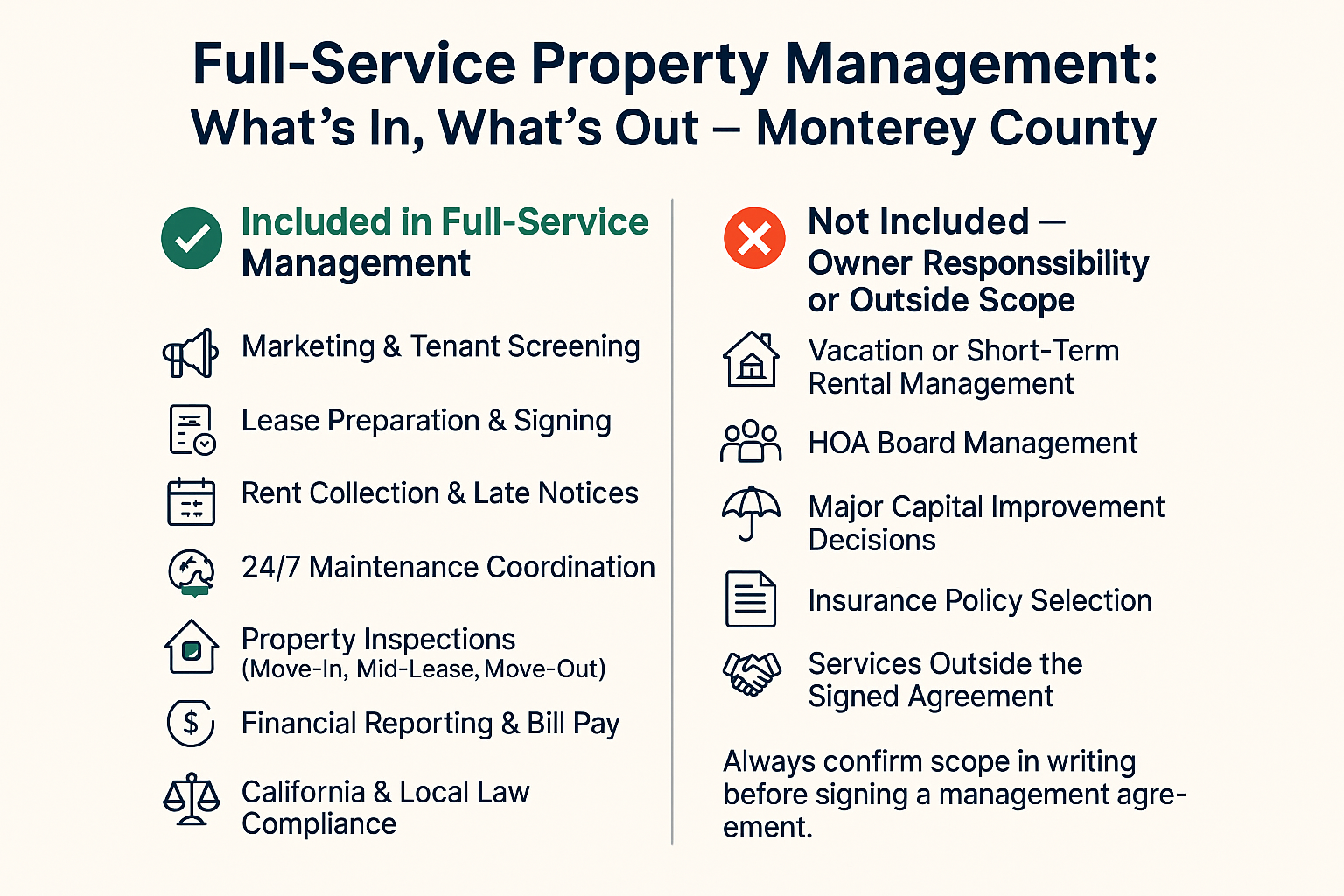
The Full-Service Management Scope at a Glance
This breakdown shows what falls inside and outside a full-service management agreement for Monterey County rental properties.
What Full-Service Property Management Does Not Cover
This is where assumptions get expensive. Owners sometimes expect their property manager to handle things that fall clearly outside any management agreement — or that no legitimate firm offers at all.
Short-term and vacation rental management is the most common example in this market. Given Monterey County's short-term rental ordinance that took effect in October 2024, platforms like Airbnb require a separate licensing and operational framework that residential property managers don't provide. If you want to run a vacation rental in Carmel-by-the-Sea or Pacific Grove, that's a different business model entirely — and a different type of operator.
HOA board management is another common misconception. A property manager handles the relationship between owner and tenant. Managing the rules, finances, and governance of a homeowners association is a separate specialty. These are distinct services, even when they share similar terminology.
Major capital decisions — whether to re-roof, replace an HVAC system, or renovate a kitchen — remain with the owner. A good property manager surfaces the need, provides vendor quotes, and advises based on market knowledge. But the decision and the funding are yours.
And anything not written into your management agreement simply isn't covered. Before signing, it's worth reading what the contract actually says — not what the conversation implied. Choosing the right property management company starts with understanding exactly what you're buying.
Full-Service Property Management: Covered vs. Not Covered
Use this as a quick reference when evaluating what a management firm in Monterey County should be handling for you.
| Service Area | Typically Covered | Notes |
|---|---|---|
| Tenant Marketing & Screening | Yes | Credit, background, income, and rental history checks |
| Lease Preparation | Yes | Must use California-compliant documents |
| Rent Collection | Yes | Includes late notices per CA law — 3-day grace period |
| Maintenance Coordination | Yes | Vendor dispatch, follow-up, and documentation |
| 24/7 Emergency Response | Yes | Should be available nights and weekends |
| Property Inspections | Yes | Move-in, mid-lease, and move-out |
| Financial Reporting & Bill Pay | Yes | Monthly statements, year-end summaries, utility/HOA payments |
| California Compliance (AB 1482, Ord. 2663) | Yes | Requires locally knowledgeable firm |
| Short-Term / Vacation Rental Management | No | Separate specialty — not residential property management |
| HOA Board Governance | No | Different service category entirely |
| Capital Improvement Decisions | No | Owner decides; manager advises and sources bids |
| Insurance Policy Selection | No | Owner responsibility; manager may flag coverage gaps |
Why the Scope of Services Matters More Than the Label
Two firms can both call themselves "full-service" and offer dramatically different things. One might handle maintenance coordination but not bill payment. Another might process rent but skip mid-lease inspections — which is a risk most owners don't realize until a tenant dispute arrives. When a single missed inspection becomes a six-figure problem isn't hypothetical in this market.
The right question isn't "do you offer full-service management?" It's a longer conversation about what specific tasks are performed, how often, by whom, and what happens when something goes wrong at 11 p.m. on a Saturday.
In a market as specific as Monterey County — with distinct neighborhoods from the Salinas Valley ag corridor to the Carmel Highlands — the depth of local knowledge behind those services matters just as much as the list of services itself. A firm that knows your neighborhood handles a maintenance issue in a Pebble Beach property differently than one in a Salinas multi-unit, because the tenant base, vendor relationships, and exposure levels are different.
Frequently Asked Questions About Full-Service Property Management
Does full-service management include paying my mortgage or HOA fees from rent?
It can — but only if it's written into your agreement. A true full-service firm should offer bill payment as part of the financial management function, which means they can pay your mortgage, HOA dues, and utilities directly from collected rent before disbursing your net proceeds. Confirm this is explicitly listed in the contract before assuming it's included.
Is tenant eviction included in a full-service agreement?
Serving legal notices — like a 3-Day Notice to Pay or Quit — is typically part of rent collection management. But the formal eviction (unlawful detainer) process in California courts usually involves additional legal fees and is handled by an attorney, not the property manager directly. Your manager should coordinate and guide the process, but legal costs are generally billed separately.
What's the difference between residential and commercial full-service management?
Residential management is built around tenant relationships, habitability, and California landlord-tenant law. Commercial management adds lease compliance oversight, insurance coordination, and sometimes more complex vendor relationships. The financial reporting functions overlap, but the regulatory environment and day-to-day demands are different enough that not every firm handles both well.
Does full-service management include short-term or vacation rentals?
No. Short-term rental management is a separate business model with its own licensing requirements, operational demands, and regulatory framework — especially following Monterey County's short-term rental ordinance that took effect in October 2024. Residential property managers handle long-term leases only.
How do I know if a firm is actually delivering full-service or just billing for it?
Ask for documentation. A legitimate full-service firm should be able to show you inspection reports, maintenance logs, financial statements, and a copy of your lease with all required California disclosures in place. Access to an owner portal where you can review activity in real time is also a strong indicator that they're actually doing the work — not just claiming to.
Want to Know Exactly What's Covered Before You Sign?
Coast & Valley Properties manages residential and commercial rentals across Monterey County — from Salinas and Seaside to Carmel and Pacific Grove — with a clearly defined scope of services and a team that stays current on California's regulatory requirements. If you want a straight answer about what full-service management looks like for your specific property, call us at (831) 757-1270 or reach out through the contact form at coastandvalleypm.com.

Why Experienced Salinas Owners Stop Managing Their Own Properties
Most Salinas property owners who start self-managing do it for one reason: they don't want to pay a management fee. That's understandable. But the owners who've been at it for three, five, or ten years tend to reach the same conclusion — the fee isn't the expensive part.
Monterey County's rental market has grown significantly more complex over the past few years. Between AB 1482 rent caps, the City of Salinas Residential Rental Registration Ordinance (Ord. 2663) passed in 2024, and the standard weight of California landlord-tenant law, self-managing a rental here is no longer something you can wing. The paperwork alone has changed.
This article focuses on the two or three things that actually push experienced owners over the edge — not every possible reason, but the real ones. If you've been managing your own property and wondering whether it still makes sense, this is worth reading.
The Legal Complexity That Catches Self-Managing Owners Off Guard
California is one of the most tenant-protective states in the country. That's not a criticism — it's just the reality of managing property here, and experienced owners know it.
What's changed recently is the pace of that regulation. The City of Salinas Rental Registration Ordinance, which took effect in 2024, requires landlords operating within city limits to register their rental units and maintain compliance with local habitability standards. Missing this registration doesn't just mean a fine — it can affect your ability to collect rent.
And that's on top of existing state law. AB 1482, California's Tenant Protection Act, caps annual rent increases at 5% plus local CPI for most properties built before 2007. It also limits the legal reasons you can remove a tenant — a concept called just cause for eviction. Getting either of these wrong, even accidentally, can expose you to significant liability.
Self-managing owners frequently run into problems in these areas:
- Applying a rent increase that exceeds the AB 1482 cap
- Serving a notice that doesn't meet California's strict formatting requirements
- Failing to provide required disclosures at lease signing (lead paint, Megan's Law, military ordinance, etc.)
- Missing the Salinas registration renewal window
For a deeper look at how mid-lease law changes affect your rental obligations, it's worth understanding that the rules can shift even on an existing tenancy. That's not something most self-managing owners are tracking in real time.

The Hidden Time Cost Most Owners Underestimate
When owners calculate the cost of self-management, they usually think about the management fee they're avoiding. What they rarely calculate is their own time — and what that time actually costs.
A single-family rental in Salinas generates, on average, somewhere between 15 and 30 hours of owner time per year during a stable tenancy. That number spikes sharply during a turnover: advertising the vacancy, fielding calls, showing the property, screening applicants, preparing the lease, doing the move-in inspection, and coordinating any repair work between tenants.
A realistic turnover cycle in the Salinas market can easily consume 40 to 60 hours of owner time. And if the unit sits vacant for even three weeks between tenants at an average rent of $2,200 to $2,600 per month, you've already absorbed more in lost rent than most management fees would have cost for the year.
The hidden workload behind managing a single rental home breaks this down in more detail — but the short version is that most owners are working for free, or close to it, once you account for their time honestly.
The owners who stick with self-management longest tend to be retired or otherwise available during business hours. For anyone with a full-time job or a family, the math gets uncomfortable quickly.
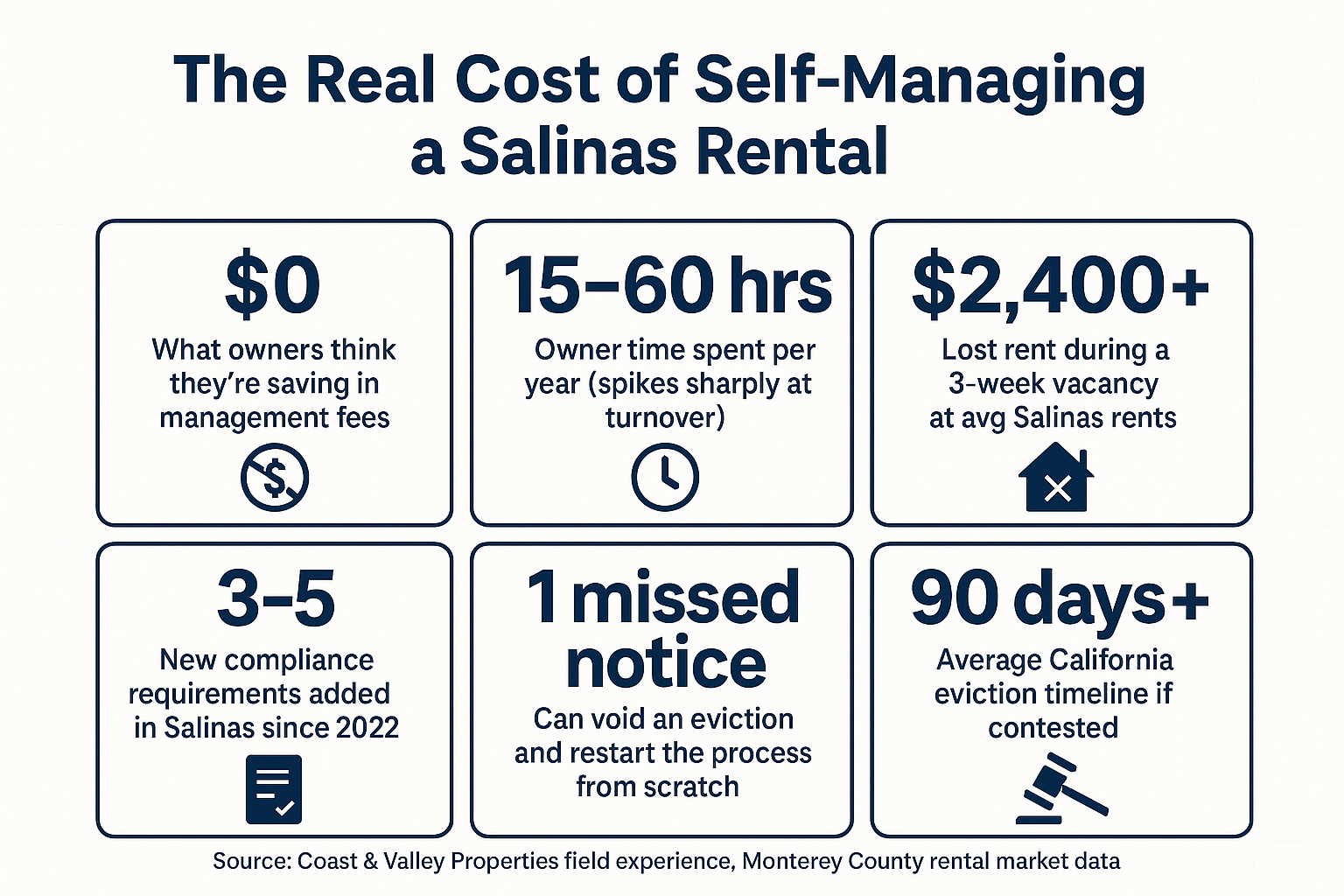
What Self-Managing a Salinas Rental Actually Costs Per Year
This infographic breaks down the real annual cost of self-management — in time, money, and legal exposure — compared to what most owners assume.
The Tenant Problem That Finally Changes the Calculation
For most experienced owners, the turning point isn't a legal fine or an accountant's warning. It's a bad tenant experience — and the realization of how much damage a single poorly screened tenant can do.
In California, once a tenant is in place, removing them is a legal process. Even a tenant who stops paying rent cannot be removed without proper notice, proper service, and — if they contest it — a court proceeding. In Monterey County, a contested eviction can take 90 days or more from notice to lock change. During that window, you're absorbing lost rent, legal fees, and often damage repair costs.
The difference between a tenant who stays four years and pays on time versus one who lasts eight months and leaves with $8,000 to $15,000 in damages and unpaid rent almost always comes down to screening. Not just a credit check, but how the application process is structured, what questions get asked, what references actually say, and how experienced the screener is at reading the picture those pieces form together.
The difference between a good tenant and a great one starts before move-in — and that process is harder to do well when you're not doing it every week. A professional screening system, run by someone who reviews dozens of applications a year, catches things a self-managing owner with one vacancy every few years is more likely to miss.
Many of the owners we speak with can trace their decision to stop self-managing to one specific tenant story. The fee they were saving was never the issue — they just needed that lesson to see it clearly.
Self-Managing vs. Professional Management: Where the Real Differences Show Up
This isn't a feature list — it's a look at where the two approaches produce different outcomes in the Monterey County market.
| Area | Self-Managing Owner | Professional Management |
|---|---|---|
| Compliance tracking | Owner responsible for monitoring law changes | Tracked continuously; lease updates applied proactively |
| Salinas rental registration | Owner must self-register and renew | Managed as part of full-service oversight |
| Tenant screening | Varies — typically one vacancy every few years | Standardized process run on every applicant |
| Rent increase timing | Often missed or applied incorrectly under AB 1482 | Calculated and documented per state requirements |
| Maintenance response | Dependent on owner availability | Coordinated through vetted vendor network, 24/7 emergency line |
| Eviction process | Owner must hire attorney, manage timeline | Handled or directly coordinated by experienced broker |
What Experienced Owners Say They Wish They'd Known Earlier
When owners who've made the switch look back, a few things come up consistently.
First, they underestimated how much California law would change over a five-year window. AB 1482 was passed in 2019. The Salinas registration ordinance came in 2024. Owners who were self-managing comfortably in 2018 were managing a meaningfully different legal landscape by 2025 — and not all of them knew it.
Second, they didn't have a reliable vendor network. When a water heater fails at a Salinas property on a Friday evening, the owner who has a trusted plumber's direct line is in a very different position than the one calling around to whoever answers. Response time protects the property and the tenant relationship.
Third — and this one surprises people — they underestimated how much they'd benefit from having a licensed broker between them and their tenant. When a tenant raises a habitability concern, or hints at a legal complaint, having a professional fielding that communication matters. It changes the tone and the outcome.
For owners considering what a property management company actually does day to day, the answer goes well beyond rent collection and maintenance calls.
Frequently Asked Questions About Stopping Self-Management in Salinas
At what point does self-managing stop making financial sense?
For most Salinas owners, the math shifts when you factor in the time cost of a vacancy, the risk exposure from a compliance mistake, or the actual cost of a bad tenant situation. A management fee that runs 8–12% of collected rent often costs less than a single eviction or a month of vacancy. The calculation is different for every owner, but it's rarely as simple as 'I'm saving X per month.'
Do I have to register my rental property with the City of Salinas?
Yes. The City of Salinas Residential Rental Registration Ordinance (Ord. 2663), effective 2024, requires landlords with rental units within city limits to register. Failure to register can affect your legal standing as a landlord. The requirements are separate from any state-level compliance obligations under California law.
Can I switch to professional management mid-lease?
Yes — and it's more common than people expect. A tenant doesn't need to sign a new lease for management to transfer. The owner simply executes a management agreement, the management company introduces itself to the tenant in writing, and rent payments redirect to the new account. The transition is handled carefully so the tenant relationship stays intact.
What happens to my tenant relationships when I bring in a manager?
Good tenants rarely mind the change — they get a professional point of contact who responds faster and handles maintenance more efficiently. The communication style matters more than the structure. A well-run management company keeps the relationship professional and responsive, which most tenants prefer over the variability of dealing directly with an individual owner.
Is it harder to self-manage a multi-unit property than a single-family home?
Considerably harder. With multiple units, you're managing staggered lease renewals, multiple maintenance streams, and the interpersonal dynamics between tenants. California's just cause eviction rules under AB 1482 apply to most multi-unit buildings, and compliance across multiple units multiplies the documentation burden. How multi-unit owners in Monterey County stay legally compliant covers this in more depth.
Thinking About Making the Switch?
If you're an owner in Salinas, Monterey, Carmel, or anywhere across Monterey County who's been managing your own property and wondering whether there's a better way, Coast & Valley Properties is worth a conversation. We've worked with owners who managed successfully for years before deciding the legal complexity or the time burden finally tipped the scale — and we can give you an honest picture of what professional management would actually look like for your specific property. Reach us at (831) 757-1270 or through the contact form at coastandvalleypm.com.

How Well Does Your Property Manager Actually Know Your Neighborhood?
Most property owners evaluate a management company on price, responsiveness, and reviews. Those things matter. But there's a question that gets skipped more often than it should: does this company actually know the block my property sits on?
In Monterey County, that question carries real weight. A rental home in Salinas's Alisal neighborhood operates in a completely different regulatory and market environment than a property in Pacific Grove or Carmel. The rent ceilings differ. The tenant pool differs. The inspection requirements and local ordinances differ. A manager who can't tell you why those differences matter probably isn't tracking them closely enough to protect you.
This article breaks down what genuine local knowledge looks like in practice — and what it costs you when your property manager is working from generic templates instead of real street-level familiarity.
What 'Local Knowledge' Actually Means for a Rental Property
It's easy for any management company to say they know the area. The question is whether that knowledge shows up in the decisions they make on your behalf.
Real local knowledge has three practical dimensions:
- Rental pricing accuracy — knowing what a three-bedroom on Natividad Road actually rents for right now, not what an algorithm estimates based on zip code data
- Tenant pool awareness — understanding the seasonal employment patterns in Salinas's agricultural economy, or the military rotation cycles tied to the Presidio of Monterey, and how those affect tenant stability and turnover timing
- Regulatory specificity — tracking city-level rules like the City of Salinas Residential Rental Registration Ordinance (City Ord. 2663, enacted 2024), which requires landlords to register rental units and meet ongoing inspection standards, separate from state-level obligations
A manager working remotely from a dashboard in another city doesn't have this. They have data. There's a meaningful difference between the two.
Pricing is where the gap shows up fastest. Set the rent $150 too high and the unit sits vacant for six weeks — that's more than most owners would save in a year of management fees. Set it $150 too low and you've left money on the table for 12 months. Both mistakes come from not knowing the neighborhood well enough. You can read more about what separates a local property manager from a national firm and why it matters in this specific market.

The Compliance Problem That Out-of-Area Managers Miss Most Often
California landlord-tenant law is complicated on its own. Layer in Monterey County's local rules and the compliance surface area gets significantly larger.
AB 1482, the Tenant Protection Act, caps annual rent increases for qualifying properties at 5% plus local CPI, or 10% — whichever is lower. But whether your property is even subject to AB 1482 depends on factors like the age of the structure and ownership type. A manager who doesn't understand those exemptions may either over-restrict your rent increases or expose you to a wrongful increase claim.
Then there's the Salinas rental registration requirement. As of 2024, rental properties in the City of Salinas must be registered under City Ordinance 2663, and owners face penalties for non-compliance. A property manager unfamiliar with this ordinance may not have flagged it during onboarding — which means you could be out of compliance without knowing it.
Inspections are where these gaps compound. A missed inspection isn't just an administrative inconvenience. As we've covered before, a single missed inspection can become a six-figure problem when deferred maintenance meets tenant habitability claims. A locally grounded manager knows which city programs trigger mandatory inspections and schedules proactively — not reactively.
For owners with multiple units, the compliance picture gets more complex still. How multi-unit owners in Monterey County stay legally compliant is a question worth understanding before a problem surfaces, not after.
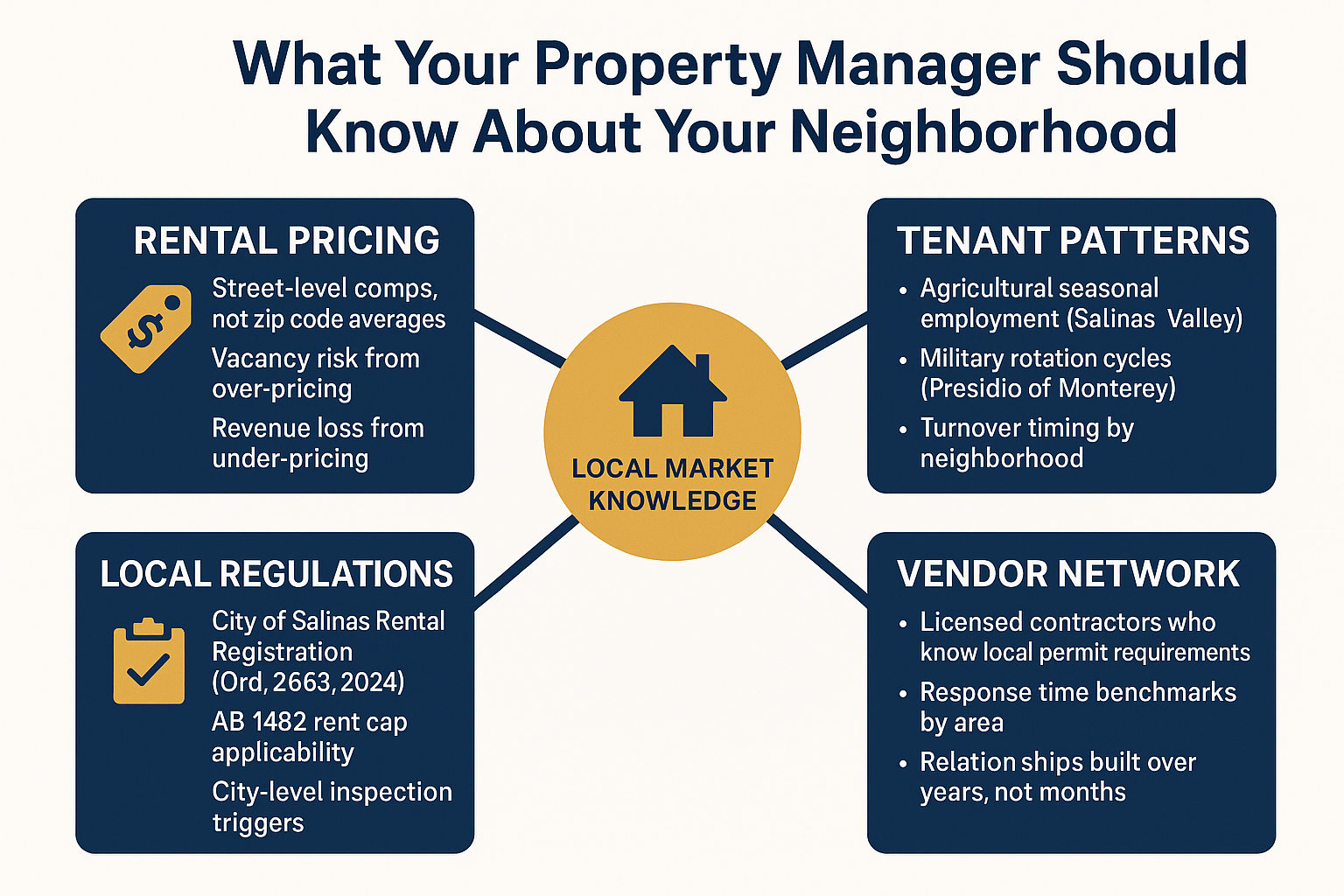
What Local Market Knowledge Actually Covers
This infographic breaks down the four areas where genuine neighborhood knowledge directly affects your rental property's performance and legal standing.
The Vendor Network Problem Nobody Talks About
When something breaks at your rental — a water heater fails on a Saturday night in Monterey, or an HVAC unit goes down during a Salinas heat spell — your property manager's local vendor relationships are the only thing standing between a quick fix and a week of tenant complaints.
A manager with deep local roots has spent years building relationships with licensed plumbers, electricians, roofers, and HVAC technicians who know Monterey County's permit requirements and show up when called. Those relationships matter because good contractors in this market are busy. They prioritize clients whose management companies send them consistent work and pay invoices on time.
A national firm or a manager who handles properties across multiple counties doesn't have those relationships in your specific area. They're pulling from a general vendor list and hoping for the best. That's fine until it isn't — and when it isn't, it's usually your tenant calling you directly because nobody showed up.
Responsive maintenance also affects tenant retention more than most owners expect. A tenant who sees fast, professional repairs stays longer. One who waits two weeks for a plumber starts shopping for a new place. The hidden workload behind managing a single rental home includes exactly this kind of coordination — and it only works smoothly when the manager has the right people on speed dial.
Local Knowledge vs. Generic Management: What Changes in Practice
These aren't abstract differences. Each row reflects a real decision that gets made differently depending on whether your property manager actually knows your market.
| Decision Point | Generic/Remote Manager | Locally Grounded Manager |
|---|---|---|
| Rental pricing | Relies on algorithm or regional averages | Sets rent based on current comps within the same neighborhood |
| AB 1482 compliance | Applies standard increase across all units | Evaluates each property's exemption status individually |
| Salinas rental registration | May not track city-level ordinances | Flags Ord. 2663 at onboarding and handles registration |
| Maintenance response | Dispatches from a general vendor list | Calls established local contractors with priority relationships |
| Tenant screening | Runs standard national background check | Screens against local employment patterns and references |
| Inspection scheduling | Follows a generic annual schedule | Schedules around city program triggers and property age |
How to Actually Test a Property Manager's Neighborhood Knowledge
Before signing a management agreement, ask specific questions. The answers — or the lack of them — tell you everything.
A few questions worth asking:
- "What did comparable properties in this neighborhood rent for in the last 90 days?" — A manager who knows your market can answer this without checking a website.
- "Is this property subject to AB 1482?" — They should be able to explain why or why not based on the year the structure was built and how it's owned.
- "Does this city require rental registration, and are we currently compliant?" — If they don't know about Salinas Ord. 2663 or Monterey County's local requirements, that's a gap worth noting.
- "Who are your go-to plumbing and HVAC contractors in this area, and how long have you worked with them?" — Specific names and multi-year relationships are a good sign. A vague answer is not.
These aren't trick questions. A locally experienced manager answers them easily because the information is part of how they already think about their work. Choosing the right property management company comes down to exactly this kind of due diligence — not just checking whether they're licensed, but whether they're genuinely embedded in the market where your property sits.
If you're self-managing right now and considering making a change, what Salinas property owners get wrong about self-managing is worth reading before that conversation.
Frequently Asked Questions About Property Manager Local Knowledge
Does it really matter if my property manager is based locally, as long as they're responsive?
Responsiveness matters, but it's not a substitute for local knowledge. A manager based outside Monterey County may return your calls promptly but still price your rental based on regional averages, miss a Salinas-specific compliance requirement, or send a vendor who isn't familiar with local permit processes. Being reachable and being knowledgeable are two different things.
How does the Salinas rental registration ordinance affect me as a property owner?
Under City Ordinance 2663, enacted in 2024, residential rental properties within the City of Salinas must be registered with the city. There are ongoing compliance requirements tied to the program, including inspections. Failure to register or maintain compliance can result in penalties. Your property manager should have flagged this at onboarding and handled the registration process on your behalf.
What does AB 1482 mean for my rental property in Monterey County?
AB 1482 limits annual rent increases for covered properties to 5% plus local CPI, with a maximum of 10%. But not every property is covered. Single-family homes owned by individual landlords who provide proper notice may be exempt. Condos and multi-unit buildings generally are covered if the structure is more than 15 years old. A manager who doesn't understand these exemptions may be leaving rent increase capacity on the table — or exposing you to a wrongful increase claim.
Can a property manager really make a difference in tenant quality?
Yes — and it starts before a single showing is scheduled. Accurate local pricing attracts more qualified applicants. Proper screening that accounts for local employment patterns filters out higher-risk candidates. A manager who understands the Salinas tenant pool, including the seasonal nature of agricultural employment or the stability patterns tied to healthcare and education sectors, makes better screening decisions. The difference between a good tenant and a great one starts before move-in — and local knowledge is a big part of how that gap gets closed.
What should I ask about vendor relationships when interviewing a property manager?
Ask for specific contractor names, how long they've worked together, and whether those vendors are licensed and insured in California. Ask how quickly they typically respond to emergency calls and whether they have backup vendors when a primary contractor isn't available. Vague answers about a 'network of trusted vendors' are not the same as being able to name the plumber they've called for the last six years.
Want to Know If Your Property Is Being Managed With the Right Local Expertise?
Coast & Valley Properties has been managing residential and commercial properties throughout Monterey County since 2009 — with direct knowledge of Salinas, Monterey, Carmel, Pacific Grove, and the surrounding communities that only comes from doing this work here, every day. If you have questions about your property's compliance status, current rental pricing, or what a locally grounded management relationship actually looks like, we're happy to have that conversation. Reach us at (831) 757-1270 or through the contact form at coastandvalleypm.com.

What Separates a Local Property Manager From a National Firm?
Most property owners in Monterey County start their search the same way — they Google a few names, get some calls back, and assume the big national brand is the safer choice. After all, a company with offices in 30 states must know what they're doing, right?
But California rental law is not like rental law anywhere else. The City of Salinas has its own registration ordinance. AB 1482 caps rent increases on a long list of properties here that wouldn't qualify in other states. What a regional call center in Phoenix doesn't know can cost you thousands of dollars in fines, legal fees, or lost rent.
This article breaks down the two or three things that actually separate a local property manager from a national firm — not in theory, but in the decisions that get made on your property every week.
What a National Firm Actually Looks Like From the Owner's Side
National property management companies are not bad at what they do. They've built systems that work across markets at scale — standardized lease templates, automated rent collection, 1-800 maintenance lines. For a basic rental in a low-regulation state, that's probably fine.
But when you hand a Carmel-area duplex or a Salinas fourplex to a firm running hundreds of properties through a centralized system, a few things tend to happen:
- Your property gets assigned to a local franchise owner or regional manager who may or may not have deep California experience
- Lease terms get generated from a national template that may miss California-specific disclosures like lead paint, mold, or AB 1482 exemption notices
- Maintenance decisions get routed through a vendor network that doesn't know local contractors — meaning slower response times and higher costs on repairs
- Owner communication happens through a portal, not a person, and escalations can take days
For a straightforward rental in a simple market, that might be acceptable. But Monterey County is not a simple market. What Salinas property owners get wrong about self-managing applies equally to owners who outsource to the wrong firm — the risks don't disappear just because someone else is handling the paperwork.

Why California Compliance Is a Local Knowledge Problem
California has some of the most layered landlord-tenant law in the country — and Monterey County adds its own requirements on top of that.
Take the City of Salinas Residential Rental Registration Ordinance (Ordinance 2663), which went into effect in 2024. It requires rental property owners operating within city limits to register their units, pay annual fees, and meet inspection standards. A national firm that manages properties across multiple states is unlikely to track a single city's new ordinance proactively — and missing a registration deadline can mean fines starting at $250 per day.
Then there's AB 1482, California's Tenant Protection Act. It applies to most multi-family properties that are more than 15 years old and limits annual rent increases to 5% plus local CPI — a number that changes year to year. Applying the wrong increase, even accidentally, exposes you to wrongful eviction claims.
A local manager who works exclusively in Monterey County follows these changes the same way a local tax attorney follows IRS updates — because their clients' exposure is directly tied to staying current. How multi-unit owners in Monterey County stay legally compliant goes deeper on exactly what that compliance picture looks like for portfolio owners here.
This is not something you can replicate with a checklist from a national compliance team. Local law changes fast, and the people who catch it first are the ones with relationships inside the market.
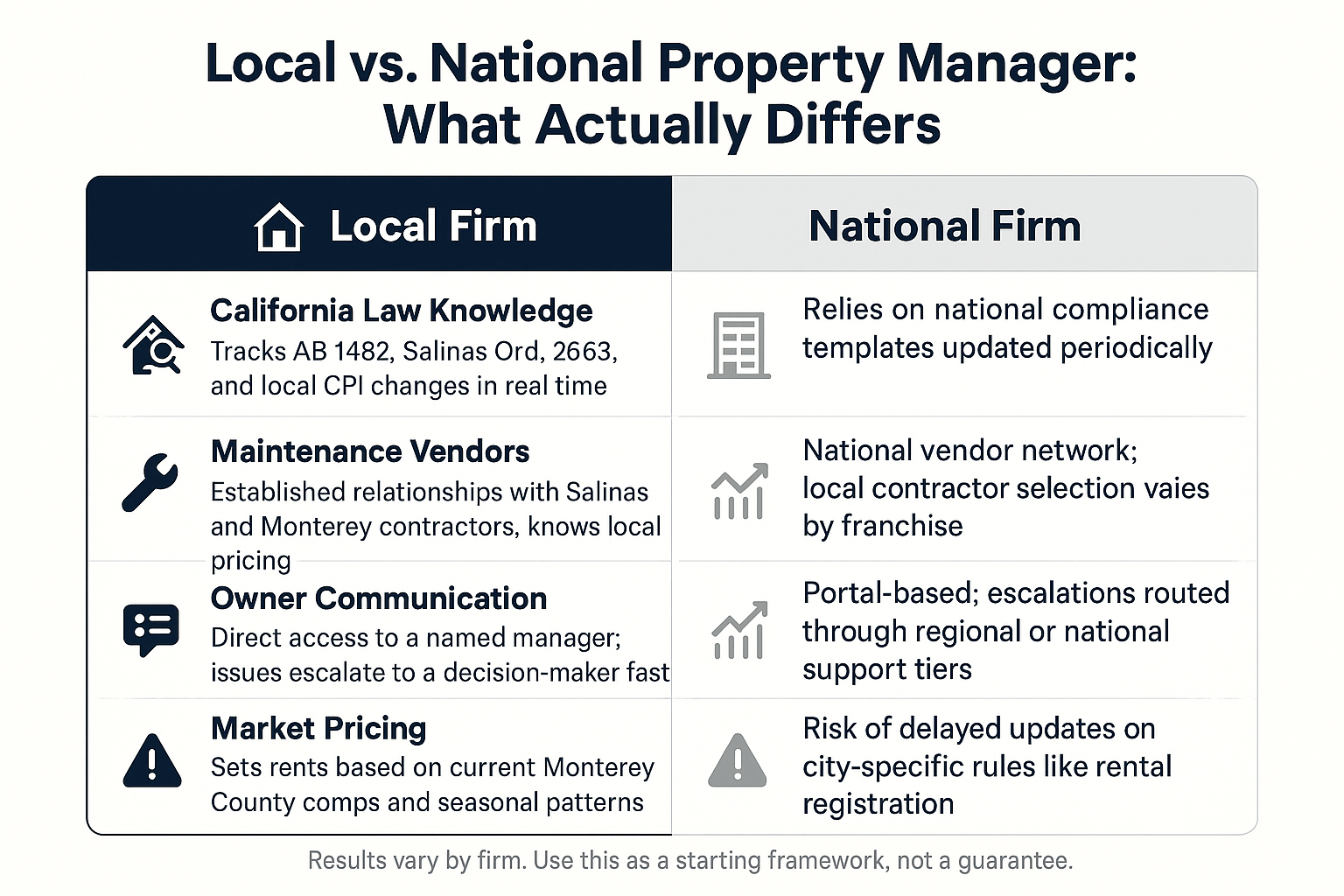
Local vs. National Property Manager: Side-by-Side
This comparison shows how local and national property management firms typically differ across the decisions that matter most to Monterey County property owners.
The Vendor Network Problem (and Why It Costs You Money)
One of the least-discussed differences between local and national property management is who actually shows up to fix things at your property.
A national firm typically uses a managed vendor network — a list of contractors who've agreed to standardized pricing in exchange for volume work. On paper, that sounds efficient. In practice, it often means slower response times, contractors who are stretched thin across a wide area, and pricing that doesn't reflect local market rates.
In the Salinas and Monterey market, a skilled licensed plumber typically runs $125–$175 per hour for service calls. A property manager with long-standing local relationships can often get priority scheduling and fair pricing because they're sending repeat business. A national firm's vendor portal doesn't build that kind of relationship.
The stakes are highest in emergencies. A burst pipe in a Pacific Grove rental at 9pm on a Friday needs someone who knows the market — not a dispatch center trying to find an available contractor in a zip code they service once a month. When a single missed inspection becomes a six-figure problem illustrates exactly how maintenance gaps escalate when the right people aren't watching.
Local managers also tend to have better instincts about when to repair vs. replace, because they've seen what holds up in the coastal climate here — salt air, fog moisture, and temperature swings that affect materials differently than they would in Sacramento or San Diego.
How Key Decisions Typically Differ by Firm Type
This table summarizes how local and national firms tend to handle the decisions property owners care most about — based on how these firms generally operate, not a guaranteed outcome.
| Decision Area | Local Property Manager | National Property Manager |
|---|---|---|
| Lease compliance (CA-specific) | Drafted with current state and local law in mind | Template-based; may require owner review for local gaps |
| Rent pricing | Set using current Monterey County comps | Often set using automated valuation tools |
| Maintenance response | Local contractors, established relationships | National vendor network, variable local coverage |
| Regulatory updates | Tracked and applied as local law changes | Updates may lag by weeks or months |
| Owner communication | Direct line to a named manager | Portal-based with tiered support structure |
| Tenant screening | Familiar with local rental market and applicant norms | Standardized national criteria applied uniformly |
What 'Local Knowledge' Actually Means for Your Rental Income
Setting the right rent is not a math problem. It's a judgment call that requires knowing what's happening in Salinas right now — not what Zillow's algorithm thinks based on data that's 60 to 90 days stale.
Monterey County has distinct micro-markets. A three-bedroom house near Natividad Medical Center in Salinas rents for a different price than a comparable home near Hartnell College — and both of those are different from a unit in Pacific Grove or a commercial space on Alvarado Street in Monterey. Getting the price wrong by even $75–$100 per month adds up to $900–$1,200 in missed revenue over the course of a year.
Beyond pricing, a local manager understands the seasonal patterns that affect the Monterey Bay rental market — the way inventory tightens in late summer as families want to be settled before the school year, or the slower absorption rate for higher-end rentals in December and January. That timing affects when you list, how you price, and how much vacancy you absorb.
Tenant selection is part of this too. The difference between a good tenant and a great one starts before move-in — and local experience shapes how you read an application, not just which boxes get checked on a screening form.
Frequently Asked Questions About Local vs. National Property Management
Are national property management companies less expensive than local ones?
Sometimes the advertised management fee is lower, but the total cost often isn't. National firms frequently charge separately for lease renewals, maintenance coordination markups, vacancy fees, and advertising. A local firm with a slightly higher base fee may cost less overall because the ancillary charges are fewer. Always compare the full fee structure, not just the monthly percentage.
What happens if my national property management company doesn't know about the Salinas rental registration ordinance?
You're still liable. City of Salinas Ordinance 2663 holds the property owner responsible for compliance — not the management company. If your manager misses the registration deadline, the fines come to you. This is one of the clearest arguments for working with a firm that operates specifically in this market and tracks local ordinances as part of their regular workflow.
Can a local property manager really compete with the technology a national firm offers?
Yes. Most reputable local property management firms today use the same professional software platforms — AppFolio, Buildium, Propertyware — that national chains use. Owner and tenant portal access is standard. The technology gap that existed ten years ago largely doesn't exist anymore. What local firms offer that software can't replicate is judgment — and that's what you're actually paying for.
Is a local property manager the right choice for a small portfolio — say, one or two rentals?
A boutique local firm is often the best fit for owners with one to five properties, because your portfolio gets real attention rather than being a small account inside a large system. National firms build their margins on volume; a single Carmel rental isn't going to be anyone's priority. A local firm that specializes in Monterey County treats every property as a meaningful part of their business.
How do I evaluate whether a local property management company actually knows California law?
Ask them directly. A firm with real California compliance knowledge should be able to explain AB 1482 coverage thresholds, what properties are exempt, and how they handle mid-lease law changes. Ask how they handled the rollout of the Salinas rental registration ordinance in 2024. If they can answer those questions in plain language without hesitating, they're operating at the right level. What happens to your rental when California law changes mid-lease is a good reference point for what that knowledge should actually look like in practice.
Ready to Work With a Team That Knows Monterey County?
Coast & Valley Properties has managed rental properties across Salinas, Monterey, Carmel, Pacific Grove, and the broader Monterey County area since 2009 — and that depth of local experience is something no national franchise can replicate. If you'd like to talk through your property and what full-service local management would look like, you can reach our team directly at (831) 757-1270 or through the contact form at coastandvalleypm.com.

When a Single Missed Inspection Becomes a Six-Figure Problem
Most Monterey County landlords don't lose money all at once. They lose it slowly — one skipped walkthrough, one unnoticed leak, one tenant who said everything was fine when it wasn't. By the time the damage is visible, the bill is already deep into five or six figures.
California law doesn't give landlords much grace here. Under the warranty of habitability, you're legally responsible for conditions at your property whether you knew about them or not. That distinction matters enormously in a dispute — and in a courtroom.
This article covers how missed inspections turn into real financial exposure, what the law actually requires of Monterey County owners, and what a professional inspection process looks like compared to the informal check-ins most self-managing landlords rely on.
How Undetected Damage Compounds Over Time
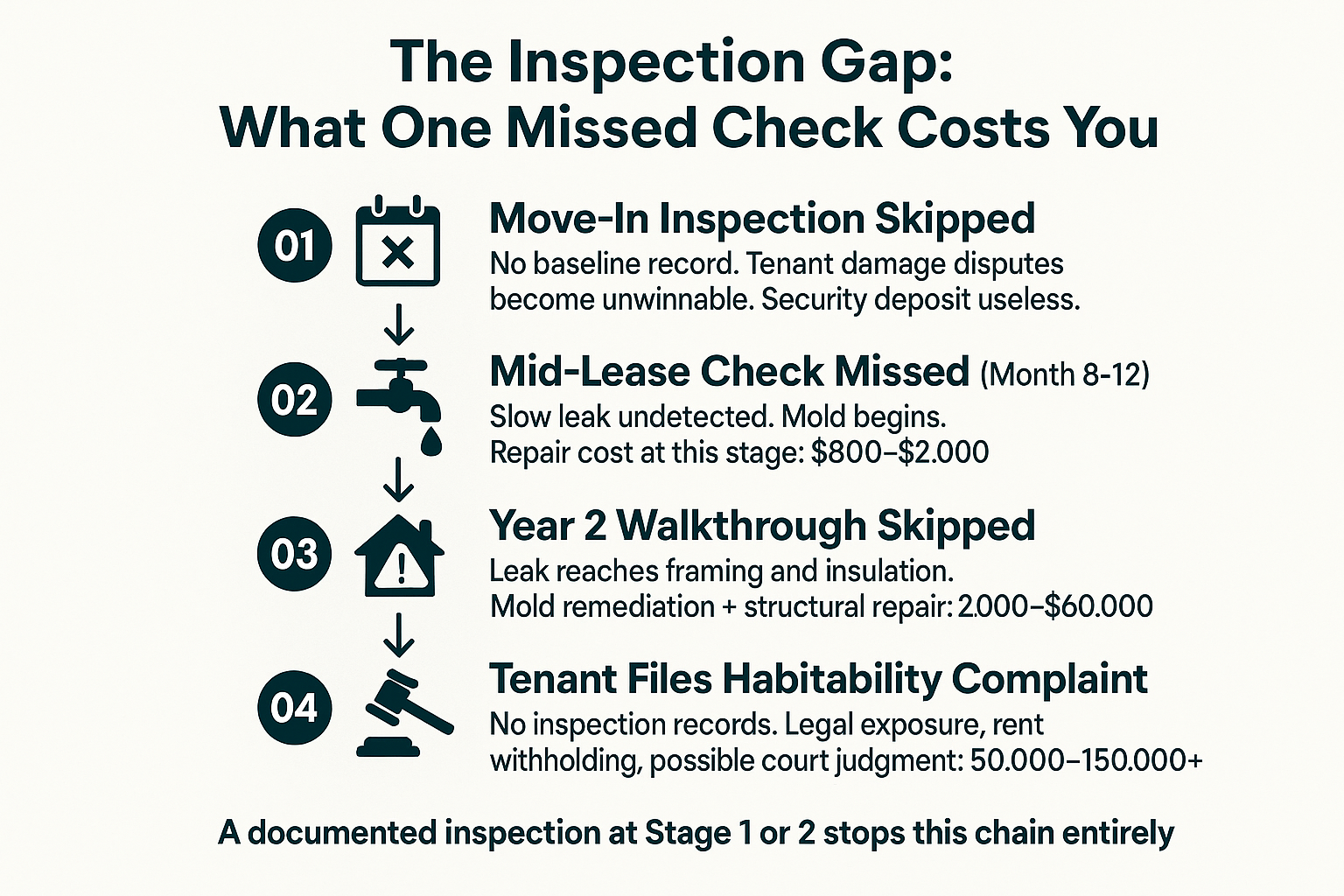
A slow roof leak in a Salinas rental might cost $800 to $1,200 to fix if caught in year one. Left alone for two to three years — which is common when owners skip regular inspections — that same leak can destroy insulation, rot structural framing, and trigger mold remediation. At that point, you're looking at $30,000 to $80,000 depending on the scope, and that estimate doesn't include tenant displacement, temporary housing costs, or lost rent during repairs.
The damage categories that compound fastest in Monterey County's climate include:
- Roof and flashing failures — coastal fog and seasonal rain accelerate deterioration, especially on older homes near Pacific Grove or the beach corridors
- Plumbing slow leaks — inside walls and under slabs, invisible for months until drywall fails
- HVAC neglect — filter buildup leads to coil freeze, refrigerant loss, and eventual compressor failure, typically $3,500 to $6,000 to replace
- Pest intrusion — termites and rodents move fast in Central Coast properties with wood-frame construction; quarterly gaps in inspection let infestations establish
- Deferred tenant-caused damage — scuffs become gouges, small holes become structural concerns, and unreported modifications become your liability
None of these problems announce themselves. They surface when a tenant finally calls — or when you walk in after they leave. What a property manager looks for during a rental walkthrough covers the specific items that separate a professional inspection from a casual visit.

California Law and What It Actually Requires
California's warranty of habitability under Civil Code 1941 doesn't require you to be negligent to be liable. It requires only that the condition existed at your property. If a tenant can show they lived with a habitability problem — broken heat, water intrusion, mold — and that you had reasonable opportunity to discover and fix it, the legal exposure is substantial.
In practice, landlords who lack documented inspection records are in a much weaker position than those who can show a written inspection history. Courts and arbitrators look at what you knew, when you knew it, and what you did about it. A binder of dated, signed inspection reports is your paper trail. An informal memory of "checking in" is not.
Monterey County owners also need to be aware of the City of Salinas Residential Rental Registration Ordinance (Ordinance 2663), adopted in 2024, which requires rental property registration and creates a framework for city-initiated inspections. Failing to register or maintain compliant records puts owners at risk of fines and can complicate any future dispute — even one that originates from a civil habitability claim rather than a code complaint.
For a deeper look at how state and local regulations interact for multi-unit owners, how multi-unit owners in Monterey County stay legally compliant breaks down the compliance picture in practical terms.
The Inspection Gap: How Small Problems Become Large Losses
This infographic maps how a single missed inspection at each stage of a tenancy translates into a specific, predictable financial outcome.
What a Professional Inspection Process Actually Looks Like
There's a meaningful difference between a landlord stopping by and a structured property inspection. The first is a social call. The second is a documented risk management event.
A professional inspection process includes:
- A written baseline at move-in — room-by-room condition notes, photos with timestamps, and a signed acknowledgment from the tenant
- Mid-lease walkthroughs at 6 to 12-month intervals — with 24-hour written notice per California Civil Code 1954, documented findings, and any repair requests issued in writing
- Move-out inspection with cost documentation — compared directly against the move-in baseline to support any security deposit deductions
- Vendor follow-up records — written confirmation that flagged repairs were completed, with receipts and dates
This isn't bureaucracy. It's the documentation that determines whether you win or lose a dispute.
Self-managing owners often skip the written records, either because they trust their tenants or because it feels like unnecessary paperwork. But California's security deposit rules under Civil Code 1950.5 require itemized written documentation to justify any deduction — and without a move-in baseline, even a legitimate claim can fall apart. What Salinas property owners get wrong about self-managing covers this pattern in detail, including why good landlords still end up in bad situations.
Inspection Frequency and What Each Stage Protects
This table shows the three inspection points in a standard tenancy, what each one documents, and what financial exposure it protects against.
| Inspection Stage | What It Documents | Financial Risk It Mitigates |
|---|---|---|
| Move-In Baseline | Pre-existing condition, tenant acknowledgment, timestamped photos | Security deposit disputes, tenant damage claims, liability for pre-existing defects |
| Mid-Lease Walkthrough (6–12 months) | Maintenance needs, lease compliance, early damage identification | Compounding repair costs, habitability complaints, deferred maintenance liability |
| Move-Out Inspection | Condition changes since move-in, cost documentation for deductions | Security deposit litigation, small claims disputes, unreturned unit preparation costs |
The Legal Risk That Gets Overlooked Most Often
Landlords tend to think about inspection failures in terms of repair costs. But the deeper exposure is often legal — specifically, a tenant's right to withhold rent or pursue damages under California's repair-and-deduct provisions.
Under Civil Code 1942, a tenant can spend up to one month's rent on repairs for habitability issues and deduct that amount from rent — without your approval — if you failed to address the problem within a reasonable time after notice. In Salinas, where average rents on single-family homes run $2,200 to $3,000 per month, that deduction right adds up fast. And it doesn't require a lawsuit to trigger.
More serious habitability failures — mold, heating failure in winter, persistent water intrusion — can open the door to rent withholding claims that go months before resolution. By then, you've lost rental income, paid for emergency repairs, and possibly spent on legal defense. The total frequently exceeds $50,000 before any judgment is entered.
This is why documentation at every inspection stage isn't just good practice. It's your primary defense. And it's worth reading why eviction rules make tenant disputes harder for Monterey County landlords to understand how the eviction framework connects to habitability disputes in this market specifically.
Carbon Monoxide, Smoke Detectors, and Items You Can't Miss
Beyond physical damage, there's a category of inspection items that carry direct statutory liability: life-safety equipment.
California requires working smoke detectors in every bedroom and on every level of a rental unit. Carbon monoxide detectors are required in any unit with an attached garage, gas appliance, or fireplace — which covers the vast majority of Monterey County rental homes. These aren't optional upgrades. Failure to maintain them creates liability exposure that insurance doesn't always cover cleanly.
Inspection visits are the consistent opportunity to test this equipment, replace batteries, and document that everything was functioning on a specific date. Without that record, a loss event becomes a legal event very quickly. The full breakdown of what California requires is in our guide on carbon monoxide alarms in rented properties.
And because inspections surface these items in real time, they also catch situations like a tenant who has disabled a smoke detector or added a gas appliance without disclosure — both of which shift liability in ways that matter under your insurance policy.
Frequently Asked Questions About Rental Property Inspections in Monterey County
How much notice do I have to give a tenant before a property inspection in California?
At least 24 hours written notice is required under California Civil Code 1954 for routine inspections. The inspection must happen during normal business hours unless the tenant agrees otherwise. There are narrow exceptions for emergencies, but for any planned walkthrough, 24-hour written notice is the floor — not a suggestion.
Can I do inspections more than once a year?
Yes. California law doesn't set a hard cap on inspection frequency as long as you're not harassing the tenant. Twice a year is standard and defensible. More frequent inspections are reasonable on a newer tenancy or a property where prior issues have been flagged. What matters is that each visit is documented.
What happens if I don't have a move-in inspection report and the tenant damages the unit?
Without a documented baseline, your security deposit claim is significantly weakened. The tenant can simply argue the damage was pre-existing, and without a dated, signed move-in report, you have no documentation to contradict that. California courts have consistently sided with tenants in these disputes when landlords can't show a baseline condition. This is one of the most common and most preventable losses in self-managed rentals.
Does the Salinas Rental Registration Ordinance require inspections?
The City of Salinas Ordinance 2663 (2024) requires rental property registration and creates a framework for city-initiated inspections. While it doesn't mandate that owners conduct private inspections on a set schedule, failure to maintain compliant and registered properties can trigger city inspections — and any violations found create documented liability. Keeping your own detailed inspection records puts you in a much stronger position if the city comes calling.
Is a text message to my tenant enough to schedule an inspection legally?
Technically, written notice via text can satisfy the notice requirement if the tenant has previously used and accepted that communication method. But a documented notice — emailed, mailed, or delivered through a tenant portal — is far easier to prove in a dispute. Courts want a record. Screenshots of texts can disappear or be disputed. A portal message log or certified delivery is clean evidence.
How does a professional property manager handle inspections differently than a self-managing landlord?
The biggest difference is documentation discipline. Professional management uses standardized inspection checklists, timestamped photos, signed tenant acknowledgments, and software-tracked repair follow-ups. Every visit produces a written record that lives in a file. Self-managing landlords often rely on memory or informal notes — which hold little weight if a dispute escalates. The inspection itself is rarely the issue. It's the paper trail that determines the outcome.
Want a Second Opinion on Your Current Inspection Process?
Coast & Valley Properties manages residential properties across Monterey County — from Salinas to Carmel — with a documented inspection process built to protect owners from exactly the kind of exposure described above. If you're managing on your own and want to understand whether your current approach has gaps, reach out directly at (831) 757-1270 or through the contact form at coastandvalleypm.com. A short conversation can clarify a lot.

What Salinas Property Owners Get Wrong About Self-Managing
A lot of Salinas property owners look at professional management fees and decide they can handle it themselves. On paper, it seems straightforward — collect rent, fix what breaks, find a new tenant when one leaves. But the owners who call us after a year or two of self-managing almost always say the same thing: they didn't know what they didn't know.
Monterey County's rental market carries some of the most complex landlord obligations in California. The City of Salinas passed Ordinance 2663 in 2024, which requires residential rental registration and adds a layer of compliance that many owners still aren't aware of. That's before you get into state-level rules under AB 1482, security deposit changes under SB 567, and the warranty of habitability requirements that apply to every rental in the state.
This article covers the two areas where self-managing landlords in this market tend to get hurt the most — not to scare anyone, but because understanding the real risks is the only way to make a sound decision about how to manage your property.
The Legal Exposure Self-Managing Landlords Don't See Coming
California is one of the most tenant-protective states in the country. That's not an opinion — it's reflected in the volume of landlord-tenant legislation that passes in Sacramento every year. For a property owner in Salinas or Monterey, that means the rules governing your rental can change while a tenant is already living in the property.
Most self-managing landlords find out about new requirements after something has already gone wrong. A notice served in the wrong format. A security deposit held too long. A lease clause that's no longer enforceable. Each of those mistakes can expose an owner to legal liability that far exceeds whatever they saved by not hiring a manager.
Some of the compliance areas that trip up Salinas owners most often:
- AB 1482 rent increase caps — most owners in Salinas are covered, and violating the cap (even unintentionally) can trigger tenant claims
- City of Salinas Ordinance 2663 — the 2024 rental registration requirement that many owners haven't completed
- SB 567 security deposit rules — as of 2024, deposits are capped at one month's rent for most residential rentals, with limited exceptions
- Just cause eviction requirements — Salinas tenants who have lived in a property for 12 months or more are protected, meaning many common termination scenarios require documented cause
- Lead paint disclosure requirements — mandatory for any home built before 1978, with specific language required in the lease
If you want to understand how these rules interact across a multi-unit portfolio, how multi-unit owners in Monterey County stay legally compliant breaks down the compliance picture in real detail. And if a law changes while your tenant is already in place, what happens to your rental when California law changes mid-lease explains exactly what you're responsible for.

The Time Cost That Never Shows Up in the Math
When property owners calculate whether self-management makes financial sense, they almost always leave out one number: their own time. And in Salinas and across Monterey County, self-managing a single-family rental typically runs 5 to 15 hours per month — more in months with a vacancy or a maintenance issue.
That's not theoretical. Think about what actually happens in a year:
- Fielding maintenance calls (including the ones at 9pm on a Sunday)
- Getting quotes from contractors and following up when the work isn't done
- Handling late rent situations without violating the three-day notice requirements under California law
- Conducting move-out inspections, documenting condition, and returning deposits within the 21-day legal deadline
- Re-marketing the unit when a tenant leaves, which in Salinas's competitive rental market still takes real work to do right
- Keeping records organized for tax purposes
Most working professionals or retirees managing one or two properties didn't plan for this when they acquired the asset. The property was supposed to generate income, not a second job.
For a closer look at what the actual workload looks like on a single rental, the hidden workload behind managing a single rental home lays it out week by week. It's a useful gut check before deciding how much of this you actually want to own.
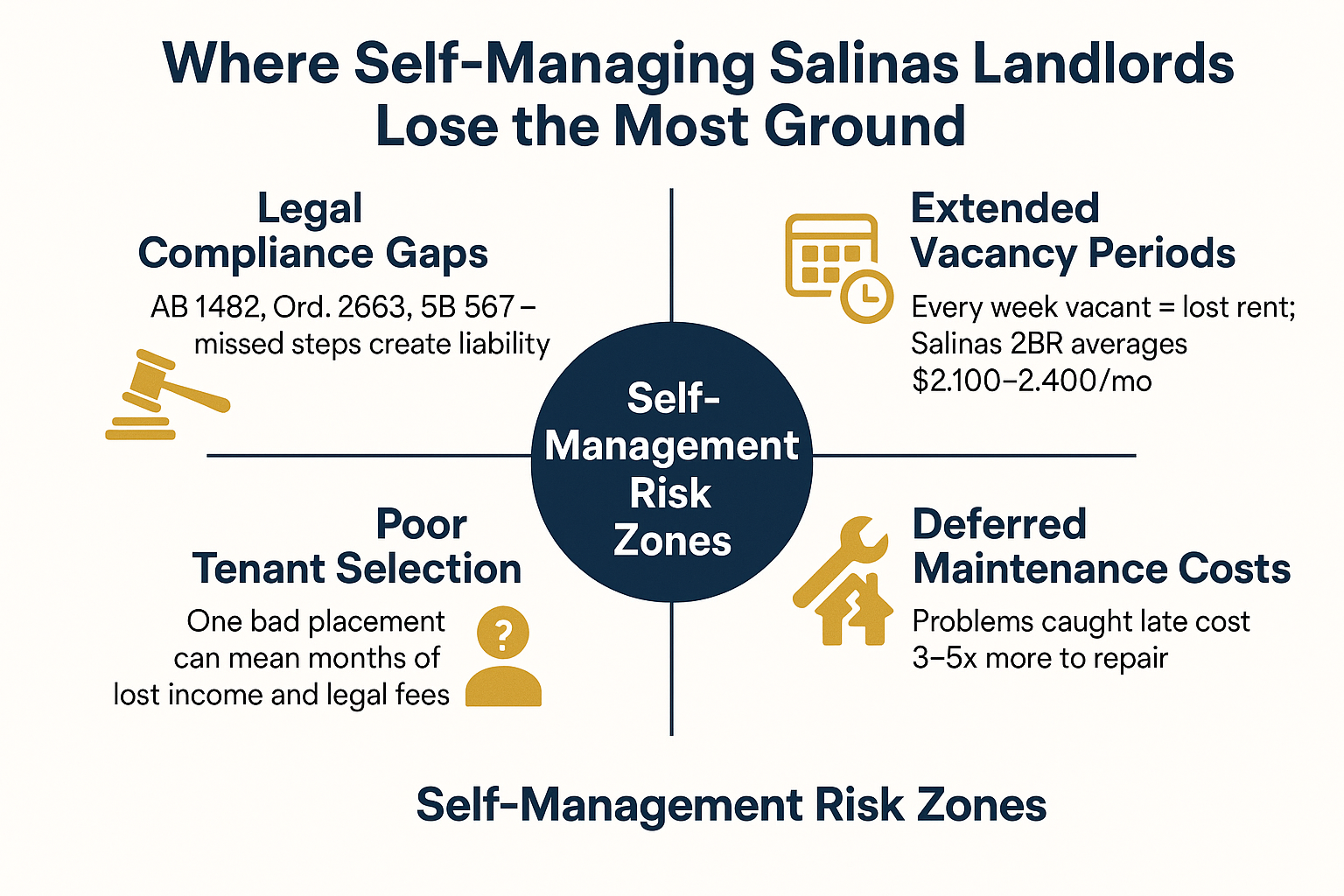
Where Self-Managing Landlords Lose the Most Ground
This breakdown shows the four areas where self-managing property owners in Salinas tend to absorb the biggest costs — and what drives each one.
Tenant Screening Is Where Most Self-Managing Owners Cut Corners
The biggest single mistake self-managing landlords make in this market isn't a legal violation — it's choosing the wrong tenant.
Screening a tenant properly takes time, the right tools, and knowledge of what to look for. A credit score alone doesn't tell you much. You need to understand income verification relative to Salinas rent levels, rental history, eviction records, and how to evaluate applications without running into fair housing violations under California's FEHA and federal law.
Many self-managing owners in Salinas admit they've approved a tenant because they seemed nice, showed up on time, or offered to pay the first month upfront. Those aren't screening criteria. And once a tenant is in the property with a signed lease, the process of removing them for non-payment or lease violations in California is slow and expensive — often three to six months from notice to possession, even in straightforward cases.
The decision you make before someone moves in determines almost everything that follows. The difference between a good tenant and a great one starts before move-in explains what a professional screening process actually looks at — and why the gap between a good tenant and a great one matters a lot in this market.
Self-Managing vs. Professional Management: What the Real Comparison Looks Like
This isn't a features comparison — it's a practical look at what each approach typically costs a Salinas property owner when things don't go perfectly.
| Scenario | Self-Managing Owner | Professionally Managed |
|---|---|---|
| Extended vacancy (30+ days) | Full month of lost rent — $2,100–$2,400 on a 2BR in Salinas | Faster re-marketing typically shortens vacancy to under 3 weeks |
| Tenant dispute or wrongful eviction claim | $3,000–$15,000+ in legal exposure depending on the violation | Documented compliance and proper notice procedures reduce risk significantly |
| Missed AB 1482 rent increase cap | Potential tenant claim for overpayments plus penalties | Rent increases tracked and applied within legal limits |
| Deferred maintenance discovery at move-out | $1,500–$8,000+ depending on what was missed | Regular inspections catch issues before they compound |
| Time cost (estimated monthly) | 5–15 hours per month of owner time | Typically less than 1 hour of owner involvement per month |
Frequently Asked Questions About Self-Managing in Salinas
Is self-managing a rental property in Salinas actually illegal if I don't register it?
Under City of Salinas Ordinance 2663, which took effect in 2024, residential rental units must be registered with the city. Operating a rental without completing that registration can expose you to fines and enforcement action. It's one of those requirements that flew under the radar for a lot of owners when it passed.
How do I know if my Salinas rental is covered by AB 1482?
Most single-family homes, condos, and multi-unit buildings in Salinas that are more than 15 years old and not owner-occupied are covered. AB 1482 caps annual rent increases at 5% plus local CPI (or 10%, whichever is lower) and requires just cause for eviction after 12 months of tenancy. There are exemptions — single-family homes where the owner has provided a specific written exemption notice, for example — but assuming you're exempt without confirming it is a common mistake.
What's the biggest financial risk of self-managing a rental in Monterey County?
Probably a bad tenant placement. One tenant who stops paying rent, causes property damage, or requires formal eviction proceedings can cost a Salinas landlord $5,000 to $20,000 or more when you add up lost rent during the eviction process, legal fees, repairs, and re-leasing costs. California's eviction timeline makes that exposure worse than in most states.
Can I manage my own property and still have someone handle just the legal stuff?
You can, but it gets complicated. A real estate attorney can review your leases and notices, but they won't be managing your day-to-day relationship with the tenant, responding to maintenance calls, or catching compliance issues in real time. Most owners who try this hybrid approach find that the legal review happens after a problem has already developed — not before.
How do eviction rules in California affect self-managing landlords specifically?
Self-managing owners are far more likely to make procedural mistakes that slow down or invalidate an eviction. California has strict requirements for how and when notices must be served, what language they must contain, and what just cause is required. One wrong step resets the clock. Why eviction rules make tenant disputes harder for Monterey County landlords covers the specific pitfalls in detail.
Want a Clearer Picture of What Your Property Actually Needs?
If you're managing a rental in Salinas, Monterey, Carmel, or anywhere across Monterey County and you're starting to wonder whether the workload and risk are worth it, Coast & Valley Properties is happy to talk it through — no pressure, just a straight conversation about your property and what full-service management would actually look like for you. Call us at (831) 757-1270 or reach out through coastandvalleypm.com.

The Difference Between a Good Tenant and a Great One Starts Before Move-In
Most landlords say they want a great tenant. But when you ask them how they find one, the answer is usually something like: 'I go with my gut.' That's where the trouble starts.
In Monterey County, the stakes are especially high. California's tenant protections — including AB 1482 and the City of Salinas's Residential Rental Registration Ordinance (City Ord. 2663) — make it difficult and expensive to remove a tenant who turns out to be the wrong fit. One bad placement can cost you months of headaches, legal fees, and lost rent.
The good news is that most tenant problems are preventable. And prevention starts well before move-in day — with how you screen, what you look for, and how consistently you apply your own standards.
What 'Good Enough' Screening Usually Misses
A lot of landlords check the basics: credit score, employment verification, maybe a reference call. And for many rentals, that feels like enough — until it isn't.
The problem with bare-minimum screening is that it tells you what a tenant has done financially, but not much about how they'll treat your property or handle problems. A person can have a 720 credit score and still leave a rental in poor condition, ignore maintenance issues, or create friction with neighbors.
What gets missed most often in casual screening:
- Rental history depth — Did they pay on time, or did they frequently pay just before a late fee kicked in? There's a difference. The grace period for rent rules in California exist for a reason, but a tenant who routinely uses every day of that window is showing you a pattern.
- Communication style — How does this person respond to follow-up questions? Are they clear and direct, or vague and slow to respond? Tenant communication during the application process often mirrors how they'll communicate during tenancy.
- Reason for moving — A tenant leaving because a lease ended naturally is very different from one who's been asked to leave or is fleeing a troubled rental situation.
- Consistency of income — Gross monthly income should typically be at least 2.5 to 3 times the monthly rent. But income type matters too — a freelancer with variable monthly income carries different risk than a salaried hospital worker at Community Hospital of the Monterey Peninsula.
None of these factors require special tools. They require asking better questions and actually listening to the answers.

The Screening Criteria That Actually Predict Tenancy Quality
There's a meaningful difference between screening to avoid a bad tenant and screening to find a great one. The first approach is defensive. The second is strategic.
Great tenants tend to share a few predictable traits that show up consistently before move-in — if you know what to look for.
Stability of residence and employment
A tenant who has lived in the same place for two or more years and held the same job for a similar stretch is telling you something important: they don't uproot easily. Frequent moves — say, three addresses in three years — may indicate financial instability, conflicts with landlords, or a lifestyle that doesn't lend itself to long-term tenancy. In a market like Salinas or Monterey, where vacancy costs can run $1,500 to $2,500 per month in lost rent alone, tenant stability is a real financial variable.
Verifiable landlord references — not just personal ones
Personal references are nearly useless. A previous landlord reference, especially one you actually call and ask specific questions, is worth far more. Ask things like: Did they give proper notice? Would you rent to them again? Were there any maintenance issues they didn't report promptly? The answers reveal a lot more than any form.
How they treat the property during showings
This one sounds minor, but it's not. A prospective tenant who shows up to a showing and immediately asks about parking, storage, and what's included is thinking about their life in the space. One who walks through looking for defects to negotiate on or asks immediately about subletting is showing you a different set of priorities. First impressions in the application process are often more accurate than landlords give them credit for.
For owners managing more than one unit, staying legally compliant across a portfolio adds another layer to why consistent screening matters — your criteria must be applied uniformly to avoid fair housing exposure.
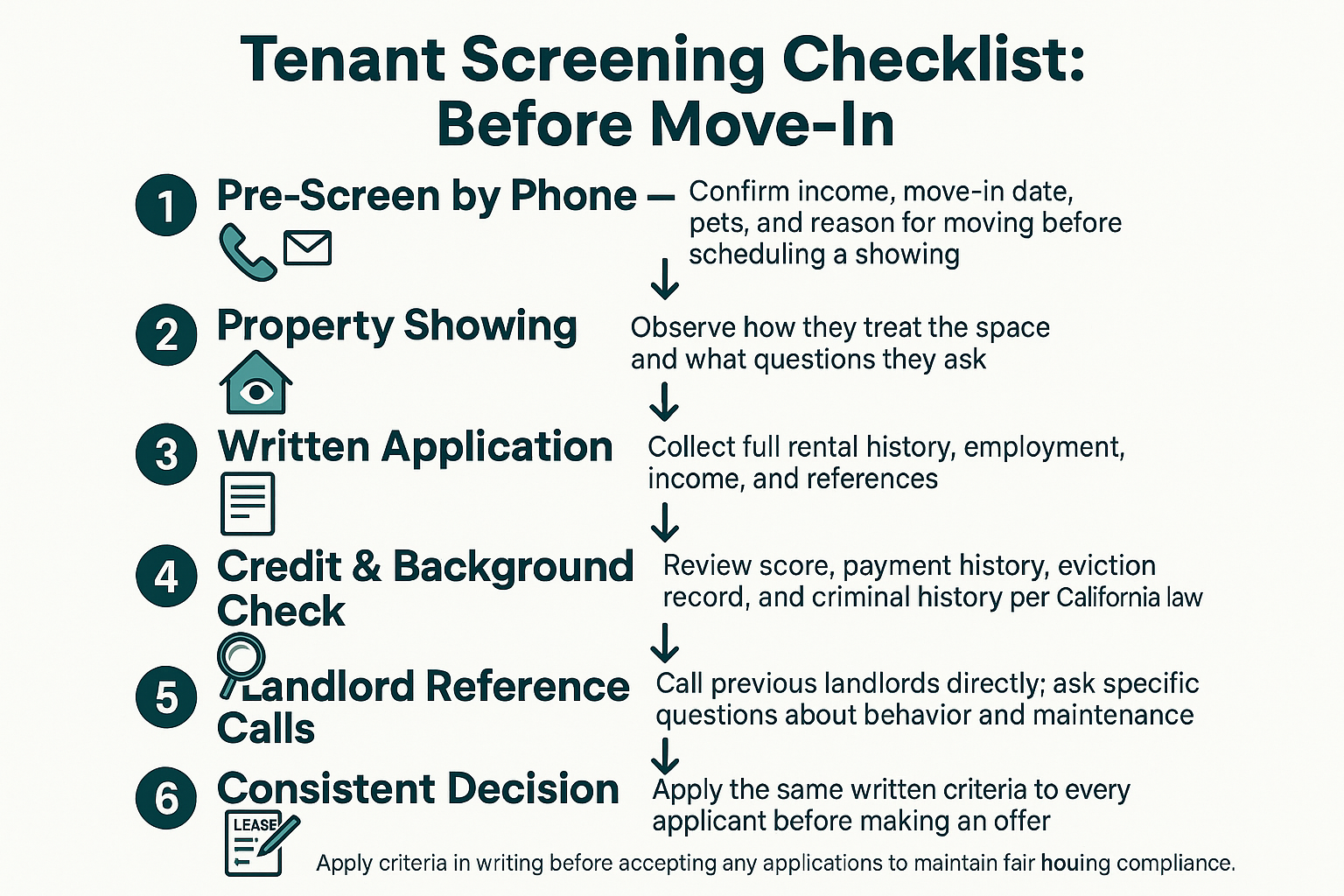
The Tenant Screening Checklist: Before Anyone Signs
This checklist walks through the key screening steps in order — from first contact to lease signing. Use it as a reference for where most landlords cut corners.
Why Consistency Matters More Than Instinct
One of the most common mistakes landlords make — especially those managing their first or second rental — is applying different standards to different applicants. Sometimes unconsciously. Someone seems more likable, or their story feels more sympathetic, and the bar quietly shifts.
Under California's Fair Employment and Housing Act (FEHA) and federal Fair Housing Act, inconsistent screening criteria can create serious legal exposure. This is true even when the intent isn't discriminatory. If your written criteria say one thing and your decisions show a pattern that says another, you have a problem.
The solution isn't complicated: write down your criteria before you accept any applications. Set your minimum income threshold, your minimum credit score, your policy on past evictions, and your requirements around rental history length. Then apply those standards the same way every time, for every applicant.
This also protects you from yourself in a tight market. When a property has been vacant for six weeks and you're fielding a marginal application, having written criteria makes it easier to hold your standard rather than fill the vacancy out of pressure. The hidden workload of managing even one rental home grows considerably when you're also dealing with a difficult tenancy — so getting placement right the first time has real value.
And once that great tenant is in place, the relationship doesn't run itself. Clear expectations at move-in — written lease terms, a documented property condition report, and a clear process for maintenance requests — set the tone for everything that follows.
Good Tenant vs. Great Tenant: What the Difference Looks Like
These aren't rigid rules — they're patterns that show up consistently when comparing tenancy outcomes over time.
| Screening Factor | Good Tenant | Great Tenant |
|---|---|---|
| Credit Score | 650–699, no major derogatory marks | 700+, clean payment history across all accounts |
| Income Verification | Meets 2.5x rent minimum | Stable employment 2+ years, meets 3x rent or more |
| Rental History | 1–2 prior landlord references | 2+ verifiable references, long lease terms, no early terminations |
| Communication | Responds within a few days during application | Responds promptly, asks clear and practical questions |
| Reason for Moving | Lease ended, relocating for work | Lease ended on good terms; prior landlord would rent to them again |
| Move-In Readiness | Ready within the week with deposit in hand | Prepared with all documentation before the showing ends |
What Happens When You Skip Steps
There's a version of tenant screening that moves fast because the landlord is eager to fill the unit. References go unchecked. Income docs are taken at face value. The application looks fine on paper and the person seemed pleasant at the showing — so the lease gets signed.
Six months later, the rent is consistently late. There are maintenance issues the tenant didn't report, and now there's water damage behind a wall. Or a neighbor complaint about noise. Or an unauthorized occupant.
None of those outcomes are guaranteed by skipping steps. But they're far more common when screening is rushed. In a market like Monterey County — where eviction proceedings can take three to six months from notice to resolution, and where AB 1482 limits removal options for covered properties — a problematic tenancy isn't just an inconvenience. It can tie up a significant asset for the better part of a year.
The cost of a thorough upfront screening process — in time and any third-party background check fees, typically $30 to $75 per applicant — is almost always less than one month of vacancy, let alone the cost of a contested tenancy. That math is simple. The discipline to actually follow through on it, especially when a vacancy has been sitting for a while, is where most self-managing landlords struggle.
Frequently Asked Questions About Tenant Screening in Monterey County
Can I reject an applicant because of a low credit score?
Yes, as long as your written criteria establish a minimum credit score threshold that you apply equally to all applicants. Under California and federal fair housing law, the issue isn't the standard itself — it's inconsistent application. Set your floor before you accept applications, document it, and stick to it.
How many previous landlord references should I require?
At minimum, two verifiable previous landlord references. Personal references from friends or employers don't tell you much about how someone lives in a rental. And 'verifiable' means you actually call — don't just accept names on a form.
What income standard should I use for Salinas or Monterey rentals?
The standard most property managers use is gross monthly income of 2.5 to 3 times the monthly rent. For a $2,400/month rental in Salinas, that means looking for applicants earning at least $6,000 to $7,200/month before taxes. For a $3,500/month rental in Monterey or Pacific Grove, that threshold climbs to $8,750 to $10,500/month.
Does California law limit what I can charge for a credit or background check?
Yes. California limits screening fees to the actual cost of the background and credit check, capped at an amount adjusted annually for inflation — in 2025, that figure is approximately $65 per applicant. You cannot charge more than that, and you must provide an itemized receipt if the applicant requests one.
What's the biggest screening mistake landlords in Monterey County make?
Skipping the landlord reference call. It's the step that takes the most effort and gets skipped most often. A previous landlord will almost always tell you things a credit report never will — how the tenant communicated, whether they reported maintenance issues promptly, and whether they left the unit in good condition. That information changes placement decisions.
Is it worth hiring a property manager just for tenant placement?
That depends on the management company and their structure. Some firms offer placement-only services. Others require full management. Either way, a professional who screens tenants daily in the local market will often identify red flags that a first-time or occasional landlord would miss. Understanding what a property management company actually does can help you decide whether placement alone is enough or whether ongoing management makes more sense for your situation.
Looking for Help With Tenant Placement in Monterey County?
Coast & Valley Properties handles tenant screening for residential properties throughout Monterey County — from Salinas and Soledad to Carmel and Pacific Grove. If you'd like to talk through your current screening process or learn how we approach placement, reach out directly at (831) 757-1270 or through the contact form at coastandvalleypm.com.

How Multi-Unit Owners in Monterey County Stay Legally Compliant
Owning two or three rental units in Monterey County feels manageable — until California adds another layer to the legal stack. Between AB 1482, the City of Salinas Residential Rental Registration Ordinance, and the state's habitability requirements, the compliance picture for multi-unit owners is genuinely more complicated than it was even three years ago.
And the consequences of missing something aren't minor. A wrongful eviction claim in California can cost a landlord two to three times the monthly rent in statutory damages, on top of attorney fees. For owners in Salinas or Monterey who are managing a duplex or small apartment building on their own, one procedural error can turn a routine tenancy into a costly dispute.
This article focuses on the two or three compliance areas that actually carry the most risk for multi-unit owners in this county — not a laundry list of every rule on the books, but the ones where real owners run into real problems.
AB 1482 and What It Actually Means for Your Building
AB 1482 — California's Tenant Protection Act — went into effect in January 2020 and it still catches owners off guard. If your building was built before January 1, 2005, and it isn't a single-family home or condo, it's almost certainly covered. That means two things: rent increase caps and just cause eviction requirements.
On rent increases, AB 1482 caps annual increases at 5% plus local CPI, with a hard ceiling of 10%. For 2025, the Monterey County area CPI figure puts that effective cap around 8.8% for most covered units. If you raise rent above that without documentation, you've created a problem even if the tenant doesn't immediately challenge it.
The just cause requirement is where multi-unit owners get hurt most often. You can't end a tenancy on a month-to-month lease just because you want to. You need a qualifying reason — non-payment, lease violations, owner move-in, or similar grounds. And even then, the process has specific notice requirements. If you're unsure where your property stands, understanding what happens when California law changes mid-lease is worth reading before you make any tenancy decisions.
Key AB 1482 checkpoints for multi-unit owners:
- Confirm your building's construction date against county records
- Review every lease for proper AB 1482 exemption disclosures if applicable
- Document all rent increase notices with the correct calculation
- Never serve a termination notice without confirming just cause applies

The Salinas Rental Registration Ordinance — What Multi-Unit Owners Must Do Now
If any of your units are in the City of Salinas, the Residential Rental Registration Ordinance (City Ordinance 2663, adopted 2024) applies to you. This is a local layer on top of state law, and it requires residential rental property owners to register their units with the city.
The ordinance was designed to give the city better oversight of housing conditions and renter protections in Salinas — a city where roughly 60% of households are renters, one of the highest ownership-to-rental ratios on the Central Coast. Registration isn't optional, and operating unregistered units puts you at risk of fines and complicates any future legal action against a tenant.
What registration generally requires:
- Contact information for the property owner and any local agent
- Unit count and address documentation
- Proof of habitability compliance or pending inspection scheduling
- Renewal on the city's established cycle
Owners with multiple units in Salinas need to track each unit separately. A four-plex is four registrations, not one. If you also own units in unincorporated Monterey County, the city ordinance doesn't apply there — but state law still does, fully.
For owners who self-manage, this administrative layer adds real time. For those who've been asking whether to manage an apartment building themselves or hire a company, registration compliance is one of the most practical arguments for professional management.
AB 1482 vs. Salinas Rental Registration: What Applies to Your Units
These two compliance requirements overlap but cover different things. Here's a quick reference to help you identify what applies to each property you own.
| Requirement | Who It Applies To | Key Risk If Ignored |
|---|---|---|
| AB 1482 Rent Cap (5% + CPI) | Most CA buildings built before Jan 1, 2005 | Illegal rent increase, potential damages |
| AB 1482 Just Cause Eviction | Same covered buildings, month-to-month tenants | Wrongful eviction claim, attorney fees |
| Salinas Rental Registration (Ord. 2663) | All residential rentals within City of Salinas | Fines, registration violations on record |
| CA Warranty of Habitability | Every residential rental in California | Habitability lawsuit, rent withholding |
| Lead Paint Disclosure | Any building built before 1978 | Federal fine up to $11,000 per violation |
The Compliance Timeline for a Multi-Unit Building in Monterey County
This shows the recurring compliance touchpoints a multi-unit owner needs to manage across a typical year — not a one-time checklist, but an ongoing calendar of obligations.
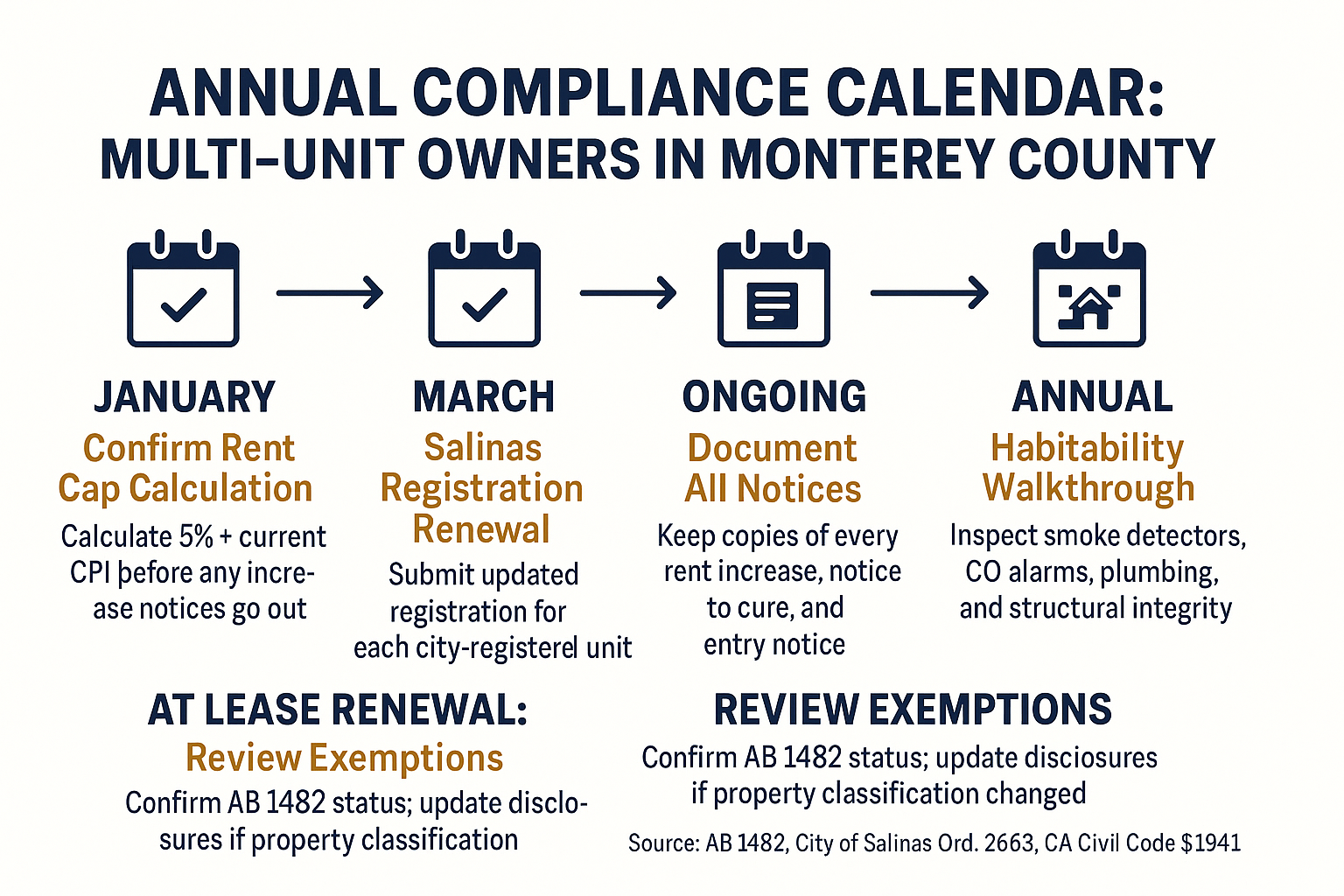
Habitability Requirements Across Multiple Units — Where Owners Miss Things
California's warranty of habitability under Civil Code §1941 applies to every unit you own, regardless of how long a tenant has been there or how good your relationship is with them. For multi-unit owners, the challenge is that one deferred maintenance issue in unit three doesn't stay contained to unit three — if a tenant documents it and reports to code enforcement, it creates a record that can affect all your units.
The most commonly overlooked habitability items in Monterey County properties:
- Smoke detector placement — required in every bedroom and on every floor
- Carbon monoxide alarms — required in units with attached garages or gas appliances; the rules here are more specific than most owners realize
- Weatherproofing — particularly relevant in older Salinas homes built in the 1940s–1960s where window seals and door frames have deteriorated
- Functioning heating — California requires a heating system capable of maintaining 70°F in living areas
- Pest and rodent control — the landlord's responsibility to address if it affects habitability
For a multi-unit building, a single annual professional walkthrough doesn't cut it. Conditions change between units and between seasons. Owners who track inspections property-by-property and document findings in writing are in a much stronger position if a dispute ever arises. What a property manager looks for during a rental walkthrough covers the specific items that matter most.
The Record-Keeping Reality Nobody Talks About
Compliance isn't just about knowing the rules — it's about being able to prove you followed them. In California landlord-tenant disputes, documentation wins cases. And for multi-unit owners, the volume of records grows fast.
For each unit, you should be maintaining:
- Signed lease agreements with current addenda
- All written notices served to tenants (with proof of delivery)
- Rent increase calculation worksheets
- Maintenance request logs and repair invoices
- Move-in and move-out inspection reports with photos
- Registration records and renewal confirmations
Salinas and Monterey County courts see eviction and habitability cases regularly. A landlord who shows up with organized records — timestamped photos, signed notices, maintenance receipts — is in a fundamentally different legal position than one who can't find paperwork from 18 months ago.
Good bookkeeping for landlords also matters here beyond taxes. Financial records that show rent payment history are often the first thing needed in an eviction proceeding. Owners managing two, three, or four units manually — often across spreadsheets or handwritten logs — are quietly accumulating risk every month they don't have a system.
For owners who want to understand what can go wrong when eviction rules intersect with tenant disputes in Monterey County, that's a useful place to understand the legal terrain before it becomes a problem.
Frequently Asked Questions About Multi-Unit Compliance in Monterey County
Does AB 1482 apply to every building I own in Monterey County?
Not necessarily. Single-family homes and condos are exempt if the owner has provided a written exemption notice to the tenant. Buildings constructed after January 1, 2005 are also generally exempt. But multi-unit buildings — duplexes, triplexes, apartment buildings — built before that date are almost always covered. If you're unsure about a specific property, pull the county assessor's construction date and compare it against your current lease disclosures.
I own a duplex in Salinas. Do both units need to be registered separately?
Yes. Under City Ordinance 2663, each residential rental unit requires its own registration — not just the property address. A duplex is two registrations.
What happens if a tenant claims my unit isn't habitable?
Under California law, a tenant can withhold rent, repair and deduct, or sue for damages if a landlord fails to maintain habitable conditions after receiving written notice. Courts take habitability claims seriously. The owner's best defense is always documented notice, documented response, and documented repair — ideally with dated photos and contractor invoices. If the issue wasn't reported in writing and you didn't know about it, that matters too, but don't count on it being enough on its own.
Can I raise rent on a long-term tenant in a covered building by more than 5%?
Under AB 1482, the cap is 5% plus the local CPI figure, with a hard maximum of 10%. For most Monterey County owners in 2025, that puts the ceiling around 8.8%. Going above that — even accidentally — creates legal exposure. Calculate before you send any increase notice.
My units are in unincorporated Monterey County, not in the City of Salinas. Does the rental registration ordinance apply?
No. Ordinance 2663 applies only within Salinas city limits. If your properties are in unincorporated areas — Prunedale, Spreckels, parts of South County — the city ordinance doesn't reach them. But AB 1482 and state habitability law apply everywhere in California.
How often should I inspect my multi-unit property?
California law requires 24-hour written notice before entering an occupied unit for non-emergency inspections. Most experienced property managers schedule two formal inspections per year per unit — one mid-lease and one at turnover. For older buildings in Salinas or Seaside, more frequent checks on plumbing, roofing, and heating systems are worth the time before a small issue becomes a habitability complaint.
Questions About Your Specific Properties?
Compliance questions are usually best answered with the details of your specific building in front of someone who knows Monterey County law. Coast & Valley Properties works with multi-unit owners across Salinas, Monterey, Carmel, and the surrounding communities — and we're happy to talk through what applies to your situation. Reach us at (831) 757-1270 or through the contact form at coastandvalleypm.com.

The Hidden Workload Behind Managing a Single Rental Home
Most property owners in Monterey County go into self-management thinking it will be manageable. One house, one tenant, one rent check a month — how complicated can it be?
The answer surprises almost everyone. The actual workload behind a single rental home spans legal compliance, maintenance calls, tenant disputes, financial recordkeeping, and a growing stack of California regulations that change whether you're paying attention or not.
This article breaks down what that workload actually looks like in practice — not in theory — so you can decide whether you're taking it on with eyes open.
What Landlords Actually Spend Their Time On Each Month
The visible tasks are easy to list: collecting rent, handling repair requests, maybe doing a drive-by. But the invisible tasks are what eat your time.
On a quiet month with a stable tenant, a self-managing landlord in Salinas or Monterey might spend 4 to 6 hours on routine work. That includes tracking rent, responding to tenant questions, following up on a minor maintenance issue, and keeping basic financial records.
But months are rarely quiet. One repair request escalates into two vendor calls. A tenant asks a question about their lease that requires you to actually read the lease. A late payment triggers a conversation about California's grace period rules that you may not have memorized.
Here's what a typical month's workload actually looks like:
- Rent collection and late payment follow-up (1–2 hours)
- Maintenance coordination — getting bids, scheduling, confirming completion (2–4 hours)
- Tenant communication — questions, complaints, requests (1–2 hours)
- Financial tracking and receipt filing (1 hour)
- Regulatory check-ins — lease compliance, notice requirements, inspection records (30–60 minutes)
Add a turnover or a repair emergency and that number jumps to 20+ hours in a single month. For most owners, that's a part-time job they didn't sign up for.

The Compliance Layer Most Self-Managing Landlords Underestimate
California landlord-tenant law is not simple, and Monterey County adds its own layer on top of it.
The City of Salinas Residential Rental Registration Ordinance (City Ord. 2663, enacted 2024) requires landlords renting within city limits to register their units, pay annual fees, and pass inspections. Miss a deadline and you're looking at fines, not just a warning.
AB 1482 — the statewide Tenant Protection Act — caps annual rent increases for many properties and requires "just cause" for most evictions. If your property qualifies, your lease language, your notices, and your rent increase timing all have to align with rules that change how you handle mid-lease situations in ways most owners don't anticipate.
There's also the California warranty of habitability, which obligates landlords to maintain rental units in livable condition — and the timeline for responding to certain repairs is not optional. Combine that with carbon monoxide alarm requirements and lead paint disclosure rules, and you have a compliance checklist that grows every year.
A few areas where self-managing landlords most often fall short:
- Serving legally valid notices — wrong format, wrong delivery method, or wrong timeline can void the notice entirely
- Handling security deposits — California has strict rules on deductions, documentation, and the 21-day return window
- Lease renewal language — failing to update terms when state law changes can expose you to liability
- Inspection documentation — without written records, move-in and move-out disputes are almost impossible to win
None of this is obscure law. It's the standard operating environment for any Monterey County landlord, and staying current with it takes consistent attention.
How a Single Maintenance Call Turns Into a Half-Day Project
A tenant reports a leaking water heater. Here's what actually happens between that call and resolution — and where most of the landlord's time goes.
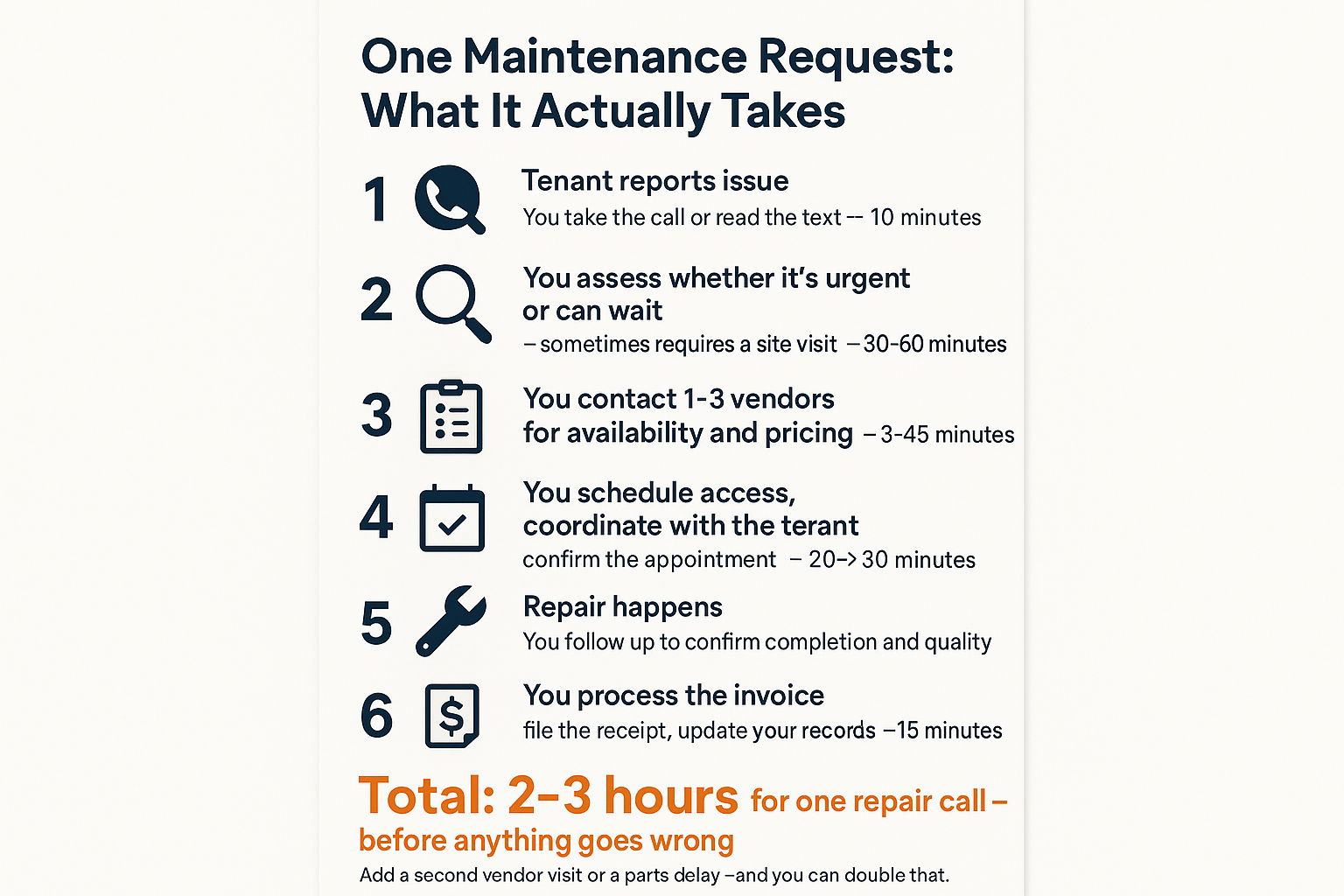
Tenant Turnover: The Month That Costs You the Most
Nothing exposes the full weight of self-management like a tenant moving out.
A turnover in Monterey County — even for a single-family home — typically takes 3 to 6 weeks from move-out to a new tenant moving in. During that window, you're paying the mortgage without rental income while also managing a long list of tasks.
Here's what a turnover actually involves:
- Move-out inspection with written documentation and photos
- Security deposit accounting — itemized within 21 days under California law
- Cleaning and paint touch-up — expect $300–$700 for a standard Salinas-area home
- Any deferred maintenance repairs that were invisible with a tenant in place
- Photography and listing across rental platforms
- Showings — often 6 to 12 before a qualified applicant applies
- Tenant screening — credit check, background check, rental history verification, income verification
- Lease preparation and signing
If you're managing your own property and you haven't done a turnover before, budget at least 30 to 40 hours of your own time for that cycle. That's on top of the one-to-two months of lost rent while the unit sits vacant.
A poorly screened tenant who turns over again in 8 months costs far more than any management fee would have.
Monthly Time Estimate: Self-Managing One Rental Home
These are real-world estimates for a single-family rental in Monterey County — not best-case scenarios.
| Task | Quiet Month | Active Month (repair or dispute) |
|---|---|---|
| Rent collection & follow-up | 1–2 hrs | 2–4 hrs |
| Maintenance coordination | 1–2 hrs | 4–8 hrs |
| Tenant communication | 1 hr | 3–5 hrs |
| Financial recordkeeping | 1 hr | 1–2 hrs |
| Compliance & legal review | 30 min | 2–4 hrs |
| Total estimated time | 4–6 hrs | 12–23 hrs |
The Financial Recordkeeping Nobody Talks About
Running a rental property means running a small business — and the IRS expects you to treat it that way.
Every repair receipt, every mortgage statement, every mile driven to your property for management purposes is potentially deductible. But only if you tracked it. Most self-managing landlords keep records inconsistently, and that costs them real money at tax time.
California also adds complexity. If you own property in Salinas or elsewhere in Monterey County and have an LLC or trust involved, the recordkeeping requirements go up another level. Bookkeeping for rental properties isn't complicated in concept, but it requires discipline that's easy to let slip when you're already juggling maintenance calls and tenant texts.
The practical minimum for clean records on a single rental home:
- A dedicated bank account for rental income and expenses
- Monthly reconciliation of all income and expenses
- Receipts filed within 30 days of the transaction
- A mileage log if you're driving to the property for management tasks
- Year-end 1099 preparation for any vendor paid more than $600 in the year
If you're not doing all of this already, you're either leaving deductions on the table or setting yourself up for a messy tax season.
Frequently Asked Questions About Managing a Rental Home in Monterey County
How many hours per week does it really take to manage one rental home?
On a calm month, most Monterey County landlords spend 1 to 2 hours per week on a single home. But that average hides the spikes. A repair emergency, a late-paying tenant, or a lease renewal can push one week to 8 or 10 hours without warning. The workload isn't steady — it clusters.
Do I have to register my rental with the City of Salinas?
Yes, if the property is within Salinas city limits. City Ordinance 2663, enacted in 2024, requires landlords to register rental units, pay annual fees, and comply with inspection requirements. Penalties for non-compliance are real. Check the City of Salinas website or consult a local property manager for current deadlines and fee amounts.
What happens if I don't return a security deposit on time?
California law gives landlords 21 calendar days after move-out to return the deposit with an itemized statement. Miss that window and you can forfeit your right to make deductions — and expose yourself to a small claims lawsuit for up to twice the deposit amount if a court finds bad faith.
Can I manage my rental myself if I live out of the area?
Technically yes, but the practical challenges multiply fast. Coordinating vendors, conducting inspections, responding to emergencies, and serving legally valid notices from a distance is workable in theory and exhausting in practice. Out-of-state owners who self-manage typically find that one emergency makes the math on professional management look very different.
What's the biggest mistake first-time landlords make in Monterey County?
Underestimating tenant screening. A qualified tenant who pays on time and stays for two or three years is worth far more than a slightly higher rent from someone who doesn't. California's eviction process is slow and expensive — a disputed eviction in Monterey County can take four to six months and cost $3,000 to $7,000 in legal fees. Screening is where you protect yourself before a problem starts.
Want a Clear Picture of What Professional Management Actually Covers?
If this article made the workload feel bigger than you expected, that's because it is — especially in a market as regulated as Monterey County. Coast & Valley Properties works with property owners across Salinas, Monterey, Carmel, and the surrounding area who want the income without the time burden. Reach out at (831) 757-1270 or through the contact form at coastandvalleypm.com to have a straightforward conversation about what full-service management looks like for your specific property.

What Happens to Your Rental When California Law Changes Mid-Lease?
You signed a lease. Your tenant moved in. Everything was compliant on day one. Then six months later, Sacramento passes a new law — and suddenly the agreement both of you signed is no longer the whole story.
This happens more often than most Monterey County landlords expect. California has one of the most active rental regulation environments in the country, and local ordinances on top of state law mean the rules can shift without much warning. AB 1482, the City of Salinas Rental Registration Ordinance, and a steady stream of smaller statutory changes all have the ability to reshape what you can legally do inside an existing tenancy.
The key thing to understand is that a signed lease doesn't freeze the law. If a new statute applies to your property and your tenant, it applies now — not at the next renewal. Here's what that actually means in practice.
Why Your Lease Doesn't Lock In the Old Rules
A lease is a contract between you and your tenant. But California law sits above that contract, and the state can — and regularly does — change the terms of that relationship after the fact.
The legal principle here is called statutory supremacy. When the legislature passes a new landlord-tenant law, it doesn't matter what your lease says. If the statute applies to residential rentals in California, your property is subject to it. Courts have consistently upheld this, and it's one of the reasons knowing what a property management company actually handles matters so much in this state.
Practical examples of mid-lease changes that have affected Monterey County landlords in recent years:
- AB 1482 (Tenant Protection Act of 2019) imposed rent increase caps and just-cause eviction requirements on properties that weren't previously subject to rent control — many owners discovered they were covered only after the law passed
- Carbon monoxide alarm requirements expanded to cover more unit types, and landlords had to retrofit existing rentals regardless of lease date — see the full breakdown in our carbon monoxide alarm guide
- The City of Salinas Residential Rental Registration Ordinance (Ord. 2663, 2024) required registration of existing rental units — not just new leases going forward
- Updated security deposit rules under SB 567 changed how landlords must handle and document deposits, effective for existing tenancies
In every one of these cases, the change applied to active leases. There was no grace period tied to your existing lease term.

The Two Types of Mid-Lease Changes That Create the Most Risk
Not all legal changes carry the same weight. Some require you to update a physical feature of the property. Others change what you're allowed to do with rent, notices, or tenant communication. Both create liability if you ignore them — but they require different responses.
Habitability and safety changes are non-negotiable and time-sensitive. California's warranty of habitability is a living standard — it gets updated as building codes and safety requirements evolve. If a new rule requires a specific alarm, ventilation upgrade, or structural disclosure, you typically have a short compliance window. These cannot be waived by a lease clause or tenant agreement. Failing to comply exposes you to rent withholding claims and potential liability if something goes wrong.
Rent and notice rule changes are where landlords most often get caught off guard. AB 1482 sets a rent increase cap of 5% plus local CPI, or 10% — whichever is lower — for covered properties. If your property became covered mid-tenancy, any increase you planned based on prior practice may now be illegal. The grace period for rent rules in California also changed in recent years, and the five-day statutory grace period now has stronger tenant protections attached to it.
The practical test for any mid-lease change:
- Does the new law apply to your property type and location?
- Does it affect an active tenancy or only new leases going forward?
- Is there a compliance deadline, or is it effective immediately?
- Does your existing lease contain any clause that conflicts with the new requirement?
If you're not certain of any of those answers, the default assumption should be that the law applies and you need to act.
Common California Law Changes and How They Affect Active Leases
This table covers the most common categories of mid-lease legal changes Monterey County landlords have faced in the past five years, and what each one required in practice.
| Law / Requirement | Effective for Active Leases? | What Action Was Required |
|---|---|---|
| AB 1482 Rent Cap & Just Cause | Yes — if property is covered | Audit rent history; limit increases to legal cap; update notice language |
| Salinas Rental Registration (Ord. 2663) | Yes — existing units required registration | Register property and pay fee; provide tenant with registration number |
| Carbon Monoxide Alarm Expansion | Yes — retrofit required | Install alarms per updated placement requirements; document compliance |
| SB 567 Security Deposit Limits | Yes — new cap on deposits for most units | Refund excess deposits within required timeframe for existing tenancies |
| Updated 3-Day / 30-Day Notice Rules | Yes — notice format and content changed | Update all notice templates; prior non-compliant notices may be void |
What to Do When a New Rental Law Passes in California
This step-by-step flow shows the four questions every Monterey County landlord should work through when a new California rental law takes effect.
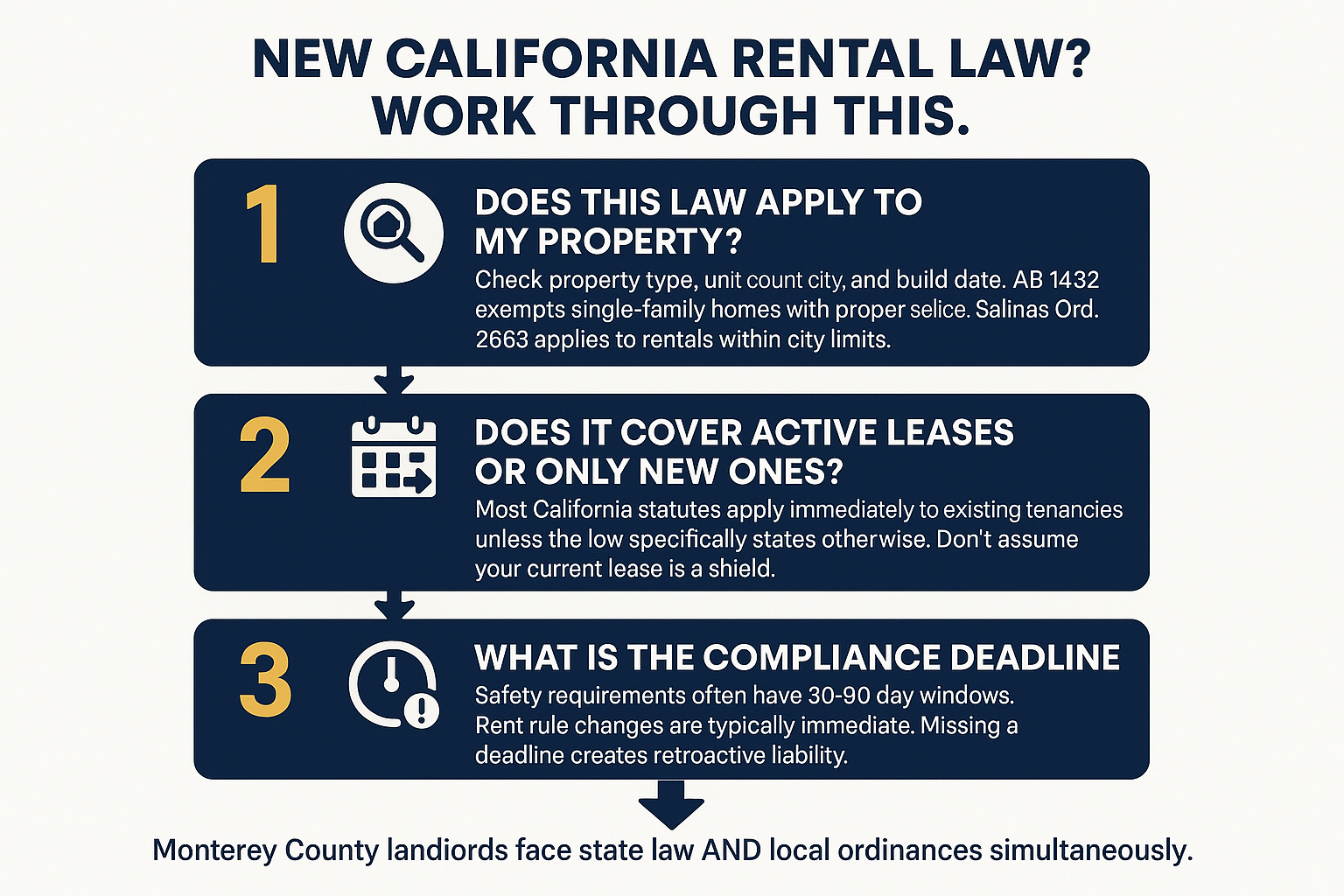
What Self-Managing Landlords Get Wrong Most Often
The biggest mistake we see from self-managing owners in Salinas and across the Monterey Peninsula is treating a lease renewal as the trigger for compliance. They assume they'll "get current" at the next signing. California law doesn't work that way.
A second common error is relying on a lease template that hasn't been updated. Many landlords download a standard California lease form and use it for years. But statutory changes require corresponding updates to notice language, disclosure requirements, and addendum terms. An outdated lease doesn't just create compliance risk — it can also void notices and, in the worst case, derail an eviction. Our piece on why eviction rules make tenant disputes harder for Monterey County landlords covers exactly how this plays out in local courts.
And because Monterey County sits in a high-cost, high-regulation market, the stakes are higher than in many parts of the state. A missed carbon monoxide requirement in Fresno and a missed one in Pacific Grove both carry the same liability exposure — but in Pacific Grove, the property involved might be worth $1.4 million. The cost of getting it wrong scales with the asset.
If you're managing your own rental and wondering whether self-management still makes sense given the regulatory complexity, this guide on managing apartment buildings yourself versus hiring a company lays out the honest tradeoffs.
When You Do Need to Formally Notify Your Tenant
Not every new law requires you to send your tenant a formal notice. But some do — and the timing and format of that notice matter.
California law requires written notice of certain material changes to the rental agreement. If a new statute alters a term that was previously spelled out in your lease — rent amounts, entry procedures, notice periods, required disclosures — you typically need to provide written notice before acting on the new terms.
Specifically, watch for these scenarios:
- Rent increase rules change mid-tenancy: You must provide the updated calculation method and comply with the statutory cap before issuing any rent increase notice
- Required disclosures are added: New habitability or safety disclosures often require a signed acknowledgment from the tenant, even mid-lease
- Notice period requirements change: If the state extends or modifies required notice windows (for entry, lease termination, or rent changes), the new periods apply immediately — serving a shorter notice based on your old lease is legally defective
The safest practice is a written lease addendum that references the new statute, confirms the change, and gets a tenant signature. This documents that both parties are aware of the updated terms. It doesn't require rewriting the entire lease — a one-page addendum with the relevant legal citation is typically sufficient.
Frequently Asked Questions About Mid-Lease Law Changes in California
If my tenant signed a lease before a new law passed, do they have to follow the new rules?
Yes. California statutes that apply to residential rentals generally override existing lease terms. Your tenant can't waive state law protections, and you can't enforce lease clauses that conflict with a newer statute. The lease date doesn't matter — what matters is whether the law applies to your property type and location.
Does AB 1482 apply to my property if I bought it after the law passed?
It depends on your property type and whether the prior owner provided an exemption notice. Single-family homes and condos can be exempt from AB 1482's rent cap and just-cause eviction rules — but only if the owner provides a specific written notice to the tenant. If that notice was never given, or if your property doesn't qualify for an exemption, AB 1482 applies regardless of when you purchased. A licensed broker familiar with Monterey County inventory can tell you quickly whether your property is covered.
Can I wait until the lease renews to come into compliance?
For safety requirements like carbon monoxide alarms or habitability standards — no. Those apply immediately. For procedural changes like notice formats and rent increase caps, the rule is also effective immediately for active tenancies. Waiting for renewal is the most common way self-managing landlords create retroactive liability.
What happens if I've already sent a notice that doesn't comply with the new law?
A non-compliant notice is generally considered legally defective, which means it may be void. If you served a rent increase notice with the wrong format or an eviction notice with an outdated cure period, you may need to re-serve the notice correctly before any deadline clock starts running. In Monterey County courts, judges have dismissed eviction cases over notice defects that the landlord considered minor. This is one area where professional management — and regularly updated notice templates — pays for itself.
The City of Salinas rental registration requires me to register my property. Does that affect my current tenant?
The registration itself is an owner obligation, not a tenant obligation. But Ord. 2663 does require you to provide your tenant with documentation of registration, and failure to register can affect your ability to collect rent and pursue certain legal remedies. If you own a rental in Salinas city limits and haven't registered, that's a compliance gap that needs to be addressed now — not at the next lease signing.
Questions About Compliance on Your Monterey County Rental?
California rental law changes faster than most landlords can track, and Monterey County adds another layer of local ordinances on top of that. Coast & Valley Properties monitors regulatory changes across Salinas, the Monterey Peninsula, and South County so our owners don't have to. If you'd like to talk through how a recent law change affects your property or tenancy, reach out directly at (831) 757-1270 or through the contact form at coastandvalleypm.com.