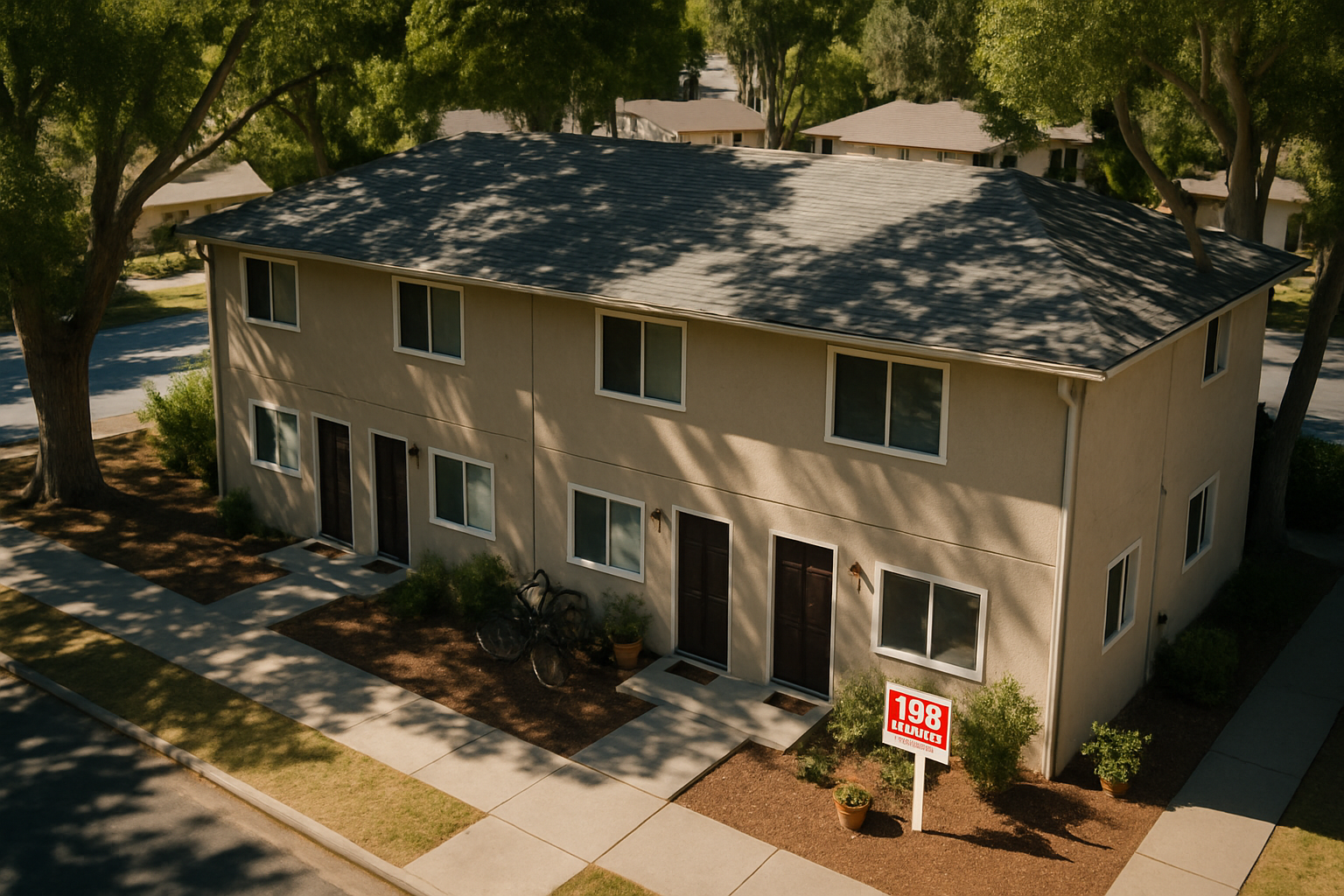
Managing a Multi-Unit Property in Salinas: What Changes as You Add Doors
There's a version of residential property management in Salinas that one person can handle with a good calendar and some discipline. One rental home, one lease, one tenant relationship. I've seen plenty of owners do it reasonably well for years.
But I've also watched those same owners call us in a different state of mind entirely once they've added a second unit, then a third, then a fourth. The calls start sounding the same: "I have several rental units across Salinas and managing everything on my own has become genuinely unmanageable." That's not a complaint about any one thing — it's a description of a system that stopped scaling.
This article is about what actually changes as you add doors in Salinas — the regulations that kick in at the multi-unit level, the coordination demands that stack up fast, and the financial picture that gets hard to see clearly when you're running it yourself.
The Regulatory Picture Shifts Under Your Feet
One of the most common misconceptions I encounter is the owner who has heard of AB 1482 — California's statewide Tenant Protection Act — and assumes that's the only rent control framework they need to worry about. For a lot of Salinas multi-unit owners, that's wrong.
Salinas has its own Rent Stabilization Ordinance (Ord. 2681), and it generally applies to multi-family dwellings built before February 1, 1995. Given the age of Salinas's rental housing stock — a significant portion of which predates that cutoff — this affects more owners than you'd think. And the rent cap under the local ordinance is 2.75%, which is separate from and can differ from what AB 1482 would allow in a given year.
So if you own a four-unit building in Salinas and it was built in 1980, you're not operating under AB 1482's just-cause eviction and rent increase rules. You're operating under the city ordinance, which has its own notice requirements, its own allowable increase schedule, and its own compliance obligations.
How do you figure out which rules govern your specific property? Start with the year it was built, then check the property type. The California Department of Housing and Community Development maintains guidance on state-level tenant protections, and Salinas city staff can confirm local ordinance applicability for your specific parcel. But the honest answer is that this determination is not always obvious — and getting it wrong can expose you to penalties that far exceed whatever you saved by figuring it out yourself.
For more on how the local ordinance landscape is evolving, see Salinas' Rent Ordinances Are Going to Voters — What Owners Need to Know Now.
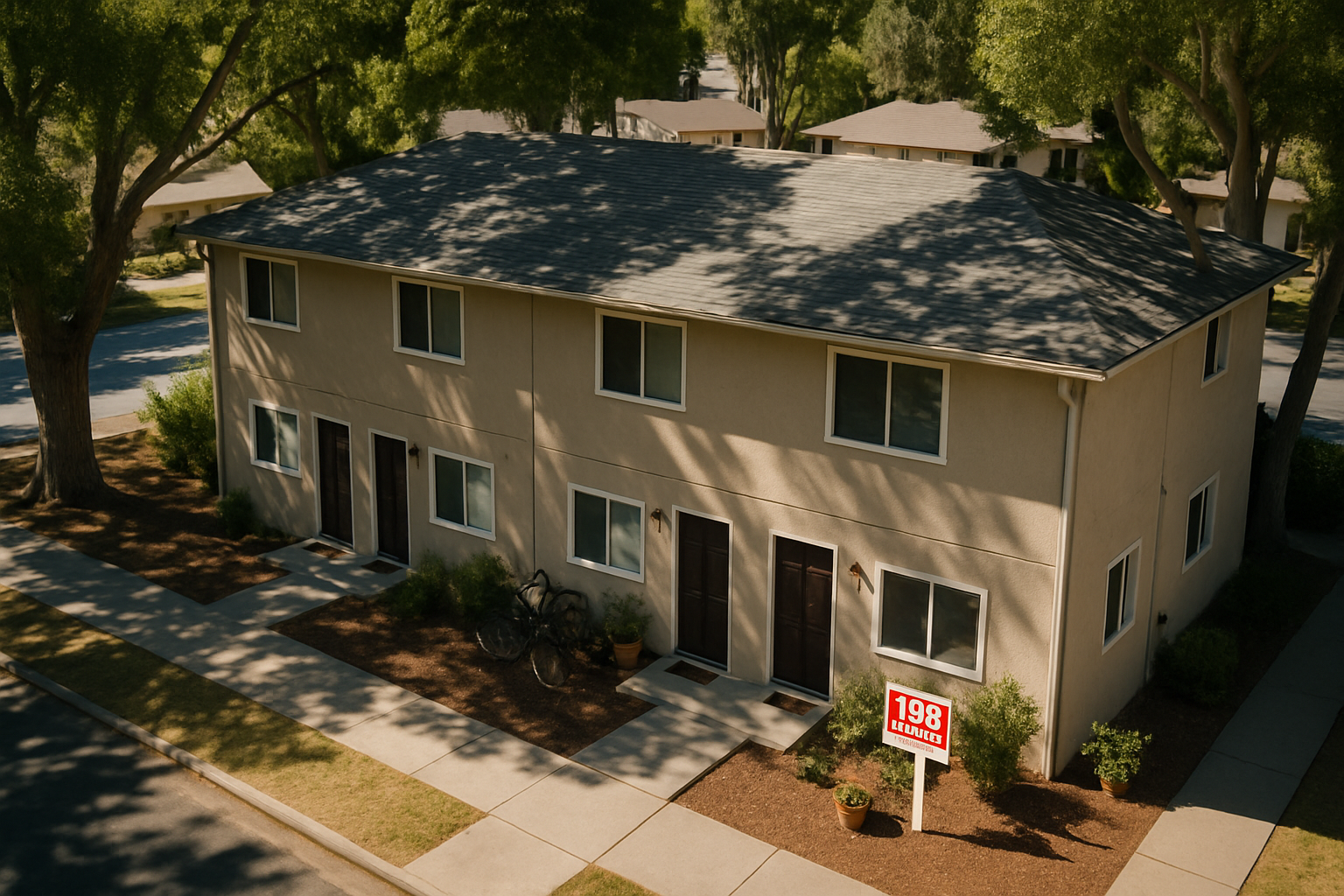
The Tipping Point Most Owners Hit Around Four Units
A single-family rental has one lease renewal date. One maintenance relationship. One set of utility bills. When something breaks, you call one contractor and you're done.
Add three more units to that building and none of that math holds anymore. Lease renewals happen on different dates. Maintenance requests stack up across units, often at the same time. If one tenant is late on rent, the other three still need their rent collected and their requests answered. The building doesn't pause because one unit has a problem.
I've seen this described clearly by owners who reach out to us: someone managing four to six units in Salinas who says they are approaching the point where the volume of coordination is genuinely getting away from them. It's not laziness — it's physics. The administrative load of four units isn't four times the load of one. It's more like eight times, because everything overlaps.
For a deeper look at where that workload actually comes from, The Hidden Workload Behind Managing a Single Rental Home breaks it down unit by unit — and the math gets significantly less comfortable once you multiply it.
The specific situations that tend to push owners past the tipping point:
- Multiple lease end dates that don't align, forcing ongoing turnover management year-round
- Overlapping maintenance requests from different tenants hitting the same week
- One vacant unit while the rest of the building keeps running — rent still needs collecting, inspections still need to happen
- Compliance deadlines — notice periods, annual inspections, registration renewals — that are easy to miss when you're managing on a spreadsheet
We recently heard from an owner with a fully remodeled, vacant four-unit building in Salinas. On paper that sounds like an ideal situation — move-in ready units, no current tenant complications. In practice, it meant pricing all four units competitively at the same time, sequencing showings efficiently so units weren't sitting empty for weeks while applications processed, and getting four leases signed on a coordinated timeline. That's a job, not an errand.
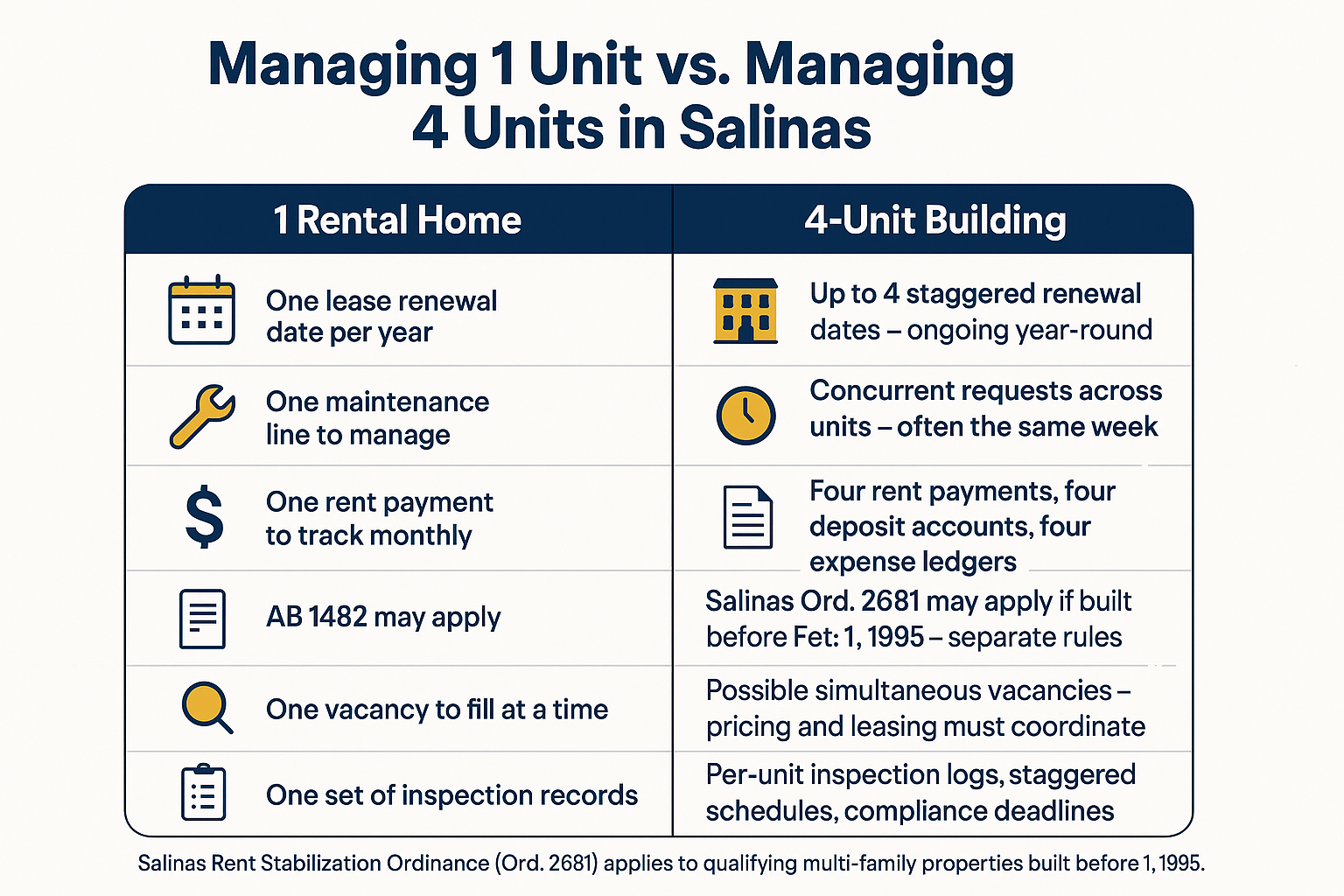
Single-Family vs. Multi-Unit: What Actually Changes
This comparison shows the management demands that shift — and multiply — when an owner moves from one rental home to a four-unit property in Salinas.
Why Financial Reporting Gets Messy Fast
This is the area where I see the most self-managing multi-unit owners get into trouble — not with tenants, not with compliance, but with their own books.
When you have one rental, it's not hard to track income and expenses. One checking account, one deposit, one repair invoice. But four units means four sets of maintenance invoices — and when a plumber fixes something in Unit 2 and you pay from a shared account, that expense needs to be attributed to the right unit for your taxes, your insurance claims, and your own understanding of which units are actually profitable.
Most self-managing owners I talk to are running this on spreadsheets. Some are running it on memory. Both approaches tend to break down somewhere between year one and year three, usually around tax time when the accountant starts asking questions.
Security deposit accounting is another place where this gets complicated. California law is specific about how deposits must be handled, itemized, and returned. When you have four units with staggered move-outs, keeping that straight without a dedicated system is harder than it sounds. One missed deadline or improperly itemized deduction can expose you to a claim for twice the deposit amount under California Civil Code.
Technology that consolidates financial reporting across multiple units — real-time owner portals, per-unit expense tracking, monthly consolidated statements — matters far more at the four-unit level than it does with a single home. It's the difference between knowing how your portfolio is performing and guessing.
For a broader look at what that compliance picture looks like across a multi-unit portfolio, How Multi-Unit Owners in Monterey County Stay Legally Compliant covers the full scope.
Which Rules Typically Apply to Your Salinas Multi-Unit Property
The regulatory framework for a multi-unit property in Salinas depends on when it was built, how many units it has, and whether it falls under city or state jurisdiction. This table gives a general starting point — always verify with city staff or a licensed broker for your specific parcel.
| Property Type | Year Built | Framework That Likely Applies | Key Implication |
|---|---|---|---|
| Multi-family (2+ units) | Before Feb 1, 1995 | Salinas Rent Stabilization Ord. 2681 | 2.75% rent cap, local compliance rules |
| Multi-family (2+ units) | Feb 1, 1995 or later | AB 1482 (if not exempt) | 5% + CPI cap, just-cause eviction rules |
| Single-family home | Any | AB 1482 (if not owner-occupied) | State rules apply, no local ordinance overlay |
| All rentals in Salinas | Any | City Ord. 2663 (Rental Registration) | Annual registration required regardless of unit count |
| Pre-1978 construction | Before 1978 | Federal lead paint disclosure law | Written disclosure required before any lease |
What the Transition to Professional Management Actually Looks Like
A lot of owners I talk to have been managing their own properties for years and are weighing whether to hand that off. The hesitation is usually the same: they worry about losing visibility, losing control, or paying for a service that doesn't actually change how the property runs.
What I've found is that the owners who wait the longest to make the transition are the ones who most clearly describe what they were missing. The ones who come to us with four or six units in Salinas aren't usually complaining about one bad thing — they're describing a slow accumulation of tasks that never quite got done on time, compliance details they weren't sure about, and a sense that they were always one maintenance emergency away from a real problem.
The process of transitioning to a property manager is more straightforward than most owners expect. Switching to a Property Manager in Salinas: What the Process Actually Looks Like walks through exactly what happens — from the initial handoff of tenant records to how existing leases are handled mid-term.
For multi-unit owners specifically, that transition also means getting financial records consolidated, having per-unit inspections documented properly, and establishing a maintenance coordination system that doesn't run through the owner's personal cell phone. Those aren't small things. But they're also not complicated once the right systems are in place.
Frequently Asked Questions About Multi-Unit Property Management in Salinas
Does the Salinas Rent Stabilization Ordinance apply to my four-unit building?
It depends on when your building was built. Salinas Ord. 2681 generally applies to multi-family dwellings built before February 1, 1995. If your building meets that threshold, the city's 2.75% rent cap and local compliance rules apply — not just AB 1482's statewide framework. The distinction matters significantly for how and when you can raise rents. Check your property's build date and confirm with Salinas city staff or a licensed local broker before assuming which rules govern you.
I have four vacant remodeled units. Can I just price them all the same and list them at once?
You can, but it's usually not the right approach. Units in the same building often appeal to slightly different tenant profiles depending on floor level, exposure, or layout. Pricing all four identically without a market analysis risks leaving money on the table or extending vacancy. Sequencing showings also matters — running four simultaneous applications creates a bottleneck, while a staggered approach lets you move efficiently from application to lease to move-in without units sitting empty mid-process.
How should I track maintenance expenses across multiple units for taxes?
Each unit should have its own expense ledger — separate from the others and from any building-wide shared costs. When a repair affects one unit specifically, it gets attributed there. When it affects the whole building (roof, common area, shared systems), it gets recorded as a property-wide expense. Most self-managing owners running spreadsheets blur this line over time, which creates real problems at tax time. A dedicated owner portal that logs expenses by unit automatically is significantly more reliable than manual tracking.
What is the Salinas Residential Rental Registration Ordinance and does it apply to multi-unit properties?
City Ord. 2663, which took effect in 2024, requires rental property owners in Salinas to register their units with the city. This applies regardless of property type or unit count — single-family and multi-unit owners alike are subject to it. Failure to register can affect your ability to collect rent and expose you to fines. For more on how 2024 and 2025 law changes affect Salinas owners, What New California Landlord Laws Mean for Monterey County Owners in 2026 covers the details.
At what point does it make financial sense to hire a property manager for a multi-unit building?
There's no universal answer, but the math tends to shift meaningfully around three to four units. Below that, a disciplined owner can often absorb the coordination themselves. Above it, the time cost of self-management — handling maintenance calls, processing applications, tracking compliance deadlines, reconciling financials — starts to exceed the management fee in real hours, even before you account for the liability exposure of doing any of it wrong. Most owners who reach that point describe it less as a financial calculation and more as a clarity about how they want to spend their time.
Thinking About How Your Portfolio Is Actually Running?
If you're managing multiple units in Salinas and starting to feel that tipping point, we're familiar with exactly what that looks like. Coast & Valley Properties works with multi-unit owners across Monterey County — from Salinas and Carmel to South County — and we're happy to talk through what professional management would mean for your specific situation. You can reach us at (831) 757-1270 or through the contact form at coastandvalleypm.com.

Switching to a Property Manager in Salinas: What the Process Actually Looks Like
We get messages from Salinas property owners fairly regularly that say something close to this: 'I need help, but I don't really understand how the process works.' That's not a knock on anyone — it's just an honest gap. Most owners know they need professional support before they actually know what that support looks like in practice.
Some of the owners who reach out are managing several units and have hit the wall. The coordination — maintenance calls, rent tracking, compliance paperwork — has become more than a side task alongside a full professional life. Others own a single home they've inherited or plan to rent for the first time and want to start right. Either way, the question is the same: what actually happens, step by step, when I hand this property over?
This article walks through the real process as we carry it out — not a marketing overview, but the actual sequence of decisions and actions from the first conversation through ongoing day-to-day management. If you've been putting off the transition because the process felt opaque, this should clear that up.
Step One: The Property Assessment
The process begins with a walkthrough. Before anything else happens — before photos, before pricing, before a listing goes live — someone needs to see the property in person.
That walkthrough covers a few different things at once:
- Current physical condition — what's functional, what's deferred, what needs attention before a tenant moves in
- Compliance status — including whether the property is registered under the City of Salinas Residential Rental Registration Ordinance, which took effect in 2024
- Realistic rental rate — based on comparable recent leases in the same neighborhood, not a zip code average
On that last point: Salinas rents in 2025 have generally ranged somewhere around $2,000 to $2,700 per month depending on unit type, size, and location — but those are broad market figures. The number that matters is what a well-prepared unit in your specific neighborhood and condition will actually attract right now. Owners who price based on what they need to cover the mortgage, rather than what the market supports, tend to sit vacant longer than they expect.
The assessment isn't a formality. It's the foundation for every decision that follows.
Step Two: Getting the Property Ready to List
After the walkthrough, the focus shifts to preparing the unit for the market. This is where we coordinate any deferred maintenance items, arrange professional photography, and write the listing itself.
Owners frequently underestimate how much the quality of a listing affects the quality of applicants. A poorly photographed unit — dark photos, odd angles, clutter visible in the background — draws fewer inquiries from qualified renters. In a competitive market like Salinas, that matters. Fewer qualified inquiries means more pressure to accept the first person who applies rather than the best-qualified person.
A listing also needs to be accurate. California law is specific about what can and cannot be represented in a rental advertisement, including lead paint disclosure requirements for older properties. Getting the listing right from the start protects the owner legally and attracts tenants who are a genuine match for the unit.
Once the listing is ready, it goes out across multiple rental platforms simultaneously. The goal is maximum qualified exposure in the shortest window — because every additional day of vacancy is a day of lost rent.

Step Three: Tenant Screening — The Decision That Shapes Everything Else
If there is one step in this entire process that determines whether the next twelve months go smoothly or become a serious problem, it's tenant screening. And it's also the step where self-managing owners most often get into legal trouble without realizing it.
Lawful screening in California involves a defined process:
- Income verification — typically looking for gross income of roughly three times the monthly rent
- Credit review — payment history, outstanding debt, prior evictions
- Rental history — past landlord references, patterns of tenancy
- Consistent criteria — the same standards applied to every applicant in the same order
That last point is not optional. California's Fair Employment and Housing Act requires that screening criteria be applied consistently. Owners who make ad hoc decisions — accepting one applicant over another based on intuition rather than documented criteria — expose themselves to discrimination claims.
Starting January 1, 2026, AB 1414 adds another layer: landlords who use third-party tenant screening services now have specific obligations around how applicant data is collected, stored, and protected. What new California landlord laws mean for Monterey County owners in 2026 covers this in more depth, but the short version is that compliance requirements around screening are increasing, not decreasing.
A well-qualified tenant placed in a Salinas rental through a thorough, lawful screening process is genuinely the difference between a smooth tenancy and a situation that ends in a legal dispute. As one article we've published on the topic puts it, the difference between a good tenant and a great one starts before move-in.
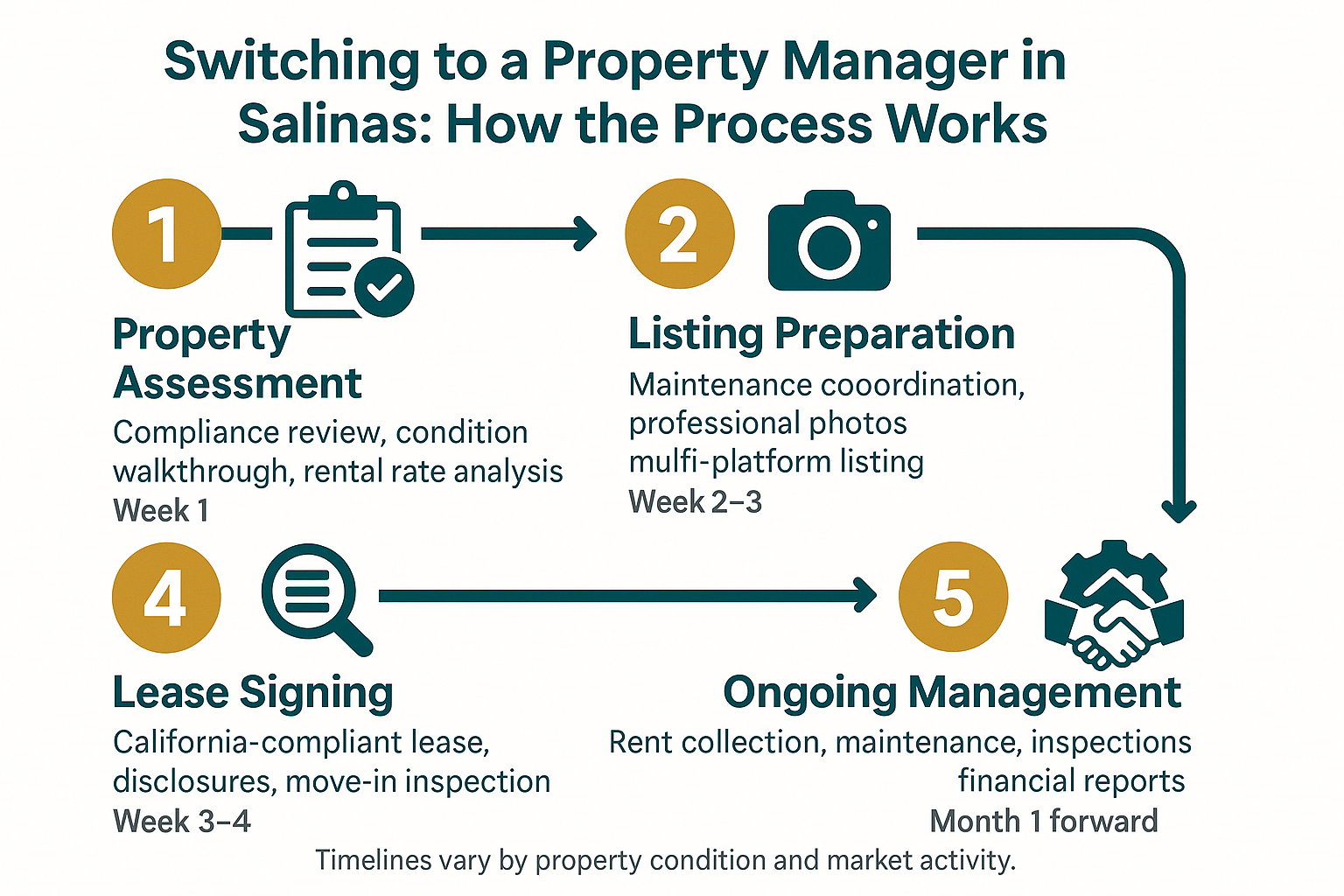
The Onboarding Process at a Glance
Here's how the process typically unfolds from first contact to active management — and roughly how long each phase takes.
What Happens After the Lease Is Signed
This is where first-time managed-property owners are often most surprised. The lease signing feels like the finish line. It's actually the starting point.
Ongoing management is not a passive role. Every month involves:
- Rent collection and follow-up when payment is late
- Maintenance coordination — fielding requests, dispatching vendors, tracking completion
- Scheduled property inspections to catch issues before they become expensive
- Bill payment including mortgage, HOA fees, and utilities where applicable
- Monthly financial statements delivered through the owner portal
- 24/7 emergency response for situations that can't wait until Monday morning
Several owners who have contacted us after attempting to self-manage described reaching a point where the volume of coordination had become unmanageable alongside a full professional or personal life. One property owner with multiple units in Salinas described it as reaching 'the point where I need dedicated support' — not because anything had gone wrong, but because the sheer number of moving parts had outgrown what one person could reasonably track.
That's a normal inflection point. And it's exactly what full-service property management is designed to absorb.
California's warranty of habitability also means that maintenance isn't discretionary — owners have a legal obligation to maintain livable conditions, and a professional manager's documentation and vendor relationships are a direct line of defense against habitability claims.
Self-Managing vs. Professional Management: What Changes
This isn't a complete side-by-side of every task — it's the specific areas where owners most often feel the difference after making the switch.
| Task | Self-Managing Owner | Professional Manager |
|---|---|---|
| Rental pricing | Based on mortgage needs or guesswork | Based on current comparable leases in the neighborhood |
| Listing quality | Often phone photos, single platform | Professional photos, multiple rental platforms |
| Tenant screening | Informal or inconsistently applied | Documented criteria, legally compliant process |
| Maintenance coordination | Owner fields every call directly | Manager coordinates vendors, tracks completion |
| Legal compliance | Owner researches changes independently | Manager monitors CA law updates and city ordinances |
| Financial reporting | Manual spreadsheets or no tracking | Monthly statements via owner portal |
| Emergency response | Owner's personal phone, any hour | Dedicated 24/7 response line |
The Compliance Layer Most Owners Don't Think About Until It's a Problem
Salinas is not a simple regulatory environment. The City of Salinas Residential Rental Registration Ordinance (City Ord. 2663) requires landlords to register rental properties annually — a requirement that caught a number of owners off guard when it rolled out in 2024. That registration is separate from California state law requirements, which include AB 1482 rent increase limits for covered properties, habitability standards, and disclosure obligations.
For properties in Monterey County more broadly, the California Department of Consumer Affairs publishes the state's landlord-tenant handbook, which outlines baseline legal obligations — but local ordinances layer on top of that, and they change. An owner managing their own property has to track those changes independently. A professional manager does it as part of the job.
This is one of the less visible benefits of professional management, but it's one of the more consequential ones. A missed registration, an improper rent increase, or a failed disclosure can create liability that far exceeds the cost of management fees. When a single missed inspection becomes a six-figure problem explores how quickly those gaps compound.
Frequently Asked Questions About Switching to a Property Manager in Salinas
How long does it take from first contact to having a tenant in place?
It depends on the condition of the property and current market activity, but owners should generally plan for two to four weeks from the initial walkthrough to a signed lease. A unit that needs deferred maintenance addressed before listing will take longer. A well-prepared unit in a high-demand Salinas neighborhood can move faster.
What happens to my existing tenant if I bring on a property manager mid-lease?
The existing lease stays in place — a change in management doesn't void a valid tenancy. The manager introduces themselves to the tenant, establishes new payment and maintenance communication channels, and takes over from there. The transition is typically straightforward as long as the lease documentation is in order.
Do I need to be registered with the City of Salinas before a manager can list my property?
Yes. The City of Salinas Residential Rental Registration Ordinance (City Ord. 2663) requires landlords to register rental properties. That registration needs to be in place — or initiated — before a unit is listed. Part of the initial property assessment is identifying any compliance gaps, including registration status.
Can I stay involved in decisions about my property after handing it over?
Absolutely. Most owners want to be informed without being the ones fielding every maintenance call or applicant question. A professional manager handles the day-to-day coordination and brings the owner in for decisions that warrant it — major repairs, lease renewals, significant tenant issues. The owner portal gives you real-time visibility into financials and reports at any time, without requiring you to be in the middle of every transaction.
What does tenant screening actually look like legally in California right now?
A lawful screening process in California involves documented, consistently applied criteria — income verification, credit review, and rental history — applied the same way to every applicant. Starting January 1, 2026, AB 1414 adds new obligations for landlords who use third-party screening services around how applicant data is handled. Self-managing owners who are unaware of these requirements and making screening decisions on instinct are taking on real legal risk.
How do I know what rent to charge?
Market averages for Salinas give you a general range, but the right number for your specific unit depends on size, condition, neighborhood, and what comparable units have actually leased for in recent months — not just what they're listed at. Pricing based on your mortgage payment rather than market data is one of the most common reasons units sit vacant longer than necessary.
Ready to See What This Looks Like for Your Property?
If you own a rental in Salinas, Monterey, Carmel, or anywhere across Monterey County and you've been wondering how the handoff actually works, we're happy to walk you through it — starting with a straightforward conversation about your property and your situation. Coast & Valley Properties can be reached by phone at (831) 757-1270 or through the contact form at coastandvalleypm.com.

Triple Net Leases in Monterey County: What the 'NNN' Actually Means for Owners
I get asked about triple net leases regularly from commercial property owners across Salinas and the Monterey Peninsula — and most of the time, the question isn't 'what is it?' so much as 'is it actually as good as it sounds?' That skepticism is healthy. The NNN structure has real advantages for owners, but it also comes with real risks that a basic definition doesn't prepare you for.
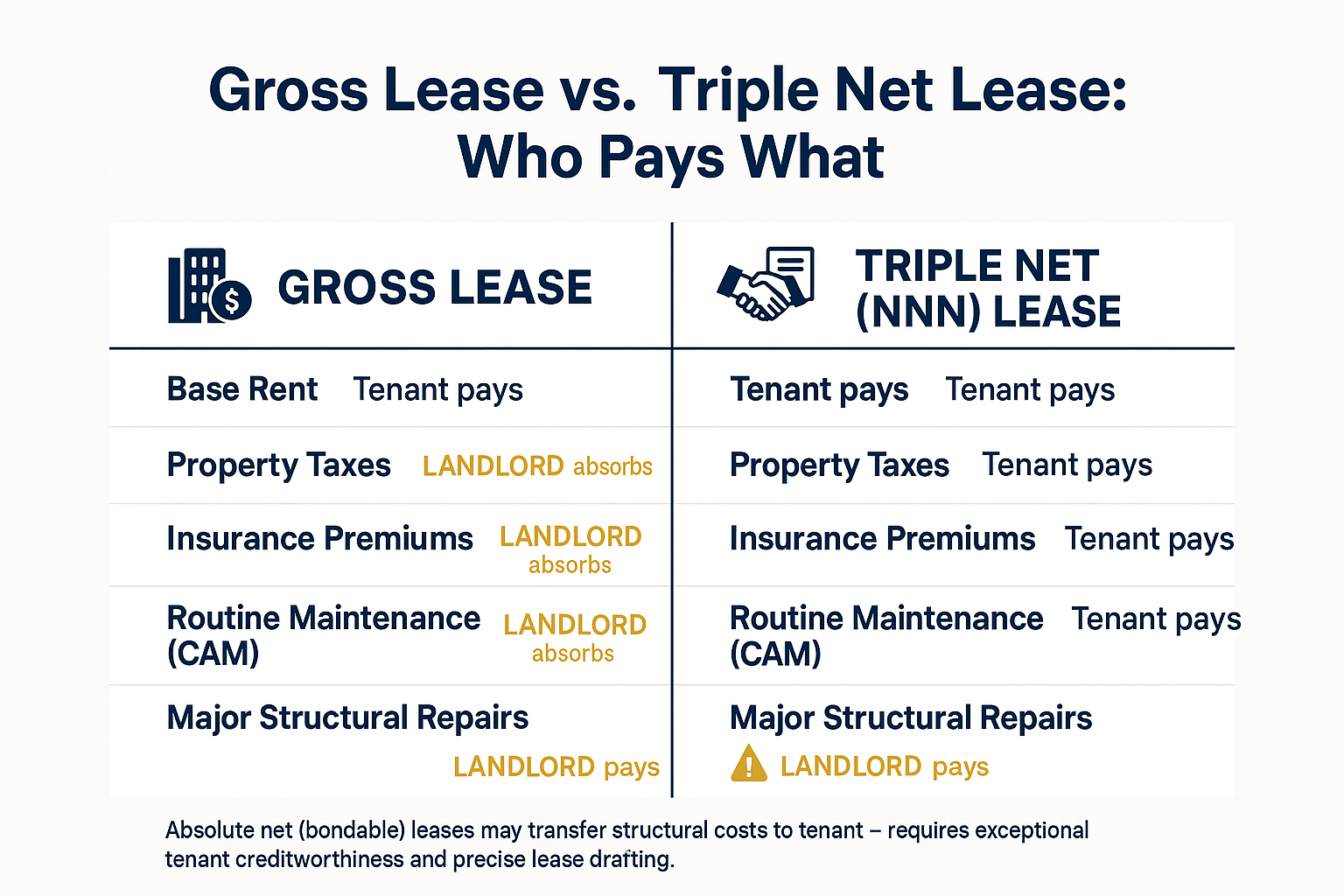
In a standard gross lease, you as the landlord collect rent and absorb the property's variable costs — taxes, insurance premiums, maintenance bills — out of that income. In a triple net lease, the tenant takes on those three expense categories on top of base rent. For owners in Monterey County, where California property taxes can jump with reassessments and insurance premiums have climbed sharply over the past few years, shifting those costs to the tenant is genuinely appealing.
But the value of that structure lives entirely in the lease document itself. What I want to walk through here isn't just the definition — it's the practical questions you need to answer before signing one, and the places where NNN arrangements in this market go wrong.
What the Three 'Nets' Actually Cover
The three expenses in a triple net lease are:
- Property taxes — the tenant pays their proportionate share of the real estate tax bill, including increases from Proposition 13 reassessments or supplemental tax bills
- Property insurance premiums — the tenant covers their share of the building's hazard, liability, and sometimes umbrella insurance costs
- Maintenance and common area costs (CAM) — the tenant is responsible for upkeep of the space and, in multi-tenant buildings, a proportionate share of shared areas
In a gross lease, you'd collect a higher base rent to cover all three. In an NNN arrangement, the base rent is lower — sometimes significantly lower — because the tenant is absorbing those variable costs directly. The owner's income becomes more predictable because you're not at the mercy of a bad insurance renewal year or a county tax reassessment eating into your net.
For a commercial property in Salinas or Monterey, this structure can make a real difference. California insurance premiums for commercial properties have risen in many cases by 20–40% over the past three years, and Monterey County's assessed property values in desirable corridors have climbed steadily. Transferring those variables to the tenant isn't just a preference — it's a meaningful financial protection.

The Biggest Misconception: 'NNN Means Hands-Off'
This is where I see commercial owners get tripped up more than anywhere else. A triple net lease does not make you a passive owner. In a standard NNN arrangement, the tenant handles day-to-day maintenance and their proportionate operating costs — but major structural components typically remain the landlord's responsibility.
That means:
- Roof replacement — if the roof fails, you're likely writing the check
- Foundation repairs — structural issues are almost always on the owner
- HVAC system replacement — depending on how the lease defines 'capital repairs,' a full system replacement may fall to you
- Building envelope repairs — exterior walls, structural supports, major plumbing systems
There is a more extreme version called an absolute net lease (sometimes called a 'bondable' lease) that can transfer even these structural costs to the tenant. But that structure requires a very creditworthy tenant — think a national pharmacy or a well-capitalized franchise — and extremely precise lease drafting. Most commercial properties in Salinas, Monterey, or Pacific Grove are not going to attract a tenant with that kind of balance sheet.
The practical takeaway: even in a well-structured NNN lease, build a capital reserve for major structural items. Don't assume the 'triple net' label means you'll never spend money on the building again.
Why Lease Language Matters More Than the Label
I can't stress this enough: two leases can both be called 'triple net' and operate completely differently in practice. The label is not the protection — the definitions inside the document are.
Common problems I've seen in vaguely drafted NNN leases:
- CAM definitions that are too broad — if the lease doesn't specify exactly what qualifies as a common area maintenance expense, disputes are almost inevitable. A tenant who disputes a landscaping invoice or a parking lot reseal can tie up collections for months.
- Tax pass-through language that doesn't address increases — the lease should spell out how tax reassessments, supplemental bills, or new county assessments are handled. California's Proposition 19 changed inheritance and transfer rules in ways that can trigger reassessments on commercial transfers — if that's not addressed in the lease, you may end up absorbing an increase you thought you'd passed through.
- Insurance reconciliation procedures — who collects documentation? What happens if the tenant's coverage lapses? The lease needs to answer these questions before they become problems.
A vaguely drafted NNN lease can create disputes that cost you far more in legal fees and lost rent than you ever saved by structuring it that way. For owners managing commercial properties, this is one area where staying legally current in a changing regulatory environment pays for itself.
Gross Lease vs. Triple Net Lease: Who Pays What
This comparison shows how costs are divided between landlord and tenant under each lease structure.
Vetting a Commercial Tenant for a Long-Term NNN Commitment
Screening a commercial NNN tenant is a very different process from screening a residential renter. You're not just confirming someone can pay next month's rent — you're assessing whether a business can sustain a multi-year financial obligation that includes taxes, insurance, and maintenance on top of base rent.
The financial documents that actually tell you something meaningful:
- Two to three years of business tax returns — these show real profitability, not projected income
- Business financial statements (P&L and balance sheet) — a profit-and-loss statement shows operating margins; a balance sheet shows whether the business carries significant debt
- Bank statements (three to six months minimum) — cash reserves matter; a business that's profitable on paper but cash-starved can miss payments quickly when an NNN expense spike hits
- Personal financial statement from business principals — especially important for small businesses where the owner's personal financial stability is intertwined with the company's
- Commercial credit report — services like Dun & Bradstreet provide business credit profiles that go beyond a personal FICO score
- Landlord references from prior commercial tenancies — how a business treated its last landlord tells you more than a credit score
This vetting process takes longer than a residential screen, and it should. A five-year NNN lease with a tenant who turns out to be financially fragile is a significantly worse outcome than a vacant property while you find the right fit. As we've written before, the difference between a good tenant and a great one starts before move-in — and that principle applies on the commercial side too, just with higher stakes.
What to Request from a Commercial NNN Tenant Applicant
These are the core financial documents and what each one actually tells you about a prospective tenant's ability to handle a long-term NNN obligation.
| Document | What It Shows | Why It Matters for NNN |
|---|---|---|
| Business tax returns (2-3 yrs) | Actual net income over time | Reveals real profitability vs. projected numbers |
| P&L and balance sheet | Operating margins and debt load | Shows whether the business can absorb variable NNN costs |
| Bank statements (3-6 months) | Cash flow and reserves | A cash-poor business fails fast when expenses spike |
| Personal financial statement | Owner's personal financial stability | Critical for small businesses where owner = business |
| Commercial credit report | Business credit history and payment patterns | Goes beyond personal FICO — specific to business obligations |
| Prior landlord references | How they treated the last property and lease | Past commercial behavior predicts future performance |
Setting Base Rent When Taxes and Insurance Are Being Passed Through
One question commercial owners in this market often wrestle with: if the tenant is covering taxes and insurance, how do you set a fair base rent?
The short answer is that base rent in an NNN lease should reflect current market rates for comparable NNN spaces — not a gross lease rate with expenses subtracted. These are different markets, and conflating them leads to either underpricing the space or asking a tenant to pay effective gross-lease rates while also covering operating expenses.
For Monterey County commercial properties, the variables that influence base rent in an NNN context include:
- Property type and use — retail, medical office, and light industrial each have distinct market rent ranges in this area
- Location within the county — a Cannery Row-adjacent commercial space trades at very different rates than a property along North Main Street in Salinas
- Tenant improvement allowances — if you're contributing to buildout costs, that's often reflected in a slightly higher base rent or a longer initial term
- Lease term length — longer commitments typically support lower base rent; shorter terms justify a premium
Getting the base rent conversation right matters beyond the first year. Because property value in California is tied to income performance, an underpriced commercial lease can affect the property's appraised value for years.
Frequently Asked Questions About Triple Net Leases in Monterey County
Does a triple net lease mean I never have to pay for repairs?
No — and this is the most common misconception. In a standard NNN lease, the tenant handles routine maintenance and their share of operating costs. But major structural repairs — roof replacement, foundation work, HVAC system replacement — typically remain the landlord's responsibility unless the lease is specifically drafted to say otherwise. An absolute net lease can transfer structural costs to the tenant, but that requires an exceptionally creditworthy tenant and very precise language.
How is a triple net lease different from a modified gross lease?
In a modified gross lease, some expenses are split between landlord and tenant — often the landlord covers taxes and insurance while the tenant handles utilities and interior maintenance. In a triple net lease, the tenant absorbs all three major variable expense categories. The modified gross structure is a middle ground, and it's worth knowing that both are negotiable — the label matters less than what the document actually assigns to each party.
What financial documents should I ask a commercial tenant to provide?
At minimum: two to three years of business tax returns, a current P&L and balance sheet, three to six months of bank statements, and a commercial credit report. For small businesses, a personal financial statement from the principals is also important. Commercial tenant vetting takes longer than residential screening — that's appropriate given the multi-year financial commitment involved.
Can California property tax increases be passed through to the tenant in a NNN lease?
Yes, but only if the lease says so clearly. The pass-through language needs to specify how supplemental tax bills, reassessments, and increases triggered by property transfers are handled. Without that language, you may find yourself absorbing a tax increase you expected to pass through. This is one reason California-specific lease review matters more here than in states with simpler tax structures.
Is a triple net lease the right structure for every commercial property?
Not necessarily. The NNN structure works best when the tenant is financially strong, the lease term is long enough to justify lower base rent, and both parties have the legal representation to draft the expense definitions clearly. For smaller commercial spaces with shorter-term tenants, a modified gross or full gross lease may actually be simpler to administer and less prone to disputes.
Questions About a Commercial Property in Monterey County?
If you own a commercial property in Salinas, Monterey, or the surrounding area and you're working through a lease structure decision, Coast & Valley Properties is available to talk through what we're seeing in the local market. Reach us by phone at (831) 757-1270 or through the contact form at coastandvalleypm.com — we're happy to have a straightforward conversation about your situation before any decisions are made.

California's Warranty of Habitability: A Plain-Language Breakdown for Rental Owners
One of the most common misconceptions I hear from owners — especially those who've self-managed for years — is that a signed lease protects them from habitability claims. Specifically, the belief that a clause saying 'tenant accepts the property as-is' satisfies their legal obligation. It doesn't. Not even close.
California's warranty of habitability is implied by law under Civil Code Section 1941. That means it exists whether or not it appears in any lease, and no lease language can waive it. This isn't a technicality that only matters in court — it's the standard that determines whether a tenant can legally withhold rent, hire their own contractor, or terminate their lease without penalty.
For owners managing properties in Salinas, Monterey, Carmel, or anywhere across Monterey County, understanding this standard isn't optional. California is one of the most tenant-protective states in the country, and what happens to your rental when California law changes mid-lease can catch unprepared owners completely off guard.
What the Habitability Standard Actually Requires
Most owners assume habitability means the unit was in decent shape at move-in. The law means something more demanding: the property must remain fit for human habitation throughout the entire tenancy — not just at the start.
California Civil Code 1941.1 spells out the specific conditions that must be maintained. I find it helps to think of this less as a legal checklist and more as a question: could a reasonable person live here safely and with basic dignity?
Here's what the law actually requires:
- Effective waterproofing and weather protection on the roof and exterior walls, with no broken windows or doors
- Working plumbing in good condition, connected to a functioning water supply
- Hot and cold running water connected to a sewage disposal system
- Heating facilities capable of maintaining indoor temperatures — this matters during Salinas Valley winters more than people expect
- Electrical lighting in working condition
- Clean and sanitary buildings, grounds, and fixtures — free of debris, filth, and rodent or vermin infestation
- Adequate ventilation in all rooms
- Floors, stairways, and railings in good repair
And starting January 1, 2026, AB 628 adds working stoves and refrigerators to this list under qualifying circumstances — specifically when the landlord has provided those appliances as part of the rental. If your lease covers appliances, that addition changes your maintenance obligations in a real way. You can see how this fits into the broader picture of new California landlord laws for Monterey County owners in 2026.

What Happens When a Repair Gets Ignored
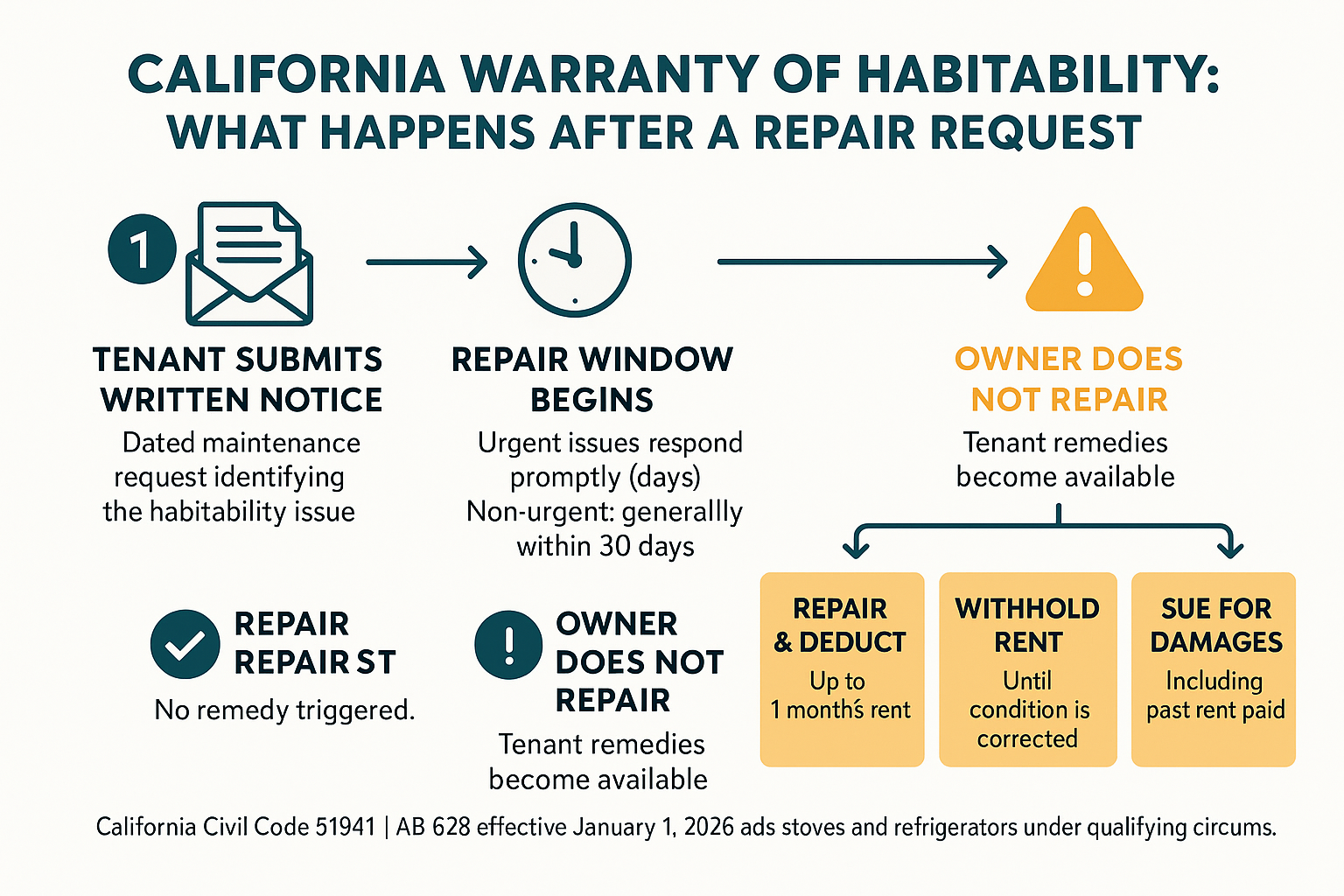
This is the part that catches owners off guard. Once a tenant gives proper written notice of a habitability problem and the owner fails to make the repair within a reasonable time — generally 30 days, though urgent issues like a plumbing failure or broken heater require faster action — California law hands the tenant several powerful remedies.
Repair and deduct. The tenant can hire their own contractor and deduct the cost from rent, up to one month's rent. The owner's recourse is extremely limited if the original request was documented and ignored.
Rent withholding. The tenant may stop paying rent entirely until the condition is corrected. In a dispute, courts weigh whether the owner responded in good faith and with reasonable speed.
Lease termination. A serious habitability breach can give a tenant legal grounds to walk away from the lease without penalty.
Civil lawsuit. Tenants can sue for damages — including rent they paid while living in substandard conditions.
I've seen real situations that illustrate how quickly this escalates. One tenant described a water leak that wasn't addressed for two full months, resulting in water bills over $300 per month. Another described a dryer that vented directly into a crawl space — a clear fire code violation and a textbook habitability failure. In both cases, the tenants had documentation. The owners did not.
The repair-and-deduct remedy especially surprises owners. Many assume they can dispute a deduction later. But if the tenant's written notice is dated and the owner's repair was delayed or absent, the tenant's action is often lawful. The owner loses the argument before it starts.
This is one reason when a single missed inspection becomes a six-figure problem is worth understanding before you're in that position.
California Habitability: Notice, Deadline, and Tenant Remedies
This flow shows what happens after a tenant submits a maintenance request — and what rights they have at each stage if the repair isn't made.
California Civil Code 1941: Required Conditions at a Glance
Here's a quick-reference view of the conditions required under California's habitability standard, organized by category and what a failure typically looks like in the field.
| Category | What the Law Requires | Common Failure Example |
|---|---|---|
| Weatherproofing | Effective roof, walls, windows, and doors | Leaking roof, broken window seal, door that won't latch |
| Plumbing | Working fixtures, connected to water supply and sewage | Persistent leaks, backed-up drains, no hot water |
| Heating | Functional heating system | Broken furnace in a Salinas Valley winter |
| Electrical | Working lighting throughout the unit | Outlets that don't function, exposed wiring |
| Pest/Rodent Free | No infestation of insects or rodents | Active rodent access points, cockroach infestation |
| Ventilation | Adequate airflow in all habitable rooms | Dryer venting into crawl space, blocked exhaust fans |
| Appliances (AB 628) | Working stove and refrigerator if provided by landlord | Broken refrigerator not replaced after notice — effective Jan 1, 2026 |
| Structural Safety | Floors, stairways, and railings in good repair | Loose stair railing, rotting subfloor boards |
Documentation Is the Difference Between a Defensible Position and None at All
The habitability standard itself is relatively stable — it hasn't changed dramatically in years. What changes constantly is the quality of documentation owners carry into a dispute.
When a tenant files a repair-and-deduct claim or withholds rent, the central question isn't just whether the problem existed. It's whether the owner knew about it, when they were told, and how quickly they responded. That record is built entirely from:
- Dated written maintenance requests — email, text, or written notice with a clear timestamp
- Repair invoices showing who did the work, what was fixed, and when
- Inspection photos taken at move-in, during the tenancy, and at move-out
- Vendor communications confirming scheduling and completion
Owners who manage their own properties often rely on informal systems — a phone call here, a text thread there. Those records are hard to compile under pressure, and some of them disappear entirely.
This is exactly what I mean when I say the law itself isn't the hard part. The hard part is building the paper trail that proves you met your obligations when it counts. What Salinas property owners get wrong about self-managing goes into this in more depth — including the operational gaps that look small until a dispute surfaces.
For owners managing multiple properties across Monterey County — say, units in Salinas alongside a rental in Pacific Grove — keeping that documentation system consistent across every address is a real workload. It's one of the practical reasons multi-unit owners in Monterey County often move toward professional management over time.
Frequently Asked Questions About California's Warranty of Habitability
Can I include a lease clause that says the tenant accepts the property as-is and waives habitability claims?
No. California law makes the warranty of habitability non-waivable. A tenant cannot contract away their right to a habitable unit, and a lease clause that purports to waive it is unenforceable. Courts have consistently rejected this argument. If a tenant later claims a habitability breach, that clause won't protect you.
How quickly do I have to respond to a repair request before a tenant can legally withhold rent or repair-and-deduct?
California law doesn't set a single fixed number of days for every situation. Urgent conditions — no heat in winter, a sewage backup, a significant water leak — require a much faster response than a non-urgent cosmetic issue. For most repairs, courts have generally treated 30 days as a reasonable outer limit, but that window shrinks considerably when health or safety is at risk. When in doubt, respond in writing the same day and schedule the repair as soon as possible.
What does AB 628 actually change for me as a landlord?
Effective January 1, 2026, AB 628 adds working stoves and refrigerators to the list of habitability conditions — but only when the landlord provided those appliances as part of the rental. If your lease includes appliances, you now have a maintenance obligation that didn't exist before. If the tenant brought their own appliances, this doesn't apply to you.
A tenant withheld rent saying the property was uninhabitable. Can I just evict them?
This is a situation where you need to be careful. If the tenant had a legitimate habitability complaint, gave proper written notice, and you didn't respond in a reasonable time, a California court may side with the tenant — even if you filed the eviction. Document your repair response immediately and consult a California attorney before proceeding. Attempting to evict over a documented habitability complaint without addressing the underlying issue can expose you to additional liability.
Does the warranty of habitability apply to commercial rentals I own in Monterey County?
The specific provisions of Civil Code 1941 are written for residential tenancies. Commercial leases are governed by different rules and typically do allow more negotiation over maintenance responsibilities between landlord and tenant. If you own commercial property, the habitability standard as described in this article does not apply in the same way — but other code compliance obligations still exist.
What's the single most important thing I can do right now to protect myself?
Build a documentation system and use it consistently. Every maintenance request should be acknowledged in writing with a date. Every repair should produce a vendor invoice. Every inspection should generate dated photos. The habitability standard itself is stable — your ability to defend against a claim depends almost entirely on the paper trail you've created before that claim ever arrives.
Questions About Your Properties in Monterey County?
If you're managing rentals in Salinas, Carmel, Pacific Grove, or anywhere across Monterey County and you're not certain your maintenance documentation holds up to scrutiny, that's worth addressing before a dispute rather than during one. Coast & Valley Properties works with property owners throughout the region who want to stay ahead of California's compliance requirements — not scramble to catch up. You're welcome to reach out directly at (831) 757-1270 or through the contact form at coastandvalleypm.com.

Lead Paint Disclosure in California: What Rental Owners Get Wrong
I've talked with a lot of Monterey County property owners over the years, and lead paint disclosure is one of those topics where confidence and compliance rarely match. Owners of older homes in Pacific Grove, Salinas, and Monterey often assume they handled this when they first rented the property — and haven't thought about it since. That assumption is where the liability starts.
Pre-1978 housing stock is substantial on the Monterey Peninsula. The Craftsman bungalows along Lighthouse Avenue in Pacific Grove, the Victorian-era rentals near downtown Salinas, the older single-family homes throughout Monterey — many of these properties were built during an era when lead-based paint was standard. Federal law has required disclosure since 1996, and California has layered on its own requirements that many owners don't know exist.
This article isn't a legal opinion, and it doesn't replace an attorney. But it does go deeper than the standard 'here is the form' explanation — because the questions I actually hear from owners are more specific than that. When does the obligation trigger again? What happens if there are no renovation records? What if a tenant claims they never got the pamphlet?
What Federal Law Actually Requires — and When It Applies
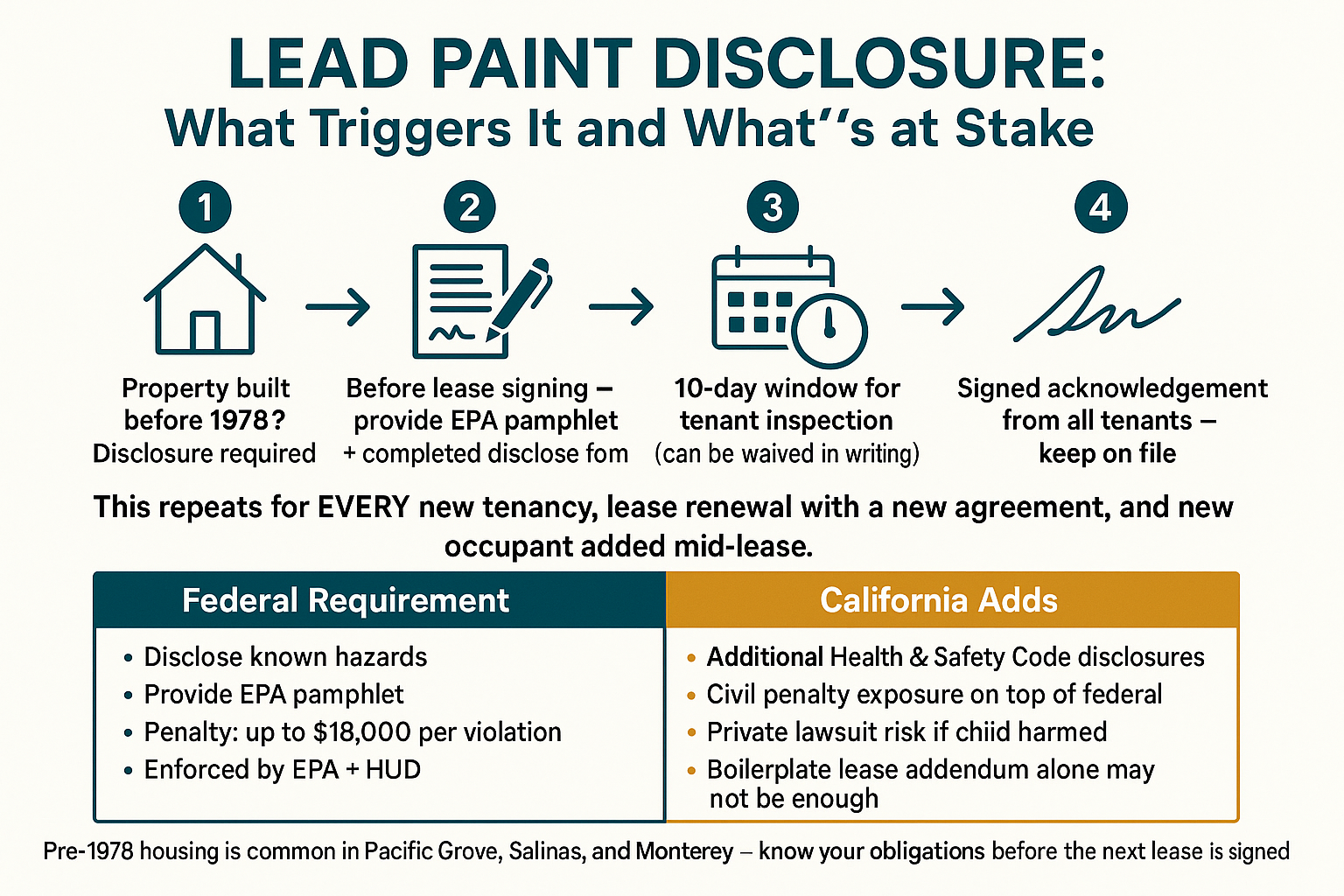
The federal requirement comes from the Residential Lead-Based Paint Hazard Reduction Act of 1992, and it is enforced jointly by the EPA and HUD. The rule is straightforward on its face: before a tenant signs a lease for a pre-1978 residential property, the owner must do three things:
- Disclose any known lead-based paint hazards on the property using an approved disclosure form
- Provide the tenant with the EPA's pamphlet, Protect Your Family from Lead in Your Home
- Give the tenant a 10-day window to conduct a paint inspection or risk assessment at their own expense (though the tenant can waive this in writing)
The word 'known' is doing a lot of work in that first bullet. The form asks what you know — it does not require you to test. But knowingly omitting information you do have is where federal liability begins. 'I don't know if there's lead paint' is a legitimate answer on the form. Saying you have no knowledge when you actually received a prior inspection report is not.
What trips up owners most is the assumption that this is a one-time item. The disclosure obligation applies to every new tenancy — not just the first time you rented the property. It also applies to lease renewals where a new lease agreement is signed, and when a new occupant is added who wasn't part of the original lease. I've seen owners who handled this correctly in 2015 and haven't revisited it since — which means every subsequent tenant may have signed a lease without a compliant disclosure package.
For a deeper look at how California law keeps shifting the compliance landscape for owners, the 2026 landlord law breakdown for Monterey County is worth reading alongside this.

Where California Goes Further Than Federal Law
Here's where a lot of owners get into trouble: they've done the federal form and provided the EPA pamphlet, and they consider the box checked. But California has its own requirements under the Health and Safety Code, and the interaction between the two layers is genuinely confusing.
California's lead hazard disclosure requirements under Health and Safety Code Section 17920.10 and related provisions can impose additional obligations in residential rental situations — particularly where known hazards exist or where specific renovation activity has occurred. The state framework is designed to work alongside federal requirements, not replace them, which means owners who rely solely on a standard lease addendum may still be out of compliance.
Civil penalties under California law for failing to comply can add exposure on top of the federal civil penalties of up to $18,000 per violation. And 'per violation' matters — if you have a four-unit property and failed to provide proper disclosure to each tenant, that's four separate violations.
The more serious risk is a private lawsuit. If a child living in your rental is diagnosed with lead poisoning and you cannot demonstrate that you properly disclosed known hazards — or worse, that you had reason to know about a hazard and didn't disclose it — you are exposed to civil litigation that goes well beyond a regulatory fine. This is not a hypothetical risk for owners of older Peninsula-area homes. It is one of the more consequential liability items hiding in plain sight.
Owners managing multiple units should also read how multi-unit owners in Monterey County stay legally compliant — the compliance picture gets more complex with each additional door.
The Lead Paint Disclosure Requirement at a Glance
This summarizes when the obligation triggers, what's required, and what the penalties look like if something goes wrong.
The Two Scenarios That Actually Keep Owners Up at Night
I hear two specific situations more than anything else when this topic comes up.
Scenario one: no renovation records from prior owners. A lot of Monterey Peninsula properties have changed hands multiple times, been renovated at various points, and have zero paper trail for what happened to the paint. If you purchased a 1940s bungalow in Monterey and the previous owner did work without pulling permits — which happens more than anyone wants to admit — you may have zero documentation of what's behind the walls or on the trim.
In this case, your disclosure form accurately reflects 'no knowledge of lead-based paint hazards.' That's a legitimate and legally appropriate answer. Where owners get into trouble is when they've received information — even informal information, like a prior inspection from when they bought the property — and choose not to disclose it. The obligation is to report what you know. If you genuinely don't know, say so clearly and in writing.
Scenario two: a tenant claims they never received the disclosure or pamphlet. This is a documentation problem more than anything else. Federal regulations require the tenant to sign an acknowledgment confirming they received the disclosure form and the EPA pamphlet. That signed acknowledgment is your protection. If you can't produce it, the burden shifts in an uncomfortable direction.
I'd also flag that the acknowledgment needs to come from every adult tenant on the lease — not just the primary leaseholder. If a couple signs the lease and only one person signed the lead paint acknowledgment, you may have a gap.
This kind of detail is exactly why the hidden workload behind managing a single rental home is harder than most owners expect when they start self-managing.
When the Disclosure Obligation Triggers
Many owners treat lead paint disclosure as a one-time event. This table shows every situation where the obligation applies — some of which routinely catch owners off guard.
| Situation | Disclosure Required? | Common Mistake |
|---|---|---|
| New tenant signs first lease | Yes — always for pre-1978 properties | Assuming one disclosure covers the property forever |
| Lease renewal with a new signed agreement | Yes — new lease, new disclosure | Treating the renewal as a continuation, not a new document |
| New occupant added to an existing lease | Yes — new person must receive disclosure and pamphlet | Only providing disclosure to the original tenant |
| Month-to-month continuation, no new agreement signed | Generally not required again — consult an attorney if unsure | Assuming it's always required, which can create redundancy confusion |
| Prior owner completed renovations, no records available | Disclose 'no known hazards' in writing if truthful | Staying silent rather than documenting the gap on the form |
| Property tested and found lead-free by certified inspector | Disclosure still required — attach the test report | Thinking a clean test eliminates the disclosure obligation |
Frequently Asked Questions About Lead Based Paint Disclosure
My property was fully renovated in the 1990s. Do I still need to disclose?
Yes. The disclosure obligation is based on the year the structure was built, not when it was renovated. If the property was built before 1978, the requirement applies regardless of how much work has been done since. If you have documentation showing the renovation included lead abatement by a certified contractor, attach that to your disclosure — it's useful context, but it doesn't remove the obligation to complete the form.
What exactly is in the EPA pamphlet, and can I just email it?
The pamphlet is Protect Your Family from Lead in Your Home, published by the EPA. It covers health risks, where lead paint is typically found, and steps families can take. Electronic delivery is permitted as long as you can document that the tenant received and acknowledged it — a signed email confirmation or an e-signature platform both work. What doesn't work is claiming you 'mentioned it' without written acknowledgment.
A tenant is now claiming they were never given the disclosure when they moved in two years ago. What do I do?
This is where documentation either protects you or exposes you. If you have the signed acknowledgment form from move-in, that's your evidence. If you don't have it, you have a problem that's worth discussing with a California landlord-tenant attorney before it escalates. Going forward, use a consistent, signed disclosure packet at every move-in — and keep copies permanently, not just for the duration of the tenancy.
Is there a penalty for forgetting to provide the pamphlet, even if I did the disclosure form?
Yes. Both the disclosure form and the pamphlet are required under federal law, and they're treated as separate obligations. Providing one without the other leaves you out of compliance. Federal civil penalties can reach $18,000 per violation, and California's civil exposure adds another layer on top of that.
I own a few older homes near downtown Salinas. Do I need to test for lead paint before renting?
Testing is not required. The disclosure form asks what you know — not what a test would reveal. That said, if you choose to test and the results come back positive, you are now obligated to disclose that finding going forward. Some owners prefer not to test for exactly this reason. Others test proactively so they can document the property's actual condition. There's no universally right answer, and this is a decision worth making with an attorney who knows California landlord-tenant law.
Does this apply to commercial properties too?
The federal lead paint disclosure rule applies specifically to residential dwellings. Commercial-only properties are not covered under this rule. However, mixed-use properties that include residential units fall under the requirement for those units. If you're unsure how your property is classified, that's worth confirming before the next lease is signed.
Why This Gets Missed Even by Careful Owners
I want to be honest about something: this isn't a compliance area where you have to be careless to fall short. The lead paint disclosure requirement is older than most people's property management systems, it predates e-signature platforms, and it's easy to treat as legacy paperwork rather than an ongoing obligation.
The owners I've seen get tripped up are often people who did everything right at the start — they completed the disclosure, they gave the pamphlet, they got a signature. And then years passed, tenants turned over, someone signed the new lease but not the disclosure packet, and now the file has a gap that nobody noticed.
This is compounded by the dual-layer nature of California compliance. Federal law and state law each impose their own requirements, and a lease addendum that covers one layer may not cover the other. Assuming a standard lease template handles everything is a reasonable assumption — it just isn't always a correct one.
For owners who want to understand how California's regulatory layers interact more broadly, what happens to your rental when California law changes mid-lease is useful background. And for the compliance picture specific to this market, how multi-unit owners in Monterey County stay legally compliant covers more of the same territory.
Questions About Your Property's Compliance Picture?
Coast & Valley Properties works with residential property owners throughout Monterey County — including many owners of older homes in Salinas, Monterey, and Pacific Grove where pre-1978 housing is the norm, not the exception. If you have questions about how lead paint disclosure fits into a professionally managed lease process, we're happy to talk through it. Reach us at (831) 757-1270 or through the contact form at coastandvalleypm.com.
What New California Landlord Laws Mean for Monterey County Owners in 2026
Every January, California adds new requirements to an already complicated landlord-tenant framework. But January 1, 2026 brought a batch of changes that I think are genuinely consequential — not the kind you can set aside to review later. Four new laws hit simultaneously, and the owners most likely to get caught off guard are the ones who haven't touched their lease templates, their deposit processes, or their billing arrangements in a year or two.
I work with property owners across Monterey County every day — from Salinas and Gonzales to Carmel and Pacific Grove. And the pattern I keep seeing is that owners assume compliance is static. They got it right once, so they're still fine. That assumption is what turns a minor oversight into a real legal exposure.
This article walks through the four changes that matter most to residential landlords in our market, and explains exactly what you need to review now — before a lease renewal, a new tenant, or a move-out creates a problem you can't undo.
AB 628: Working Stoves and Refrigerators Are Now a Legal Requirement
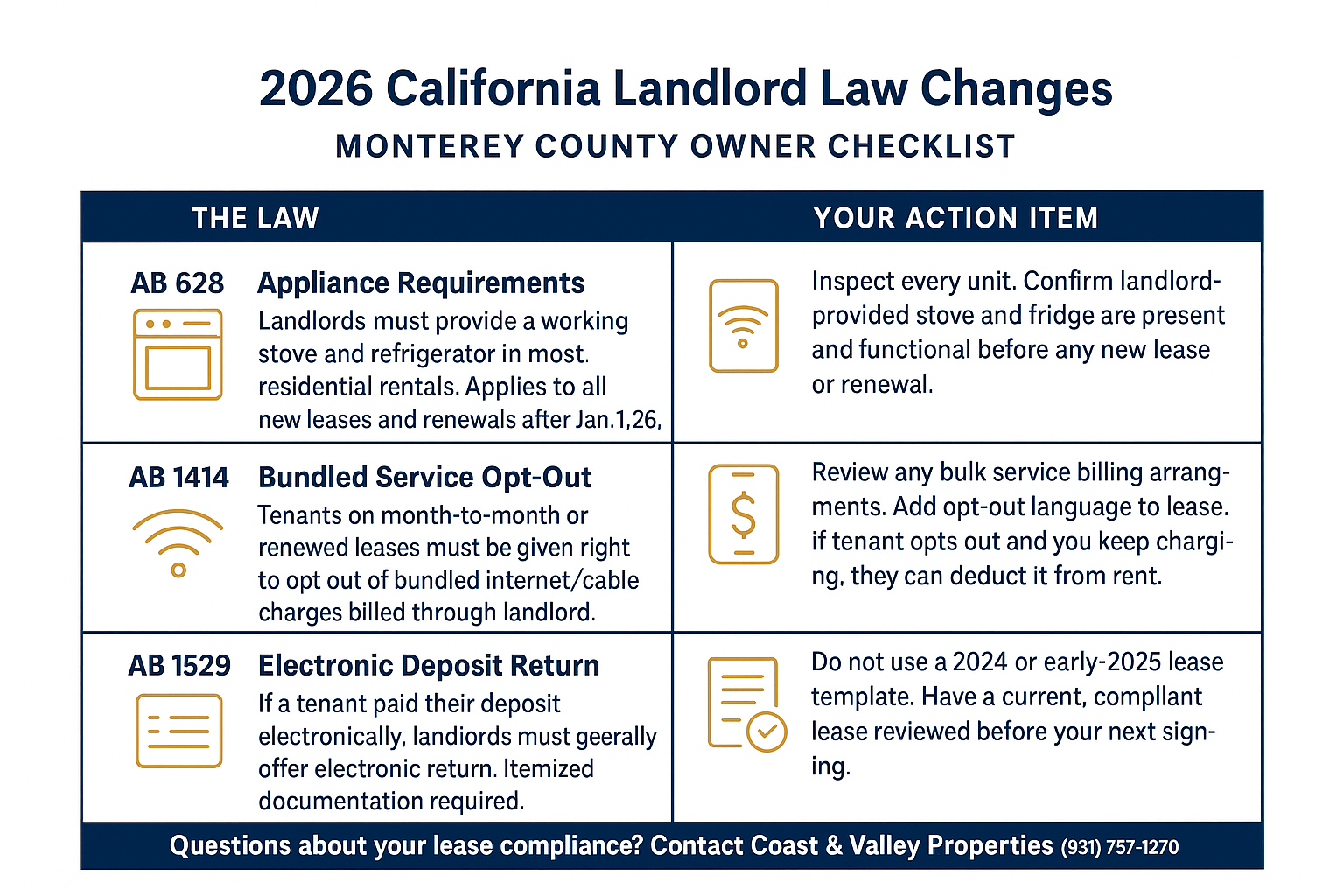
This one surprised a lot of owners I've spoken with, because the question of who provides appliances has always been treated as a matter of lease negotiation — not law. AB 628, effective January 1, 2026, changes that for most residential rentals.
Landlords are now required to provide a working stove and refrigerator in most residential rental units. For existing month-to-month tenants, the law may not automatically apply until there's a change in lease terms. But any new lease or renewal signed after January 1, 2026 triggers the requirement — full stop.
Where this gets complicated is with older properties. I've seen Salinas owners with units built in the 1960s and 70s where the understanding has always been that tenants bring their own appliances. That arrangement doesn't work for a new tenancy under this law. If the unit doesn't have a landlord-provided stove and refrigerator, you need to either supply them or get clear legal advice about your specific situation before signing a lease.
The cost of adding appliances isn't enormous, but the cost of a habitability dispute — especially under California's warranty of habitability — can be. What happens to your rental when California law changes mid-lease is exactly the kind of question this law raises for owners who didn't see it coming.
AB 1414: The Bundled Internet Billing Trap
Over the past few years, some landlords — especially in multi-unit properties — started adding bulk internet or cable service packages to their leases and passing the cost through to tenants as part of monthly billing. It simplified vendor management and gave the building a competitive edge in the rental market. I get why it caught on.
AB 1414 makes that arrangement legally risky for any tenancy that is month-to-month or that renews on or after January 1, 2026. The law requires landlords to give tenants the option to opt out of bundled subscription service charges — things like internet or cable that are billed through the landlord.
And here's the part that really matters: if a tenant opts out and the landlord continues charging anyway, the tenant can legally deduct those costs from their rent. That's not a gray area — it's a defined remedy under the statute.
If you have a bulk internet arrangement at a Salinas fourplex or a Monterey multi-family property, you need to review whether your current lease and billing setup accounts for this. Many owners added these packages without any opt-out language because none was required at the time. That lease language has a shelf life now, and it expired.
AB 414: Security Deposit Returns Just Got More Complicated
California already had strict rules around security deposit accounting — 21-day return deadline, itemized statements, documentation of deductions. AB 414 adds a new layer: if a deposit was paid electronically, landlords are now generally required to offer electronic return of that deposit.
I want to frame this as what it really is: a documentation and process issue. If your deposit accounting still runs on paper checks and handwritten statements, you're not just behind on technology — you may be out of compliance.
The practical risk shows up at move-out, which is the worst possible time to discover a process problem. Tenants who paid digitally and receive a paper check may have grounds to dispute the handling. Combine that with any weakness in your itemized statement — missing photos, vague descriptions, undocumented deductions — and a routine move-out can turn into a dispute that costs far more than the deposit itself.
Owners who want to understand what good move-out documentation actually looks like should read what Salinas property owners get wrong about self-managing. Deposit disputes are one of the most consistent pain points I see, and almost all of them trace back to process gaps that were entirely preventable.
Four Laws, Four Action Items: Your 2026 Compliance Checklist
Here's a quick reference showing what each new law requires and what Monterey County owners should do right now.
AB 1529: Your Lease Template Probably Has an Expiration Date
This one is the easiest to overlook and, in my experience, the most common compliance mistake I see Monterey County owners make.
AB 1529 allows landlords to embed AB 1482 Tenant Protection Act disclosures directly within the lease body rather than attaching them as a separate addendum. On the surface, that sounds like a convenience — one less document to track.
The trap is this: that flexibility only works if your lease template actually contains the updated 2026 disclosure language. A lease form from 2024 — or even early 2025 — likely doesn't. If you're using last year's template, you may think you're covered because you've always included the AB 1482 addendum, but the embedded language required under the new provision may be missing or out of date.
Lease templates have a shelf life. If you downloaded one from a legal forms site two years ago, printed a stack, and have been reusing it, that stack is now a liability. Every lease signing is an opportunity to get this right — or wrong. And wrong in California landlord-tenant law rarely comes with a warning before it comes with a consequence.
For owners managing multiple units in Salinas, where local rent ordinances are actively evolving, this is doubly important. AB 1482 rent caps and local ordinance compliance have to coexist in your lease documents, and keeping both current requires more than an annual glance at your paperwork.
How the Rules Stack Up Across Monterey County Markets
One of the most common misconceptions I hear from owners is that there's one set of rules for all their properties. There isn't. The table below shows how the regulatory picture differs across the markets we work in.
| Market | AB 1482 Rent Cap Applies? | Local Rental Ordinance | Key Complexity |
|---|---|---|---|
| Salinas | Yes (where applicable) | City Ord. 2663 — Residential Rental Registration (2024) | Must register rentals AND comply with state rent cap; ballot measures active |
| Monterey | Yes (where applicable) | No citywide rent control ordinance currently | State AB 1482 is primary framework; verify property-by-property |
| Carmel | Yes (where applicable) | Limited local rental regulations | Smaller rental market; individual property review essential |
| Pacific Grove | Yes (where applicable) | No current rent control ordinance | AB 1482 applies; city rules differ from Salinas |
| Unincorporated County | Yes (where applicable) | Monterey County STR Ordinance (Oct. 2024) — long-term rules separate | County vs. city jurisdiction must be determined per property |
Why the 'One Set of Rules' Assumption Causes Most Compliance Problems
The layering of city, county, and state regulations is what makes property management in Monterey County genuinely complex — more so than most California markets. A rule that applies in Salinas may not apply in Pacific Grove. An exemption that covers one property type may not cover another unit in the same portfolio.
I've talked with owners who manage properties in both Salinas and the unincorporated county, and they're often surprised to learn that their compliance obligations aren't identical across those properties — even when the properties look similar on paper. How multi-unit owners in Monterey County stay legally compliant gets into this in more detail, but the short version is: you cannot apply a single template to a geographically diverse portfolio and assume you're covered.
And that's before you layer in the four new 2026 state laws on top of existing AB 1482 rent cap rules, Salinas's rental registration ordinance (City Ord. 2663, passed in 2024), and the Monterey County Short-Term Rental Ordinance that took effect in October 2024.
The owners who stay out of trouble are the ones who treat compliance as a living process — not a one-time setup.
Frequently Asked Questions About California Landlord Laws in Monterey County
Do these new 2026 laws apply to my existing tenants, or only new ones?
It depends on the law. AB 628 (appliance requirements) and AB 1414 (bundled service opt-outs) generally apply to month-to-month tenancies and any lease that renews on or after January 1, 2026. They don't automatically rewrite a fixed-term lease mid-term in most cases, but once that lease ends or converts to month-to-month, the requirement kicks in. AB 414 (deposit returns) and AB 1529 (lease disclosure language) apply going forward with any new or renewed lease. When in doubt, have your current lease reviewed against the 2026 requirements before the next renewal date.
My lease template is from 2024 — is it really that outdated?
For AB 1529 purposes, yes — it likely is. The 2026 embedded disclosure language for AB 1482 compliance is updated, and a 2024 form almost certainly doesn't include it. Using an outdated template isn't just a technicality; it can affect your legal standing if a tenant challenges the disclosure. This is one of the most preventable compliance errors I see, and it's worth a legal review before your next signing.
What exactly is the AB 1482 Tenant Protection Act, and does it apply to my property?
AB 1482 is California's statewide rent cap and just-cause eviction law, in effect since 2020. It limits annual rent increases to 5% plus local CPI (up to 10% total) for covered properties and requires landlords to have a qualifying reason before terminating a tenancy. However, it has significant exemptions — single-family homes where the owner has provided proper notice, certain condos, and properties built within the last 15 years are often exempt. Whether your specific property is covered depends on property type, age, ownership structure, and local ordinance overlap. This is not a question to guess at.
I include internet in my rent — do I need to change my lease right now?
If you have tenants on month-to-month agreements, or if any leases renew after January 1, 2026, then yes — AB 1414 requires you to offer an opt-out from those bundled charges. If you don't update your lease and a tenant opts out but you keep charging them, they can legally deduct the amount from rent. Updating your lease language before the next renewal is far simpler than unwinding a billing dispute after the fact.
Is the Salinas rental registration ordinance different from what AB 1482 requires?
Yes. City Ord. 2663 — Salinas's Residential Rental Registration Ordinance, passed in 2024 — is a separate local requirement that applies on top of state law. It requires landlords with covered properties in Salinas to register those units with the city. AB 1482 is a statewide rent cap and just-cause eviction framework. Both can apply to the same property simultaneously. Owners with Salinas rentals need to be aware of both layers — and those rules are still evolving. Salinas's rent ordinances are heading to voters in 2026, so this is a moving target worth watching closely.
How do I know if my deposit accounting process is compliant with AB 414?
Start by answering one question: did your tenant pay their deposit electronically? If yes, you now need to be able to return it electronically and document the return. Beyond that, your itemized move-out statement needs to be detailed, timestamped, and supported by photos or receipts. If you're still doing deposit accounting on paper with handwritten notes, that process is a liability waiting to surface. The time to fix it is before a tenant moves out — not during a dispute.
Questions About How These Laws Affect Your Monterey County Properties?
We work with property owners throughout Monterey County — from Salinas and Gonzales to Carmel and Pacific Grove — and staying current on California landlord law is a core part of what we do. If you're not sure whether your leases, deposit processes, or billing arrangements are aligned with the 2026 requirements, Coast & Valley Properties is a good place to start. You can reach us directly at (831) 757-1270 or through the contact form at coastandvalleypm.com.

Salinas' Rent Ordinances Are Going to Voters — What Owners Need to Know Now
On September 23, 2025, the Salinas City Council voted 4-3 to send four rental ordinances to the November 3, 2026 general election ballot. Voters will decide whether to repeal them. But here's what matters most to you as an owner right now: every one of those ordinances is still the law today.
Several owners reaching out to Salinas property management firms recently have expressed real confusion — some assuming the ballot vote means the rules are paused or softened. They are not. Non-compliance between now and November 2026 exposes you to enforcement actions, legal liability, and penalties that won't disappear regardless of how the election goes.
This article walks through what the four ordinances actually require, where owners most commonly get it wrong, and how to think about planning your leasing and management strategy in the face of genuine uncertainty.
The Four Ordinances — and What Each One Actually Requires
The City of Salinas enacted four rental ordinances that work as a package. Understanding what each one does is the starting point for any owner of covered residential property in the city.
- Ord. 2663 — Residential Rental Registration: Requires landlords to register covered rental units with the City annually. Properties not registered within the first 30 days of the calendar year receive a delinquency notice. From that notice, owners have 45 days to pay before additional enforcement follows.
- Ord. 2681 — Rent Stabilization: Caps annual rent increases on qualifying multi-family units built before February 1, 1995 at 2.75% — meaningfully below the statewide AB 1482 ceiling of 5% plus CPI.
- Ord. 2682 — Just Cause Eviction: Requires landlords to have a legally qualifying reason before issuing any termination notice to a covered tenant. A standard lease expiration alone is not enough.
- Ord. 2683 — Tenant Anti-Harassment: Defines prohibited conduct by landlords and creates legal exposure when tenant complaints are mishandled, ignored, or met with retaliatory action.
All four ordinances apply to covered properties in Salinas — and whether your specific unit is covered depends on property type, build date, and other factors worth confirming before you assume either way.
Rental Registration: What It Actually Takes to Comply
Ord. 2663 is the ordinance owners most often underestimate. Registration is not a one-time formality — it is an annual requirement, and the timeline matters.
Owners of covered units must register each calendar year. If you miss the first 30 days of the year without registering, the City sends a delinquency notice. You then have 45 days from that notice to pay and complete registration before additional enforcement steps begin.
Several Salinas landlords have contacted property managers recently with a straightforward question: does my property even need to be registered? The confusion is understandable. Single-family homes rented under certain conditions, newer construction, and some owner-occupied duplexes may fall outside the ordinance's reach. But assuming you are exempt without verifying it is the kind of oversight that generates delinquency notices.
What registration actually involves:
- Submitting unit information to the City of Salinas
- Paying the applicable registration fee for each covered unit
- Keeping registration current — it does not carry over automatically year to year
- Maintaining records that confirm your compliance status if enforcement questions arise
For owners managing multiple Salinas units, staying on top of annual registration across a portfolio is one of the more practical arguments for working with a Salinas property management firm that tracks these deadlines on your behalf.
Rent Stabilization: Which Cap Applies to Your Property?
This is where owners most frequently make costly mistakes. California's AB 1482 Tenant Protection Act sets a statewide rent increase ceiling at 5% plus the local CPI, with a hard cap of 10% in any 12-month period. The Salinas Rent Stabilization Ordinance (Ord. 2681) sets a stricter local cap of 2.75% for qualifying units.
Which cap applies to your property depends on several factors:
- Build date: Salinas rent stabilization covers multi-family properties built before February 1, 1995. Newer construction is generally exempt from the local ordinance but may still fall under AB 1482.
- Property type: Single-family homes and condos rented by individual owners operate under different rules than multi-family buildings under both state and local law.
- Ownership structure and exemptions: Certain ownership categories affect AB 1482 applicability — this is a detail many owners get wrong when relying on template lease language.
If you own a pre-1995 multi-family building in Salinas and issue a rent increase notice based on the AB 1482 ceiling rather than the local 2.75% cap, that notice is non-compliant under city ordinance. A non-compliant notice can expose you to tenant legal action and may require you to rescind the increase entirely.
The safest approach is to determine which framework governs your specific unit before issuing any increase notice — not after. What happens to your rental when California law changes mid-lease is a question that applies directly here, and owners who have not revisited their compliance position recently are most at risk.
How the Four Salinas Ordinances Stack Up Against State Law
This comparison shows where Salinas goes further than California's baseline AB 1482 protections — and where the two frameworks intersect.
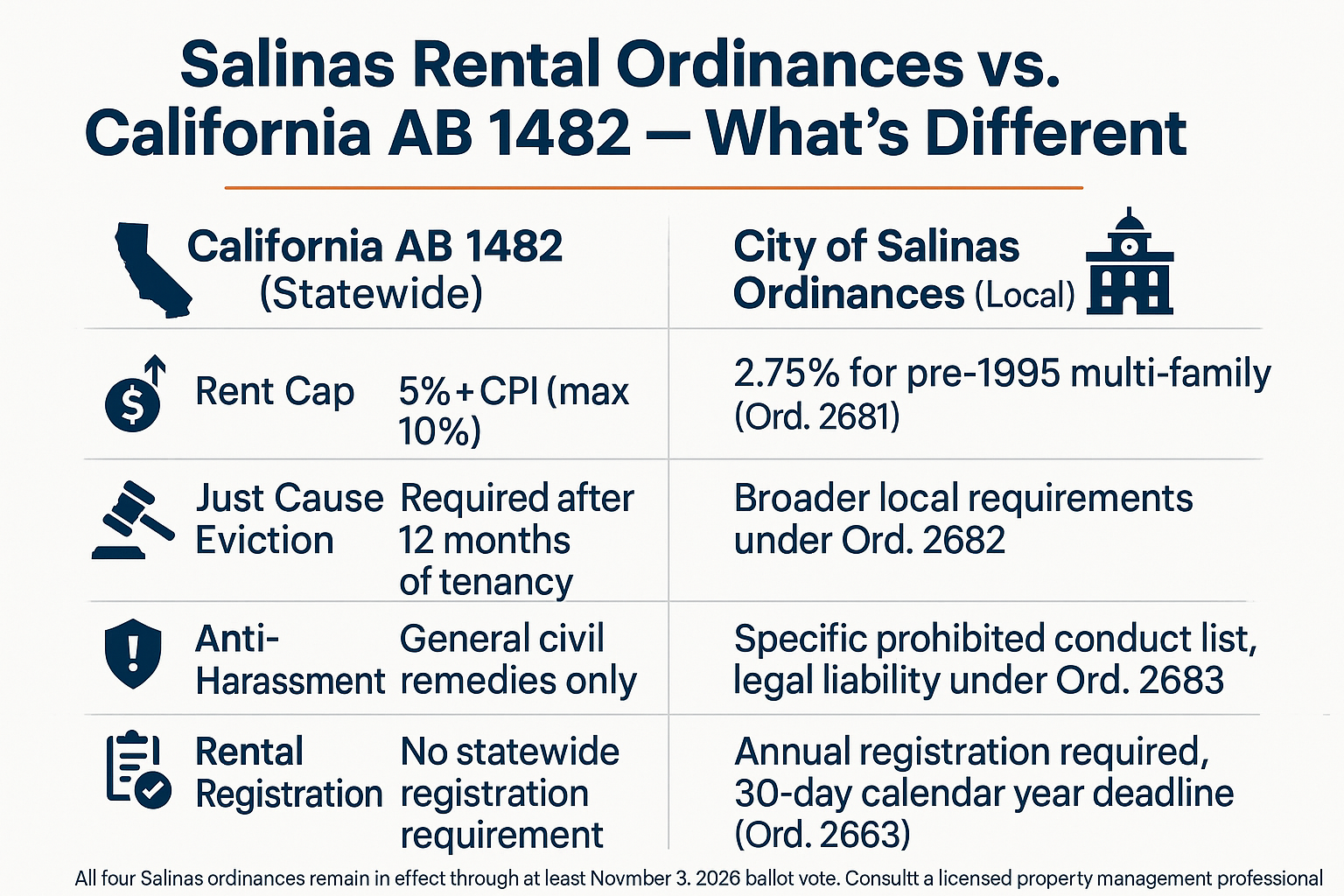
Just Cause and Anti-Harassment: The Most Underestimated Part of This Package
Most Salinas owners who are aware of these ordinances focus almost entirely on the rent cap. The just cause eviction and anti-harassment requirements are far less understood — and in our experience, they carry the highest liability risk for owners who rely on standard lease templates and informal management practices.
Ord. 2682 — Just Cause Eviction means you cannot terminate a covered tenancy without a legally qualifying reason. Lease expiration alone does not qualify. Selling the property requires specific procedures. Owner move-in evictions carry strict requirements and relocation assistance obligations. Issuing a notice that does not cite a qualifying just cause gives a tenant grounds to challenge the eviction and potentially seek damages.
Ord. 2683 — Tenant Anti-Harassment defines a list of prohibited landlord behaviors — including unreasonable entry, interference with quiet enjoyment, threats, and conduct that pressures a tenant to vacate. A mishandled maintenance complaint or a poorly worded communication can create liability that a judge may view as harassment under the ordinance.
The practical gap here is significant. A lease drafted from a generic California template will not include the procedural language these ordinances require. An owner who self-manages and responds to tenant complaints informally may not recognize when a communication crosses a line. What Salinas property owners get wrong about self-managing covers this gap in broader terms — but with these four ordinances in place, the stakes for getting it wrong are higher than they have been in years.
Salinas Ordinance Compliance at a Glance
Here is a quick reference for the key requirements under each of the four ordinances currently in effect.
| Ordinance | What It Requires | Common Owner Mistake |
|---|---|---|
| Ord. 2663 — Registration | Annual registration of covered units; 30-day deadline from start of calendar year | Assuming the property is exempt without verifying |
| Ord. 2681 — Rent Stabilization | Max 2.75% annual increase on pre-1995 multi-family units | Issuing notice at the AB 1482 rate instead of the local 2.75% cap |
| Ord. 2682 — Just Cause Eviction | Termination notice must cite a qualifying legal reason | Using a standard 30-day or 60-day notice without just cause language |
| Ord. 2683 — Anti-Harassment | Prohibits specific landlord conduct; creates tenant legal remedies | Informal communications that could be read as pressure to vacate |
Planning Around the November 2026 Vote — Without Betting Your Compliance on the Outcome
The November 3, 2026 ballot measure is a genuinely contested issue in Salinas. There is organized advocacy on both sides, and the outcome is uncertain. Some owners are privately hoping the ordinances get repealed and are informally deferring compliance decisions until after the vote. That is a real risk.
Here is why: the ordinances are the law on the ground today. A rent increase issued above the 2.75% cap is non-compliant now — regardless of what voters decide 12 months from now. An eviction notice served without just cause is challengeable now. Registration delinquency generates enforcement action now.
Even if all four ordinances were repealed in November 2026, that repeal would not retroactively protect an owner from actions taken in violation of the current law. Any enforcement action, tenant legal claim, or administrative penalty filed before the vote date survives regardless of election results.
The prudent approach is to operate in full compliance through the vote, maintain clear documentation of every rent notice and tenant communication, and then reassess your strategy in late 2026 based on the actual outcome. Understanding what full-service property management actually covers gives context on how a professional management relationship can absorb this kind of ongoing compliance burden so individual owners do not have to track it themselves.
Frequently Asked Questions About Salinas Rental Ordinances
Do these ordinances apply to single-family homes I rent out in Salinas?
It depends. Single-family homes are generally treated differently than multi-family units under both state law and the Salinas ordinances, but ownership structure matters. An individually owned single-family rental may qualify for AB 1482 exemptions that a corporate-owned property would not. The registration ordinance may or may not apply depending on the specific property classification. Do not assume you are exempt — verify your property's status.
My building was built in 1998. Does Salinas rent stabilization apply to me?
Probably not under Ord. 2681 specifically — that ordinance covers multi-family properties built before February 1, 1995. But your 1998 building may still fall under AB 1482's statewide rent cap of 5% plus CPI depending on property type and ownership structure. You could also still be subject to the just cause eviction, anti-harassment, and registration ordinances. Build date is only one piece of the analysis.
What happens if I issued a rent increase above 2.75% to a covered tenant?
A non-compliant rent increase notice can be challenged by the tenant. In the worst case, you may be required to rescind the increase, issue a corrected notice, and potentially face a tenant claim for the overpayment. Document everything and consult a property management professional or real estate attorney as soon as possible — do not wait for the tenant to raise the issue first.
Can I wait until after the November 2026 vote to register my units?
No. Registration is required now under Ord. 2663, and the 30-day deadline runs from the start of each calendar year. Waiting for the vote does not suspend your registration obligation, and delinquency triggers a formal notice and enforcement timeline. The election outcome does not retroactively excuse a missed registration deadline.
What counts as a 'qualifying reason' for eviction under just cause?
Qualifying reasons under Ord. 2682 include things like non-payment of rent, material lease violations, criminal activity on the premises, and owner move-in — but each comes with specific procedural requirements. Owner move-in and substantial rehabilitation evictions also require relocation assistance payments to the displaced tenant. A general desire to re-rent the unit at a higher rate or bring in a new tenant does not qualify. Always consult a licensed professional before serving any termination notice on a covered unit.
Questions About How These Ordinances Apply to Your Property?
Coast & Valley Properties works with residential rental owners across Salinas, Monterey, Carmel, and the broader Monterey County area who need someone to stay on top of exactly this kind of regulatory complexity. If you are not certain whether your units are registered, which rent cap applies, or how to properly document a lease action on a covered property, a direct conversation is the fastest way to get clarity. You can reach us at (831) 757-1270 or through the contact form at coastandvalleypm.com.

Is Your Salinas Rental Property Ready for a Super El Niño? What Monterey County Owners Need to Know
When weather forecasters use the phrase Super El Niño, it means something specific for the Salinas Valley — not just wet winters, but sustained, heavier-than-average rainfall over multiple months. For the low-lying areas around Salinas, that translates to flooded drainage systems, saturated soil, and stress on roofs, gutters, and foundations that may have gone years without a close look.
Most rental property owners don't think about storm readiness until water is coming through a ceiling. By then, you're not managing a maintenance issue — you're managing an emergency, a displaced tenant, and a potential legal exposure under California's Warranty of Habitability all at the same time.
This article is about what preparation actually looks like before the storms arrive — which systems are most vulnerable in Monterey County properties, what California law requires of you when conditions deteriorate, and how the gap between proactive and reactive management tends to show up most clearly when the weather does.
What a Super El Niño Actually Means for Monterey County
A Super El Niño isn't a national headline for this region — it's a local weather event with specific local consequences. The Salinas Valley sits in a natural drainage basin. When atmospheric rivers stack back-to-back, as they did during the 2022-2023 season when Monterey County experienced some of its most significant flooding in decades, the valley floor absorbs the impact first.
Property owners in neighborhoods near the Salinas River corridor, lower Alisal, or parts of east Salinas have seen firsthand what that kind of rainfall does to aging infrastructure. But even properties on higher ground in Monterey, Pacific Grove, and Carmel aren't immune — coastal storms hit rooflines, exposed wood trim, and older drainage systems just as hard.
The risk profile for a rental property during an El Niño year typically clusters around a few specific vulnerabilities:
- Roof penetrations and aging shingles — small gaps that leak slowly under normal rain become active problems under sustained downpour
- Gutters and downspouts — blocked or undersized systems cause water to back up against fascia boards and foundation edges
- Crawl space drainage — a common issue in older Salinas residential stock, where standing water under a home can damage subfloor framing and create mold conditions quickly
- Exterior grading — soil that slopes toward a foundation rather than away from it channels runoff directly against the structure
- Window and door seals — deteriorated caulking allows moisture intrusion that doesn't show up until walls start to discolor
None of these are catastrophic on their own in a normal rain year. Under Super El Niño conditions, deferred maintenance on any one of them can escalate into a five-figure repair and a habitability complaint in the same week.

California's Warranty of Habitability Doesn't Pause for Storms
California Civil Code Section 1941 requires landlords to maintain rental properties in a habitable condition at all times. That obligation doesn't have a weather exemption. If a roof leak or flooded crawl space makes a unit unsafe or uninhabitable during a storm, the owner is legally responsible — regardless of whether they had advance warning.
This is the part that catches self-managing landlords off guard. The storm is the event, but deferred maintenance is almost always the underlying cause. A roof that was borderline two years ago doesn't get a pass because rain was unusually heavy. A drainage system that backed up last winter and was never properly cleared creates the same liability the second time as the first.
When a tenant reports a habitability issue, California law gives landlords a reasonable timeframe to respond — but what counts as reasonable shrinks considerably during an active storm event. A tenant who can document a leak, a flooded unit, or a loss of heat because of weather-related damage has a clear path to withholding rent, repair-and-deduct remedies, or pursuing damages under state law.
For owners who are self-managing their Salinas properties, this is where the exposure is highest. There's no documented inspection record. There's no 24/7 response system. And there's no paper trail showing that the owner identified and addressed deferred maintenance before the weather arrived. When something goes wrong, that absence of documentation is its own problem.
Professionally managed properties carry a different posture into storm season — not because the weather is kinder to them, but because the groundwork has already been laid.
Storm Season Risk: Where Monterey County Rentals Are Most Vulnerable
This overview maps the most common failure points in Monterey County rental properties during heavy rainfall — and what each one means for owner liability.
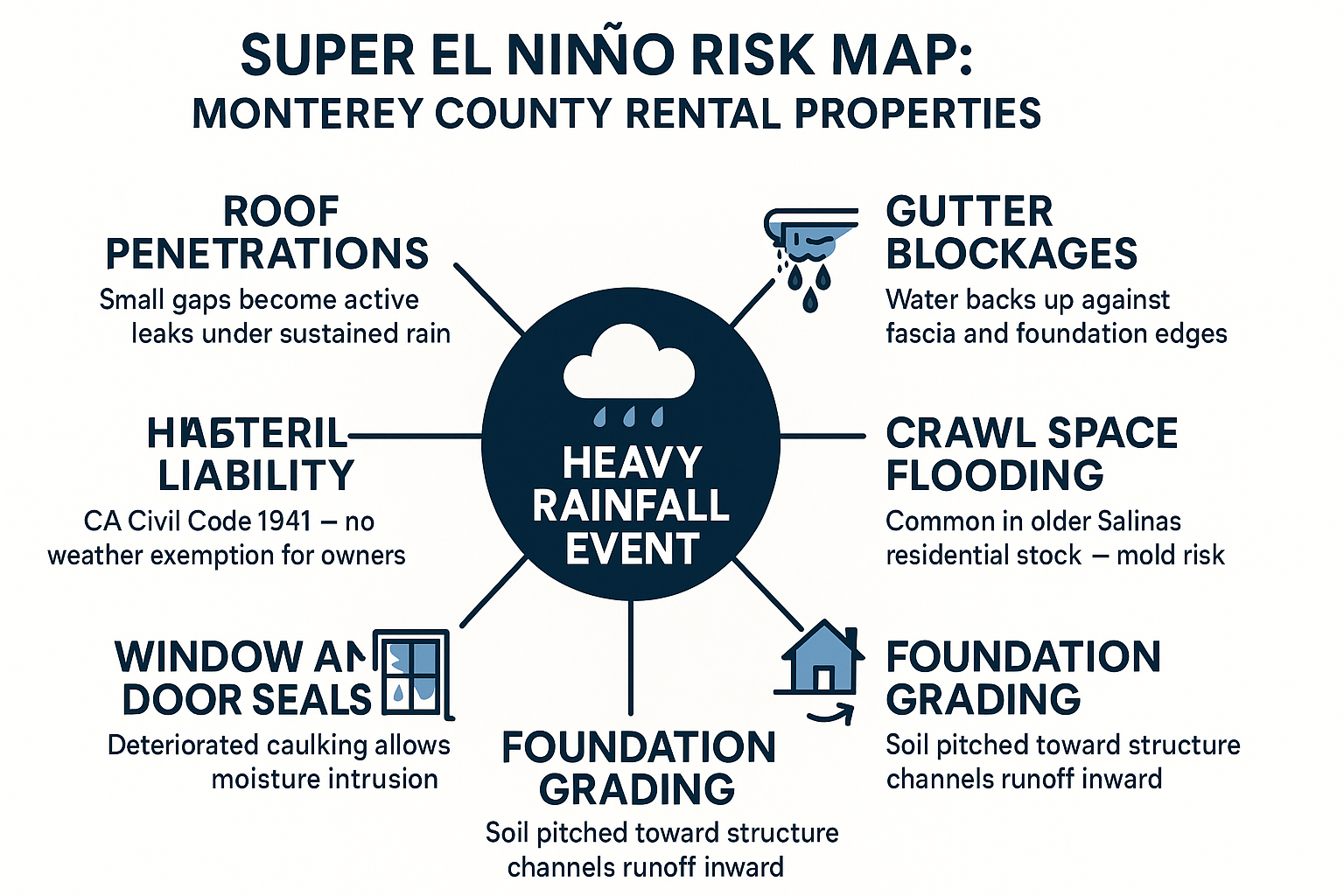
What Storm Preparation Looks Like for a Professionally Managed Property
The difference between a property that weathers an El Niño season without incident and one that generates an emergency call at midnight on a Saturday isn't luck. It's what happened in the two to three months before the first major storm.
For professionally managed properties, storm readiness starts with a seasonal inspection before winter sets in. That means a documented walk-through that looks specifically at the vulnerabilities that El Niño conditions exploit — rooflines, gutters, drainage, crawl spaces, and exterior seals. Not a general once-over, but a targeted review with written records and photos that establish the property's condition before any weather event occurs.
Beyond inspection, the preparation that matters most is vendor relationships. When a roof starts leaking during a storm, the property owner without a management relationship in place is calling around cold — leaving voicemails for roofers who are already booked, waiting days for a callback while water damage accumulates. A firm with established vendor relationships in Monterey County can dispatch a qualified contractor quickly, because those relationships exist before the emergency arises.
The maintenance request system matters here too. When a tenant submits a report through a professional portal — rather than texting a landlord's personal cell at 10pm — there is a documented timestamp, a record of the complaint, and a traceable response chain. That documentation protects the owner if a habitability dispute arises later.
Owners who have wondered what full-service property management actually covers often find that storm season is when the answer becomes concrete. The 24/7 emergency response, the vendor network, the inspection records — these aren't marketing language. They're the infrastructure that keeps a single weather event from becoming a legal and financial problem.
Self-Managing vs. Professionally Managed: Storm Season Comparison
The gap between these two approaches tends to be invisible during dry summers. It becomes very visible once the first atmospheric river hits.
| Scenario | Self-Managing Owner | Professionally Managed Property |
|---|---|---|
| Pre-season inspection | Rarely scheduled, often skipped | Documented seasonal walk-through before winter |
| Vendor availability during storm | Cold calls — often delayed days | Established contractor relationships, faster dispatch |
| Tenant maintenance report | Text to personal cell, informal | Timestamped portal submission, documented response chain |
| 24/7 emergency response | Owner's personal availability | Dedicated after-hours response system |
| Habitability documentation | Limited or none | Inspection records, repair logs, written communication trail |
| Legal exposure if unit becomes uninhabitable | Higher — no documented due diligence | Lower — proactive record of maintenance and response |
The Hidden Cost of Getting Caught Off Guard
Property owners in Salinas and across Monterey County who are currently managing their own rentals often reach a breaking point after something goes wrong — not before. Several owners who have come to professional management in recent years described the same pattern: a maintenance issue they knew about but hadn't gotten around to addressing became a much larger problem when weather accelerated it.
One common scenario is a roof that showed minor wear signs but wasn't leaking badly enough to feel urgent. Under a normal winter, it holds. Under a sustained atmospheric river event, it doesn't — and by then, the repair cost is compounded by interior damage, tenant displacement costs, and potential liability exposure.
The hidden workload of managing a single rental home is significant in dry weather. In an El Niño year, that workload doesn't just increase — it compresses. Vendors are stretched thin across the county. Materials take longer to source. Every other landlord who deferred the same maintenance is calling the same contractors at the same time.
Owners who have professional management in place don't scramble during those windows, because the preparation was done months earlier. Those who don't are making decisions in the dark, under pressure, without documentation, while water is actively entering a property they're legally responsible for maintaining.
The Salinas Rental Registration Ordinance Adds Another Layer
Storm readiness isn't purely a maintenance conversation for Salinas landlords — it has a regulatory dimension too. The City of Salinas Residential Rental Registration Ordinance (City Ord. 2663, 2024) requires rental properties in Salinas to be registered with the city, and that registration process includes compliance with habitability standards.
An El Niño event that exposes deferred maintenance doesn't just create a repair problem. If a property is found to be out of compliance with habitability standards — whether through a tenant complaint or a city inspection — the owner is dealing with both a physical repair and a regulatory response at the same time.
For owners with multiple Salinas units, staying legally compliant across a portfolio in Monterey County becomes meaningfully harder when storm damage is also in play. And California's AB 1482 Tenant Protection Act creates additional layers around rent adjustments and lease modifications that can come into play if a unit becomes temporarily uninhabitable.
Professional management doesn't make regulations disappear. But it means someone is tracking those requirements year-round — not scrambling to understand them during a weather emergency.
Frequently Asked Questions: El Niño and Monterey County Rental Properties
When should property owners in Salinas start preparing for El Niño storm season?
September and October are the right window — before the first major atmospheric river events typically arrive on the Central Coast. That's when inspections, gutter cleaning, and vendor outreach can happen without competition from other owners doing the same thing in a panic. By November, the window starts to close.
If a storm causes damage to my rental, am I responsible even if the weather was unusually severe?
In most cases, yes. California's Warranty of Habitability under Civil Code Section 1941 doesn't include an exception for severe weather. If a property had deferred maintenance that the storm exposed — an aging roof, blocked drainage, deteriorated seals — the owner's prior knowledge of those conditions matters in any dispute. The storm is rarely the sole cause; it's the event that reveals what wasn't addressed.
What specific parts of a Salinas rental property are most likely to fail during heavy rain?
Roof penetrations, clogged gutters and downspouts, crawl space drainage, and foundation grading are the four most common failure points in older Salinas residential stock. Window and door seals are also worth checking — deteriorated caulking causes moisture intrusion that often isn't visible until it's already caused damage inside walls.
Does the City of Salinas Rental Registration Ordinance affect how I handle storm damage?
It can. City Ord. 2663 (2024) requires registered Salinas rentals to meet habitability standards. A storm that reveals pre-existing maintenance deficiencies could trigger both a repair obligation and a compliance review if a tenant files a complaint with the city. Having documented inspection records and a clear maintenance response history is the best protection an owner can have in that situation.
I manage my own property. What should I do right now to prepare for a heavy rain season?
Start with the roof — hire a licensed roofer to inspect and document condition, especially around any penetrations, skylights, or older flashing. Then clear gutters and verify downspouts discharge water away from the foundation. Check crawl space vents and drainage. And make sure you have vendor contacts lined up before the storms arrive, not after. Every roofing and plumbing contractor in Monterey County is harder to reach once the first major storm hits.
Can a tenant legally withhold rent if storm damage makes the unit uninhabitable?
Under California law, tenants have several remedies when a rental becomes uninhabitable — including repair-and-deduct rights and the ability to argue rent withholding in certain circumstances. The specific rules depend on factors like how quickly the owner responded and whether the owner had prior notice of the maintenance issue. This is exactly the scenario where having documented maintenance records and a timestamped response chain is the difference between a manageable situation and a legal dispute.
Storm Season Is Coming — Preparation Is the Work That Happens Before It
Property owners across Salinas, Monterey, and the surrounding communities who have professional management in place going into an El Niño season aren't scrambling when the first atmospheric river arrives. The inspections are done. The vendors are relationships, not cold calls. The documentation exists. If you're a Monterey County property owner thinking about what this season could mean for your rental, Coast & Valley Properties is available to talk through your specific situation. Reach the team directly at (831) 757-1270 or through the contact form at coastandvalleypm.com.

The Difference Between a Local Firm and a National Name in Monterey
When you're deciding who should manage a rental property in Salinas, Carmel, or Pacific Grove, the choice often comes down to a familiar national brand versus a local firm you may not have heard of. The national name feels safe — they have a website, a 1-800 number, and offices in every state. But that's exactly the problem.
Monterey County is one of California's most complex rental markets. Between AB 1482, the City of Salinas Rental Registration Ordinance (Ord. 2663), and rent control nuances that vary block by block, this isn't a market where a one-size-fits-all approach holds up.
This article breaks down the two most important places where local and national firms actually diverge — not in their marketing language, but in day-to-day decisions that affect your property, your tenants, and your legal exposure.
What 'Local Knowledge' Actually Means in This Market
Every property management firm — national or local — claims to know your market. But there's a difference between having an office in Monterey County and actually understanding it.
A manager who works this market daily knows that a single-family home in North Salinas rents at a meaningfully different rate than the same square footage near Natividad Road or in the South Salinas neighborhoods closer to Highway 68. They know which pockets of the Salinas Valley have higher turnover patterns. They know the vendors who actually show up — and the ones who don't.
National firms typically assign your property to a regional portfolio manager who may oversee 50 to 150 doors across multiple counties. That manager isn't driving your street to assess a maintenance complaint. They're routing requests through a ticketing system and working from averages, not specifics.
For owners with properties in Carmel or Pacific Grove — where homes can carry significant value and tenant expectations are high — that difference isn't minor. As we've covered before, what makes a property manager truly local goes far deeper than a local area code.
Local knowledge also applies to compliance. The City of Salinas Residential Rental Registration Ordinance went into effect in 2024 and requires annual registration of rental units, with fees and inspection timelines that national systems weren't built to track. A firm headquartered in Salinas doesn't need to look that up.

How California Compliance Separates the Two Models
California landlord-tenant law is genuinely difficult. It changes often, and Monterey County adds its own layer on top of state requirements. This is where the structural difference between local and national firms becomes most visible.
National property management companies typically use standardized lease templates and compliance checklists built for the broadest possible California applicability. That's fine — until a local ordinance creates a requirement the template doesn't address.
Here's what a property owner in Monterey County is actually navigating:
- AB 1482 (Tenant Protection Act) — caps annual rent increases at 5% plus local CPI and restricts certain evictions for covered properties
- City of Salinas Ord. 2663 — requires rental registration, annual fees, and compliance documentation for properties within city limits
- Lead paint disclosure requirements — mandatory for pre-1978 properties, with specific documentation that must accompany every lease
- California warranty of habitability — creates ongoing maintenance obligations with real legal exposure if ignored
- Security deposit accounting rules — require itemized returns within 21 days of move-out, with penalties for non-compliance
A national firm's compliance team may catch the state-level items. But what happens to your rental when California law changes mid-lease often depends on whether your manager is watching Sacramento and City Hall simultaneously — or just running last year's checklist.
A locally rooted firm with a licensed California broker at the helm handles these as routine. They're not escalating to a corporate compliance department in another state.
Local Firm vs. National Brand: Where It Actually Matters
This comparison covers the key operational differences that affect your property's performance and compliance in Monterey County.
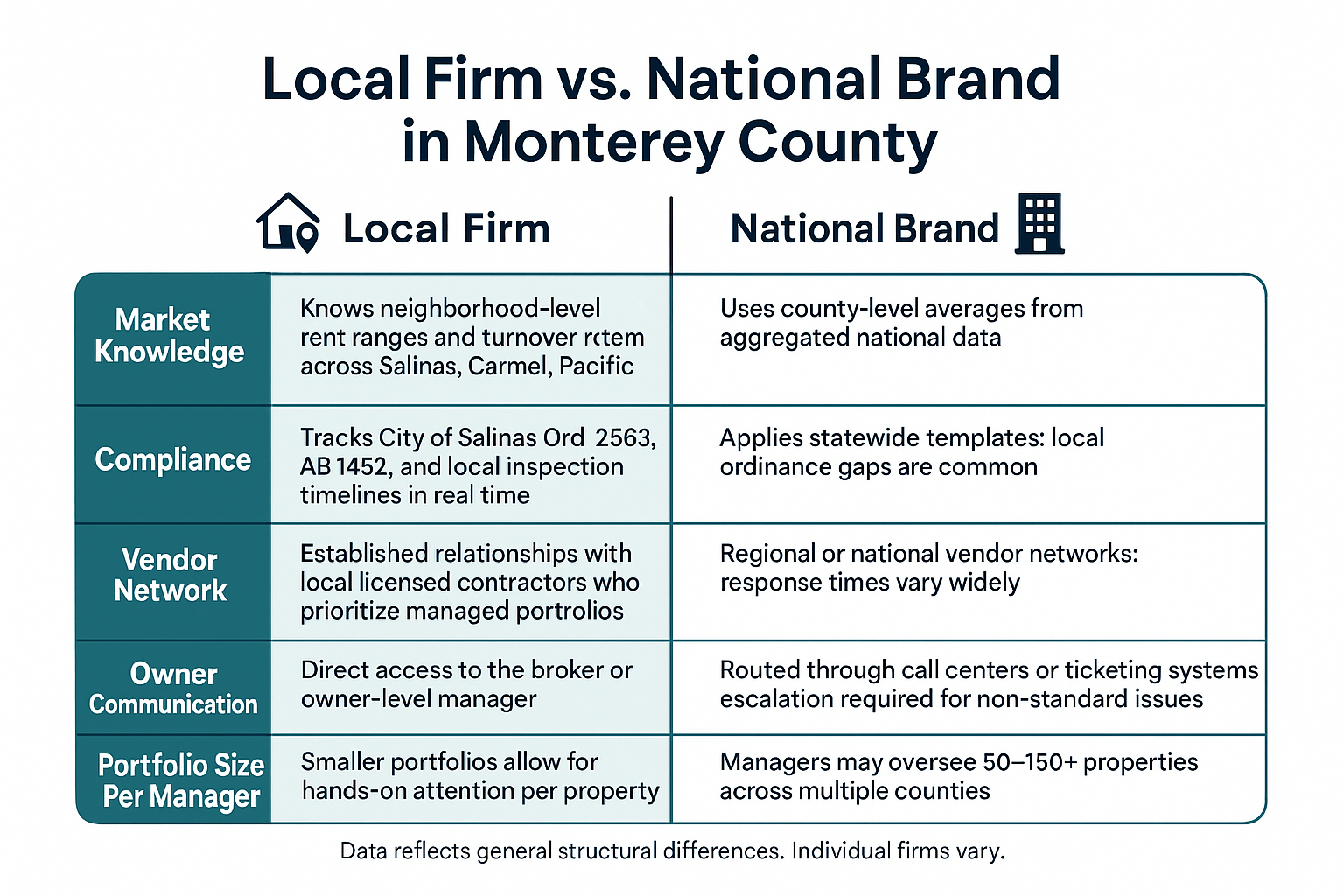
The Vendor Problem Nobody Talks About
One of the least discussed differences between local and national firms is how maintenance gets handled — specifically, who shows up when something breaks.
National firms often work with preferred vendor networks. On paper, this looks like efficiency. In practice, it means a plumber or HVAC technician who covers a three-county territory may take 3 to 5 business days to schedule a non-emergency repair. In the meantime, your tenant is waiting, and California's habitability clock is running.
A local firm with years of relationships in Monterey County has already sorted through the vendors. They know which electrician calls back the same day, which roofer does honest work in the Salinas Valley, and which general contractor handles Pacific Grove's older housing stock without cutting corners. Those relationships get built over years — they don't transfer from a national brand's preferred vendor list.
This matters financially, too. When a single missed inspection becomes a six-figure problem, the difference is almost always a delayed response, not a complicated legal question. Fast, trusted vendors close that gap.
For multi-unit owners, the vendor gap compounds quickly. If you have 6 or 8 units in Salinas and a national firm is routing your maintenance tickets through a regional queue, you're not getting the same service level as an owner who's managed by a firm with direct lines to local trades.
How Decisions Get Made: Local vs. National
The table below shows how common property management decisions are typically handled depending on firm structure.
| Decision Type | Local Firm | National Brand |
|---|---|---|
| Rent pricing adjustment | Based on current local comps, manager's direct market knowledge | Based on algorithmic rent analysis from aggregated regional data |
| Lease compliance question | Handled by licensed broker with California-specific training | Routed to corporate compliance team; response time varies |
| Emergency maintenance at 10 PM | Local after-hours contact with established vendor relationships | National hotline dispatches from a regional vendor network |
| Tenant dispute or notice | Manager familiar with local court system and Monterey County procedures | Standardized process; may not reflect local judicial preferences |
| Owner financial reporting | Customized reports with local context; direct conversation available | Standardized portal reports; explanations require a support ticket |
What You're Really Paying For When You Choose Local
Property owners sometimes assume a national firm offers more value simply because of brand recognition or technology. And it's true — most large national firms have polished owner portals, automated rent collection, and slick onboarding.
But technology doesn't file a proper notice with the Monterey County Superior Court. It doesn't spot a lease clause that conflicts with a 2024 City of Salinas ordinance. And it doesn't call the right plumber at 9 PM on a Tuesday.
What a local firm offers isn't nostalgia — it's accountability. When the broker-owner of a Salinas-based firm is personally involved in your portfolio, the decision-making structure is completely different. There's no corporate buffer between a problem and the person responsible for fixing it.
For property owners evaluating what full-service property management actually covers, the honest answer is: the service list matters less than whether the firm behind it can actually execute in your specific market. A firm that knows Monterey County's rental ecosystem — its regulations, its neighborhoods, its vendors, its courts — simply has fewer gaps.
Frequently Asked Questions About Local vs. National Property Management in Monterey
Isn't a national firm safer because they have more resources and legal backing?
Larger firms do have legal departments, but those departments are built around California-wide compliance, not Monterey County-specific ordinances. The City of Salinas Rental Registration Ordinance, for example, is a local requirement that national templates may not address correctly. Resources don't help if the system isn't calibrated for your market.
How do I know if a local firm actually has the capacity to manage my property well?
Ask directly: How many units does each manager in your firm currently oversee? A local boutique firm keeping portfolios under a manageable number per manager is a meaningful quality indicator. Also ask whether the broker-owner is actively involved in day-to-day decisions — or whether they've stepped back from operations.
Does it matter whether my property manager is a licensed California real estate broker?
Yes. In California, property managers who collect rent or negotiate leases on behalf of others must hold an active real estate broker or salesperson license under a broker. A licensed broker has passed state-mandated examinations and is subject to DRE oversight. That matters when legal questions arise.
What about technology — don't national firms have better portals and tools?
Many local firms now use the same platforms — AppFolio, Buildium, and similar systems — that national brands run on. The technology gap that existed ten years ago has largely closed. What a local firm adds on top of those tools is the judgment and market knowledge to interpret what the reports actually mean for your specific property.
I inherited a property in Salinas and I live out of state. Does a local firm make more sense for me?
Almost always yes. Out-of-state owners are the exact clients who benefit most from a locally embedded manager. You need someone who can physically inspect the property, respond to emergencies without a multi-day delay, and make compliance decisions in real time. Why experienced Salinas owners stop managing their own properties covers this in more detail — but for an out-of-state owner, the case is even stronger.
Want to Talk Through What's Right for Your Property?
Coast & Valley Properties has managed residential and commercial rental properties across Monterey County since 2009, with a licensed broker involved in every portfolio. If you own property in Salinas, Monterey, Carmel, Pacific Grove, or anywhere in the surrounding area and you want a straightforward conversation about what professional local management looks like, call us at (831) 757-1270 or reach out through coastandvalleypm.com.

What Makes a Property Manager Truly Local — and Why It Matters
Every property management company calls itself local. It's on their website, in their ads, and in the first sentence of every sales call. But there's a wide gap between a company that has an office in Monterey County and one that actually knows how this market works from the inside.
For owners with rentals in Salinas, Carmel, Pacific Grove, or anywhere along the Central Coast, that gap has real consequences — missed compliance deadlines, weak tenant screening, maintenance that drags for weeks, and rent pricing that leaves money on the table.
This article breaks down what genuine local knowledge looks like in practice, and why it's one of the most important things to evaluate before handing over the keys to any management firm.
Local Knowledge Is Regulatory Knowledge First
California is already one of the most landlord-regulated states in the country. Monterey County adds another layer on top of that. A property manager who handles rentals in Sacramento or San Jose is not automatically equipped to manage your property in Salinas.
Take the City of Salinas Residential Rental Registration Ordinance (City Ord. 2663), which took effect in 2024. Owners of rental units in Salinas are now required to register their properties with the city, complete inspections, and maintain compliance on an ongoing basis. A national firm or an out-of-area manager may not even know this ordinance exists, let alone track its renewal requirements.
The same goes for AB 1482, California's statewide Tenant Protection Act, which caps annual rent increases on covered units and restricts certain types of eviction. Knowing whether your specific property is covered — and by how much — requires someone who tracks these rules actively, not occasionally.
For a deeper look at how these laws affect active rental owners, how multi-unit owners in Monterey County stay legally compliant covers the specific compliance obligations that come up most often in this market.
Knowing a Neighborhood Means More Than Knowing the Zip Code
There's a real difference between a manager who can identify a Salinas address on a map and one who knows what a fair rent looks like on a specific street in the Alisal District versus a property near Natividad Road versus a unit in North Salinas near the 101.
Those distinctions matter when setting rent. Price too high and you sit vacant. Price too low and you leave hundreds of dollars per month on the table — which adds up to $2,400 or more per year on a single unit.
A manager with genuine neighborhood knowledge also knows:
- Which blocks have higher tenant turnover and why
- What property features local renters actually prioritize vs. what looks good in a listing
- How quickly units rent in different pockets of the market at different times of year
- What comparable properties actually rented for — not just what they were listed at
This isn't information you can pull from a national database. It comes from years of boots-on-the-ground experience in one specific market. There's more on this in how well does your property manager actually know your neighborhood? — it's a useful read if you're currently evaluating management firms.

The Vendor Network Problem No One Talks About
One of the biggest hidden advantages of a genuinely local property manager is the vendor network they've built over years of actual work in the area.
When a pipe bursts at 11 PM on a Friday night in Salinas, the response time depends entirely on who your manager knows and whether those contractors actually pick up the phone. A national firm routing calls through a centralized maintenance system may dispatch someone from two counties away — or not until Monday morning.
A manager who has spent years working in Monterey County has licensed plumbers, electricians, HVAC techs, and roofers who they've vetted personally and who prioritize their calls because of an ongoing relationship. That's not a small thing when you're looking at potential water damage or a habitability issue under California's warranty of habitability standard.
It also affects routine maintenance costs. Local vendors competing for steady repeat work from a well-established management firm typically offer better pricing than one-off contractors found through a national dispatch platform. Over the course of a year, those savings are real.
For owners who want to understand what happens when maintenance coordination breaks down, when a single missed inspection becomes a six-figure problem lays out exactly how quickly deferred issues can escalate.
Local vs. Out-of-Area Property Management: What's Actually Different
This breakdown shows the specific areas where local expertise creates a measurable difference for Monterey County rental owners.

What 'Local' Actually Looks Like Across Key Management Functions
Here's how local expertise shows up in the day-to-day decisions that affect your property's performance and compliance.
| Management Function | Genuinely Local Manager | Generic or Out-of-Area Manager |
|---|---|---|
| Regulatory Compliance | Tracks Salinas Ord. 2663, AB 1482 rent caps, and county inspection timelines | Applies statewide rules only; may miss city-specific requirements |
| Rent Pricing | Uses neighborhood-level data from recent actual leases | Uses broad regional averages from third-party databases |
| Emergency Maintenance | Calls vetted local contractors who respond within hours | Routes through centralized system; response may take 1-3 days |
| Tenant Screening | Draws on local rental history and regional applicant knowledge | Standardized national screening criteria only |
| Property Inspections | Manager physically familiar with local property types and conditions | Inspection checklists applied without local context |
| Owner Reporting | Reflects local market conditions and specific property context | Generic financial summaries with no local framing |
Tenant Screening With Local Context
Screening a tenant isn't just about pulling a credit report. It's about knowing what questions to ask, what red flags look like in a local rental history, and how to evaluate applications in the context of what the Monterey County rental market actually looks like right now.
A manager who has handled rentals in Salinas for years has seen patterns that don't show up on a standard background check — applicants who look good on paper but have a track record of disputes with local landlords, or applicants with modest credit scores who have been exemplary tenants in the area for years.
That kind of judgment only develops through time spent in one specific market. The difference between a good tenant and a great one starts before move-in goes deeper on what thorough pre-screening actually looks like and why it matters more than most owners realize.
And for owners who've been handling screening themselves, what Salinas property owners get wrong about self-managing covers the gaps that tend to show up first — tenant selection is usually near the top of that list.
Frequently Asked Questions About Local Property Management
Does it matter if my property manager is based in Monterey County specifically, or just California?
Yes, it matters quite a bit. California landlord-tenant law is statewide, but local ordinances like the City of Salinas Rental Registration Ordinance and Monterey County-specific regulations apply only to properties in those jurisdictions. A manager based in Sacramento or Los Angeles has no practical reason to track those local rules closely — and that gap in knowledge can expose you to compliance failures that cost real money.
How do I tell if a property manager is genuinely local versus just claiming to be?
Ask them specific questions. What is the current rental registration requirement for Salinas rental properties? What's the average days-on-market for a 3-bedroom home in North Salinas right now? Who is your go-to licensed plumber in the area and how fast do they typically respond? A manager with genuine local depth will answer those questions without hesitating. A manager who's claiming local expertise will get vague fast.
Can a national property management company do the same job as a local firm?
National firms offer consistency and technology platforms, but they apply standardized systems to markets that don't behave the same way. Monterey County has rent control considerations, specific city registration requirements, and a rental market that varies significantly by neighborhood and season. The differences between a local property manager and a national firm go well beyond brand size — they affect how your property performs and how protected you are from legal exposure.
Does local knowledge affect how quickly my property gets rented?
Directly, yes. A manager who understands what drives rental demand in your specific neighborhood — and what local renters actually look for — prices and markets your property more accurately. Overpricing by even $150–$200/month in the Salinas market can extend vacancy by 3–6 weeks, which often costs more than a year's worth of the pricing gap.
What's the risk of hiring a manager who doesn't know local vendor relationships?
The biggest risk is response time during an emergency. California's warranty of habitability requires that owners address certain conditions — like heating failure or water intrusion — promptly. If your manager can't get a licensed contractor on-site quickly because they don't have established local relationships, you're exposed to habitability complaints and potential legal claims. That's not a theoretical risk; it happens.
Looking for a Property Manager Who Actually Knows Monterey County?
Coast & Valley Properties has been managing residential and commercial rentals across Monterey County since 2009 — from Salinas and Soledad to Carmel and Pacific Grove. If you have questions about what local management actually looks like for your specific property, you can reach us directly at (831) 757-1270 or through the contact form at coastandvalleypm.com.