

A Property Owner's Guide to Property Management Workflow Automation in Monterey County
Managing a high-end property in places like Carmel-by-the-Sea or Pebble Beach demands more than just collecting rent; it requires a concierge-level experience where precision and responsiveness are paramount. This is where property management workflow automation becomes a strategic asset. It’s the core system we use at Coast & Valley to handle everything from tenant inquiries to maintenance dispatch, freeing you from tedious tasks so you can focus on what matters most: growing your investment portfolio.

The New Standard for High-End Monterey County Property Management
For savvy investors and owners of luxury properties across the Monterey Bay Area, "good enough" is unacceptable. You expect seamless, proactive service that preserves your asset's value and maximizes your return on investment. This is precisely where property management workflow automation shifts from a nice-to-have tool to an essential component of a successful, modern portfolio.
Imagine a system where rent reminders are sent automatically, maintenance requests are instantly routed to the right local vendor, and lease renewal notices go out 90 days in advance without anyone lifting a finger. This isn't a futuristic concept; it's the operational standard for premier property management today, delivering the peace of mind you deserve.
From Simple Convenience to a Tangible Strategic Edge
Automation isn't just a time-saver—it’s a powerful advantage in a competitive market like Monterey County. By putting routine tasks on autopilot, we virtually eliminate the risk of human error and ensure every action is handled with consistency and precision. Whether your property is a luxury vacation home in Pacific Grove or a multi-family building in Salinas, this operational excellence keeps high-quality tenants happy and encourages long-term stays.
The benefits for busy professionals and serious investors are clear and impactful:
- Enhanced ROI: Automated systems ensure rent is collected on time, every time. They can even support dynamic pricing strategies based on real-time market data, from the Salinas Valley to the Monterey Peninsula coast, ensuring your asset is always priced for optimal returns.
- A Superior Tenant Experience: Your tenants receive faster responses and appreciate the convenience of secure online portals for paying rent and submitting maintenance requests. This concierge-level service leads directly to higher satisfaction and longer, more profitable tenancies.
- Proactive Property Preservation: Automation helps us track and manage all maintenance proactively, preventing small issues from escalating into expensive, complex repairs. This is absolutely critical for protecting the long-term value of your high-end asset.
For our clients, the real value of automation is the peace of mind it brings. Knowing that day-to-day operations are handled flawlessly allows them to focus on their investment goals and their own busy lives. This is the concierge-level experience we are committed to providing.
The following table offers a clear, actionable comparison of manual processes versus the automated systems we implement for our clients.
Manual vs. Automated Workflow: A Side-by-Side Comparison
| Task | Manual Process (The Old Way) | Automated Workflow (The Coast & Valley Way) |
|---|---|---|
| Rent Collection | Chasing tenants via phone/email, processing paper checks, manual ledger entries. | Automatic email/SMS reminders, secure online payment portal, instant payment logging. |
| Maintenance | Fielding calls, playing phone tag with vendors, manually tracking work orders. | Tenants submit requests online with photos; requests auto-route to approved local vendors. |
| Lease Renewals | Manually tracking end dates, drafting and sending notices, following up individually. | System flags upcoming renewals, sends automated offers 90 days out, and tracks all responses. |
| Reporting | Spending hours compiling spreadsheets to create monthly financial statements. | Generate instant, detailed owner statements with one click from real-time, secure data. |
As you can see, the automated approach isn't just faster—it's smarter, more reliable, and built to deliver a superior experience for you and your tenants.
Embracing a Data-Driven, Local-First Approach
Modern automation has become a core operational standard for good reason. Recent data shows that 67% of property management companies have adopted specialized software to improve their processes, and 65% of these firms use AI-powered tools are improving property management for critical jobs like tenant screening. This systematic approach eliminates common errors and guarantees a professional, reliable system for managing your property.
Here at Coast & Valley, our team—led by fourth-generation Salinas native Amy Salmina—integrates this powerful technology with deep, boots-on-the-ground local expertise. We understand the unique demands of properties in our community, from the South County towns of King City and Gonzales to the prestigious estates on the Monterey Peninsula. Our promise is to pair this cutting-edge efficiency with the personalized, trustworthy service you deserve.
Step 1: Mapping Your Workflows to Find Automation Opportunities
Before you can implement property management automation, you first need a crystal-clear picture of your current operations. For property owners across Monterey County, from Salinas to Soledad, this process is often an eye-opener, revealing the hidden costs of inefficiency and pinpointing where technology can deliver the greatest ROI.
The goal is to create a "process map"—a detailed, step-by-step breakdown of your daily, weekly, and monthly tasks. Think of it as a diagnostic tool for your business. It’s not just about listing chores; it’s about understanding the actual time and resources each one consumes.
Actionable Checklist: Identifying Bottlenecks and Repetitive Work
Begin by tracking your most common activities. Be brutally specific. How many phone calls and emails does it really take to coordinate a simple plumbing repair for a rental in Gonzales or King City? How much time do you or your team spend chasing down late rent payments each month?
Use this checklist to document your current processes:
- Daily Tasks:
- Time spent answering tenant questions via phone/email.
- Steps to log a new maintenance request.
- Process for contacting and scheduling vendors.
- Weekly Tasks:
- Time spent following up on open work orders.
- Steps to process and pay vendor invoices.
- Process for reviewing and screening rental applications.
- Monthly Tasks:
- Hours spent on rent collection and follow-up.
- Steps to reconcile accounts for owner statements.
- Process for tracking and managing lease renewals.
This initial review provides the hard data you need to make smart decisions. Skipping this step is like navigating without a map—you risk investing in software that solves the wrong problems.
A process map does more than just spot inefficiencies. It builds the business case for automation by connecting specific operational headaches to tangible solutions. When you can clearly see you're spending 10 hours a month on a task that software could do in minutes, the value is undeniable.
This infographic shows a perfect example of an automated workflow for a common problem—maintenance requests—and the powerful results it can drive.
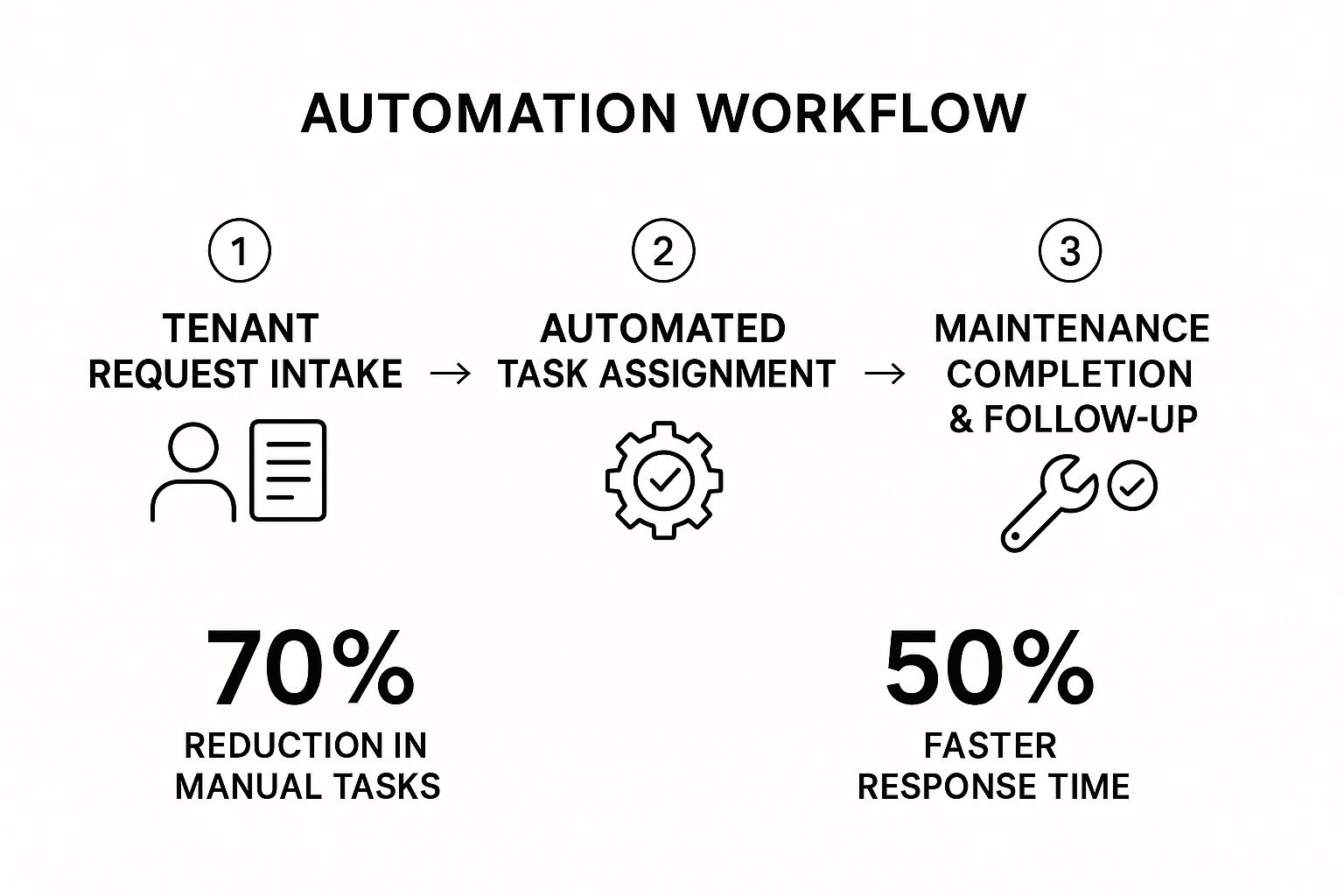
The visual makes it obvious how automation can slash manual effort while delivering faster service to your tenants. A 70% reduction in manual tasks and a 50% faster response time are numbers that speak for themselves, directly impacting tenant satisfaction and your bottom line.
From Audit to Actionable Strategy
Once your process map is laid out, the opportunities for improvement practically jump off the page. You’ll see the patterns of repetitive, time-draining work that are prime candidates for automation. For inspiration, reviewing various workflow automation examples can spark ideas for your own operations.
Your action plan should prioritize tasks that are:
- High-Volume and Repetitive: Such as sending rent reminders or acknowledging maintenance requests.
- Prone to Human Error: Including manual data entry for bookkeeping or tracking lease expirations.
- Critical for Tenant Satisfaction: Like providing rapid responses to inquiries and timely updates on repairs.
This detailed audit sets the stage for everything that follows. The data you gather now will help you define the key performance indicators (KPIs) you'll use to measure success. For a closer look at what to track, you can learn more by mastering property management KPIs and seeing how they tie directly to your investment goals.
Armed with this knowledge, you’re no longer guessing. You’re building a strategic foundation to select the right tools that will genuinely protect and enhance your valuable Monterey County property portfolio.
Step 2: Choosing and Implementing the Right Automation Tools
With a clear map of your processes, you’re ready for the next step: selecting the technology to automate your property management workflows. This is a critical business decision that impacts your property's performance, security, and the high-end experience you deliver.
For investors with properties in Monterey County, this means focusing on tools that offer bank-level security, seamless integration, and absolute convenience for both you and your tenants. The goal is to find a system that protects your investment while making it far simpler to manage.
The right choice will always depend on your specific portfolio. A luxury vacation rental in Pacific Grove has different needs—like managing short-term inquiries and fast turnovers—than a multi-unit apartment building in Salinas, where the biggest wins come from streamlining rent collection and maintenance requests.

Core Features for a Premier Monterey Bay Portfolio
At Coast & Valley, we cut through the sales hype and focus on features that deliver tangible value to our clients, who own high-end properties from the South County towns of Soledad and King City to coastal gems like Carmel.
Here are the non-negotiable features every owner should demand:
- A Secure and Intuitive Owner Portal: This is your 24/7 window into your property’s health. It must provide instant, secure access to financial statements, inspection reports, and maintenance updates with bank-level security.
- A Convenient Tenant Portal: Today's tenants expect to pay rent online, submit maintenance requests with a photo from their phone, and receive quick answers. A great tenant portal is a key factor in attracting and retaining high-quality tenants.
- Integrated Accounting and Reporting: The system must automate the entire financial trail—from rent collection to vendor payments—and generate clean, accurate owner statements with a single click. Manual bookkeeping is a time-sink and risk you can’t afford.
- Robust Maintenance Management: The platform must track a work order from the moment a tenant reports it all the way through to vendor payment. All parties should receive automated updates, ensuring full transparency.
Technology should increase transparency, not complexity. The right platform gives you total oversight and control of your investment, which builds trust and provides the peace of mind that your asset is being managed with precision.
Vetting Software for Security and Reliability
In today's digital world, security is paramount. When evaluating property management software, you are entrusting it with sensitive financial and personal data for both you and your tenants. Due diligence is essential.
Here are actionable questions to ask potential software providers:
- What are your data encryption protocols? Insist on industry-standard encryption for data both in transit and at rest.
- How do you handle data backups and disaster recovery? Your property's data must be protected from any worst-case scenario.
- What security compliance certifications do you hold? Look for SOC 2 compliance, a third-party audit that validates a provider's commitment to security and operational integrity.
This is the exact vetting process we use at Coast & Valley to ensure our technology partners meet the high standards our clients expect. We only work with platforms that have a proven history of security, reliability, and continuous improvement. For more on this, see our overview of current property management technology trends.
A Practical Implementation Plan
After you’ve selected your software, it’s time for implementation. Your process map from Step 1 becomes your guide. A phased rollout is the most effective approach, allowing you and your team to master one function before moving to the next.
Action Plan for a Phased Rollout:
- Start with Automated Rent Collection: This delivers the quickest win. Setting up online payments immediately reduces administrative work and improves cash flow.
- Implement Maintenance Request Automation: Once rent is flowing smoothly, roll out the online maintenance portal to tenants.
- Introduce Automated Reporting: Begin using the system to generate and review financial statements.
- Launch Lease Management: Finally, automate lease renewal tracking and communication.
Remember, a smooth rollout depends on clear communication. When migrating tenants to a new system, provide simple instructions and highlight the benefits for them, such as the ease of online payments or faster repair responses. This thoughtful approach sets the stage for a more efficient, profitable, and professionally managed property.
Step 3: Integrating Automation to Maximize ROI and Tenant Satisfaction
Acquiring property management software is just the start. The real value, especially for discerning investors in Monterey County, comes from the deep integration of that technology into your daily operations. This is when property management workflow automation evolves from a simple tool into a powerful engine for profitability and a superior tenant experience.
Proper integration means weaving these systems into the very fabric of how your property is managed. When done right, this directly boosts your bottom line, creating a more responsive, profitable, and well-maintained investment that meets the high standards of the local luxury market.

Driving Profitability with Intelligent Systems
True integration means using automation to make smarter financial decisions. For a high-value portfolio in places like Carmel or Pebble Beach, this goes far beyond simply collecting rent online. It’s about using data to actively enhance your returns.
- Actionable Strategy: Dynamic Pricing Intelligence. A properly integrated system can analyze local market data—from seasonal demand on the Monterey Peninsula to vacancy rates in the Salinas Valley—to suggest optimal rental pricing. This ensures you're never leaving money on the table.
- Actionable Strategy: Predictive Maintenance. Instead of just reacting to emergencies, automation helps us spot trends. If the data shows frequent minor plumbing calls from a specific building, the system flags it for a proactive inspection. This allows us to prevent a catastrophic—and costly—failure down the road, preserving your asset's value.
This forward-thinking approach is fundamental to property preservation. As Coast & Valley's principal, Amy Salmina, often emphasizes, a well-integrated system is the backbone of the concierge-level service that high-end owners expect. It provides the confidence that your investment is being protected and grown.
Enhancing the Tenant Experience for Higher Retention
For your tenants, a seamlessly integrated system simply feels like superior service. In a competitive rental market, a positive living experience is the most critical factor for tenant retention, and automation is how we deliver that experience consistently.
This is especially true for communication. Timely, clear communication builds trust. When a tenant submits a maintenance request, they should receive an instant confirmation. If they have an after-hours question, an AI-powered tool can provide immediate answers. To elevate the experience, integrating solutions like a specialized answering service for apartments ensures no tenant query ever goes unanswered, day or night.
An integrated system ensures that from the moment a tenant applies to the day they move out, every interaction is smooth, professional, and efficient. This creates a positive feedback loop that leads to longer tenancies, fewer vacancies, and a more stable return for you, the owner.
The impact of these automated functions on efficiency is significant. One recent survey found that 73% of property managers saw improved tenant quality because automated screening speeds up approvals while maintaining accuracy. As bryckel.ai, which details how AI is transforming the industry notes, this technology is a proven force.
Ultimately, this focus on a superior tenant experience directly benefits you. Happy tenants are more likely to care for the property and renew their leases, protecting your cash flow and enhancing your property's reputation.
Reducing Operational Costs Through Smart Automation
One of the most powerful results of embracing property management workflow automation is its direct and measurable impact on operational costs. For serious investors in the Monterey Bay Area, reducing overhead isn't just about saving a few dollars—it’s about creating a more resilient, efficient, and scalable portfolio. Smart automation achieves this by systematically tackling the small, repetitive tasks that represent a significant drain on time and money.
This strategic shift allows a management team to move from reactive problem-solving to high-value activities that grow your investment. Instead of chasing late rent, we can focus on strategic financial planning, market analysis, and strengthening owner relationships—turning property management from a cost center into a value driver.
Where Automation Delivers Tangible Financial Gains
The financial benefits are most evident in daily operations. For properties across our region, from Salinas to the Monterey Peninsula, these small efficiencies add up significantly.
Here are three real-world examples of cost-saving automation:
- 24/7 Tenant Support Without 24/7 Staffing: AI-powered chatbots instantly handle common tenant inquiries about trash day, amenity hours, or rent payments. This provides immediate answers for tenants while freeing up our team to handle complex, human-centric issues.
- Streamlined Maintenance Coordination: An automated system processes a maintenance request the moment a tenant submits it, assigns the job to a pre-approved local vendor, and tracks it to completion, often without manual intervention. This reduces administrative time and leads to faster fixes, preventing small issues from becoming costly emergencies.
- Error-Free Financial Processing: Automation dramatically reduces the risk of human error in accounting. By automating invoice processing and expense tracking, you get cleaner, more accurate financial reports—essential for making informed decisions about your property. You can learn more about what to look for in our guide to mastering your Monterey County property's financial reports.
For a high-end property owner, every dollar saved on operational waste is a dollar that can be reinvested into the property or added to your bottom line. It’s about using technology to achieve greater financial efficiency and scale your investments with confidence.
The ROI of a Smarter, Leaner Operation
Implementing automation is a direct investment in your property's long-term financial health. The return on investment (ROI) appears in two key areas: reduced labor costs for routine administrative tasks and strategic cost control through data analysis.
For example, by analyzing automated maintenance logs, we can spot recurring issues with specific appliances or systems. This data empowers us to negotiate better rates with vendors for bulk repairs or make informed decisions about capital improvements that will save you money in the long run.
Ultimately, a leaner, more efficient operation is a more profitable one. By automating the mundane, we unlock the capacity to focus on what truly matters: preserving the value of your asset and maximizing your return.
Step 4: Measuring Success and Optimizing Your Automated Systems
Implementing property management workflow automation is not a one-time task; it's a living system that requires ongoing refinement to deliver maximum value. For investors with high-value properties in the Monterey Bay Area, the real power of automation is the actionable data it provides. This data transforms your management approach from reactive to predictive, allowing you to constantly sharpen performance and maximize returns.
Good automation provides a steady stream of information. The key is knowing what to look for and how to use those insights to make smarter decisions for your portfolio.
Defining Your Key Performance Indicators (KPIs)
To measure success, you must define the metrics that matter. Key Performance Indicators (KPIs) are the hard numbers that tell you if your automated systems are delivering results. For our clients, who own everything from luxury homes in Carmel to multi-family units in Salinas, we focus on KPIs that directly impact profitability and tenant satisfaction.
Actionable Checklist for Measuring Success:
- Average Time to Resolve Maintenance Requests: Track this monthly. A downward trend indicates improved tenant satisfaction and property preservation.
- Rent Delinquency Rate: Monitor this KPI to see the direct impact of automation on your cash flow.
- Tenant Turnover Rate: A lower turnover rate signifies a healthy, well-run property and reduces vacancy costs.
- Cost Per Maintenance Ticket: Analyze this data to spot trends, negotiate better vendor rates, and plan for capital improvements.
Turning Data Into Actionable Strategy
Once you track these KPIs, your systems become a powerful analytical engine, providing a clear window into your property's operational health. This is where true optimization happens.
It’s about spotting patterns and asking the right questions. For example, if your data shows a spike in plumbing calls at a specific property in Soledad or King City, that's an actionable insight. Instead of reacting to each clog, you can proactively schedule a full plumbing inspection, potentially preventing a catastrophic flood and an expensive emergency call.
The ultimate goal of property management workflow automation is to create a self-improving system. The data from one workflow—like maintenance requests—should directly inform your strategy for another, like long-term capital planning. This interconnected approach is what preserves and enhances the value of a high-end investment.
This proactive mindset is at the core of the concierge-level service we provide at Coast & Valley. We use technology not just for efficiency, but for foresight.
The Power of Transparent Reporting
Your automation software should make accessing and understanding this data effortless. A secure owner portal acts as your command center, giving you 24/7 access to real-time information. This transparency is crucial for building trust and ensuring you always have a clear, unfiltered view of your investment's performance.
You should be able to instantly pull up reports showing month-over-month rent collection trends or see a complete maintenance history for a specific unit. This level of detail empowers you to make informed, data-driven decisions alongside your property manager. For a deeper look at what these summaries should include, our guide on understanding property management reporting offers valuable insights.
By constantly measuring performance and using data to fine-tune your workflows, you ensure your automation systems are always delivering maximum value. This cycle of measuring, analyzing, and optimizing is the key to unlocking the long-term ROI and peace of mind that smart automation promises.
Ready to unlock the full potential of your Monterey County investment property? The experts at Coast & Valley Properties can provide a professional evaluation to identify opportunities for automation that will enhance your ROI and deliver a true concierge-level management experience.
Contact us today to learn more about our full-service solutions.

How to Choose a Property Management Company in Monterey County
Choosing the right property management company in Monterey County isn't just about hiring a service; it's about selecting a strategic partner dedicated to preserving and enhancing your investment's value. For the discerning owner of a high-end property, the process begins with a non-negotiable vetting checklist, focusing on credentials, hyperlocal expertise, and operational integrity before even discussing fees.

First Things First: Your Essential Vetting Checklist
For any serious investor or high-end homeowner in the Monterey Bay Area, choosing a property management firm is one of the most critical decisions you'll make. Your property, whether it's a luxury home in Pebble Beach or a multi-unit complex in Salinas, is a significant asset. Entrusting it to an unqualified firm can lead to diminished returns, legal complications, and unnecessary stress.
The key is to begin with a methodical vetting process that filters out misaligned companies from the start. This initial screening isn't about comparing fee structures or marketing plans. It's about establishing a baseline of professionalism, compliance, and local expertise.
Confirming Credentials and Insurance
First and foremost, you must verify their legal standing. In California, any company managing properties for others must operate under a licensed California Real Estate Broker. This is a non-negotiable legal requirement that ensures they are bound by state laws and professional ethics, protecting your investment.
Next, request proof of both General Liability and Errors and Omissions (E&O) insurance. This coverage protects your financial interests from damages arising from the management company's negligence or mistakes. A professional, trustworthy firm will have this documentation readily available and will provide it without hesitation.
Actionable Step: Before scheduling a meeting, ask for the company’s California DRE license number and a current certificate of insurance. A firm’s transparency here is the first indicator of its commitment to professionalism. Evasiveness is a clear red flag.
Gauging Local Market Mastery
Once the legal and insurance fundamentals are confirmed, assess their local expertise. A company with a deep, nuanced understanding of the Monterey County market—from the agricultural hubs of South County towns like Soledad and King City to exclusive coastal communities like Carmel and Pacific Grove—offers a powerful competitive advantage.
A true local expert can provide sophisticated rental pricing analysis, navigate city-specific ordinances effortlessly, and maintain a network of reliable, local vendors built over years of experience. This local insight is critical for maximizing your ROI and ensuring seamless operations.
When evaluating potential partners, you should also inquire about their internal processes, specifically how to measure operational efficiency, to ensure they manage properties with precision.
This foundational process ensures you only invest your valuable time considering serious contenders—the firms that can truly act as stewards for your investment.
Quick-Reference Vetting Checklist for Monterey Property Managers
To simplify your initial screening, use this checklist to rapidly assess whether a property management company meets the essential, non-negotiable standards for your high-value property.
| Vetting Criteria | What to Look For | Why It's Critical for Your Monterey Property |
|---|---|---|
| CA Real Estate Broker License | A valid, active license number for the firm's broker. You can verify this on the CA DRE website. | This is a legal requirement. It ensures the firm operates under California's strict real estate laws and ethical codes, protecting you from illegal practices and providing a clear path for recourse. |
| Errors & Omissions (E&O) Insurance | A current Certificate of Insurance (COI). Do not accept a verbal confirmation; ask for the document. | This protects your finances from potential mistakes, negligence, or omissions by the management company. No reputable firm operates without it. |
| Deep Local Market Knowledge | Ask for specific rental comps for a property like yours in Salinas vs. Pebble Beach. Inquire about their trusted local vendors. | Generic national data doesn't work here. Local expertise means accurate pricing for maximum ROI, faster problem-solving, and access to a trusted network of local tradespeople. |
| Operational Integrity | Ask about their processes for maintenance requests, rent collection, and financial reporting. Do they use professional software? | A well-run company prevents small issues from becoming costly problems. This is a direct indicator of their ability to preserve your asset's value day-to-day. |
Treat this list as your initial filter. If a company cannot confidently and transparently check every box, they do not belong on your shortlist. This upfront diligence is the secret to finding a management partner who will safeguard and enhance your property's value.
Decoding Fee Structures and Hidden Costs
When comparing property management companies, the primary management fee is the first number you see, but it rarely tells the whole story. An attractively low percentage can conceal a web of ancillary charges that inflate your total costs. For savvy investors in Monterey County, understanding the complete financial picture is non-negotiable for protecting your ROI.
The two most common models are percentage-based and flat-fee. A percentage-based fee, typically between 6-10% of monthly collected rent, aligns the manager’s income with yours. A flat-fee structure offers predictability but may not incentivize the manager to achieve the highest possible market rent for your Carmel or Pacific Grove property.
However, the real cost is almost always buried in the details of the management agreement.
Beyond the Management Fee
A lower headline rate from one firm can end up being far more expensive than a competitor's higher, all-inclusive fee. As a high-end property owner, you must dig deeper to uncover potential charges that can erode your net income.
- Leasing or Tenant Placement Fee: A one-time charge, often 50-100% of the first month's rent, for marketing the property, conducting showings, rigorously screening applicants, and executing the lease.
- Maintenance Markups: A critical point of inquiry. Some firms add a surcharge, typically 10-20%, to vendor invoices for repairs. A truly transparent partner passes these costs directly to you without a markup, ensuring their recommendations are unbiased.
- Lease Renewal Fee: A fee for negotiating and preparing the paperwork to retain a high-quality tenant.
- Vacancy Fee: A significant red flag. This is a monthly fee charged even when your property is empty, misaligning the manager’s goals with your urgent need to secure a new tenant.
- Eviction Processing Fee: This covers the administrative and legal coordination costs associated with the unfortunate but necessary process of removing a tenant.
This process flow chart illustrates how to systematically narrow down a long list of potential managers to the most qualified candidates.
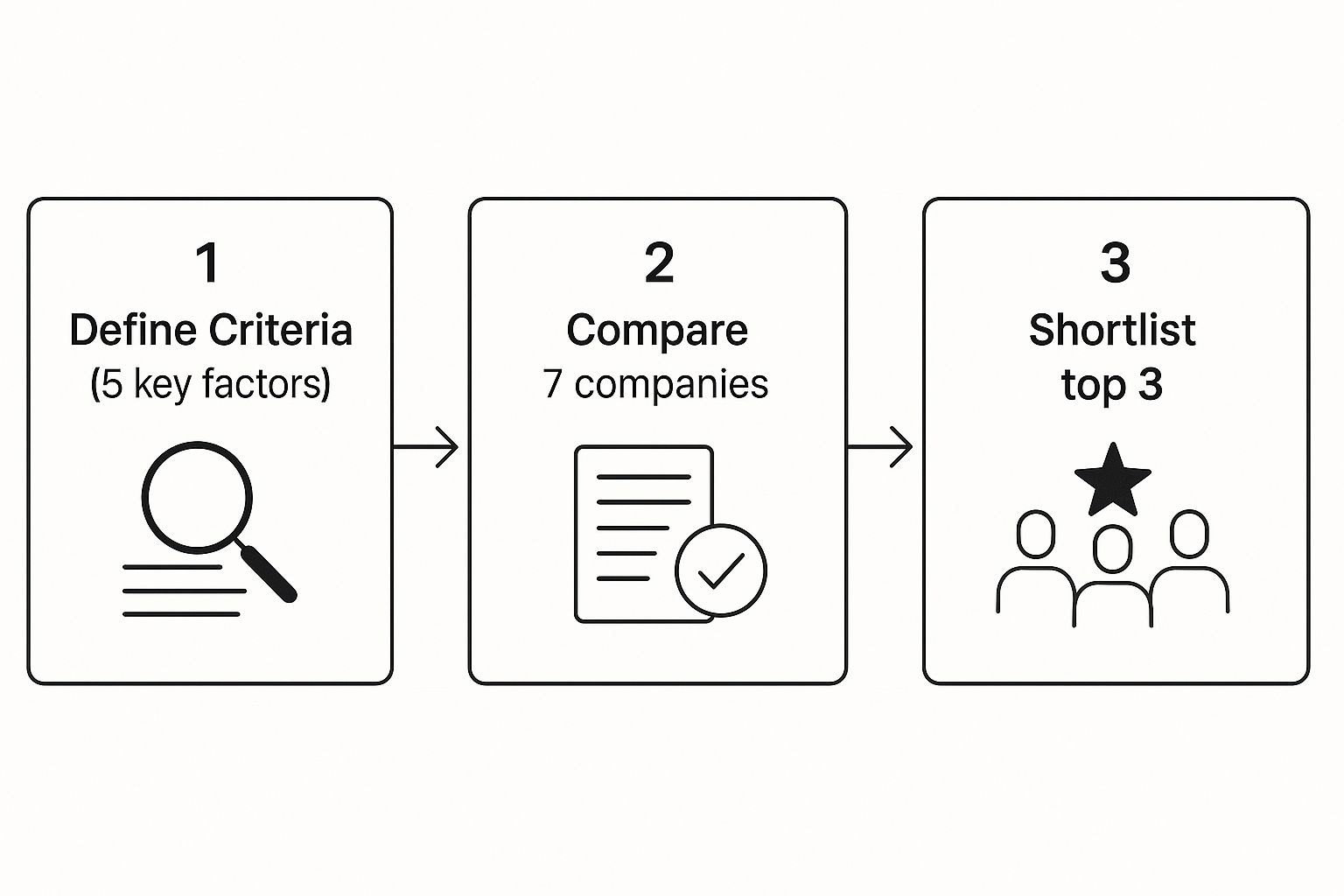
Following a structured approach like this saves invaluable time and dramatically improves your odds of selecting the right long-term partner.
Real-World Cost Comparison
Let's illustrate with a realistic local example. Imagine you own a luxury rental in Carmel that generates $6,000 per month.
Firm A offers a tempting 6% management fee ($360/month). However, their agreement includes a 10% maintenance markup. A necessary $500 plumbing repair now costs you $550.
Firm B offers a straightforward 8% management fee ($480/month) with a policy of no maintenance markups or hidden administrative fees.
Over a year, Firm A’s "cheaper" rate could easily cost you more, especially if your property requires several maintenance calls. The clarity and predictability of Firm B’s transparent fee structure are invaluable for financial planning and building trust. This is why a full understanding of the numbers is critical; explore our resources on how to interpret property management financial reports to see how we champion this transparency.
Actionable Step: Before signing any agreement, demand a complete, written schedule of every potential fee. Ask direct questions: “Do you charge markups on maintenance?” and “What fees, other than the management percentage, could appear on my statement?”
A trustworthy partner, like our team at Coast & Valley led by local expert Amy Salmina, believes in 100% financial transparency. We build our business on the principle that our success is directly tied to your profitability.
Evaluating Their Approach to Service and Communication
For any discerning investor with a high-end property in Monterey County, proactive service and crystal-clear communication are the bedrock of a successful partnership. A company’s service philosophy—how they actually operate—is far more revealing than any marketing slogan. To understand it, you must look beyond promises and evaluate their processes.
Your first interaction is a test. When you inquire, how quickly and professionally do they respond? A slow or generic reply is a strong indicator of how they will communicate once you are a client. True concierge-level service begins at the first touchpoint.
Proactive Maintenance vs. Reactive Repairs
One of the clearest distinctions between an average manager and a premium one is their approach to maintenance. Many firms operate on a reactive, “break-fix” model, only acting after a tenant reports a problem. For a luxury property in a place like Carmel or Pacific Grove, this is a recipe for asset degradation and higher long-term costs.
A premier firm champions a proactive, preventive maintenance strategy. This is a fundamental mindset shift focused on property preservation.
This involves:
- Scheduled Inspections: Regular, documented walkthroughs to identify and address small issues before they escalate into expensive emergencies.
- Seasonal Preparedness: Servicing HVAC systems before the Salinas Valley summer heat and ensuring proper drainage before the Monterey Bay's winter rains.
- Vendor Management: Leveraging a vetted network of trusted, local tradespeople who deliver quality work at fair prices, avoiding the "emergency" premium.
This philosophy is about protecting your investment's value and ensuring a superior living experience for the high-caliber tenants you want to attract and retain.
An investment property isn't a passive asset if your manager requires your input for every minor decision. The goal is to find a partner who can operate autonomously within agreed-upon guidelines, saving you time and mental energy.
Communication Protocols and Technology
Exceptional service is impossible without a robust communication framework. You need clarity on how and when you will receive updates. Will you get a detailed monthly statement via a secure portal? How are after-hours emergencies communicated?
Modern, professional firms leverage technology to create seamless communication. An online owner portal should be a non-negotiable standard, providing 24/7 access to financial statements, maintenance logs, and lease documents. This isn't just for convenience; it's a pillar of transparency and trust. You should be able to see exactly what’s happening with your property at any time. Explore our guide on effective property management communication to understand the systems that enable this.
Ultimately, when you choose a property management company, you are selecting a team to represent you. Their communication style, responsiveness, and service approach directly reflect on you as the owner. Settling for anything less than exceptional is a risk your Monterey County asset cannot afford.
Why Local Market Mastery Matters
When choosing a property management company, it's easy to be impressed by large, national firms. But for an asset as valuable as your Monterey County property, broad scale cannot compete with hyperlocal precision. True profitability and asset protection are rooted in a deep, intuitive understanding of the local market—something a national chain cannot replicate.

This specialized knowledge translates directly into tangible financial benefits. It’s about more than knowing street names; it's about understanding the pulse of the community.
A local expert, for instance, knows the Salinas renter pool is heavily influenced by our thriving agriculture and healthcare sectors. That insight leads to targeted marketing that attracts stable, high-quality tenants faster, dramatically reducing costly vacancy periods.
Pricing Power and Nuanced Strategy
In a region as diverse as Monterey County, a one-size-fits-all approach to rental pricing is a guaranteed way to leave money on the table. A seasoned local manager understands the subtle but critical differences that define our micro-markets. They know why a home in the sunnier parts of Pacific Grove commands a different rent than one in Gonzales or King City.
This granular knowledge allows for pinpoint rental pricing that maximizes your income. It's the difference between a good return and an exceptional one.
A local firm’s network is its superpower. When a pipe bursts on a weekend at your Carmel property, they aren’t scrolling a national vendor list. They’re calling a trusted, local plumber they’ve worked with for years—ensuring a prompt response, quality work, and fair pricing.
This network of reliable, cost-effective local vendors is an invaluable asset. It ensures maintenance issues are resolved efficiently, without the inflated costs often associated with a national provider’s impersonal system.
Your Local Advantage
Ultimately, a manager with deep roots in the community provides a layer of security and proactive care that a distant corporation cannot. They are attuned to local ordinances, seasonal rental trends, and the economic shifts affecting the entire Monterey Bay Area. This foresight is the foundation of intelligent asset management.
This deep community expertise is key to unlocking your property's full value. Our guide on property management best practices offers more insights into what sets a top-tier local firm apart.
Choosing a partner like Coast & Valley, led by fourth-generation Salinas native Amy Salmina, means you're not just hiring a manager. You're gaining a dedicated local steward for your investment.
Verifying Trust, Reputation, and Performance

When you hand over the keys to a high-value asset in Monterey County, trust is paramount. Finding a property manager is about more than a handshake; it’s about securing a long-term partner whose reliability is proven.
A company's true reputation is revealed through client experiences, operational stability, and a consistent history of success. Your task is to look past marketing claims and uncover that story.
Reading Between the Lines of Online Reviews
Anyone can glance at a star rating, but discerning owners must dig deeper. A long string of generic five-star reviews can be as suspect as a few negative ones. Look for detailed feedback describing a specific situation and how the manager resolved it.
Consider the context. For firms managing properties from Salinas to the luxury market in Pebble Beach, a negative review about a maintenance delay during a major storm might be understandable. Consistent complaints about poor communication or surprise fees, however, are a major red flag.
Pay close attention to how the company responds to criticism. A professional, empathetic reply that offers a solution demonstrates accountability. A defensive or canned response suggests a company culture that will not deliver the concierge-level service you require.
Key Takeaway: A company’s character shines brightest when things go wrong. Look for a firm that addresses criticism head-on, as it shows a commitment to continuous improvement and client satisfaction—a core tenet of our philosophy at Coast & Valley.
The Power of Direct References and Testimonials
Online reviews are public, but direct references are personal and far more revealing. Do not hesitate to ask for a list of current client references. A top-tier firm will gladly connect you with other owners. Then, make the call.
To maximize these conversations, prepare pointed questions. Our list of essential questions to ask property management companies can guide you.
When you speak with their clients, ask:
- How proactive is their communication regarding maintenance and property inspections?
- Are financial statements clear, accurate, and consistently on time?
- Can you describe a time they handled a difficult tenant situation or an unexpected vacancy?
The answers will provide a real-world picture of what it's truly like to partner with them.
Assessing Operational Stability and a Forward-Thinking Approach
A trustworthy partner is also one that is built to last. A firm that invests in modern property management technology, such as a secure online owner portal, and prioritizes ongoing professional development for its team is better equipped to protect your investment. This is not a perk; it is a necessity for risk management.
The U.S. property management market is projected to grow from $81.52 billion in 2025 to $98.88 billion by 2029, indicating an increasingly complex industry. A firm’s investment in its systems and people is a clear signal of its ability to navigate market shifts and safeguard your asset for the long term.
Verifying trust is an active investigation. It requires looking beyond claims and digging into the evidence of performance, client satisfaction, and operational integrity. This diligence ensures you find a partner who will treat your Monterey County property with the care it deserves.
Your Monterey Property Management Questions Answered
As an owner of a valuable property in Monterey County, asking direct questions is essential to choosing the right partner. Here are clear, straightforward answers to the most common concerns we hear from discerning owners and investors.
How Much Should I Expect to Pay in Management Fees?
In the Monterey Bay Area, management fees typically range from 6% to 10% of the monthly collected rent. However, the percentage itself is less important than the value and transparency you receive.
A suspiciously low fee can be a red flag for hidden costs, like maintenance markups or administrative charges. A premium, full-service firm may have a higher stated percentage but will provide a completely transparent fee structure. This approach aligns their success with yours—they only profit when you do. Always demand a complete fee schedule in writing before signing an agreement.
Be wary of any company that charges a management fee on a vacant property. A true partner is motivated to place a high-quality tenant quickly, not to profit from your vacancy.
What is a Realistic Timeframe to Find a Tenant?
For a well-maintained, competitively priced property in a desirable area like Pacific Grove or Salinas, our goal is to secure a highly qualified tenant within 30 days. This can vary with market seasonality, as the rental market naturally slows during the winter holidays.
The key to minimizing vacancy is not just speed, but a combination of targeted marketing and a rigorous screening process. A great manager doesn't just find any tenant; they find the right one to protect your asset. You can get a better sense of our meticulous process by reading our guide on how to find good tenants.
How Are After-Hours Emergencies Handled?
A top-tier property management company must have a clear, reliable, and tested protocol for 24/7 emergencies. This is non-negotiable. It should involve a dedicated after-hours contact number for tenants and, crucially, a pre-vetted list of trusted local vendors who can respond at a moment's notice.
When interviewing a firm, ask them to walk you through their exact process. Who receives the call? How and when is the owner notified? What is the spending threshold for pre-approved repairs? A well-defined system is a hallmark of professionalism and the only way to ensure your property is protected around the clock, providing you with genuine peace of mind.
Finding the right management partner is the single most important decision you can make to protect your asset and maximize your return on investment. Coast and Valley Properties brings the deep local expertise and concierge-level service your Monterey County property deserves.
Contact us today for a complimentary property evaluation and discover how our dedicated, hands-on approach can make all the difference.

How to Screen Potential Tenants: A Guide for Monterey County Property Owners
For an owner of a high-end property in Monterey County, tenant screening is single-handedly the most important process for protecting your real estate investment. I’m not just talking about checking a box—this is your first line of defense against income loss, property damage, and massive legal headaches.
In a market as diverse as ours, stretching from Salinas to Pebble Beach, a meticulous, professional screening process is what ensures you place reliable tenants who will treat your property with the respect it deserves. This guide provides an actionable, step-by-step framework for protecting your asset.
Why a Professional Screening Process Is Non-Negotiable
For any serious property owner or investor in Monterey County, knowing how to screen potential tenants is the absolute cornerstone of a successful rental strategy. A haphazard approach sets you up for costly evictions, long vacancies, and significant stress. A structured, professional process, on the other hand, delivers peace of mind and protects your high-end asset.
The global Tenant Screening Services market was valued at around USD 1.76 billion in 2024 and is expected to climb, all because sophisticated landlords and property managers understand its critical role in risk management.
As Amy Salmina, a fourth-generation Salinas native and our firm's leader, often says, “Treating every property like our own starts with finding tenants who will do the same.” This philosophy is the engine behind our concierge-level approach to tenant placement, designed to protect your ROI.
A truly effective screening strategy is built on four key pillars. Getting these right provides consistency, ensures legal compliance, and allows you to make a final decision with complete confidence.
The Four Pillars of an Effective Tenant Screening Process
To achieve that level of confidence, your process must go beyond a quick credit check to create a complete, verifiable picture of each applicant. A great place to start is by reviewing our comprehensive tenant screening checklist, which breaks down these essential steps.
Here’s a quick look at the core components that make up a rock-solid screening process.
| Pillar | Objective | Key Focus Area |
|---|---|---|
| Objective Rental Criteria | Establish fair, consistent standards | Defining income, credit, and rental history requirements before marketing the property. |
| Thorough Verification | Confirm all applicant-provided information | Rigorously checking employment, income, and past landlord references. |
| Legal Compliance | Avoid discrimination and legal trouble | Strictly adhering to all federal, California, and local Monterey County Fair Housing laws. |
| Consistent Evaluation | Ensure fairness and defensibility | Applying your established criteria equally to every single applicant, every single time. |
These pillars aren't just suggestions; they form the foundation of a process that protects your investment for the long haul. When you move beyond a simple gut feeling and adopt a structured approach, you're not just finding a tenant—you're securing a key component of your asset's performance.
Step 1: Establish Your Gold Standard Rental Criteria

Before you even consider listing your property, you must define and document your rental criteria. This isn't just a suggestion; it's a non-negotiable first step. Think of this documented standard as your personal playbook, ensuring every applicant is measured against the same objective, fair, and legally compliant benchmarks.
This is the most effective way to streamline your decision-making and shield your investment. It’s about setting the "house rules" before the game even starts. This isn’t about being overly restrictive; it’s about being clear and consistent, which is absolutely essential for staying on the right side of California's strict Fair Housing laws. Having these standards in black and white is your single best defense against potential discrimination claims.
Defining Your Core Financial Standards
For high-end properties in the Monterey Bay Area, tenant financial stability is paramount. The goal is to set realistic expectations that protect your asset without unreasonably shrinking your applicant pool. For owners of luxury homes, finding tenants who clear these hurdles is essential. We offer more in-depth advice on this in our guide on how to find good tenants.
Here are the key financial benchmarks we establish for our clients:
- Income Requirements: A widely accepted industry benchmark is a gross monthly income of three times the monthly rent. This standard provides a reliable indicator of financial capacity, whether for a luxury property in Carmel or a family home in Gonzales or Soledad.
- Credit Score Threshold: A credit score is a quick snapshot of financial responsibility. We generally look for scores that signal a low risk of default. However, we always analyze the entire credit report for context. A single old medical collection is a world away from a consistent pattern of late payments.
- Employment and Rental History: Stability is a key indicator. Verifying a consistent history of on-time rent payments and positive references from previous landlords is one of the most powerful predictors of future tenant behavior.
Expert Insight: Document every single one of your criteria. Whether it's your income-to-rent ratio, credit score range, or your pet policy, having it in writing and applying it uniformly to every applicant is your legal shield. It’s the cornerstone of a fair and defensible screening process.
Tailoring Criteria to Your Specific Property
While your legal framework must be consistent, your financial standards can be tailored to the property itself. The income required for a prestigious Pebble Beach estate will naturally differ from that for a modern condo in Salinas.
The crucial element, however, is that the method of verification remains identical for every applicant.
By creating your gold standard before you meet a single applicant, you remove emotion and potential bias from the equation. This professional, methodical approach is central to how we screen potential tenants, ensuring you secure a qualified individual who will respect your property and fulfill their lease, protecting your valuable Monterey County investment.
Step 2: Verify Applicant Information to Uncover the Full Story
Once you’ve set your rental criteria, the real work begins: rigorous verification. A signed application is just a starting point. The heavy lifting in tenant screening is methodically confirming every single piece of information provided. This "trust but verify" approach is absolutely fundamental to protecting your high-value Monterey County property.
Think of an application as a series of claims. Our job, as your property manager, is to substantiate those claims with hard facts. A thorough screening process that includes detailed credit checks, income verification, criminal background checks, and landlord references dramatically cuts down on headaches like late rent and property damage. It's the core of smart risk management.
Properly screening tenants is a lot like mastering the qualification process in any professional field. You set clear standards, gather information, and then diligently verify that information.
Beyond the Credit Score
A credit score gives you a quick snapshot, but the full report tells the story. For a luxury property in Pacific Grove or Carmel, a high score is expected, but we always dig deeper to understand an applicant’s complete financial picture.
- Debt-to-Income Ratio: We look at how much debt they're carrying compared to their earnings. A mountain of credit card debt can be a red flag, even with a strong salary.
- Payment History: Are they consistently late on other payments? This is one of the strongest predictors of whether they'll pay rent on time.
- Collections and Judgments: We look for patterns. A single, old medical bill from years ago is a world away from recent, unpaid utility bills or collections from a previous landlord.
This infographic gives you a basic idea of the workflow for confirming income, a key piece of the puzzle.
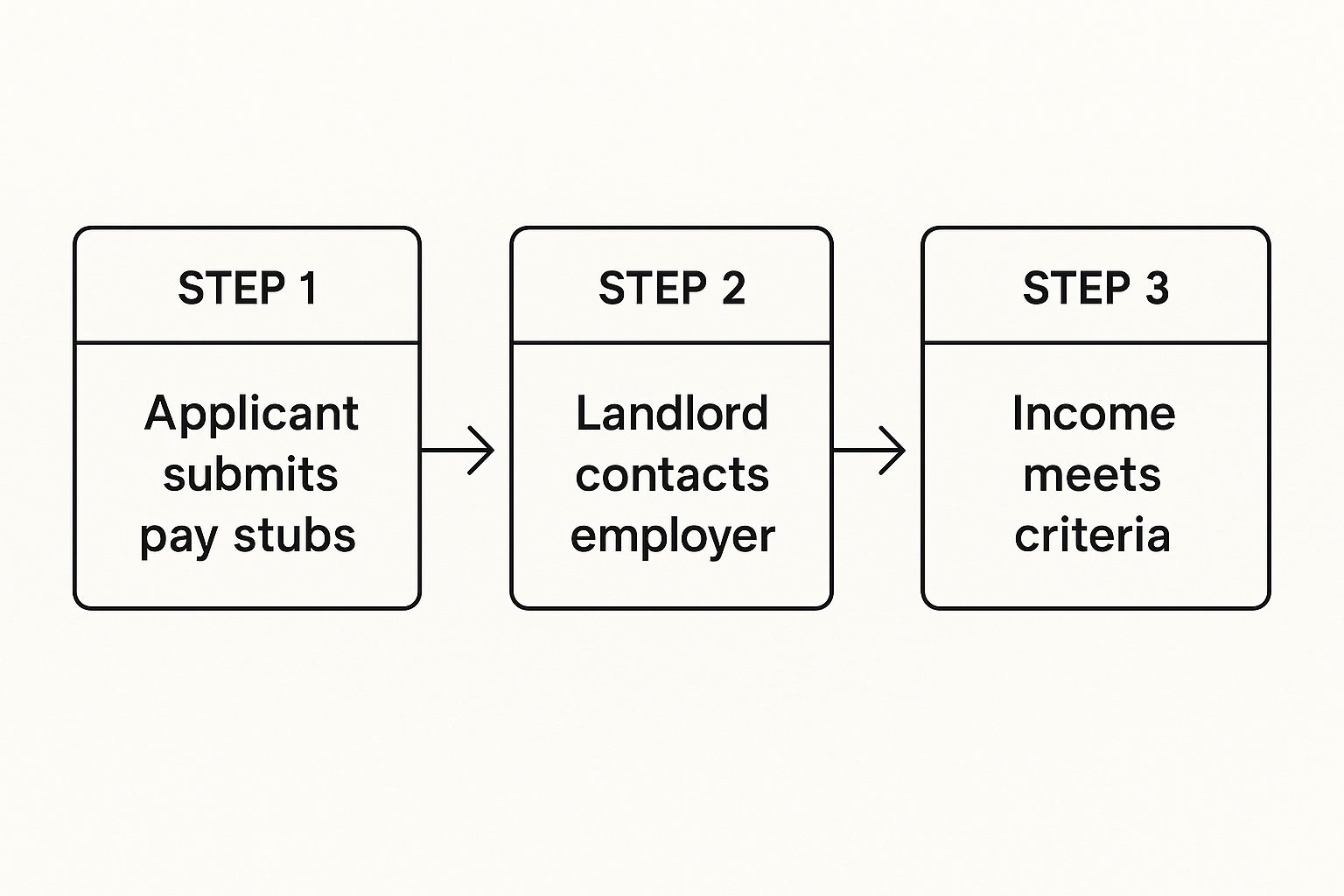
As you can see, it’s a multi-step process that moves from applicant-provided documents to direct confirmation with the source.
The Power of Direct Confirmation
Accepting pay stubs at face value is risky, especially with how easily fraudulent documents can be created. The only way to be certain is through direct verification—a time-consuming but non-negotiable step we handle with practiced efficiency for our clients.
Actionable Verification Checklist:
- Call the Employer: We contact the employer’s HR department directly to confirm job title, employment duration, and salary. This one call eliminates the risk of falsified income information.
- Contact Previous Landlords: This is where you get the most valuable insights. We ask specific, open-ended questions to get the real story:
- "Did they pay their rent on time, every single month?"
- "Were there ever any lease violations or complaints from neighbors?"
- "What was the property's condition when they moved out, allowing for normal wear and tear?"
- "Would you rent to them again?" The answer here is incredibly telling.
Expert Tip: Never use the phone number provided on the application for the previous landlord. We always independently verify the property owner's contact details to ensure we're speaking to the actual owner, not a friend posing as one. This is a critical trust and transparency checkpoint.
This meticulous verification is what separates professional screening from a superficial one. It’s a core component of mastering the Salinas & Monterey rental application process, and it's how you ensure the person placed in your property is the reliable, responsible tenant they appear to be on paper.
Step 3: Navigate California and Local Rental Laws

Legal compliance isn’t just a good idea—it's a non-negotiable part of owning rental property in California's highly regulated housing market. For owners of high-end properties here in Monterey County, from Salinas to the coastal communities, a deep understanding of federal, state, and local laws is the only way to prevent costly lawsuits and protect your reputation.
A single misstep, even an unintentional one, can lead to serious financial penalties. This is why any discussion about how to screen potential tenants must be built on a solid foundation of legal knowledge. It’s about building a fair, ethical, and legally defensible process.
The Fair Housing Act and California's Protected Classes
Every landlord in the country must comply with the federal Fair Housing Act, which prohibits discrimination based on race, color, religion, national origin, sex (including sexual orientation and gender identity), disability, and familial status.
California takes tenant protections even further by adding several more protected classes. This is where many well-intentioned landlords get into trouble.
These additional state-level protections include:
- Source of Income: This is critical in our local market, from Salinas to King City. You cannot legally reject an otherwise qualified applicant just because they use a Section 8 voucher or another form of public assistance to pay their rent.
- Marital Status: Your rental decisions can't be influenced by whether an applicant is single, married, or divorced.
- Age: You cannot discriminate based on an applicant's age.
- Ancestry and Medical Condition: These are also protected characteristics under California law.
Understanding the nuances of these rules is paramount. For a more detailed look, you can explore our guide covering landlord-tenant laws in California, which breaks down these complexities.
A Word of Caution: Accidental discrimination is just as illegal as intentional discrimination. A seemingly innocent comment like, “This home in Pacific Grove is perfect for a young family,” could be interpreted as a preference, creating significant legal risk. Always focus your conversation on the property's features, not on who you imagine living there.
Application Fees and Criminal History Rules
California has specific, strict rules that govern common screening practices. One of the most misunderstood areas is the application fee. You can only charge a fee that covers your actual out-of-pocket screening costs, and as of 2024, this amount is capped and adjusted annually for inflation. You cannot profit from application fees.
How you handle criminal history has also changed dramatically. Recent laws require a more nuanced approach. You can no longer have a blanket policy of rejecting anyone with a criminal record. Instead, you're required to conduct an individualized assessment, considering the nature and severity of the offense and how much time has passed.
Navigating these rules requires precision and constant vigilance. This is where professional property management becomes a powerful asset, ensuring your screening process stays compliant and shields you from legal headaches.
Step 4: Make a Confident and Compliant Final Decision
You’ve done the legwork. You’ve sifted through applications, run the checks, and verified every last detail. Now comes the most important part: choosing your tenant. This is precisely why setting your rental criteria before you list the property is so critical. With the facts in front of you, you can make an objective, systematic choice.
The goal isn't just to find someone who clears the minimum bar. It’s about finding the best possible fit for your property. If you own a premium home in a community like Carmel or Pebble Beach, this decision is directly tied to protecting your asset and maximizing your ROI. Your best ally in this process is consistency. It keeps you fair, objective, and legally sound.
Weighing the Variables
It's rare to find the "perfect" applicant whose every detail lines up flawlessly. Most of the time, you'll be comparing individuals with different strengths. This is where experience and good judgment come into play.
Consider these common scenarios:
- Credit vs. Income: An applicant has a lower-than-ideal credit score due to old medical debt but has a stable job with an income that's 5x the rent. Compare that to someone with a perfect 800 credit score but whose income just squeaks past your 3x rent rule. The first person could be the more reliable tenant.
- Rental History vs. Employment: You have an applicant with glowing references from past landlords, but they just started a new job last month. On the other hand, you have someone who's been with the same company for a decade but had one late rent payment three years ago.
You must weigh these situations against the standards you set from the start. In our experience, a long, positive history of paying rent on time and taking care of a property is one of the strongest predictors of a great tenant.
The cardinal rule here is to apply your logic consistently. If you decide to make an exception for one applicant—like accepting a lower credit score due to high income—you must be willing to make that same exception for any other applicant in a similar situation. Always document why you made your decision.
Communicating Your Decision Professionally
How you deliver the news—good or bad—reflects on you as a professional property owner and builds your reputation in the Monterey County community.
For the chosen applicant, the conversation is straightforward. A clear "Congratulations, you've been approved!" followed by immediate next steps (lease signing, security deposit payment) starts the relationship on a positive, transparent note.
For applicants you didn't choose, your communication must be professional and legally compliant. This is critical. In California, if your decision was based on any information from their credit report or background check, you are required to send an adverse action notice.
This formal letter states why they were denied and must include the name and contact information of the screening company you used. It’s not just a professional courtesy; it’s a legal requirement.
Taking this final step seriously solidifies your entire screening process. A well-documented, fair decision followed by respectful communication protects your investment and establishes you as a top-tier property owner.
Bringing in a Pro for Ultimate Peace of Mind

As you can see, an airtight tenant screening process is a serious undertaking. It demands time, a sharp eye for detail, and a firm grasp of California's ever-shifting rental laws.
For busy owners with high-value properties in Salinas, Monterey, and surrounding South County towns, the complexity and legal exposure can become overwhelming.
This is where you should consider a full-service, professional solution. When you partner with a dedicated property manager like Coast & Valley Properties, you’re not just delegating a task list; you’re investing in a proven system designed to protect your asset, save you time, and maximize your returns.
The Coast & Valley Advantage: Trust and ROI
We don’t just run basic checks. We provide a complete placement service focused on securing high-quality, long-term tenants who will treat your property with respect. Our process is built on years of local Monterey County experience and a simple philosophy: we treat your property like our own.
Here’s how our full-service solution delivers peace of mind:
- We Give You Your Time Back: We handle every step, from marketing your property in Pacific Grove to vetting every applicant in King City. This frees you to focus on your own priorities.
- We Minimize Your Risk: Our team, led by Salinas native Amy Salmina, lives and breathes Fair Housing law. We ensure strict compliance to shield you from costly legal mistakes that can sink an investment.
- We Protect Your Asset: By placing only the most responsible, thoroughly vetted tenants, we actively help preserve your property’s condition and protect its long-term value.
A professional manager's true value is in shouldering the complexities so you can enjoy the benefits of your investment without the day-to-day headaches. It's a direct investment in your time and ROI.
When you weigh the time, stress, and potential legal pitfalls, the argument against self-management becomes compelling. You can dive deeper into why so many savvy investors make this choice and learn why you should not manage your own investment properties.
By working with specialized landlord services, you bring a powerful local ally into your corner—one completely dedicated to helping you achieve your financial goals.
Your Monterey County Tenant Screening Questions Answered
Even the most seasoned investors have questions about the nitty-gritty of tenant screening, especially for high-value properties in Monterey County. Here are some of the most common questions we answer for our clients.
Can I Charge an Application Fee?
Yes, but you must follow California's strict rules. The fee can only cover your actual out-of-pocket screening costs, such as the price of a credit report and background check. You cannot profit from application fees. The maximum amount is capped by law and adjusted annually for inflation, so it's critical to know the current limit.
How Should I Handle Applicants with Pets?
Deciding to allow pets can significantly expand your pool of potential renters. If you go this route, you need a crystal-clear pet policy in writing before listing the property.
Your policy should spell out:
- Pet Deposit: A separate, refundable deposit for pet-related damages.
- Pet Rent: A small, extra monthly fee, if you choose to implement one.
- Restrictions: Be specific about limits on the type, size, or number of pets allowed.
A crucial point: you cannot charge a pet deposit or pet rent for verified service or support animals. Under Fair Housing laws, they are not legally considered pets.
What About Applicants Who Are Self-Employed?
Verifying income for a self-employed applicant simply requires different documentation. Instead of pay stubs, you need other proof of financial stability.
To get a complete financial picture, we ask for the last two years of tax returns, recent bank statements, and a profit and loss statement for their business. This combination provides a much more reliable view of their true financial health and ability to consistently pay rent.
Do I Have to Accept Section 8 Vouchers?
Yes, in California, you absolutely do. Source of income is a protected class. This means it is illegal to deny an otherwise qualified applicant just because they use a Housing Choice Voucher (Section 8) or another form of rental assistance. You must apply all your normal screening criteria—credit history, rental background, etc.—to every single applicant, regardless of how they plan to pay the rent.
Navigating these rules and details is exactly where Coast & Valley Properties steps in. Our team manages every part of the screening process with precision and a deep understanding of California law, ensuring your investment is protected and your mind is at ease.
Ready to experience hands-off, concierge-level property management? Contact us today and let's discuss how we can maximize the potential of your Monterey County property.

A Practical Guide to Using a Rental Property ROI Calculator for Your Monterey Investment
When evaluating investment properties, it's easy to get caught up in the potential. But in a high-value market like Monterey County, you need more than a gut feeling. A rental property ROI calculator is the tool that separates serious investors from hopeful guessers, providing a clear, data-driven look at an investment's true potential.
This guide moves beyond simple napkin math to give you a realistic, actionable forecast of how a property in Salinas, Monterey, or surrounding communities will perform financially.
Moving Beyond Guesswork in Monterey Bay Real Estate

Investing here—whether it's a luxury vacation home in Pacific Grove or a multi-family building in Salinas—demands a sharp pencil and concierge-level analysis. The difference between a thriving portfolio and a financial headache often boils down to the quality of your upfront diligence.
A common mistake new investors make is simply comparing potential rent to the monthly mortgage payment. This is a dangerously oversimplified view for a market as nuanced as ours. It completely ignores the real-world expenses that ultimately determine if an investment is profitable. A professional-grade rental property ROI calculator forces you to take a more disciplined, CEO-like approach to your portfolio.
Why Detailed Calculations Are Non-Negotiable
A thorough ROI analysis provides the clarity needed to make decisions with confidence. It paints a true financial picture by accounting for all easily overlooked costs, many of which are unique to our area—like higher insurance premiums for coastal properties or seasonal maintenance driven by our local climate.
Before you commit any capital, you must run the numbers. Here is a step-by-step checklist of what to dig into:
- Operating Expenses: Account for property taxes, which can differ dramatically between Monterey and a South County town like Gonzales or King City.
- Vacancy Rates: Project for potential income loss when a unit is empty. This isn't a guess; it's a projection based on local Monterey County market trends.
- Capital Expenditures: Plan for future big-ticket items. A new roof or HVAC system isn't a surprise; it's a predictable future cost that must be budgeted for.
As a fourth-generation Salinas native, our founder Amy Salmina understands that local insights are everything. A generic online calculator won’t grasp the unique economic drivers of the Salinas Valley or the tourist-fueled cycles of the Monterey Peninsula. That’s where true local expertise and trust are built.
To get an accurate picture of your property's potential, you'll need to gather specific information. These are the core inputs that will fuel your calculation.
Essential Inputs for Your Monterey Property ROI Analysis
| Data Point | Why It Matters in Monterey County |
|---|---|
| Purchase Price & Closing Costs | The foundation of your investment. Closing costs in California typically run 2-5% of the purchase price. |
| Down Payment | Determines your loan amount and directly impacts your monthly cash flow and overall leverage. |
| Loan Details (Interest Rate, Term) | Your mortgage is often your largest single expense. Minor rate changes can significantly alter your returns. |
| Projected Monthly Rent | Must be based on current, local market rates for comparable properties in Salinas, Carmel, or your target area. |
| Annual Property Taxes | Varies significantly by city. Salinas, Monterey, and Carmel all have different tax structures. Use precise figures. |
| Annual Insurance Premium | Coastal properties or those in specific zones may face higher insurance costs. Obtain actual quotes for accuracy. |
| Monthly HOA Fees | Common in condos and newer developments; a fixed cost that directly reduces your net income. |
| Vacancy Rate (%) | An essential buffer. A 5-8% vacancy rate is a conservative and prudent estimate for financial planning. |
| Maintenance & Repairs (%) | Budgeting 1-2% of the property value annually is a smart rule of thumb for preserving your high-end asset. |
| Property Management Fees | For busy professionals, this is typically 8-10% of monthly rent. It's an investment in asset protection and your own time. |
Getting these details right is the most critical step. The quality of your analysis depends entirely on the accuracy of your inputs. Ultimately, running a detailed ROI calculation isn't just about a single percentage; it’s about building a solid financial model. This is the foundational work that allows you to confidently compare opportunities and protect your assets in the competitive Monterey Bay market.
Gathering Your Financials for an Accurate ROI

Any rental property ROI calculator is only as good as the numbers you plug into it. To move from fuzzy percentages to actionable insights, you must dig into the specific financial details of owning a property right here in Monterey County. This process goes far beyond the purchase price—it's a deep dive into the local costs that truly shape your investment's performance and preservation.
"Garbage in, garbage out" is a fundamental truth in real estate investment. To get a precise calculation, your data must be just as precise. A great first step is organizing your raw financial data. If you’re looking at a pile of bank statements, it helps to get them into a workable format. There are excellent guides that show you how to convert bank statements to Excel, which can simplify sorting your expenses significantly.
Once your records are organized, you can pull together the figures that truly matter in our local market.
Core Expenses for Your Monterey County Property
Before you can calculate returns, you need a rock-solid handle on every single cost. These are not numbers you can afford to guess on; they demand research and local know-how.
- Property Taxes: This is never a one-size-fits-all figure. The tax rate for a luxury property in Pebble Beach will look very different from a family home in Salinas or a rural asset near Gonzales. You must use the specific tax rate for your property's exact location.
- Landlord Insurance: California has its own set of insurance requirements. Furthermore, properties in coastal areas like Monterey or Carmel often need supplemental coverage, such as flood or earthquake riders. Don't estimate—get actual quotes. This is non-negotiable for accuracy and asset protection.
- HOA Fees: Many high-end communities and nearly all condominium complexes come with Homeowners' Association fees. These are fixed costs that directly impact your bottom line and must be included in any professional analysis.
Projecting Variable and Ongoing Costs
Beyond fixed monthly bills, a savvy investor always accounts for the variable expenses that can erode profitability. Overlooking these is one of the most common and costly mistakes we see investors make.
At Coast & Valley, we advise our clients to be conservative with these projections. It’s far better to be pleasantly surprised by lower-than-expected costs than to have your projected returns derailed by an expense you failed to budget for. Trust and transparency begin with realistic forecasting.
A realistic budget for these moving parts is the key to calculating your true Net Operating Income (NOI), the foundation of any ROI analysis. You can learn more about getting this number right in our NOI in our detailed guide.
Consider these critical projections:
- Maintenance & Repairs: Our coastal climate, with its fog and salty air, can accelerate wear-and-tear. We recommend setting aside 1-2% of the property's value annually for maintenance. This covers everything from routine landscaping to an unexpected plumbing issue, ensuring your property is preserved.
- Vacancy Rate: No property stays occupied 100% of the time. Based on our experience in the Salinas and broader Monterey Bay markets, factoring in a 5-8% vacancy rate provides a realistic buffer for tenant turnover.
- Property Management: For busy professionals and out-of-area investors, our full-service management is an investment in your peace of mind and ROI. This fee, typically 8-10% of the monthly rent, is a key expense that ensures your property is professionally maintained and your asset is protected.
Taking the time to pull these figures together is the single most important step. A detailed financial picture transforms a simple calculator into a powerful strategic tool, helping you make confident and profitable investment decisions in Monterey County.
Calculating Cash Flow, Appreciation, and True ROI
Once you’ve gathered all your financials, the real analysis begins. This is where we shift from data collection to calculation. A good rental property ROI calculator transforms those numbers into metrics that reveal the true story behind a potential investment.
First, you'll establish the foundation: Net Operating Income (NOI). This is your annual rental income minus all operating expenses—everything except the mortgage. From there, we can dig into two key performance indicators that every serious investor in Monterey County must master.
This visual breaks down the direct path from your initial investment to that final, all-important ROI percentage.
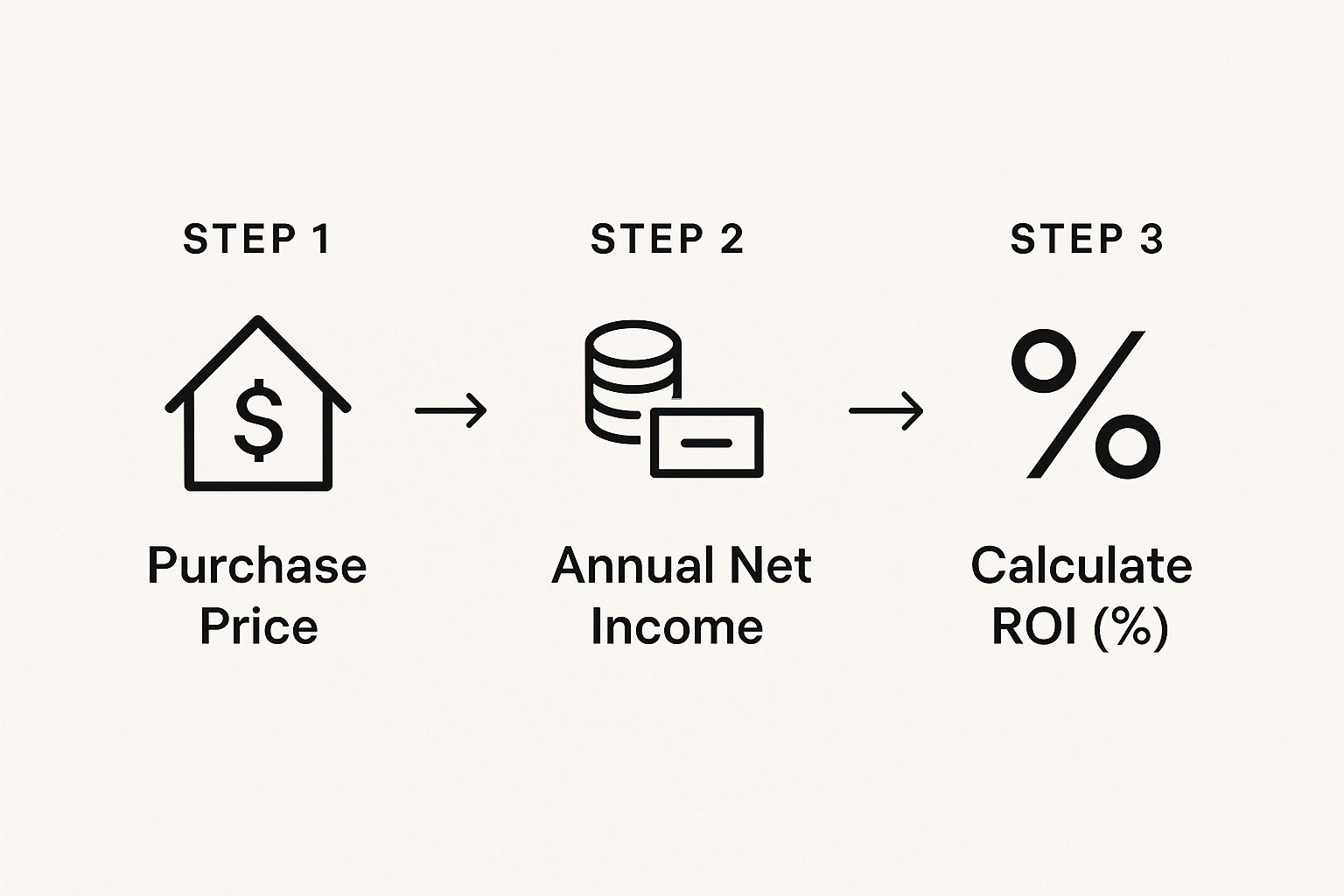
As you can see, a firm grasp of your purchase price and annual net income is the most direct route to a trustworthy ROI calculation.
Measuring Immediate Profitability with Cash-on-Cash Return
Your Cash-on-Cash Return is arguably the most powerful metric for understanding immediate profitability. It cuts to the chase, telling you how much pre-tax cash flow you’re generating each year relative to the actual cash you invested to acquire the property.
The formula is straightforward:
Annual Cash Flow / Total Cash Invested = Cash-on-Cash Return
Let's walk through an actionable, local example. Imagine you’re evaluating a duplex in a desirable Salinas neighborhood.
- Total Cash Invested: You make a down payment of $150,000 and pay $10,000 in closing costs. Your total cash investment is $160,000.
- Annual Cash Flow: After collecting rent and paying the mortgage, taxes, insurance, and maintenance, you have $12,000 left over for the year.
Your calculation is: $12,000 / $160,000 = 7.5%.
That 7.5% Cash-on-Cash return shows you precisely how hard your invested capital is working for you right now. It's an indispensable metric for comparing different properties, especially when deciding where to allocate your capital for the best immediate return. For a deeper dive, there are some great resources that explain how to calculate return on investment property in even more detail.
Factoring in Appreciation for Total ROI
Cash flow is critical, but it’s only half the story when investing in a high-value market like ours. The other, often more significant, piece of the puzzle is property appreciation—the growth in your property's value over time.
Total ROI provides a more complete picture by combining both cash flow and equity growth. This is especially true for long-term holds in sought-after locations like Pacific Grove or Carmel. Getting this full scope is why it's so critical to track your income and expenses meticulously. For more on that, you can explore our guide on mastering your Monterey County property’s financial reports.
While predicting appreciation is never an exact science, you can get a reasonable estimate by analyzing historical market trends here in Monterey County. By adding your annual cash flow to that projected equity gain, you get a holistic view of your investment’s power. This comprehensive understanding empowers you to make smart, wealth-building moves.
What a Good ROI Looks Like in Monterey County

So, you've plugged all the numbers into a rental property ROI calculator and it has produced a percentage. Now what? The critical question for a discerning investor is whether that number is actually good for an investment right here in Monterey County.
The truth is, there's no single magic number. What constitutes a great return is deeply personal and depends on your financial goals and the specific community you're investing in. The expectations for a high-end vacation rental in Carmel-by-the-Sea are worlds apart from a long-term family home in Soledad. One may offer lower cash flow but incredible appreciation, while the other provides a steady, predictable income stream.
Understanding these local nuances is the key to interpreting your results and aligning them with your goals.
Defining Your ROI Benchmarks
Many real estate investors target an 8% to 12% Cash-on-Cash Return. While this is a decent rule of thumb, it doesn't always capture the full picture in a premium market like ours. A lower cash-on-cash percentage can be more than acceptable if the property is in a sought-after area with a strong history of appreciation.
Consider this real-world example: A property in scenic Pacific Grove might generate only a 5% Cash-on-Cash Return. However, if it's also appreciating at 7% annually, your total return is very healthy. Conversely, a multi-unit building in King City could easily hit a 10% Cash-on-Cash Return with slower appreciation. Neither is inherently better—they simply fit different investment strategies.
The most practical way to judge a deal is to compare your calculated ROI against similar, recently sold properties in the same micro-market. This data-backed approach, a cornerstone of our service, tells you if your potential investment is performing at, above, or below the local standard.
Local Drivers That Influence Your Returns
Your ROI isn't a static figure. It’s a living number, constantly influenced by the unique economic pulse of the Monterey Bay Area.
A few key factors to keep in mind:
- Tourism & Seasonality: For properties in Monterey or Carmel, income will likely ebb and flow with tourist seasons. A busy summer and major events like Monterey Car Week can send revenue soaring, but you must budget for the quieter winter months to maintain stability.
- Agricultural Cycles: In the Salinas Valley, the health of the agricultural industry directly impacts rental demand and stability. Understanding these cycles is vital for accurately forecasting occupancy and rent in towns like Gonzales and Greenfield.
Navigating these local trends is precisely why so many high-end property owners turn to professional management. The industry is projected to grow from $24.18 billion to $52.21 billion by 2032, fueled by investors who need experts to handle rising rents and complex regulations to protect their ROI.
Ultimately, your ROI calculation is more than a number—it’s a strategic compass. It helps you decide when to refinance for better cash flow, when to sell for peak profit, or which new property is the right fit for your portfolio. To further optimize your returns, explore our guide on tax deductions for landlords in Salinas & Monterey County.
Actionable Strategies to Boost Your Property's ROI
Obtaining an initial number from a rental property ROI calculator is an excellent first step. Consider it a benchmark—a snapshot in time. For savvy investors in Monterey County, this calculation isn't the finish line; it's the starting line for building real wealth. Improving your property's financial performance means looking beyond simple rent hikes and taking a holistic, strategic view of your asset.
The real power lies in making smart, high-impact improvements that enhance your property's value and appeal to high-caliber tenants. This means focusing on the upgrades that residents in our local market value and are willing to pay a premium for.
Targeted Capital Improvements with Proven Returns
Not all renovations are created equal. While a fresh coat of paint is almost always a good idea, certain capital improvements provide a much bigger return by boosting your Net Operating Income (NOI) and, consequently, your ROI.
Actionable Example: For a family rental in a Salinas neighborhood, a modern kitchen is often the single most effective upgrade. Quartz countertops, new energy-efficient stainless steel appliances, and updated cabinetry can directly justify a higher monthly rent and attract a stable, long-term tenant, preserving your asset and cash flow.
Alternatively, for a luxury property in Pacific Grove, adding a beautifully landscaped, low-maintenance outdoor living space with a fire pit can significantly increase its desirability and rental value.
A key takeaway for our clients is to focus on improvements that enhance both aesthetics and functionality. Upgrades like smart home technology—thermostats, security systems, and keyless entry—are becoming standard expectations for premium tenants and can make your property stand out, justifying higher rent and reducing turnover.
Optimize Operations to Minimize Costs and Maximize Income
Beyond physical upgrades, some of the most effective ways to boost ROI involve fine-tuning your operations. Every dollar saved on expenses or prevented in lost income goes directly to your bottom line.
A thorough tenant screening process is your best defense against the high costs of vacancies and turnover. Finding a reliable, long-term resident ensures consistent income and less wear-and-tear on your property. Our guide on how to find good tenants provides a complete framework for this critical, time-saving step.
Proactive maintenance is another non-negotiable for property preservation. Here’s a simple checklist:
- Regular HVAC servicing to prevent system failure during a heatwave.
- Annual roof and gutter inspections, essential given our coastal climate.
- Scheduled pest control to keep the property clean, healthy, and desirable.
This hands-on approach not only prevents costly emergency repairs but also demonstrates a commitment to your tenants, which is key to retention.
The Financial Power of Professional Management
For many busy professionals and serious investors, the single greatest lever to pull for boosting ROI is partnering with a full-service property management firm. A professional partner handles every detail, from marketing and tenant relations to financial reporting and maintenance. This operational efficiency directly increases your NOI and frees up your most valuable asset: your time.
This isn't just a local trend; it's confirmed by global real estate data. For example, a recent report showed that even mature markets can see impressive growth with the right oversight, with annualized European total returns increasing to 4.8% and rents climbing by 4%. You can learn more about how market conditions and expert management drive returns from this global real estate outlook.
By putting these strategies into practice, you can transform your property from a passive asset into a dynamic, high-performing investment that grows in value and increases your returns, year after year.
Common Questions About Rental Property ROI
Even with a great rental property ROI calculator, it’s normal to have questions. What do these numbers really mean for your investment strategy here in Monterey County? Understanding the story behind the percentages is what separates a good decision from a great one.
Let's address some of the most common questions we hear from property owners like you, reinforcing the trust and transparency we're known for.
How Often Should I Recalculate My Property's ROI?
Your ROI isn't a "set it and forget it" number; think of it as a living metric for your investment's health. We advise our clients to run the numbers annually at a minimum. This yearly check-up ensures your analysis is current, factoring in changes to local property taxes, new insurance premiums, and shifting market rents across areas like Salinas and Monterey.
Actionable Advice: You should also recalculate ROI before any major financial move.
- Planning a capital improvement? Run the numbers first to project how the expense will impact future returns.
- Considering a mortgage refinance? A new interest rate will directly change your cash flow and bottom line. Model it out.
What Is a Good ROI in a High-Value Market?
This is the most common question, and the honest answer is always: it depends entirely on your goals.
You'll often hear a general target for Cash-on-Cash Return around 8-12%. But in a premium market like ours, that benchmark can be misleading. A property in a high-appreciation area like Pebble Beach might show a lower initial cash flow but could deliver spectacular total returns when you factor in its value growth over time.
Globally, what's considered a "good" return varies wildly. Some markets might boast rental yields over 10%, while others are much lower. This shows that ROI is always a product of location, risk, and economic stability. In Monterey County, the key is finding the right balance between immediate cash flow and powerful long-term appreciation.
The Biggest Mistake Investors Make
By far, the most common error we see is underestimating expenses. Investors often forget to budget for real-world costs: vacancy periods, nagging repairs, major capital expenditures (that new roof won't pay for itself), and professional management fees. A truly accurate ROI calculation demands a brutally honest look at all potential costs to ensure transparency and prevent future surprises.
How Does Professional Management Improve My ROI?
Hiring a professional property manager is not an expense—it's an investment that directly fuels your ROI. It works by improving your numbers in a few key areas, delivering peace of mind and time-saving solutions:
- Reduced Vacancy: Top-tier marketing and a rigorous tenant screening process find higher-quality tenants faster, keeping your property occupied and generating income. Our guide on proven tenant retention strategies dives deep into how keeping great tenants is one of the best ways to protect your cash flow.
- Lower Maintenance Costs: We focus on proactive, preventative maintenance. This approach catches small issues before they become expensive emergencies, preserving your asset.
- Optimized Rent: With deep local data, we price your property at the sweet spot—high enough to maximize your income but competitive enough to attract a pool of qualified applicants.
These efficiencies work together to boost your Net Operating Income (NOI), the real engine driving your ROI. While our world is rental properties, the core principle of using a dedicated financial tool to get clear on the numbers applies everywhere. For example, you can see how financial planning calculators work for other types of assets. The goal is always the same: gain clarity and make smarter decisions.

What Is Fair Market Rent and How Does It Affect Your Monterey County Investment?
For premium property owners and serious investors in Monterey County, the government benchmark known as Fair Market Rent (FMR) is simply the starting line. Think of it as the base sticker price for a standard car—it provides a general idea, but it fails to account for the luxury model with premium upgrades. For your high-end rental in Carmel or a meticulously maintained property in Salinas, this number is an economic indicator, not a price cap. Understanding it is the first step toward maximizing your return on investment.
Defining Fair Market Rent for Your Monterey County Property

As a discerning property owner, your first step toward building a winning investment strategy is understanding what FMR really means for your portfolio. It’s not about blindly following a government-set price; it’s about knowing the economic landscape you’re operating in, from the Salinas Valley to the Monterey Peninsula.
At its core, Fair Market Rent is a number calculated by the federal government. It represents the estimated rent for moderately priced, well-maintained rental units in a specific local market. The U.S. Department of Housing and Urban Development (HUD) crunches the numbers annually using rental surveys and census data, trying to find a balance between tenant affordability and landlord profitability. If you're curious, you can explore how HUD calculates FMR to see the data behind the figures.
FMR as a Strategic Tool for Local Investors
For investors with properties in Salinas, Monterey, or South County towns like Soledad or King City, FMR is a valuable piece of the puzzle. It gives us a foundational read on the local rental market's health and what a broad segment of tenants can afford.
But here’s the key takeaway for a high-end property owner: it rarely reflects the true market value of a premium property. A luxury home with ocean views in Pacific Grove or a newly renovated single-family home in a top-tier Carmel school district will—and should—command a price well above the standard FMR.
To provide a clear, actionable overview, here’s a breakdown of FMR and how we view it for high-end Monterey County properties.
Fair Market Rent at a Glance: A Monterey County Investor's View
| Component | Description for Monterey County Investors |
|---|---|
| What It Is | A government benchmark for average, moderately-priced rental units, calculated annually by HUD for our specific region. |
| Data Source | Based on broad census data and rental surveys across the Monterey County metropolitan area. |
| Primary Use | Primarily used to determine payment standards for federal housing assistance programs like Section 8. |
| Our Strategic View | It's a baseline economic indicator. For premium properties, it's the floor, not the ceiling. |
| Limitations | Doesn't account for luxury finishes, prime locations (e.g., Pebble Beach), unique property features, or recent high-end renovations. |
This table shows why we use FMR as a single data point—not the final word. Our job is to build a pricing strategy that goes far beyond this baseline to reflect your property's true worth and protect your investment.
"Think of FMR as the floor, not the ceiling. It’s the baseline from which we build a customized pricing strategy that accounts for the unique features and superior quality of your investment property. It's about protecting your asset and maximizing its potential." - Amy Salmina, Owner/Broker, Coast & Valley Properties
Our approach at Coast & Valley, grounded in Amy Salmina’s deep local roots and expertise, is to translate this federal data into a practical, localized strategy. We analyze the factors that truly drive value for a premium rental:
- Premium Amenities: Does it have custom finishes, brand-new appliances, or smart home technology?
- Location Desirability: How close is it to top-rated schools in Salinas, beautiful parks in Monterey, or exclusive enclaves like Pebble Beach?
- Unique Property Features: Are there stunning ocean views, an expansive yard, or one-of-a-kind architectural details?
This kind of concierge-level analysis ensures your property is priced to attract high-quality, long-term tenants while maximizing your return on investment. We protect your asset by never settling for a generic, one-size-fits-all number.
How Fair Market Rent Is Actually Calculated
Ever wonder where that Fair Market Rent (FMR) number actually comes from? It’s not a figure pulled from thin air. The Department of Housing and Urban Development (HUD) undertakes a surprisingly detailed, data-driven effort every year to get a snapshot of local rental economies, including ours right here in Monterey County.
For any property owner in the Monterey Bay Area, from Salinas to Pacific Grove, understanding this process is key. It’s like checking a vital sign for the market, telling a story about tenant affordability and the overall health of the local rental scene. This insight helps you make smarter, more profitable decisions.
The Core Calculation Method
The process begins with a massive data-gathering operation. HUD uses data from the U.S. Census Bureau's American Community Survey (ACS) to get a comprehensive picture of our rental landscape. This on-the-ground information paints a broad, reliable picture of what people are actually paying for rent across Monterey County.
To keep the data fresh, HUD updates these baseline figures using the most current, localized survey data available, often focusing on what recent movers are paying.
The goal of all this work is to pinpoint the 40th percentile rent.
Actionable Insight: What is the 40th Percentile? Imagine lining up all the standard rental units in an area from cheapest to most expensive. The FMR is the price point where 40% of the units are cheaper and 60% are more expensive. It's designed to represent a modest, reasonable rent—not the average price or what you'd pay for a luxury penthouse in Carmel.
This infographic breaks down the three main steps HUD takes to set the FMR each year.
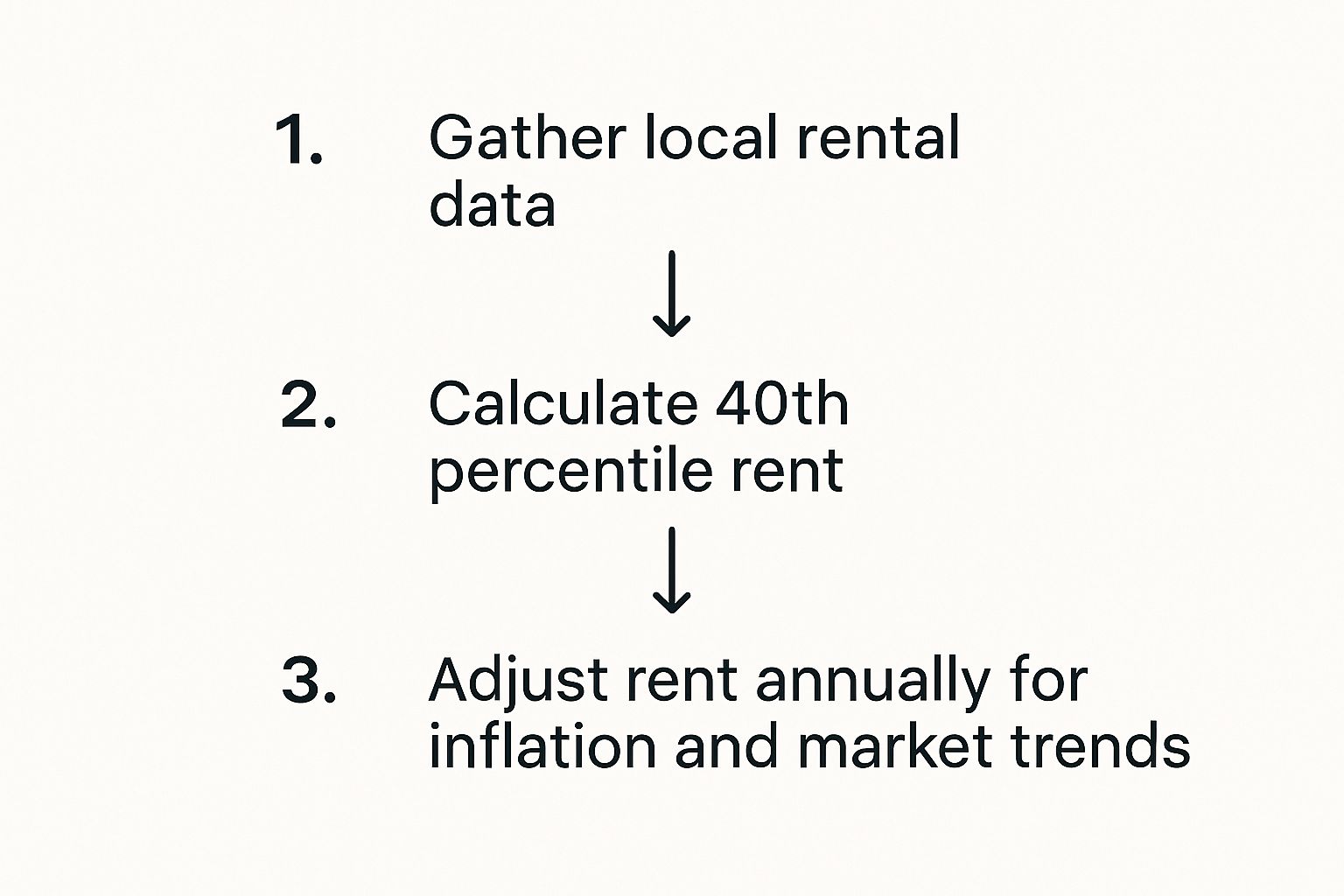
As you can see, the FMR isn't a static number. It’s designed to be a dynamic figure that adjusts to what’s happening in the market right now.
What This Means For Your Investment
If you own a high-end property, the FMR isn't a price you must follow, but it's a crucial piece of market intelligence. It gives you a clear baseline for affordability—what a significant portion of the local tenant pool can comfortably pay. For instance, knowing the FMR for South County towns like Soledad, Gonzales, or King City helps you understand the economic realities for a wide range of renters in the region.
At Coast & Valley, we take this government data and view it through a strategic, local lens. Here’s how we make it actionable for you:
- Benchmark Affordability: It helps us understand the financial capacity of the broader tenant market before we even list a property.
- Identify Market Gaps: By knowing the baseline, we can clearly identify where premium properties fit in and which discerning tenants they will appeal to.
- Inform Pricing Strategy: We start with the FMR as a foundation. From there, we layer on the unique value your property offers—the new kitchen, the prime location, the security of a gated community—to land on a competitive market rate that maximizes your profit and protects your asset.
Understanding this benchmark has financial benefits, too. A solid grasp of the rental landscape helps you make smarter decisions about property expenses and potential write-offs. For a deeper look at this, check out our guide on key tax deductions for landlords. It’s packed with insights to help you boost your financial efficiency and protect your bottom line.
Using FMR To Build Your Investment Strategy

Now, let's put this concept to work. For a savvy investor, understanding what is fair market rent isn't just about setting a price—it's about building a smarter, more resilient investment strategy. This number is your key to spotting market opportunities and guiding your decisions across Monterey County.
When you understand the FMR for Soledad versus, say, Monterey, you start to see the unique economic pulse of each community. It helps you anticipate what local tenants can realistically afford and pinpoint where your high-end property will command the best returns. This is the kind of local intelligence that is absolutely crucial for protecting your investment and projecting long-term profitability.
A Practical Framework For Your Rental Analysis
A professional rental analysis doesn't stop at the government's FMR number. It uses that figure as a starting point and then strategically layers on all the unique features that make your property special. Here is our step-by-step process to get your pricing right and maximize your ROI:
- Establish the FMR Baseline: First, we lock down the current FMR for your property's specific size and location, whether it's in Salinas, King City, or Gonzales. This gives us a solid, data-backed foundation.
- Conduct a Hyper-Local Comparative Market Analysis (CMA): Next, we analyze what similar premium properties are currently renting for in your immediate neighborhood. This is where local expertise shines.
-
Layer on Premium Value Drivers: Finally, we meticulously document and quantify every feature that sets your property apart. We're looking at things like:
- Recent high-end renovations in the kitchen or bathrooms.
- Zoning for a highly desirable school district like those in parts of Salinas or Carmel.
- Exclusive community perks or those coveted ocean views.
- Superior walkability in neighborhoods like Downtown Monterey or Pacific Grove.
This methodical approach is how we elevate your property from being just another rental to a premium offering. It provides the clear evidence needed to justify a higher price point by showing prospective tenants the superior value and lifestyle they're getting.
From FMR To Financial Performance
This detailed analysis has a direct impact on your bottom line. When you set the right rent, you directly influence your property's cash flow—the lifeblood of any real estate investment. A solid grasp of cash flow analysis is essential for knowing the true financial health of your rental, based on both the FMR and your final, optimized market price.
At Coast & Valley, we see FMR as one vital tool in a much larger toolkit. Our ultimate goal is to attract high-quality, long-term tenants who see the value in your property and are happy to pay for it. This process involves detailed reporting and transparent financial oversight so you can see exactly how our strategy is protecting your asset. To get a better idea of what this looks like in practice, explore our guide to mastering property management reporting and see how we track your success.
Pricing Your Premium Rental Beyond the Benchmark
If you own a high-end property, understanding what is fair market rent is just the starting point. The real art, and where true ROI is generated, is knowing how to price your asset well beyond that government baseline. After all, your custom-built home in Carmel Valley or your condo with sweeping ocean views in Monterey is not a "standard" rental, so why would you ever price it like one?
This is where a hands-on, local valuation process becomes critical for preserving your property's value. It's about moving past generic formulas to pinpoint the exact local factors that justify a premium rental price. We essentially build a compelling case for value that attracts top-tier tenants and maximizes your return.
Quantifying Your Property's Unique Value
A standard two-bedroom FMR figure for Monterey County just can’t capture the unique character of your property. Our approach is to conduct a much more granular analysis, treating your property like the one-of-a-kind asset it is. We meticulously identify and assign value to the features that command a higher price.
This means we look far beyond simple square footage and bedroom counts to assess things like:
- Luxury Finishes & Upgrades: Did you recently install a chef’s kitchen with high-end appliances, or renovate the bathrooms with spa-like features? These details absolutely matter to discerning tenants.
- Exclusive Community Amenities: Does your property include access to a private golf course in Pebble Beach, a community pool, or dedicated security services?
- Irreplaceable Location Factors: We quantify the value of oceanfront access, being in a top-rated Carmel school district, or having a prime spot in a desirable Salinas neighborhood.
- Architectural Significance & Design: A property with unique design elements or historical significance carries an intrinsic value that we make sure to highlight.
A generic FMR calculation sees a three-bedroom house. A professional analysis from Coast & Valley sees a three-bedroom house in a top Salinas school district with a recently remodeled kitchen, ocean views, and smart home technology—and prices it accordingly to maximize your income.
This detailed evaluation ensures you never leave money on the table. For a deeper dive into our approach, check out our complete guide on setting the right price for your rental property.
FMR vs. Actual Market Rent in Monterey County
To show you how these local factors directly impact your rental income, let's look at a quick comparison. The FMR provides the baseline, but the actual market rent is a story told by your property’s unique advantages and location.
| Factor | Impact on FMR Baseline | Example Location (Monterey County) |
|---|---|---|
| Ocean Views | Significant Premium | A condo in Pacific Grove or Monterey with even a partial ocean view will command a much higher rent than a similar-sized inland unit. |
| Top School District | Moderate to High Premium | A family home in a sought-after Carmel or Salinas school district is highly desirable and justifies a higher rental rate. |
| Recent Renovations | Moderate Premium | A newly updated kitchen in a South County town like Soledad or Gonzales makes a property stand out and supports a higher price. |
| Gated Community | Moderate Premium | The security and exclusivity offered by communities in areas like Pebble Beach or Pasadera add tangible value for discerning tenants. |
As you can see, a one-size-fits-all approach just doesn't work in our diverse market. As your trusted partner, our goal at Coast & Valley is to conduct a valuation that protects your asset, grows your income, and solidifies your property’s position as a premium offering in the competitive Monterey County market.
Staying Compliant with Local and State Regulations

Pricing your rental correctly is one challenge; navigating the complex web of local and state regulations is another. For savvy property owners in Monterey County, staying compliant isn't just a suggestion—it's a non-negotiable part of protecting your investment, minimizing risk, and maintaining your reputation as a professional landlord.
Fair Market Rent (FMR) plays a significant part in this legal landscape, especially concerning federal housing programs. Even though FMR is a federal benchmark, its application has real, local consequences for property owners from Salinas to King City.
FMR and the Section 8 Program
The most direct link between FMR and legal compliance is its role in the Housing Choice Voucher program, commonly known as Section 8. HUD uses FMR to establish the payment standard—the maximum subsidy the local housing authority will contribute for a rental unit.
Deciding to accept Section 8 vouchers is a major business decision. On one hand, it can mean guaranteed, on-time rent payments directly from the housing authority. On the other, it means your rental income for that unit is tethered to the local FMR. This is a crucial factor to weigh, especially for premium properties in places like Carmel or Monterey that could command a much higher price on the open market.
While FMR is the backbone of federal assistance programs, it also serves as a key yardstick for affordability. It helps set the rental standards that influence who qualifies for different housing initiatives, with the goal of providing reasonably priced options for low- and moderate-income families. You can dig deeper into how income limits and FMR work together on SocialExplorer.com.
Navigating California and Monterey County Rules
Beyond federal programs, California has some of the toughest landlord-tenant laws in the country. These rules dictate everything from security deposits and evictions to rent increase notices and required disclosures. A simple misstep can lead to expensive legal disputes and significant financial penalties.
For instance, even if a city doesn't have its own rent control ordinance, statewide legislation like the Tenant Protection Act (AB 1482) caps annual rent hikes and establishes "just cause" eviction rules for many properties. Staying current on these ever-changing regulations is a full-time job.
This is exactly where professional management proves its worth. At Coast & Valley, we manage the complexities of compliance so you don’t have to. Our team, led by Salinas native and local expert Amy Salmina, has a deep, hands-on understanding of the specific regulations impacting Monterey County. We ensure every lease is ironclad, every action is compliant, and your investment is fully protected. For a closer look, check out our guide on navigating landlord-tenant laws in California.
Partner with Local Experts for Optimal Rental Pricing
While understanding what is fair market rent provides a solid economic baseline, setting the perfect price in a market as diverse as the Monterey Bay Area requires more than a single data point. It demands a hands-on approach, deep local knowledge, and a strategy built specifically for your property. For owners who value their time and their investment, partnering with a dedicated local expert is the clearest path to maximizing ROI.
At Coast & Valley, we provide the full-service, high-end solutions that turn market data into tangible returns. We begin with an in-depth, custom property evaluation that goes far beyond generic FMR figures. We analyze every premium feature your property offers, from a beautifully remodeled kitchen in Salinas to stunning ocean views in Pacific Grove.
Your Full-Service, Time-Saving Solution
Our mission is to manage every detail, preserving your property’s value while freeing up your time. Here's how we deliver on that promise:
- Expert Market Analysis: We don't just find a price; we pinpoint the optimal rental price that attracts high-caliber tenants and minimizes vacancy.
- High-Quality Tenant Placement: Our rigorous screening process is designed to find reliable, long-term tenants who will treat your property with respect. Learn more in our guide on how to find good tenants.
- Comprehensive Operations: From rent collection and detailed financial reporting to coordinating preventative maintenance, we handle the day-to-day work with professionalism and transparency.
Our core promise is simple: we maximize your ROI, protect your asset, and deliver peace of mind. As a client of Coast & Valley, you can trust that your property is being managed with the same care and attention to detail we would give our own.
Ready to unlock your property's true market potential?
Frequently Asked Questions for Monterey County Investors
For property owners and investors in Monterey County, a few key questions always come up when we discuss fair market rent and what it really means for high-end properties. Here are clear, actionable answers to help you navigate the market.
Can I Charge More Than Fair Market Rent for My Property?
Yes, absolutely. For private market rentals, you should view FMR as a government-set benchmark, mainly used for federal housing programs and aimed at standard, moderately-priced homes. It is a baseline, not a price ceiling.
If you own a premium property in Carmel, a well-maintained home in a desirable Salinas neighborhood, or a custom home in Pasadera, you can and should charge a rate based on a comprehensive market analysis. A premium property will almost always command a rent that's significantly higher than the local FMR. At Coast & Valley, we specialize in conducting that deep-dive analysis to pinpoint the optimal market rate that maximizes your return on investment.
How Often Does Fair Market Rent Change?
Officially, the Department of Housing and Urban Development (HUD) updates FMR figures annually. These changes are published ahead of the new fiscal year to reflect new survey data and economic shifts.
However, the actual market rent in a dynamic area like the Monterey Peninsula can change much more frequently. Seasonal demand (especially for coastal rentals), the opening of a major employer in the Salinas Valley, or shifts in local housing inventory can all move the needle. Our team constantly monitors these hyper-local trends to ensure our clients' pricing remains competitive and profitable year-round.
Actionable Takeaway: While FMR is updated once a year, true market rent is always in motion. Proactive, professional management is the only way to ensure you aren't leaving money on the table.
Does Knowing FMR Mean I Have to Accept Section 8?
No, not at all. Understanding the FMR for our area does not obligate you to participate in the Section 8 Housing Choice Voucher program. FMR is simply the number HUD uses to set payment standards for that specific program.
While California law includes strict rules about source of income discrimination that all landlords must follow, the decision to operate exclusively within the private market or to accept vouchers is a separate business strategy. Knowing the FMR simply provides you with another valuable piece of market intelligence to inform your investment decisions, regardless of how you choose to operate your rental business.
Are you confident your rental is priced to unlock its full potential? Coast and Valley Properties delivers expert, data-driven rental evaluations that go far beyond the FMR baseline. We help you uncover your property's true market value to attract top-tier tenants and boost your return on investment.
Contact us for a personalized rental analysis today

A Property Owner's Guide to Property Management Fees in California
When investing in California's high-value real estate market, from the Monterey Bay Area to South County, a firm handle on property management fees is critical for protecting your ROI. As a general benchmark, you can expect to pay 7-10% of the monthly rent for full-service, ongoing management of your property. In addition, there is typically a tenant placement fee, which often lands between 50-100% of the first month's rent.
Of course, these numbers can shift depending on your property's location—whether a luxury home in Carmel or a multi-family unit in Salinas—and the specific concierge-level services your investment requires.
Understanding Property Management Fees in Monterey County

For busy professionals and serious investors with assets in Monterey County—from a luxury home in Pacific Grove to a portfolio of rentals in Salinas—understanding these costs is non-negotiable. The fee structure isn't just a number; it's a direct reflection of the service, asset protection, and peace of mind you are investing in.
In a state with notoriously complex landlord-tenant laws in California, that management fee is your direct investment in compliance and avoiding costly legal headaches.
A premier management partner does far more than collect rent. They are your local expert, protecting your asset's value through proactive maintenance, rigorous tenant screening, and sharp financial oversight. This is especially vital in a region as diverse as Monterey County, where the needs of a coastal property in Carmel are worlds away from a home near the agricultural heartland of Soledad or King City.
Actionable Guide: Typical California Property Management Fee Structure
To provide clear, actionable insight, we've outlined the common fees you'll encounter with property management firms across California. Use this as a checklist when evaluating potential partners.
| Fee Type | Common California Range | What It Covers & Actionable Tip for Investors |
|---|---|---|
| Monthly Management Fee | 7-10% of monthly rent | Actionable Tip: Ask if the fee is based on rent collected or rent due. A fee on collected rent aligns the manager's success with yours. |
| Tenant Placement Fee | 50-100% of first month's rent | Actionable Tip: Clarify if this fee includes professional marketing photography and syndicated listings to attract high-quality tenants faster. |
| Lease Renewal Fee | Varies (often a flat fee) | Actionable Tip: A great tenant is an asset. Ask if this fee can be reduced or waived for exemplary long-term tenants to encourage retention. |
| Maintenance Markup | 10-20% of the invoice | Actionable Tip: Request a list of their vetted, local vendors. A transparent partner should not prevent you from using your own trusted contractors. |
| Vacancy Fee | Sometimes a flat monthly fee | Actionable Tip: This fee should cover proactive services like weekly security checks and managing utilities, not just a "set it and forget it" charge. |
| Eviction Fee | Flat fee or hourly rate | Actionable Tip: Ask for a breakdown of what this covers (e.g., serving notices, court filing, representation). This fee highlights the value of their tenant screening process. |
Remember, these figures are a baseline. The objective for a serious investor is to find a partner whose fees directly translate into a higher-performing, better-protected asset for the long term.
Decoding the Numbers: Cost vs. Value
The fees you see are almost always tied directly to the level of service and the complexity of your local market. Higher costs often signify a more comprehensive, concierge-level service designed to save you time and, more importantly, prevent expensive mistakes. It helps to think of it not as a cost, but as an investment in a strategic partner dedicated to maximizing your returns.
Key Investor Insight: The true value of a property manager isn't found in the lowest percentage. It's in their proven ability to boost revenue, minimize vacancy, and shield you from liability. A transparent, all-inclusive fee from a firm like Coast & Valley often delivers a far better long-term ROI than a low base rate loaded with hidden charges.
A premier management company will always provide a detailed proposal that clearly explains how their fees translate into tangible benefits, like reducing your legal exposure. This guide will give you the foundational knowledge you need to confidently assess any management proposal and choose a partner who truly aligns with your financial goals.
The Monthly Management Fee: What Are You Actually Paying For?

The monthly management fee is the operational engine of your property management agreement. For any discerning investor in Monterey County, understanding what this fee truly buys you is the key to identifying a manager's real worth.
This core fee typically comes in two models: a percentage of collected rent or a flat-rate fee. Each is suited to different types of properties, from a luxury estate in Carmel to a multi-family building in Soledad.
The Percentage-Based Fee Model
The most common structure is the percentage-based fee, where the management company takes a percentage of the rent they successfully collect each month. In California, this typically falls between 7% and 10%.
This model is popular for one simple reason: it directly aligns the manager’s success with your own. They only get paid when you get paid. If your property in Salinas or Gonzales sits vacant, they aren't collecting a management fee, which gives them a powerful incentive to place high-quality tenants—fast.
Real-World Example: Imagine a high-end property in Pebble Beach renting for $10,000 a month. A 9% management fee ($900) should deliver a comprehensive suite of services:
- Secure Rent Collection: Utilizing modern online portals for secure and timely rent collection.
- Concierge-Level Tenant Relations: Acting as the professional point of contact for every tenant inquiry, request, and concern.
- Proactive Maintenance Coordination: Fielding all maintenance calls and dispatching vetted local vendors, ensuring quality work that preserves your asset.
- Compliance & Risk Management: Ensuring every action taken is in strict compliance with California's ever-changing landlord-tenant laws, protecting you from liability.
A higher percentage fee often translates directly into a higher caliber of service. It funds proactive asset preservation, more rigorous tenant screening, and a level of attentiveness that protects the long-term value of your high-end property.
The Flat-Rate Fee Model
Alternatively, some management companies offer a flat-rate monthly fee. This model provides absolute budget predictability. This can be especially appealing for owners of properties with very high rental incomes, where a percentage fee could become substantial.
For instance, a flat fee of $450 per month might seem more cost-effective for that luxury Carmel home than a 9% fee. The key, however, is to ensure the scope of services isn't diminished.
Actionable Step: When evaluating a flat-fee proposal, request a detailed "Scope of Work" document. Compare it line-by-line against a percentage-based offer to ensure you are still receiving the same full-service commitment to proactive care and tenant management.
The debate isn't which model is universally better, but which one is better for your specific asset and investment goals. The right partnership ensures your fee, whether percentage-based or flat, delivers exceptional value and peace of mind. Remember, these fees are typically an operating expense. You can learn more in our guide on key tax deductions for landlords.
Uncovering Ancillary Costs and Hidden Fees
A low monthly management percentage can look attractive on paper, but for a sophisticated investor, it’s often a red flag. The true cost of property management isn't in the headline number; it's buried in the fine print. An appealing 7% fee can quickly lose its luster when weighed down by a dozen "a la carte" charges that erode your cash flow.
For owners of high-end properties in Monterey County, from Salinas to Pacific Grove, scrutinizing these extra costs is non-negotiable. At Coast & Valley, we champion a transparent, all-inclusive approach, but it’s critical you know what to look for when comparing firms.
This image breaks down some of the most common fee percentages you'll run into in the California market.
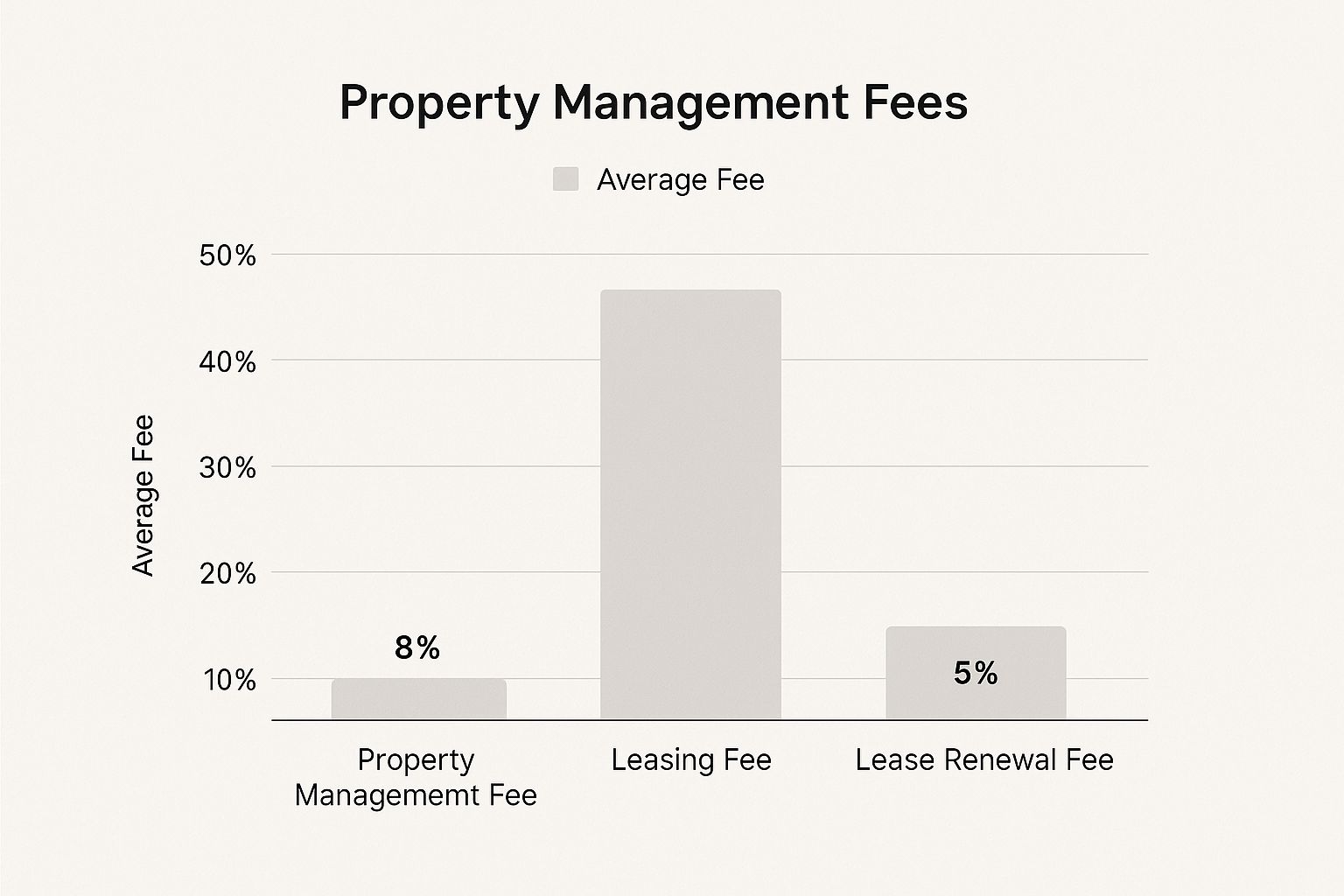
As you can see, the expenses go far beyond a simple monthly percentage. In many models, tenant placement and lease renewals are major, separate costs.
A Deeper Dive Into Common Ancillary Fees
Before signing any management agreement, you must ask pointed questions about these potential charges. Think of the base management fee as the vehicle's sticker price; ancillary fees are the dealership add-ons, taxes, and registration that determine what you actually pay.
Actionable Checklist: Common Ancillary Fees for Monterey County Landlords
| Fee Type | Typical California Cost | Actionable Question for Your Potential Manager |
|---|---|---|
| Tenant Placement Fee | 50% - 100% of the first month's rent. | "For a high-end rental in Carmel, this is a significant one-time cost. Does this fee also apply if a tenant breaks their lease early and you must find a replacement?" |
| Lease Renewal Fee | $200 - $500 flat fee. | "Keeping a great tenant saves me money on turnover. Is this fee negotiable for long-term, problem-free tenants in my Soledad property?" |
| Maintenance Coordination Fee | 10% - 20% markup on vendor invoices. | "This can create a conflict of interest. What is your policy if I want to use my own trusted local contractor for a repair?" |
| Routine Inspection Fee | $100 - $200 per inspection. | "For my coastal property in Pacific Grove, regular inspections are vital. How many inspections are included in the base fee versus charged separately? Are move-in/move-out inspections extra?" |
Getting straight answers on these items is the only way to ensure your partnership is built on trust and transparency from day one.
The Importance of Transparent Technology
A modern, professional property manager should use technology to create efficiency and transparency, not to obscure costs. The right systems provide a clear, real-time view of your investment's performance. You can learn more about how technology empowers owners in our guide to key property management technology trends. When vetting a partner, ensure their fee structure is simple, predictable, and fully aligned with your long-term financial goals.
How Monterey County Market Dynamics Affect Your Fees

While there are standard ranges for property management fees in California, what you actually pay is shaped by the unique realities of your local market. For an investor in Monterey County, understanding how our regional dynamics impact service needs—and therefore fees—is essential. A generic, one-size-fits-all approach from a national firm simply cannot account for the distinct variables across our communities.
Managing a luxury vacation rental in Carmel-by-the-Sea is a world away from overseeing a family home in Salinas or a multi-unit building in King City. The level of hands-on service, marketing strategy, and maintenance required are fundamentally different, and a professional management fee will reflect that complexity.
This is where true local expertise, like that of Coast & Valley founder Amy Salmina, whose family has fourth-generation roots in Salinas, becomes an investor's greatest asset.
Comparing High-End Coastal and Inland Properties
The Monterey Peninsula is a world-renowned destination, creating specific management challenges and opportunities.
- Coastal Properties (Pebble Beach, Pacific Grove): These assets demand proactive, preventative maintenance. The salt air corrodes metal fixtures, damages window seals, and ages exteriors. A premier manager must schedule regular, specialized inspections to mitigate these issues. This higher level of service commands a corresponding fee but is crucial for preserving your property's long-term value.
- Inland Properties (Salinas, Soledad, Gonzales): In agricultural hubs, the focus shifts to securing stable, long-term tenants from the local workforce. While maintenance may be more standard, the tenant screening process must be exceptionally rigorous to ensure consistent cash flow and asset reliability.
Investor Insight: A savvy investor knows the fee structure must align with the property's specific needs. Paying a premium for a manager who understands the hyper-local challenges of your asset—whether it’s coastal salt air or the Salinas rental market—is an investment in a better ROI, not just an expense.
Seasonal Tourism and Vacancy Rates
Monterey County's economy is heavily driven by seasonal tourism, from the AT&T Pebble Beach Pro-Am to Monterey Car Week. These events create peaks and valleys in the rental market that require expert navigation.
A skilled local manager leverages this seasonality to your advantage, knowing precisely when to pivot marketing from short-term executive rentals to long-term leases. This dynamic strategy minimizes vacancy and maximizes income, a high-value service that generic firms often overlook.
The Influence of Local Regulations and Tenant Pools
California’s rental laws are complex, but many cities in Monterey County have their own ordinances. This is where a locally-based leader provides an indispensable advantage, ensuring compliance and navigating community-specific expectations.
This regional specificity is a statewide phenomenon. For instance, market dynamics in other high-end California markets demonstrate how intense local competition and new regulations create unique fee environments. Ultimately, choosing a management partner isn't about finding the lowest number. It’s about securing a team with the on-the-ground expertise to navigate the specific challenges of your property's location, preserving its value and maximizing its return.
Calculating the ROI of Professional Property Management
As a sophisticated investor, you understand that the lowest fee rarely represents the best value. The critical conversation isn't about cost, but about Return on Investment (ROI), especially when evaluating property management fees in California. A top-tier, full-service management partner isn't an expense; they are a profit-generating asset working to maximize your returns.
Viewing management fees through the lens of ROI changes the entire equation. A slightly higher, all-inclusive fee from a firm like Coast & Valley often delivers a far greater financial return than a cut-rate service that charges for every task. While it's helpful to understand the general principles of ROI calculation, a property manager's value is measured in tangible financial outcomes.
From Cost to Tangible Financial Benefits: An Actionable Breakdown
A professional manager demonstrates their worth in key areas that directly and positively impact your profitability.
- Reduced Vacancy (Increased Revenue): An expert who knows the Salinas and Monterey markets can lease your property faster.
- Actionable Impact: If your $4,000/month rental is leased 30 days faster, that's $4,000 in revenue that directly offsets the annual management cost.
- Higher-Quality Tenant Placement (Reduced Risk): Rigorous screening is your best defense against late rent, property damage, and costly evictions.
- Actionable Impact: Avoiding a single eviction can save you $5,000 to $10,000+ in legal fees and lost rent, making the placement fee a high-ROI investment.
- Asset Preservation Through Proactive Maintenance (Cost Avoidance): Preventive care is always cheaper than emergency repairs.
- Actionable Impact: A $300 proactive plumbing repair that prevents a $15,000 flood and mold remediation bill delivers an immense ROI. This is critical for coastal homes in Pacific Grove constantly battling the elements.
The Financial Shield of Legal Compliance
Perhaps the most significant ROI comes from legal protection. California’s landlord-tenant laws are a minefield. A single misstep—like mishandling a security deposit or serving an improper notice—can lead to thousands in legal fees, penalties, and lost rent. A professional manager is your shield against this liability.
A Real-World Monterey County Example
An out-of-state owner of a single-family home in Salinas was self-managing to "save money" on fees. After a non-compliant eviction attempt, he faced a potential lawsuit that could have easily cost over $20,000. By engaging Coast & Valley, he not only resolved the issue correctly but also benefited from our proactive maintenance. We caught a failing water heater and replaced it for under $2,000, preventing a catastrophic flood. The management fee became a small price to pay to avoid massive losses. This is the tangible ROI we detail in our comprehensive property management financial reports.
Your Guide to Choosing a Management Partner in Monterey County
Selecting a property management partner is one of the most critical decisions for your investment. You are entrusting a high-value asset to their care. To choose the right firm in Monterey County, you must look beyond a simple comparison of property management fees in California. The goal is finding a partner whose value proposition—transparency, local expertise, and commitment to your ROI—aligns with your goals.
Your Actionable Evaluation Checklist
Use this step-by-step guide to vet potential management companies and make an informed decision.
- Compare Fee Structures Apples-to-Apples: Don't focus on the monthly percentage. Request a complete fee schedule. Action Step: Ask them to model the total annual cost for your specific property, including potential tenant placement and renewal fees. A transparent partner will welcome this request.
- Scrutinize the Service Agreement: This contract is your road map. Action Step: Pay close attention to the termination clause, service guarantees, and the exact scope of services, especially for high-end homes in Carmel or coastal properties in Pacific Grove that require specialized care.
- Verify Local Reputation and Expertise: Look beyond their website. Action Step: Dig into online reviews, ask for testimonials from current clients with properties similar to yours, and verify their local involvement. A firm with deep roots, like our founder Amy Salmina's fourth-generation connection to Salinas, signals a long-term commitment to the community.
Key Investor Takeaway: True value is found in trust and performance, not the lowest price. A transparent, locally-rooted partner who treats your property as their own is the ultimate protection for your investment and your peace of mind.
To prepare for these crucial conversations, use our detailed list of questions to ask potential property management companies to ensure you cover all critical bases.
Ready to see how a professional partner can enhance your ROI? If you own property in Salinas, Monterey, or the surrounding South County communities, we invite you to take the next step.
Your Questions, Answered
When evaluating property management fees in California, especially in a high-value market like Monterey County, many questions arise. Here are clear, straightforward answers to the most common inquiries we receive from investors.
Can I Negotiate Property Management Fees in California?
Yes, negotiation is often possible, particularly if you own a portfolio of properties or a single high-end asset in a location like Pebble Beach. However, the most effective negotiation focuses on total value, not just the percentage point.
Actionable Tip: Instead of only asking to lower the management percentage, propose negotiating ancillary costs. A quality firm might be more flexible on a lease renewal charge or agree to waive a one-time setup fee for a long-term partnership. Frame the conversation around the all-in cost and the services included to protect your asset.
Is a Flat Fee or Percentage Fee Better for My Monterey County Property?
The optimal choice depends entirely on your specific property and investment goals.
- Percentage Fee: For a luxury home in a premium area like Carmel or Pacific Grove, a percentage-based fee powerfully aligns your manager's success with yours. They are incentivized to secure the highest possible market rent.
- Flat Fee: For more standardized long-term rentals, perhaps in communities like Salinas or Gonzales, a competitive flat fee can offer excellent budget predictability.
Actionable Step: Request proposals for both models if available. Analyze them against your property’s rent, your financial goals, and the level of service you expect. The best choice is the one that offers transparent, comprehensive service for your unique asset.
The Biggest Mistake to Avoid with Fee Structures
The most common and costly mistake an investor can make is choosing a property manager based solely on the lowest monthly percentage. This approach almost always backfires, leading to a barrage of hidden fees for leasing, maintenance, and inspections that cost far more in the long run. A transparent, slightly higher fee from a trusted local expert consistently delivers a superior ROI through quality tenants, proactive upkeep, and true asset protection.
Ready to partner with a team that offers concierge-level service backed by unmatched local expertise? Coast and Valley Properties provides transparent, value-driven management solutions designed to protect your investment and maximize your returns.

A Property Investor's Guide to Landlord Tenant Laws in California
Navigating California's landlord-tenant laws can feel like a labyrinth, especially for owners of high-value properties. If you own a premium rental anywhere from Salinas to Carmel, mastering these regulations isn't just about legal compliance—it's a fundamental strategy for protecting your asset, maximizing your ROI, and securing your peace of mind.
For busy professionals and serious investors, a misstep isn't an option. One mistake can jeopardize years of hard work. This guide provides clear, actionable insights to help you manage your Monterey County property with the precision and professionalism it deserves.
Making Sense of California's Complex Rental Landscape

Trying to untangle the web of landlord tenant laws in California can feel like a full-time job. This is especially true now, with recent legislative changes piling on new responsibilities for property owners. For those of you with premium properties in Monterey County—whether it's a luxury home in Pebble Beach, a family residence in Salinas, or a multi-unit complex in a South County town like King City—getting these rules right is completely non-negotiable.
Think of these regulations as the foundation for your entire rental business. You wouldn’t build a high-end home on a shaky foundation, and you can't build a successful rental portfolio without a solid understanding of your legal duties. A single misstep, like mishandling a security deposit or issuing an improper eviction notice, can trigger serious financial penalties and damage your reputation as a trustworthy owner.
Key Pillars of California Rental Law
California law dictates every stage of the landlord-tenant lifecycle. For busy professionals and serious investors in the Salinas and Monterey Bay area, mastering these key areas is the first and most important step toward managing risk and protecting your asset:
- Lease Agreements: This document is your most important legal shield. A generic, one-size-fits-all template just won't cut it for a high-value asset. Your lease needs to be customized for your specific Monterey County property, crystal clear, and compliant with state and local laws.
- Security Deposits: The state has very strict rules on how much you can collect, how you must store the funds, and the exact process you must follow for deductions. A huge update to know is that as of July 1, 2024, Assembly Bill 12 (AB 12) now caps most security deposits at just one month’s rent.
- Tenant Protection Act (AB 1482): This landmark law introduced statewide rent caps and "just cause" eviction requirements. It’s absolutely critical to determine if your property is subject to this law or if it qualifies for an exemption, a distinction that directly impacts your ROI.
- Eviction Procedures: The eviction process is unforgiving. It demands perfect, meticulous adherence to all notice requirements and legal steps. One small mistake can force you to start the entire process over again, wasting precious time and money.
Being proactive with legal compliance is the single most effective way to protect your asset. As our founder, Amy Salmina, always emphasizes, when you treat legal diligence as a core part of your management strategy, you stop reacting to problems and start proactively controlling your investment and preventing risks before they arise.
To help you navigate all this, we've put together a quick-reference table summarizing the main legal areas you'll encounter as a Monterey County property owner.
Key Areas of California Landlord-Tenant Law at a Glance
| Legal Area | Core Principle for Investors & Owners | Relevance in Monterey County |
|---|---|---|
| Lease Agreements | Must be detailed, compliant with state law, and customized to protect your specific property and its unique features. | Essential for all properties, from luxury Carmel homes to Salinas family residences, to protect your investment and define responsibilities. |
| Security Deposits | Collection and deductions are strictly regulated. As of July 1, 2024, deposits are capped at one month's rent for most properties. | This new law (AB 12) applies to all Monterey County landlords and requires immediate updates to your leasing policies and trust accounting procedures. |
| Rent Control & Evictions (AB 1482) | Statewide rent increase limits and "just cause" eviction rules apply unless a property is specifically exempt (e.g., newer homes). | Determining your property's exemption status is crucial for setting rents and managing tenant turnover in markets like Salinas or Pacific Grove. |
| Habitability (Implied Warranty) | You are required to provide and maintain a safe, livable environment with essential utilities. | Regular, documented maintenance is key to compliance and preventing costly tenant disputes, protecting the value of high-end homes. |
| Fair Housing | You must not discriminate against tenants based on protected characteristics like race, religion, family status, or source of income. | Crucial for ethical and legal tenant screening and management across diverse communities like Salinas, Seaside, and Monterey. |
This table is a great starting point, but this guide is designed to give you real clarity and actionable insights, not just dense legal jargon. We'll break down what these laws actually mean for you as a property owner right here in the Monterey Bay Area.
Beyond just the rules, understanding how to build a positive and professional landlord-tenant relationship is a huge part of long-term success. Here at Coast & Valley, our deep local expertise, led by Salinas native Amy Salmina, helps turn these legal complexities into a smooth, profitable ownership experience. We handle all the details so you can focus on what matters most: your investment goals.
Crafting Your Ironclad California Lease Agreement
When you own a high-end rental property, your lease is the single most important document you have. It’s what stands between your investment and a world of potential liabilities. For premium homes in places like Pebble Beach or Pacific Grove, a generic template from the internet is a recipe for disaster. A truly ironclad lease is a custom-built legal shield, designed to protect your asset and ensure complete clarity from day one.
Think of it as the foundational blueprint for your relationship with a tenant. A solid, well-written lease agreement clearly lays out all expectations, preempts confusion, and addresses potential issues before they can escalate into expensive disputes. This is especially true when your property has unique or luxury features that require specific care.
Moving Beyond Basic Clauses
For property owners here in Monterey County, a standard lease often misses the critical details that are unique to premium homes. Your agreement needs to be meticulously detailed to cover every single aspect of the tenancy.
Consider adding specific clauses or even entire addendums that address things like:
- High-End Amenities: Be crystal clear about the rules for using and maintaining features like pools, hot tubs, outdoor kitchens, or sophisticated home security systems. Spell out exactly who is responsible for routine servicing and what constitutes tenant misuse.
- Landscaping and Groundskeeping: If your Carmel or Salinas property has significant outdoor space, the lease must explicitly state who handles garden care, how the irrigation system should be used, and any restrictions on planting or making changes to the grounds.
- Unauthorized Alterations: A simple "no alterations" clause isn't enough. Get specific. Prohibit painting, installing new fixtures, or tampering with smart home hardware without your explicit written permission. This is vital for protecting your property's curated aesthetic and high-end finishes.
A customized lease agreement is your first line of defense. By clearly articulating tenant duties and property rules, you create an environment of mutual respect and significantly reduce the likelihood of future conflicts. This proactive approach is fundamental to safeguarding your investment.
Legally Required Disclosures in California
Under landlord tenant laws in California, a compliant lease isn’t just about the rules you set; it's also about the information you are legally required to provide. Failing to include these disclosures can lead to legal penalties and undermine your authority as the owner. Taking the time to get this right demonstrates professionalism and builds trust from the start.
Your lease package absolutely must include several state-mandated disclosures:
- Lead-Based Paint: For any property constructed before 1978, you are required to give tenants an EPA-approved pamphlet and disclose any known lead paint hazards.
- Megan's Law Database: Your lease must inform tenants that they can access the state’s database of registered sex offenders.
- Pest Control: If you have a pest control service on a regular schedule, you must give tenants a copy of the notice provided to you by that company.
- Demolition Permits: If you've applied for a permit to tear down the rental unit, you must disclose this before you accept any money from a prospective tenant.
These are just a few of the big ones, and the full list can change, so staying on top of it is critical. To ensure their agreements are precise and legally sound, many savvy investors use specialized tools. For example, platforms with legal document automation software can be a huge help in ensuring all the right clauses and disclosures are included.
A strong lease agreement is only one piece of the puzzle. It works hand-in-hand with a thorough tenant screening process. After all, even the world's best lease is only as effective as the person who signs it. Knowing how to find and select good tenants is the other half of the equation for protecting your valuable Monterey County property.
Managing Security Deposits Without Legal Headaches

Security deposits are a frequent source of friction between landlords and tenants. But with a precise, professional approach, they don’t have to be a headache. For owners of high-end properties in the Monterey Bay Area, handling these funds correctly is non-negotiable—it protects your investment and keeps the landlord-tenant relationship on solid ground.
California's regulations on this are notoriously strict, leaving absolutely no room for error.
The biggest recent shift comes from Assembly Bill 12 (AB 12), which went into effect on July 1, 2024. This new law caps almost all security deposits at just one month’s rent, a dramatic change from the two or three months' rent landlords could previously collect. There’s a narrow exception for "small landlords" who own no more than two properties, but it's a complicated area you'll want to navigate with professional guidance.
The Right Way To Handle Deposit Deductions
When a tenancy ends, the clock starts ticking. You have exactly 21 calendar days to return the tenant's security deposit. If you make any deductions, you must provide an itemized statement that clearly explains every charge.
This is where many landlords get into hot water. Vague justifications like "general cleaning" or "painting" won't cut it and are often challenged in court. To sidestep costly disputes, your deductions must be specific and backed by solid proof.
Under California law, you can legally deduct for:
- The cost to repair damages that go beyond normal wear and tear.
- Cleaning expenses needed to bring the unit back to the same state of cleanliness it was in at move-in.
- Any unpaid rent the tenant still owes.
The secret to avoiding deposit disputes is meticulous documentation. Think of the move-in and move-out inspections as the two most critical moments in the entire tenancy. This proactive mindset transforms a potential point of conflict into a straightforward financial reconciliation.
A Real-World Example of Proactive Documentation
Let's say you own a luxury property in Carmel. At the start of the lease, you conduct a detailed move-in inspection with the tenant. You walk through the home together, filling out a comprehensive checklist. Critically, you take extensive photos and videos of every room, capturing the pristine condition of the high-end appliances, gleaming hardwood floors, and custom fixtures. You both sign the report.
Fast forward a year, and the tenant is moving out. During the move-out inspection, you notice a deep scratch across the stainless steel refrigerator door that definitely wasn't there before. You also spot a large wine stain on the living room carpet. These are not "normal wear and tear."
Because you have crystal-clear "before" photos and a signed checklist, you can confidently make deductions. You get invoices from a professional appliance repair company and a carpet cleaning specialist. Within the 21-day window, you send the tenant their remaining deposit balance along with the itemized statement and copies of those receipts. This transparent, evidence-based process protects you from legal blowback and cements your reputation as a professional.
This process also underscores the clear line between a landlord's duties and a tenant's responsibilities, a distinction vital for any successful tenancy. To dive deeper into this, you can check out our guide on landlord responsibilities vs. tenant duties.
At Coast & Valley, we manage this entire process for you, from state-of-the-art move-in reports to legally compliant fund handling. Our goal is to take the stress and risk out of security deposits so your investment stays secure.
Cracking the Code on the Tenant Protection Act and Rent Control
California's Tenant Protection Act of 2019, better known as AB 1482, completely changed the rulebook for property owners. If you own high-end properties anywhere in Monterey County, from Salinas to Carmel, getting this law right isn't just a good idea—it's a core part of managing your risk. A simple misunderstanding can lead to hefty fines and legal battles that chip away at your investment's bottom line.
The law is built on two major pillars: statewide rent caps and "just cause" eviction rules. But before we even get into those, the first and most critical question every owner needs to ask is: does this law even apply to my property?
Is Your Monterey County Property Exempt?
Many owners of premium single-family homes or newer buildings are often surprised to find their properties might be exempt from AB 1482. This is a massive distinction, as it directly affects how you can set rents and handle the end of a tenancy.
Generally speaking, your property could be exempt from both the rent cap and just cause rules if it fits one of these descriptions:
- Newer Construction: Any housing that received its certificate of occupancy within the last 15 years is typically exempt.
- Single-Family Homes and Condos: Most single-family homes and condos are exempt, but there's a big "if." This only applies if they are not owned by a real estate investment trust (REIT), a corporation, or an LLC where at least one member is a corporation.
- Owner-Occupied Duplexes: If you own a duplex and live in one of the units, that property is also exempt.
Heads up: for that single-family home exemption to stick, you must include a very specific, written notice in your lease agreement. This clause tells the tenant that the property isn't subject to the rent and eviction controls of AB 1482. If you forget to add this exact language, you could accidentally lose your exemption.
The Two Pillars of AB 1482 for Covered Properties
If your property isn't exempt, then you must play by the law's strict rules. This means you need to be an expert in both calculating rent increases and knowing the legally approved reasons for ending a tenancy.
1. Statewide Rent Caps
For properties covered by the act, you can't just raise the rent to whatever you want. The maximum increase is 5% plus the local inflation rate (as measured by the Consumer Price Index, or CPI), or 10% total in a 12-month period—whichever amount is lower.
So, for a Salinas rental at $3,500 a month, you'd need to find the current CPI for Monterey County and do the math precisely. It's a small detail that demands total accuracy.
2. "Just Cause" Eviction Rules
This is probably the biggest shift the law introduced. You now need a legally valid reason—a "just cause"—to ask a tenant who has lived in the property for 12 months or more to leave. These reasons fall into two camps:
- At-Fault Just Cause: This is when the tenant has done something wrong. Think failing to pay rent, breaking a major part of the lease, or conducting illegal activities on the premises.
- No-Fault Just Cause: This is when the tenant is following all the rules, but you need the property back. Valid reasons include the owner or their immediate family planning to move in, undertaking a substantial remodel, or taking the property off the rental market completely. For these "no-fault" situations, you're usually required to pay for the tenant's relocation assistance, which is typically equal to one month's rent.
The Tenant Protection Act of 2019 represents a significant shift in landlord-tenant regulation, substantially limiting landlords' ability to evict tenants without "just cause," especially in properties over 15 years old. This law requires landlords to provide one of several enumerated legal reasons to remove a tenant. Further tilting the legal balance, a 2023 expansion now allows tenants to sue landlords for up to three times the damages plus attorneys' fees in eviction disputes. You can learn more about how this has impacted California landlords in this City Journal report.
Getting these regulations right takes precision and a forward-thinking approach. At Coast & Valley, we bring the expert oversight needed to make sure every move you make, from a simple rent increase to ending a tenancy, is done in full compliance. We're here to protect your investment and give you peace of mind.
Navigating The California Eviction Process Correctly
Eviction is a legal process that demands absolute precision, a fact that’s especially true under the complex umbrella of landlord tenant laws California. For owners of high-value properties in Monterey County, a single procedural mistake isn’t just a minor hiccup—it can send you straight back to square one, costing you a small fortune in lost rent and legal fees.
Think of it as a high-stakes surgical procedure; every step must be performed flawlessly. This unforgiving nature is why so many experienced investors rely on professional oversight. From serving the right notice to navigating the court system, each move is dictated by strict legal protocols. A misstep, like improper notice delivery or a hint of retaliation, can completely derail your case.
The Critical First Step: The Legal Notice
Before you can even think about filing an eviction lawsuit (known as an unlawful detainer action), you must serve the tenant with a proper written notice. The type of notice you use depends entirely on the reason for the eviction. Using the wrong one is a fatal flaw that will get your case tossed out of court before it even begins.
Here are the most common notices used in California:
- 3-Day Notice to Pay Rent or Quit: This is your go-to when a tenant has failed to pay rent. It gives them a clear, three-day window to either pay the full amount owed or move out.
- 3-Day Notice to Cure or Quit: This notice addresses lease violations that can be fixed, such as having an unauthorized pet or letting the property fall into disrepair. The tenant has three days to correct the issue (or "cure" the violation) or vacate the premises.
- 3-Day Unconditional Quit Notice: This one is reserved for serious lease violations that can't be fixed. This includes things like causing major damage to your Salinas property, engaging in illegal activity, or subletting the unit without permission.
This infographic simplifies the core stages that follow a properly served notice.
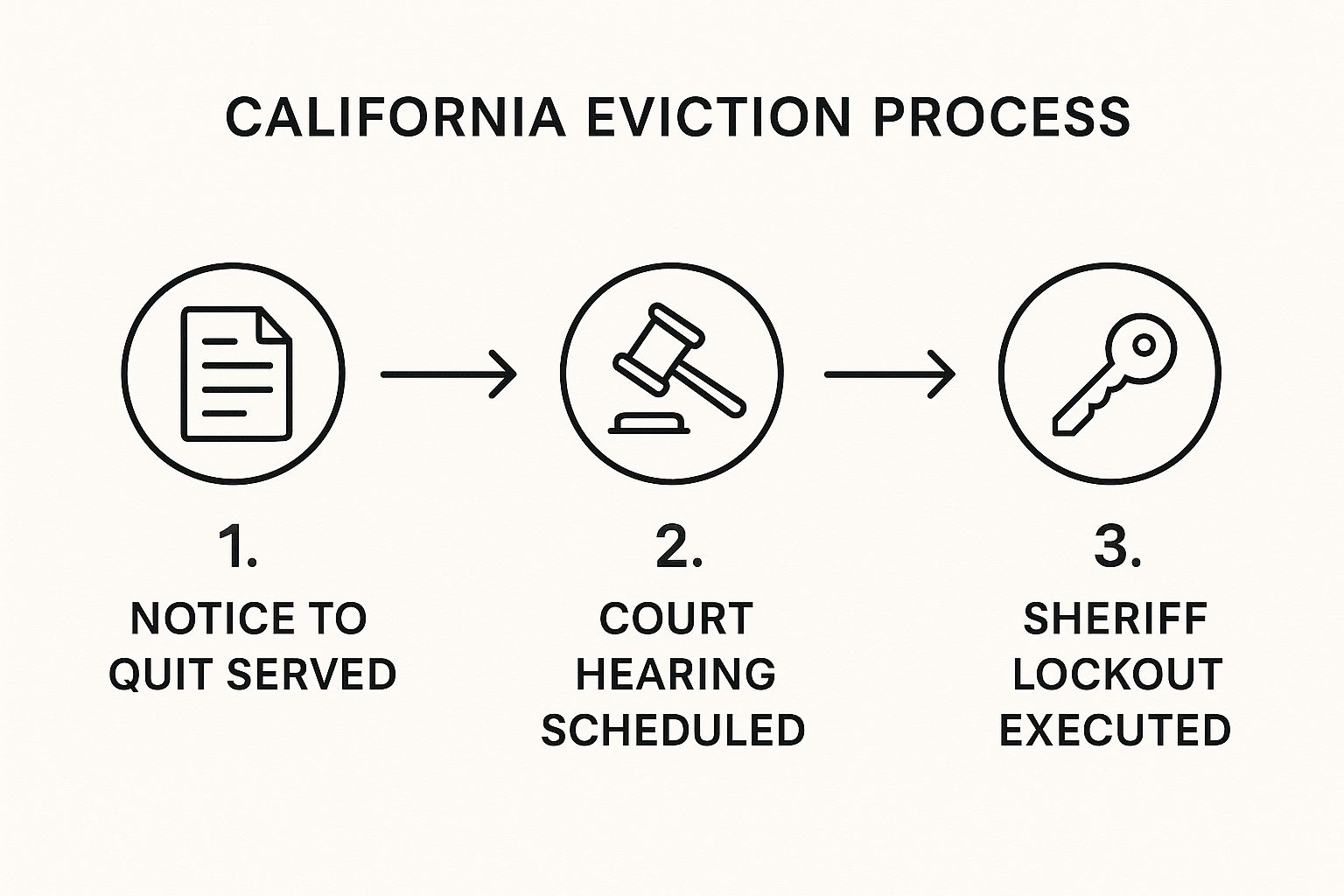
As the visual shows, eviction is a linear, multi-step legal procedure—not a simple request for a tenant to leave. Each stage, from the initial notice to the final lockout, must be executed perfectly to move on to the next.
Navigating No-Fault Evictions And The Ellis Act
For investors weighing their long-term strategy, understanding "no-fault" evictions is crucial. This is particularly relevant under the Ellis Act, a state law that gives landlords the right to exit the rental business entirely. For example, an investor with properties in a South County town like Gonzales or Soledad might decide to remove them from the rental market for redevelopment.
However, the Ellis Act comes with its own set of stringent rules and notice periods. You can’t just decide to do it on a whim. Successfully using this Act requires careful legal navigation to avoid compliance headaches and potential lawsuits.
Eviction is a remedy of last resort, and the legal system is designed to protect tenants from improper procedures. Meticulous documentation and unwavering adherence to legal timelines are not just best practices—they are the only way to successfully regain possession of your property.
Common Pitfalls That Derail Evictions
Even with the right notice in hand, many owners stumble during the process. Some of the most common errors we see include:
- Improper Service: Simply taping a notice to the door isn't always enough. California law has very specific rules for how notices must be delivered to be considered legally served.
- Accepting Partial Rent: If you accept any amount of rent after a notice period expires, you may have just voided the entire eviction notice. You'll likely have to start all over again.
- Retaliation Claims: A tenant can fight an eviction by claiming it's in retaliation for them requesting repairs or reporting a code violation. Proving otherwise requires solid documentation on your part.
The eviction process is riddled with complexities, and getting it right is essential for protecting your investment. For a more detailed breakdown, check out our guide on how to evict a tenant in California, which provides additional context for property owners. At Coast & Valley, we manage this entire process with professional precision, ensuring full compliance and protecting you from the costly risks of a botched eviction.
Protect Your Investment with Proactive Management

Knowing the ins and outs of landlord tenant laws in California is a great start, but it’s only half the battle. For serious investors with properties in Salinas, Carmel, or anywhere in between, real protection comes from putting that knowledge to work through diligent, proactive management. This is where you turn legal theory into a powerful tool for maximizing your return on investment.
Think of compliance not as a chore, but as your strategic advantage. When you handle every detail—from drafting the lease to returning the security deposit—with professional precision, you’re building a fortress around your investment. This approach does more than just sidestep legal headaches; it preserves your property's condition and, most importantly, frees up your valuable time.
The Tangible Benefits of Expert Oversight
For busy professionals and discerning investors, the value of professional management goes far beyond just collecting rent. It's about creating a seamless and profitable ownership experience, even from a distance. The right local partner transforms a tangle of legal complexities into smooth, efficient operations.
This is especially true in a unique market like Monterey County. Our deep-seated local expertise means we don't just know the state statutes; we understand the specific challenges and opportunities that come with managing luxury properties from the Salinas Valley to the coast.
Proactive management is the art of preventing problems before they start. It is the most effective strategy for preserving property value, ensuring steady returns, and achieving peace of mind in California's demanding rental market.
A Partnership Focused on Your Goals
Ultimately, our goal is to align with yours: to protect and grow your real estate portfolio. We get there by concentrating on four key pillars that directly impact your bottom line:
- Mitigating Legal Risks: We ensure every action is fully compliant with ever-changing state and local laws, shielding you from expensive disputes and penalties.
- Securing High-Quality Tenants: Our rigorous screening process is designed to find responsible tenants who will treat your high-end property with the respect it deserves.
- Preserving Property Condition: Through consistent inspections and preventive maintenance, we safeguard the long-term value and appeal of your investment.
- Maximizing Your Time and ROI: We handle the day-to-day operations so you can focus on your broader investment strategy, confident that your property is in expert hands.
For owners of premium properties in Salinas, Pacific Grove, or South County, this level of service isn't a luxury—it's a necessity. It’s the difference between merely owning a property and running a successful, stress-free investment.
If you’re ready to stop reacting to regulations and start proactively managing your valuable asset, Coast & Valley is here to help. Our team, led by Salinas native Amy Salmina, brings the local leadership and high-end solutions you need to navigate California’s rental landscape with confidence.
Protect your investment and unlock its full potential. Contact Coast & Valley today for a complimentary property evaluation and discover the peace of mind that comes with professional management.
Common Questions About California Rental Laws
When you're a landlord in California, especially in places like Salinas and Monterey County, certain questions pop up again and again. Let's walk through some of the most common issues we help property owners navigate.
If My Property Is Exempt From AB 1482, Can I Still Evict?
Yes, you can, but you still have to follow proper procedure. An exemption from the Tenant Protection Act (AB 1482) means you're not held to the statewide rent caps or "just cause" eviction standards.
However, that doesn't give you a free pass. You are still bound by every other state and local regulation. This means serving proper legal notice is a must, as is upholding the tenant's right to a safe and livable home. For a deeper look, check out our property owner’s guide to the warranty of habitability in California.
How Much Can I Raise The Rent In Monterey County?
For any property that falls under AB 1482, the annual rent increase is capped. The formula is 5% plus the local Consumer Price Index (CPI), but it can never exceed a total of 10% in a year. It's absolutely critical to check the current CPI figures for our area, as they are constantly changing.
If your property is exempt from AB 1482, this specific cap doesn't apply. However, any rent increase you implement still requires you to give the tenant proper, formal written notice (typically 30 or 60 days, depending on the amount of the increase).
What Are The Biggest Mistakes To Avoid During An Eviction?
Stepping on a legal landmine during an eviction is easier than you'd think. The most costly errors we see property owners make are:
- "Self-help" evictions: This is when a landlord takes matters into their own hands by illegally changing the locks, shutting off the power or water, or moving a tenant's belongings out. Don't do it.
- Improper notice: Using the wrong legal form or failing to deliver it in the legally required manner can derail the whole process.
- Retaliation: Trying to evict a tenant simply because they asked for a necessary repair is illegal and will backfire.
Making any of these mistakes can get your eviction case thrown out of court. You'll have to start the entire process over from scratch and could even find yourself facing lawsuits and penalties.
Do I Have To Pay My Tenant To Move Out?
Sometimes, yes. This is a common requirement for "no-fault" evictions under AB 1482. A no-fault cause is when the tenant has done nothing wrong, but you need the property back—for instance, if you or a family member plan to move in, or if you're planning a major renovation.
In these specific cases, you are generally required to provide the tenant with relocation assistance. This payment is typically equal to one month’s rent, which is a significant cost you need to budget for ahead of time.
Staying on the right side of these complex laws takes more than just a quick read-through; it requires local expertise and diligent oversight. Coast and Valley Properties delivers the strategic management needed to keep your investment protected and your returns on track.
Explore our full-service property management solutions today.

12 Best Property Condition Report Template Options for 2025
For high-end property owners and investors in Salinas and the greater Monterey Bay Area, a meticulously detailed Property Condition Report (PCR) is not just paperwork; it's a critical asset protection tool. This document forms the bedrock of a transparent landlord-tenant relationship, mitigates disputes over security deposits, and preserves the long-term value of your portfolio, whether it's a luxury home in Pebble Beach or a multifamily unit in Soledad. A generic, one-size-fits-all template simply won't suffice for the unique demands of our local market, from coastal humidity considerations in Pacific Grove to the specific needs of agricultural-adjacent properties in South County.
This guide moves beyond basic checklists to provide a curated list of the 12 best property condition report template resources. We'll analyze each for its practical application, customization potential, and suitability for the discerning owner who demands precision, efficiency, and peace of mind. As you evaluate these tools, remember that the template itself is part of a larger strategy. Adhering to strong documentation best practices ensures that your records are not only complete but also legally defensible and operationally effective. For busy professionals, this is your next step toward standardizing excellence in your property management process.
1. Coast & Valley Properties: Expert Rental Property Inspection Checklist
For investors and homeowners with premium properties in Salinas and Monterey County, this resource from Coast & Valley Properties is an exceptional starting point. Far more than a generic document, it’s a specialized property condition report template crafted with deep local expertise by firm owner Amy Salmina and her team. It directly addresses regional challenges like coastal humidity's effect on fixtures and specific building considerations in towns from Carmel to King City, making it a powerful tool for preserving the value of high-end residential properties. This checklist embodies a professional, proactive approach to property oversight.
This resource is designed for discerning owners who demand meticulous care, reflecting the firm's concierge-level service model. Its framework is ideal for conducting thorough move-in, move-out, and periodic inspections that go beyond surface-level checks. By integrating this checklist into your management routine, you can preemptively identify issues before they escalate into costly repairs—a crucial strategy for maximizing ROI in competitive markets like Monterey and Salinas.
Key Features & Use Cases
- Hyper-Local Focus: The template is engineered for the unique environmental conditions of the Monterey Bay area, including prompts to check for salt air corrosion on fixtures in Carmel and moisture ingress common in Pacific Grove homes.
- System-by-System Framework: It offers a detailed, room-by-room and system-by-system guide. This structure ensures nothing is missed, from HVAC filter status to appliance functionality and window seal integrity.
- Digital Integration: This checklist is part of a larger ecosystem. Coast & Valley provides an advanced online portal for owners to access inspection reports, photos, and maintenance updates, which is perfect for busy professionals and remote investors needing 24/7 transparency. For more on this, see how it complements their approach to proactive care in their guide to rental property maintenance in Monterey County.
Analysis
| Feature | Assessment |
|---|---|
| Usability | The checklist is clearly structured, making it easy for an owner or manager to follow systematically. Its real value is unlocked when paired with professional management expertise to interpret findings. |
| Applicability | Best suited for single-family homes, luxury rentals, and multi-unit portfolios where property preservation is a top priority. It may be overly detailed for lower-budget or basic rental units. |
| Access | The checklist is available for free as a downloadable resource on their website, serving as an entry point to their comprehensive property management services. |
Pros:
- Specifically tailored to Salinas and Monterey County’s unique environmental factors.
- Actionable framework helps prevent costly repairs and maintain high property value.
- Ideal for remote investors and busy landlords requiring thorough oversight.
Cons:
- Focused on mid- to high-end properties and may be excessive for basic rentals.
- Requires some property management experience for maximum effectiveness.
Website: https://coastandvalleypm.com/rental-property-inspection-checklist/
2. Jotform
Jotform distinguishes itself by offering a highly intuitive, drag-and-drop form builder that transforms a standard property condition report template into a fully customized, interactive document. This platform is ideal for Monterey County landlords and property managers who need more than a static PDF. You can easily add fields for photo uploads, e-signatures, and specific notes for different rooms, making on-site inspections in Salinas or Carmel seamless.
The platform's strength lies in its automation and integration capabilities. Once a tenant completes a report, the data can automatically sync with Google Sheets for tracking or be stored in Dropbox. This saves significant administrative time, a crucial benefit for busy investors managing multiple properties. While the free plan is robust, a paid subscription is necessary to unlock unlimited submissions and remove Jotform branding, which is a key consideration for maintaining a professional, high-end image. For those managing luxury portfolios, understanding tenant history is as vital as property condition; you can learn more about perfecting your tenant evaluation process with a detailed tenant screening checklist.
- Best For: Tech-savvy landlords and property management firms seeking customizable, mobile-friendly digital forms with powerful integration options.
- Key Feature: The drag-and-drop editor allows for unparalleled customization without needing any code.
- Pricing: A free plan is available with limitations; paid plans offer more features and higher submission limits.
- Website: Jotform Property Condition Report Template
3. ClickUp
ClickUp elevates the concept of a property condition report template by integrating it into a comprehensive project management ecosystem. Instead of a simple checklist, ClickUp transforms the inspection process into a dynamic task board. This is a game-changer for Monterey County investors managing renovations or overseeing multiple maintenance projects alongside routine inspections. You can create a task for each room, attach photos and documents, assign it to a team member, and track its status from "to be inspected" to "completed."
The platform’s real power is its customizability, allowing you to build a workflow that mirrors your exact operational needs, from Salinas to Soledad. However, this robust functionality comes with a learning curve that might overwhelm users seeking a simple plug-and-play solution. For property owners who value deep operational control and data visibility, the initial time investment pays off. Integrating such a powerful tool into your workflow is a key decision; you can explore how it stacks up against other platforms in a detailed property management software comparison.
- Best For: Portfolio managers and property management companies who need to track inspections alongside maintenance tasks and team collaboration.
- Key Feature: The ability to convert report items into actionable tasks with custom statuses, assignments, and deadlines.
- Pricing: A "Free Forever" plan is available; paid tiers unlock advanced features like unlimited storage and custom automations.
- Website: ClickUp Property Condition Report Template
4. Typeform
Typeform redefines the user experience by turning a standard property condition report template into a sleek, conversational interaction. This platform excels at engaging tenants through its one-question-at-a-time format, making the inspection process feel less like a chore and more like a guided conversation. For Monterey County landlords managing high-end or seasonal homes, this elevated, modern approach can significantly enhance the tenant relationship from day one, reflecting a professional and detail-oriented management style.

The platform’s strength is its seamless integration with over 300 tools, allowing data to flow directly into systems like Slack for instant team notifications or HubSpot for client record updates. This is particularly valuable for absentee landlords or busy investors who rely on streamlined digital workflows to stay informed. While the free plan is a great starting point, the most powerful features, such as advanced logic jumps and unlimited questions, are reserved for paid tiers. This makes it an investment best suited for those prioritizing a premium, branded user experience over basic data collection.
- Best For: Property managers and luxury property owners who want to provide a highly engaging, modern, and branded reporting experience for tenants.
- Key Feature: The conversational, one-question-at-a-time interface makes filling out detailed reports less intimidating and more user-friendly.
- Pricing: A limited free plan is offered; paid plans unlock advanced features, integrations, and remove Typeform branding.
- Website: Typeform Property Condition Report Form Template
5. Woorise
Woorise offers a straightforward approach to creating a property condition report template, focusing on simplicity and efficiency for property check-ins. Its platform is designed for landlords in areas like Soledad or Gonzales who need a reliable, no-fuss digital solution for documenting property conditions. The drag-and-drop builder allows for quick customization, letting you add specific fields for appliances, flooring, or exterior features without any technical expertise.

The platform's key advantage is its ease of use and multiple sharing options. You can send a unique URL directly to a tenant or embed the form on your website, streamlining the move-in process. Data can be integrated directly with Google Sheets, providing a simple yet effective way to track reports for multiple properties. While it may lack some of the advanced integrations of larger platforms, its secure and accessible system is a perfect example of the efficient solutions discussed in our overview of our property management technology. This makes it a great entry-level tool for investors managing smaller portfolios.
- Best For: Landlords and small-scale investors who need a simple, easy-to-use digital form for basic property assessments.
- Key Feature: Multiple sharing options, including unique URLs and website embeds, make distribution effortless.
- Pricing: Free templates are available; paid plans are required to unlock more advanced features and remove branding.
- Website: Woorise Property Condition Report Form
6. doForms
doForms is engineered for property managers and owners in regions like Monterey County who require robust, offline capabilities for their inspections. Its platform excels in creating a detailed property condition report template that functions seamlessly even in areas with poor connectivity, a common issue when inspecting rural properties in South County towns like Soledad or King City. This feature allows for uninterrupted data collection, photo uploads, and note-taking directly from a mobile device, syncing automatically once a connection is re-established.
The platform’s strength lies in its backend integration, which reduces administrative burdens by connecting inspection data to other business systems for streamlined workflows. This is particularly valuable for investors managing diverse portfolios who need to consolidate information efficiently. While the initial setup may require some time to customize the forms to your specific standards, the long-term benefit of secure, accessible digital records is significant. The available free trial allows you to test its features before committing to a subscription, which is necessary for full access.
- Best For: Property managers overseeing a large number of properties, especially in areas with unreliable internet, who need offline functionality and system integration.
- Key Feature: Offline data collection ensures that inspections can be completed anywhere, anytime, without risk of data loss.
- Pricing: A free trial is offered, but a paid subscription is required for ongoing use and full feature access.
- Website: doForms Property Condition Reports
7. forms.app
forms.app offers an accessible and straightforward solution for creating a digital property condition report template. Its clean, user-friendly interface and drag-and-drop builder make it easy for landlords in communities like Soledad or Gonzales to quickly assemble a comprehensive form without technical expertise. The platform excels at creating simple, effective forms that can be shared via a direct link, embedded in a website, or sent through email, ensuring tenants can complete them on any device.
The platform’s value lies in its simplicity and efficiency. For property investors managing a handful of homes in the Monterey Bay Area, forms.app provides the essential tools for documentation, including fields for notes and photo uploads, with secure data storage. While it offers a generous free plan, those needing advanced features or a higher volume of submissions will need to upgrade. Its integrations are more limited than some competitors, making it a better fit for those who don't require complex automation workflows but still want to move beyond paper reports.
- Best For: Landlords and small-scale investors seeking a simple, no-fuss digital form builder to professionalize their inspection process.
- Key Feature: An intuitive drag-and-drop interface combined with multiple sharing options for maximum accessibility.
- Pricing: A free plan with generous features is available; paid plans unlock advanced capabilities and remove branding.
- Website: forms.app Property Condition Report Form Template
8. ContractMaker.ai
ContractMaker.ai provides a highly professional and structured property condition report template designed for landlords who prioritize thoroughness and industry standards. This platform is particularly useful for Monterey County property owners who need a document that covers every detail, from structural conditions to specific maintenance requirements, ensuring nothing is overlooked during inspections in Soledad or Monterey. The template is built around standard evaluation criteria, making it a reliable tool for creating legally sound and comprehensive reports.
The platform's key advantage is its blend of professional formatting with user-friendly customization. You can modify the template to fit your specific property needs and use its digital signature support to streamline the approval process with tenants. This is a significant time-saver for absentee landlords managing Salinas properties from afar. While the free template is robust, an ongoing subscription may be needed to access more advanced features or create other types of contracts, which is a consideration for investors managing diverse portfolios.
- Best For: Landlords and investors who need a formal, legally-grounded template that follows established industry best practices.
- Key Feature: The template’s comprehensive sections for structural conditions, maintenance needs, and professional recommendations.
- Pricing: A free template is available; a subscription may be required for access to advanced features or other contract types.
- Website: ContractMaker.ai Property Condition Report
9. Visme
Visme approaches the property condition report template from a design-first perspective, making it the ideal choice for luxury property owners and high-end managers in Monterey County who prioritize brand consistency and visual appeal. While many platforms focus solely on data entry, Visme empowers you to create reports that look like professionally designed marketing materials. This is particularly useful for presenting a polished, premium image to discerning tenants and owners, whether your property is in Pebble Beach or along the Salinas corridor.
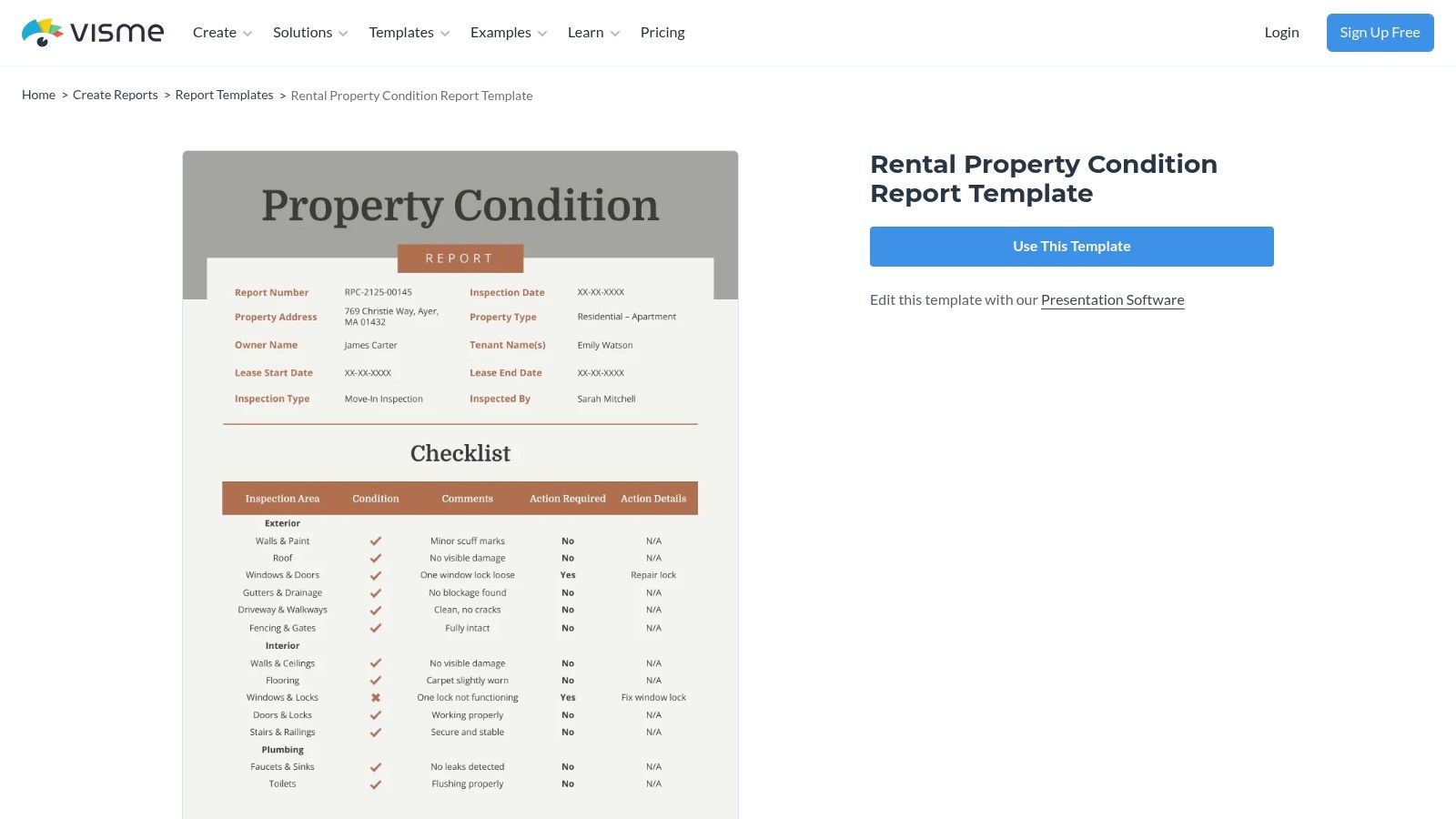
The platform excels at embedding high-resolution images, custom charts, and your company's branding directly into the document. This visual-centric approach helps document property conditions with undeniable clarity. A potential downside for those needing a quick, simple form is the slight learning curve associated with its advanced design tools. While free templates are available, a paid subscription is needed to access premium assets and remove Visme branding, a necessary step for maintaining the concierge-level presentation expected by high-net-worth investors.
- Best For: Property managers and owners who want to create visually stunning, branded reports that reflect a high-end service level.
- Key Feature: Extensive design customization tools, allowing for the inclusion of high-quality images, charts, and brand elements.
- Pricing: Free templates are available; a paid subscription is required for advanced features and branding removal.
- Website: Visme Rental Property Condition Report
10. Jotform Tables
While Jotform's form builder is well-known, Jotform Tables offers a powerful backend for managing the data collected from your property condition report template. It transforms submitted information into a dynamic, spreadsheet-like database called a Schedule of Condition Report. This is particularly useful for Monterey County investors who need to track the condition of multiple properties over time, from a single-family home in Salinas to a multi-unit complex in Gonzales. You can view data as a grid, calendar, or gallery, making it easy to spot trends or review historical records.
The true benefit lies in its integration with Jotform's forms. A property manager can conduct an inspection in Carmel using a mobile form, and the data, including photos and notes, instantly populates the corresponding table. This creates a centralized, secure hub for all property condition records, accessible 24/7. Collaboration tools allow team members to comment or update entries, ensuring everyone is aligned. While it offers robust functionality for free, a paid plan is required to handle a high volume of submissions, a necessary investment for growing property portfolios.
- Best For: Landlords and property management teams who need a centralized system to track and analyze condition report data over time.
- Key Feature: Multiple view options (spreadsheet, calendar, cards) allow for flexible data analysis and visualization.
- Pricing: A free version is available; paid plans unlock higher record limits and advanced features.
- Website: Jotform Tables Schedule of Condition Report
11. TemplateLab
TemplateLab offers a straightforward, no-frills approach for landlords and property managers who need a basic property condition report template without the complexity of digital platforms. It stands out by providing a curated library of completely free, downloadable templates in both Word and PDF formats. This is an excellent resource for new landlords in Monterey County or those managing a small number of properties who prefer a simple, printable document they can customize themselves. The process is hassle-free with no registration required, allowing for immediate access.
The main advantage of TemplateLab is its simplicity and cost-effectiveness. You can download a template, add your property details in Salinas or Soledad, print it, and be ready for a walkthrough in minutes. However, the platform lacks the advanced features of a dedicated software solution, such as digital signatures, photo embedding, or cloud storage. While effective for basic record-keeping, it relies on manual processes. Adopting such templates is a fundamental step, and understanding broader strategies is key; you can explore expert advice on these essential property management best practices to further enhance your operations.
- Best For: Landlords and investors who prefer a simple, printable, and completely free template for manual inspections.
- Key Feature: A diverse collection of free, easily customizable templates in Word and PDF formats with no required sign-up.
- Pricing: Completely free.
- Website: TemplateLab Property Condition Report Templates
12. LawDepot
LawDepot stands out by offering a legally-informed property condition report template that guides users through a structured, step-by-step creation process. This platform is particularly beneficial for Monterey County property owners who prioritize legal compliance and clarity in their documentation. Instead of a generic form, LawDepot’s wizard asks specific questions about the property and inspection type, tailoring the final document to meet precise legal standards, a crucial advantage for protecting investments in high-value areas like Pebble Beach or Carmel.
The platform’s core strength is its integration within a larger library of legal documents, ensuring consistency across all landlord-tenant paperwork. While you can generate a report, the real value comes from its holistic approach to property law. The main drawback is that full access to download, print, or store your customized documents requires a subscription after the initial free trial. This makes it less of a one-off tool and more of a comprehensive legal resource for serious investors managing valuable portfolios who need ongoing access to legally vetted forms.
- Best For: Landlords and investors who prioritize legally sound documentation and want a guided, step-by-step report creation process.
- Key Feature: The question-and-answer wizard that customizes the report based on specific property details and legal requirements.
- Pricing: A free trial is available; ongoing access requires a subscription for its full library of legal documents.
- Website: LawDepot Property Inspection Report
Feature Comparison of 12 Property Condition Report Templates
| Product | Core Features / Highlights | User Experience / Quality ★ | Value Proposition 💰 | Target Audience 👥 | Unique Selling Points ✨ |
|---|---|---|---|---|---|
| Your Expert Rental Property Inspection Checklist | Tailored to Salinas & Monterey Bay; detailed room/system checks | ★★★★★ Pro-level, digital integration | 💰 Premium service, included in Coast & Valley PM | 👥 High-net-worth owners, remote investors | ✨ Local expertise, white-glove service, online portals |
| Jotform | Customizable forms, drag/drop, e-signatures | ★★★★☆ Intuitive, mobile-friendly | 💰 Free plan available; paid upgrades | 👥 Property managers, landlords | ✨ Extensive integrations, easy customization |
| ClickUp | Custom statuses, fields, collaboration tools | ★★★★☆ Powerful but complex | 💰 Free plan, enterprise pricing | 👥 Teams managing multiple properties | ✨ Project management + inspections combined |
| Typeform | Interactive forms, branding, data analytics | ★★★★★ Engaging UX, mobile responsive | 💰 Free tier limited; premium pricey | 👥 Agents wanting detailed tenant interactions | ✨ Over 300 integrations, engaging workflows |
| Woorise | Drag/drop builder, Google Sheets integration | ★★★☆☆ Simple, easy to use | 💰 Free templates; paid plans for advanced | 👥 Small landlords, users needing simple tools | ✨ Multiple share options, embedded forms |
| doForms | Digital forms, offline data, secure storage | ★★★★☆ Reliable, mobile-friendly | 💰 Trial available; subscription needed | 👥 Inspectors needing offline capability | ✨ Offline collection, versatile integrations |
| forms.app | Drag/drop builder, multiple sharing, secure storage | ★★★☆☆ User-friendly, customizable | 💰 Free templates; paid features | 👥 Landlords, small managers | ✨ Easy sharing, secure storage |
| ContractMaker.ai | Detailed, professional template, digital signatures | ★★★★☆ Comprehensive reports | 💰 Free template; subscription for advanced | 👥 Professional property managers | ✨ Industry-standard criteria, legal-grade templates |
| Visme | Visually rich reports, charts, branding options | ★★★★☆ Attractive layouts; learning curve | 💰 Free templates; subscription for features | 👥 Investors, agents needing visuals | ✨ Custom charts & images |
| Jotform Tables | Checklists, multiple views, collaboration | ★★★★☆ Simple data management | 💰 Free templates; paid plans for advanced | 👥 Teams tracking property conditions | ✨ Spreadsheet + calendar views |
| TemplateLab | Downloadable Word/PDF templates | ★★★☆☆ Basic, easy access | 💰 Completely free | 👥 DIY landlords, quick report creators | ✨ No registration, printable templates |
| LawDepot | Step-by-step report builder, legal doc library | ★★★★☆ Easy, legally compliant | 💰 Free trial; subscription needed | 👥 Legal-focused users, agents | ✨ Legal documents integration |
Elevate Your Property Management with Professional Oversight
Navigating the landscape of digital tools and templates is a crucial first step in modernizing your property management practices. As we've explored, solutions ranging from versatile form builders like Jotform and Typeform to more specialized legal resources like LawDepot offer powerful ways to standardize your inspection process. Each property condition report template we've detailed provides a unique set of features, whether it's the robust data management of ClickUp or the visual appeal of a Visme-designed report.
The central takeaway is clear: a generic, one-size-fits-all checklist is no longer sufficient for protecting high-value assets in a competitive market like Monterey County. Your choice of template must directly align with your investment goals, portfolio size, and desired level of hands-on involvement. A tech-savvy investor with multiple units might gravitate toward a comprehensive system like Jotform Tables, while a landlord managing a single luxury home in Carmel might prefer the simplicity and professional polish of a well-designed PDF from TemplateLab.
From Template to Strategy: Your Actionable Next Steps
Choosing the right tool is only half the battle. The true value emerges from a well-executed implementation strategy that prioritizes consistency, detail, and legal defensibility. To truly protect your ROI, consider the following actionable steps:
- Customize for Local Specifics: Your chosen template must be adapted to address hyper-local concerns. This includes checking for the impact of coastal fog on properties in Pacific Grove, noting seasonal pest considerations in the Salinas Valley, or documenting specific wear patterns common to homes in historic Monterey. A generic template won't capture these nuances.
- Establish a Baseline: Before a new tenant moves in, conduct a meticulous inspection using your new, customized report. This document, signed by both parties, becomes the undisputed baseline against which all future inspections are measured, protecting you from disputes over pre-existing damage.
- Integrate Media: Leverage the power of digital templates by embedding high-resolution photos and videos. Timestamped visual evidence is your most powerful tool in documenting property condition and settling security deposit claims fairly and efficiently. It transforms a subjective report into an objective record.
- Train and Standardize: If anyone else assists with your property management, ensure they are trained on the exact same reporting process. Consistency across every inspection, for every property, is what creates a professional, defensible system that safeguards your investment and streamlines operations.
Ultimately, a property condition report template is a foundational component, not the entire structure. For discerning owners of luxury, single-family, and multi-unit properties along the Monterey Bay Coast, the real asset is professional oversight. It’s the expert eye that knows what to look for, the local knowledge that anticipates seasonal maintenance needs, and the dedicated management that saves you time while maximizing your return. A template provides the framework, but expertise delivers the results.
Ready to move beyond DIY templates and implement a professional, full-service property preservation strategy? At Coast and Valley Properties, we combine cutting-edge technology with deep local expertise to manage high-end properties throughout Salinas and Monterey County. Contact Coast and Valley Properties today to learn how our meticulous, concierge-level approach can protect your investment and provide you with true peace of mind.

Master Property Management Reporting for Maximizing Your Monterey County Investment
For any serious investor in Monterey County, from Salinas to Pebble Beach, you know that basic spreadsheets just don't cut it anymore. Professional property management reporting isn't just about getting numbers; it's a powerful tool for maximizing your ROI and protecting the value of your asset. It gives you a clear, real-time picture of your investment's health, shifting you from putting out fires to making smart, proactive decisions based on solid data.
Beyond Spreadsheets: The Power Of Professional Reporting

If you're a busy professional or a serious investor with properties in the Monterey Bay Area, your time is your most valuable asset. The days of trying to make sense of messy spreadsheets or chasing down a property manager for a simple update are over. Today, modern reporting is the bedrock of trust and performance, giving you both clarity and peace of mind.
This approach turns raw data into a story about your property. It’s not just about knowing if you turned a profit last month, but understanding why. It can spotlight trends in maintenance costs, pinpoint opportunities to adjust rent based on the local Salinas Valley market, and deliver all the documentation you need for a stress-free tax season.
From Simple Numbers to Strategic Insights
Think of professional reporting as the dashboard of your real estate investment. A pilot wouldn't fly without accurate instruments, and you shouldn't steer your property toward greater profits without clear, concise data. This is becoming even more critical as the property management industry gets more sophisticated. The U.S. market alone is expected to jump from $81.52 billion in 2025 to a massive $98.88 billion by 2029, a boom driven by investors who demand more professional, data-backed services.
At Coast & Valley, we believe that transparency is non-negotiable. Our reporting is designed by our founder, Amy Salmina, to empower you with the insights needed to make confident, informed decisions that protect and grow your wealth.
Making the switch from manual data entry to automated systems is a game-changer. To really unlock the power of professional reporting, especially on the financial side, looking into financial reporting automation can dramatically boost accuracy and save incredible amounts of time.
For our clients in communities like Pacific Grove or Gonzales, this means they get:
- Clarity on Cash Flow: Instantly see where every dollar comes from and where it goes, no guesswork involved.
- Proactive Maintenance Planning: Spot recurring issues before they blow up into expensive emergencies, protecting the long-term value of your home.
- Performance Benchmarking: Understand exactly how your property is doing compared to its own history and what's happening in the local market.
At the end of the day, top-notch property management reporting gives you more than just numbers—it gives you confidence and saves you time. It’s the proof that your investment is being handled with the highest level of professionalism and care, a core principle we bring to every client we serve.
Deconstructing Your Owner Statement

Your owner statement is easily the most critical piece of property management reporting you'll receive. Think of it as the financial pulse of your investment—a detailed account that cuts through the jargon to show you exactly how your property performed over the last month.
For our clients with properties from Salinas to Monterey, we ensure this report is a straightforward story. It starts with all the income, not just the rent but also any extra revenue like late fees. Then, it walks through the expenses—all the costs of maintaining and managing your property. The story ends with the bottom line: your net proceeds.
Key Components of a Comprehensive Statement
A truly useful owner statement gives you more than just the totals. It breaks down every single transaction, so you never have to wonder where your money went. This is all about building trust through total transparency.
For instance, a statement for a luxury home in Pacific Grove should itemize expenses with precision:
- Gross Potential Rent vs. Actual Rent Collected: This simple comparison shows what your property could have earned versus what it did earn, instantly flagging any vacancies or payment issues.
- Itemized Operating Expenses: This covers everything from routine landscaping in Carmel Valley to a specific plumbing repair in Soledad. We often include links to the actual scanned invoices for complete clarity.
- Management Fees: Calculated and displayed clearly, showing exactly what you paid for our professional services.
- Owner Distributions: The final net income that gets deposited directly into your account.
The single most important metric on your owner statement is the Net Operating Income (NOI). This figure—your total income minus all operating expenses—is the true measure of your property's profitability before you account for your mortgage and taxes.
From Data to Decisions
Once you get comfortable with these components, you can start spotting trends and asking smarter questions. Is a utility bill looking a little high this month? Are maintenance costs slowly creeping up? This level of detail turns your statement from a simple summary into a powerful tool for making strategic decisions.
Here’s a quick, actionable checklist for reviewing your statement:
- Check for Vacancy Loss: Compare potential rent to actual rent collected. A gap means lost income.
- Scan for Expense Anomalies: Look for unusually high costs in any one category, like maintenance or utilities.
- Confirm Your Distribution: Verify the net income matches what was deposited into your bank account.
By tracking these figures, you can get a much better handle on performance and plan for the long term. To really dig into the numbers that matter most, you can explore our guide to mastering your Monterey County property's financial reports, which is a great companion to your monthly statements.
Ultimately, a well-crafted owner statement is the foundation of a solid partnership between an owner and their management team. It provides the clarity you need to protect and grow your investment right here in Monterey County.
The Four Essential Reports For Maximizing ROI
While your owner statement gives you a crucial monthly snapshot, a full suite of property management reports is what truly tells the complete story of your investment. For any serious investor with assets in Salinas, Gonzales, or anywhere else in Monterey County, understanding this full narrative is simply non-negotiable for preserving your property's value.
Think of it like getting a complete physical for your property. Each report tests a different vital sign, and together, they create a comprehensive picture of its health and performance. Beyond the basic owner statement, four specific documents provide the strategic depth you need to really maximize your returns. These reports work together to flag risks, pinpoint opportunities, and confirm your asset is being managed with precision.
The image below shows how a great property manager synthesizes all these different data points—from occupancy rates to tenant satisfaction—into one clear performance overview.
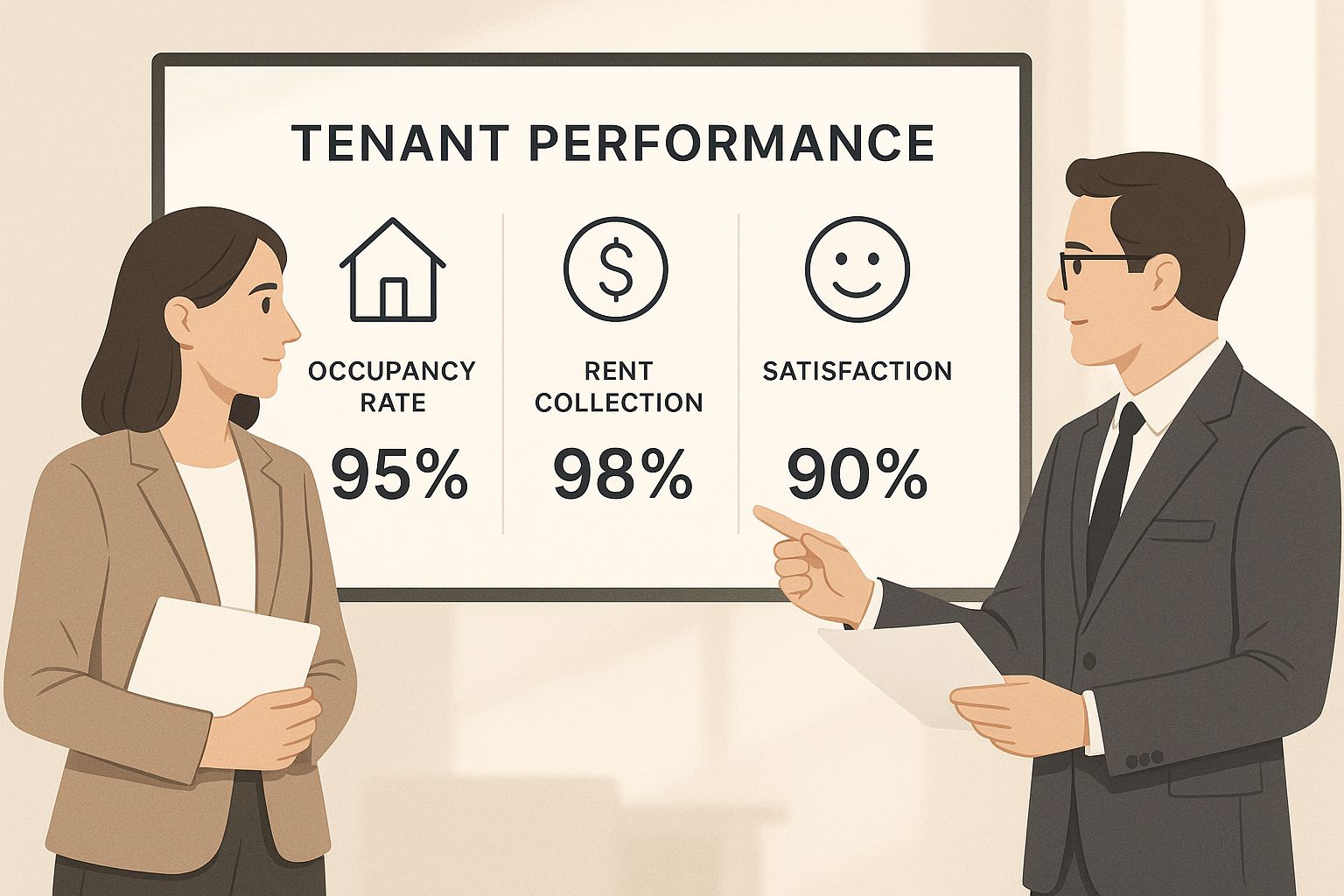
This kind of big-picture view highlights how key metrics feed into smart, strategic decisions. It’s all about making sure every aspect of your property's performance is monitored and optimized. Let’s break down the four essential reports that make this high-level analysis possible.
To make it even simpler, here's a quick rundown of the reports we're about to cover.
Essential Property Management Reports At A Glance
| Report Type | Primary Purpose | Key Question Answered |
|---|---|---|
| Income & Expense Statement | Provides a detailed, line-by-line breakdown of all monthly financial activity. | "Where exactly did every dollar go this month?" |
| Rent Roll Summary | Offers a real-time census of tenants, leases, and rent payment status. | "Who is paying, who isn't, and when are leases ending?" |
| Maintenance & Inspection Report | Documents all repair and upkeep activities, creating a property condition history. | "What work was done, why was it needed, and what did it cost?" |
| Year-End Financial Summary | Aggregates all annual income and categorized expenses for tax purposes. | "What's my total profit, and what can I deduct on my taxes?" |
Now, let's dig into what makes each of these documents so valuable for you as a property owner.
The Monthly Income and Expense Statement
This report is the detailed ledger sitting right behind your summary owner statement. It meticulously itemizes every single dollar earned and every dollar spent within a given month. For one of your properties in King City or Soledad, this means you won't just see "maintenance" as a lump sum. Instead, you'll see a line-by-line breakdown of a specific plumbing repair or landscaping service, often with links to the scanned invoices for total transparency.
Actionable Insight: Get in the habit of scanning this statement for spending anomalies or unexpected cost spikes. For instance, consistently high utility bills for a Salinas property could signal it's time for an energy-efficiency audit or maybe some upgraded appliances. That's a proactive investment that can seriously lower your long-term operating costs and boost your ROI.
The Rent Roll Summary
The rent roll is essentially a real-time census of your tenants and, more importantly, your revenue stream. It gives you a concise summary of every single unit, including:
- Tenant name and contact info
- Lease start and end dates
- Monthly rent amount
- Security deposit held on file
- Current payment status (paid, due, or delinquent)
This report is your number-one tool for managing lease cycles and cash flow. If you own multiple units in the Monterey Bay area, it quickly shows you any upcoming vacancies. This allows our team to get a head start on marketing and minimize costly downtime. It also immediately flags any tenants who have fallen behind on rent, enabling swift and professional follow-up.
The Maintenance and Inspection Report
For high-end properties especially, preservation is everything. This report documents all maintenance activities, from routine preventative care to emergency repairs. A good report will detail the issue that was reported, the vendor who was dispatched, the work they completed, and the total cost.
At Coast & Valley, we pair this with detailed inspection reports—complete with photos—from move-in, move-out, and periodic property reviews. This creates an undeniable record of property condition, which is essential for properly allocating security deposit funds and planning for future capital expenditures.
The Year-End Financial Summary
When tax time rolls around, this report becomes your most valuable document. It pulls together all the data from your monthly statements into a single, clean summary of your total income and categorized expenses for the entire year. This makes the tax preparation process a breeze for you and your accountant, saving hours of work and ensuring you capture every single available deduction.
Getting a handle on these reports is fundamental to successful real estate investing. This level of clarity is the foundation of the trust and performance our clients expect from us.
How Technology Delivers Transparent And Secure Reporting
Top-tier property management in today's market is built on a foundation of solid technology. For any sharp investor with properties in Salinas or anywhere along the Monterey Bay coast, the old days of waiting on emailed spreadsheets and month-end reports are long gone. Modern platforms give you a secure, real-time window into how your investment is performing.
At Coast & Valley, we use a dedicated and secure online owner portal that grants you 24/7 access to your financial data. This digital-first approach is a massive leap forward from outdated methods. It boosts security by getting rid of the risks that come with sending sensitive financial info over email, and it gives you the freedom to check in on your property's reports from anywhere, at any time, on any device.
The Power of Automation and Transparency
This technology does more than just show you information; it actively makes our reporting better. By automating the data entry for all income and expenses, we drastically cut down on the chances for human error. That means the numbers you see are always the numbers you can trust.
Our commitment to these digital tools reflects a major shift happening across the industry. The global property management software market is valued at roughly $3.04 billion in 2025, and it's growing fast because it helps firms be more accurate and transparent. You can learn more about the growth of these platforms and how they're changing the game.
This level of transparency builds incredible trust. Right through the portal, you can pull up the supporting documents yourself, including:
- Scanned Invoices: See the actual bill for every single repair or service.
- Detailed Work Orders: Understand the exact scope of maintenance done on your property.
- Lease Documents: Securely access current lease agreements and tenant details.
Our investment in technology is an investment in your peace of mind. It’s about providing you with the same level of secure, on-demand access you expect from your banking or investment portfolio.
By pairing these advanced tools with our client-focused service, we've created a reporting experience that’s efficient, secure, and completely transparent. To get a better sense of how these systems work, you can explore specialized real estate document automation solutions that are designed to turn complex data into clear, secure reports.
This digital infrastructure isn't a luxury anymore—it’s a core part of modern asset protection. For a deeper dive into the specific tools shaping our industry, check out our guide on key property management technology trends.
Turning Your Reporting Data Into Actionable Decisions
Getting a detailed report is a great first step, but the real value is in turning that data into smart, profitable decisions for your property. For any sharp investor in Salinas or South County, solid property management reporting isn't just about record-keeping. It's your strategic playbook for boosting performance and maximizing your return on investment.
This process is all about turning raw numbers into a clear action plan. Think of your reports as a diagnostic tool for your property's health. A high vacancy rate isn't just a number; it's a signal to dig into your property's competitiveness in the local market. Likewise, consistently high maintenance spending isn't just a cost; it's an invitation to budget for a long-term capital improvement that could save you a fortune down the road.
The whole point of robust reporting is to get ahead of problems before they start. This proactive approach is closely related to financial planning and analysis (FP&A), a discipline that uses financial data to forecast future performance and guide business strategy—exactly what you should be doing with your rental property.
Your Monthly Statement Review Checklist
To make this a habit, treat each monthly statement review like a strategic check-in. Don't just glance at the net income line and call it a day. A more systematic approach is your best bet for spotting trends and grabbing opportunities.
Here’s a simple checklist to guide you:
- Analyze Income vs. Potential: Look at your ‘Gross Potential Rent’ and compare it to the ‘Actual Rent Collected.’ See a gap? That immediately flags potential issues with vacancy or late payments that need to be addressed.
- Scrutinize Expense Categories: Go beyond the total expense figure. Is one category, like plumbing or landscaping, always creeping up? For a property in Gonzales, this might point to an aging system that needs a real fix, not just another patch job.
- Track Your Net Operating Income (NOI): Your NOI is the true measure of your property's profitability. Is it trending up or down over the last few quarters? A declining NOI is a major red flag that deserves an immediate conversation with your property manager.
At Coast & Valley, we see these reports as conversation starters. Our goal is to partner with you, using this data to identify opportunities, mitigate risks, and ensure your property performs at its peak potential in the unique Monterey County market.
Key Questions To Ask Your Property Manager
Good reports should empower you to ask even better questions. This kind of collaborative review ensures everyone is on the same page and working toward the same goals for your asset.
Here are a few examples of questions that move the conversation forward:
- "Our vacancy period was 25 days last month. How does that compare to similar properties in the Salinas area right now?"
- "I see maintenance costs for HVAC have increased for three straight months. What is our long-term plan to address this?"
- "Based on the current rent roll and upcoming lease expirations, do you see an opportunity to adjust rents to market rate in the next six months?"
This level of detailed inquiry is the hallmark of a great owner-manager partnership. For a deeper dive into financial oversight, check out our expert guide to comprehensive property management accounting, where we break down how we handle your funds with the utmost care.
By actively engaging with your reports, you stop being a passive recipient of information and become a strategic, well-informed investor.
Your Partner In Clarity And Performance
When you’re staring at rows of figures, it’s easy to feel lost. That’s why property management reporting should do more than list numbers; it should guide your next move. With Coast & Valley, you get clear monthly statements and secure, 24/7 portal access that actually makes sense.
At Coast & Valley, we combine local expertise in Monterey County with technology that sharpens every insight. Instead of drowning in data, you’ll see performance metrics translated into practical steps. Whether you’re tracking occupancy rates or comparing maintenance costs, our reports give you a straightforward roadmap.
Choosing the right manager means asking smart questions about their reporting standards. Dive into our guide on questions to ask property management companies to ensure transparency from day one.
Ready to experience data-driven clarity and save valuable time? Contact Coast & Valley today for a complimentary property evaluation—and a personalized tour of our owner reporting platform.
Your Reporting Questions, Answered
When it comes to understanding your investment's performance, reports are everything. But let's be honest, they can sometimes raise more questions than they answer. If you're a busy investor in Monterey County, you're not alone. Here are a few of the most common questions we get from property owners, with straightforward, no-nonsense answers.
How Often Should I Get Reports for My Rental Property?
You should expect a detailed Owner Statement every single month, no exceptions. That's the baseline.
At Coast & Valley, we take it a step further by giving our clients 24/7 access to their statements and other critical reports through a secure online portal. This way, you're never left in the dark waiting for an email to arrive.
Beyond the monthly check-in, a comprehensive year-end financial summary is absolutely essential. It makes tax time so much simpler. We also believe you should get timely pings for specific events, like when a maintenance job is finished or a new lease is signed. It’s all about keeping you connected to the day-to-day reality of your valuable asset.
What Is the Most Important Metric in My Reports?
While every number tells a piece of the story, your Net Operating Income (NOI) is the main character. It's the truest measure of your property's profitability.
We calculate it by taking your total income and subtracting all the operating expenses—everything except your mortgage and taxes. This gives you the clearest picture of how well the property itself is performing as a business.
Tracking your NOI trend over several months or even years is the single best way to gauge the financial health of your investment. A rising NOI is the clearest sign of strong, efficient management.
How Does Reporting Help with Salinas Market Conditions?
This is a great question, and it gets to the heart of what strategic property management is all about. Reports shouldn't exist in a vacuum; they are your frontline tool for responding to the unique market conditions right here in Salinas, Soledad, or Pacific Grove.
Think of it this way: your rent roll and vacancy data aren't just numbers on a page. We constantly cross-reference them against the latest Monterey County market trends.
This data-driven approach tells us if your rents are competitive, if your vacancy periods are normal for the area, or if we need to adjust. It’s how we make smart decisions on lease renewals and marketing that are specifically tailored to our region’s tenant pool, not some generic national average.

7 Essential Questions to Ask Property Management Companies Before You Hire Them
Choosing a property management company in Salinas or Monterey County is a critical decision that directly impacts your ROI, tenant quality, and peace of mind. For high-end property owners and busy investors, this isn't just about finding someone to collect rent; it's about entrusting a valuable asset to a local expert who provides concierge-level service.
The right partner acts as a steward for your property, whether it's a luxury home in Pebble Beach, a multi-family unit in Salinas, or agricultural real estate in South County towns like King City or Soledad. Protecting your investment goes beyond physical maintenance. It's also crucial to consider the administrative details from the very beginning, such as ensuring document integrity in real estate transactions to secure your ownership foundation.
To ensure you find a firm that aligns with your goals of property preservation and financial growth, you need to ask insightful, targeted questions to ask property management companies. This guide provides the seven most crucial questions to help you identify a team that offers the professionalism, transparency, and local expertise that Coast & Valley Properties champions. Use this checklist to vet potential partners and secure the white-glove service your investment deserves.
1. How Do You Define Your Fee Structure and What Services Are Truly All-Inclusive?
Among the most critical questions to ask property management companies is a direct inquiry into their fee structure. A seemingly low percentage-based management fee can be misleading, concealing a web of à la carte charges that can quickly erode your return on investment. For high-value properties in Salinas and Monterey County, it’s imperative to understand precisely what your fee covers to ensure a transparent financial partnership and avoid unwelcome surprises on your owner statement.

Beyond the Base Percentage: Uncovering Hidden Costs
A premium, full-service firm should provide a clear, itemized breakdown distinguishing their base management services from any additional charges. The goal is to move beyond the percentage and evaluate the total cost of ownership under their management. Hidden fees often appear in areas you might assume are included.
For example, some national firms offer a lower base rate but then charge extra for managing HOA communications, a frequent necessity in planned communities like those in Pacific Grove or Carmel. Others may add an administrative surcharge to every maintenance invoice they process, a practice we believe should be an integral part of the core service, not a separate profit center.
What an All-Inclusive Fee Should Cover
At Coast & Valley, our white-glove approach means a more comprehensive fee structure. We consider professional photography and premium marketing listings on top platforms as standard, ensuring your property attracts the highest quality tenants from day one. In contrast, many competitors bill these essential marketing activities separately.
Key Insight: A transparent fee structure is the foundation of trust. If a company is not forthcoming with a detailed list of all potential charges, it can be a significant red flag. Your peace of mind depends on financial clarity and predictability.
To ensure you are comparing services accurately, ask for a written, itemized list of all included and à la carte services. Specifically inquire about costs associated with:
- Tenant Placement: Is there a separate leasing fee?
- Lease Renewals: Is there a charge to renew a lease with an existing, high-quality tenant?
- Eviction Proceedings: What are the administrative costs if an eviction becomes necessary?
- Detailed Inspections: Are move-in, move-out, and periodic inspections included?
Finally, ask a simple but powerful question: “Under what specific circumstances would I see a charge on my statement beyond the management fee and direct repair costs?” Their answer will reveal their commitment to true transparency.
2. What Are Your Tenant Screening Criteria and Process?
The quality of your tenant directly correlates to the performance of your investment property. A robust tenant screening process is a property management company’s first line of defense against potential issues like late payments, property damage, and costly evictions. When evaluating potential managers for your Salinas or Monterey County property, you must dissect their screening methodology to ensure it is thorough, compliant, and designed to attract a superior caliber of resident.

Beyond the Credit Score: A Holistic Applicant Review
A basic credit check is simply not enough, especially for the high-value rental markets in communities like Carmel and Pebble Beach. A premier property manager employs a multi-faceted approach, creating a comprehensive profile of each applicant. This process must be rigorous enough to protect your asset yet fully compliant with all fair housing laws.
For instance, while many national franchise firms might rely on a rigid benchmark like a 650 credit score and income 3x the rent, a more nuanced local expert understands the bigger picture. At Coast & Valley, we conduct in-depth verifications of employment and rental history, contact previous landlords directly, and perform comprehensive background checks that include criminal and eviction history. This detailed process allows us to assess an applicant’s reliability far more accurately than a simple algorithm.
What a Comprehensive Screening Process Includes
A white-glove management firm should be able to articulate its screening standards clearly and provide you with confidence in its process. While not directly applicable to California, understanding how a property management company handles complex tenant issues, such as the UK eviction process for landlords, can demonstrate their depth of knowledge in property law.
Key Insight: A disciplined and well-documented screening process is non-negotiable. It not only secures a reliable income stream but also minimizes liability by ensuring strict adherence to fair housing regulations, a critical consideration for every property owner.
To gauge a company’s diligence, ask these pointed questions:
- Approval Criteria: What are your specific, written criteria for income, credit, and rental history?
- Verification Methods: How do you verify employment and past rental performance? Do you speak directly with previous landlords?
- Marginal Applications: How do you handle an applicant who is strong in one area but weak in another? Is there a process for considering a co-signer?
- Compliance: Can you confirm your process is fully compliant with all federal, state, and local Fair Housing laws?
By digging into the specifics of their approach, you can better understand a company’s commitment to placing only the most qualified tenants in your property. You can learn more about our comprehensive tenant screening checklist to see how we prioritize protecting your investment.
3. How quickly do you respond to maintenance requests and emergencies?
A property management company's approach to maintenance is a direct reflection of its commitment to both tenant satisfaction and the preservation of your asset. Response times for maintenance issues can significantly impact tenant retention, prevent minor problems from escalating into costly repairs, and ultimately protect the value of your Salinas or Monterey County property. Asking about their maintenance protocols is a crucial part of vetting any potential partner.

Defining Urgency and Setting Expectations
A premier management firm will have clear, tiered protocols for handling maintenance. This isn't just about speed; it's about having a system. For instance, a burst pipe at a luxury property in Carmel requires a different level of immediate action than a running toilet in a Soledad rental. You need to understand their exact definitions and guaranteed response times for different categories of issues.
Many national chains or tech-focused platforms offer online portals, which provide real-time tracking of requests. While convenient, it’s vital to know the human-powered process behind the technology. A digital acknowledgment is meaningless without a qualified, local vendor being dispatched promptly.
What to Ask to Gauge True Responsiveness
Drilling down into the specifics of their maintenance process reveals their operational efficiency and the quality of their vendor network. When inquiring about their maintenance protocols, ask if they utilize a thorough, perhaps even a commercial-grade maintenance checklist, to ensure all aspects of your property are regularly inspected and cared for. This proactive approach is a hallmark of top-tier management.
Key Insight: A company's maintenance response system is the lifeline of your investment. It must be fast, reliable, and backed by a network of trusted, vetted vendors who can perform quality work at fair prices, protecting both your tenants and your bottom line.
To get a clear picture of their capabilities, ask these pointed questions:
- What are your specific, guaranteed response times for acknowledging a routine request and an emergency request?
- How do you define an emergency, and what is your after-hours and holiday procedure?
- Can you describe your vendor vetting and approval process? Are they licensed, insured, and familiar with the nuances of Monterey County properties?
- Do you have an in-house maintenance team, a preferred vendor list, or both?
Finally, ask for access to their rental property maintenance checklist to understand their proactive strategy for preserving your property's long-term health and value. A firm that can provide this documentation demonstrates a systematic and professional approach to property care.
4. What is Your Average Vacancy Rate and Time to Re-Lease?
A prolonged vacancy is the single greatest threat to your property's profitability. This is why one of the most revealing questions to ask property management companies is a direct inquiry into their vacancy and re-leasing metrics. These figures are not just numbers; they are a direct reflection of a company's marketing prowess, pricing strategy, and operational efficiency in the competitive Monterey County rental market.
Beyond the Market Average: Demonstrating Efficiency
Any management firm can quote generic market averages, but a premium provider will have specific data for their portfolio, broken down by property type and location. A low vacancy rate indicates they are proactive, beginning the marketing process for an upcoming vacancy long before the current tenant moves out. It shows they understand how to price a property in Salinas competitively versus one in Monterey to attract immediate interest without leaving money on the table.
For instance, many national firms might boast a low average re-lease time, but this can be misleading if their portfolio is concentrated in high-demand urban centers. An expert in the local market will know the seasonal nuances of renting in coastal communities versus agricultural hubs like Soledad or King City, adjusting their strategy accordingly to minimize downtime.
The Balance Between Speed and Quality
Quickly filling a vacancy is pointless if it leads to a costly eviction down the road. The true measure of a top-tier management company is their ability to place a high-quality tenant swiftly. Companies that leverage modern tools like virtual tours and seamless online applications often reduce physical vacancy periods significantly by allowing prospective tenants to view and apply from anywhere.
Key Insight: The time-to-re-lease metric is a powerful indicator of a management company’s proactive systems. A firm that consistently fills vacancies quickly and with qualified tenants demonstrates a mastery of local marketing, tenant screening, and operational readiness.
When you discuss this topic, get specific. Ask for data relevant to your type of property and drill down into their process:
- Property-Specific Data: What is your average vacancy period for single-family homes in my specific zip code?
- Proactive Marketing: When do you start marketing a property once a tenant gives notice?
- Listing Strategy: Which premium platforms do you use for listings, and is professional photography included?
- Speed vs. Screening: How do you ensure your tenant screening process remains thorough when trying to fill a unit quickly?
Your goal is to find a partner who understands that every day a high-value property sits empty, your return on investment diminishes. Their ability to minimize this gap is a crucial component of white-glove service.
5. What technology platforms do you use for property management?
In today's digital world, one of the most revealing questions to ask property management companies is about the technology they leverage. Sophisticated software is no longer a luxury; it's the engine of efficient operations, transparent communication, and enhanced tenant services. For owners of high-value properties in Salinas and Monterey County, the right tech stack ensures you have real-time, 24/7 access to your investment's performance, from financial reporting to maintenance updates.
The Power of a Modern, Integrated System
A premier property management firm invests in robust, integrated software to streamline every facet of their service. Antiquated methods involving spreadsheets and manual rent collection are inefficient and create a higher risk of errors, costing you time and money. Modern platforms like AppFolio or Buildium automate critical tasks, providing a seamless experience for both owners and tenants.
For instance, a unified system allows tenants to pay rent online, submit maintenance requests with photos directly from their phone, and access their lease documents at any time. For you, the owner, this same system provides a secure online portal where you can view detailed financial statements, track maintenance progress, and access important documents whenever you need them. This level of digital convenience is a hallmark of a white-glove service provider.
What to Look for in a Tech Platform
A manager's choice of software directly impacts your experience and ROI. A company committed to excellence will use a platform that offers more than just basic accounting. Their technology should serve as a central hub for communication, operations, and financial transparency, ensuring nothing falls through the cracks. Learn more about how different software impacts service delivery by exploring a property management software comparison.
Key Insight: A property manager’s investment in technology is a direct reflection of their commitment to efficiency, security, and owner transparency. A lack of modern tools can signal operational weaknesses and an outdated approach to service.
When evaluating a company's technology, be sure to ask for specifics:
- Owner & Tenant Portals: Request a live demo. Is the interface user-friendly and intuitive?
- Mobile Functionality: Do they offer a dedicated mobile app for owners and tenants? What are its user ratings?
- Maintenance & Inspections: How does the system track maintenance requests and log inspection reports with photos and notes?
- Data Security: What measures are in place to protect your financial data and your tenants’ personal information?
Finally, ask them to walk you through how their technology streamlines the tenant lifecycle, from online applications and digital lease signing to automated rent reminders and efficient move-out processing. Their answer will tell you everything you need to know about their operational sophistication.
6. Can You Provide References from Current Property Owners?
While marketing materials and initial presentations showcase a company’s ideal image, one of the most revealing questions to ask property management companies is for client references. Speaking directly with current property owners offers an unfiltered view of a firm's day-to-day performance, reliability, and service quality. For investors entrusting high-value assets in Monterey County, this step validates marketing claims and uncovers the true nature of the partnership you can expect.
Beyond Testimonials: The Power of a Live Conversation
Polished testimonials on a website are valuable, but a direct conversation allows you to probe deeper. A premier management firm should be proud of their client relationships and readily provide a list of references. Hesitation or an inability to produce more than one or two contacts is a significant red flag, suggesting a potential lack of satisfied long-term clients or a system that doesn't foster strong partnerships.
Successful companies are often prepared to connect you with current clients who own a variety of properties, from single-family homes in Salinas to luxury estates in Carmel. This demonstrates confidence and a proven track record across different asset types and owner needs. It shows they understand the unique demands of high-net-worth property management and have built the trust to back it up.
How to Get the Most from Your Reference Checks
When you connect with a reference, go beyond generic questions. Your goal is to understand their specific experience with communication, financial reporting, and problem resolution. A prepared list of questions will yield the most insightful answers.
Key Insight: A company’s willingness to provide multiple, relevant references is a direct reflection of their confidence in their service quality. The best firms have built a roster of advocate clients who are happy to share their positive experiences.
To conduct a thorough reference check, be sure to:
- Request Relevant Contacts: Ask for references with properties similar to yours and who share your investment goals.
- Seek Varied Tenures: Inquire if you can speak with both a new client (onboarded in the last year) and a long-term client (5+ years).
- Ask About Specifics: Prepare questions like, "Can you describe a time they handled a difficult maintenance issue?" or "How timely and clear is your monthly financial statement?"
- Inquire About Weaknesses: A powerful question is, “If there was one thing you could change or improve about their service, what would it be?” An honest answer can be incredibly telling.
7. What are your fees for leasing, maintenance markups, and other services?
While the monthly management percentage is a headline number, it's often the ancillary fees that reveal the true cost of a property management partnership. For savvy investors in Monterey County, understanding every potential charge is a non-negotiable part of the due diligence process. A company’s approach to these extra fees for leasing, maintenance, and administrative tasks is a direct reflection of its business model and commitment to transparency.
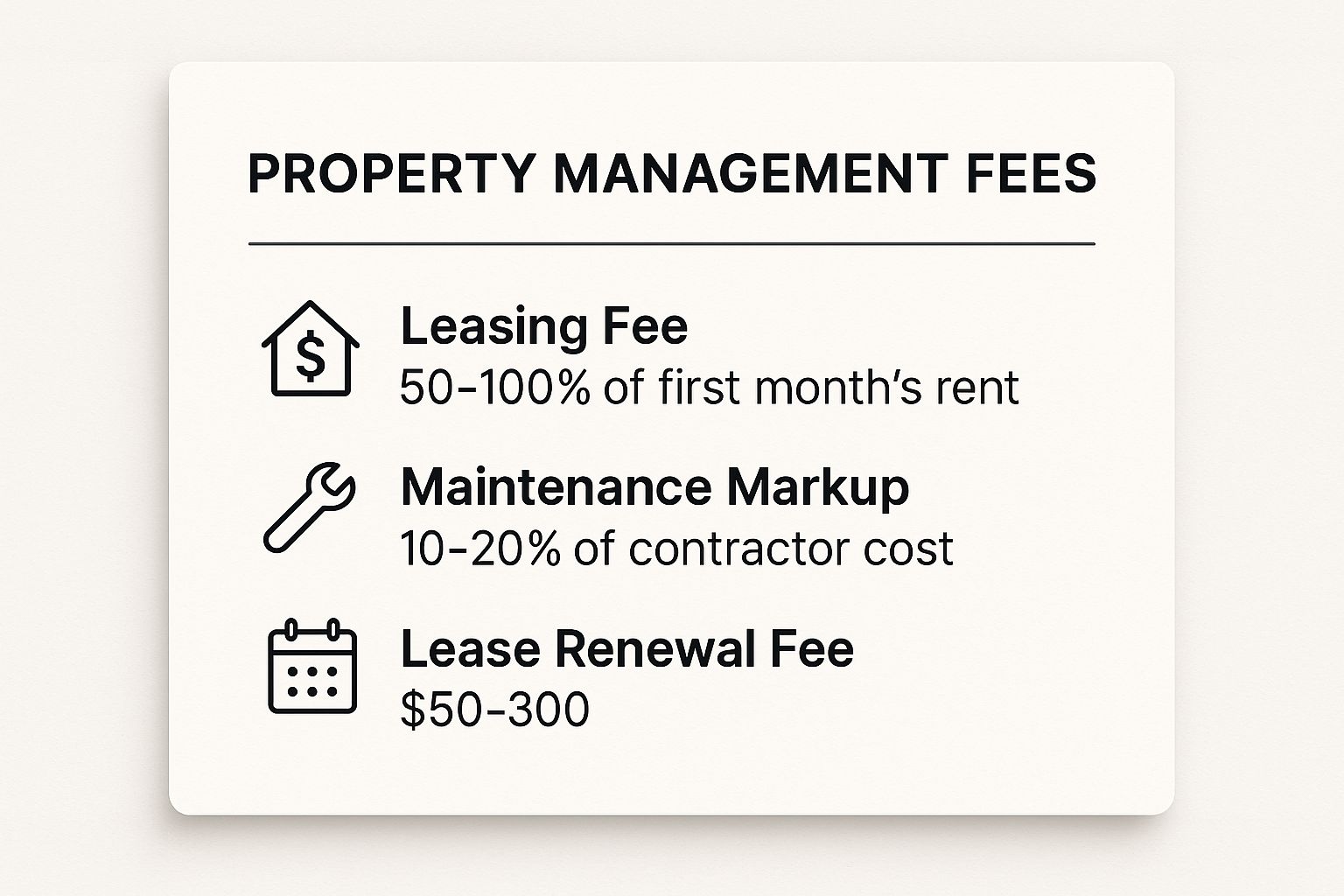
This quick reference visualizes common industry fee ranges that can significantly affect your net operating income if not clearly defined upfront.
Deconstructing the 'Extra' Charges
A premier management firm should never hide revenue streams in the fine print. You need to ask direct questions about costs beyond the base fee, as these can accumulate quickly and create friction. For example, a high leasing fee might incentivize tenant turnover rather than retention, which is counterproductive for long-term ROI.
Similarly, a significant maintenance markup can be a major point of contention. While coordinating repairs is a core management duty, some firms add a 10-20% surcharge on every contractor invoice. At Coast & Valley, we believe this practice creates a conflict of interest. Our philosophy is to pass through maintenance costs directly, ensuring our focus remains on finding the most cost-effective solution for you, not on profiting from repairs.
What a Comprehensive Fee Schedule Reveals
A clear, itemized fee schedule is essential for an accurate financial forecast. It’s a key component of any solid agreement and one of the most important things to review in your property management contract in California. If a company hesitates to provide one, consider it a serious warning sign.
Key Insight: A company's revenue model tells a story. If a firm relies heavily on transactional fees like leasing and maintenance markups, their interests may not be fully aligned with yours, which should be to secure and retain high-quality, long-term tenants.
When vetting a company, specifically ask them to outline their charges for:
- Tenant Placement Fee: Typically 50-100% of the first month's rent, this is a standard one-time cost for finding and screening a new tenant.
- Lease Renewal Fee: Does the company charge you when a great tenant decides to stay? Fees can range from $50 to over $300, penalizing you for successful retention.
- Maintenance Coordination/Markup: Ask if they add a percentage to vendor invoices. A transparent firm will pass these costs through without a surcharge.
- Routine Inspections: Are drive-by or annual interior inspections included, or do they come with an extra fee, often between $50 and $150?
By demanding a complete fee schedule, you can project your total annual management costs with greater accuracy and choose a partner whose financial model aligns with your goals for long-term profitability.
7 Key Questions Comparison for Property Management Firms
| Item | Implementation Complexity 🔄 | Resource Requirements ⚡ | Expected Outcomes 📊 | Ideal Use Cases 💡 | Key Advantages ⭐ |
|---|---|---|---|---|---|
| What services are included in your management fee? | Medium – varies by company and package | Moderate – requires ongoing coordination of multiple services | Clear cost structure and service expectations | Cost evaluation and comparing management firms | Prevents surprise charges; establishes transparency |
| What are your tenant screening criteria and process? | High – detailed checks and compliance needed | Significant – credit, background, income verification | Higher tenant quality; reduced turnover and risk | Tenant quality control and risk mitigation | Ensures legal compliance; reduces problem tenants |
| How quickly do you respond to maintenance requests and emergencies? | Medium – requires reliable vendor network and protocols | High – must maintain 24/7 readiness and communication | Improved tenant satisfaction and property upkeep | Enhancing tenant retention and property condition | Fast responses prevent costly damages; boosts tenant loyalty |
| What is your average vacancy rate and time to re-lease? | Medium – depends on marketing and operational strategy | Moderate – marketing resources and market knowledge needed | Lower vacancies; faster re-leasing | Maximizing rental income and minimizing downtime | Reflects effectiveness in occupancy management |
| What technology platforms do you use for property management? | Variable – depends on software integration and training | Moderate to High – investment in platforms & user onboarding | Increased transparency and operational efficiency | Streamlined management and real-time reporting | 24/7 access; improved communication and accuracy |
| Can you provide references from current property owners? | Low – mostly communication and verification effort | Low – coordination to gather and share references | Validated company performance and reliability | Due diligence before engagement | Honest insights; helps assess service quality |
| What are your fees for leasing, maintenance markups, and other services? | Medium – requires detailed fee structure management | Low to Moderate – accounting and communication | Transparent budgeting; avoids unexpected costs | Comprehensive cost analysis | Helps accurate cost comparison; prevents surprises |
Partner with a Local Leader Who Has the Right Answers
Selecting the right property management company is one of the most significant decisions you will make as a real estate investor. It's a partnership that directly impacts your property's profitability, its long-term value, and your personal peace of mind. The comprehensive list of questions to ask property management companies provided in this guide is your strategic roadmap to cutting through marketing claims and assessing the true capabilities of a potential partner. Your goal is not just to hire a manager but to align with a firm that shares your commitment to excellence and understands the unique dynamics of the Monterey County market.
By moving beyond surface-level inquiries, you empower yourself to identify a team that operates with transparency, leverages modern technology for your benefit, and possesses the local expertise necessary to navigate everything from Salinas's rental market trends to Pacific Grove's specific maintenance needs. The right answers to these questions will reveal a company's core operational philosophy.
Key Takeaways for Choosing Your Management Partner
Your vetting process should be built on three core pillars uncovered by these critical questions:
- Financial Transparency and ROI: A top-tier firm will provide a clear, itemized fee structure and demonstrate how their services, from tenant placement to proactive maintenance, directly contribute to maximizing your return on investment. Vague answers about costs or an inability to explain their value proposition are major red flags.
- Operational Excellence and Proactive Care: How a company handles tenant screening, maintenance response, and vacancy rates is a direct reflection of its efficiency. Look for firms with documented processes, established vendor relationships in areas like Soledad or King City, and a proven track record of minimizing downtime and preserving property condition.
- Communication and Technology: In today's market, 24/7 access to information is non-negotiable. A leading company will utilize a robust owner portal, provide regular, detailed reporting, and ensure you are always informed. Their investment in technology is an investment in your convenience and confidence.
Ultimately, choosing a property management partner is an investment in your asset's future. The time you spend now, diligently asking these questions and evaluating the responses, will pay dividends for years to come. For property owners in Salinas and across the Monterey Bay Area, the ideal partner is one who not only has the right answers but embodies them through their actions every single day. Seek a leader who offers a concierge-level experience, grounded in deep local roots and a proven commitment to protecting and growing your wealth.
Ready to partner with a firm that welcomes these tough questions and delivers transparent, high-performance results? Discover how Coast & Valley Properties provides the sophisticated, full-service management that high-end property owners in Monterey County trust. Contact us today for a comprehensive evaluation of your property and experience the peace of mind that comes from working with a true local expert.