

How to Find Good Tenants: A Monterey County Investor's Guide
Finding the right tenants for your high-end property in Monterey County doesn't just happen when you post a "For Rent" sign. For the serious investor, the real work begins long before that. It starts with meticulously preparing your property to attract a pool of high-caliber applicants and nailing down a competitive, data-driven rental price. This foundational effort, rooted in local expertise, is what makes the difference—ensuring you connect with responsible, long-term tenants who will treat your investment with the care it deserves.
Setting the Stage to Attract Premium Tenants

In Monterey County, the search for an ideal tenant is a proactive strategy, not a reactive one. For busy property owners and serious investors, this means turning your property into an asset that the best applicants are actively seeking. Whether you own a single-family home in a quiet Salinas neighborhood, a luxury condo in Pacific Grove, or an executive property in Pebble Beach, the groundwork you lay is everything.
This preparation goes far beyond a quick sweep and a fresh coat of paint. It’s about stepping into the shoes of a discerning professional, a relocating military family, or a high-income couple who values quality, security, and modern convenience. This shift in perspective, guided by local market demands, is what elevates your property from just another vacancy to a truly premium home that commands top-dollar rent and minimizes your risk.
Perfecting the Property for a Discerning Audience
You get one chance to make a first impression, and a prospective tenant’s judgment is formed in seconds, starting at the curb. Manicured landscaping, a freshly painted front door, and clean, inviting walkways send a clear message: this is a well-cared-for home managed by a professional. It sets a high standard from the moment they arrive.
Once inside, the details matter just as much. As a trusted advisor to property owners across the Monterey Bay Area, Amy Salmina and our team at Coast & Valley always recommend focusing on these key areas to maximize your ROI:
- Modern Amenities: In our competitive local market, renters have high expectations. Features like stainless steel appliances, in-unit laundry, and smart home technology aren't just perks; they're often deal-breakers for top-tier applicants seeking a premier living experience.
- Impeccable Condition: Ensure every fixture works, the paint is fresh and neutral, and the entire space has been professionally cleaned. This level of detail communicates respect for your property and your future tenant, justifying a premium rent.
- Safety and Security: This is non-negotiable. Robust locks, well-lit exteriors, and properly maintained entryways create the peace of mind that high-quality tenants demand and are willing to pay for.
For a deeper look into what local renters are searching for, review our guide on the top amenities to attract renters in the Monterey Bay area.
Pricing and Legal Preparation
Setting the right rent is a delicate balancing act. Price too high, and you risk long, costly vacancies. Price too low, and you leave money on the table and may attract less-qualified applicants. To get it right, you need a solid market analysis of comparable properties in your specific neighborhood, whether you're in South County towns like Soledad and Gonzales or right on the coast.
As a property owner, your goal is to align your rent with the premium quality you offer. This positions your property to attract tenants who appreciate and can afford a superior living experience, maximizing your return on investment.
Finally, getting all your documentation in order ahead of time is the mark of a professional. As you're getting the property ready, it's the perfect time to implement expert tips on real estate document management. Having everything organized ensures a smooth, efficient process, reinforcing the concierge-level experience you want to provide from start to finish.
Pre-Listing Checklist for Monterey County Landlords
| Action Item | Why It Matters for High-End Properties | Local Tip for Monterey County |
|---|---|---|
| Enhance Curb Appeal | A pristine exterior sets a premium tone and justifies higher rent. | Professional landscaping that can withstand coastal fog or inland Salinas Valley heat is a major plus. |
| Professional Deep Cleaning | Top-tier tenants expect a move-in-ready, spotless environment. This is non-negotiable. | Focus on windows to maximize natural light and showcase any beautiful local views of the bay or hills. |
| Upgrade Key Amenities | Features like in-unit laundry and modern kitchens attract discerning tenants and support premium pricing. | Given our tech-savvy population, smart thermostats and keyless entry are highly sought after. |
| Conduct a Safety Audit | Secure locks, smoke detectors, and good lighting are essential for tenant safety and owner liability. | Ensure outdoor lighting is robust, especially for properties in more rural or secluded areas of South County. |
| Complete All Repairs | Addressing minor issues prevents them from becoming costly tenant complaints and shows proactive management. | Check for any signs of moisture or mold, a common concern in our coastal climate. |
| Prepare All Documents | Having leases and disclosures ready demonstrates professionalism and expedites the signing process. | Ensure your lease is compliant with all current California and local rental laws, which change frequently. |
By methodically preparing your property, you're not just renting out a space; you're offering a superior product. This approach naturally filters for tenants who appreciate quality, setting the stage for a successful and stress-free landlord experience.
Crafting a Marketing Plan That Reaches the Right People
To land a great tenant for your high-end property in Monterey County, you can't just slap a "For Rent" sign in the yard and hope for the best. Your marketing is their first impression, and it needs to convey quality and professionalism from the get-go.
The goal isn't just to fill a vacancy—it's to build a pipeline of qualified, serious inquiries. You must position your property as the premium choice it is, whether it's a sleek apartment for a young professional in Salinas or a sprawling luxury home in Pebble Beach. Every piece of your marketing plan should speak directly to that ideal renter, saving you time and attracting a better applicant pool.
Writing Descriptions That Sell a Lifestyle
Your property description is a sales pitch. Simply listing "3 beds, 2 baths" is a missed opportunity. You need to paint a vivid picture of the lifestyle your property offers.
Is your Salinas property the perfect retreat for an agricultural executive who needs a dedicated home office and quick access to Highway 101? Say that. Does your cozy Pacific Grove cottage offer breathtaking sunset views, ideal for a remote worker craving coastal peace? Lead with that.
- Be Specific: Don't just say "nice appliances." Mention the Viking range or the Bosch dishwasher. Talk about the custom cabinetry, quartz countertops, or unique architectural details.
- Sell the Neighborhood: Is it a short walk to the local farmers' market in Oldtown Salinas? Is it zoned for a highly-rated school district? Mention nearby parks and local favorites.
- Set Expectations Early: Be upfront about your policies on pets and smoking. This simple, actionable step pre-screens applicants and saves everyone time.
This targeted approach draws in people who don't just fit the space, but who will truly appreciate and value the unique lifestyle your investment provides.
Why Professional Visuals Are Non-Negotiable
In a market where every rental search starts online, blurry phone pictures are unacceptable. For a premium property, professional photography and virtual tours are essential investments, not optional add-ons. They are what justify a higher rent and attract discerning tenants who recognize and appreciate quality.
A high-quality visual package gives a busy professional in another city or a military family relocating to the Monterey Bay Area the confidence to pursue your property. It’s a clear signal that you're a serious, professional landlord who values your asset.
Your marketing materials are a direct reflection of your property's value. Exceptional visuals attract exceptional tenants by showcasing the quality and care you’ve invested in your home.
When putting your plan together, don't forget modern communication tools. For instance, incorporating effective SMS marketing strategies for real estate can be a powerful way to send tour reminders and handle initial inquiries with concierge-level efficiency.
By weaving compelling descriptions with stunning visuals and smart outreach, you create a powerful marketing engine. This is a fundamental part of how a professional property manager can attract good residents and, most importantly, protect your investment for the long haul.
Implementing a Rigorous and Fair Screening Process
Once your targeted marketing brings in interested applicants, the real work begins. Your screening process isn't just a formality—it's the single most important tool you have for protecting your investment. It must be both thorough and scrupulously fair to comply with California's stringent laws.
For owners of high-end properties in Salinas, Monterey, or the surrounding communities, a meticulous, documented process is non-negotiable. This is about more than just avoiding bad tenants; it’s about making a confident, data-driven decision that provides peace of mind and preserves your property's value.
This diagram shows the journey from attracting applicants to handing over the keys.
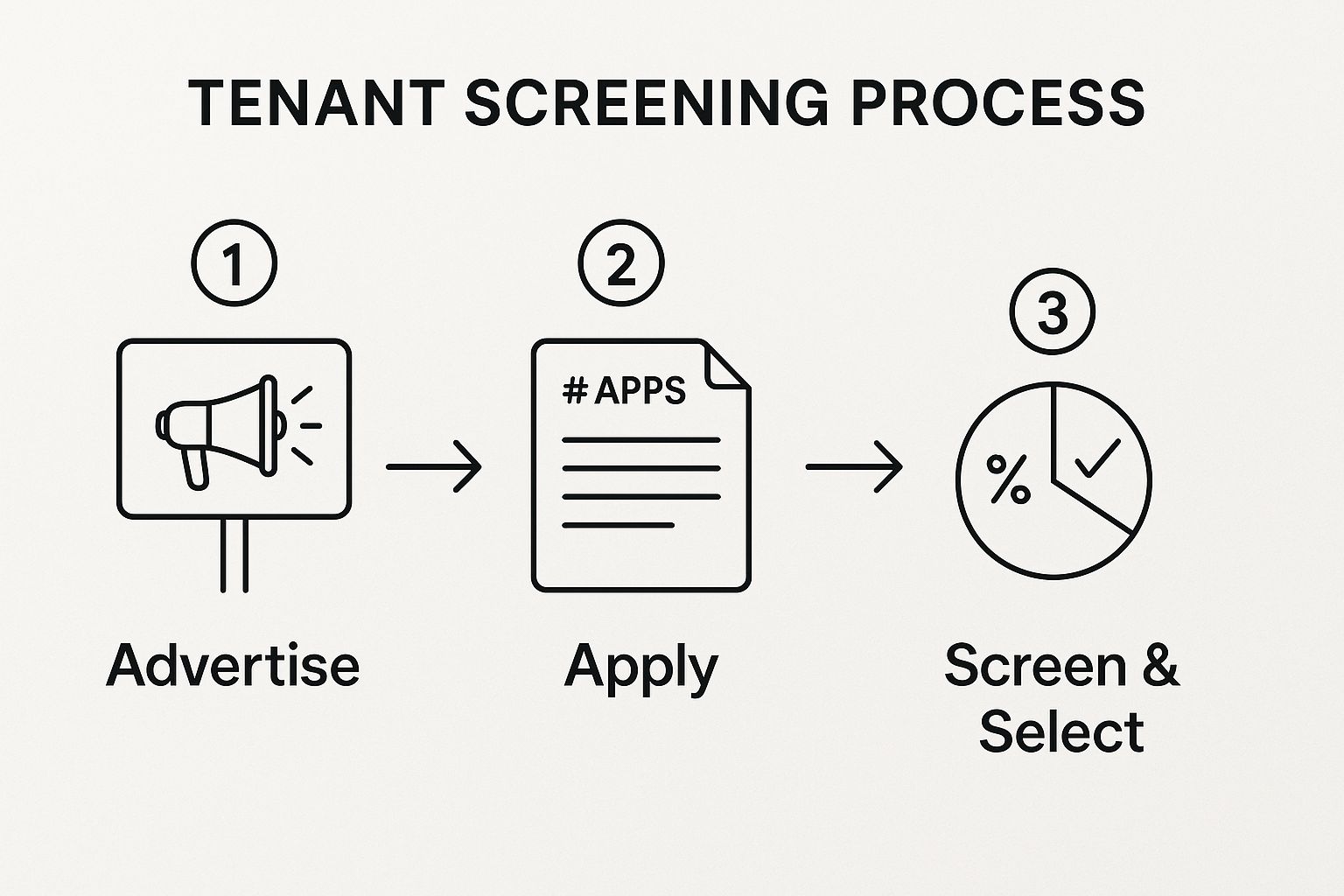
As you can see, the screening and selection phase is the critical filter that ultimately determines the quality of your tenancy and the long-term performance of your asset.
Establishing Standardized Screening Criteria
Consistency is the cornerstone of any screening process that's both effective and compliant. Before reviewing the first application, you must define your qualifications for an ideal tenant. Then, you must apply those same standards uniformly to every single person who applies. This isn't just good practice—it's essential for staying compliant with California's strict fair housing laws.
Your criteria should always be objective, measurable, and directly related to an applicant's ability to fulfill their lease obligations. At Coast & Valley, our criteria are built on these key pillars:
- Income Verification: We require a gross monthly income of 2.5 to 3 times the rent. We verify this with recent pay stubs, bank statements, or official offer letters from reputable local employers in sectors like agriculture, healthcare, or hospitality.
- Credit History: A solid credit score, typically 670 or higher for premium properties, indicates financial responsibility. However, we analyze the full report to understand the story behind the score, not just the number itself.
- Rental History: We contact previous landlords to confirm a history of on-time rent payments, proper property care, and a positive tenancy record. This firsthand experience is invaluable.
- Background Check: We conduct a comprehensive check for relevant criminal history and past evictions, all in full compliance with state and federal regulations to protect you from liability.
At Coast & Valley, every applicant undergoes the same professional, transparent process. Our standardized criteria ensure decisions are based on qualifications, not personal feelings, which protects our owners from potential liability.
For a detailed breakdown of what to look for, reference our complete tenant screening checklist designed specifically for Monterey County landlords.
Verifying Every Detail
A rental application is just a piece of paper until every claim on it has been independently verified. This meticulous step is what separates professional management from amateur efforts. It’s not enough to take an applicant's stated income at face value; you must confirm it at the source.
The global market for tenant screening services was valued at approximately USD 1.95 billion for a reason—there is a massive demand for reliable, professional vetting.
Once you have your applications in hand, a rigorous and fair screening process is what separates the great tenants from the rest. You can learn more about effective prospect screening strategies that help property managers make informed choices. This methodical approach is the best way to find tenants who not only pay on time but also act as caretakers for your valuable property.
Decoding Background and Credit Check Reports

After qualifying your applicants, it's time to look beneath the surface. A background and credit report is far more than a simple pass or fail; it’s a detailed story about an applicant's financial habits and personal responsibility.
For any owner of a premium property in Monterey County, understanding this story is the key to predicting a tenant’s reliability and, ultimately, protecting your asset. A high credit score is a great start, but it never tells the whole story. As professional managers, we’ve learned to dive much deeper, analyzing the components that truly matter. This data-first approach takes emotion and guesswork out of the equation, leading to defensible, high-quality tenant selections every time.
Analyzing Key Financial Indicators
When we pull a credit report, we’re looking for patterns, not just numbers. A single late payment from five years ago is likely not a deal-breaker. A consistent, recent history of missed payments is a major red flag.
Here is a quick checklist of what we examine to get the full picture:
- Payment History: This is the most critical element. We look for a solid track record of on-time payments for credit cards, car loans, and other debts. A history riddled with collections points to a higher risk of rent default.
- Debt-to-Income (DTI) Ratio: This tells us how much of an applicant’s income is already committed to other debts. Even with a fantastic salary, a high DTI could mean they might struggle to afford rent comfortably, especially in a high-cost area like Monterey or Carmel.
- Credit Utilization: Maxed-out credit cards can signal financial distress. We prefer to see responsible credit management, with low balances compared to available credit limits.
At Coast & Valley, we've spent years learning to interpret these reports. We know that a medical collection account tells a very different story than chronic, unpaid credit card debt. It's this nuanced analysis, backed by Amy Salmina’s local experience, that helps us find genuinely reliable tenants for our clients.
Navigating Criminal Background Checks in California
Conducting criminal background checks requires strict adherence to California law to ensure the process is fair and compliant. This isn't about blanket denials; it's about making an individualized assessment based on relevant information.
California law requires landlords to consider the nature and severity of an offense, when it occurred, and whether it has any direct bearing on the applicant's ability to be a good tenant. A conviction that could pose a threat to the property or other residents is viewed differently than a minor, unrelated offense from a decade ago. The legal landscape here is complex, and one misstep can expose you to significant liability. Using a professional service ensures these checks are handled ethically and legally, protecting you from costly discrimination claims.
Market data suggests property managers who use integrated screening platforms can slash tenant default risks by up to 30%. You can dig into the numbers by reading research about tenant screening services.
Ultimately, decoding these reports is about building a complete picture of an applicant. By combining financial data with rental history and a compliant background check, we can make an informed decision that secures a responsible tenant and protects your investment for years to come.
From Offer to Ironclad Agreement
After carefully sifting through applications, you likely have a clear frontrunner. Now it’s time to make a confident, informed decision and extend an offer to the best-qualified applicant for your Monterey County property. This final step is where you set the tone for a professional and respectful landlord-tenant relationship right from the start.
Once you’ve picked your ideal tenant, communicate your decision clearly and promptly let the other applicants know they weren’t selected. A courteous notification is a hallmark of a professional and helps maintain a great reputation in communities from Salinas to Soledad.
With your chosen applicant ready to move forward, your focus must pivot to the lease agreement. This isn't a standard form you download online. It’s the single most important legal document protecting you, your new tenant, and your valuable investment.
Your lease agreement is the absolute foundation of the tenancy. A professionally drafted, California-specific lease is a non-negotiable tool for protecting your investment and ensuring clear expectations from day one.
Essential Clauses for a California Lease
To fully shield your property from liability, your lease needs to be robust and locally tailored. Every rental agreement we draft at Coast & Valley includes specific, detailed clauses designed to eliminate ambiguity and protect our clients' interests. Critical provisions include:
- Security Deposit: Clearly state the exact amount, what it covers (like unpaid rent or damages beyond normal wear and tear), and the precise conditions for its return, adhering strictly to California law.
- Maintenance Responsibilities: Define who is responsible for what, including routine tasks and, most importantly, the tenant's duty to report issues promptly. This is vital for the preventive care that saves you money.
- Use of Property and Guest Policies: Outline rules for property use, set clear occupancy limits, and establish policies for long-term guests to prevent unauthorized occupants.
- Subletting: Explicitly prohibit subletting without your prior written consent. This clause prevents you from finding a stranger living in your property—one you never screened.
Crafting an agreement that covers all these bases is complex. For a closer look, review our guide on essential lease terms for a Salinas tenant. A professionally managed signing process solidifies these terms and kicks off the tenancy on a positive note.
Common Questions About Finding Tenants in Monterey
Even with a solid plan, property owners in Monterey County often have questions. Based on our experience managing high-end properties from Salinas to the coast, here are some of the most common questions we hear—and the practical, actionable answers you need.
What Is a Good Credit Score for a Tenant?
For premium properties in Monterey or Salinas, a credit score of 670 or higher is a great starting point, as it signals a history of financial responsibility. However, the score alone is not enough. We've approved great applicants with slightly lower scores due to past issues like medical debt, but who also had a fantastic income and glowing landlord references. The most important action you can take is to set a reasonable standard and apply it consistently to every applicant to comply with fair housing laws.
How Do I Reliably Verify an Applicant's Income?
This is a step you cannot skip. The best practice is to request recent pay stubs or bank statements showing consistent direct deposits. For a new job, a formal offer letter on company letterhead works. For an extra layer of security, call the employer’s HR department to confirm employment using a publicly listed number, not one the applicant provides. A good rule of thumb in the Monterey Bay Area is to require a gross monthly income that is 2.5 to 3 times the monthly rent. This ensures they can comfortably meet their obligations.
What Are My Obligations Under California Fair Housing Laws?
California's fair housing laws are among the strictest in the nation. As a landlord, you are legally prohibited from discriminating against anyone based on a long list of protected classes, including race, religion, sex, gender identity, sexual orientation, familial status (having children), disability, or source of income. This means you must use the exact same screening criteria for every applicant, with zero exceptions. Use a standardized application and keep detailed records of your screening process to create a clear, documented trail showing your objective, legal decision-making process.
Proper documentation is also crucial if issues arise later. To see why this matters, read our guide on how Salinas landlords should handle tenant damage, which highlights how following proper procedures is essential for protecting your rights.
Trust is built on fairness and consistency. Applying the same rigorous, objective standards to every applicant not only helps you find good tenants but also shields you from significant legal risk.
Finding and keeping the perfect tenant takes local knowledge, a strict process, and a real commitment to professional management. At Coast and Valley Properties, we provide the peace of mind that comes from knowing your investment is managed by seasoned experts who know this market inside and out. Our full-service solutions are designed to protect your asset, save you time, and maximize your return.

What Is Net Operating Income for Your Monterey County Rental?
For any busy property investor in Salinas or Monterey County, one number cuts through the noise to reveal the true health of your asset: Net Operating Income (NOI). It is the single most important metric for judging a rental's financial performance.
Think of NOI as your property's annual profit and loss statement, simplified. It shows you exactly how profitable your investment is from its day-to-day operations, before considering financing or income taxes. It’s like calculating the profit from a Carmel Valley vineyard after paying for staff and supplies, but before you pay the bank.
The True Profitability of Your Monterey County Property
If you're a serious investor with a high-end property in Pacific Grove or a multi-unit building in Salinas, understanding Net Operating Income is non-negotiable. It answers one critical question: Is this property making money from its core business?
A high nightly rate on a Carmel rental might look impressive, but that number doesn't tell the whole story. NOI forces you to look at the complete financial picture by accounting for all the necessary costs of running the property. This reveals its true operational performance, not just its gross revenue.
As your local property management experts, we’ve seen it time and again. A relentless focus on NOI is the foundation of any intelligent investment strategy in the Monterey Bay Area. It’s the difference between a property that looks good on paper and one that actively builds your wealth.
What makes this metric so powerful is its ability to create an apples-to-apples comparison between different properties. It doesn't matter if you're evaluating a single-family home in a South County town like Soledad or a luxury condo overlooking Monterey Bay. NOI standardizes performance by focusing only on the income and expenses you can directly control through expert management—delivering clarity and empowering better decisions.
This diagram breaks down how Gross Income and Operating Expenses flow together to create your property's Net Operating Income.
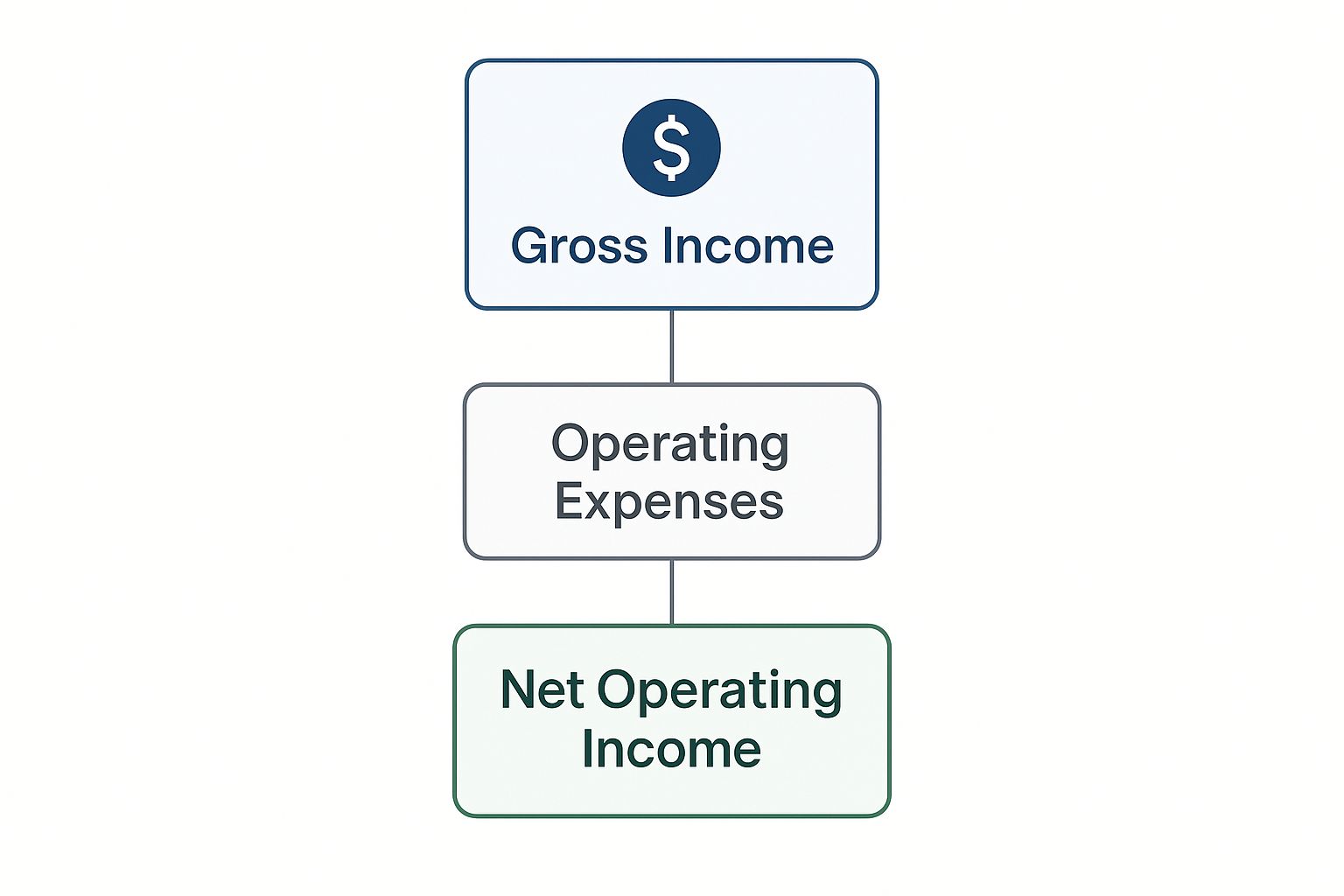
As the visual clearly shows, NOI is the crucial number you get after subtracting all the day-to-day operational costs from your total revenue. It’s the real measure of your property's success and the cornerstone of maximizing your return on investment.
Calculating Your Property's True Revenue

When you think about your property’s income, the monthly rent check is just the beginning. For savvy investors here in Monterey County, understanding every single dollar that comes in is the first step toward getting an accurate Net Operating Income (NOI).
We start with a figure called Gross Operating Income (GOI). This number represents the absolute maximum your property could earn if it were 100% occupied and every tenant paid on time, every time. Think of GOI as the best-case, blue-sky scenario for your investment.
Step 1: Sum Up All Income Streams
To calculate your GOI, you must add up all potential revenue sources. Whether you own a high-end property in Pebble Beach or a multi-unit complex in Salinas, this usually includes more than just the base rent.
- Scheduled Gross Rent: This is the straightforward part—the total rent you’re supposed to collect from all your units each month.
- Additional Income: Don't forget the extras. Revenue from amenities and other services can significantly boost your bottom line. This could be pet fees, laundry machine income, or charges for assigned parking in packed areas like downtown Monterey or Carmel-by-the-Sea.
By tracking these numbers meticulously, you start building a complete picture of your property's total earning power.
Step 2: Adjust for Real-World Conditions with EGI
Let's be realistic: no property stays 100% occupied all year long. To move from a theoretical number to a realistic one, you need to calculate your Effective Gross Income (EGI). This is where professional experience really makes a difference.
EGI takes your Gross Operating Income and adjusts it for the realities of being a landlord, like vacancy periods and credit loss (uncollected rent). It gives you a much clearer, more honest projection of the cash you'll actually have in hand to cover expenses.
For example, a luxury rental in Pacific Grove might sit empty for a month between long-term tenants. A property in a South County town like Soledad or King City might have a tenant who pays late or, worse, defaults on their lease. These are the real-world scenarios you have to account for. For a deeper dive, explore our guide on strategies for higher rental income.
If you're in the vacation rental game, this gets even more complex. Forecasting revenue for a short-term rental requires a different approach, and using specialized Airbnb revenue forecasting tools can offer a huge advantage. By nailing down your EGI, you create a solid, realistic foundation for the entire "what is net operating income" calculation.
Identifying Your Real Operating Expenses

One of the most common—and expensive—mistakes we see investors make is miscategorizing expenses. When you get this wrong, you get a distorted picture of your property’s health, which often leads to poor financial decisions and missed opportunities to improve ROI.
To get an accurate Net Operating Income, you must subtract only the true operating expenses. These are the necessary, everyday costs of keeping your property safe, functional, and generating income. They are the cost of doing business as a landlord, not one-off investments or financing costs.
Fixed vs. Variable Operating Expenses
Your operating expenses fall into two buckets. Mastering both is critical for forecasting cash flow and building a realistic budget, whether you own a single-family home in Salinas or a portfolio of coastal properties.
1. Fixed Expenses: These costs barely change from month to month, regardless of occupancy. They form the predictable foundation of your budget.
- Property Taxes: A significant and unavoidable cost set by Monterey County.
- Property Insurance: Absolutely essential for protecting your valuable asset from liability and unexpected events.
- HOA Fees: A regular expense if your property is in a planned community, which is common in areas like Pebble Beach or parts of Carmel.
2. Variable Expenses: These costs fluctuate based on tenant usage, seasonality, and occupancy levels.
- Utilities: Water, sewer, and trash, if you are responsible for these costs.
- Routine Maintenance & Repairs: This covers everything from landscaping and pest control to fixing a leaky faucet. Get a deeper dive in our guide to rental property maintenance costs.
- Property Management Fees: A key expense that pays for itself in time saved, asset preservation, and professional expertise.
The core idea is simple: If a cost is necessary for the daily operation of the property, it’s an operating expense. If it’s related to your loan, a major upgrade, or your personal tax situation, it doesn’t belong in the NOI calculation.
What to Exclude From Your NOI Calculation
Knowing what to leave out is just as important as knowing what to include. Adding these items will corrupt your numbers and give you a false sense of profitability. These are not operating expenses:
- Mortgage Payments (Debt Service): This is a financing cost related to how you bought the asset, not how you run it.
- Capital Expenditures (CapEx): Big-ticket improvements like a new roof, a full kitchen remodel, or an HVAC replacement are investments that add long-term value, not daily expenses.
- Depreciation: This is a non-cash deduction your accountant uses for tax purposes. No actual money leaves your pocket.
- Income Taxes: Your personal or corporate tax liability is separate from the property's operational performance.
Understanding operating income is fundamental to business, not just real estate. For example, in the U.S. retail sector, operating profits—a metric very similar to NOI—more than tripled between 2001 and 2022, showing how powerful this figure is for tracking performance. While NOI is a key metric, a full financial picture also requires understanding all the eligible tax deductions for rental property you can claim.
How NOI Directly Impacts Your Property's Value

You’ve done the hard work of identifying your property’s true income and expenses. Now we get to the exciting part: turning that NOI number into tangible wealth.
Your Net Operating Income is far more than a performance metric. It's the engine that directly powers your property's market value. For any serious investor in Monterey County—whether you own a multi-unit building in King City or a luxury estate in Carmel—this connection is everything.
The bridge between your annual profit and your property's total worth is a concept called the Capitalization Rate, or "Cap Rate." A Cap Rate is a percentage that shows the expected rate of return on a real estate investment. It’s set by the market and reflects the perceived risk and potential return for similar properties in a specific area like Salinas or the Monterey Peninsula.
The Valuation Formula Every Investor Must Know
The relationship between NOI, Cap Rate, and your property's value is captured in a simple but incredibly powerful formula:
Property Value = Net Operating Income (NOI) / Capitalization (Cap) Rate
Think of it like this: if your NOI is the fuel, the Cap Rate is the engine's efficiency rating. A lower, more attractive Cap Rate means the engine is more powerful—it can convert every dollar of NOI into a much higher property valuation.
A higher, more stable NOI makes your property a premium asset in the eyes of appraisers and potential buyers. It demonstrates proven profitability and lower risk, which naturally commands a higher price and attracts serious, well-qualified investors.
Local Market Forces and Your Property's Worth
Cap Rates are hyper-local. A commercial property in downtown Salinas will have a very different Cap Rate than a vacation rental in Pacific Grove or an apartment complex in Soledad. These rates are constantly being shaped by the local economy, tenant demand, and investor confidence in that specific community.
This is where having a local expert becomes essential. At Coast & Valley, we don't just manage properties; we live and breathe the Monterey County market, so we know the prevailing Cap Rates for assets like yours. By focusing on boosting your NOI through strategic management—like minimizing vacancies and tightening control over maintenance costs—we directly increase the top number in that valuation formula.
Every dollar you add to your NOI has a multiplied effect on your property's value. For example, increasing your annual NOI by just $5,000 in a market with a 5% Cap Rate instantly adds $100,000 to your property’s valuation ($5,000 / 0.05).
That’s how small, consistent operational improvements translate into significant equity growth. Seeing how all your key metrics work together is crucial, which you can explore further in our overview of essential property management KPIs.
Actionable Strategies to Boost Your Rental's NOI
Understanding Net Operating Income is one thing; actively improving it is where savvy investors in Monterey County build real wealth. This is your playbook for increasing profitability. At Coast & Valley, we focus on two fundamental areas to enhance your property’s performance and long-term value: smart revenue growth and strategic expense reduction.
Think of boosting your NOI not just as a real estate task, but as a core business principle. It's a time-tested measure of efficiency and profitability that's been around for over a century. It's not some modern buzzword—it's a foundational concept that smart operators have always used to gauge the health of their business.
Smart Revenue Growth
Growing your revenue doesn't always mean dramatic rent hikes. It often involves a combination of careful analysis, adding value, and minimizing losses from downtime. Our approach for properties from Salinas to Carmel is proactive and data-driven.
- Conduct Thorough Market Rent Analyses: One of the costliest mistakes is under-charging. We continuously analyze comparable properties in your specific neighborhood—be it South County or the Monterey Peninsula—to ensure your rent is aligned with current market demand, preventing you from leaving money on the table.
- Add New Income Streams: High-end tenants will pay for convenience. Consider adding small, revenue-generating amenities like offering paid, secure storage units for recreational gear, or implementing a premium for reserved parking spots in high-demand areas.
- Improve Tenant Retention: Vacancy is the ultimate profit killer. By providing exceptional, concierge-level service and responding quickly to tenant needs, we reduce turnover. A happy, long-term tenant means no lost rent between leases, no marketing costs, and no make-ready expenses. To ensure a steady stream of prospective tenants and maximize your property's revenue, explore additional proven real estate lead generation tactics.
Strategic Expense Reduction
Controlling costs is about being smart and proactive, not just cutting corners. Effective expense management protects your asset and boosts your bottom line simultaneously.
A dollar saved on expenses is a dollar added directly to your NOI. Unlike revenue, which can fluctuate, cost savings deliver a consistent, reliable boost to your property's profitability and overall value.
Here’s our action plan for strategically lowering your operating expenses:
- Leverage Our Vendor Network: With our long-standing relationships with trusted, local Monterey County contractors, we negotiate preferred rates for everything from landscaping to plumbing, passing those savings directly to you.
- Implement Proactive Maintenance: Waiting for something to break is always more expensive. We schedule regular inspections and preventive care to catch small issues before they become costly emergencies, protecting both your budget and your property.
- Install Energy-Efficient Upgrades: Simple changes like installing LED lighting, low-flow fixtures, or smart thermostats can significantly lower utility costs, especially in larger properties. These upgrades not only cut expenses but also appeal to environmentally conscious tenants and may qualify for certain tax benefits. To learn more, read our comprehensive guide on tax deductions for landlords.
Partner with Experts to Maximize Your Investment
Let's be honest—calculating and optimizing your Net Operating Income isn't a "set it and forget it" task. It requires constant attention, a deep understanding of the local Monterey County market, and a solid strategic plan. For any busy professional or serious investor, that’s a massive commitment of time and energy.
This is exactly where professional property management stops being a simple service and becomes a powerful strategic advantage for your high-end Monterey County asset. At Coast & Valley, we take the complex ideas behind what is net operating income and turn them into real, measurable results that boost your bottom line. We treat your property not as a building, but as a business that deserves expert oversight to maximize its ROI.
Your Strategic Advantage in the Monterey Bay Area
Our approach is built on trust, transparency, and two simple pillars: pushing revenue up and keeping costs down.
It all starts with our expert tenant placement process. By finding reliable, long-term occupants, we dramatically cut down on costly vacancies that erode your profits. Simultaneously, our proactive maintenance programs address small issues before they become expensive emergencies, directly lowering your operating expenses and preserving your asset's value.
With deep local roots in Salinas and a reputation for transparent, concierge-level service across the Monterey Peninsula, our founder, Amy Salmina, ensures we manage every property with the care it deserves. We provide the peace of mind that comes from knowing your valuable investment is in expert hands.
Managing a rental is so much more than just collecting a check. As we explain in our article on why rental properties are true businesses, success requires a dedicated, professional focus.
Your property in Carmel, Pacific Grove, or Salinas is a significant investment. Let our team provide a professional analysis of its NOI and unlock its true potential. Your asset deserves nothing less.
Your Top NOI Questions Answered
As property management experts here in Monterey County, we get a lot of questions from savvy investors trying to really nail down the details of Net Operating Income. It's a foundational concept, but the nuances are where the real money is made—or lost. Here are a few of the most common questions we hear, with straightforward answers.
How Often Should I Be Calculating My Property's NOI?
Great question. At a bare minimum, you need to calculate your NOI once a year. This is non-negotiable for tax purposes and for getting that big-picture, annual look at how your investment is performing.
But for active, hands-on management? We strongly recommend a quarterly review, especially for properties in dynamic markets like Carmel or downtown Monterey. Running the numbers every three months allows you to spot trends early, catch rising expenses before they become major problems, and make timely adjustments to your strategy. This proactive approach is key to optimizing your ROI.
Is NOI the Same Thing as Cash Flow?
No, it's not—and this is probably one of the most critical distinctions for any serious real estate investor to grasp. Your Net Operating Income shows you how profitable the property itself is, based purely on its day-to-day operations. It completely ignores your mortgage payment (debt service).
Cash flow is the actual money left in your bank account after you’ve paid the mortgage. Think of it like this: NOI tells you if the property is a well-run business. Cash flow tells you how much profit you personally walk away with after your financing costs are covered.
Can a Property Have a High NOI but Negative Cash Flow?
Absolutely, and it happens more often than you might think, especially in high-value markets like ours. This exact scenario usually pops up with highly leveraged properties—ones where the mortgage payment is hefty relative to the income.
Imagine a well-managed apartment building in Salinas. It could be running perfectly, with full occupancy and controlled expenses, generating a strong, positive NOI. But if the owner's loan payment is too high, it can consume all that operational profit and then some, leaving them with negative cash flow each month. This is precisely why savvy investors look at both metrics to get the full financial story.
It’s also crucial to remember how sensitive income can be to big economic shifts. During the 2008 financial crisis, for instance, the U.S. banking industry’s version of operating income fell to a staggering loss of $35.7 billion in a single quarter. This Statista analysis shows just how quickly external shocks can hammer profitability, a lesson that applies across industries.
Getting the most out of your property's NOI takes expertise and a constant finger on the pulse of the local Monterey County market. Let Coast and Valley Properties provide a professional analysis to unlock your investment's true potential. Contact us today for a comprehensive property evaluation.

What Is a Triple Net Lease? A Guide for Monterey County Investors
For savvy real estate investors, the term triple net lease, or NNN lease, represents a powerful strategy for building a stable, low-maintenance portfolio. In simple terms, it's a commercial real estate agreement where the tenant agrees to pay for the three nets—property taxes, building insurance, and all common area maintenance (CAM) costs—in addition to their base rent. This structure effectively shifts nearly all of a property's operational expenses from the owner to the tenant, creating a more predictable return on investment.
Understanding the Triple Net Lease Structure
For high-end property owners in Monterey County, from agricultural holdings in Salinas to prime retail spaces in Carmel-by-the-Sea, a triple net lease can transform an active management responsibility into a passive, predictable income stream. It aligns your goals with your tenant's, creating a partnership focused on long-term stability.
Imagine owning a high-value asset, but the end-user is responsible for its operational costs, insurance, and taxes. You simply collect a steady payment for its use. This is the core appeal for busy professionals and serious investors seeking to maximize ROI while preserving their time.
This structure is a favorite in commercial real estate because it transfers most of the property's financial risks and operational burdens to the tenant. An NNN lease typically covers everything from utilities and property taxes to insurance and repairs. These leases are built for the long haul, often lasting 10 to 15 years or more, which gives investors a reliable income stream with minimal day-to-day management. For a deeper dive, you can explore more about NNN lease terms and what they entail on DoorLoop.
The Three "Nets" Explained
To truly grasp the value of a triple net lease, you must understand its three core components. These "nets" are the expense categories passed on to the tenant, which differentiates this agreement from other lease types.
This diagram offers a clear visual of the three main expenses a tenant assumes.
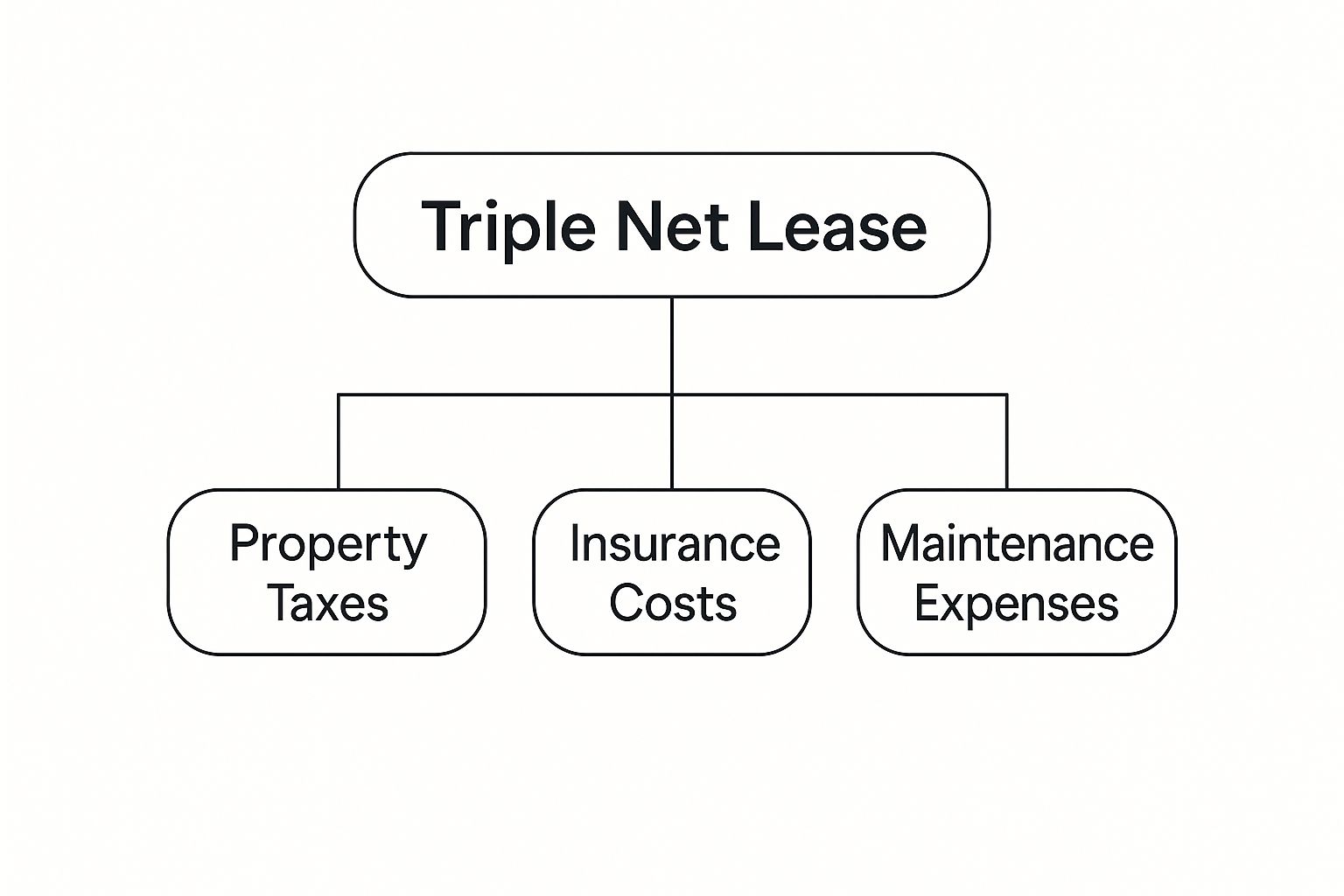
As you can see, the landlord's financial responsibilities are significantly reduced, leading to a cleaner, more straightforward income stream and enhanced property preservation.
NNN Lease Responsibilities: An Actionable Comparison
To make it even clearer, let's compare who pays for what in a typical NNN lease versus a standard gross lease. For an investor in Monterey County, this distinction is critical for projecting returns.
| Expense Category | Tenant Responsibility (NNN Lease) | Landlord Responsibility (Gross Lease) | Actionable Insight for Owners |
|---|---|---|---|
| Property Taxes | ✅ Pays directly or reimburses landlord | ✅ Pays | Your net income is protected from rising local property tax rates. |
| Building Insurance | ✅ Pays directly or reimburses landlord | ✅ Pays | You are insulated from unpredictable hikes in California insurance premiums. |
| Maintenance & Repairs (CAM) | ✅ Pays for most, including CAM | ✅ Pays | Tenant is incentivized to maintain the property, preserving your asset's value. |
| Structural Repairs | ❌ Usually remains landlord's duty | ✅ Pays | Negotiate this point carefully; an "absolute NNN" can shift this cost too. |
The table highlights the fundamental shift in responsibility. In an NNN lease, the tenant absorbs the variable costs, giving you, the owner, a predictable net income. Just remember, major structural repairs—like the roof or foundation—typically remain with the landlord unless specifically negotiated otherwise.
The Financial Advantages for Monterey County Investors
For property owners in Monterey and Salinas, a triple net lease is a powerful tool for mitigating market volatility. This is especially true in California, where property taxes and insurance premiums can rise unexpectedly and erode your returns. By having the tenant cover these variable costs, you are locking in a more secure and predictable investment.
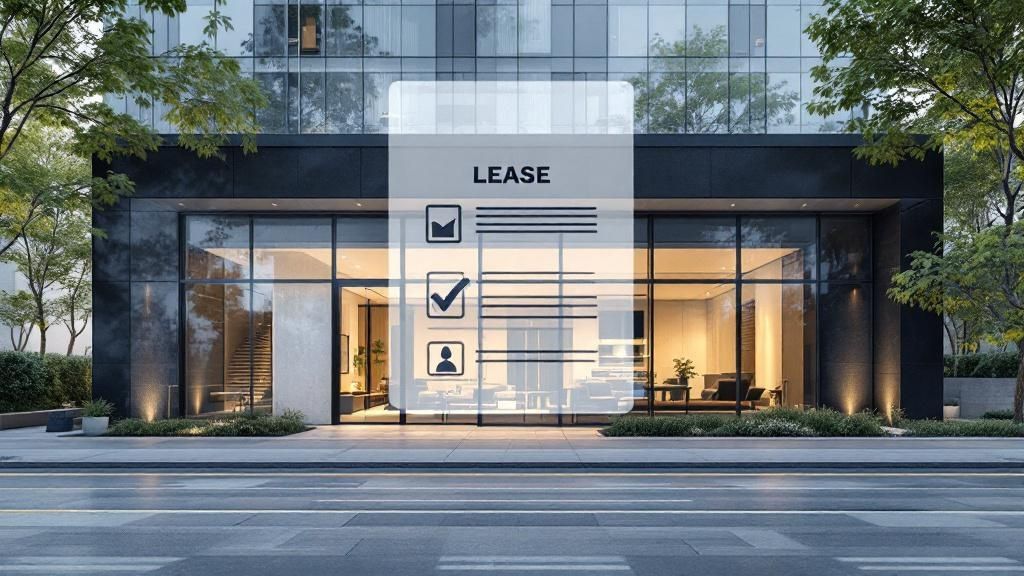
This structure transforms your property's income into something much more stable—almost like a high-yield bond. You receive a consistent base rent each month, while the tenant absorbs the operational expense fluctuations. That level of predictability is the bedrock of long-term wealth building and simplifies financial forecasting for your entire portfolio.
Creating a Stable, Bond-Like Income Stream
The true financial power of an NNN lease lies in its stability. Your tenant assumes responsibility for expenses that can add 20% to 30% on top of base rent, insulating your cash flow from sudden cost increases.
We've seen property taxes and insurance premiums climb by 3% to 5% annually in many markets, a trend that directly erodes profits for landlords on gross leases. For investors holding property in sought-after locations from Pebble Beach to the Salinas Valley, this protection isn't just a benefit—it's essential for preserving your ROI.
This stability also simplifies your financial planning. When you know your exact net income, you can better manage your own capital and strategically identify tax advantages. To optimize your returns, explore our guide on tax deductions for landlords and ensure you’re maximizing every opportunity.
Maximizing ROI with Expert Lease Structuring
While the benefits are clear, your actual return on investment hinges on meticulous lease structuring. A precisely crafted agreement, negotiated by a professional who understands the Monterey County market, ensures every term is clear, enforceable, and aligned with your long-term goals. This is where partnering with a firm like Coast & Valley provides a significant advantage.
As a fourth-generation Salinas native, our founder Amy Salmina understands the specific economic pressures and opportunities in Monterey County. We structure NNN leases that not only protect your investment but also attract high-quality, long-term tenants who contribute to your property's value.
To get a clearer picture of the potential returns and overall financial health of an NNN lease investment, it's wise to use real estate profit estimation tools. These can help you forecast profitability before you commit. Ultimately, a well-managed triple net lease is more than a rental contract; it’s a strategic move to build a resilient, high-performing real estate portfolio.
Why Busy Investors Prefer NNN Leases
For busy professionals and serious property owners, time is the ultimate luxury. A triple net (NNN) lease is specifically structured to protect that time, transforming a hands-on, high-maintenance asset into a source of predictable, passive income.
The real value is its simplicity. By shifting most day-to-day operational duties to the tenant, you are free to focus on your primary business or personal life, not property management details. This structure drastically reduces the work involved in managing an investment property, a major draw for our clients. Instead of fielding repair calls or managing vendors, your primary role becomes collecting a steady rent check.
A Genuinely Passive Investment
If you're seeking a "set it and forget it" real estate investment, the NNN lease is as close as it gets. The tenant is responsible for property taxes, insurance, and all maintenance, freeing you from the most time-consuming aspects of property ownership.
- Minimal Management Burden: Forget late-night calls about a leaky roof or disputes over landscaping. The tenant handles it directly, protecting your time.
- Reduced Administrative Work: With the tenant paying property taxes and insurance premiums directly, you avoid chasing down bills and drowning in paperwork.
- Predictable Cash Flow: Your income stream is stable and largely insulated from surprise maintenance bills or sudden hikes in insurance rates. It makes financial planning clean and simple.
This setup is a game-changer, especially for owners with properties across different areas—from the agricultural hubs of Soledad and King City to the bustling retail centers in Monterey. It allows you to own prime real estate without the operational drag.
A well-structured triple net lease, managed professionally, is one of the closest things to a truly passive real estate investment. It allows our clients to enjoy the financial benefits of property ownership without the typical operational headaches.
Preserving Property Value and Tenant Longevity
NNN leases also create a powerful alignment of interests between you and your tenant. Since the tenant is responsible for all upkeep, they have a built-in incentive to keep the property in excellent condition to support their own business success.
This tenant-funded maintenance directly contributes to the preservation and appreciation of your asset’s value over the long term. Furthermore, NNN tenants are typically established businesses looking to plant roots, leading to longer tenures. This dramatically reduces your vacancy risk and the high costs associated with tenant turnover.
Of course, structuring the agreement correctly from the start is absolutely critical. You can learn more about how we handle this in our guide to commercial property management best practices.
How to Mitigate Potential NNN Lease Risks

While a triple net lease offers incredible advantages, its hands-off nature can lull owners into a false sense of security. The reality is that NNN leases carry unique risks that demand a proactive management strategy. For any discerning investor in Monterey County, understanding these potential downsides is the first step toward protecting your asset.
The primary risks include tenant default, property neglect, and the long, costly vacancies between long-term tenancies. A passive income stream should never mean passive oversight. Protecting your investment requires an expert partner who understands the local economic currents, from the agricultural businesses in Gonzales to the high-end retail storefronts in Monterey.
Proactive Risk Management Checklist
The secret to a successful NNN lease is mitigating risks before they become costly problems. At Coast & Valley, we implement a multi-layered strategy to safeguard our clients' properties. This is about active asset preservation, not just rent collection.
Here is our actionable checklist for NNN risk management:
- ✅ Step 1: Rigorous Tenant Vetting: This is your primary defense against default. We conduct exhaustive financial background checks, analyze business stability, and review operating history. Our deep roots in the Salinas business community give us unique insight into a potential tenant’s reputation and reliability.
- ✅ Step 2: Ironclad Lease Agreements: A generic NNN lease is inadequate. We draft and negotiate custom lease clauses that detail the tenant's maintenance obligations, set firm deadlines for tax and insurance payments, and outline clear remedies for non-compliance.
- ✅ Step 3: Scheduled Property Inspections: Trust, but verify. We perform periodic, fully documented inspections to ensure the tenant is upholding their maintenance responsibilities. This prevents minor issues from becoming major capital repairs and confirms your property is receiving proper care.
Addressing Tenant Default and Neglect
Even with the most thorough screening, circumstances can change. A good tenant can face financial hardship or become uncooperative. When a tenant fails to pay rent, taxes, or maintain the property as agreed, you need a clear, enforceable plan of action.
This is where professional management proves its immense value.
The strength of a triple net lease is only as good as the diligence behind it. Proactive management isn't an expense; it’s an insurance policy against default, neglect, and vacancy.
Having a professional team handle these situations shields you from direct, often stressful, confrontations and ensures every action taken is fully compliant with California law. Our experience helps us handle tricky tenants effectively and legally. We use established protocols to enforce lease terms, issue proper notices, and, if necessary, navigate the eviction process to regain control of your asset as swiftly as possible. This professional buffer preserves both your time and your peace of mind.
The Evolution of the Modern NNN Lease
The triple net lease did not appear overnight. It was an innovative solution born from the need of a growing class of real estate investors who wanted to own property without the burdens of day-to-day management. Understanding its history reveals why it has become the go-to structure for high-value commercial properties in dynamic markets like Monterey County.
Over the last 50 years, the NNN lease evolved from a niche agreement to a cornerstone of institutional real estate. As investment from firms and REITs surged in the 1970s and 80s, they required a standardized, lower-risk way to own property. The triple net lease fit perfectly, creating a hands-off, predictable income stream that fueled the expansion of national retail chains and industrial facilities—a role it still serves today. You can get more details on the legal framework of triple net leases from Cornell Law School.
From Niche Concept to Industry Standard
This evolution directly benefits property owners in our local communities, from South County towns like Soledad and King City to the coastal hubs of Monterey and Carmel. The same principles that made NNN leases a success for large institutional funds are now empowering individual high-net-worth investors to build wealth. The goal remains unchanged: secure, long-term income without the midnight calls about a leaky roof.
A well-crafted NNN lease builds a protective wall around your investment, shielding it from rising maintenance costs, insurance premium hikes, and unexpected property tax increases. For anyone owning commercial assets in a competitive area, understanding how local trends impact property value is non-negotiable. Our real estate market analysis for Salinas provides deep insights into these exact dynamics.
The rise of the NNN lease reflects a fundamental shift in real estate investment philosophy—moving from active landlord to strategic asset owner. It’s about building resilient wealth, not just managing buildings.
At Coast & Valley, this history shapes our modern strategy. We leverage the proven stability of the NNN structure and tailor it to protect and grow the value of your local properties. It’s an approach backed by decades of market evolution, ensuring your investment is positioned for long-term success.
Is an NNN Lease Right for Your Monterey County Property?
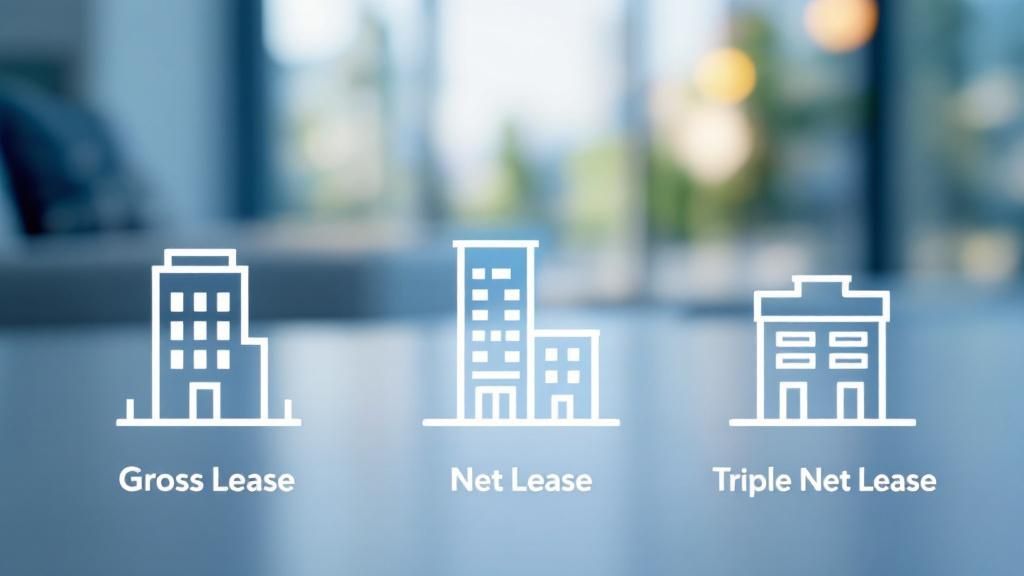
Deciding if a triple net lease is the right strategy for your commercial property depends on your personal investment goals and the nature of the property itself. While the benefits are compelling, this structure is not a one-size-fits-all solution. Asking the right questions upfront is crucial to ensure this powerful lease type aligns with your long-term objectives.
To help you determine the right path, run through this quick evaluation. If you find yourself answering "yes" to these questions, an NNN lease could be an excellent fit for your Monterey County asset.
A Practical Checklist for Property Owners
- Are you seeking a hands-off, truly passive investment? If your primary goal is to reclaim your time and eliminate the daily headaches of property operations, the NNN lease is designed for you.
- Is predictable, steady cash flow a top priority? This lease structure is engineered to deliver a stable, bond-like income stream, protecting you from the volatility of operating costs like taxes and insurance.
- Is your property suitable for a long-term commercial tenant? Think standalone retail, medical offices, industrial buildings, or quick-service restaurants. A property in a high-traffic area of Salinas or a prime location in Pacific Grove is precisely what quality national and regional brands seek.
- Are you prepared to secure a high-quality, creditworthy tenant? This is paramount. The success of an NNN lease is almost entirely dependent on the financial strength and reliability of the business you sign.
When weighing whether an NNN lease is the right call, consider your property's marketability. Attracting the best tenants often starts with exceptional presentation; learn more about elevating your property listings with engaging video content to make your property stand out to desirable brands.
The right lease structure does more than just secure a tenant; it protects your asset and helps you achieve your specific financial goals. Our role is to ensure that alignment is perfect.
If you’re still exploring all your options, our guide for first-time rental property buyers is packed with foundational knowledge that can help bring your investment strategy into focus.
Ultimately, structuring the perfect lease demands deep local expertise. Amy Salmina and the Coast & Valley team can evaluate your property and advise on the best path forward. Contact us today for a professional property evaluation and let us help you build a lease that delivers both security and peace of mind.
Frequently Asked Questions About NNN Leases
Even for sophisticated investors, the details of a triple net lease can raise important questions. Here are clear, actionable answers to common concerns we hear from property owners in Monterey County, empowering you to manage this powerful investment tool with confidence.
What Happens if My NNN Tenant Fails to Pay Property Taxes?
This is a critical question that highlights a significant risk. If your tenant fails to pay property taxes, the liability—and any potential liens—ultimately falls on you, the owner. Your asset is on the line. This is why proactive, professional management is non-negotiable.
Here is our step-by-step approach to prevent this:
- Step 1: Set Up Escrow Accounts: We often structure leases to require tenants to pay a monthly estimate for property taxes into an escrow account. This ensures funds are set aside and available when the tax bill is due.
- Step 2: Draft Ironclad Lease Clauses: Our agreements include default clauses with specific penalties and grant us the authority to act immediately if a payment is missed.
- Step 3: Actively Monitor Payments: We don't wait for a delinquency notice from the county. Our team proactively verifies that tax and insurance payments are made on time, every time.
Are Major Structural Repairs a Tenant Cost?
This is one of the most important points to clarify during negotiations. In a standard NNN lease, major capital expenditures—such as a full roof replacement or foundation work—remain the landlord's responsibility. The tenant handles routine maintenance, but not the large-scale projects that extend the building's life.
However, an absolute net lease (or "bondable lease") takes it a step further. This structure passes all responsibilities, including major structural repairs, to the tenant. It offers the ultimate hands-off investment but requires an exceptionally strong, creditworthy tenant and a meticulously drafted lease. Structuring these terms correctly is a specialized skill our team uses to protect our clients' long-term financial health.
How Is This Different from a Double Net Lease?
The primary difference lies in the third "N": maintenance. It's a simple distinction with significant financial implications for an investor.
- Double Net (NN) Lease: The tenant pays for property taxes and insurance premiums. The landlord remains responsible for all maintenance costs, from landscaping to repairs.
- Triple Net (NNN) Lease: The tenant pays for property taxes, insurance, and all common area maintenance (CAM) costs.
That third "N" is what transfers the majority of the operational burden and financial risk from the owner to the tenant. For investors in Salinas and the surrounding Monterey Bay Area who seek a more stable, predictable ROI, the NNN lease is almost always the superior choice.
Your property deserves expert oversight to maximize its potential and protect its value. Coast and Valley Properties provides the strategic, hands-on management needed to make your real estate investment a success. Contact us to schedule a professional evaluation of your property portfolio.

Top Property Management Technology Trends for High-End Monterey Bay Portfolios
For high-end property owners and serious investors in Salinas, Monterey, and across the South County, staying ahead of the curve is essential for maximizing ROI and preserving asset value. The real estate market is constantly evolving, driven by powerful property management technology trends that redefine efficiency, security, and the tenant experience. Gone are the days of manual rent collection and paper-based maintenance requests. Today's premium properties demand seamless, tech-driven solutions that offer owners unparalleled convenience and peace of mind.
This guide moves beyond generic advice to provide a detailed, actionable overview of the top platforms and systems revolutionizing the industry. We will dive deep into the specific technologies that solve the biggest challenges for busy professionals and absentee landlords, from 24/7 digital access to proactive maintenance coordination. For investors with portfolios in communities like Pacific Grove or Pebble Beach, adopting these tools is a critical part of implementing essential asset management best practices.
Here, you will find a comprehensive roundup of the leading technology solutions, including our own integrated platform, Buildium, AppFolio, and more. Each review includes screenshots, direct links, and practical insights tailored to the unique demands of the Monterey Bay market. We will show you precisely how these innovations can elevate your portfolio, reduce operational friction, and deliver the concierge-level service that protects your investment and attracts high-caliber tenants. This is your definitive resource for choosing the right technology to enhance your property's value and performance.
1. Our Technology by Coast & Valley Properties: A High-Touch, High-Tech Approach
For property owners in Salinas and the greater Monterey Bay Area, the challenge is often finding a management solution that pairs sophisticated technology with genuine, hands-on local expertise. Coast & Valley Properties masterfully resolves this by integrating a powerful digital platform with its signature white-glove service. This hybrid model represents a key trend in property management technology: using tools not to replace human oversight, but to enhance it, delivering a seamless experience for discerning owners and high-quality tenants.
Led by fourth-generation Salinas native Amy Salmina, the company's approach stands out in a crowded market. It’s not just about providing an online portal; it’s about creating a centralized, secure hub that reflects their commitment to trust, efficiency, and premium care. This makes their service ideal for busy professionals, remote investors, and luxury homeowners who demand both cutting-edge convenience and the assurance of a trusted local expert managing their assets.
Core Features and Owner Benefits
Coast & Valley Properties leverages a robust online portal that serves as the digital backbone for its comprehensive management services. This technology is intentionally designed to streamline operations and provide owners with unparalleled access and control, maximizing your time and ROI.
- 24/7 Owner Access: Log in anytime to get a real-time snapshot of your portfolio's performance. This includes viewing detailed financial statements, tracking income and expenses, and accessing important documents like lease agreements and inspection reports. This level of secure transparency is crucial for investors managing properties in Salinas from afar or those who simply value immediate access to information.
- Streamlined Financial Management: The platform automates rent collection and facilitates secure, direct-deposit owner disbursements. This eliminates the delays and manual processing associated with traditional methods, ensuring predictable, reliable cash flow for your Monterey County properties.
- Centralized Maintenance Coordination: When a tenant submits a maintenance request through their portal, it is instantly logged and tracked. Owners can view the status of all work orders, approve estimates from trusted local vendors, and access invoices, all in one place. This creates an efficient, auditable trail that prevents small issues from becoming costly problems.
- Enhanced Tenant Relations: Tenants in your Soledad or Gonzales property benefit from the same level of digital convenience. They can pay rent online, submit maintenance requests with photos, and communicate directly with our team. A positive, tech-enabled tenant experience leads to higher retention rates and reduces costly vacancies.
Why It Stands Out: Beyond the Portal
While many firms offer an online portal, Coast & Valley’s strength lies in how this technology is interwoven with its concierge-level service. The platform is a tool that empowers our team to be more proactive, responsive, and strategic.
Key Insight: The most effective property management technology trends are not about automation alone. They are about using digital tools to amplify human expertise, build trust, and deliver superior service. Coast & Valley embodies this by ensuring every digital interaction is backed by a knowledgeable local professional, a principle reinforced by Amy Salmina’s deep community roots.
Furthermore, our communication strategy extends beyond a single platform. Efficiently managing tenant and owner interactions across multiple touchpoints is critical. For instance, understanding omnichannel customer service highlights how integrating email, phone, and portal messages creates a cohesive and responsive experience, a principle at the core of our service philosophy.
For property owners who want to delve deeper into the strategic advantages of adopting such systems, Coast & Valley provides excellent resources. You can explore our insights on why a digital-first approach is essential for modern landlords. Learn more about the benefits of going digital on coastandvalleypm.com.
Practical Use Case: Managing a Luxury Carmel Rental Remotely
Consider an investor who owns a luxury vacation rental in Carmel-by-the-Sea but resides out of state. With Coast & Valley, they can:
- Monitor Finances: Log in to the owner portal to see that rent was paid on time.
- Oversee Maintenance: Receive a notification that the tenant reported a malfunctioning Sub-Zero refrigerator via the tenant portal.
- Approve Repairs: Review the work order, see the trusted local appliance vendor assigned, and approve the repair estimate—all without a single phone call.
- Access Records: Download the final invoice and a year-end financial statement for tax purposes.
This entire process is seamless, transparent, and handled with the urgency and professionalism that high-value assets demand, all thanks to the powerful combination of our technology and expert local management.
Website: coastandvalleypm.com/our-technology/
2. Buildium
Buildium stands out as a powerful, all-in-one platform engineered to meet the complex demands of modern property management. For owners of premium residential portfolios, community associations, and even specialized assets in areas from Salinas to the Monterey Bay coast, it provides a centralized command center. It effectively merges accounting, leasing, and operational workflows into a single, intuitive interface, making it a cornerstone for managers aiming to deliver white-glove service. The platform's commitment to continuous updates ensures it remains aligned with the latest property management technology trends.
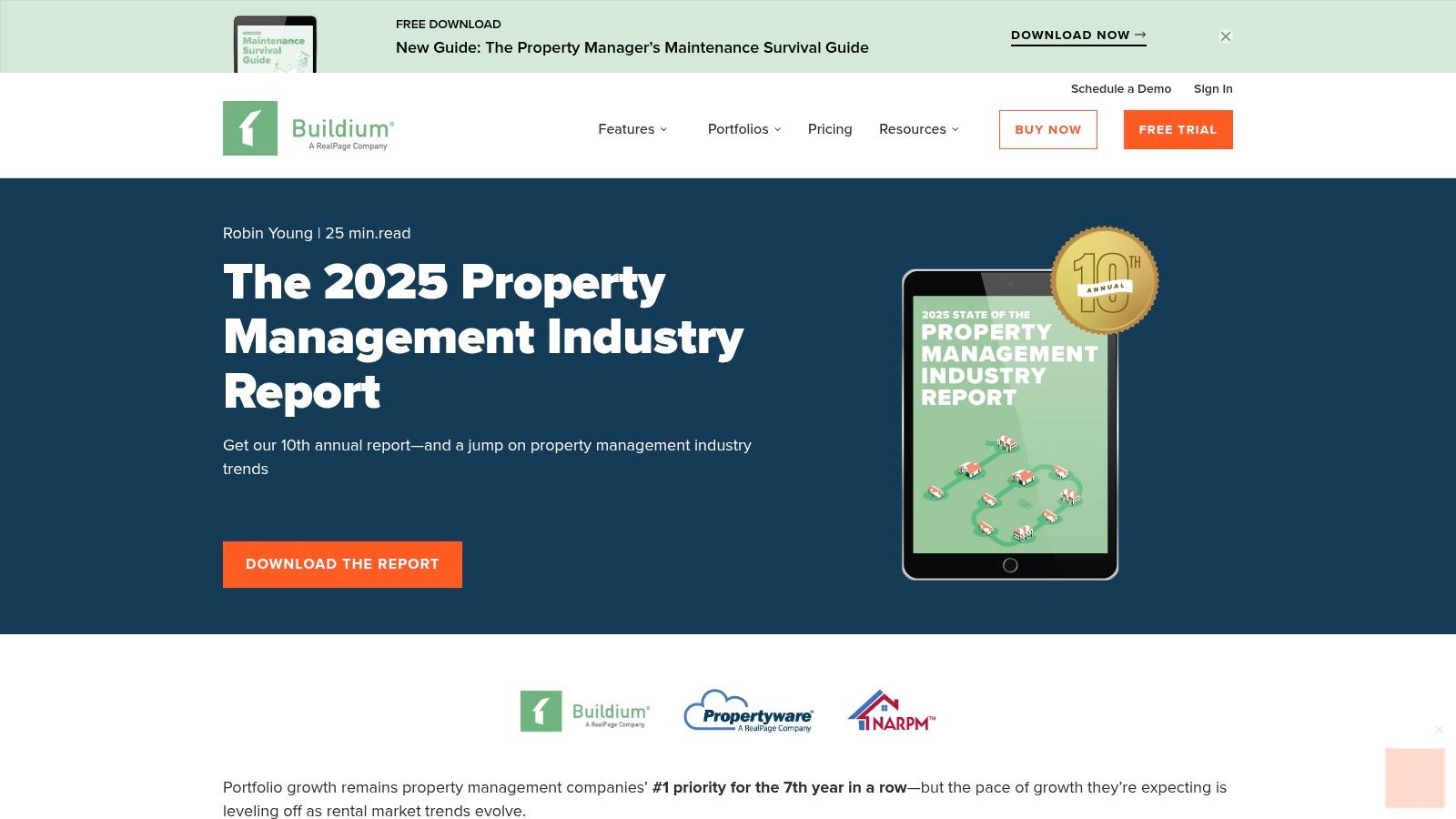
What makes Buildium particularly valuable for managing high-end properties is its robust feature set that prioritizes efficiency and transparency. From integrated accounting tools that handle complex financial reporting to online portals that facilitate seamless communication between tenants, owners, and managers, Buildium streamlines every touchpoint. This digital access is crucial for busy professionals and absentee landlords who need 24/7 insight into their investments.
Key Features and Benefits
Buildium’s platform is designed to automate and simplify core property management tasks, allowing managers to focus on strategic growth and tenant relations.
- Integrated Financial Management: The platform offers comprehensive accounting tools, from automated rent collection and late fee processing to vendor payments and detailed financial reporting. This ensures complete transparency for property owners tracking their ROI.
- Online Portals: Secure, dedicated portals for tenants and owners create a direct line of communication. Tenants can pay rent and submit maintenance requests, while owners can access financial statements and property updates in real-time.
- Maintenance and Vendor Coordination: Track maintenance requests from submission to resolution. You can assign jobs to vendors, communicate updates, and pay invoices directly through the platform, ensuring luxury properties receive prompt and professional care.
- Marketing and Leasing Automation: When vacancies arise, Buildium helps you market your properties across top listing sites. It also manages the entire leasing lifecycle, from online applications and tenant screening to digital lease signing. For a deeper analysis of how Buildium stacks up against other tools, this property management software comparison provides additional insights.
Pricing and Access
Buildium offers tiered pricing based on the number of units you manage. The plans are named Essential, Growth, and Premium. While the entry-level "Essential" plan is feature-rich, unlocking the full suite of automation tools, analytics, and integrations requires subscribing to the "Growth" or "Premium" tiers. Some advanced functionalities may come with additional fees, so it's essential to evaluate your portfolio's specific needs. Their comprehensive customer support and training resources help ensure a smooth implementation process. Access is web-based, providing flexibility for managers and owners to log in from anywhere.
3. AppFolio
AppFolio positions itself as a dynamic, cloud-based solution built for real-time property management. It serves a diverse range of portfolios, from premium residential properties in Salinas to complex commercial holdings across Monterey County, by offering a scalable and intuitive platform. Its key strength lies in centralizing operations with a strong emphasis on data-driven insights and mobile accessibility, making it an indispensable tool for investors and owners who demand both efficiency and on-the-go control. The platform’s design aligns perfectly with emerging property management technology trends by prioritizing real-time data and remote capabilities.
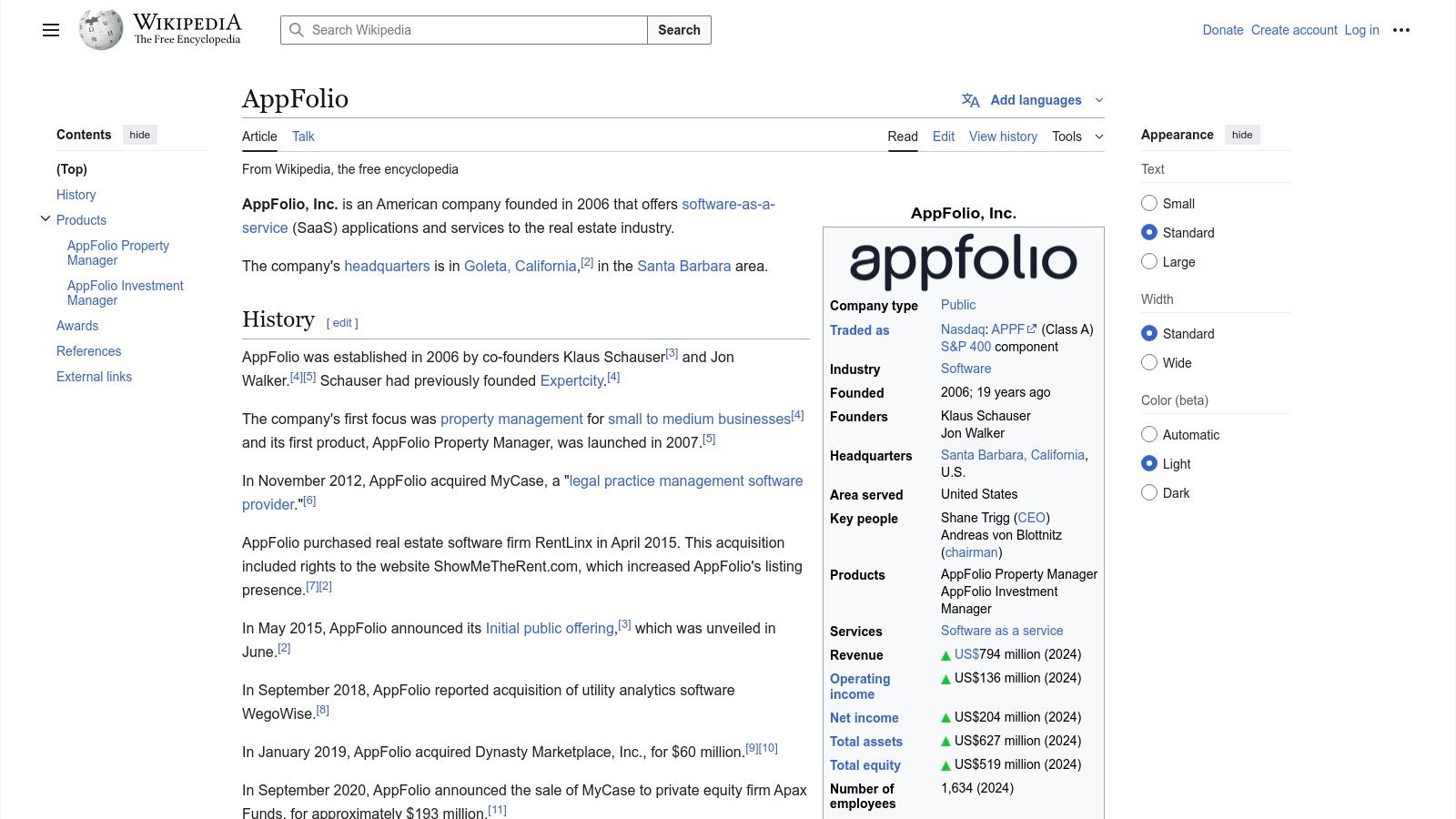
For managers overseeing high-value assets, from luxury homes in Pebble Beach to multi-unit buildings, AppFolio's seamless integration of leasing, accounting, and communication is a significant advantage. Its modern, user-friendly interface simplifies complex tasks, while its robust reporting features provide the deep financial visibility that serious investors require. This focus on a clean user experience and powerful backend functionality ensures that managers can deliver the premium service and transparency that high-net-worth clients expect.
Key Features and Benefits
AppFolio is engineered to streamline the entire property lifecycle, empowering managers to operate more effectively and make smarter, data-backed decisions. Its features are particularly beneficial for managing properties along the Monterey Bay Coast, where owners may be remote.
- Real-Time Accounting and Financials: The platform delivers powerful, real-time accounting with customizable financial reports. This allows for instant performance analysis, helping owners track ROI and make informed decisions without delay.
- Online Leasing and Digital Signatures: AppFolio automates the entire leasing process, from online applications and comprehensive tenant screening to legally binding digital lease signing. This accelerates the leasing cycle and secures high-quality tenants faster.
- Mobile-First Management: With a fully functional mobile app, managers can handle critical tasks like communicating with tenants, approving work orders, and accessing property data from anywhere. This is crucial for providing responsive, concierge-level service.
- Automated Marketing and Vacancy Posting: The system automatically syndicates vacant listings to top rental websites, maximizing exposure for properties. Its professional, customizable marketing websites help attract premium tenants. AppFolio's website provides more details on its comprehensive marketing suite.
Pricing and Access
AppFolio’s pricing is typically structured on a per-unit, per-month basis, with different tiers for residential, commercial, and student housing portfolios. There is generally a monthly minimum fee, making it better suited for managers with established portfolios rather than those with just one or two properties. While its cost may be higher than some entry-level competitors, the investment is justified by its robust feature set and continuous innovation. The platform is entirely web-based, ensuring secure access from any device, and is known for its excellent customer support and onboarding process, although the initial setup can have a learning curve for new users.
4. Rent Manager
Rent Manager distinguishes itself with a highly flexible and powerful platform built for property portfolios of any scale. Its strength lies in its profound customizability, allowing managers from Salinas to Monterey to tailor every aspect of the software to their specific operational needs. For those overseeing diverse assets, from single-family luxury homes to multi-unit commercial buildings, Rent Manager offers an open-architecture system that can be precisely molded to fit unique business processes. This adaptability is a key reason it remains a leader among property management technology trends.
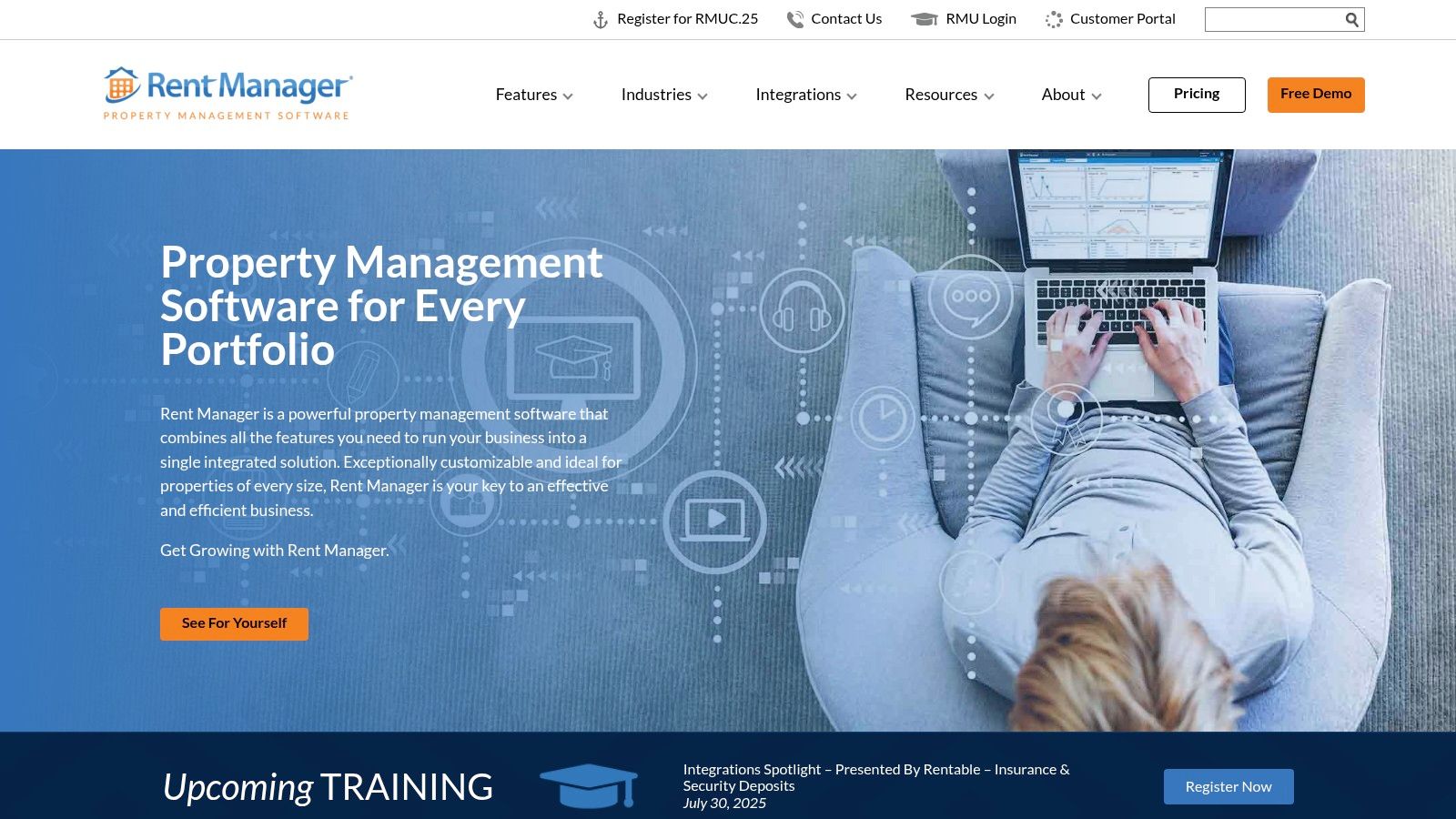
What makes Rent Manager especially appealing for high-end portfolio management is its combination of robust, built-in features and the ability to integrate with other best-in-class tools. The platform provides a comprehensive accounting suite, detailed maintenance tracking, and powerful communication portals. For busy investors and absentee owners who demand both granular detail and at-a-glance summaries, this level of control ensures complete oversight and confidence in their property's performance.
Key Features and Benefits
Rent Manager’s platform is engineered to provide deep functionality and control, empowering managers to optimize workflows and enhance service delivery.
- Comprehensive Accounting System: The software includes a fully integrated, customizable accounting system capable of handling complex financial tasks. From detailed general ledger reporting to accounts payable and receivable, it offers unparalleled financial control and transparency for property owners.
- Work Order and Maintenance Tracking: Efficiently manage maintenance requests with a detailed work order system. You can track jobs, dispatch vendors, communicate with tenants, and bill owners or tenants directly through the platform, ensuring premium properties are maintained to the highest standard.
- Integrated Marketing and Website Tools: Rent Manager provides tools to build a professional, integrated marketing website to showcase vacancies. It also automates the process of posting listings to major rental sites, streamlining the leasing process from start to finish.
- Tenant and Owner Portals: Secure online portals foster direct and efficient communication. Tenants can pay rent and submit service requests, while owners can access customized reports and financial statements 24/7, aligning with modern property management best practices.
- Mobile App for Remote Management: The rmAppSuite offers full mobile capability, allowing managers to handle inspections, work orders, and tenant communications directly from the field, which is essential for providing responsive service across Monterey County.
Pricing and Access
Rent Manager's pricing is customized based on the portfolio's size and specific needs, requiring direct contact for a quote. This bespoke approach ensures you only pay for the features you require. While the user interface may present a steeper learning curve compared to some newer platforms, its power and flexibility are unmatched. The company is known for its strong customer support and extensive training resources, including online courses and live support, which help new users navigate its extensive capabilities. Access is available through both a locally installed version (Rent Manager 12) and a cloud-based option (Rent Manager Online), offering flexibility for different IT infrastructures.
5. Re-Leased
Re-Leased carves out a specialized niche within the proptech landscape, offering a powerful, cloud-based platform tailored specifically for commercial real estate portfolios. For owners and managers of office buildings, retail centers, and industrial properties in areas like Salinas and greater Monterey County, it provides a sophisticated toolkit designed to handle the unique complexities of commercial leases and asset management. Its core strength lies in its deep integration with accounting software and its automation of critical administrative tasks, positioning it as a key component of modern property management technology trends.
What makes Re-Leased particularly effective for commercial asset management is its singular focus on automating lease administration and financial oversight. The platform excels at managing intricate lease agreements with multiple tenants, tracking critical dates like rent reviews and expirations, and providing a clear financial picture in real-time. This level of detail is indispensable for commercial landlords who need to maximize revenue, ensure compliance, and make data-driven decisions about their investments.
Key Features and Benefits
Re-Leased is engineered to bring efficiency and clarity to the commercial property lifecycle, from leasing and operations to financial reporting and strategic planning.
- Automated Lease Management: The platform centralizes all lease information and sends automated reminders for critical dates, such as rent reviews, lease expiries, and insurance renewals. This proactive approach minimizes risk and helps secure tenant retention.
- Integrated Accounting with Xero and QuickBooks: Re-Leased offers a seamless two-way sync with leading accounting platforms. This integration eliminates double data entry and provides landlords with a real-time, accurate view of property performance and profitability.
- Maintenance and Task Automation: Manage property maintenance workflows efficiently by tracking jobs, assigning tasks to vendors, and communicating updates to tenants. This ensures that commercial properties are maintained to the highest standards, protecting asset value.
- Tenant and Owner Communication Portals: Dedicated portals provide a direct and transparent line of communication. Tenants can report issues, and owners can access financial reports and property updates, which is crucial for tracking the key performance indicators that matter most. For more information, you can explore this overview of essential property management KPIs.
Pricing and Access
Re-Leased employs a customized pricing model, requiring direct contact for a quote tailored to the specific needs and size of your commercial portfolio. While this approach ensures you only pay for what you need, it means pricing is not transparently listed on their website. The platform is best suited for commercial property managers and is less ideal for those managing residential units. Its robust integration capabilities and user-friendly interface make it a top choice for investors looking to professionalize the management of their commercial assets. Access is entirely web-based, offering the flexibility to manage your portfolio from any location.
6. MRI Software
MRI Software is a powerhouse in the property management technology landscape, offering a highly adaptable and comprehensive suite of solutions designed for sophisticated real estate portfolios. For owners and investors managing complex assets, including commercial, residential, and mixed-use properties in regions like Salinas and Monterey County, MRI provides an enterprise-grade platform. It excels at unifying lease administration, advanced accounting, and facilities management into a cohesive, scalable system, making it a critical tool for those pursuing strategic growth and operational excellence. This platform's robust architecture and focus on extensibility are hallmarks of today's property management technology trends.
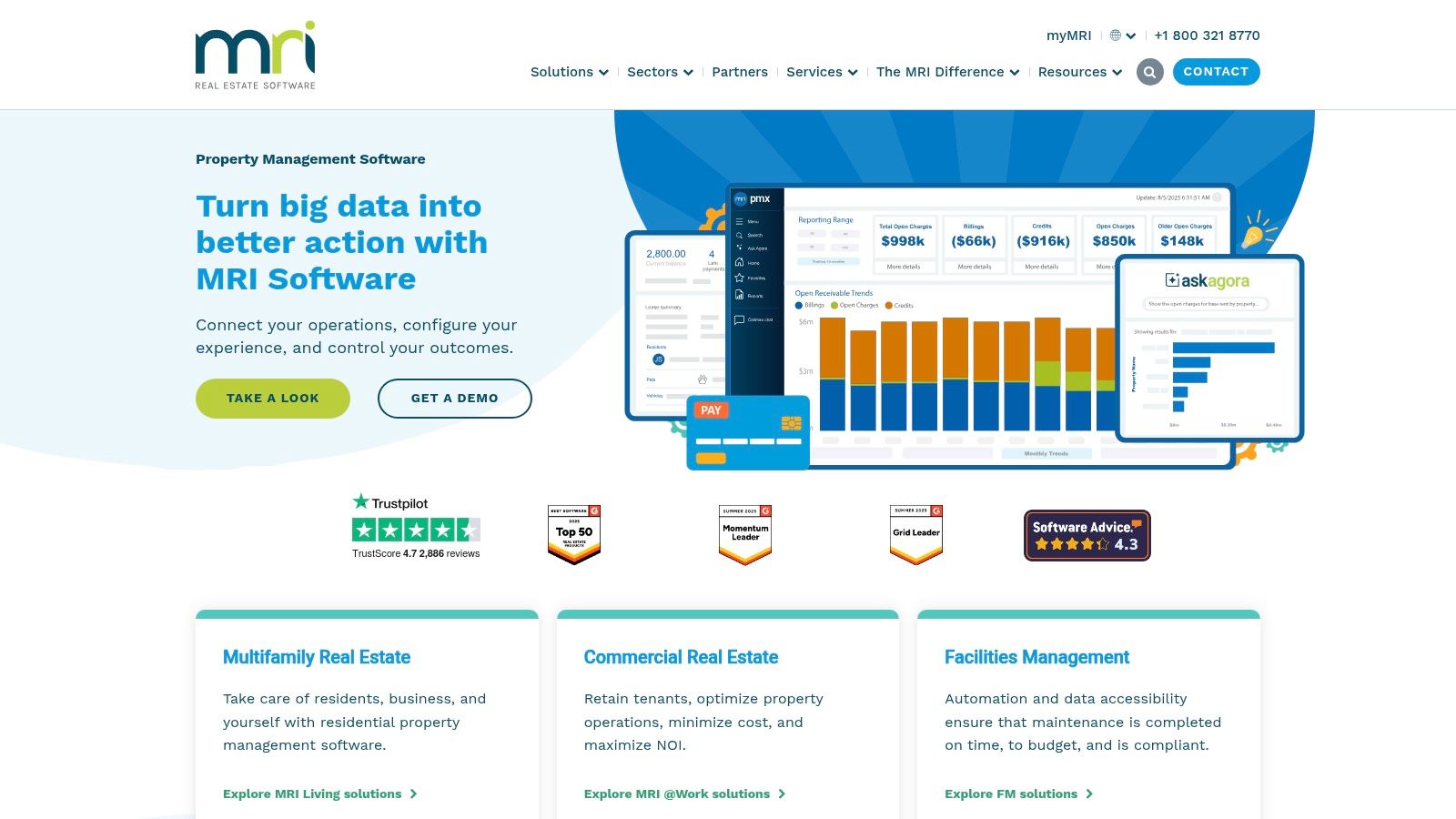
What sets MRI Software apart is its deep specialization and flexibility. Unlike one-size-fits-all solutions, MRI's platform is highly configurable, allowing it to be tailored to the unique financial and operational requirements of large-scale or diversified portfolios. Its strong focus on compliance and intricate lease administration makes it particularly suitable for commercial property management, ensuring landlords meet regulatory standards while maximizing returns. This level of detail provides the transparency and control that discerning investors and absentee owners demand.
Key Features and Benefits
MRI Software’s open and connected ecosystem empowers managers to build a technology stack that perfectly matches their business needs, from financial oversight to tenant engagement.
- Advanced Lease Administration and Accounting: MRI offers sophisticated tools for managing complex lease clauses, escalations, and recoveries. Its accounting module is built for real estate, handling everything from general ledger and accounts payable to job costing and financial consolidations, providing owners with institutional-grade reporting.
- Facilities Management: The platform provides a comprehensive system for tracking maintenance requests and managing work orders from start to finish. This ensures that high-value commercial and residential properties receive prompt, documented care, preserving asset value and tenant satisfaction.
- Tenant and Investor Portals: MRI facilitates seamless communication through dedicated online portals. Tenants can manage payments and service requests, while investors gain secure, on-demand access to performance dashboards and financial statements, fostering trust and transparency.
- Business Intelligence and Reporting: With powerful analytics and customizable reporting tools, managers can transform raw data into actionable insights. This helps in making strategic decisions regarding leasing, budgeting, and capital improvements to maximize portfolio ROI.
Pricing and Access
MRI Software’s pricing is customized based on the specific modules, user count, and portfolio size. Given its enterprise focus, it is generally positioned for larger or more complex operations, and its cost reflects the depth of its capabilities. Implementation and training can be resource-intensive, but this investment ensures the platform is configured to deliver maximum value. As a highly scalable solution, it is designed to grow with your business, accommodating diversification into new asset classes. Access is typically web-based, providing the flexibility needed to manage properties from anywhere.
7. Showdigs
Showdigs introduces a revolutionary approach to one of the most time-consuming aspects of property management: showings. It operates as a specialized platform that connects property managers with a network of on-demand, licensed real estate agents to conduct property tours. For managers of premium portfolios from Salinas to the Monterey Bay coast, this service is a game-changer, freeing up valuable time and ensuring prospective tenants receive prompt, professional attention, even on short notice. This model is a prime example of how property management technology trends are moving towards specialized, on-demand services to create efficiency.
What makes Showdigs uniquely valuable is its ability to eliminate the logistical nightmare of scheduling and conducting dozens of showings. Instead of stretching your team thin, you can dispatch a local, vetted agent to meet prospects, answer basic questions, and secure the property afterward. This flexibility is crucial for attracting high-quality tenants in competitive markets, as it allows for immediate responses to inquiries and accommodates the busy schedules of professionals seeking luxury rentals. The platform also provides valuable feedback from each tour, giving you real-time market insights.
Key Features and Benefits
Showdigs is engineered to streamline the top of the leasing funnel, ensuring vacancies are filled faster with a better tenant experience.
- On-Demand Property Showings: Access a network of licensed real estate agents to handle property tours seven days a week. This "showings-as-a-service" model ensures no lead is missed due to scheduling conflicts.
- Automated Scheduling and Communication: The platform manages communications with prospective tenants, confirming appointments and sending reminders. This automation reduces administrative workload and provides a seamless experience for potential renters.
- Real-Time Feedback and Reporting: After each showing, the agent submits a detailed report, including prospect feedback and property condition notes. This data is invaluable for adjusting marketing strategies or addressing property issues.
- Integration with PM Software: Showdigs integrates with popular property management systems, allowing for a smooth transition from showing to application. This is a critical step before moving on to the screening phase. For a comprehensive guide on what to look for next, exploring a detailed tenant screening checklist can ensure you select the best candidates.
Pricing and Access
Showdigs offers a pay-per-showing model, making it a scalable solution that aligns with your leasing activity. The cost varies based on location and the specific services required, such as open houses versus individual tours. There are no long-term contracts or subscription fees, providing flexibility for property managers to use the service as needed. Access is managed through a web-based dashboard where you can request showings, track progress, and view reports. While service availability is robust in major metro areas, it's important to confirm agent coverage in more specific locales like South Monterey County.
Technology Features Comparison of 7 Property Management Solutions
| Property Management Solution | Implementation Complexity 🔄 | Resource Requirements ⚡ | Expected Outcomes 📊 | Ideal Use Cases 💡 | Key Advantages ⭐ |
|---|---|---|---|---|---|
| Our Technology | Medium 🔄 | Moderate ⚡ | High 📊 | Busy professionals, investors, landlords seeking quality tenants 💡 | Local expertise, concierge service, advanced portals, strong reputation ⭐ |
| Buildium | Low-Medium 🔄 | Moderate ⚡ | High 📊 | Residential properties, community associations, student housing 💡 | User-friendly, comprehensive tools, regular updates ⭐ |
| AppFolio | Medium 🔄 | Moderate-High ⚡ | High 📊 | Residential, commercial, student housing, scalable portfolios 💡 | Real-time data, mobile app, continuous tech updates ⭐ |
| Rent Manager | Medium-High 🔄 | Moderate-High ⚡ | High 📊 | Portfolios of any size needing customization 💡 | Highly customizable, strong support, integrated website tools ⭐ |
| Re-Leased | Low-Medium 🔄 | Moderate ⚡ | High 📊 | Commercial real estate with strong automation needs 💡 | Automation, integration with accounting software, user-friendly ⭐ |
| MRI Software | High 🔄 | High ⚡ | Very High 📊 | Large, complex commercial/residential/mixed-use portfolios 💡 | Comprehensive, scalable, compliance-focused, robust BI tools ⭐ |
| Showdigs | Low 🔄 | Low ⚡ | Medium 📊 | Automated property showings, leasing-focused managers 💡 | On-demand showings, scheduling automation, tenant experience enhancement ⭐ |
Partner with Coast & Valley to Implement a Future-Ready Property Strategy
The landscape of property management is no longer defined by traditional methods but by a dynamic fusion of technology and hands-on expertise. As we've explored, the leading property management technology trends—from comprehensive platforms like Buildium and AppFolio to specialized tools like Showdigs and Re-Leased—are reshaping how owners, investors, and tenants interact with their properties. These innovations are not just about convenience; they are strategic assets that drive efficiency, maximize return on investment, and elevate the standard of care for high-end residential and commercial portfolios.
For property owners in Salinas and across Monterey County—from luxury homes in Pebble Beach to multi-unit investments in Soledad and King City—simply knowing about these tools isn't enough. The real challenge, and opportunity, lies in implementing them as part of a cohesive, future-ready strategy that preserves your asset's value and maximizes your time. The goal is to create a seamless system where technology handles the routine so that human expertise can focus on what matters most: strategic decision-making, proactive maintenance, and white-glove tenant relations.
From Trends to Tangible Results: Your Actionable Checklist
Adopting new technology can feel overwhelming, but a structured approach simplifies the process and ensures you select the right solutions for your specific goals. For busy professionals and serious investors, the path forward involves careful evaluation and strategic implementation.
Here is an actionable checklist to guide your next steps:
- ✅ Define Your Core Needs First: Before you get dazzled by features, clarify your biggest pain points. Are you struggling with rent collection, maintenance coordination, or lengthy vacancy periods? Your answer will guide you toward the right tool. An investor with a single-family rental in Salinas might prioritize a tool with a robust owner portal, while a commercial owner in Monterey will need advanced lease administration.
- ✅ Prioritize Integration and Scalability: The most effective tech stack is one where tools work together. A scalable solution will grow with your portfolio, preventing the need to migrate systems every few years as you acquire more properties in the Monterey Bay area.
- ✅ Evaluate the Tenant Experience: Today's tenants, especially in premium markets like Carmel or Pacific Grove, expect digital convenience. A platform with a user-friendly tenant portal for paying rent and submitting maintenance requests is a necessity for retaining high-quality tenants and reducing vacancies.
- ✅ Emphasize Trust and Security: Technology must be secure. Ensure any platform you consider uses robust security protocols to protect your financial data and tenant information. Trust is paramount.
- ✅ Consider the Human Element: Technology should empower, not replace, professional oversight. The best property management service combines powerful software with local, on-the-ground expertise. This blend ensures that while a system can flag a maintenance request at 2 AM, a trusted local vendor is dispatched promptly to resolve the issue.
The Coast & Valley Difference: Technology with a Personal Touch
Navigating these property management technology trends requires a partner who understands both the software and the unique demands of the Salinas and Monterey County markets. At Coast & Valley Properties, we have already done the heavy lifting. We've vetted, tested, and integrated the industry's best technology to create a management system that delivers unparalleled efficiency, security, and transparency.
Our approach, guided by Amy Salmina’s deep local roots and professional expertise, ensures your property is managed with a tech-forward mindset and a commitment to concierge-level service. We leverage these tools not as a replacement for personal interaction but as a way to enhance it, giving you 24/7 access to your property's performance while we handle the day-to-day complexities. By partnering with us, you are not just hiring a property manager; you are investing in a proven system designed to protect your asset, maximize your returns, and give you back your most valuable resource: time.
Ready to see how a strategic blend of advanced technology and local expertise can transform your property's performance? Contact Coast and Valley Properties to learn how our full-service management solutions are tailored for high-end owners and investors in the Monterey Bay area. Let us build a future-ready strategy for your portfolio today.

A Salinas Investor's Guide to Commercial Property Management
Think of your commercial property manager less as a vendor and more as the Chief Operating Officer for your real estate investment. Their real job isn't just to collect rent and fix leaky faucets; it's to turn your asset from a passive holding into a high-performing business, generating maximum ROI and giving you back your time. This is the core of our commercial property management guide for Salinas and Monterey County investors.
Your Blueprint for Success in Salinas Commercial Real Estate
This partnership is absolutely vital for navigating the unique market here in Salinas and across Monterey County. Whether you own retail space in historic Oldtown, a professional building near Salinas Valley Memorial Hospital, or industrial facilities along the Highway 101 corridor, you need a clear roadmap. For discerning investors in the Salinas Valley, this guide is your blueprint for achieving both peace of mind and a superior return on your investment.
Truly effective management is built on a foundation of several key services, all working together to create a seamless, profitable operation.
"A successful commercial asset functions just like a well-run business. The property manager is the CEO, making the strategic decisions that drive revenue, control costs, and build long-term value for you, the owner." - Amy Salmina, Founder of Coast & Valley.
The image below breaks down the three core pillars that hold up any successful commercial property investment.
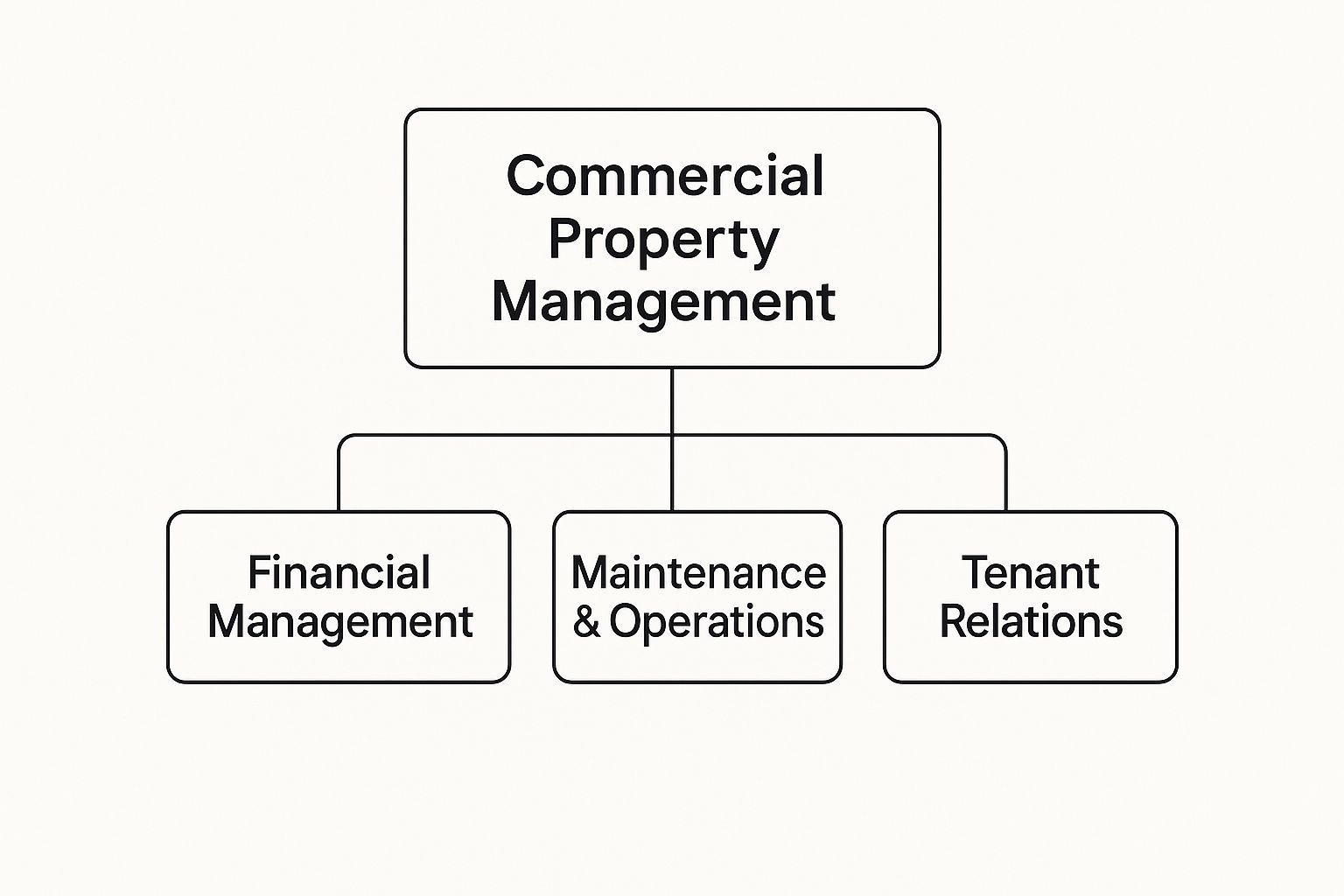
As you can see, financial oversight, operational excellence, and tenant relations are completely interconnected. When managed by a local expert, they form a comprehensive strategy that protects and grows your asset.
To bring this all together, we've outlined these fundamental areas in a simple table. Think of this as the playbook a professional manager uses to ensure your property not only performs well today but also appreciates in value for the long haul.
Core Pillars of Strategic Commercial Property Management
| Pillar | Objective | Key Activities for a Monterey County Property |
|---|---|---|
| Financial Oversight | Maximize ROI and provide clear financial transparency for busy investors. | Strategic budgeting, meticulous CAM reconciliation, proactive rent collection, and detailed owner reporting through a secure portal. |
| Operational Excellence | Preserve and enhance the physical asset's value and curb appeal. | Proactive maintenance scheduling for Salinas Valley's climate, vetted local vendor management, and capital improvement planning. |
| Tenant & Lease Management | Secure stable income and high occupancy through strong professional relationships. | Rigorous business screening, negotiation of protective lease terms (e.g., NNN leases), and concierge-level communication. |
These pillars aren't managed in isolation. They are deeply dependent on one another, and when an expert handles them in concert, the result is a thriving commercial property that practically runs itself from your perspective.
The Modern Management Toolkit
Laying a strong foundation for your commercial real estate ventures means embracing modern systems. The right property management tech is the operational backbone for these pillars, bringing a new level of efficiency and transparency to the table. For busy professionals and remote investors, having 24/7 access to financial reports and maintenance updates isn't just a bonus—it's essential for peace of mind.
This structured, tech-forward approach is what transforms property ownership from a demanding second job into a streamlined, rewarding investment.
Mastering Your Property's Financial Performance
There's a world of difference between just collecting rent and truly mastering your investment's financial performance. A premier commercial property manager acts as the Chief Financial Officer for your asset. Their role is to ensure every single financial decision—big or small—is geared toward driving profitability and long-term growth for you, the owner.
This is the very core of strategic financial stewardship. For any investor, but especially for those in the competitive Monterey Bay Area, this level of meticulous oversight is what transforms a physical building into a predictable, high-performing financial engine that you can rely on, year after year.
Setting Competitive and Strategic Lease Rates
The foundation of your property's financial health is, without a doubt, its rental income. But setting the right lease rate isn't a guessing game. It's a science, grounded in hyper-local data.
- Actionable Step: For a retail space in downtown Salinas, we analyze foot traffic patterns and sales data from neighboring businesses. For an industrial warehouse in Gonzales or King City, we assess logistics demand and proximity to the Highway 101 corridor.
This rigorous market analysis ensures your rates hit that sweet spot—competitive enough to attract top-tier tenants, but high enough to maximize your revenue. It's how you avoid the pain of a costly vacancy from an overpriced unit or, just as bad, leaving money on the table.
Diligent Budgeting and Expense Management
This is where profitability is forged. Managing operating budgets goes far beyond just paying the bills. It involves the complex administration of Common Area Maintenance (CAM) charges, making sure every shared cost, from landscaping to security, is accurately calculated, billed, and reconciled. This transparent process builds incredible trust with your tenants.
- Actionable Step: An easy first step to controlling expenses is to conduct a commercial energy audit guide. This can pinpoint significant opportunities for cost reduction, which directly boosts your Net Operating Income (NOI).
Diligent oversight of accounts payable ensures vendors are paid promptly, which is crucial for preserving our long-standing local relationships. Paired with a proactive rent collection system, you can minimize delinquencies and keep cash flow steady. This detailed approach gives you the kind of clarity and hard data that sophisticated investors require. For a closer look, explore our overview of financial reports for your Salinas investment property.
Meticulous financial oversight is the difference between simply owning a property and commanding a high-performing investment. Every dollar saved on expenses and every percentage point gained in rent directly increases the asset's capital value.
Transparent Reporting and Performance Analysis
For busy professionals and discerning investors, clear, timely financial reporting isn't a "nice-to-have"—it's non-negotiable. You need a concise, accurate picture of your asset's performance at your fingertips, accessible 24/7 through a secure online portal.
This commitment to transparency breaks down into a few key elements:
- Monthly Owner Statements: Detailed reports breaking down all income and expenses, giving you a clean snapshot of profitability.
- Variance Analysis: We compare actual performance against the budget to spot trends, identify areas for improvement, and make decisions backed by real data.
- Annual Budgeting: A forward-looking financial plan that aligns perfectly with your long-term investment goals.
This level of detailed reporting, championed by local experts like our founder Amy Salmina, ensures you are always in the driver's seat of your investment. According to a recent industry survey, 68% of commercial real estate professionals expect improvements in leasing activity and rental growth. This financial discipline is what positions your property to capitalize on these trends.
Securing and Retaining High-Value Tenants

If financial oversight is the brains of your investment, then your tenants are its beating heart. A commercial property’s success ultimately hinges on the strength and stability of the businesses inside it. We turn leasing from a simple task into a powerful strategy for building long-term value.
Finding and keeping great commercial tenants is an active process that starts with smart marketing and grows into a solid, mutually beneficial business relationship. The real win is attracting a business that becomes a true partner in the property's ongoing success.
This process is especially critical here in Monterey County. The needs of an agricultural tech firm in Soledad are worlds apart from a luxury retail shop on Alvarado Street in Monterey. Getting this right is the key to protecting your property's financial health and reputation.
Strategic Marketing and Precise Tenant Targeting
Filling a vacancy the right way starts long before a "For Lease" sign ever goes up. It begins with defining who the perfect occupant would be. We don't just market a "space"; we market a strategic business opportunity.
Here’s our actionable approach:
- Ideal Tenant Profile: We analyze the property’s unique strengths—location, layout, features—to pinpoint the exact type of business that would thrive there. Is it a logistics company needing access to Highway 101, or a professional services firm that belongs in the heart of downtown Salinas?
- Targeted Marketing Materials: All marketing, from professional photography to property descriptions, speaks directly to that ideal tenant, highlighting benefits that matter to them.
- Leveraging Professional Networks: We tap into our deep connections within the Salinas and Monterey business communities, built over generations, to find top-tier candidates.
This targeted strategy dramatically cuts down on vacancy time and attracts a higher caliber of applicant, saving you time and money.
The Art of Rigorous Tenant Screening
Once we have interested parties, the next step is crucial: rigorous screening. In commercial leasing, you're evaluating the financial health and operational track record of an entire business. A weak tenant is a huge risk.
Our due diligence is designed to eliminate that risk. We conduct a comprehensive review of an applicant's business financials, credit history, and reputation in the local Salinas market.
A vacant property costs you money, but the wrong tenant can cost you a fortune. Thorough screening is the single most important risk-management tool an property owner has.
This careful vetting ensures that only reliable, creditworthy businesses occupy your property. You can see the essential checks we perform by reviewing our top tenant screening checklist, which outlines the steps we take to protect your investment.
Negotiating Favorable and Protective Lease Terms
The lease agreement is the legal bedrock of your tenant relationship. A thoughtfully crafted lease protects your interests and paves the way for a positive partnership. Our founder, Amy Salmina, draws on her extensive local expertise to ensure terms are not only favorable but also perfectly suited to your specific property.
Key areas we focus on during negotiations include:
- Lease Structure: Determining the right model, like a Triple Net (NNN) lease, common and advantageous for commercial properties in the Monterey Bay Area.
- Rent Escalations: Building in scheduled rent increases to ensure your income keeps pace with inflation and rising market rates.
- Permitted Use Clauses: Clearly defining what activities can take place, ensuring the tenant's business is a good fit for the property and its neighbors.
- Maintenance and Repair Obligations: Explicitly stating which party is responsible for every aspect of property upkeep, leaving no room for ambiguity.
By negotiating with clarity and foresight, we craft agreements that head off future disputes. It's this level of detailed, concierge-style attention that provides the peace of mind high-end investors expect.
Protecting Your Asset with Proactive Maintenance
The most expensive repairs are almost always the ones you didn’t see coming. A reactive approach—waiting for something to break—is a recipe for tenant disruptions and emergency labor costs. The concierge-level alternative is proactive asset preservation: a strategy that shifts from fixing problems to preventing them.
This forward-thinking approach is the cornerstone of protecting your investment's long-term capital value. This is especially true here in Monterey County, where our diverse microclimates present unique challenges.
Creating a Hyper-Local Maintenance Calendar
A generic checklist won't cut it. An effective preventive maintenance schedule must be customized to your property's specific needs and location.
For instance, managing a commercial building in the Salinas Valley demands a different strategy than one on the coast in Monterey or Pacific Grove.
- Salinas Valley Heat: HVAC systems in Salinas, Gonzales, and Soledad work hard during hot summers. Actionable Step: Schedule semi-annual HVAC inspections and filter changes—before and after peak season—to prevent a system failure during a heatwave.
- Coastal Air Corrosion: Properties in areas like Pebble Beach or Monterey are constantly exposed to salty, moist air, accelerating rust. Actionable Step: Implement regular inspections and apply protective coatings to HVAC units, window frames, and structural elements.
- Seasonal Rain Preparedness: Before winter rains arrive, we conduct thorough roof, gutter, and drainage inspections to prevent leaks, water damage, and mold.
This diligent, localized planning transforms maintenance from an expense into a powerful tool for risk management and value preservation.
Proactive maintenance is an investment, not a cost. Every dollar spent on prevention saves an estimated five dollars on future repairs, protecting both your cash flow and your asset's market value.
The Power of a Vetted Local Vendor Network
Effective execution is impossible without a team of reliable, skilled, and trustworthy vendors. A premier property manager’s value is deeply tied to the quality of their professional network. We’ve spent years building solid relationships with the best local, licensed, and insured contractors in Salinas and the surrounding communities.
This curated network, personally vetted by our founder Amy Salmina, provides:
- Priority Service: Our established relationships mean our clients often get faster response times in an emergency.
- Competitive Rates: We leverage our volume of work to negotiate favorable pricing without sacrificing quality.
- Local Accountability: Working with professionals who live and work in our community means a higher level of accountability and pride in their work.
This network is a core part of our asset protection strategy. Of course, protecting your property also involves robust security. To safeguard your premises, you can explore resources on effective mobile patrol security solutions, which add another crucial layer of protection. This holistic view of asset care minimizes liability and boosts tenant confidence. Dive deeper into understanding rental property maintenance costs to see how a proactive budget prevents financial surprises and safeguards your investment.
Navigating Local Commercial Real Estate Market Trends

In commercial real estate, you can’t just react to the market—you have to get ahead of it. Staying on top of market trends isn't just an advantage; it’s a core strategy for maximizing your investment’s potential. An expert manager uses real-time data and genuine foresight to position your property for future growth.
This means we’re constantly analyzing the evolving landscape of Monterey County. We track shifts in consumer behavior that impact retail spaces in Carmel-by-the-Sea and monitor the rising demand for logistics centers that fuel our region's vital agricultural sector. It's about making smart, strategic decisions right now that will pay off for years to come.
Decoding Local Market Dynamics
Understanding the Salinas and Monterey County market means digging deep into the key indicators that reveal the real health and direction of the local market.
Our process involves a deep dive into:
- Vacancy Rates: We track vacancies across different property types—industrial, retail, office—in specific submarkets like South County towns. Low vacancy rates signal strong demand and create opportunities for rent growth.
- Rental Growth Analysis: We monitor both asking rents and actual lease rates to understand true market value, which informs our negotiation strategies to ensure your income keeps pace.
- Capital Flow and Absorption: We watch where investment money is going and how quickly vacant space is getting leased. This tells us which sectors are hot and where future development might be headed.
This ongoing analysis allows us to give you actionable advice grounded in hard evidence, not guesswork. It's the difference between managing a property and strategically directing an asset.
Connecting Macro Trends to Local Opportunities
Broader economic shifts create tangible opportunities right here in our backyard. The key is knowing how to connect those big-picture trends to local real estate. For example, the e-commerce boom has created massive demand for warehouse and distribution spaces.
A manager who understands market trends can see the future in the present. They recognize that a national surge in logistics demand translates directly into increased value for a warehouse near Highway 101 in Salinas.
This is where true local expertise, like that of our founder Amy Salmina, becomes so valuable. The industrial sector's growth is a national story. While vacancy rates have ticked up slightly nationally, key markets with strong infrastructure like the Salinas Valley have maintained a tight supply, keeping rental prices firm. For more details on this trend, you can read about the commercial real estate outlook on ccim.com.
This data-driven approach is at the heart of our long-term strategy. We don't just manage your property for today; we analyze market currents to ensure it's positioned for maximum profitability tomorrow. To learn more about our specific approach, check out our guide on performing a real estate market analysis in Salinas. This is how we provide peace of mind and superior returns for our high-end investors.
Why Partner with a Salinas Property Management Expert?
After covering the strategies for successful commercial property management, we land on the most important question: why hand over the keys to a local expert?
The answer is simple: to transform a demanding, hands-on job into a high-performing, hands-off investment. For any serious investor in this market, teaming up with a dedicated Salinas-based professional is the single best strategic move you can make. The benefits are crystal clear—you maximize your ROI through disciplined financial oversight, protect your asset's value with proactive care, and get back your most valuable resource: your time.
The Unmatched Advantage of Local Expertise
A generic, cookie-cutter approach just doesn't fly in Monterey County. Real value comes from a manager who lives and breathes the local economy, someone who understands the unique rhythm of our area—from the agricultural hubs in South County towns like Soledad and King City to the bustling retail corridors right here in Salinas.
That deep, on-the-ground familiarity is something a big national firm simply can't replicate.
Our founder, Amy Salmina, brings her fourth-generation local roots to every property we manage. This isn't just a talking point; it's a real-world asset. It means our clients get an insider's perspective and access to a trusted network of high-quality local vendors who do the job right the first time. It's a concierge-level of service built on a foundation of complete transparency and trust.
Choosing a local expert means you're not just hiring a manager. You're gaining a strategic partner who is deeply invested in the community and your success within it.
From Simple Ownership to Smart Optimization
The goal is to stop just owning a property and start actively optimizing an investment. This takes a partner who can weave together financial strategy, operational excellence, and tenant relations into a single, seamless plan.
By applying proven commercial property management best practices, we turn your building from a source of constant demands into a predictable, profitable, and stress-free business.
This shift creates powerful, tangible advantages:
- Financial Clarity: No more guessing games. You get clear, timely reports that give you a complete and honest picture of your asset's performance.
- Risk Mitigation: We tackle problems before they start. Proactive maintenance and rigorous tenant screening protect you from expensive surprises.
- Time Freedom: We handle all the day-to-day complexities—the phone calls, the paperwork, the repairs—freeing you to focus on your next big opportunity.
We invite you to experience the difference a dedicated, local expert can make. Let us show you how the right partner can help you achieve your most ambitious financial goals in the Salinas market.
Frequently Asked Questions About Commercial Management

If you’re a serious property investor in Monterey County, you’ve probably got questions about how professional management can really protect and grow your portfolio. It's smart to be thorough. Below, we’ve put together straightforward answers to the questions we hear most often from owners like you.
What Makes Commercial Property Management Different From Residential?
The simplest answer? Complexity and the business-to-business relationship. The success of your tenant's business is directly tied to the success of your investment, which changes everything.
Here are the main distinctions for a Salinas investor:
- Lease Complexity: Commercial leases are far more detailed and often involve complex structures like triple-net (NNN) terms, tenant improvement allowances, and specific use clauses.
- Financial Reporting: The financial side involves meticulous Common Area Maintenance (CAM) reconciliations, sophisticated budgeting, and advanced analysis to track asset performance.
- Regulatory Knowledge: The rules for a retail space in Salinas or an industrial park in Gonzales are worlds apart from residential housing laws, covering zoning, ADA compliance, and specific business regulations.
Thinking they’re the same is a common and costly mistake. You need a manager with a specialized skillset geared toward business operations and asset performance.
How Do You Determine the Right Rent for My Salinas Property?
Setting the right rent isn't guesswork; it's a data-driven science. We start by performing a detailed Comparative Market Analysis (CMA) that’s tailored specifically for your property type and its exact location.
Our actionable process involves a deep dive into:
- Direct Comparables: We look at what similar properties are leasing for right now in your immediate area, whether that's a storefront in Oldtown Salinas or a warehouse near the Highway 101 corridor.
- Vacancy Rates & Demand: We analyze local vacancy trends. High demand for agricultural support facilities in Soledad signals an opportunity for stronger rental rates.
- Property Attributes: We objectively evaluate your building's condition, amenities, visibility, and access. All these factors impact what a quality tenant will pay.
An empty property costs you money every day, but underpricing your asset costs you significant revenue over a long-term lease. Our goal is to find the perfect balance that attracts creditworthy tenants quickly while optimizing your income stream.
How Does Professional Management Directly Increase My Property's Value?
This is a question every smart investor should ask. Professional management boosts your property’s value in two fundamental ways: by increasing its income and by protecting the physical asset.
First, we are relentless about increasing your Net Operating Income (NOI). We do this by setting the optimal rent, minimizing vacancy with high-quality tenants, and carefully controlling operating expenses. Since a commercial property's value is calculated directly from its NOI, every dollar we add to your bottom line directly increases the capital worth of your asset.
Second, we implement proactive maintenance programs customized for the Monterey County climate. This isn't just fixing things; it’s preventing the deferred maintenance that silently erodes a property's value. A well-maintained building with a stable, predictable rent roll is a premium asset—viewed as lower-risk and far more attractive to future buyers or for refinancing.
Ready to transform your commercial property from a passive holding into a high-performing investment? The team at Coast and Valley Properties brings generations of local Salinas expertise and a commitment to concierge-level service.
Contact us today for a personalized evaluation of your commercial property.

The High-ROI Guide to Property Management Communication in Monterey County
When you own a high-value real estate investment, you need more than just someone to collect the rent. You need a strategic partner dedicated to preserving your asset. Exceptional property management communication is the foundation of that partnership—it’s what protects your property, keeps high-quality tenants satisfied, and ensures you achieve the best possible return on investment in a premier market like Monterey County.
The Cornerstone of Concierge-Level Property Management
For owners of premium properties in Salinas, Pacific Grove, or the exclusive enclaves of Pebble Beach, communication is about much more than quick updates. It’s the very core of a concierge-level service that demonstrates professionalism, builds transparency, and proves a genuine commitment to protecting your investment. It’s not just about answering the phone; it's about executing a proactive, clear system of dialogue that gives you confidence and delivers measurable results for your bottom line.
Ultimately, superior communication solves the biggest concerns for any high-end property investor: preserving trust, saving time, and maximizing ROI. Without it, a small maintenance issue can easily balloon into a major expense, a good tenant relationship can sour, and your valuable time gets consumed by problems that were entirely preventable.
Building Trust Through Proactive Transparency
A solid communication plan is the bedrock of trust between an owner and a property manager. It begins with setting clear expectations from day one and then consistently delivering on those promises. For busy professionals and serious investors in the Monterey Bay Area, that means:
- Proactive Updates: You shouldn't have to ask what's happening with your property. You should receive regular, scheduled reports on its financial performance, physical condition, and any tenant matters.
- Transparent Maintenance: We believe in a clear, documented process for handling repairs—from the moment a tenant submits a request via their portal to the final invoice from a trusted local vendor. You have full visibility.
- Accessible Expertise: You’ll have a dedicated point of contact who understands your financial goals and the specific dynamics of the local market, from the agricultural heart of Salinas to the coastal communities of Monterey and Pacific Grove.
Think of your property manager as the central hub for all communication. The diagram below illustrates how information flows from our team to your tenants and the service providers who maintain your property, always keeping your interests as the top priority.
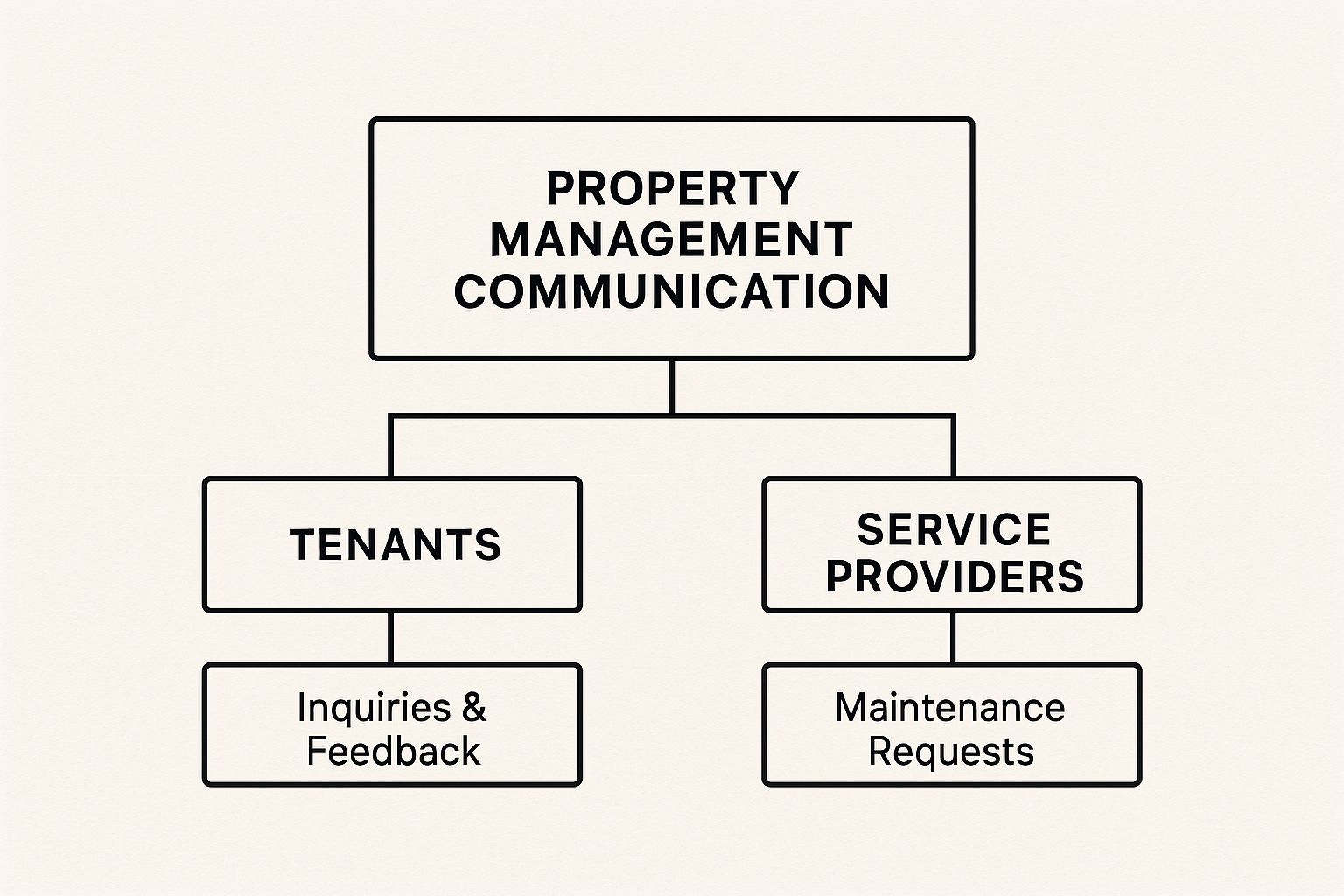
This isn't a simple back-and-forth. A premier property manager orchestrates every interaction, ensuring your asset is protected and your goals are met.
The Real Costs of Poor Communication
When communication breaks down, it's not just frustrating—it's expensive. Recent industry studies show that 26% of property owners cite communication as a top daily challenge. The speed of that communication is the third most important factor they consider when choosing a management company. Often, these frustrations boil down to maintenance coordination and getting clear updates on repairs—precisely where a proactive system prevents costly damage before it starts.
At Coast & Valley, we don't see exceptional communication as a feature. It's a strategic imperative for asset preservation. As our leader and fourth-generation Salinas native Amy Salmina often says, "We treat your property like our own, and that begins with communicating with the clarity and respect you deserve as a valued client."
To make this crystal clear, we've organized our communication philosophy around four key pillars. This framework is our commitment to ensuring that both you and your tenants have a premier experience.
The Four Pillars of Effective Property Communication
The following table summarizes the core principles that guide our premier property management communication, ensuring owner peace of mind and tenant satisfaction.
| Pillar | For the Property Owner | For the Tenant |
|---|---|---|
| Proactivity | You receive regular financial and property status updates without having to ask. We anticipate needs and inform you of potential issues before they escalate. | We provide timely notices for maintenance, inspections, and community updates. We check in to ensure their needs are being met. |
| Transparency | You get detailed, easy-to-understand financial statements and full visibility into all maintenance requests and vendor costs. No surprises. | Tenants have a clear understanding of lease terms, policies, and procedures. Repair processes are straightforward and documented. |
| Responsiveness | Your calls and emails are answered promptly by a knowledgeable professional who can provide real answers and take decisive action. | Tenants have access to a 24/7 portal for maintenance requests and receive prompt replies to all inquiries, especially for urgent issues. |
| Accessibility | You have a dedicated point of contact who knows you and your property. We use modern tools like owner portals to keep information at your fingertips. | Tenants can easily submit requests, pay rent, and communicate through multiple channels, including a user-friendly online portal. |
This commitment to clear, structured communication is what truly sets a premier management service apart. It’s about more than just keeping you in the loop; it’s about providing genuine peace of mind.
To see how this philosophy translates into tangible benefits, you can learn more about the five ways a property manager helps homeowners protect their investment.
Building a Proactive Communication Framework

Superior property management communication isn’t about reacting to fires; it’s about having a system that prevents them from starting. For owners of high-value properties in Monterey County, this proactive strategy is key to protecting your asset and preserving your time.
This framework is a complete cycle, beginning the moment a new tenant is approved and continuing through every stage of their residency. A proactive approach transforms communication from a stream of emergencies into a predictable, smooth-running machine. For a tenant moving into a home in Soledad or King City, this process starts long before we hand over the keys. It begins with clear, consistent dialogue during the application phase.
Our Client-First Philosophy: A well-informed tenant is a better tenant. By establishing clear expectations and providing comprehensive information upfront, we minimize future misunderstandings and foster a respectful, professional relationship that protects your investment from day one.
The Actionable Onboarding Experience
The first 30 days of a tenancy are critical. This is where we lay the foundation for a positive, successful relationship. Instead of simply handing over the keys, we provide a comprehensive welcome packet that serves as an essential reference tool.
Actionable Checklist: The Tenant Welcome Packet
- Key Contact Information: Clear distinction between who to call for routine questions versus true emergencies.
- Maintenance Protocols: Step-by-step instructions on how to submit a maintenance request through our online portal, ensuring rapid response.
- Community Guidelines: Details on HOA rules, trash/recycling schedules, and other local ordinances relevant to their neighborhood, whether it's in Gonzales or Pacific Grove.
- Emergency Procedures: Actionable information on what to do during local challenges like winter storms or PSPS power outages common in the Monterey Bay Area.
A robust onboarding experience is the logical follow-through to a meticulous screening process. Finding a great resident is only half the battle, and our detailed tenant screening checklist is built to do just that.
Establishing Consistent Owner Communication
For our property owners, proactive communication means predictable, transparent reporting without the noise. As a busy professional or investor, you need the big picture without being bogged down by minor issues. We establish a communication rhythm that respects your time while delivering the crucial information needed to make informed decisions.
What to Expect: A Sample Communication Rhythm
- Monthly: Detailed financial statements delivered to your secure owner portal, clearly breaking down income, expenses, and net proceeds.
- Quarterly: Strategic property updates from our periodic inspections, complete with photos and recommendations for preventative maintenance to protect your asset.
- As Needed: Proactive analysis of rental trends in your specific area (e.g., Salinas, Monterey), helping you make sharp, data-driven decisions on renewals and pricing.
Building out this kind of forward-thinking communication plan is a non-negotiable part of modern property management. For those who want to dig deeper, there are excellent resources on modern customer communication strategies that highlight the importance of these structured systems.
Essential Communication Channels for Modern Properties

Delivering a truly top-tier experience for premium properties across Monterey County requires a smart combination of modern technology and a personal, human touch. The goal isn’t to replace personal service with automation. It’s about leveraging digital tools to handle routine tasks with efficiency, freeing up our team to focus on what truly matters: providing personal, strategic oversight for your investment.
This hybrid approach means your tenants get quick, convenient service, and your property gets the dedicated, expert attention it deserves.
The Power of Secure Digital Portals
For busy owners and investors, 24/7 access to information is non-negotiable. Our secure online owner portals are the cornerstone of our transparent service, giving you on-demand access to critical data from anywhere in the world.
Through this portal, you can:
- Access Financial Statements: Review detailed monthly and year-end reports that clearly show income, expenses, and your bottom line.
- View Inspection Reports: See in-depth property evaluations, complete with photos and our professional recommendations for preventative maintenance.
- Track Maintenance: Follow the status of every work order—from initial tenant report to final invoice—for complete transparency.
Simultaneously, we empower residents with their own tenant portals. Here, they can handle routine matters on their own schedule, such as paying rent, submitting non-emergency maintenance requests (with photos), and accessing their lease documents. This self-service capability enhances their experience and streamlines property operations.
The Indispensable Human Element
While technology handles routine processes, our team provides the critical thinking and personal service that software cannot. Our portals streamline operations, giving us more time for the high-value activities that protect your asset and enhance tenant relations. If you're curious about how these automated tools are developed, you can learn how to create an AI chatbot to get a behind-the-scenes look.
This human oversight is where real value is created. It includes:
- Personal Follow-ups: Calling a tenant after a major repair to ensure they are completely satisfied with the work.
- Strategic Consultations: Discussing market trends in Salinas or Soledad to help you make informed decisions about rental rates and property improvements.
- Complex Problem-Solving: Personally intervening to handle sensitive issues like lease disputes with the professionalism and deep local knowledge they require.
This balanced system is central to our operational philosophy. By pairing smart technology with dedicated local experts, we uphold the highest property management best practices to ensure your investment is both profitable and impeccably cared for.
Navigating Difficult Conversations with Professionalism

The true measure of excellent property management communication isn't when things are going smoothly—it's when conversations get tough. For owners of premium properties, the way these sensitive situations are handled is a direct reflection of a manager's expertise and ability to protect your investment and mitigate risk.
A firm, fair, and professional approach is the only way to navigate everything from late rent payments to lease violations. Whether addressing an unauthorized pet in a Salinas home or discussing a necessary rent increase for a property in Pacific Grove, the goal is always resolution, not conflict. This requires a deep understanding of California law, a calm and steady hand, and an unwavering commitment to protecting your interests.
A Framework for Firm but Fair Communication
Effectively managing tough conversations is a skill built on a structured, repeatable process, not emotion. It’s about a professional, documented, and compliant approach that prioritizes a positive outcome while upholding the lease terms.
Our 3-Step Process for Handling Sensitive Tenant Issues:
- Document and Reference: Every conversation begins with the facts. We reference the specific clause in the lease agreement that has been violated. This immediately removes personal opinion and grounds the discussion in the legal contract both parties signed.
- Communicate Clearly and Privately: We initiate a private, direct conversation. Depending on the issue and legal requirements, this may be a phone call or a formal written notice. The tone is always professional and respectful, clearly outlining the issue, the required remedy, and a reasonable timeline for compliance.
- Follow Up in Writing: After any verbal discussion, we send a written summary via the tenant portal. This creates a clear, time-stamped record, ensuring there are no misunderstandings and documenting that we followed all proper procedures.
This structured communication is a core part of how we build a respectful environment, which is fundamental when we work to attract and keep good residents for your property.
Real-World Scenarios in Monterey County
Let's apply this framework. Imagine a tenant in a South County property, perhaps in Gonzales or King City, is consistently paying rent late.
Instead of letting the problem fester, our approach is immediate and professional. The tenant first receives an automated reminder from the system. If payment isn't made, they receive a personal but firm communication from our team. We explain the consequences as outlined in their lease and under California law, while providing clear instructions for payment through their online portal.
This straightforward, professional method resolves the issue 9 times out of 10 without needing to escalate to formal legal notices, saving you time, stress, and potential legal fees.
At Coast & Valley, we believe that professionalism under pressure is the ultimate measure of a property manager. Our expertise, honed over years in the Salinas and Monterey markets, allows us to handle these challenges with the diligence and care your investment deserves.
How Superior Communication Impacts Your Bottom Line
It’s a mistake to dismiss property management communication as a "soft skill." For savvy owners with properties in Salinas, Monterey, and across the county, great communication is a powerful financial tool that directly grows your return on investment.
Every proactive update, transparent report, and efficiently handled maintenance request translates into tangible financial benefits for your portfolio. This link between communication and profitability is a major driver in our industry. The U.S. property management market is projected to hit $98.88 billion by 2029, largely fueled by digital tools that make interactions faster and more effective. It's about using real-time, personalized communication to keep vacancies low and occupancy high.
Reducing Tenant Turnover
High tenant turnover is one of the biggest profit killers for a rental property, with costs for marketing, cleaning, repairs, and lost rent quickly accumulating. Superior communication is your most effective tool for increasing tenant satisfaction and retention.
When tenants in communities like Pebble Beach or Soledad feel heard and respected, they are more likely to stay. Knowing their maintenance requests will be handled promptly and that they’ll receive clear, timely notices makes them far more likely to renew their lease. That stability provides consistent cash flow and helps you avoid the costs and headaches of finding new residents. For more on this, explore our guide to effective tenant retention strategies that build long-term value.
Preventing Costly Repairs
Proactive communication about maintenance can save you thousands. Consider a minor leak reported at a property in King City. A responsive system means a trusted local vendor is dispatched immediately. That quick action prevents a small drip from becoming a catastrophic water damage event that requires expensive, large-scale remediation.
By fostering an environment where tenants feel comfortable reporting issues early, we transform them into frontline partners in asset preservation. This proactive dialogue is one of the most effective risk management tools at your disposal.
Enhancing Your Reputation and Attracting Quality Tenants
In today's digital market, a property manager’s reputation is paramount. A track record of clear, professional communication doesn't just keep current tenants happy—it attracts higher-quality, more reliable applicants who are willing to pay premium rates for a well-managed home.
This positive reputation shortens vacancy periods because the best applicants actively seek out properties managed by firms known for their integrity. This principle also applies to our owner relationships; understanding the strategic importance of investor relations is key to the financial health and success of your portfolio.
Your Communication Questions Answered
We understand that for a serious investor, clear and consistent communication isn’t a “nice-to-have”—it’s a non-negotiable. Here are answers to common questions we hear from property owners across Salinas and Monterey County.
How Will You Keep Me Informed Without Overwhelming Me?
Our communication approach is built around your preferences. From our first conversation, we establish how and how often you wish to be contacted. You receive a consolidated monthly financial and performance report via your secure owner portal, giving you the complete picture at a glance. Our policy is simple: we only contact you immediately for urgent matters that require your input. The goal is to provide total peace of mind, not a cluttered inbox.
What Is Your Process for Tenant Maintenance Requests?
Our system is designed for efficiency, transparency, and asset protection. Tenants submit non-emergency maintenance requests 24/7 through their online portal, creating an instant digital record with photos and a timestamp. Our team assesses the urgency and dispatches a trusted professional from our vetted network of Monterey County vendors. Throughout the process, both you and the tenant receive automated updates, from assignment to completion. This structured process ensures small issues get fixed fast, preventing expensive problems.
How Does Your Local Expertise Improve Communication?
Our deep roots in Salinas and the Monterey Bay Area are a significant advantage. We have a hands-on understanding of local regulations, the seasonal maintenance needs unique to our climate (like prepping for coastal fog or inland heat waves), and the nuanced rental market differences between communities.
This local knowledge, led by our fourth-generation Salinas-native leader, Amy Salmina, means our communication is always relevant, compliant, and forward-looking. Whether we’re discussing rental rate trends in South County or a new city-specific ordinance, our advice is backed by years of on-the-ground experience.
This allows us to speak with an authority and foresight that out-of-area firms cannot replicate, ensuring every piece of advice is aimed at protecting your valuable investment.
Can Technology Replace Personal Interaction with Tenants?
Absolutely not. We use technology strategically to handle routine tasks like rent collection and maintenance logging with peak efficiency. The purpose of this tech is to free up our property managers to provide high-touch, personal service where it truly matters. This means personally mediating complex tenant issues, handling sensitive disputes with professionalism, and conducting thorough on-site property evaluations. It's a hybrid model that gives you the best of both worlds: the convenience of modern digital tools and the irreplaceable value of human empathy and expert judgment.
At Coast and Valley Properties, we believe exceptional communication is the bedrock of a successful partnership. If our proactive, transparent, and expert-driven approach sounds like what you’re looking for, we’d love to start a conversation.
Contact us today for a complimentary evaluation of your Monterey County property.

Mastering the Lease Renewal Process for Your Monterey County Investment
A seamless lease renewal process is more than just paperwork—it's a critical financial strategy that shields your investment from the high costs of vacancies and tenant turnover. For owners of high-end properties in competitive markets like Carmel, Salinas, or Pebble Beach, retaining a great tenant is often the single most profitable move you can make. This isn't about avoiding hassle; it's about actively securing your return on investment.

Why a Strategic Renewal Always Beats Tenant Turnover
As a busy property owner or investor in Monterey County, focusing on tenant retention is a direct line to better profits and stability. The costs of tenant turnover can quickly erode your annual returns. You face marketing expenses, deep cleaning, fresh paint, and—most significantly—lost rent during the vacancy. For a premium property in our local market, this can amount to thousands of dollars.
A proactive lease renewal strategy is your best defense. It transforms a routine administrative task into a powerful tool for maximizing your property's performance.
The Financial Upper Hand of Retention
When you handle a renewal with professional care, you're not just keeping a unit filled. You are actively reinforcing the value of your asset. By keeping a proven, responsible tenant in place, you achieve several key financial goals:
- Eliminate Vacancy Costs: Even one month of lost rent in a market like Pacific Grove is a significant financial hit.
- Cut Turnover Expenses: Avoid the bills for painting, repairs, deep cleaning, and advertising required to find a new tenant.
- Maintain Consistent Cash Flow: A successful renewal means your rental income continues without interruption. This predictable revenue is the bedrock of a healthy investment portfolio.
- Build a Stronger Tenant Relationship: A smooth, professional renewal process fosters goodwill. Tenants who feel valued are far more likely to care for your property as if it were their own.
Lease Renewal vs. Tenant Turnover: A Monterey County Snapshot
To see the difference in black and white, let's compare the two outcomes for a typical high-end rental in our area. The financial and operational impact is stark.
| Factor | Successful Lease Renewal | Tenant Turnover |
|---|---|---|
| Income Stability | $0 lost rent, seamless cash flow | 1-2+ months of lost rent |
| Direct Costs | Minimal administrative time | Advertising, cleaning, painting, repairs ($2,000 - $5,000+) |
| Time Investment | A few hours for communication and paperwork | 20-40+ hours for showings, screening, and move-out/move-in coordination |
| Risk Factor | Low; you're keeping a known, reliable tenant | High; a new tenant is an unknown quantity |
| Tenant Relationship | Strengthened, fostering long-term care for the property | Reset to zero, requiring time to build trust and rapport |
The numbers make it clear: retaining a good tenant isn't just easier, it's exponentially more profitable.
"At Coast & Valley, we treat the lease renewal as a key performance indicator for our clients' investments. It’s not about avoiding work; it’s about making the smart financial play that protects your asset for the long term." - Amy Salmina, Owner/Broker
A well-managed renewal workflow is a sign of professionalism. It tells your tenants they're valued, which is fundamental to long-term success. For property owners looking to build strong, lasting tenant relationships, understanding how to earn a lease renewal is the first step toward maximizing your investment's true potential.
Conducting Your Pre-Renewal Property Assessment
A successful lease renewal doesn't happen when you send the offer. For savvy investors in Monterey County, the real work begins 90-120 days before a lease expires. This is your prime opportunity to build a data-backed case for your renewal terms, turning a routine task into a strategic financial move.
This preparation phase is about gathering intelligence to protect and enhance your asset. It starts with a comprehensive review of the tenant's history. Have they paid on time? How have they communicated? A review of their payment ledger and our internal notes provides a clear picture of their reliability. Our rigorous tenant screening checklist sets the initial standard, and their performance since then tells the rest of the story.
Actionable Pre-Renewal Checklist
To ensure a data-driven approach, follow this step-by-step process:
- Tenant Performance Review (120 Days Out):
- Confirm an unbroken record of on-time rent payments.
- Review all communication records for professionalism and responsiveness.
- Note any past lease violations, however minor.
- Detailed Property Inspection (90 Days Out):
- Schedule and conduct a thorough interior and exterior inspection.
- Identify any tenant-caused damage versus normal wear and tear.
- Proactively list any preventive maintenance needed (e.g., servicing the HVAC, checking for leaks). This demonstrates a commitment to property care.
- Hyper-Local Market Analysis (90 Days Out):
- Analyze rental comps for truly similar properties in the specific neighborhood (e.g., comparing a South Salinas home only to other South Salinas homes).
- Factor in unique property features that add value.
- Determine a fair market rent that is both competitive and maximizes your ROI.
A thorough pre-renewal inspection does two things: it protects your investment and gives you the hard data needed to justify your rental rate. It shifts the renewal conversation from a subjective negotiation to an objective, fact-based discussion about the property's true value and condition.
This three-pronged approach—tenant review, property inspection, and market analysis—is the bedrock of a professional leasing strategy. The infographic below gives a great visual of the initial data collection for this critical phase.
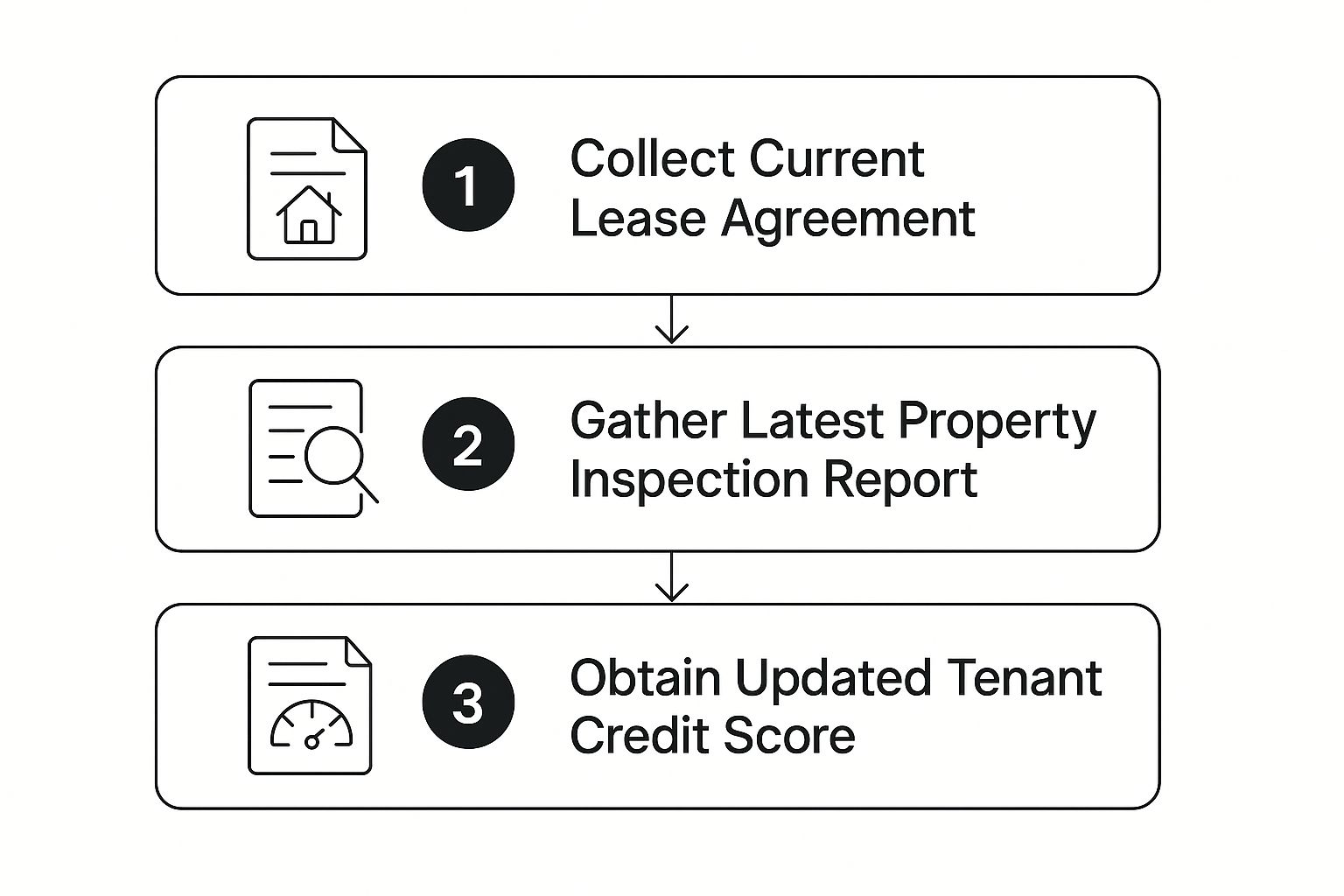
By grounding your lease renewal process in solid data, you enter negotiations not with demands, but with a clear, professional, and justifiable position that protects your investment. For busy professionals, leveraging our expertise and commercial real estate technology solutions streamlines this entire process, saving you time while maximizing returns.
Crafting a Compelling and Compliant Renewal Offer
How you frame your renewal offer can be the deciding factor between a smooth, continuing tenancy and a costly vacancy. This isn't just about sending a form; it's about blending concierge-level professionalism with a firm grasp of your property's market value. The goal is to create a proposal that is compelling for your tenant and makes solid financial sense for you. This is where your communication strategy shines in the lease renewal process.

Your first move is a formal, written offer sent with ample notice. It must clearly outline all proposed terms. For example, if your market analysis for comparable homes in Salinas indicates a rent adjustment is warranted, present it with context and professionalism.
An Example of Professional Framing: "We have truly valued having you as tenants. After reviewing current rental rates for similar homes in the area and accounting for rising operational costs, we will be adjusting the monthly rent to $X,XXX for the upcoming 12-month term. We believe this new rate is competitive and ensures we can continue maintaining the property to the high standard you expect and deserve."
This transparency builds trust. It presents the rent adjustment as a fair-market business decision, not an arbitrary increase, showing respect for the tenant relationship while protecting your investment.
Timing and Delivery Are Everything
In California, proper timing isn't just good practice—it's a legal mandate. The delivery of a renewal offer, especially one with a rent increase, must be precise to be legally binding. For any property owner in Monterey County, from Salinas to King City, this is a detail you cannot afford to get wrong.
- For Rent Increases of 10% or Less: You are required to provide a minimum of 30 days' written notice.
- For Rent Increases Over 10%: California law mandates a stricter 90-day written notice.
We always send these notices via a trackable method, such as certified mail or our secure online owner portal. This creates an undeniable digital or paper trail, proving compliance and protecting you from potential disputes.
The financial upside of a well-handled renewal can't be overstated. A recent report from Global Net Lease Inc. revealed that its single-tenant lease renewals in early 2024 locked in an 8.2% rent increase with an average term of 6.6 years. This just goes to show how renewals can often outperform trying to find new tenants in a competitive market. A strategic renewal process directly boosts your bottom line. You can dig into more of these financial trends in the full Q1 2024 report.
At Coast & Valley, we navigate these delicate communications with the concierge-level service your investment deserves. We manage every detail, from drafting compliant offers to justifying terms with hard data, ensuring your renewal process is professional, profitable, and painless.
Navigating Tenant Negotiations Like a Pro
Even with a perfectly fair, well-researched renewal offer, some tenants will want to negotiate. When managing a high-end property in a competitive market like the Monterey Bay Area, this is not a problem—it's an opportunity to reinforce a positive relationship and secure a mutually beneficial agreement. The key is to enter these conversations with a clear strategy and a firm grasp of your financial bottom line.
A counter-offer is a normal part of the lease renewal process. Perhaps they request a smaller rent increase in exchange for signing a longer, 18-month lease. Or maybe they ask for an upgrade, like a new appliance, before committing. These are not unreasonable requests, but each must be evaluated through a strict return on investment (ROI) lens.
Evaluating Tenant Counter-Offers: An ROI-Based Approach
When a tenant proposes different terms, your response must be measured and data-driven, not emotional. A quick "no" can damage a good relationship, but agreeing to every request can erode your profits.
Here’s our framework for evaluating counter-offers:
- Calculate the True Cost: If a tenant asks for $50 less per month than offered, that's a $600 difference over a year. Is retaining a proven, reliable tenant worth that $600 when compared to the thousands in potential turnover costs (vacancy, cleaning, marketing)? In most cases, yes.
- Analyze Upgrade ROI: A request for a new dishwasher isn't just an expense; it's a capital improvement. It enhances your current tenant's experience, increases your property's value, and makes it more marketable for the next tenancy. It’s an investment in your asset.
- Consider Lease Term Flexibility: A tenant offering to sign a longer lease provides you with guaranteed income and stability. This security has tangible financial value and can easily justify a small concession on rent.
Knowing when to be flexible and when to hold firm is a skill rooted in experience and data. Basing your decisions on financial analysis, not emotion, keeps you in control.
The best negotiations are built on transparency. If a request cannot be approved, explain why professionally. For example: "While a full kitchen remodel isn't in our budget this year, we can commit to installing the new dishwasher you requested." This shows you're listening and willing to find a middle ground, even while protecting your financial position.
Document Everything and Finalize the Agreement
During any negotiation, every point of communication must be documented in writing. A phone call to discuss details is effective, but it must be immediately followed by an email summarizing the conversation and any agreements made. This prevents misunderstandings and creates a professional record. A robust real estate follow-up system is invaluable for ensuring no detail is missed.
Once you have a verbal agreement, it’s time to make it official. The final step is to draft a new lease agreement or a comprehensive renewal addendum that details the new terms precisely. This new document must be signed by both you and the tenant before the old lease expires, creating a fresh, legally binding contract that is a cornerstone of effective tenant retention strategies.
Ensuring Legal Compliance and Ironclad Documentation
When managing high-value properties—from family homes in South County towns like Gonzales and King City to coastal estates in Pebble Beach—navigating California's legal landscape is non-negotiable. A seemingly minor paperwork error during a lease renewal can escalate into a significant legal and financial liability. This is where professional diligence becomes your most valuable asset.

California’s landlord-tenant laws are notoriously complex and constantly evolving. Using a generic lease template from the internet is one of the riskiest decisions an owner can make. These documents often lack critical, state-specific clauses and fail to account for local ordinances in cities like Monterey or Salinas, leaving your investment exposed.
Adhering to California’s Strict Notice Requirements
The first legal hurdle in any renewal involving a rent increase is the notice period. Governed by the Tenant Protection Act (AB 1482), these timelines are absolute and must be followed precisely for your new terms to be enforceable.
- For rent increases of 10% or less: A 30-day written notice is required.
- For rent increases over 10%: The requirement increases to a 90-day written notice.
Proper delivery is just as important. We ensure these notices are delivered via a trackable method, creating a clear, defensible record of compliance that protects you from potential disputes.
The Power of a Professional Lease Agreement
A professionally drafted, attorney-vetted lease agreement is the foundation of a secure tenancy. It's a detailed tool designed to protect your rights, clearly define tenant responsibilities, and eliminate gray areas. Finalizing the renewal is also the perfect time to verify insurance coverages and remind the tenant of the importance of renters insurance for their protection.
At Coast & Valley, we never rely on generic templates. Our team, led by Salinas native Amy Salmina, uses attorney-vetted lease agreements that are continuously updated to reflect the latest changes in California law. This provides our clients with ironclad protection and peace of mind.
This level of professional oversight is critical in the current market. With tight supply and high demand across the Monterey Bay Area, landlords have an opportunity to negotiate renewals that reflect a property's true market value. However, this also means that legally sound documentation is more important than ever. This diligence is how we safeguard your ROI and ensure your investment is secure.
Your Monterey County Lease Renewal Questions Answered
The lease renewal process is full of specific questions that every Monterey County property owner will face. Handling these situations with confidence requires a deep understanding of local laws and on-the-ground best practices. Here are clear, actionable answers to the most common challenges we help our clients navigate.
What Is the Required Notice for a Rent Increase in Monterey County?
In California, the notice period for a rent increase depends entirely on the percentage of the increase. This is a strict legal requirement under the Tenant Protection Act (AB 1482).
- For any increase of 10% or less of the tenant's current rent, you must provide a 30-day written notice.
- For an increase of more than 10%, the law mandates a 90-day written notice.
We always advise owners to send these critical notices using a trackable method, like certified mail or our secure owner portal. This simple step ensures compliance and protects you from potential legal disputes.
How Should I Respond If My Tenant Wants to Negotiate Rent?
First, view negotiation not as a confrontation, but as a normal part of business and an opportunity to strengthen your relationship. Listen to your tenant's position, then calmly walk them through the market data supporting your proposed rate.
You can professionally explain that the new rent reflects market rates for similar properties in Salinas or Pacific Grove and covers rising operational costs. If you have flexibility, consider non-rent concessions. For example, you could offer a small property upgrade they've mentioned or propose a longer 18-month lease in exchange for them accepting the new rate. The key is to know your financial bottom line before you begin the conversation.
What if a Tenant Does Not Respond to My Renewal Offer?
Silence from a tenant is not acceptance. If your response deadline passes without a word, you must follow up immediately and in writing. It could be an oversight, or it could signal their intent to vacate.
If they do not wish to renew, the notice-to-vacate terms in their original lease agreement will apply. If the lease is set to convert to a month-to-month tenancy, your properly delivered rent increase notice will still take effect on the specified date. Proactive, documented communication is your best defense against a confusing and costly holdover situation.
Should I Use a New Lease or a Simple Renewal Addendum?
We always recommend using a completely new lease agreement for every renewal period. Landlord-tenant laws in California are complex and change frequently. A fresh, attorney-vetted lease ensures that both you and your tenant are bound by the most current legal standards, disclosures, and protections.
This is also the ideal opportunity to officially incorporate any new property rules, update clauses, or more clearly define expectations around property care. You can find more detail on separating these duties in our guide to understanding landlord responsibilities vs tenant duties. This comprehensive approach provides maximum legal clarity and is standard practice for protecting a high-value asset in Monterey County.

Mastering Your Monterey County Property's Financial Reports
For any serious property owner in the Monterey Bay Area, true peace of mind goes beyond simply seeing rent hit your bank account. It’s about having absolute financial clarity and confidence in your investment's performance. Property management financial reports are the official story of your asset's health, turning complex data into actionable insights that fuel growth and preserve your property's long-term value.
Your Guide to Financial Clarity and ROI in Monterey County
Whether you own a luxury home in Carmel-by-the-Sea, a multi-unit apartment building in Salinas, or a portfolio of properties across South County towns like Soledad and Gonzales, mastering these financial documents is non-negotiable for maximizing your return on investment (ROI). These reports aren’t just for your accountant at tax time; they are powerful, concierge-level tools that facilitate productive conversations with your property manager, track performance against your goals, and empower you to make savvy, data-driven decisions.
For a busy professional or serious investor, these documents offer a transparent, line-by-line account of every dollar that comes in and every dollar that goes out. They are the foundation of trust and professionalism between an owner and a management team, proving that your high-end property is being handled with precision. This guide will demystify the most important reports, showing you exactly what to look for and how to leverage them to grow your portfolio with confidence.
The Core Financial Reports Every Investor Should Know
At the heart of professional property management accounting are three essential reports. Think of them as a team—each tells a different part of the story, but together they paint the complete financial picture of your investment property.
- Income Statement (P&L): This report details your property's profitability over a specific period, like a month or quarter. It answers the critical question: "Is my property truly generating wealth?"
- Balance Sheet: This provides a snapshot of your property's financial strength at a single point in time, listing assets, liabilities, and your equity. It answers: "What is the overall net worth of my investment right now?"
- Cash Flow Statement: This tracks the real cash moving in and out of your accounts, showing how money is being generated and spent. It answers the crucial question: "Where did my cash go?"
This infographic illustrates how these foundational documents are interconnected.
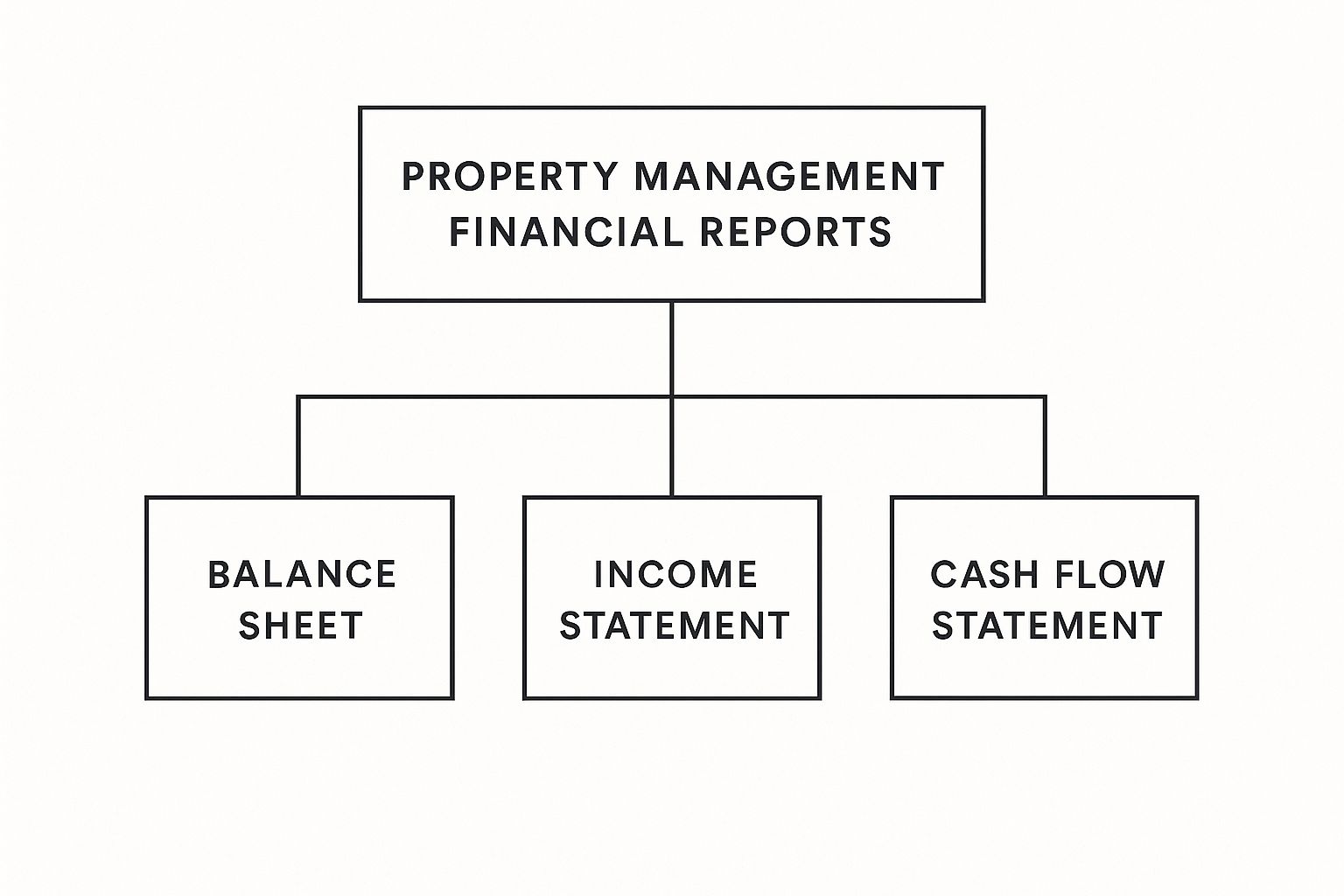
As you can see, each report offers a unique angle. When you review them together, you get a comprehensive financial overview of your Monterey County property.
To help you get a quick handle on this, here's a simple breakdown of the most critical reports and what they tell you at a glance.
Key Financial Reports for Monterey County Property Owners
| Report Name | What It Tells You | Key Question It Answers for an Owner |
|---|---|---|
| Income Statement (P&L) | A summary of revenues and expenses over a period. | Is my property profitable over the long term? |
| Balance Sheet | A snapshot of assets, liabilities, and owner's equity. | What is my property's net worth right now? |
| Cash Flow Statement | Tracks the movement of actual cash. | Where did my money come from and where did it go? |
| Rent Roll | A detailed list of all tenants and their lease terms. | Who is paying, how much, and are they on time? |
| General Ledger | A complete record of every single financial transaction. | Can I see the detailed history of every transaction? |
Understanding these five reports is the first step toward mastering your investment's finances and making truly informed, strategic decisions.
Modern Tools for Ultimate Transparency & Trust
Achieving this level of financial insight is easier than ever with modern technology. At Coast & Valley, we provide our clients with a secure online owner portal, a cornerstone of our commitment to trust and transparency. This gives you 24/7 access to all these reports and the detailed data behind them, reinforcing our authority and professionalism.
This digital-first approach means you’re always in control of your investment, no matter where you are. For a deeper look into how this works, you can explore this strategic guide to cloud accounting solutions. It’s this kind of on-demand, high-end service that discerning property owners from Pebble Beach to King City expect and deserve.
The Owner Statement: Your Monthly Performance Snapshot

If the full suite of property management financial reports tells the complete story of your investment, then the Owner Statement is the executive summary. Think of it as your property’s monthly performance report, designed for the busy investor who demands clarity, precision, and a time-saving solution.
Frankly, it's the single most important document for understanding your property’s immediate cash flow. This statement boils down all financial activity for a specific period—usually one month—into a clear, digestible format. It details every dollar of income collected and every dollar of expense paid, giving you an unambiguous bottom line. This is where you see your gross rental income, any extra fees collected, and all deductions for management, maintenance, and other services.
Ultimately, the Owner Statement answers one critical question for our clients from Salinas to Monterey: "How much cash did my property generate this month, and where did it go?"
Breaking Down a Typical Owner Statement
A well-structured Owner Statement provides a transparent, line-by-line breakdown of your finances. At Coast & Valley, founded on Amy Salmina’s local roots and commitment to professionalism, we ensure every single entry is clear and traceable. Here’s what you can expect to see:
- Income Summary: This section lists all sources of revenue. The main entry is, of course, the rent we've collected. But it might also include other income streams like late fees, pet fees, or application fees, giving you a complete picture of your property's earning power.
- Expense Summary: Here, you'll find an itemized list of all costs. Common expenses include our management fee, landscaping for a Carmel property, a plumbing repair in Soledad, or a pre-approved appliance upgrade you requested to preserve the property's value.
- Owner Distribution: This is the bottom line—the net income paid directly to you after all expenses are covered. It's the actual cash deposited into your account from the month's operations, reflecting your immediate ROI.
A Note on Trust & Transparency: Every expense listed on your Owner Statement is backed by a corresponding invoice. Through our secure owner portal, you can access these documents 24/7. This gives you absolute confidence that your funds are being managed with the utmost integrity and professionalism.
Actionable Insight: Using Your Statement for Strategic Oversight
Your Owner Statement is more than just a receipt; it’s a powerful tool for strategic oversight. By reviewing it each month, you can quickly spot trends, identify unusual spending, and see how your property is performing against your budget.
Actionable Step: When you receive your statement, compare the maintenance expenses to the previous month. A sudden spike in utility costs at your Salinas rental could signal a leak or other maintenance issue that needs immediate attention. This proactive review helps protect your asset.
Understanding this report empowers you to have meaningful, data-driven conversations with your property manager. It’s the foundation for planning future capital improvements and optimizing your ROI. For a detailed walkthrough, you can explore a sample of our comprehensive Owner Statement layout and its components.
This focus on clear, actionable reporting is essential. Globally, real estate performance often hinges on the balance between income and capital growth. For example, recent market analysis showed an 8.1% total return in the UK, driven primarily by income, not asset appreciation. This underscores how vital these reports are for knowing which levers are actually driving your returns, a topic you can learn more about by reviewing insights on global real estate trends from Aberdeen Investments.
Analyzing Your Profit And Loss Statement for Long-Term Growth
While your monthly Owner Statement provides a clear picture of cash flow, the Profit and Loss (P&L) Statement offers a broader perspective on your investment's long-term financial health. Think of it this way: the Owner Statement is a snapshot of the cash in your wallet today. The P&L is your annual financial review, showing if you're truly building wealth over time.
This is the document your accountant will rely on for tax preparation and the report you'll analyze to evaluate how your Monterey County portfolio performed over a quarter or an entire year. It shifts your focus from simple cash-in, cash-out transactions to overall profitability, helping you make smart, forward-looking decisions that enhance your ROI.
From single-family homes in Salinas to high-end rentals in Pacific Grove, understanding your P&L is non-negotiable for any serious investor. It’s the ultimate report card for your property’s financial success.
Cash vs. Accrual: The Story Behind The Numbers
One of the most important concepts to grasp when looking at your P&L is the difference between cash-basis and accrual-basis accounting. This distinction often explains why your P&L might show a healthy profit even when your bank account feels tight.
- Cash-Basis Accounting: This method is straightforward. It records income only when cash is received and expenses only when cash is paid. It mirrors your bank account activity, much like the Owner Statement.
- Accrual-Basis Accounting: This method records income when it's earned (even if the check hasn't arrived) and expenses when they're incurred (even if you haven't paid the bill). Your P&L typically uses this approach to give a truer financial picture.
Here’s a real-world example for Monterey County. Let's say a major roof repair was completed on your Gonzales property in December, but you arranged to pay the contractor's invoice in January. An accrual-basis P&L for December would show that expense, giving you an honest look at that month's profitability. A cash-basis report wouldn't, pushing the expense to January and making your December results look deceptively strong.
Actionable Insight: Identifying Trends And Optimizing Performance
The real power of the P&L is its ability to reveal trends over time. When you analyze your categorized revenue and expense lines month after month, you can uncover powerful insights.
For a discerning investor, the P&L isn't just a tax document—it's a strategic roadmap. It highlights opportunities to enhance revenue, control costs, and maximize the long-term value of your asset.
A detailed review can uncover patterns specific to the Monterey Bay Area. You might notice utility bills spiking during the cooler winter months or see the clear ROI from a recent kitchen upgrade through increased rent potential.
Actionable Step: Lay out your last three P&L statements side-by-side. Look for expense categories that are consistently rising, like "Repairs & Maintenance." This could indicate an aging system that needs a capital improvement plan, rather than continued small fixes. By analyzing your P&L, you can pinpoint areas for improvement and implement proven strategies to save expenses, which goes directly to your bottom line.
This deep dive into your property’s numbers is what allows for truly strategic management. At Coast & Valley, we use these insights to offer proactive advice that helps you meet—and exceed—your investment goals. You can see how we present these crucial numbers by checking out our guide to property management financial reports for Salinas investment properties.
The General Ledger: The DNA of Your Financials

If your Owner Statement is the highlight reel of your property's performance, think of the General Ledger (GL) as the complete, unabridged encyclopedia. It’s the most detailed of all property management financial reports, providing a chronological, line-by-line record of every single transaction. For every summary number you see on another statement, the GL holds the full story behind it.
This is where trust and transparency are truly forged between a property owner and their management team. For the serious investor with assets in Monterey County, the General Ledger offers the ultimate assurance that every dollar is accounted for with meticulous precision, a cornerstone of professionalism.
Tracing Every Transaction with Confidence
The real power of the General Ledger is its ability to trace any financial event from start to finish. Let’s say a necessary plumbing repair was done at your rental property in Salinas. The GL will show you the entire journey:
- The Initial Entry: A charge from the plumbing company is recorded.
- The Payment: A corresponding entry shows the funds leaving the account to pay that invoice.
- The Categorization: The expense is correctly coded under "Repairs & Maintenance."
This creates an unbreakable audit trail. If a tenant in Soledad disputes a charge or you have a question about a specific maintenance cost, the GL provides the definitive answer—often linked directly to the original invoice, which you can access 24/7 in your owner portal.
For discerning owners, the General Ledger is non-negotiable. It transforms financial management from a matter of trust to a matter of verifiable fact, providing absolute clarity and protecting your investment from ambiguity.
Why This Granular Detail Is Essential for High-End Investors
This meticulous record-keeping isn't just for peace of mind; it's a critical business tool that reinforces trust. It guarantees accuracy for tax purposes, simplifies potential audits, and provides the unshakeable documentation you need to resolve any financial question. In an industry where operational efficiency and trust are paramount, this level of detail is a global standard of excellence.
For instance, Europe’s property management market represents over 30% of worldwide revenue in 2025. Markets like Germany are projected to grow 7.3% annually, largely driven by adopting platforms that sharpen financial reporting accuracy. This global shift underscores the immense value of precise systems like a well-kept General Ledger.
At Coast & Valley, we see the General Ledger as a cornerstone of our professional commitment. It is the DNA of your financials, and our team, led by Amy Salmina’s expertise, ensures it’s managed with the integrity your high-end property deserves. To see how we put this into practice, take a look at our overview of professional property management accounting services.
Of all the reports we run for your property, the Owner Statement and P&L are the ones that track performance over time. But there are two other critical property management financial reports that give you a more strategic, big-picture look at your asset's health and future potential: the Balance Sheet and the Rent Roll.
Learning how to read these two together gives a savvy investor like you the full story—not just your investment's current value, but also its power to generate revenue down the road.
The Balance Sheet: A Snapshot of Your Asset's Value
Think of the Balance Sheet as a perfectly clear financial photograph of your property, taken on one specific day. It doesn't track performance over a month or a quarter. Instead, it’s a static snapshot of everything you own (your assets) and everything you owe (your liabilities). The difference between those two numbers is your equity—the true measure of your stake in the investment.
For any property owner in the Monterey Bay Area, the Balance Sheet is built on one simple, powerful equation: Assets = Liabilities + Owner’s Equity.
Let’s break that down with a real-world example for a high-end rental in Pacific Grove:
- Assets: This includes everything of value tied to the property. Your biggest asset is the property itself, listed at its original purchase price. Other assets include cash in the bank and major capital improvements you've made that boosted its value.
- Liabilities: This column lists everything the property owes. It includes the remaining mortgage balance, any other property loans, and tenant security deposits (which we hold in trust and are obligated to return).
- Owner’s Equity: This is the number you really want to watch. It's what’s left when you subtract all liabilities from your assets. It shows you the pure, net value of your investment at that exact moment.
By checking your Balance Sheet regularly, you can watch your wealth grow as you pay down your mortgage and the property appreciates. It's a fantastic motivator and a key indicator of long-term ROI.
The Rent Roll: Your Revenue Engine
If the Balance Sheet shows your asset’s value, the Rent Roll shows its pulse. This report is all about future income potential. It isn't a backward-looking financial statement; it's a dynamic, unit-by-unit look at your current and expected rental income.
For investors with multi-unit properties, whether in Salinas or down in South County towns like King City, the Rent Roll is one of the most important day-to-day management tools you have. It provides a clean, organized list of every tenant and the financial details of their lease.
The Rent Roll is your primary tool for forecasting income, managing lease renewals, and proactively identifying vacancy risks. It transforms your tenant list into an actionable financial document that drives strategic leasing decisions.
A detailed Rent Roll from a professional manager like Coast & Valley will always provide:
- Unit & Tenant Information: Identifies each unit and tenant name.
- Lease Terms: Shows lease start and end dates, critical for planning renewals.
- Rent Details: Lists the monthly rent, security deposit held, and current payment status (e.g., "paid," "past due").
- Market Rent Comparison: A top-tier report compares current rent to the estimated market rate, instantly showing opportunities to optimize rent upon renewal.
Actionable Step: When reviewing your Rent Roll, look at the "Lease End Date" column. If you see multiple leases ending in the same month, contact us to discuss a strategy for staggering renewals to minimize potential vacancy loss. This proactive step helps protect your cash flow and ensures your property performs at its absolute best.
Using Reports For Strategic Growth And Asset Protection

Your property management financial reports shouldn't just be a look in the rearview mirror; they are powerful tools for charting your future. For any serious investor in Monterey County, these documents are the foundation for smart growth, asset protection, and confident decision-making. This is how you move beyond just reviewing past performance and start using financial data to actively build long-term wealth and save valuable time.
Think of your reports as a strategic roadmap. They show you exactly where you've been, but their true value lies in helping you plot the best course forward. A hands-on, concierge-level property manager uses this financial story to offer proactive advice, turning raw numbers into a clear, actionable strategy for your portfolio.
Actionable Strategy: Conducting A Variance Analysis
One of the most powerful things you can do is a variance analysis. It sounds technical, but it’s a straightforward comparison of your actual performance (from the P&L Statement) against your budget. This simple step immediately flags where you're over or under budget.
For instance, say your budget for a Salinas property allocated $500 for landscaping, but the P&L shows you actually spent $800. That’s a significant variance that demands a closer look. Was it a one-time cleanup project, or have your monthly maintenance costs gone up? This analysis gives you the power to control costs with real precision and find new ways to optimize your revenue.
Actionable Strategy: Forecasting Budgets And Capital Expenditures
Your past financial reports are a goldmine of data for planning ahead. By analyzing historical maintenance costs and seasonal utility bills, you can build incredibly accurate operating budgets for the next year. This is especially valuable for properties across Monterey County, where seasonal trends and weather patterns can impact expenses.
For a high-end property owner, this data is essential for forecasting Capital Expenditures (CapEx)—those large, infrequent expenses like a new roof or an HVAC system replacement. By setting aside funds based on data-driven predictions, you turn a potential financial emergency into a planned investment. This protects both your cash flow and your asset’s long-term value.
This proactive financial planning can also strengthen your position at tax time. To get a better handle on how these planned expenses can benefit you, check out our guide on investment property tax deductions for landlords.
Securing Financing For Your Next Investment
When you're ready to grow your real estate portfolio, lenders want to see proof of success. A clean, professional set of financial reports from your current properties is one of the most compelling assets you can bring to the table. These documents prove you know how to manage properties profitably and responsibly.
A strong track record, backed by clear reporting that shows consistent ROI, signals that you are a low-risk borrower. This dramatically improves your odds of securing favorable financing for your next investment, whether it's in Pacific Grove, Carmel, or anywhere else on the peninsula.
Frequently Asked Questions About Financial Reports
Even the most experienced real estate investors have questions about their property management financial reports. That's completely normal—these documents are packed with detail for a reason. For owners with properties in Monterey County, from Salinas to Pebble Beach, having total clarity isn't a luxury; it's the standard of professional service you should expect.
Here are a few of the most common questions we hear, along with the straightforward, transparent answers you deserve.
How Often Should I Receive Financial Reports?
You should expect a comprehensive financial package delivered to you every single month. Timely reporting is essential for monitoring your property's performance and making smart, quick decisions.
At Coast & Valley, we provide our clients with 24/7 access to a secure online owner portal. All your reports are there on-demand, whenever you need them, underscoring our commitment to owner convenience and transparency.
Annually, you will also receive a complete Profit & Loss (P&L) statement and a year-end summary, essential for tax time and for evaluating the big-picture performance of your investment over the past 12 months.
How Can I Verify The Expenses On My Statement?
Trust is everything, but it must be backed by verifiable proof. A professional property manager makes this easy by providing copies of the actual invoices for any work done on your property. Every single expense, whether it's a minor repair in Soledad or a major capital improvement in Carmel, must be documented.
Our Commitment to Trust: Through your secure owner portal, you can pull up and review every invoice connected to your property. This direct 'paper trail' is then cross-referenced in your General Ledger, giving you complete confidence that every charge is legitimate, recorded correctly, and tied directly to maintaining your asset.
What Is The Difference Between Management Fees And Maintenance Costs?
This is a fantastic question because it gets right to the heart of understanding your statements. These are two fundamentally different costs, and they should always be broken out as separate line items for clarity.
- Management Fee: This is the predictable, recurring cost for our professional, full-service solutions. It’s the agreed-upon rate, usually a percentage of collected rent, for expertly overseeing and administering your property to protect its value and your time.
- Maintenance Cost: These are the hands-on, variable expenses for the physical upkeep and repair of the property itself. This covers everything from landscaping and plumbing fixes to replacing an appliance or painting a room.
Keeping these two categories separate is vital for accurate budgeting and understanding the true financial health of your property. To get a better handle on this, you can learn more about the critical property management KPIs to track for your investment.
At Coast & Valley Properties, we believe that clear, accurate, and transparent financial reporting is the cornerstone of a successful partnership and exceptional ROI. If you’re ready for a property management experience that provides this level of clarity, trust, and peace of mind for your Monterey County investment, contact us for a consultation. https://coastandvalleypm.com

Mastering Rental Property Maintenance Costs in Monterey County: An Investor's Guide
For discerning property owners in Monterey County, managing upkeep isn't just another line on a spreadsheet—it's a strategic investment in your asset's long-term appreciation. While you might hear generic rules of thumb, like budgeting 1-2% of the property's value annually for maintenance, a luxury home in Pebble Beach or a multi-unit property in Salinas requires a far more sophisticated approach to preserve its value and maximize your return on investment.
Understanding the True Cost of Upkeep in Monterey County

For serious investors, truly mastering rental property maintenance costs is the first step toward smart, sustainable growth. It’s about moving beyond simply reacting to broken appliances and instead building a proactive system that preserves your asset's integrity and value. Think of it less as an expense and more as a financial plan to ensure your property continues to command premium rent and appreciate for years to come.
While national benchmarks offer a starting point, they fail to capture the unique conditions we see here in the Monterey Bay Area. To protect a high-value property, a concierge-level approach is essential.
Moving Beyond Generic Rules
Standard budgeting guidelines are useful for a quick calculation, but they’re often too simplistic for high-value properties, especially in our specific microclimates.
- The 1% Rule: This old standby suggests setting aside 1% of your property's value each year for maintenance. For a $1.5 million home in Carmel, that’s $15,000 annually. It’s a simple place to start but ignores critical factors like the home's age, its exposure to coastal air, or the quality of its systems.
- The 50% Rule: This suggests that 50% of your gross rental income will go toward all operating expenses, including maintenance, taxes, and insurance. It offers a broader financial picture but isn't precise enough to help you budget specifically for upkeep and repairs.
These rules can't tell you about the impact of salt air on a home in Pacific Grove or the specialized landscaping needs of an estate in the Salinas Valley. To give you a clearer picture, here’s a quick breakdown of how these rules stack up for local property owners.
Quick Guide to Rental Maintenance Cost Benchmarks
| Budgeting Rule | How It Works | Best For | Monterey County Consideration |
|---|---|---|---|
| The 1% Rule | Set aside 1% of the property’s purchase price annually. | Quick, simple estimates for newer, single-family homes in average condition. | Tends to be too low for older homes or properties exposed to corrosive coastal air. |
| The 50% Rule | Assume 50% of gross rent covers all non-mortgage expenses. | A holistic view of operating costs, not just maintenance. | Can obscure the true cost of maintenance vs. other expenses like local taxes or insurance. |
| The Square Foot Rule | Budget $1 per square foot, per year. | Gaining a baseline for larger properties or multi-unit buildings. | Fails to account for luxury finishes, complex systems, or specialized labor costs in our high-cost area. |
| The 5x Rule | Multiply the monthly rent by 1.5 to get an annual budget. | Better accounts for higher rental income properties. | Can still be inaccurate if rent doesn't reflect the property's age or unique local conditions. |
Ultimately, these rules are just a starting point. A truly effective budget requires a deeper, property-specific analysis.
At Coast & Valley, our approach, led by local expert Amy Salmina, is built on an asset-specific strategy. A generic percentage doesn’t understand the corrosive effects of coastal fog or the demands of a high-end HVAC system. True property preservation requires a plan built for your specific property and its unique Monterey County environment.
The Strategic Value of Proactive Care
Effective maintenance is all about shifting your mindset from reactive repairs to proactive preservation. This approach turns unpredictable, emergency costs into a manageable, planned component of your financial strategy. It's how you protect your investment for the long haul. For more on this, check out our detailed home maintenance tips for landlords, which offer actionable advice for creating a preventative schedule.
Partnering with a professional management team provides more than just a handyman on call. You gain a proven system designed to anticipate needs, from routine appliance servicing to long-term planning for major capital expenditures. This is how the most successful investors in Monterey County safeguard their assets and ensure consistent, hassle-free returns.
Breaking Down Your Maintenance Expenses
To truly master your investment’s finances, you must know exactly where every dollar is going. General rules of thumb for budgeting are a start, but they don't suffice for a high-value asset here in Monterey County. To build a solid, actionable budget, you need to move past abstract percentages and start breaking down your rental property maintenance costs into specific, manageable categories.
This approach transforms a stream of unpredictable expenses into a predictable financial plan—the key to protecting your property's value and your peace of mind. To get this right, it helps to categorize costs based on the types of general domestic maintenance services your property will need. We group these into four main buckets, each with its own financial rhythm and operational demands.
This infographic gives you a bird's-eye view of how these costs fit together, from day-to-day upkeep to major long-term projects.
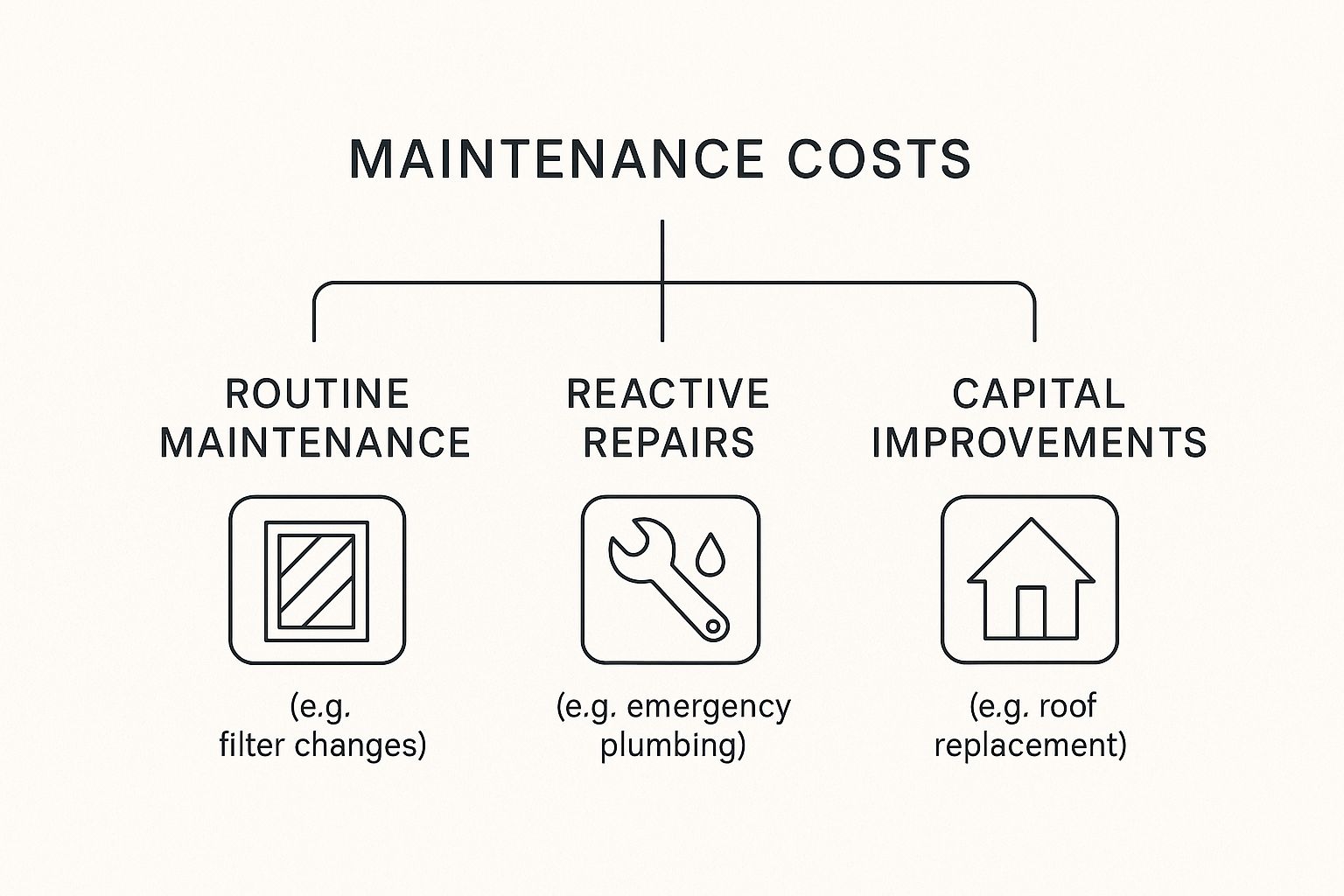
As you can see, a smart maintenance strategy is all about balance—tending to immediate needs while also planning for the future. You can’t afford to let any one of these areas slide.
Routine and Preventative Care
This is the foundation of preserving your asset. Routine care covers scheduled tasks designed to keep your property’s systems running efficiently and stop small issues from becoming massive headaches. Think of it as a wellness check-up for your home.
For a luxury property in Pacific Grove, this is more than just mowing the lawn. It means semi-annual window washing to combat salty air and regular inspections of exterior paint for corrosion. For a ranch-style home in South County towns like King City or Gonzales, it might involve servicing well pumps or maintaining complex irrigation systems.
Actionable Checklist for Routine Care:
- HVAC Servicing: Schedule bi-annual tune-ups (spring and fall) to ensure efficiency and longevity.
- Gutter Cleaning: Perform this non-negotiable task before the winter rains to prevent water damage and protect the foundation.
- Pest Control: Implement proactive treatments, especially for properties bordering agricultural fields in the Salinas Valley.
- Landscape Maintenance: Ensure consistent upkeep to maintain curb appeal and meet local standards.
Unexpected Emergency Repairs
Realistically, no amount of proactive care can prevent every surprise. Emergency repairs are unplanned, urgent problems that demand immediate attention to protect the property and ensure tenant safety. A burst pipe on a holiday weekend or a failing electrical panel requires a fast, professional response.
This is where having a trusted network of on-call professionals is invaluable. Our deep relationships with licensed, local Monterey County vendors mean we can get the right expert on-site quickly, 24/7. That responsiveness minimizes damage, ensures you meet your legal obligations as a landlord, and delivers profound peace of mind.
Tenant Turnover and Refresh
Each time a tenant moves out, your property needs a refresh to prepare it for the next high-caliber resident. These aren’t emergency repairs; they are planned expenses critical for minimizing vacancy time and commanding premium rent.
A pristine property attracts premium tenants. The costs associated with turnover—from professional deep cleaning to fresh paint—are a direct investment in your property's continuous profitability.
Activities in this category typically include:
- Professional Cleaning: A top-to-bottom deep clean of the entire home.
- Painting: Touching up scuffs or applying a fresh coat of neutral paint.
- Lock Changes: A vital security step we perform between every tenancy, without exception.
- Minor Repairs: Addressing any small cosmetic issues noted during the move-out inspection.
These costs are a significant part of your overall operating budget. In fact, 85% of landlords have raised rents partly to offset rising maintenance costs, showing just how much these expenses shape market-wide rental trends.
Major Capital Investments
This final category covers big-ticket items—large-scale replacements or upgrades that extend your property's life. These are Capital Expenditures (CapEx), and they demand serious long-term financial planning.
Replacing a roof on a Carmel home, installing a new high-efficiency HVAC system in a Salinas property, or upgrading kitchen appliances are major investments. Unlike a simple repair, these projects add significant value and must be budgeted for over years, not months. A savvy investor doesn't wait for a system to fail catastrophically. They plan for its eventual replacement, building a reserve fund to cover the cost without disrupting cash flow.
Budgeting Strategies for Savvy Investors

Understanding what you might spend on rental property maintenance costs is one thing. Knowing how to plan for those expenses is what separates successful investors from those constantly caught off guard. For owners of high-value properties in Monterey County, a sophisticated budgeting strategy is essential.
A solid budget provides the financial foresight to preserve your asset, maximize returns, and operate with confidence. We typically implement one of three powerful budgeting methods for our clients, tailored to different portfolios and investment goals.
The Proactive Percentage Method
This is a smart evolution of the basic 1% rule. Instead of a rigid number, a savvy investor budgets 1-3% of the property’s value for annual maintenance, adjusting the percentage based on factors like age, condition, and location.
For example, a newer home in a less exposed part of Salinas might sit comfortably at 1.5%. In contrast, a historic home in Pebble Beach exposed to corrosive sea spray may require a budget closer to 3%. This method’s strength is its simplicity, but it can be too general for investors needing pinpoint precision.
The Per-Unit Flat Rate Method
If you have a portfolio of similar properties—say, multiple condos in Monterey or a few single-family rentals in South County towns like Soledad or King City—the per-unit flat rate method offers excellent predictability. With this strategy, you assign a fixed dollar amount for maintenance to each unit, every year.
An investor might budget $1,500 per unit annually. This creates a predictable, portfolio-wide maintenance fund that’s easy to manage and scale. However, it requires good historical data to set an accurate rate.
A well-structured budget does more than just cover repairs; it serves as a powerful tool for financial planning and asset protection. It's the framework that supports long-term growth and shields your investment from market volatility and unexpected costs.
As a savvy investor, it's also wise to explore practical strategies to reduce operational costs across your properties.
The Asset-Specific Reserve Study
This is the gold standard for owners of high-end, unique, or complex properties, and it's the method we champion at Coast & Valley. A reserve study is a detailed, long-term financial forecast built specifically for your asset. The process begins with a comprehensive on-site inspection to identify every major capital component—from the roof and HVAC system to exterior paint and paving.
Each component is assigned a Useful Life (UL) and a Remaining Useful Life (RUL), along with its current replacement cost. The study then calculates the precise amount to set aside each year to fully fund its replacement when the RUL reaches zero.
Example of a Reserve Study Calculation:
- Component: HVAC System
- Current Replacement Cost: $15,000
- Remaining Useful Life (RUL): 10 years
- Annual Contribution Needed: $1,500 ($15,000 / 10 years)
By applying this formula to every major system, a reserve study creates a highly accurate, long-range funding plan that eliminates financial surprises. Meticulous tracking of these expenses is also essential, as many maintenance costs are deductible. Learning how to maximize deductions for property owners can significantly boost your net returns. This foresight is what truly protects a luxury asset, ensuring you are always prepared, whether for a new roof in Carmel or a full exterior repaint in Salinas.
How Local Monterey County Factors Impact Your Bottom Line
Generic advice on rental property maintenance costs doesn't apply in Monterey County. A budget for a typical inland property will fail for a luxury home in Carmel or a rural estate in the Salinas Valley. Understanding our specific local factors is the only way to build a realistic maintenance budget that protects your investment.
Your property is in a constant dialogue with its surroundings, and here, those surroundings have a significant impact on your bottom line.
The Coastal Climate Effect
If your property is anywhere along the Monterey Bay—from Pebble Beach to Pacific Grove—it’s facing the salt-laced marine layer. This beautiful coastal environment is also incredibly harsh, dramatically accelerating wear and tear.
- Metal Components: Window frames, railings, light fixtures, and HVAC units are prime targets for rust and corrosion. An HVAC unit that might last 20 years inland could have its lifespan halved near the coast without preventative care.
- Exterior Surfaces: Salty air causes paint to peel and bubble more quickly, requiring more frequent repainting to maintain curb appeal and protect the underlying structure.
- Wood and Stucco: Constant moisture from fog creates a perfect environment for wood rot, mold, and mildew, making regular inspections and specialized treatments essential.
For our clients with coastal properties, we don't just budget for maintenance; we budget for defense. This means planning for costs like corrosion-resistant materials, specialized protective coatings, and more frequent professional wash-downs to combat the salt's damaging effects.
Salinas Valley Agricultural Considerations
Head inland toward the agricultural heartland—Salinas, Soledad, Gonzales—and the maintenance challenges change. Properties near farmland face a different set of pressures.
Key planning points for valley properties:
- Advanced Pest Control: Proximity to fields often means a higher risk of pests. A standard quarterly service may not be sufficient; an integrated pest management plan is often necessary.
- Water Management: If your property has significant landscaping or uses a well, maintaining that system is vital. This includes regular service for irrigation systems, well pumps, and filtration systems dealing with extra sediment.
- Dust and Debris: Farming kicks up significant dust, which clogs HVAC filters and coats exteriors, requiring more frequent cleanings and system service to maintain air quality and efficiency.
Seasonal Demands and Local Labor
Monterey County's seasons each bring a unique to-do list. A smart budget anticipates these tasks, turning them into planned expenses.
Seasonal Task Example:
- Fall/Winter: Preparing for the rainy season is non-negotiable. This includes mandatory gutter cleaning, roof inspections, and checking drainage systems to prevent leaks and water damage.
- Spring/Summer: As temperatures rise, the focus shifts to fire risk. This means creating defensible space by managing landscaping and clearing flammable debris, a critical expense for properties in rural or hillside locations.
These maintenance expenses directly affect a landlord's operating costs. Managing these costs efficiently is key to protecting your margins and is one of the smartest strategies for higher rental income you can employ.
Finally, you can't ignore local labor rates. Monterey County is a high-cost-of-living area, and that extends to skilled trades. Access to a trusted network of vetted, reliable, and fairly-priced local vendors—like the one we provide at Coast & Valley—is a significant strategic advantage. It guarantees quality work without overpaying, protecting your ROI.
The ROI of Professional Property Management

For a busy professional or serious investor, managing rental property maintenance costs can feel like a chaotic second job. This is where the value of an expert property manager becomes undeniable. It's not just another expense; it's a strategic investment in efficiency, asset protection, and your own time.
When you partner with a dedicated team like Coast & Valley, you elevate your role from on-call repair coordinator to high-level asset manager. We replace the unpredictable headaches of maintenance with a system of professional oversight, delivering a financial return that more than justifies the management fee. It's no wonder the worldwide property management market is projected to reach $27.8 billion in the coming year.
Proactive Care That Prevents Costly Disasters
The greatest return comes from shifting from reactive repairs to proactive care. Our approach is built to stop small issues from snowballing into expensive catastrophes. A slow drip under a sink is a minor fix today, but in six months, it can become a full cabinet replacement and mold remediation project.
Our team implements a schedule of preventative checks—from biannual HVAC tune-ups to pre-winter roof inspections. This system catches problems early, extends the life of major systems, and transforms your maintenance budget from a chaotic unknown into a predictable expense. For more insights, exploring discussions within property management communities can be valuable.
Access to a Vetted Network of Local Vendors
When a repair is needed, who you call matters. Scrambling to find a reliable, licensed, and reasonably priced contractor in Monterey County—especially for an emergency—is stressful and costly.
We’ve spent years cultivating an exclusive network of trusted local vendors, from plumbers in Monterey to electricians in Salinas. Due to the volume of work we provide, we receive priority service and preferred pricing, and we pass those benefits directly to you. This network ensures every job is done right, on time, and on budget, protecting your investment.
Minimizing Vacancy and Maximizing Tenant Quality
A vacant property is an asset actively costing you money. Our service is designed to minimize that expensive downtime, starting with meticulous tenant screening. Our process goes deeper than a basic credit check to place high-quality, dependable tenants who are more likely to care for the property.
Professionally managed tenant relationships also lead to higher retention rates. Happy tenants stay longer, drastically cutting down on turnover costs. For a closer look, check out our guide to property management best practices.
Hypothetical Case Study: The Salinas Duplex
Picture two identical duplexes in Salinas. Owner A self-manages, handling repairs as they pop up. Owner B partners with Coast & Valley.Over five years, Owner A fields multiple emergency calls, deals with two costly turnovers, and overpays for a rushed plumbing repair. Meanwhile, Owner B benefits from proactive maintenance that prevented major issues, enjoyed seamless tenant transitions with zero vacancy, and saved 15% on vendor costs. The result? Owner B’s property generated a significantly higher net return, all without demanding a single minute of their personal time.
Of all topics, maintenance costs generate the most questions. As seasoned experts in Monterey County property management, we've heard them all. Here are our straightforward answers.
Are Maintenance Costs on a Salinas Home Different from a Monterey Condo?
Absolutely, and the difference lies in responsibility.
With a single-family home in Salinas, you are responsible for the entire property—foundation to rooftop, landscaping to plumbing. This provides total control but also the full financial weight of every repair.
With a luxury condo in Monterey or Carmel, an HOA's monthly dues typically cover major exterior items like the roof, siding, and common areas. This simplifies budgeting for exterior work, but you remain fully responsible for everything inside your unit's walls. We help clients analyze the true cost of ownership to ensure their investment aligns with their financial strategy.
Can I Perform My Own Maintenance to Save Money?
While DIY repairs can feel like a smart way to save, for high-end properties, this approach often backfires. For most busy professionals, the time sunk into a DIY project has a poor return on investment.
More importantly, an improper repair can lead to bigger problems, create serious liability issues, and may violate California’s strict habitability laws. We rely on our network of vetted, licensed, and insured local professionals to ensure the job is done to code, protecting your time, your asset, and your peace of mind.
Dealing with tenant-caused issues requires a firm grasp of legal protocols. We cover this in-depth in our guide on how Salinas landlords handle tenant damage.
How Do You Handle Emergency Maintenance Requests After Hours?
This is where professional management truly shines. Coast & Valley provides genuine 24/7 emergency support.
When a tenant calls with an urgent crisis, like a burst pipe or electrical failure, our on-call team responds immediately. We assess the situation and dispatch a trusted local vendor to mitigate damage, secure the property, and begin repairs. This rapid, professional response protects your investment and keeps your tenants safe, all without you receiving a single late-night phone call.
Effectively managing your rental property's maintenance costs isn't just about fixing things—it's about having a strategic partner you can trust. Coast & Valley Properties brings the local expertise, systems, and concierge-level service needed to protect your asset and maximize your return, giving you complete peace of mind. Contact us today to learn how our premier management services can benefit your portfolio.

Top Tenant Screening Checklist for Monterey County
For owners of premium properties in Salinas, Pacific Grove, or the picturesque towns of South County, selecting the right tenant is more than a transaction—it's the cornerstone of protecting your investment. A generic, one-size-fits-all approach to screening is insufficient for the discerning landlord. The true art lies in a meticulous, multi-layered process that verifies financial stability while also assessing a candidate's reliability and respect for your property. This comprehensive tenant screening checklist is designed for busy professionals and serious investors who demand precision, compliance, and peace of mind.
We'll move beyond simple credit scores to explore the nuanced steps that Coast & Valley Properties employs to secure high-caliber tenants for high-value homes, ensuring your asset is preserved and your ROI is maximized. This isn't just about filling a vacancy; it's about building a foundation of trust and security from day one. You will learn how to implement a concierge-level vetting system that covers everything from in-depth income verification to a thorough review of civil court records. Each step provides actionable insights to help you confidently place tenants who will care for your Monterey County property as if it were their own.
1. The Foundation: A Meticulously Completed Rental Application
The rental application is the bedrock of your entire tenant screening checklist. It’s not just a form; it is a standardized legal document that provides the initial, critical data points and secures the applicant's consent for deeper verification. For high-end properties in areas like Salinas or Monterey, a thorough application signals a serious, organized applicant. A complete form, with no gaps or inconsistencies, is the first green flag.

This document gathers essential personal details, contact information, a comprehensive rental and employment history, and most importantly, the applicant's signed consent for the background and credit checks to follow. This uniformity is crucial for objectively comparing candidates and ensuring you adhere to Fair Housing laws. At Coast & Valley, we utilize digital application platforms that integrate seamlessly with our screening services, ensuring efficiency and FCRA compliance from the very first step. It's the first test of an applicant's diligence and transparency, a key principle of our management philosophy.
Why It's Foundational
A meticulously completed application establishes a baseline of professionalism. An applicant who rushes through the form, leaves fields blank, or provides vague information may demonstrate a similar lack of care if they become your tenant. This first step helps you:
- Standardize Your Process: Using the same application for every prospect ensures you collect identical information, allowing for fair, side-by-side comparisons that comply with Fair Housing regulations.
- Secure Legal Consent: The signed authorization is non-negotiable. It grants you the legal right to perform credit inquiries, background checks, and contact previous landlords and employers. Without this, your screening process stops here.
- Create a Paper Trail: A well-documented application is your first line of defense in case of a dispute. It proves your screening criteria were applied consistently and without discrimination. Specifically for properties in Monterey County, a tailored form like a California rental application form can ensure you collect all state-required information.
Actionable Tips for Implementation
- Utilize an Integrated Platform: Use an online system like Zillow Rental Manager or Avail that bundles the application with screening services. This streamlines the process and ensures all actions are documented and compliant.
- Require Digital Signatures: Implement a system that requires a verifiable digital signature to confirm the applicant's identity and their consent for verification checks.
- Set Clear Expectations: Provide clear instructions, examples of required documents (like pay stubs), and a firm submission deadline to minimize incomplete applications and keep your leasing process on schedule.
2. Identity Verification
Once you have a complete application, the next non-negotiable step is confirming the applicant is exactly who they claim to be. Identity verification is a critical security measure in any robust tenant screening checklist, serving as a powerful defense against fraud. For landlords managing high-value properties in desirable areas like Carmel or Pebble Beach, this step is essential to mitigate significant financial and legal risks. An applicant who readily provides a valid government-issued ID for verification demonstrates transparency and good faith.

This process involves more than just glancing at a driver's license. Modern identity verification uses technology to match the photo on a government-issued ID against a live selfie and validate the document's authenticity. It also cross-references personal details like the applicant's name, date of birth, and Social Security Number (SSN) against reliable databases. At Coast & Valley, we leverage advanced, secure systems to ensure the person applying is the same person whose credit and background we are about to check, preventing sophisticated rental scams before they can take root.
Why It's Foundational
Failing to properly verify an applicant's identity can expose you to professional tenants, subletting schemes, and potential property damage with no recourse. A fraudulent applicant could use stolen information to pass a credit check, leaving you with a major liability. This step helps you:
- Prevent Costly Rental Fraud: Securely confirming identity is the single most effective way to stop scammers who use fake or stolen credentials. This protects your investment and the security of your property and community.
- Ensure Report Accuracy: Verifying the SSN and name ensures the credit and background reports you pull belong to the actual applicant. An inaccurate report is worse than no report at all, leading to flawed decision-making.
- Establish a Secure Foundation: For high-end property owners in Monterey County, this step underscores a commitment to security and professionalism. It sets a secure precedent for the entire landlord-tenant relationship from day one.
Actionable Tips for Implementation
- Integrate AI-Driven Verification: Utilize services like Onfido or Checkr that offer AI-powered identity proofing. These tools can be integrated directly into your online application platform, automating the process of matching an ID to a selfie.
- Communicate Your Privacy Policy: Be transparent with applicants about how their data is collected, used, and protected. Clearly explain that you use encrypted, secure systems for verification to build trust and encourage compliance.
- Require a Government-Issued Photo ID: Make it a standard requirement for all applicants over 18 to submit a clear copy of their unexpired, government-issued photo ID (e.g., driver's license, passport) as part of the application package.
3. Income & Employment Verification
After confirming an applicant's identity, the next critical piece of your tenant screening checklist is verifying their financial stability. Income and employment verification is the process of confirming that a prospective tenant has a reliable source of income sufficient to comfortably afford the rent each month. For high-value rental properties in Salinas and throughout Monterey County, this step is non-negotiable for mitigating risk and securing a dependable tenancy. A stable employment history and a healthy income-to-rent ratio are strong indicators of a tenant's long-term viability.

The industry-standard threshold is that an applicant's gross monthly income should be at least three times the monthly rent. This isn't an arbitrary number; it ensures that after paying for housing, the tenant has adequate funds for utilities, food, and other life expenses, reducing the likelihood of late or missed payments. At Coast & Valley, we use a combination of direct documentation review and technology-driven verification to paint a clear and accurate picture of an applicant's financial health. This diligent process is a core part of how our premium tenant placement services protect your investment and ROI.
Why It's Foundational
Verifying income goes beyond simply checking a box; it's about confirming an applicant's capacity to fulfill their primary lease obligation. An applicant with a strong income but a volatile employment history might pose a greater risk than one with a more modest but stable long-term job. This step helps you:
- Minimize Payment Risk: It is the most direct way to assess an applicant's ability to consistently pay rent on time. This is the single most important factor in maintaining your property’s cash flow and maximizing your ROI.
- Gauge Financial Responsibility: A stable employment history often correlates with general responsibility. This check provides insight into an applicant’s reliability, which can translate to better property care and adherence to lease terms.
- Maintain Objective Standards: Setting a clear, uniform income requirement (e.g., 3x the rent) for all applicants ensures your selection process is fair and defensible, keeping you compliant with Fair Housing laws.
Actionable Tips for Implementation
- Establish a Clear Income Threshold: Clearly state your minimum income requirement (e.g., "gross monthly income must be at least 3 times the rent") in your rental listing to pre-qualify prospects and save time.
- Require Verifiable Documentation: Request the last two months of pay stubs, the previous year’s W-2, or signed offer letters for new employment. For self-employed individuals, common in creative communities like Carmel, ask for the two most recent tax returns (Form 1040) and three months of bank statements.
- Leverage Modern Verification Tools: Consider using secure, automated services like LeaseRunner’s income verification or Plaid-powered platforms. These tools can link directly to an applicant's bank account to instantly verify income and account balances, reducing fraud and increasing efficiency.
4. Credit Report & Score Analysis
Beyond the application, the credit report is a crucial part of your tenant screening checklist, offering a direct look into an applicant's financial responsibility. Pulling a comprehensive report from a major bureau like Experian, TransUnion, or Equifax provides an objective measure of their payment history, outstanding debts, and overall financial health. For premium properties in Monterey County, this step is non-negotiable for mitigating risk and ensuring a tenant can consistently meet their rent obligations.

This analysis isn't just about the three-digit score; it’s about understanding the story behind the numbers. A history of on-time payments for car loans, credit cards, and other obligations is a strong indicator of a responsible tenant. Conversely, numerous collections, high debt-to-income ratios, or recent delinquencies are significant red flags that could jeopardize your rental income. To gain a full understanding of an applicant's financial responsibility, a thorough analysis of their Credit Check history is essential.
Why It's Foundational
A detailed credit analysis moves past an applicant's self-reported information to provide verified, third-party data on their financial habits. It is one of the most reliable predictors of on-time rent payments. This step helps you:
- Assess Financial Reliability: The credit history reveals patterns of financial management. Consistent, on-time payments suggest a dependable individual who is likely to treat their rent obligation with the same seriousness.
- Identify Potential Risks: High levels of consumer debt, recent bankruptcies, or accounts in collection can indicate financial distress. An applicant who is overextended financially may struggle to pay rent, even with a sufficient income.
- Comply with FCRA: Using a professional screening service ensures you receive a credit report that is compliant with the Fair Credit Reporting Act (FCRA), including the proper mechanisms for notifying applicants of any adverse action taken based on the report.
Actionable Tips for Implementation
- Establish a Clear Minimum Standard: Define a minimum credit score (e.g., 650+) for your property and apply it consistently to all applicants. Also, consider the recency of negative items, focusing on issues within the last 24 months.
- Use a Tenant-Specific Screening Service: Utilize platforms designed for landlords, such as Experian SmartMove or TransUnion ResidentScreen. These services provide detailed reports without negatively impacting the applicant's credit score through a "soft pull."
- Look Beyond the Score: While a score is a useful benchmark, review the entire report. A low score due to past medical debt may be less concerning than one caused by multiple credit card charge-offs or a previous eviction-related judgment.
5. Rental History & Landlord References
While a credit score predicts financial reliability, a rental history verification reveals actual tenant behavior. This step involves contacting an applicant's previous landlords to get a firsthand account of their tenancy. It is arguably the most insightful component of any robust tenant screening checklist, offering a real-world preview of what you can expect. For high-value properties in Salinas or Carmel, this qualitative data is just as critical as quantitative financial metrics.
This process confirms key details provided on the application, such as on-time rent payments, property upkeep, and adherence to lease agreements. It uncovers potential red flags that a credit report or background check would never show, like unauthorized pets, disruptive behavior, or a history of breaking leases. At Coast & Valley, we treat these conversations as crucial intelligence-gathering missions, ensuring the person you entrust with your valuable asset has a proven track record of responsibility.
Why It's Foundational
A glowing landlord reference is the ultimate social proof of a quality tenant. It moves beyond numbers on a page to provide a narrative of the applicant's conduct and reliability. This step is essential to:
- Verify Applicant Honesty: Cross-referencing the information provided by the applicant with their former landlord is a powerful truth test. Discrepancies in dates, rent amounts, or reasons for leaving can be significant red flags.
- Gain Behavioral Insights: This is your only chance to ask specific, behavior-oriented questions. You can learn if they maintained the property, communicated effectively about maintenance issues, and respected their neighbors—all crucial factors for protecting your investment and community peace.
- Mitigate Future Risks: A previous landlord can confirm if there were any lease violations, late payments, or eviction proceedings. Discovering these issues upfront is far less costly than dealing with them after a lease is signed, especially given the strict tenant-protection laws in California.
Actionable Tips for Implementation
- Ask Specific, Open-Ended Questions: Avoid simple "yes" or "no" questions. Instead, ask, “Can you describe the condition of the property when they moved out?” or “Were there any instances of late rent payments during their tenancy?” and “Would you rent to them again?” The last question is often the most revealing.
- Contact at Least Two Prior Landlords: Speaking with only the current landlord can be misleading; they may provide a positive review simply to get rid of a problem tenant. Contacting the two most recent landlords provides a more balanced and accurate picture.
- Document Every Conversation: Keep detailed, dated notes of every call or email. This documentation creates a consistent, defensible record of your screening process, proving that your decisions are based on objective criteria and applied uniformly to all applicants.
6. Criminal Background Screening
Beyond financial stability, a crucial part of your tenant screening checklist is a criminal background screening. This step is about safeguarding your property, your investment, and the community you're building within your rental. For high-value properties in desirable areas like Monterey or Salinas, ensuring tenant reliability extends to ensuring a history free of serious criminal convictions that could pose a risk to neighbors or the property itself. This is not about minor infractions but identifying patterns of behavior that are genuinely disqualifying.
A comprehensive criminal background check involves searching multiple databases, including national, state, and county records, as well as sex offender registries. This multi-jurisdictional approach is vital, as a single-state search can miss convictions that occurred elsewhere. At Coast & Valley, we partner with FCRA-compliant services to conduct these searches ethically and thoroughly, ensuring a complete picture while respecting applicant rights.
Why It's Foundational
A criminal background check is a fundamental component of due diligence. It protects you from potential liability and helps maintain a secure environment, which is a key selling point for premium rentals. Neglecting this step could expose you to significant risks, from property damage to endangering other residents. This screening helps you:
- Enhance Community Safety: Identifying applicants with a history of violent crimes, property damage, or other serious offenses is essential for the well-being of all tenants and neighbors. It’s a core responsibility for any conscientious landlord.
- Mitigate Potential Risks: A history of certain criminal activities can correlate with a higher risk of lease violations, property damage, or illegal activities occurring on your premises. Screening helps you make an informed decision to mitigate these risks.
- Demonstrate Due Diligence: In the unfortunate event of an incident, having a documented, consistent screening process, including criminal checks, demonstrates that you took reasonable steps to ensure a safe environment for your community.
Actionable Tips for Implementation
- Establish a Written Policy: Create a clear, written policy outlining what specific types of convictions are disqualifying. This policy must be applied uniformly to every single applicant to avoid any claims of discrimination and ensure Fair Housing compliance.
- Use a Compliant Screening Service: Always use a professional, FCRA-compliant screening company. These services ensure the information is accurate and that you follow all legal procedures, including providing applicants with a copy of the report and a notice of their rights if you deny them based on its contents.
- Adhere to "Lookback" Periods: Be aware of local and state regulations that may limit how far back you can look into an applicant's criminal history. To stay current on these rules, it's wise to review resources detailing California landlord-tenant laws or consult with a property management expert.
7. Eviction & Civil Court Records Check
While a credit report reveals financial habits, an eviction and civil court records check uncovers an applicant's legal history as a renter. This step goes beyond debt to identify patterns of lease violations, property damage disputes, or other legal conflicts with previous landlords. For high-value properties in Monterey County, this part of the tenant screening checklist is indispensable for safeguarding your investment against a history of costly legal entanglements. A clean eviction record is a powerful green flag.
This check involves a search of public court records for unlawful detainer lawsuits (evictions), monetary judgments, or other civil suits related to housing. It provides a clear, documented history of an applicant's conduct and adherence to legal lease obligations. At Coast & Valley, we use comprehensive databases that scan national and local records, ensuring that a past issue in another county or state doesn't go unnoticed. Protecting your property begins with knowing an applicant’s complete rental history, not just the parts they choose to share.
Why It's Foundational
An eviction is one of the most disruptive and costly experiences a landlord can face. Reviewing court records is a proactive measure to avoid repeating another property owner’s negative experience. This crucial check helps you:
- Identify High-Risk Behavior: A past eviction is a significant predictor of future rental problems. It signals an inability or unwillingness to meet lease obligations, which could lead to non-payment of rent, property damage, or disruptive conduct.
- Verify Applicant Honesty: Many applicants with an eviction on their record will omit that landlord from their application. This check verifies the information they provided and highlights any critical omissions or intentional misrepresentations.
- Mitigate Financial and Legal Risk: The eviction process is expensive and time-consuming. Understanding an applicant’s litigation history, especially after the complexities introduced by measures like the CDC eviction ban, allows you to make a more informed risk assessment and protect your bottom line.
Actionable Tips for Implementation
- Use a Specialized Screening Service: Partner with a reputable service like RentPrep or one integrated into a property management platform. These services have access to nationwide eviction databases that are more comprehensive than a simple county search.
- Establish a Look-Back Period: Define a consistent look-back period, typically 5-7 years, to comply with Fair Housing guidelines and focus on recent, relevant history. Applying this standard to every applicant ensures fairness.
- Allow for Context and Verification: If a record appears, give the applicant a chance to explain the circumstances. A past eviction due to a temporary job loss years ago may be viewed differently than a recent one for causing property damage. Always verify the case outcome with the court if details are unclear.
7-Point Tenant Screening Checklist Comparison
| Item | Implementation Complexity 🔄 | Resource Requirements ⚡ | Expected Outcomes 📊 | Ideal Use Cases 💡 | Key Advantages ⭐ |
|---|---|---|---|---|---|
| Completed Rental Application Form | Low to Medium - standardized form, digital or paper options | Low - basic data collection tools, possible manual entry | Uniform data collection, faster decision-making | Initial tenant screening, applicant data organization | Standardized inputs, legal consent ensured |
| Identity Verification | Medium - requires secure tech (OCR, biometrics) | Medium to High - secure data handling, fees per applicant | Fraud reduction, identity trustworthiness | High-risk rental markets, fraud prevention | Prevents identity theft, automated accuracy |
| Income & Employment Verification | Medium to High - includes automated and manual checks | Medium - payroll/bank data access, manual calls possible | Confirmed applicant financial stability | Applicants with varied income sources, financial risk mitigation | Validates rent payment ability, supports freelancers |
| Credit Report & Score Analysis | Medium - API integration with credit bureaus | Medium - subscription and access fees | Financial responsibility snapshot | Assessing financial risk, comparing applicants | Objective credit metrics, automation-friendly |
| Rental History & Landlord References | Medium - manual or semi-automated contact workflows | Low to Medium - communication and follow-up efforts | Insight into tenant behavior and reliability | Tenant conduct assessment, lease adherence checks | Direct landlord insights, uncovers lease issues |
| Criminal Background Screening | Medium - multi-jurisdictional searches, compliance required | Medium to High - database access, adherence to laws | Community safety enhancement, liability reduction | Safety-critical rentals, legal compliance | Reduces risk, protects tenants/property |
| Eviction & Civil Court Records Check | Medium - integration with public databases, some manual retrieval | Medium - database fees, time for record verification | Identifies tenants with eviction or legal issues | High-risk screening, repeat offender avoidance | Flags prior evictions, tenancy dispute context |
Partner with the Experts for Hassle-Free, Premium Tenant Placement
Navigating the complexities of tenant screening is far more than a simple administrative task; it is the cornerstone of successful, profitable, and stress-free property ownership. As we've detailed, a truly comprehensive tenant screening checklist goes beyond surface-level credit scores. It involves a meticulous, multi-layered investigation into an applicant's financial stability, personal identity, and past rental behavior. From verifying income directly at the source to analyzing eviction records and speaking with past landlords, each step is a critical safeguard for your high-value asset.
For busy owners and investors in Salinas and throughout Monterey County, mastering this process is essential. The difference between a reliable, long-term tenant and a problematic one can directly impact your ROI, property condition, and peace of mind. Overlooking even one detail, such as a thorough rental history check or a complete civil court records search, can expose you to significant financial and legal risks. The ultimate goal is not just to fill a vacancy, but to place a qualified individual who will respect your property as if it were their own.
Key Takeaways for Protecting Your Investment
To recap the most crucial insights from our checklist:
- Verification is Non-Negotiable: Never take an application at face value. Independently verify identity, income, and employment to prevent fraud.
- The Full Financial Picture Matters: A credit report is just one piece of the puzzle. Analyze the entire report for debt-to-income ratios, payment patterns, and public records, not just the score.
- Past Behavior Predicts Future Actions: Rental history and landlord references are your most valuable predictive tools. A positive reference from a previous property manager in Monterey or Soledad is a strong indicator of a responsible tenant.
- Compliance is Paramount: The screening process is governed by strict Fair Housing laws. A consistent, documented process for every applicant is your best defense against discrimination claims.
For those aiming for hassle-free and premium tenant placement, adopting innovative solutions can make a significant difference. For instance, you can streamline your rental operations with an AI leasing office assistant to handle initial inquiries and scheduling, freeing you to focus on high-level analysis.
Ultimately, executing this checklist demands significant time, local expertise, and unwavering attention to detail. This is precisely where professional partnership becomes invaluable. By entrusting your tenant placement to seasoned experts, you transform a time-consuming burden into a strategic advantage, ensuring your premium property secures an equally premium occupant.
Are you ready to protect your investment and secure a high-quality tenant without the hassle? The team at Coast and Valley Properties, led by Salinas native Amy Salmina, applies this meticulous screening process to every property we manage, from luxury homes in Carmel to multi-unit complexes in South County towns like King City and Gonzales. Partner with us for concierge-level tenant placement that prioritizes your ROI and gives you complete peace of mind.