

Maximizing Your Investment: A Guide to Tax Deductions for Landlords in Salinas & Monterey County
Owning high-end rental properties in sought-after areas like Monterey, Pacific Grove, or the agricultural heartland of Salinas and Soledad is a significant investment. As a discerning property owner, your focus is on maximizing returns and preserving the long-term value of your portfolio. Yet, many landlords overlook one of the most powerful tools for enhancing profitability: strategic tax planning. The U.S. tax code offers a wealth of deductions specifically for rental property owners, but navigating them requires local expertise and meticulous attention to detail.
Generic advice won't suffice when dealing with the unique real estate landscape of Monterey County. This definitive guide is crafted for busy professionals and serious investors who demand more than surface-level tips. We will delve into the seven most impactful tax deductions for landlords, providing actionable, step-by-step insights tailored to our local market. For broader strategies on maximizing your property's financial performance, exploring general real estate investment insights can provide a valuable foundation.
This article moves beyond theory to offer practical, actionable guidance. You will learn how to:
- Properly categorize expenses for repairs versus capital improvements, a crucial distinction in our local market.
- Maximize depreciation to reduce your taxable income significantly on your Monterey County properties.
- Deduct the full cost of professional services, including premier property management from a trusted local firm.
From understanding how California's property tax system interacts with federal deductions to leveraging professional services for maximum benefit, this article serves as your concierge-level resource. With our guidance, you can transform your tax obligations from a liability into a strategic advantage, ensuring your properties in Carmel, King City, or Gonzales deliver the robust financial performance you expect.
1. Maximizing Returns with Mortgage Interest and Financing Deductions
For owners of high-value properties in exclusive markets like Pebble Beach or Carmel-by-the-Sea, mortgage interest often represents the single most significant deductible expense. This is a crucial lever for optimizing your rental property's cash flow and substantially reducing your annual tax liability. The IRS permits landlords to deduct interest paid on loans used to acquire, build, or make substantial improvements to a rental property.
Unlike the cap on mortgage interest for a personal residence, the deduction for investment properties is not limited. This makes it an incredibly powerful tool for investors, especially those with significant holdings in the Monterey Bay Area. This deduction covers more than just your primary mortgage; it also applies to second mortgages, home equity lines of credit (HELOCs), and refinanced loans, provided the funds are used for the rental business.
How It Works: Mortgages, Points, and More
The concept is straightforward: the interest portion of your loan payments is a business expense. Beyond the primary mortgage, you can also deduct other financing costs.
- Loan Origination Fees ("Points"): These fees, paid to a lender to secure a loan, are also deductible. However, you typically cannot deduct the full amount in the year you paid it. Instead, you must amortize, or spread out, the deduction over the life of the loan.
- Credit Card Interest: If you use a credit card exclusively for rental property expenses, such as buying materials for a repair in Salinas, the interest charged on that card is fully deductible.
Local Expert Insight: Amy Salmina, our founder and a fourth-generation Salinas native, emphasizes, "The unlimited nature of the mortgage interest deduction for investment properties is a primary wealth-building advantage for Monterey County real estate investors. Diligent, professional tracking is essential to maximize this benefit and protect your ROI."
Real-World Examples in Monterey County
- Luxury Property in Monterey: An investor owns a $1.2M property near the coast, financed with an $800,000 mortgage at a 6% interest rate. This allows for an annual tax deduction of approximately $48,000 from interest payments alone, directly boosting the property's financial performance.
- Multi-Family Unit in Salinas: An owner refinances a multi-family property in Salinas with a new $500,000 loan, paying 1 point ($5,000) at closing. Spread over a 30-year loan term, this provides an additional annual deduction of $166.67 ($5,000 / 30 years).
Actionable Tips for Maximizing Your Deduction
- Demand Clear Financial Statements: Partner with a professional property management firm that provides detailed monthly statements. At Coast & Valley Properties, our secure owner portal clearly separates principal and interest payments, providing seamless, CPA-ready records. This is a non-negotiable for serious investors.
- Allocate Expenses for Mixed-Use Properties: If you own a duplex in Seaside and live in one unit while renting the other, you must allocate expenses precisely. Work with a tax professional to divide mortgage interest based on a clear metric like square footage to ensure compliance.
- Maintain Meticulous Records: Keep every Form 1098 from your lender, along with all closing documents from the original purchase and any subsequent refinancing. Securely storing these in a digital owner portal ensures they are never lost. To learn more about preparing for tax season, you can explore our guide for Salinas landlords.
- Strategize Your Refinancing: Consult your financial advisor to time any refinancing efforts. Aligning these decisions with your long-term investment strategy can optimize both your interest rates and your tax planning goals for the year.
2. Property Repairs and Maintenance
For discerning property owners in Salinas and across Monterey County, maintaining a property's pristine condition is about more than just tenant satisfaction; it's a critical tax strategy. The costs of ordinary, necessary, and reasonable repairs to keep your rental property in good working order are fully deductible in the year you pay for them. These expenses directly reduce your taxable rental income, making proactive maintenance a financially savvy move.

Unlike capital improvements, which must be depreciated over many years, repairs are expensed immediately. This distinction is crucial for maximizing your annual deductions. A repair restores an asset to its previous condition, while an improvement enhances its value, adapts it to a new use, or substantially extends its life. Swiftly addressing a leaky roof in Pacific Grove or a malfunctioning appliance in Soledad is not just good management; it's a direct path to lowering your tax bill.
How It Works: Repairs vs. Improvements
The IRS defines a repair as an expense that keeps your property in its normal, efficient operating condition. It doesn't add materially to the property's value or prolong its life. This category includes a wide range of common upkeep tasks.
- Routine Maintenance: Expenses like professional gutter cleaning in Monterey, HVAC system tune-ups in Soledad, or pest control treatments are all considered repairs and are 100% deductible in the current tax year.
- Fixing Breakages: The cost to fix a leaky faucet, replace a single broken window pane, or repair a malfunctioning garage door opener in your King City rental falls squarely into this deductible category.
Local Expert Insight: Proactive maintenance not only preserves the value of your high-end property but also provides immediate tax deductions. Distinguishing repairs from capital improvements is essential for accurate tax reporting and optimizing your cash flow. This is a core focus of our management philosophy at Coast & Valley.
Real-World Examples in Monterey County
- Coastal Property Upkeep: The owner of a luxury rental in Pacific Grove spends $1,500 on interior and exterior painting to address wear and tear from the coastal air. This entire amount is deductible in the current year as a repair.
- Multi-Unit in Salinas: A landlord hires a professional to clean the carpets in all units between tenants and repair a damaged section of drywall in one unit, costing a total of $850. This full amount is a deductible maintenance expense.
Actionable Tips for Maximizing Your Deduction
- Document Everything with Precision: Maintain meticulous records for every repair. Log the date, a detailed description of the work performed, the vendor used, and keep the receipt. Using before-and-after photos is a powerful way to justify the necessity of the repair to the IRS.
- Understand the Repair vs. Improvement Distinction: Work closely with your tax professional to correctly classify your expenses. A new roof is an improvement, but patching a leak is a repair. Replacing an entire HVAC system in a Gonzales rental is an improvement, but an annual service call is a repair.
- Utilize a Professional Management Partner: A firm like Coast & Valley Properties provides detailed, categorized financial statements through our owner portal. We track every maintenance expense, provide digital copies of invoices, and ensure you have CPA-ready documentation, simplifying one of the most complex areas of landlord tax deductions.
- Schedule Proactive Maintenance: Don't wait for things to break. Regular upkeep, such as the tasks on a spring maintenance checklist, can prevent costlier issues later and generates consistent, deductible expenses throughout the year. For more ideas, you can review our spring cleaning and maintenance tips for property owners.
3. Depreciation: The Powerful Non-Cash Deduction
Depreciation is one of the most powerful tax deductions for landlords, allowing you to recover the cost of your income-producing property over its useful life. It’s a non-cash deduction, meaning you can reduce your taxable income without spending any actual money in that year. This deduction accounts for the theoretical wear and tear, deterioration, or obsolescence of the building and its components, providing significant annual tax savings.

For high-value properties in Monterey County, from single-family homes in Salinas to luxury estates in Carmel, depreciation creates substantial paper losses that can offset real rental income. The IRS sets the recovery period at 27.5 years for residential rental properties and 39 years for commercial properties. It's crucial to note that you can only depreciate the value of the building and improvements, not the land, as land does not wear out.
How It Works: Separating Assets and Spreading Costs
The core principle is to deduct a portion of your property’s cost basis each year. This involves separating the value of the structure from the land and then calculating the annual deduction based on the appropriate recovery period.
- Property Cost Basis: This is generally what you paid for the property, plus certain settlement fees and other acquisition costs.
- Improvements vs. Repairs: Capital improvements that add value or extend the life of the property (like a new roof or a kitchen remodel) are depreciated over 27.5 years. In contrast, simple repairs (like fixing a leak) are expensed in the year they occur.
- Personal Property: Assets like appliances, carpeting, and furniture have a shorter recovery period, typically 5 or 7 years, allowing for faster deductions. Bonus depreciation rules may even allow for a 100% deduction in the first year for qualifying assets.
Local Expert Insight: Depreciation is a mandatory deduction. The IRS requires you to take it; if you don't, you will still be subject to "depreciation recapture" tax on the amount you should have deducted when you sell the property. Failing to claim it is a common and costly mistake for self-managing investors.
Real-World Examples in Monterey County
- Single-Family Rental in Salinas: An investor purchases a home for $600,000. A tax assessment or appraisal determines the land is worth $200,000, making the building's cost basis $400,000. Divided by 27.5 years, this generates an annual depreciation deduction of approximately $14,545.
- Luxury Remodel in Monterey: An owner of a high-end rental near the coast completes a $50,000 kitchen and bath renovation. This entire cost is treated as a capital improvement and depreciated over 27.5 years, providing an additional annual deduction of $1,818.
Actionable Tips for Maximizing Your Deduction
- Establish a Clear Land vs. Building Value: At the time of purchase, use a professional appraisal or the local Monterey County property tax assessor's valuation to properly allocate the purchase price between the land and the building. This is the foundation of your depreciation schedule.
- Consider a Cost Segregation Study: For properties valued over $500,000 or for multi-unit complexes in areas like Salinas or Monterey, a cost segregation study can be a game-changer. This engineering-based analysis identifies property components (like carpeting, fixtures, and landscaping) that can be depreciated over shorter 5, 7, or 15-year schedules instead of 27.5, accelerating your tax deductions significantly.
- Meticulously Track All Improvements: Every capital improvement, from new windows in a Pacific Grove cottage to a new HVAC system in a Gonzales multi-family unit, must be tracked and added to your depreciation schedule. A professional property manager can help categorize these expenditures correctly.
- Understand Depreciation Recapture: Before selling, consult with a tax professional. When you sell a rental property for a gain, the IRS will tax the total depreciation you took (or were entitled to take) during your ownership at a maximum rate of 25%. Understanding this is vital for effective exit planning.
4. Leveraging Property Management and Professional Services
For busy professionals and investors with portfolios in Salinas or Monterey County, time is a non-renewable asset. Delegating the operational complexities of a rental property to experts is not just a smart business decision; it’s a fully deductible one. The IRS allows landlords to deduct all ordinary and necessary fees paid for professional services related to the management and maintenance of their rental business. This is a key component of a successful strategy for tax deductions for landlords.

This deduction encompasses a wide range of services that keep your investment compliant, profitable, and well-maintained. From ongoing property management to one-time legal consultations, these costs are treated as essential business expenses. For high-net-worth individuals and absentee landlords, this deduction is particularly valuable, as it directly offsets the cost of securing peace of mind and professional oversight.
How It Works: A Spectrum of Deductible Expertise
Any fee paid to a professional for services rendered for your rental property can be claimed. This creates a powerful incentive to build a team of experts around your investment.
- Property Management Fees: This is the most common professional service expense. Whether it’s a percentage of monthly rent (typically 8-10% in the Salinas Valley) or a flat fee, these costs are 100% deductible. This includes fees for tenant placement, leasing, and routine management.
- Legal Fees: Costs for an attorney to draft or review a lease, handle an eviction in Monterey County, or resolve a tenant dispute are deductible.
- Accounting and Tax Preparation Fees: The fees paid to a CPA or tax professional to prepare your Schedule E (Supplemental Income and Loss) and provide tax advice for your rental activities are deductible.
- Real Estate Agent Commissions: If you use a real estate agent to find and secure a qualified tenant, their commission is a deductible expense.
Local Expert Insight: Viewing professional services not as a cost but as a deductible investment in your property's success is a critical mindset shift for serious investors. The tax savings effectively reduce the net cost of hiring expert help, making it an even more compelling value proposition for preserving your time and ROI.
Real-World Examples in Monterey County
- Single-Family Home in Monterey: An owner pays an 8% management fee to Coast & Valley Properties on a home generating $4,000 in monthly rent. This results in an annual deduction of $3,840 ($320/month x 12).
- Legal Matter in Soledad: A landlord must hire an attorney to manage a complex eviction process for a property in Soledad, incurring $2,500 in legal fees. The entire $2,500 is deductible as a business expense for that tax year.
Actionable Tips for Maximizing Your Deduction
- Demand Itemized Invoices: Ensure any professional, from your property manager to your attorney, provides detailed invoices that clearly state the services were for your rental property. This creates a clean paper trail for the IRS.
- Separate Business from Personal: If you use the same CPA for your personal and rental property taxes, ask them to bill you separately for the work done on your Schedule E. This avoids any confusion or need for allocation.
- Perform a Cost-Benefit Analysis: While self-management may seem cheaper, calculate the true cost. Once you factor in the tax-deductible nature of professional fees and the value of your own time, hiring a firm like Coast & Valley Properties often yields a higher net return and significantly less risk.
- Keep Meticulous Digital Records: Use your owner portal to store all invoices and contracts from professional service providers. Having these documents organized and accessible makes tax time seamless and audit-proof. To understand how this fits into a larger strategy, you can learn more about property management best practices.
5. Protecting Your Investment with Insurance Premium Deductions
For discerning property owners in coastal and inland Monterey County, insurance is not just a safeguard; it's a critical, and fully deductible, business expense. Protecting your valuable assets in Salinas or your luxury rental in Monterey requires comprehensive coverage, and the premiums paid for these policies are a direct deduction against your rental income. This tax deduction for landlords is essential for mitigating risk while improving your bottom line.
The IRS allows you to deduct the ordinary and necessary costs of insurance premiums for your rental business. This goes far beyond a standard homeowner's policy, encompassing specialized coverage designed for the unique liabilities and challenges faced by rental property investors. Properly documenting these expenses is key to claiming their full value and reducing your overall tax burden.
How It Works: A Shield for Your Portfolio
Any insurance policy directly related to your rental activity qualifies. The core principle is that if the insurance protects your business asset or shields you from business-related liability, its cost is a deductible expense. This is a fundamental component of managing a profitable real estate portfolio.
- Landlord Insurance: This is the most common type, covering property damage, liability for on-site injuries, and often loss of rental income.
- Liability and Umbrella Policies: These offer an additional layer of protection against significant claims that could exceed the limits of your primary landlord policy, a crucial consideration for high-net-worth investors.
- Specialized Coverage: This can include flood insurance, earthquake insurance (particularly relevant in California), and even workers' compensation if you employ staff for property maintenance.
Local Expert Insight: Viewing insurance not as a sunk cost but as a deductible operating expense changes the financial equation. It allows you to secure robust protection for your high-value assets without fully absorbing the premium costs from your profits, a strategy we consistently recommend to our clients.
Real-World Examples in Monterey County
- Single-Family Rental in Salinas: An owner pays an annual landlord insurance premium of $1,500. This entire amount is deductible, directly reducing their taxable rental income by $1,500.
- Luxury Coastal Property Portfolio: An investor with properties in Pacific Grove and Carmel holds a $2 million umbrella liability policy to protect their entire portfolio. The portion of the $950 annual premium allocated to the rentals is a deductible expense.
Actionable Tips for Maximizing Your Deduction
- Select Landlord-Specific Policies: Standard homeowner's insurance does not adequately cover rental situations. Work with an insurance agent who specializes in investment properties in the Monterey Bay Area to find a policy that includes liability and loss-of-rent coverage.
- Keep Meticulous Records: Retain every insurance declaration page and proof of payment. A professional property manager can handle this for you, storing all documents in a secure digital owner portal for easy access at tax time.
- Review Coverage Annually: As property values in Monterey County appreciate and renovation costs rise, your coverage limits may become inadequate. Annually review your policies to ensure you are fully protected, adjusting as needed. The increased premium remains a deductible expense.
- Deduct Turnover Costs: When preparing a unit for the next tenant, certain costs are deductible. This includes tasks like changing the locks and ensuring the property is pristine. Using professional move-out cleaning services, for example, is a common and deductible expense that prepares the property for a new lease.
6. Deducting Utilities and Services
While not always the largest expense, utility and service costs represent a consistent and fully deductible category of expenses for landlords. For property owners in Monterey County, especially those managing multi-unit buildings or all-inclusive luxury rentals, these costs can add up significantly. The IRS allows you to deduct the full cost of any utilities you pay for on behalf of your tenants or for the operation of the rental property.
This includes a wide range of common services. If you, as the landlord, are legally responsible for paying for electricity, gas, water, sewer, or trash collection, these are all considered business expenses. The same applies to modern amenities like internet or cable packages provided to tenants and essential services such as landscaping or security system monitoring.
How It Works: Direct Costs and Common Areas
The principle is straightforward: if it's a utility or service required to operate your rental and you pay the bill, it's deductible. This is particularly relevant for landlords with properties in Salinas or Monterey that have shared common areas.
- Direct Tenant Utilities: If your lease agreement stipulates that you will cover the water and sewer bills for a single-family home in Gonzales, those payments are 100% deductible.
- Common Area Expenses: For a multi-unit property in Seaside, the electricity bill for hallway lighting, laundry rooms, or an electric gate is a business expense. These costs are not tied to a single tenant but are essential for the property's overall function and safety.
- Bundled Services: Services like landscaping, pool maintenance, or pest control that you pay for to maintain the property's value and appeal are also fully deductible business operating costs.
Local Expert Insight: The strategic decision of which utilities to include in the rent versus which to make the tenant's responsibility directly impacts both your cash flow and your potential tax deductions. This choice should align with your specific property type and target tenant profile in the Monterey Bay market.
Real-World Examples in Monterey County
- Multi-Family Complex in Salinas: An owner pays a monthly $450 bill for water, sewer, and trash collection for the entire property. They also pay $150 per month for common area electricity. Both amounts, totaling $600 monthly or $7,200 annually, are fully deductible.
- Luxury Rental in Carmel: To attract high-end tenants, the landlord includes landscaping services at $300 per month and a security system monitoring fee of $60 per month. These services, totaling $4,320 per year, are deductible expenses that enhance the property's premium status.
Actionable Tips for Maximizing Your Deduction
- Maintain Scrupulous Records: Keep digital copies of every utility bill and proof of payment. The Coast & Valley Properties owner portal provides a centralized, secure location to store these documents, ensuring nothing is missed come tax time.
- Separate Meters for Multi-Unit Properties: If feasible, have separate utility meters installed for each unit. This simplifies accounting by clearly assigning utility usage to individual tenants, leaving only common area bills for you to track and deduct.
- Factor Costs into Your Pricing: Analyze your annual utility expenses and ensure your rental rates in the local Salinas or Monterey market reflect these costs. This ensures your cash flow remains positive while you benefit from the tax deduction.
- Explore Cost-Saving Measures: Reducing your utility overhead directly boosts your net operating income. Implementing energy-efficient lighting, low-flow water fixtures, or smart thermostats can lower bills. To discover more strategies, you can learn how landlords can save on utility costs.
7. Attracting Quality Tenants with Advertising and Marketing Deductions
Every dollar spent to attract qualified tenants and fill a vacancy is a direct business expense, making it one of the most essential tax deductions for landlords. Keeping your property occupied is fundamental to a successful investment, and the costs associated with marketing your Salinas or Monterey County rental are fully deductible. These expenses are incurred in the ordinary course of business to generate rental income, a key criterion for the IRS.
Proactive and professional marketing not only reduces costly vacancy periods but also attracts a higher-caliber tenant pool, safeguarding your asset. These deductible costs include everything from online listing fees and professional photography to traditional "For Rent" signs and flyers.
How It Works: From Digital Listings to Physical Signage
Any reasonable cost incurred to advertise the availability of your rental property is deductible in the year you pay for it. This broad category covers a wide range of modern and traditional marketing efforts.
- Online Listing Fees: Monthly or per-listing fees for popular platforms like Zillow, Apartments.com, or even featured listings on Craigslist are deductible.
- Professional Services: The cost of hiring a professional photographer or videographer to create compelling marketing assets for your property is a deductible expense. High-quality visuals are crucial in competitive markets like Monterey and Carmel.
- Print and Physical Media: Expenses for yard signs, flyers, and newspaper advertisements are also fully deductible.
Local Expert Insight: Viewing marketing not as a cost but as a deductible investment in asset performance is a critical mindset shift. An effective marketing strategy minimizes vacancy loss, which almost always outweighs the advertising expense itself—a principle we apply to every property we manage.
Real-World Examples in Monterey County
- Single-Family Home in Salinas: An owner spends $200 on professional photography, $50 for a premium Zillow listing, and $75 on a high-quality yard sign and flyers. The total $325 is fully deductible, helping to secure a long-term tenant quickly.
- Luxury Rental in Pacific Grove: To attract a discerning tenant for a high-end coastal property, an owner invests $500 in a marketing campaign that includes a virtual tour and targeted social media ads. This entire amount can be written off as a business expense.
Actionable Tips for Maximizing Your Deduction
- Track ROI on All Channels: Keep detailed records of what you spend on each advertising platform. This data helps you understand which channels deliver the best tenants for your specific property type and location, whether in South County towns like Soledad or along the coast in Monterey.
- Keep Meticulous Receipts: Whether it's a digital invoice from an online listing site or a receipt from a local print shop, every marketing expense must be documented. Using a dedicated business account simplifies tracking these costs.
- Invest in Professional Photography: First impressions are everything. A one-time investment in professional photos can be used for multiple tenant cycles and is a deductible expense that pays for itself by attracting more applicants and reducing time on the market.
- Consider Professional Tenant Placement: The fees paid to a property management firm for marketing and tenant placement services are also deductible. For a deeper dive into methods that can reduce vacancy periods and associated costs, explore these effective real estate advertising strategies. To see how a dedicated service can streamline this entire process, you can learn more about the advantages of using a tenant placement service.
From Tax Strategy to Total Peace of Mind: Your Next Step with Coast & Valley
Navigating the landscape of tax deductions for landlords is more than just an end-of-year accounting task; it is a fundamental component of a successful real estate investment strategy. Throughout this guide, we've unpacked the seven pillars of deductions that every property owner in Monterey County should master. From the significant impact of mortgage interest and depreciation to the often-overlooked costs of advertising and professional services, each deduction is a lever you can pull to increase your net operating income and enhance your long-term return on investment.
Think of it this way: a dollar saved through a legitimate deduction is a dollar earned, directly boosting your profitability without raising rents or acquiring new properties. The key is transforming this knowledge into a systematic, year-round practice. Mastering these deductions moves you from being a passive property owner to an active, strategic investor who understands how to make your assets work smarter for you.
Actionable Checklist for Monterey County Landlords:
Here's what you can do next to take control of your tax strategy:
- [ ] Create a Dedicated Bank Account: If you haven't already, open a separate checking account for all rental income and expenses. This is the single best step for clean bookkeeping.
- [ ] Digitize Your Documents: Scan and save every receipt, invoice, and loan statement to a secure cloud folder. Better yet, partner with a manager who does this for you.
- [ ] Review Your Insurance: Contact your insurance agent to confirm you have a landlord-specific policy with adequate liability coverage for your Monterey or Salinas property.
- [ ] Schedule a Professional Consultation: Book a meeting with your CPA to discuss your current expense tracking and ask about advanced strategies like cost segregation studies.
- [ ] Evaluate Your Management System: Calculate the hours you spend on operations. Is it time to leverage a professional firm to reclaim your time and ensure no deduction is missed?
This disciplined approach is what separates average returns from exceptional ones. It’s about more than just compliance; it's about optimizing the financial performance of your valuable Monterey Bay portfolio.
The Professional Bridge Between Knowledge and Execution
While understanding these principles is the first step, implementing them flawlessly is the challenge, especially for busy professionals, absentee landlords, and high-net-worth individuals. This is where the gap between knowing what to do and having the system to get it done becomes apparent. How do you ensure every single vendor invoice is captured, categorized correctly, and stored securely for years? How do you generate instant, accurate financial reports that give you a clear picture of your property's performance?
This is precisely the value a premier property management firm provides. At Coast & Valley, led by fourth-generation Salinas native Amy Salmina, we build the bridge between tax strategy and effortless execution. Our services are designed for the sophisticated investor who values both ROI and peace of mind.
Our Commitment to Your Financial Clarity: We provide a secure, 24/7 online owner portal where every financial transaction is transparent. Access detailed monthly statements, view itemized invoices for every repair, and download comprehensive year-end reports that make tax preparation seamless for you and your accountant. We don't just manage your property; we manage its financial ecosystem with precision and care, backed by Amy's deep local roots and industry expertise.
By entrusting your property to us, you are not just hiring a manager; you are partnering with a local expert dedicated to protecting and enhancing the value of your asset. We ensure that all potential tax deductions for landlords are meticulously documented, from coordinating routine maintenance in South County to managing large-scale improvements on luxury coastal homes. Our proactive approach ensures that your investment is not only well-maintained but also financially optimized, giving you the freedom to focus on what matters most to you.
Ready to transform your property management experience from a list of tasks into a streamlined, profitable system? Let Coast and Valley Properties show you how our white-glove service and local expertise can unlock the full potential of your investment. Visit us at Coast and Valley Properties to learn more about our comprehensive management solutions designed for discerning owners in Monterey County.

Top Commercial Property Management Best Practices for Salinas Investors
For high-end commercial property owners and serious investors across the Monterey Bay Area, maximizing returns is not just a goal; it is a fundamental requirement. The critical difference between a thriving, high-yield asset and a stressful liability often hinges directly on the quality of its day-to-day and strategic management. Generic, one-size-fits-all advice consistently falls short in our unique market, which spans from the agricultural core of Salinas and the communities of Soledad and Gonzales to the high-value coastal properties of Monterey and Carmel. This is where localized expertise becomes invaluable.
This definitive guide presents nine proven commercial property management best practices, specifically tailored for the discerning investor in Monterey County. We will move beyond basic oversight to provide actionable, concierge-level strategies designed to enhance asset value, ensure rigorous compliance, and secure your long-term profitability. These are not theoretical concepts; they are the practical methodologies that leading local firms like Coast & Valley Properties, guided by the deep regional experience of Amy Salmina, implement to preserve and grow premier commercial portfolios.
Throughout this article, you will discover how to implement sophisticated systems for:
- Proactive Maintenance: Shifting from reactive repairs to preventative care to protect your investment.
- Strategic Tenant Relations: Building partnerships that reduce turnover and improve stability.
- Rigorous Financial Oversight: Optimizing cash flow and ensuring transparent, accurate reporting.
- Smart Technology Integration: Using property technology (PropTech) to boost efficiency and owner convenience.
Prepare to transform your management approach from simple administration to strategic asset optimization. The following blueprint will provide the tools needed to unlock the full potential of your commercial property, ensuring it performs at its peak in the competitive Salinas and Monterey County landscape.
1. Institute Proactive Preventative Maintenance Programs
Shifting from a reactive "fix-it-when-it-breaks" model to a strategic, proactive approach is a foundational element of elite commercial property management best practices. A robust preventative maintenance program involves scheduled inspections, regular system servicing, and anticipating repairs before they become costly emergencies. This foresight is crucial for preserving the physical asset, enhancing tenant satisfaction, and protecting your investment's long-term value.
Why Proactive Maintenance is Non-Negotiable
For commercial properties in Monterey County, this means addressing region-specific challenges. This includes servicing HVAC systems to handle our coastal climate swings and maintaining the pristine building exteriors expected in communities from Monterey to Salinas. By catching small issues early, you prevent system failures, avoid business disruptions for your tenants, and control your budget with planned expenses rather than unexpected, expensive repairs.
Practical Implementation Examples:
- Retail Center: A retail property in Downtown Salinas can implement a quarterly maintenance sweep, checking everything from exterior lighting and signage to plumbing and roofing. This simple, scheduled action significantly reduces emergency call-outs and keeps the property safe and attractive for shoppers.
- Office Building: An office building in Monterey can schedule bi-annual HVAC tune-ups before the summer and winter seasons. This prevents system failures during peak usage, ensuring tenant comfort and productivity, which directly impacts lease renewals.
Actionable Tips for Implementation
- Adopt a CMMS: Implement a digital Computerized Maintenance Management System (CMMS), like the one used by Coast & Valley Properties. This provides transparent tracking, scheduling, and detailed reporting for owners.
- Create Seasonal Checklists: Develop checklists specific to the Salinas Valley climate, such as winter rain preparation (gutter cleaning, leak checks) and summer heat preparation (AC filter changes, exterior shade inspection).
- Vet Local Vendors: Build relationships with trusted, licensed local vendors in Salinas and surrounding areas before an emergency strikes. This ensures priority service and quality workmanship when you need it most.
- Document Everything: Meticulously document all maintenance activities with photos and detailed reports. This creates a clear history for compliance, warranty claims, and demonstrating property care during a future sale.
This bar chart illustrates the direct return on investment from a well-executed preventative maintenance strategy.
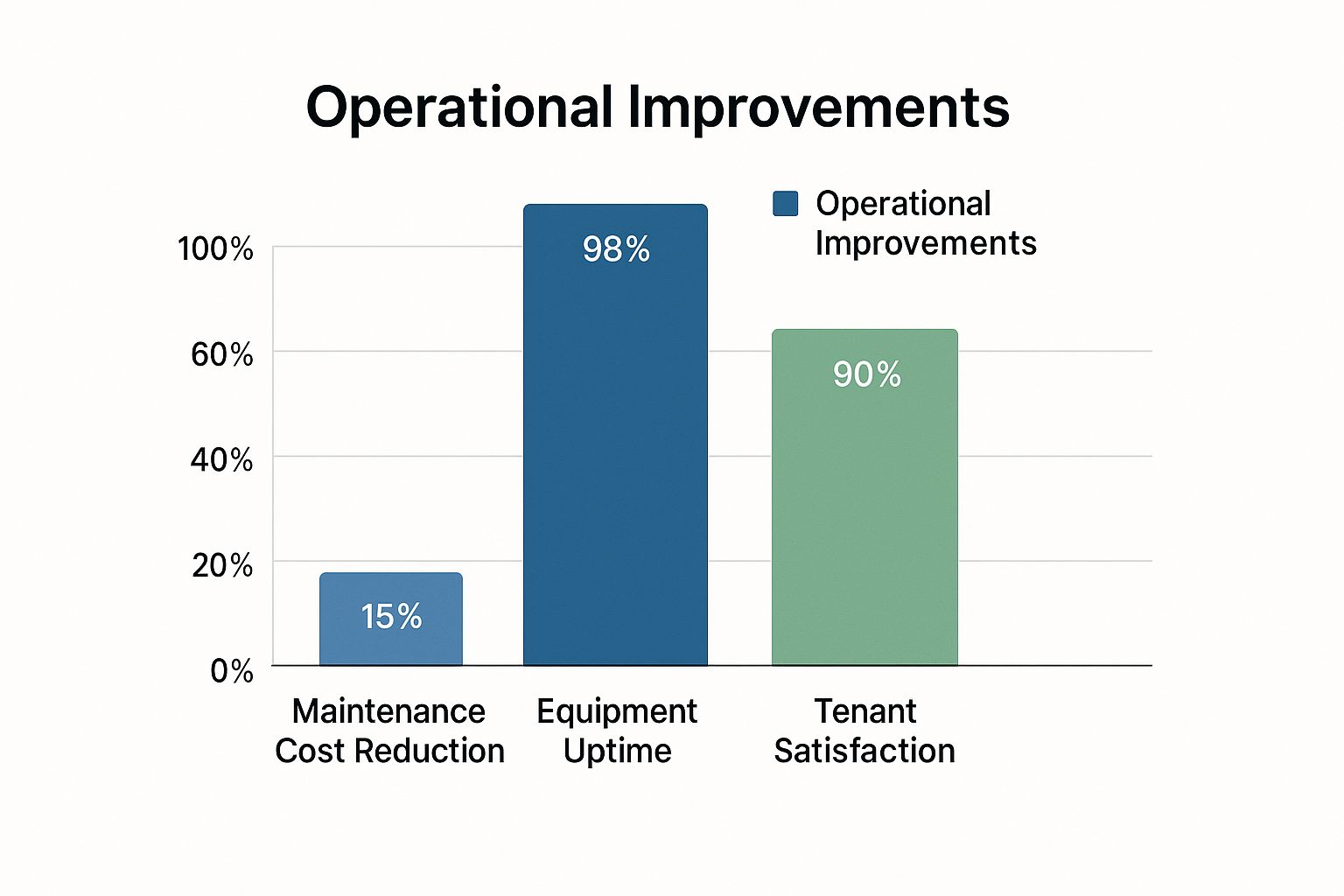
As the data shows, the benefits extend beyond simple cost savings, directly boosting critical operational metrics and tenant relations.
2. Tenant Relationship Management
Beyond collecting rent, sophisticated tenant relationship management is one of the most crucial commercial property management best practices for securing long-term profitability. This approach transforms the landlord-tenant dynamic from a transactional exchange into a strategic partnership. It involves proactive communication, responsive service, and a genuine commitment to helping your tenants' businesses succeed, which in turn fosters high retention rates and stabilizes your cash flow.

Why Tenant Partnerships are an Asset
For commercial properties across Monterey County, from Salinas's agricultural hubs to Monterey's tourism-focused storefronts, tenant success is owner success. A positive relationship means tenants are more likely to report maintenance issues early, take pride in their space, and renew their leases. This proactive partnership is the key to reducing costly vacancies and turnover expenses, creating a stable and thriving commercial environment that attracts other high-quality businesses. For an in-depth look, you can learn more about building a strong tenant-landlord relationship on coastandvalleypm.com.
Practical Implementation Examples:
- Industrial Park: For a light industrial park in Salinas, management can create a streamlined communication portal for logistics updates and maintenance requests, minimizing operational disruptions for tenants reliant on efficient daily operations.
- Mixed-Use Development: A property manager for a mixed-use building in Monterey can host quarterly networking events, connecting retail tenants with office workers upstairs to foster a synergistic community and drive internal business.
Actionable Tips for Implementation
- Establish a Communication Standard: Implement a strict 24-hour response policy for all tenant inquiries, even if it's just to acknowledge receipt and provide a timeline for a full answer. This demonstrates responsiveness and respect.
- Utilize a Tenant Portal: Provide tenants with a dedicated online portal, like the one offered by Coast & Valley Properties, for submitting maintenance requests, paying rent, and receiving building-wide announcements. This empowers them with 24/7 access and creates a transparent communication record.
- Conduct Regular Check-ins: Don't wait for a problem to arise. Schedule brief, quarterly check-in calls or visits to ask how things are going and if they need anything. This proactive approach uncovers minor issues before they escalate.
- Celebrate Their Success: Acknowledge tenant milestones, such as business anniversaries or positive press. A simple congratulatory email or social media shout-out shows you view them as partners, not just rent payers.
3. Financial Performance Optimization
Beyond day-to-day operations, superior commercial property management hinges on a data-driven approach to maximizing profitability. This means moving past simple bookkeeping into strategic financial performance optimization. This practice involves rigorous financial analysis, proactive budget forecasting, disciplined expense management, and constantly seeking opportunities to elevate property value and investor returns.
Why Financial Optimization is Non-Negotiable
In a competitive market like Monterey County, optimizing financial performance is a critical differentiator. It transforms a property from a passive asset into a high-performing investment. This involves not just collecting rent but strategically analyzing every line item, from vendor contracts in Salinas to utility costs in Monterey, to ensure maximum efficiency. For commercial property management, implementing rigorous financial performance optimization is paramount, and this extends to how you handle your payables and receivables. Learn more about strategies for effective invoice management in real estate. A proactive approach ensures your asset weathers market fluctuations and consistently outperforms expectations.
Practical Implementation Examples:
- Industrial Property: The owner of an industrial park in Soledad can benchmark utility costs against regional averages. This analysis might reveal an opportunity to install energy-efficient lighting, a capital improvement that lowers tenant operating costs and increases the property's marketability.
- Mixed-Use Building: A mixed-use property in Monterey can implement dynamic pricing for its short-term commercial spaces based on seasonal demand. This strategy, common among institutional investors, maximizes revenue during peak tourist seasons.
Actionable Tips for Implementation
- Benchmark Expenses: Regularly compare your operating expenses (e.g., landscaping, security, janitorial) against similar properties in the Salinas Valley. This identifies areas where you might be overspending and can negotiate better terms.
- Conduct Monthly Variance Analysis: Implement monthly financial reviews that compare budgeted figures to actual results. This allows for immediate course correction on budget overruns and highlights positive performance trends.
- Leverage Financial Reporting: Utilize property management software with robust financial reporting capabilities. At Coast & Valley, our detailed financial reports for Salinas investment properties give owners a clear, real-time view of their asset's performance.
- Track Key Performance Indicators (KPIs): Monitor essential metrics beyond just income and expenses. Track KPIs like Net Operating Income (NOI), Cost Per Square Foot, and Revenue Per Tenant to gain deeper insights into your property's financial health.
4. Technology Integration and PropTech Adoption
Embracing technology is no longer optional; it's a cornerstone of modern commercial property management best practices. Strategic PropTech adoption involves implementing software and smart systems to streamline operations, enrich the tenant experience, and provide owners with unparalleled transparency. This shift from manual processes to integrated digital solutions is critical for managing assets efficiently and staying competitive in a fast-evolving market.
Why Technology is a Competitive Differentiator
In a sophisticated market like Monterey County, leveraging technology sets a management company apart. It enables real-time communication, instant access to financial reports, and efficient handling of maintenance requests, all of which are expectations of today’s tenants and investors. For properties from Salinas to Monterey, this means using digital tools to deliver the high-touch, responsive service that the local market demands, ultimately improving operational efficiency and maximizing your return on investment.
Practical Implementation Examples:
- Office Complex: An office building in Monterey can implement a tenant portal app that allows tenants to book conference rooms, submit maintenance requests, and receive building announcements directly on their phones. This high-level convenience leads to higher engagement and satisfaction.
- Industrial Park: An industrial park in Salinas could use IoT sensors to monitor energy usage in common areas and for key systems. This data, analyzed by a smart building platform, can identify savings opportunities, potentially reducing utility costs significantly.
Actionable Tips for Implementation
- Build a Foundational Core: Start with a robust property management software like AppFolio or Buildium to centralize accounting, leasing, and operations before adding more specialized tools.
- Prioritize Cybersecurity: As you adopt digital platforms, implement stringent cybersecurity protocols to protect sensitive owner and tenant data. This is non-negotiable for maintaining trust and is a key focus for our team at Coast & Valley.
- Ensure Scalability: Select technology solutions that can grow with your portfolio. A system that works for one property should be scalable to manage ten or more without a complete overhaul.
- Invest in Training: Provide comprehensive training for your staff on all new systems to ensure they can leverage the technology to its full potential, improving internal efficiency and the quality of service delivered. You can discover more about how modern technology is managing Central Coast properties.
5. Compliance and Risk Management
Navigating the complex web of regulations, codes, and potential liabilities is a cornerstone of professional commercial property management best practices. A diligent compliance and risk management framework is not just about avoiding fines; it's about protecting your asset, ensuring tenant safety, and safeguarding your investment against unforeseen legal and financial threats. This involves staying current with ever-changing laws, implementing robust safety protocols, and proactively identifying risks before they escalate.
Why Compliance is Non-Negotiable
For commercial properties, from agricultural facilities in the Salinas Valley to historic buildings in Monterey, the legal landscape is intricate. Effective management requires a deep understanding of zoning laws, ADA (Americans with Disabilities Act) requirements, and California-specific regulations. A failure in compliance can lead to costly litigation, operational shutdowns, and significant damage to your property's reputation, making proactive oversight essential for long-term viability.
Practical Implementation Examples:
- Medical Office Building: A medical building in Salinas must adhere to strict HIPAA and ADA compliance, ensuring patient privacy and accessibility. This includes secure data handling, accessible ramps, and automated doors, where non-compliance poses both legal and reputational risks.
- Historic Retail Space: A historic retail property in Pacific Grove or Carmel requires careful management to balance preservation codes with modern safety standards. This includes specific guidelines for signage, facade maintenance, and fire suppression systems that protect both the building's character and its occupants.
Actionable Tips for Implementation
- Build a Legal Team: Establish relationships with experienced commercial real estate attorneys in Monterey County who specialize in landlord-tenant law and local building codes. This provides expert guidance and a crucial resource when complex issues arise.
- Conduct Regular Audits: Create detailed compliance checklists and schedule regular property audits. These should cover everything from fire safety systems and ADA accessibility to lease agreement adherence and insurance coverage adequacy.
- Invest in Security & Training: Beyond general security, consider implementing robust physical security measures such as advanced commercial access control systems to protect both the property and its occupants. Additionally, invest in regular staff training on safety protocols and emergency procedures.
- Meticulously Document Everything: Keep detailed, organized records of all compliance activities, inspections, incident reports, and communications. This documentation is invaluable for demonstrating due diligence, supporting insurance claims, and staying prepared for any potential legal challenges. To stay up-to-date, learn more about current California landlord-tenant laws.
6. Strategic Lease Management
Effective commercial property management best practices hinge on treating the lease not just as a document, but as a strategic asset. Strategic lease management is the systematic approach to overseeing lease agreements throughout their entire lifecycle, from negotiation and execution to renewal and termination. It is a dynamic process focused on optimizing terms, managing critical dates, and ensuring a favorable lease structure that aligns the landlord's financial goals with the tenant's operational needs, thereby maximizing portfolio performance.
Why Strategic Lease Management is Crucial
In a competitive market like Monterey County, a well-managed lease portfolio is your greatest defense against vacancy and your best tool for revenue growth. Proactive management allows you to anticipate lease expirations, stay ahead of market rent trends, and build strong tenant relationships that encourage renewals. For properties from the agricultural hubs of Salinas to the high-end retail spaces in Carmel-by-the-Sea, this means creating lease structures that are both attractive to quality tenants and protective of the owner's investment.
Practical Implementation Examples:
- Industrial Park: For an industrial park in Soledad, strategic management involves structuring leases with clear pass-through provisions for common area maintenance (CAM) costs and property taxes, ensuring operational expenses are covered without impacting net income.
- Mixed-Use Development: In a mixed-use property in Monterey, a manager might stagger lease expiration dates across retail and office tenants. This minimizes the risk of having multiple vacancies simultaneously and provides a steady, predictable cash flow.
Actionable Tips for Implementation
- Create a Lease Rollover Schedule: Maintain a detailed abstract and schedule for every lease, tracking key dates like expirations and renewal options 12-18 months in advance. This foresight is critical for starting renewal negotiations early.
- Conduct Regular Market Surveys: Stay informed on current rental rates, concessions, and terms for comparable properties in the Salinas Valley. This data empowers you to justify rent escalations and negotiate from a position of strength. To ensure you secure favorable terms and protect your investment in commercial properties, explore a comprehensive commercial lease negotiation checklist.
- Build Broker Relationships: Cultivate strong connections with local commercial real estate brokers. They are an invaluable source of market intelligence and a primary channel for sourcing high-quality, pre-vetted tenants for your vacancies.
- Standardize Lease Clauses: Work with legal counsel to develop standardized lease language for key provisions like escalation clauses, maintenance responsibilities, and default terms. This ensures consistency and protection across your entire portfolio.
7. Embrace Sustainability and Energy Efficiency
Integrating environmentally responsible practices is no longer a niche trend; it's a core component of modern commercial property management best practices. This approach involves implementing energy-efficient systems and sustainable operations to reduce operating costs, attract high-quality, eco-conscious tenants, and align with evolving green building standards. It's a strategic move that enhances asset value, marketability, and long-term financial performance.

Why Sustainability is a Smart Investment
For property owners in Monterey County, embracing sustainability offers a competitive edge. The region's environmentally aware demographic values green initiatives, making properties with these features more attractive for leasing. Beyond tenant appeal, energy efficiency directly lowers utility expenses, a significant portion of a commercial property's operating budget. This cost reduction boosts your Net Operating Income (NOI) and increases the property's overall valuation.
Practical Implementation Examples:
- Office Park in Monterey: A multi-tenant office park can achieve significant savings by retrofitting common areas and exterior lighting with energy-efficient LEDs and installing smart thermostats. These upgrades immediately lower electricity bills and signal a commitment to modern, responsible management.
- Winery in South County: A winery or agricultural facility in a town like Soledad or Gonzales can install solar panels to offset high energy usage. This not only reduces operational costs but also provides a powerful marketing story that resonates with the local community and visitors.
Actionable Tips for Implementation
- Start with Low-Cost Measures: Begin with high-impact, low-cost upgrades like LED lighting retrofits, smart irrigation controllers for landscaping, and regular HVAC filter changes before committing to major system overhauls.
- Leverage Rebates and Incentives: Research and take full advantage of local utility rebates from PG&E and federal tax incentives designed to offset the cost of energy-efficient improvements.
- Benchmark Performance: Use tools like the EPA's ENERGY STAR Portfolio Manager to track and benchmark your building's energy and water consumption. This data is crucial for identifying areas for improvement and measuring the ROI of your initiatives.
- Engage Your Tenants: Foster a culture of sustainability by educating tenants on energy-saving practices. Consider implementing green lease clauses that create shared goals for reducing waste and consumption, benefiting both landlord and tenant.
8. Market Intelligence and Competitive Analysis
Static management strategies fall short in a dynamic real estate market. One of the most critical commercial property management best practices is the continuous gathering and analysis of market intelligence. This involves a systematic approach to understanding competitor activities, local economic shifts, and industry trends to inform decisions on pricing, marketing, and capital improvements. This data-driven practice ensures your property remains competitive and profitable.
Why Market Intelligence is Non-Negotiable
For commercial assets in Monterey County, staying ahead of the curve is essential. From the agricultural demands influencing industrial space in the Salinas Valley to the tourism and hospitality trends shaping retail in Carmel-by-the-Sea, local nuances directly impact property value. By actively monitoring the market, you can justify rental rates, identify opportunities for property enhancements that attract high-value tenants, and forecast potential vacancies before they become a problem. This intelligence transforms property management from a guessing game into a calculated science.
Practical Implementation Examples:
- Industrial Property: The manager of an industrial park in Gonzales can analyze supply chain trends and local agricultural output to anticipate demand for warehouse space, adjusting lease terms and marketing efforts to attract logistics and food processing tenants.
- Mixed-Use Development: For a mixed-use property in Monterey, a manager can track local demographic shifts and consumer spending habits. This data helps curate a tenant mix that serves the community, such as adding a boutique fitness studio or a specialized cafe, increasing foot traffic and overall property appeal.
Actionable Tips for Implementation
- Leverage Professional Research: Subscribe to industry-standard data services like CoStar to get granular, real-time information on comps, vacancies, and absorption rates in the Salinas and Monterey markets.
- Build a Broker Network: Cultivate strong relationships with local commercial real estate brokers. Their on-the-ground insights are invaluable for understanding tenant movements and off-market trends that data platforms might miss. For a deeper dive into this process, explore our guide to conducting a thorough real estate market analysis in Salinas.
- Standardize Your Surveys: Create and consistently use a standardized market survey template. This ensures you collect uniform data on competitor properties, including rental rates, concessions, amenities, and occupancy, allowing for true apples-to-apples comparisons.
- Attend Local Industry Events: Participate in meetings held by local chambers of commerce and real estate associations. These events are goldmines for networking and gathering qualitative information about upcoming developments and business sentiment in the region.
9. Professional Development and Team Management
The excellence of your commercial property management is a direct reflection of the team executing the strategy. Investing in professional development and strategic team management is not an overhead cost; it's a core practice for building a resilient, knowledgeable, and high-performing operation. This approach involves continuous training, clear performance metrics, and creating a culture that retains top talent, ensuring your property is managed by professionals at the forefront of the industry.
Why Team Investment is Non-Negotiable
A well-trained team is the engine behind every other best practice, from financial reporting to tenant relations. For commercial property owners in Monterey County, this means having a team that understands not only national standards but also local regulations, market trends from Salinas to Monterey, and the specific needs of your tenants. At Coast & Valley, we know that investing in our people, guided by the leadership of Amy Salmina, leads to higher tenant satisfaction, lower operational risks, and superior asset performance for our clients.
Practical Implementation Examples:
- HOA Management: An HOA management team in Salinas can receive specialized training on new state laws governing community associations. This expertise prevents costly compliance errors and ensures fair, effective governance for the homeowners.
- Commercial Portfolio: A firm managing a diverse portfolio across Monterey County can implement cross-training, enabling a maintenance coordinator to understand leasing fundamentals. This creates a more versatile and resilient team capable of handling complex tenant and owner requests without delay.
Actionable Tips for Implementation
- Encourage Certifications: Support and incentivize team members to earn prestigious industry certifications like the CPM (Certified Property Manager) from IREM. This builds verifiable expertise and demonstrates a commitment to the highest professional standards.
- Implement Mentorship: Pair seasoned property managers with newer staff members. This practice, common in leading firms, accelerates learning, preserves institutional knowledge, and fosters a collaborative team culture.
- Provide Continuous Education: Offer tuition reimbursement or subsidies for courses on topics like sustainable building management or advanced financial analysis. This keeps your team's skills sharp and aligned with evolving market demands.
- Conduct Regular Performance Reviews: Establish clear, data-driven Key Performance Indicators (KPIs) for every role and review them regularly. This ensures accountability and provides a clear pathway for professional growth and compensation adjustments.
Best Practices Comparison Matrix for 9 Key Areas
| Item | Implementation Complexity 🔄 | Resource Requirements | Expected Outcomes 📊 | Ideal Use Cases | Key Advantages ⭐💡 |
|---|---|---|---|---|---|
| Preventative Maintenance Programs | Moderate to High 🔄 | Dedicated staff, planning, CMMS software | Reduced costs (12-18%), extended equipment life, fewer breakdowns 📊 | Properties needing proactive upkeep | Cost savings, longer asset lifespan, compliance ⭐ |
| Tenant Relationship Management | Moderate 🔄 | Staff for tenant services, communication tools | Higher retention (20-30%), reduced vacancies, premium rents 📊 | Tenant-focused portfolios | Increased tenant loyalty, positive referrals ⭐ |
| Financial Performance Optimization | High 🔄 | Skilled financial analysts, software tools | NOI improvement (5-15%), data-driven decisions 📊 | Portfolio profitability maximization | Better cash flow, informed investments ⭐ |
| Technology Integration & PropTech Adoption | High 🔄 | Upfront tech investment, training | Operational cost reduction (15-25%), real-time data 📊 | Modernization & efficiency focus | Automation, tenant satisfaction, security ⭐ |
| Compliance and Risk Management | Moderate to High 🔄 | Compliance teams, audits, legal advisors | Legal protection, reduced premiums, safety compliance 📊 | Properties in regulated environments | Risk reduction, operational stability ⭐ |
| Strategic Lease Management | Moderate 🔄 | Lease specialists, software systems | Maximized rental income, occupancy improvement 📊 | Lease-heavy portfolios | Rental optimization, vacancy reduction ⭐ |
| Sustainability and Energy Efficiency | High 🔄 | Capital for upgrades, sustainability experts | Utility savings (20-30%), higher property value 📊 | Green buildings, tenants seeking sustainability | Cost savings, marketability, tax incentives ⭐ |
| Market Intelligence & Competitive Analysis | Moderate 🔄 | Research tools, market analysts | Optimal pricing, strategic positioning 📊 | Investment and development decision-making | Market insights, competitive advantage ⭐ |
| Professional Development & Team Management | Moderate 🔄 | Training programs, HR resources | Improved service & retention, skilled staff 📊 | Growing teams, quality-driven management | Enhanced expertise, lower turnover ⭐ |
Your Partner in Commercial Property Excellence
Navigating the dynamic landscape of commercial real estate in Monterey County requires more than just a checklist of tasks; it demands a strategic, forward-thinking partnership. Throughout this guide, we've explored the nine pillars that form the foundation of elite commercial property management. From implementing rigorous Preventative Maintenance Programs that safeguard asset value to cultivating strong relationships through proactive Tenant Relationship Management, each practice is a critical component in a larger system designed for success.
The journey doesn't stop there. True excellence is achieved by mastering Financial Performance Optimization to ensure your property isn't just maintained, but is a thriving investment. It involves embracing Technology Integration for unmatched efficiency and transparency, and diligently practicing robust Compliance and Risk Management to protect you from the legal and financial pitfalls common in today’s market. These aren't just abstract concepts; they are the actionable strategies that distinguish a well-managed property from one that merely gets by.
From Good Practices to Great Performance
Adopting these commercial property management best practices is what separates passive ownership from active, strategic investment. The difference is profound, impacting everything from your bottom line to your peace of mind.
- Strategic Lease Management: This isn't just about filling vacancies. It’s about structuring agreements that align with long-term goals, whether your property is in the bustling agricultural hub of Salinas or the high-end retail corridors of Carmel-by-the-Sea.
- Market Intelligence: Staying ahead requires a deep, localized understanding of trends. Knowing the specific needs of businesses in Soledad versus those in Monterey allows for targeted leasing and competitive positioning.
- Sustainability and Team Excellence: Forward-thinking owners recognize that green initiatives and a well-trained management team are no longer optional. They are powerful differentiators that attract premium tenants and ensure operational continuity.
For busy professionals, absentee landlords, and serious investors with portfolios across Monterey County, the message is clear. You don't need to become an expert in all these fields yourself. The true best practice is to partner with a team that has already achieved mastery and possesses deep-rooted local knowledge.
Key Takeaway: Implementing these principles transforms your commercial property from a liability that demands your constant attention into a high-performing asset that fuels your financial goals. It's about shifting your focus from day-to-day problems to long-term strategy, confident that the details are being handled with professional precision.
Your Next Step Toward Maximizing Your Investment
Ultimately, the goal of superior property management is to unlock the full potential of your commercial asset. It’s about creating an environment where tenants prosper, the property’s physical and financial health is secured, and your return on investment is maximized. This level of service isn’t a commodity; it’s a commitment delivered by a dedicated local partner.
This is the standard we uphold at Coast & Valley Properties. Led by Salinas native Amy Salmina, our team lives and breathes these principles daily, applying them with a nuanced understanding of the unique Monterey Bay Area market. We provide the “boots-on-the-ground” expertise and 24/7 digital access that high-end property owners and discerning investors demand. Don’t let your valuable commercial property underperform. Take the definitive step toward securing its future and optimizing its returns today.
Ready to see how these commercial property management best practices can be implemented for your portfolio? Partner with Coast & Valley Properties, where our concierge-level service and local expertise turn best practices into tangible results for owners throughout Salinas and Monterey County. Contact Coast and Valley Properties today for a comprehensive evaluation of your commercial asset.

A Guide to High Net Worth Property Management in Monterey County
Think of it this way: you have a private wealth manager for your financial portfolio. But who provides that same level of strategic care for your most valuable physical assets? This is precisely the role of high net worth property management. It’s a specialized, concierge-level service that goes miles beyond simply cashing a rent check.
For owners of premier properties in Salinas, Monterey, and across the Central Coast, this isn't just a service—it's a strategic partnership. It's laser-focused on preserving your legacy, enhancing your lifestyle, and mitigating the unique risks that come with owning luxury real estate.
Redefining Management for Monterey’s Premier Properties
Let's be clear: standard property management and high net worth property management are two entirely different things. A standard service handles the basics—rent collection, routine repairs, and tenant calls. A high net worth approach operates on another level entirely. It's a fully integrated system of asset preservation and lifestyle facilitation, built for owners with significant real estate holdings in Monterey County.
For those who own exceptional homes in places like Pebble Beach, Carmel, or the exclusive agricultural estates around Salinas, this service becomes a single, trusted point of contact for complete peace of mind. Instead of just reacting to a leaking pipe, a high net worth manager proactively spots risks, optimizes financial returns, and cares for the property with the meticulous attention of a museum curator. The focus is always on long-term value, not just quick, temporary fixes.
This proactive oversight also dives deep into the financial side of things, making sure the property's performance aligns with your broader wealth management goals. The need for this specialized oversight is growing. The wealth management sector, which is closely tied to this type of property management, is projected to see assets under management nearly double to $145.4 trillion by 2025, up from $84.9 trillion in 2016. As global wealth climbs, so does the demand for professional management of high-value real estate.
The Core Difference: A Personalized, Concierge Approach
At its heart, this service is built on a trusted, one-on-one relationship. You have a dedicated manager who acts as your personal command center, coordinating a hand-picked network of vetted, local specialists to deliver whatever your property needs.
The image below gives you a clear picture of this structure, showing how one dedicated manager orchestrates everything so you don't have to.
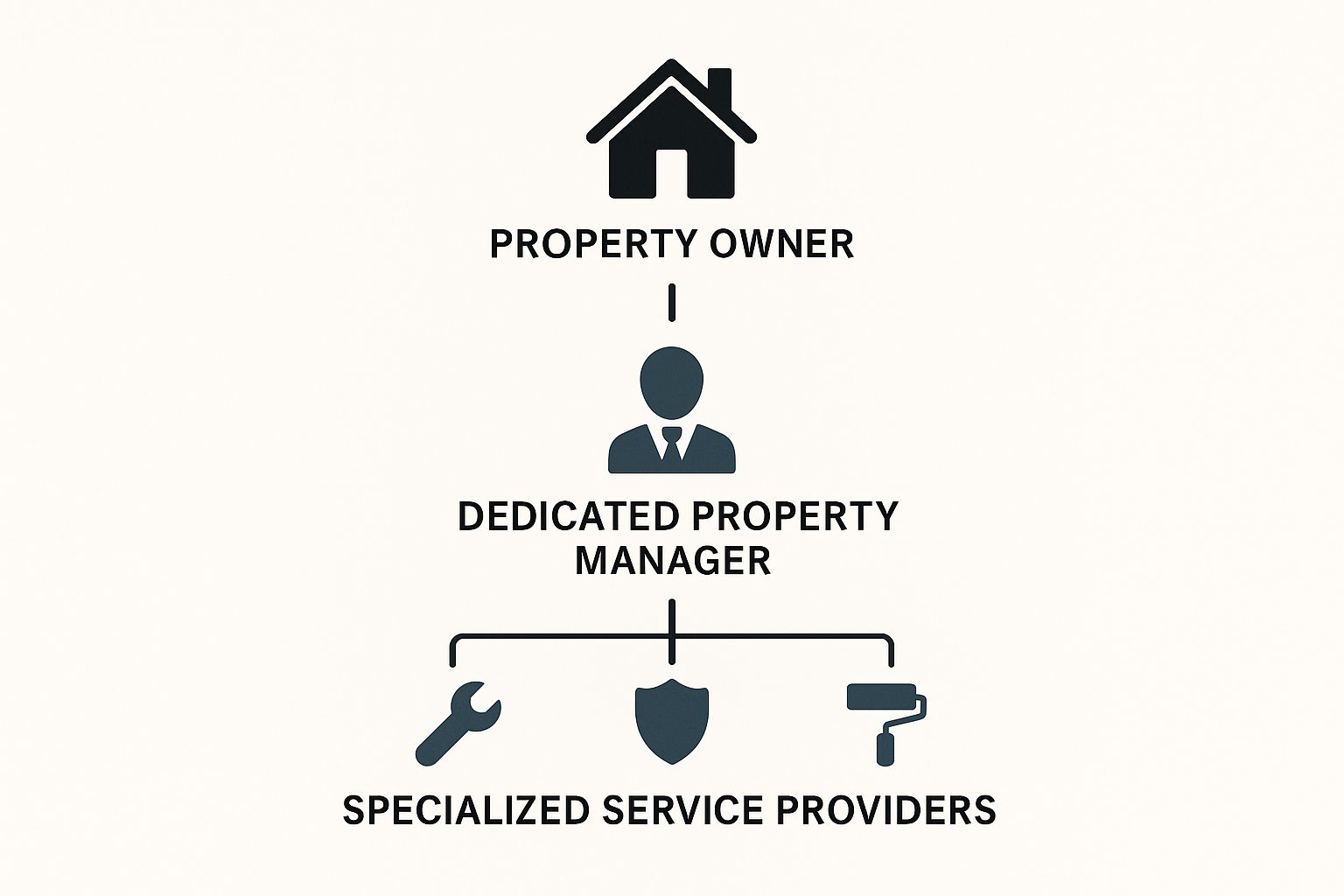
This model guarantees accountability and crystal-clear communication. It completely removes the burden of you having to find, vet, and manage separate vendors for everything from landscaping and security to advanced smart home technology. It's all handled through one trusted point of contact.
For our clients here in Monterey County, this means having one partner who truly gets it—someone who understands the nuances of coastal weather, the high expectations of luxury living, and the absolute importance of discretion. It’s about creating a truly hands-off, worry-free experience for busy owners.
To better illustrate the distinction, let's break down how these two service models compare side-by-side. The table below highlights the fundamental differences in approach and scope.
Standard vs High Net Worth Property Management At A Glance
| Feature | Standard Property Management | High Net Worth Property Management |
|---|---|---|
| Primary Goal | Operational efficiency, filling vacancies | Asset preservation, lifestyle enhancement, long-term ROI |
| Service Model | Reactive, task-based (rent, basic repairs) | Proactive, strategic, and holistic |
| Relationship | Transactional, often with multiple points of contact | Personal, one-on-one with a dedicated manager |
| Vendor Management | Uses a general pool of vendors | Manages a curated network of elite, vetted specialists |
| Financial Reporting | Basic income/expense statements | Custom, detailed reports; ROI analysis; capital planning |
| Risk Management | Standard insurance, basic compliance | Specialized insurance coordination, proactive risk mitigation |
| Property Care | Routine maintenance and repairs | Meticulous preservation, preventative maintenance, curation |
As you can see, the high net worth model is far more comprehensive, acting as a true stewardship of your asset rather than just an administrative service.
Financial Oversight and Strategic Planning
Beyond keeping the physical property in pristine condition, elite management involves serious financial stewardship. A huge part of this is navigating the fiscal responsibilities that come with owning valuable real estate. This often means providing comprehensive financial oversight, including a deep understanding of the complex taxes on investment property.
This level of financial care includes:
- Custom Financial Reporting: Delivering clear, in-depth statements that track income, expenses, and return on investment (ROI).
- Capital Improvement Planning: Creating strategic, long-term budgets for major projects designed to preserve and enhance property value, like a roof replacement or system upgrade.
- Risk Management: Coordinating specialized insurance policies—from liability to flood and fire coverage—that are specifically tailored to high-value assets in our local Monterey Bay climate.
This detailed financial oversight ensures your property isn't just well-maintained, but is also a high-performing component of your overall financial portfolio. It’s the critical difference between simple upkeep and true asset management.
The Pillars of Elite Property Management

High-net-worth property management is a framework built on three pillars that support each other. When these three pillars work in concert, they provide total peace of mind and protect the future value of your most important assets.
This integrated system is a world away from the standard, reactive "break-fix" cycle. Instead, it creates a proactive ecosystem of care that’s built for the specific demands of luxury properties, whether it's a sprawling estate in the Salinas Valley or a coastal retreat in Carmel. Let’s break down these three foundational pillars to see how they come together to create a truly elite service.
Pillar 1: Strategic Asset Preservation
This is the absolute cornerstone of managing a high-value property. Standard maintenance is all about fixing things once they're broken. Strategic asset preservation, on the other hand, is about preventing problems before they even start and protecting the unique character of your home. It’s about treating the property like a curated collection of valuable assets, not just four walls and a roof.
Think about the irreplaceable, hand-carved woodwork in a historic Pacific Grove home or the complex smart home systems in a modern Pebble Beach estate. These aren't things you can trust to a generic checklist; they need specialized knowledge and a custom care plan.
Actionable Insight: An asset preservation checklist for a Monterey coastal home should include:
- Custom Maintenance Calendars: We develop detailed, year-round schedules for HVAC systems, high-end appliances, landscape features, and security tech.
- Specialist Vendor Network: We don’t just send a general handyman. We dispatch meticulously vetted artisans and technicians to care for irreplaceable finishes like marble, custom tile, and exotic woods.
- Proactive Climate Preparation: For homes along the Monterey Bay, this means having specific protocols to manage saltwater air corrosion, prepare for winter storms, and ensure drainage systems are ready for seasonal rains.
This pillar is about future-proofing your investment. It’s the difference between replacing a weathered deck and having a regular sealing schedule that preserves it for decades to come.
Pillar 2: Lifestyle and Concierge Services
High-value properties are more than just investments; they're sanctuaries where owners come to relax and enjoy life. This second pillar recognizes that by blending in personalized lifestyle support, turning the typical property management relationship into a true concierge-level partnership. The goal is to remove every point of friction that comes with owning a home.
This is especially vital for busy professionals or absentee owners who need their property to be perfectly prepared for their arrival, with absolutely zero hassle.
Client Experience: "For our clients, this means showing up to their Monterey Peninsula home to find a fully stocked refrigerator, a perfectly climate-controlled interior, and their favorite local wines waiting for them. It’s about anticipating needs, not just reacting to requests." - Amy Salmina, Owner/Broker at Coast & Valley.
Actionable Insight: A pre-arrival concierge checklist might include:
- Pre-Arrival Preparation: Coordinating a deep clean, grocery stocking, airing out the home, and setting up fresh floral arrangements.
- Household Staff Management: Overseeing housekeepers, private chefs, groundskeepers, and any other domestic staff to ensure service is seamless.
- Event and Vendor Coordination: Handling logistics for private events, from organizing caterers and valet services to arranging post-event cleanup.
- Personalized Errands: Taking care of local tasks, whether it's accepting a special delivery or managing vehicle care and maintenance appointments.
This level of service saves our clients their most precious asset: time. It lets them use their property for exactly what it was meant for—enjoyment.
Pillar 3: Financial and Risk Management
The final pillar provides the sophisticated financial oversight and strategic risk management that high-value assets demand. It’s about managing the property as a critical piece of your overall wealth portfolio, complete with detailed reporting and long-term financial planning. A great starting point for this is using a comprehensive property management checklist to ensure all operational bases are covered.
This goes way beyond a simple monthly statement of rent collected minus repairs. It involves forward-looking analysis to protect and grow your investment. For a deeper look at operational excellence, you can explore our guide to property management best practices which covers these foundational strategies.
Actionable Insight: Key financial functions should include:
- Sophisticated Financial Reporting: Providing clear, customized reports that break down ROI, track expenses against the budget, and offer real insights into the property's financial performance.
- Long-Term Capital Planning: Creating a multi-year budget for major improvements and replacements, ensuring funds are set aside strategically to boost value over time.
- Specialized Insurance Consulting: Working alongside your advisors to make sure you have the right coverage, from liability and earthquake policies to special riders for art or wine collections.
Together, these three pillars create a powerful, all-encompassing service. They deliver asset protection, personal convenience, and financial clarity—the true hallmarks of high-net-worth property management.
Protecting Your Legacy with Proactive Maintenance
A high-value property in Monterey County is more than an investment on a balance sheet; it's a generational asset, a piece of your legacy. Protecting that legacy means moving past the typical reactive maintenance model—waiting for something to break before you fix it. True high-net-worth property management is all about proactive, specialized care that preserves value and prevents those costly, stressful surprises down the road.

For a unique home in Pacific Grove or a sprawling estate in the Salinas hills, a generic maintenance checklist just doesn’t cut it. These properties often boast custom architecture, sophisticated smart-home systems, high-end European appliances, and delicate landscaping that all demand expert attention. A proactive approach involves creating custom care plans designed around these specific features, making sure every part of your property gets the precise care it needs to perform flawlessly and hold its value.
Beyond the Checklist: Custom Care Plans
The heart of proactive maintenance is a bespoke annual plan. This isn’t a simple to-do list; it’s a strategic calendar that anticipates seasonal needs and system requirements. It’s about scheduling, not just reacting.
A coastal home on the Monterey Peninsula, for instance, faces a unique set of challenges. The salt-laden air can quietly corrode metal fixtures, damage sensitive electronics, and even degrade window seals over time. A proactive plan anticipates this with specific, scheduled actions.
A preventative audit for a luxury coastal home would include:
- Quarterly Inspections: Examining all exterior metal—light fixtures, railings, and hardware—for the first signs of corrosion and treating them with protective coatings.
- HVAC System Servicing: Scheduling semi-annual service that focuses on cleaning and protecting components from salt and moisture buildup, a common cause of premature failure in coastal areas.
- Window and Seal Checks: Performing bi-annual inspections of all window and door seals to stop moisture intrusion before it can cause significant structural damage.
- Roof and Gutter Clearing: Ensuring all drainage systems are clear before the winter rainy season hits to prevent water damage, a frequent and expensive problem in our region.
This kind of forward-thinking is what sets exceptional property care apart. To get a closer look at our strategies, you can explore our guide on rental property maintenance in Salinas, which details many of these preventative measures.
A Step-by-Step Preventative Maintenance Example
Let's walk through what this looks like in the real world. Imagine a client owns a modern home in Carmel with an infinity pool, an outdoor kitchen with premium stainless-steel appliances, and massive glass walls overlooking the ocean.
A reactive manager waits for the phone to ring with a call that the pool heater is broken or the grill is rusted. A proactive manager, like the team at Coast & Valley, puts a schedule in place:
- Spring Preparation (March): The pool is serviced, chemicals are balanced, and the heater is tested before the client even thinks about using it for the season. All stainless steel in the outdoor kitchen is professionally polished and sealed.
- Mid-Season Check (July): A technician inspects the pool's pump and filtration system to ensure it's running efficiently. The automatic pool cover is checked for any wear and tear.
- Fall Winterization (October): The outdoor kitchen appliances are deep-cleaned and covered for protection. The pool system is prepared for lower usage during the cooler, wetter months to prevent damage from the elements.
Trust & Professionalism: This methodical process ensures the property is always guest-ready, prevents the disruption of emergency repairs, and significantly extends the life of expensive equipment. It’s about stewardship, not just management.
This level of detailed oversight is fast becoming the global standard for premier properties. The global property management market is expected to reach approximately $23.03 billion by 2025 and is poised for continued growth. This approach protects your investment, preserves its long-term value, and makes sure your property remains a source of enjoyment, not stress.
Using Technology To Enhance Personalized Service
In the world of elite property management, technology isn’t here to replace the human touch—it’s here to amplify it. For busy owners of high-value properties in Monterey County, modern tech creates a seamless, secure, and remarkably convenient experience. Think of it as the invisible scaffolding that supports the hands-on, expert service you expect and deserve.

The goal is simple: give you on-demand access and complete transparency without ever drowning you in petty details. It’s about empowering you with the right information at the right time, whether you're across the country or just down the road in Salinas. This approach ensures you remain confidently in control of your asset from anywhere on the globe.
The Power Of A Secure Owner Portal
The cornerstone of this tech-forward approach is a secure, centralized owner portal. This is your property’s digital command center, accessible 24/7 right from your phone or computer. It’s far more than a place to just download a statement; it’s a real-time window into the complete operational and financial health of your property.
Actionable Insight: A well-designed portal should deliver:
- On-Demand Financial Reporting: Instantly access detailed, easy-to-read financial statements, income reports, and expense logs whenever you need them. No more waiting for end-of-month summaries.
- A Secure Document Vault: Critical documents like lease agreements, inspection reports, and vendor contracts are stored safely and are accessible to you anytime.
- Maintenance Oversight: View real-time updates on maintenance requests, track their progress, and approve work orders with a click, so you’re always in the loop.
This kind of digital infrastructure is quickly becoming the industry standard. In fact, the U.S. property management market is projected to swell from $81.52 billion in 2025 to nearly $98.88 billion by 2029, a boom driven largely by technology that helps pros manage portfolios more effectively.
Smart Integration For Total Peace Of Mind
For luxury homes in sought-after areas like Pebble Beach or Carmel, smart home technology adds an incredible layer of security and proactive care. A truly forward-thinking property manager knows how to integrate these systems directly into their management protocol, providing a level of remote oversight that actively protects your investment.
Real-World Example: Imagine this: you're traveling, and a smart sensor detects a minor water leak in your home. Your property manager gets an instant alert, dispatches a trusted plumber, and has the issue resolved before it can turn into a catastrophe. You receive a simple notification that the situation has been handled, with a full report waiting in your owner portal. That's the power of integrated tech.
Beyond the physical property, high-net-worth management hinges on transparent and efficient financial operations. Knowing how to automate financial reporting is a critical piece of this puzzle, ensuring accuracy and saving everyone precious time. For a closer look at how Coast & Valley leverages these tools, our guide on managing Central Coast properties with modern technology provides even more detail.
Ultimately, technology in high-net-worth property management has one job: to make your life easier. It untangles complex processes, offers unparalleled transparency, and gives you the absolute confidence that your valuable asset is being managed with precision and care.
How To Choose Your High Net Worth Property Manager
Picking the right manager for a high-value property isn't just a business decision—it’s a matter of trust. The right partner protects your asset's value and, just as importantly, your peace of mind.
Before you even start looking, you need to know exactly what you're looking for. It all comes down to a few core qualities: deep local expertise, a genuinely hands-on approach, and absolute financial transparency.
Your non-negotiable checklist should look something like this:
- Deep Local Market Knowledge in Salinas, Monterey, and South County towns.
- A Proven Track Record with high-value estates in the area.
- A Dedicated Point of Contact who is always responsive.
- A Secure Owner Portal for real-time updates and document access.
- Custom Financial Reporting with timely, clear statements.
Essential Vetting Questions
Once you have your list of must-haves, it's time to prepare questions that cut through the sales pitch and get to the heart of a firm’s competence. You want to test their real-world capabilities. Ask them to walk you through their process for a late-night emergency call or to show you a redacted financial report.
Here are a few key questions to have ready for any interview:
- "Can you describe your protocol for an after-hours emergency at a luxury estate in Pebble Beach versus one in Soledad?"
- "Can you share a redacted monthly financial report and owner statement template so I can see the level of detail you provide?"
- "Which specialty vendors (e.g., artisans, smart home technicians) do you maintain relationships with in the Monterey Bay Area?"
- "How do you handle compliance with local ordinances and HOA regulations in communities like Pasadera or Monterra?"
Their answers will tell you a lot about their values, their preparedness, and how resourceful they really are.
Evaluate Local Expertise
A manager’s local network is their secret weapon. It can mean better rates from vendors, quicker resolutions with community associations, and a smoother experience overall. Look for firms where the leadership, like Coast & Valley's Amy Salmina, is actively involved in Monterey Bay organizations—it’s a sign they’re truly invested in the community.
A firm with deep roots in South County can get someone on-site in Soledad or King City in a fraction of the time it would take an outsider. This isn't just about convenience; it translates to faster vendor dispatch in an emergency and smarter, more effective seasonal preparations.
| Criteria | Generic Firm | Local Specialist (Coast & Valley) |
|---|---|---|
| Community Involvement | None | Salinas Valley Chamber of Commerce, Local REALTOR® Associations |
| Vendor Relationships | Standard Pool | Vetted local artisans, landscape crews, tech specialists |
| Emergency Response Time | 24–48 Hours | 2–4 Hours in Monterey County |
Confirm Financial Transparency
This is where trust is truly built or broken. You need absolute clarity on fees, how money is disbursed, and the policies around reserve funds. A transparent fee structure is the best defense against surprise charges.
Always ask for a sample management agreement and a budget breakdown. You should understand:
- The Management Fee Percentage and what services are included.
- Reserve Fund Allocations and owner approval policies for expenses.
- The Expense Approval Process and reimbursement terms.
- Year-End Tax Reporting support, including 1099s and detailed annual statements.
When you compare proposals side-by-side, hidden costs and vague terms become obvious. A firm that is upfront and detailed with its numbers from the start is one you can likely trust down the road.
Trust & Transparency: “Trust grows when owners see clear, timely statements and know exactly what they are paying for, with no surprises. That’s our standard.”
If you want to dig deeper into this, we've put together a guide that can help. Check out our guide on 5 Questions To Ask When Choosing A Property Management Company for more insight.
Next Steps To Secure Your Manager
With a solid vetting strategy in hand, it's time to take action. Start by shortlisting firms that meet your criteria for expertise and transparency, then move on to the interview and review process.
- Shortlist your top three firms based on their expertise and transparency.
- Request client references and actually call local owners they’ve worked with.
- Review and negotiate the management agreement, paying close attention to service levels and fees.
- Confirm emergency protocols and vendor networks in writing.
Remember to document every conversation. This helps you compare not just what was said, but the level of detail and responsiveness each firm provided. After following these steps, you’ll have the confidence to choose a partner who will protect and grow your legacy for years to come.
Your Partner in Monterey County Property Management
Choosing the right high-net-worth property management firm isn't just a decision; it's the final, critical step in protecting your legacy. This is where all the concepts of elite service we’ve discussed meet the real world—your world and your portfolio. The goal is simple and clear: unmatched asset preservation, more of your personal time back, and the genuine peace of mind that comes from knowing your property is in expert hands.
At Coast & Valley, this isn't just a promise; it's what we deliver daily. Our expertise is built on decades of hands-on experience across the unique micro-markets of Monterey County. From the vibrant agricultural hubs of Soledad and King City to the iconic coastal estates of Carmel and Pebble Beach, we don’t just serve this market—we are a part of it.
Experience a New Standard of Property Care
We invite you to see for yourself what a different standard of care feels like. It’s a standard backed by the deep local knowledge of our founder, Amy Salmina, and our entire team. We believe property management should be a seamless, professional relationship built on a foundation of trust and complete transparency. It’s about so much more than just managing a building; it’s about stewarding a vital piece of your financial future.
For property owners, the benefits are immediate and tangible. Taking a moment to explore the 8 benefits of hiring a property management company can shed more light on the value we bring, from rigorous tenant screening to proactive maintenance that protects your bottom line.
We operate on a simple principle: treat every property as if it were our own. This mindset informs every single decision we make, from how we vet vendors to how we communicate with owners and tenants. It’s the cornerstone of the trust we’ve built with clients throughout the Salinas Valley and the Monterey Peninsula.
Our full-service approach was specifically designed for busy professionals and serious investors who expect and demand excellence. We handle all the complexities so you can get back to focusing on what matters most to you.
Ready to take the next step? Our team is here to provide a confidential, no-obligation evaluation of your property. Let us show you how our proactive, concierge-level service can not only preserve but enhance the value of your real estate assets.
Contact Coast & Valley today to schedule your private consultation.
Frequently Asked Questions
When you own a high-value property, the questions you have go beyond typical landlord concerns. Here are some of the most common things we discuss with clients in the Salinas and Monterey Bay area who are considering a higher level of property management.
How Is Your Fee Justified Against The Value You Provide?
That's a fair question, and the answer comes down to one thing: we’re in the business of asset protection and ROI optimization, not just rent collection. Standard management is often a reactive service—they collect a check and fix things when they break. Our approach is completely different.
We focus on preserving and growing the long-term value of your property. We do this through meticulous proactive maintenance that prevents costly emergency calls in the first place. We minimize vacancies by attracting and placing only the most qualified, reliable tenants. All the while, we’re handling every administrative headache, which gives you back your most valuable asset: your time.
Actionable Insight: For a luxury home in Carmel or a multi-unit property in Salinas, the cost of a single major, preventable issue—a slow leak that turns into major water damage, or a high-quality tenant lost due to poor service—can easily eclipse our entire annual fee. Our job is to protect you from those significant financial hits through proactive care.
What Is Your Protocol For A Vacant Luxury Home?
An empty high-end home is a unique liability. You can't just lock the door and hope for the best. Our protocol for vacant properties, whether in Pebble Beach or South County, is active, not passive. It’s all about consistent, documented oversight.
Our vacant home checklist is comprehensive:
- Weekly Walk-Throughs: We are physically on-site every week, walking the interior and exterior. We’re looking for any sign of a security issue, pest intrusion, or potential maintenance problem before it starts.
- System Checks: We don't let things sit idle. We’ll run the HVAC, flush all toilets, and run water through the faucets to keep mechanicals from seizing up and plumbing lines clear.
- Security Monitoring: We verify that all your security systems, from cameras to smart home devices, are online and functioning as they should be.
- Vendor Coordination: Curb appeal is a security feature. We make sure the landscaping, pool service, and other vendors continue their work to maintain the property’s pristine appearance, which deters unwanted attention.
This hands-on approach means your property is always secure, perfectly maintained, and ready for you to arrive—or for us to show to a prospective tenant—at a moment’s notice.
What Kind Of Concierge Services Do You Offer?
Our concierge services are built around a simple idea: giving our clients their time back. We handle the personal, property-related tasks so you can stop managing a to-do list and simply enjoy your home. You can think of us as a personal assistant for your property.
Real-World Example: A client who owns a second home on the Monterey Peninsula needs to arrive for a weekend getaway. Before they land, we have already stocked the refrigerator with their preferred groceries from a local market, set the thermostat, and arranged for their favorite bottle of Monterey County wine to be waiting. It’s about anticipating needs to make the experience completely seamless.
We also routinely coordinate with housekeeping staff, manage logistics for private events hosted at the property, or oversee the care and maintenance of vehicles left on-site. These services are tailored to your lifestyle. Our job is to sweat the details so your property remains a source of relaxation, not a source of chores.
Ready to see what a higher standard of property care looks like? The team at Coast and Valley Properties is ready to offer a confidential, no-obligation evaluation of your real estate portfolio. Let’s talk about how our proactive, concierge-level service can protect and elevate the value of your assets.
Contact us today to schedule your private consultation.

A Landlord's Guide to Lead Paint Disclosure in California
As an owner of a high-end property in California, navigating lead paint disclosure laws is a critical component of protecting your investment, especially if your property was built before 1978. This is a non-negotiable part of the leasing process. Before any tenant signs a lease for a pre-1978 home, you are legally required to provide them with a specific federal pamphlet and a signed disclosure form detailing any known lead-based paint or related hazards.
Your Core Duties for Lead Paint Disclosure in California

If you own a premier property in a place like Pebble Beach or Carmel, you know that compliance is about more than just checking a legal box—it’s a fundamental part of protecting your asset and ensuring your tenants' well-being. The charming, historic character that makes many homes in the Monterey Bay Area so desirable often means they fall under this federal mandate. Any residential property built before 1978 is what the government calls "target housing," and that label triggers specific disclosure duties for you as the owner.
The U.S. government banned lead-based house paint in 1978 due to its severe health risks. To address the issue in older homes, the federal Lead-Based Paint Disclosure Regulation was enacted in 1996. This law requires owners of pre-1978 homes to disclose what they know about lead paint to potential renters before a lease is finalized.
The Two Non-Negotiable Requirements
Your responsibility boils down to two key actions you must take for every single lease involving a pre-1978 property. It doesn't matter if it's a single-family home in Salinas or a multi-unit building in Soledad; the rules are the same.
- Provide the EPA Pamphlet: You must give every new tenant a copy of the EPA-approved pamphlet, "Protect Your Family From Lead In Your Home." This document is designed to educate them on the dangers of lead exposure and how to identify potential hazards.
- Complete the Disclosure Form: You must also correctly fill out and provide the "Disclosure of Information on Lead-Based Paint and/or Lead-Based Paint Hazards" form. This is your official, written statement about your knowledge (or lack thereof) of lead paint on the property.
Key Takeaway for Investors: A verbal heads-up during a showing is insufficient and offers no legal protection. The law demands a clear paper trail—a signed disclosure form and proof you delivered the pamphlet. This paperwork, managed by a professional like Coast & Valley, is your best defense against future liability claims.
While federal law sets the foundation, California often has its own, more stringent requirements that build on these federal mandates, reinforcing the need for local expertise.
Federal vs. California Lead Safety Rules at a Glance
This table helps clarify how California’s rules enhance the federal baseline. While the core disclosure principle is federal, California law often layers on additional requirements, especially concerning property maintenance and renovation.
| Requirement Area | Federal Rule (Baseline) | California Rule (Enhanced) |
|---|---|---|
| Disclosure | Must provide EPA pamphlet & disclosure form for pre-1978 homes. | Follows federal rule but adds state-specific health and safety codes. |
| Maintenance | No specific federal rule for intact paint in rental units. | Landlords must maintain properties in a "habitable" condition, which includes addressing deteriorated lead paint as a hazard. |
| Renovation/Repair | Requires EPA-certified renovators for work disturbing lead paint (RRP Rule). | Adopts the federal RRP Rule and integrates it into state occupational safety (Cal/OSHA) and contractor licensing (CSLB) standards. |
| Tenant Rights | Tenants can terminate the lease if disclosure isn't done correctly before signing. | Tenants have stronger protections and can sue for damages or report landlords to local health departments for hazardous conditions. |
These duties are a critical piece of the puzzle for any landlord. Understanding them, alongside other key regulations, is essential for running a successful and legally sound operation in this state. For a deeper dive into your responsibilities, our guide to California landlord-tenant laws offers valuable insights. At Coast & Valley, we handle this detailed compliance work day-in and day-out, ensuring every 'i' is dotted and 't' is crossed so you can have complete peace of mind.
An Actionable Disclosure Checklist for Landlords
Navigating California’s lead paint disclosure rules can feel complex, but a step-by-step process makes it manageable and secure. For busy owners with properties in Monterey, Salinas, or the surrounding Monterey County communities, a clear plan isn't just about compliance—it's about protecting your investment with professional diligence.
The entire process hinges on one simple fact: the year your property was built. If your rental home in Pacific Grove or an apartment complex in King City was constructed before 1978, these regulations apply directly to you.
Step 1: Gather Your Documentation
Before listing the property, your first move is to pull together all existing records on lead paint. This includes any inspection reports, risk assessments, or notes on past abatement work. Even a report from years ago that found no lead is a valuable asset that must be disclosed.
What if you have no reports or knowledge of lead paint? That’s perfectly acceptable. The law requires you to be transparent about what you know—and what you don’t know. Honesty and accuracy are the goals.
Step 2: Complete the Official Forms
Next is the paperwork. You’ll need to fill out the federal "Disclosure of Information on Lead-Based Paint and/or Lead-Based Paint Hazards" form. On this form, you will:
- State What You Know: Check the box that accurately reflects your knowledge—whether you know of lead paint hazards or have no knowledge of them.
- List Your Records: Check the box to confirm you've provided the tenant copies of any reports you have. If you have none, state that.
- Acknowledge the Pamphlet: Confirm you’ve provided the tenants with the required EPA pamphlet, "Protect Your Family From Lead in Your Home."
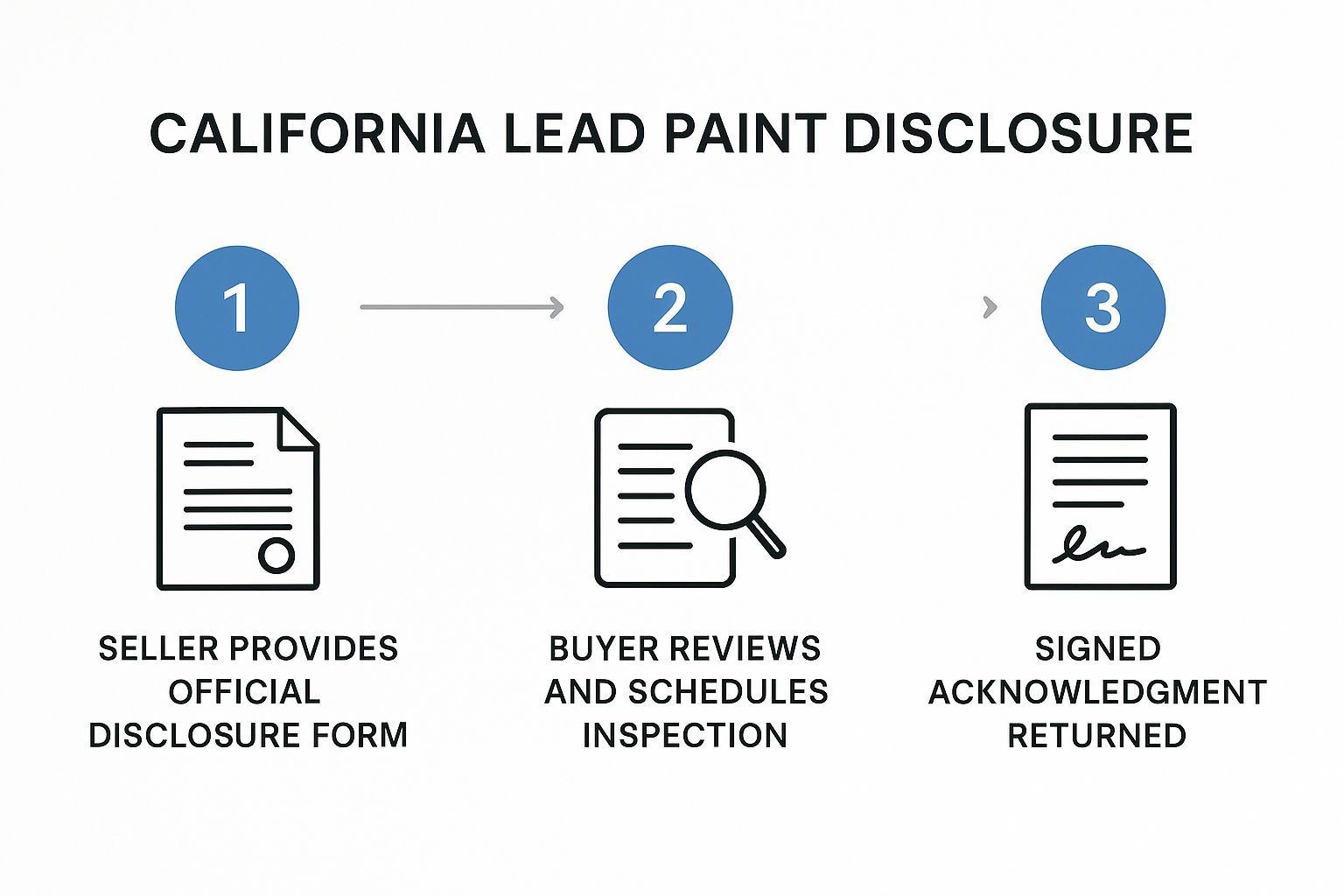
This process ensures everyone is informed and has acknowledged receipt of the information in writing.
Step 3: Finalize and Maintain Records
Getting the right signatures is the final, crucial step. Before a lease is executed, this disclosure form must be signed by yourself (the landlord), your agent (if you use one), and every adult tenant on the lease. A single missing signature can invalidate the document.
Expert Insight from Amy Salmina: "It’s not enough to just get a signature. You must give your tenants a fully signed copy of the disclosure form and the EPA pamphlet for their own records. Then, you must keep your copies for at least three years. At Coast & Valley, we digitize and securely archive these documents for all our clients. It creates an undeniable paper trail that proves compliance and protects your investment."
Properly handling these steps not only safeguards your asset but also builds the kind of trust that attracts and retains high-quality tenants. For a broader overview of your legal obligations, review our detailed guide on landlord responsibilities vs. tenant duties.
Navigating California's Strict Renovation Rules

In California, lead paint compliance extends far beyond the initial lease signing. The rules become even more stringent when it's time to renovate, repair, or repaint.
For owners of properties built before 1978—whether it’s a distinguished home in Carmel or a historic building in downtown Salinas—any work that disturbs a painted surface triggers a new set of requirements. These are not suggestions; they are serious regulations under the California Health and Safety Code designed to protect your tenants, your investment, and your liability from the dangers of lead dust. Since 2008, any such work has required Lead-Safe Work Practices, including meticulous containment and specialized cleaning protocols.
The Mandate For Certified Professionals
Forget about quick DIY touch-ups in an older property. If your building was constructed before 1978, California law is crystal clear: any person or company doing work that could disturb lead-based paint must be EPA-certified. This is a non-negotiable legal requirement.
Whether you're planning a small repair that involves cutting into a wall or a full-scale remodel, the professionals you hire must be trained in specific safety protocols. They know how to:
- Contain the Work Area: Sealing off the renovation zone with heavy-duty plastic sheeting to prevent microscopic lead dust from spreading.
- Minimize Dust Creation: Using techniques like wet sanding and vacuums equipped with HEPA filters to capture hazardous dust at the source.
- Dispose of Debris Properly: Bagging and disposing of all construction waste according to strict environmental guidelines.
Investor Takeaway: Attempting a DIY repair or hiring a non-certified handyman for work on a pre-1978 property is a significant financial risk. A single compliance failure can trigger hefty fines, legal action, and potential harm to tenants. The only prudent choice is to insist on using certified professionals for every maintenance and renovation project.
The Property Management Advantage
For a busy investor with high-end properties, managing this level of compliance is a time-consuming burden. This is where a professional property management team becomes your most valuable partner.
At Coast & Valley, we maintain a vetted network of EPA lead-safe certified vendors in the Monterey Bay Area. We have qualified professionals ready for everything from a simple plumbing repair that requires opening a wall to a major renovation. We ensure every work order for a pre-1978 property is handled by a certified professional, shielding you from legal and financial fallout while protecting your property's value.
While ensuring compliance, it's also a great time to boost your property's value. You might find these tips on rental renovations helpful for maximizing your ROI. Our comprehensive approach to property management in California weaves this compliance oversight into everything we do, giving you total peace of mind.
Common Mistakes and How to Avoid Costly Penalties

Even the most diligent property owners, from Salinas to the South County towns of Gonzales and King City, can make mistakes with California's lead paint disclosure rules. These are not minor slip-ups; they are errors that can lead to serious legal action and fines up to $21,018 per violation. Understanding these common pitfalls is your first line of defense.
One of the most frequent errors is "verbal disclosure." A landlord might casually mention the possibility of lead paint during a walkthrough, believing that's sufficient. It is not. The law is clear: only a properly completed and signed written disclosure form provides legal proof of compliance.
Another critical mistake is forgetting to provide the EPA's "Protect Your Family From Lead In Your Home" pamphlet. It’s a mandatory handout. Skipping this step can invalidate your entire disclosure effort, even if you did everything else correctly.
Incomplete Forms and Poor Record-Keeping
The details matter immensely. This is especially true for leases with multiple tenants. A disclosure form that is perfect except for one missing initial or signature from one of the tenants is non-compliant, opening you to liability.
Finally, sloppy record-keeping can undermine all your hard work. The law requires you to retain signed disclosure forms for at least three years from the lease start date. These documents are your only defense against a future claim.
A Proactive Approach to Risk: "We advise our clients to treat their disclosure records as a critical insurance policy for their asset," says Amy Salmina, owner of Coast & Valley. "We maintain secure digital backups of all compliance documents. This allows us to instantly produce proof, protecting our owners from disputes that might arise years later."
Navigating these requirements demands a robust system. To steer clear of common blunders and the steep penalties they bring, owners should look into effective regulatory compliance solutions that ensure nothing is missed.
Landlord Compliance Risk Assessment
This table shows just how high the stakes are.
| Common Landlord Mistake | Potential Consequence | The Coast & Valley Professional Solution |
|---|---|---|
| Verbal-only disclosure | No legal proof of compliance, fines up to $21,018 per violation. | Standardized, written disclosure forms are used for every lease without exception. |
| Forgetting the EPA pamphlet | Invalidates the entire disclosure process, exposing you to legal action. | Pamphlet delivery is a non-negotiable, checklist item for every new tenancy. |
| Missing signatures/initials | The disclosure is legally incomplete and unenforceable. | A multi-point check ensures all parties have initialed and signed every required field. |
| Not keeping records for 3 years | Inability to defend against future tenant claims or lawsuits. | Secure digital and physical archiving of all documents for the required retention period. |
These are not minor administrative tasks—they are significant legal requirements with major financial implications.
The Professional Management Solution
For discerning investors in the Monterey Bay Area, managing this level of administrative detail is an unnecessary risk and a drain on your time. At Coast & Valley, we have built these compliance checks directly into our property management systems.
Our expert team ensures every form is completed perfectly, every signature is captured, and every document is archived meticulously. We transform a complex legal headache into a simple, worry-free process, allowing you to focus on the growth of your investment, not the paperwork. This ironclad documentation is also a powerful asset when you have to deal with tricky tenants, as it leaves no room for dispute.
Protecting Your Investment and Your Tenants
For any serious investor, the lead paint disclosure in California isn't just another legal hoop to jump through. It’s a core piece of smart asset management, risk mitigation, and building the kind of tenant relationships that last. When you move beyond just checking the boxes, you start preserving your property's value and building a solid reputation in the competitive Monterey Bay market.
This mindset shift—from just a landlord to a responsible steward of your investment—is what separates the pros. It's about creating a safe, quality living environment that naturally attracts and keeps the best tenants. After all, a secure and well-maintained property is exactly what discerning renters are looking for.
From Legal Duty to Smart Investment
Thinking ahead can turn a simple compliance task into a real long-term advantage. For example, if you own a historic property in Pacific Grove or a multi-unit building in Gonzales, consider ordering a professional lead risk assessment. It's a proactive step that lets you spot and stabilize any deteriorating paint before it ever becomes a reportable hazard.
Taking this kind of initiative shows a higher standard of care. This commitment to your tenants' well-being builds a foundation of trust that can seriously cut down on turnover and boost your property's reputation. It sends a powerful message that you're a professional owner, which is a huge differentiator in any rental market. When tenants feel looked after, they're far more likely to take good care of your property in return.
Investor Insight: Think of proactive safety measures as an investment in your property's long-term ROI, not just an expense. A documented history of responsible ownership is a valuable asset that strengthens your position and minimizes liability.
Understanding the history here is important. Even after federal and state laws were passed, lead poisoning from homes was a major issue for decades. A 1990 survey found that around 64 million homes still had lead paint, many with active hazards from shoddy removal attempts and a lack of proper funding. This history shows us that disclosure laws are just the baseline. True asset protection comes from actively reducing hazards and insisting on safe work practices, a point underscored by research on residential lead exposure.
This focus on providing quality, safe housing can also pay off in other parts of your rental business. For example, ensuring a safe environment is a major selling point when you're looking at attracting vacationers and seasonal renters to our beautiful Monterey Bay Area.
At Coast & Valley, we build this philosophy of preventive care into everything we do. We help owners shift from reactive problem-solving to proactive asset preservation, making sure your investment is protected and your tenants feel secure.
Frequently Asked Questions from Monterey County Owners
As seasoned experts managing high-end properties across the Monterey Bay Area, we field a lot of questions from conscientious owners. When it comes to lead paint disclosure in California, the rules can seem a bit tangled. So, we've put together some clear, straightforward answers to the questions we hear most often.
Am I Legally Required to Test for Lead Paint?
Straight to the point: no. Neither federal nor California law requires you to test your property for lead-based paint. The legal obligation is disclosure, not testing. Your duty is to inform prospective tenants about any known lead paint or related hazards.
If you don't know of any and have no reports on file, you simply state that on the disclosure form. Deciding whether to test is a strategic choice for an investor.
- The upside of testing: A certified "lead-free" report can be a significant advantage, especially for a luxury rental in a competitive market like Carmel. It provides tenants with peace of mind.
- The downside of testing: If a test comes back positive, you now have legal knowledge of a lead hazard. You are now required to disclose that positive result to every future tenant and buyer, creating a permanent record for the property.
What if My Property Was Built Exactly in 1978?
This is a classic question for owners with homes in established communities like Monterey or Seaside. The law specifies "pre-1978" housing, leaving that year in a gray area.
Our Professional Advice: Do not take the risk. To be completely safe and eliminate any potential legal ambiguity, always treat a property built in 1978 as if it falls under the rule. This is a simple, zero-cost step that provides total liability protection and is the most professional way to handle the situation.
Do These Laws Apply to Short-Term Rentals?
Generally, no. The federal lead disclosure rules exempt leases of 100 days or less where there's no option to renew or extend the stay. This covers most typical vacation rentals in the Monterey Bay Area.
However, if you offer longer-term furnished rentals—for example, a three-month lease with an option to extend—you would almost certainly need to provide the disclosure. The specifics of the lease term are what matter.
What if a Former Tenant Claims They Never Received the Disclosure?
This is precisely why meticulous, professional record-keeping is non-negotiable. A claim from a former tenant is just their word against yours, unless you have proof. Your definitive defense is the fully executed disclosure form, signed and dated by every adult on the lease.
You must retain these signed forms for a minimum of three years from the tenancy start date. This document is your proof of compliance. Without it, you are exposed to serious claims and penalties. This is why we digitize and securely archive these documents for all our clients—it creates an unbreakable shield against future disputes.
Handling compliance details like these is fundamental to protecting your real estate investment. At Coast and Valley Properties, we manage the complexities of lead paint disclosure and other regulations so you can focus on what matters most. Contact our team today to learn how our professional management services can safeguard your Monterey County properties.

A Property Owner's Guide to the Warranty of Habitability in California
In California, every residential lease includes an unspoken promise from the landlord to the tenant: the implied warranty of habitability. This is a built-in guarantee that the rental property will be safe, sanitary, and livable for the entire tenancy. It is a fundamental, non-negotiable right for every tenant, meaning it cannot be waived or signed away in a lease agreement.
Protecting Your Monterey County Investment

For investors and owners of high-end property in Monterey County, this warranty is more than a legal requirement—it’s the bedrock of a secure and profitable real estate investment. A firm grasp of this concept is essential for minimizing liability, attracting premium tenants, and preserving the long-term value of your properties in exclusive communities from Pebble Beach to Carmel.
This guide is designed to cut through dense legal language, offering a practical roadmap for property owners. We'll help you shift your perspective to see compliance not as a chore, but as a powerful strategic advantage that protects your ROI.
A Foundation Built on Tenant Rights
It might be surprising, but the legal requirement for a landlord to maintain a property in good condition is a relatively modern standard in California law. This principle was truly set in stone by the landmark 1972 court case, Hinson v. Delis. That ruling established that every residential lease contains an implied warranty of habitability.
The Hinson v. Delis decision was a major shift, making it clear that landlords are responsible for ensuring their properties meet basic health and safety codes from day one. You can read more about the landmark Hinson v. Delis case to understand its impact on modern landlord-tenant law.
This legal history highlights why a proactive approach is so vital for today’s property owners. For those with investments in Salinas, Soledad, Gonzales, or King City, staying ahead of maintenance issues means:
- Minimizing Risk: Proactively handling maintenance stops small problems from snowballing into expensive legal headaches and potential disputes.
- Maximizing ROI: A property that is clearly well-cared-for will always command higher rent, attract quality long-term tenants, and reduce vacancy periods.
- Preserving Your Asset: Consistent upkeep is the best way to protect the physical structure of your building and enhance its market value over time.
At Coast & Valley, our founder Amy Salmina's local expertise informs every aspect of our service. We specialize in helping owners turn this legal duty into an operational strength. By implementing rigorous property management best practices, we ensure your investment isn't just compliant—it's thriving. Our mission is to provide total peace of mind, knowing your asset is protected by local experts committed to excellence.
What Makes a Property Habitable in California?
In California, the “warranty of habitability” isn’t just a dry legal term—it’s the fundamental promise you make to every tenant. For savvy investors, this checklist is the key to protecting your asset, boosting your reputation, and staying on the right side of the law.
The specific standards are outlined in California Civil Code § 1941.1, defining what makes a rental property legally livable. For any serious property owner, meeting these requirements is just the starting point. Exceeding them is how you attract top-tier tenants and ensure your property’s value continues to grow.
This warranty is an implied part of every single residential lease in the state, meaning you are bound by it whether it’s written in your rental agreement or not. Falling short can lead to serious headaches and financial penalties.
The Core Pillars of Habitability
At its heart, the law is about ensuring a safe, secure, and healthy home. While the full list of requirements is long, a few key areas demand every landlord's constant attention.
- Effective Waterproofing and Weather Protection: This is non-negotiable, especially here in Monterey County. For high-end properties in coastal towns like Pacific Grove or Carmel, robust defenses against the relentless fog and damp air are critical to preventing mold and rot. This means a solid roof, properly sealed windows, and doors that close securely against the elements.
- Safe and Functioning Utilities: This covers the essentials every tenant expects and the law demands. Reliable heating is a must, particularly during the chillier winters we see in inland areas like Salinas and King City. Beyond that, your electrical and plumbing systems must not only work but also meet the codes that were in effect at the time they were installed.
- Clean and Sanitary Conditions: Your responsibility extends beyond the tenant's front door. All common areas—hallways, laundry facilities, courtyards, and grounds—must be kept clean and free of trash, debris, and pests. This also includes providing enough trash receptacles for all residents.
This infographic breaks down these foundational standards.
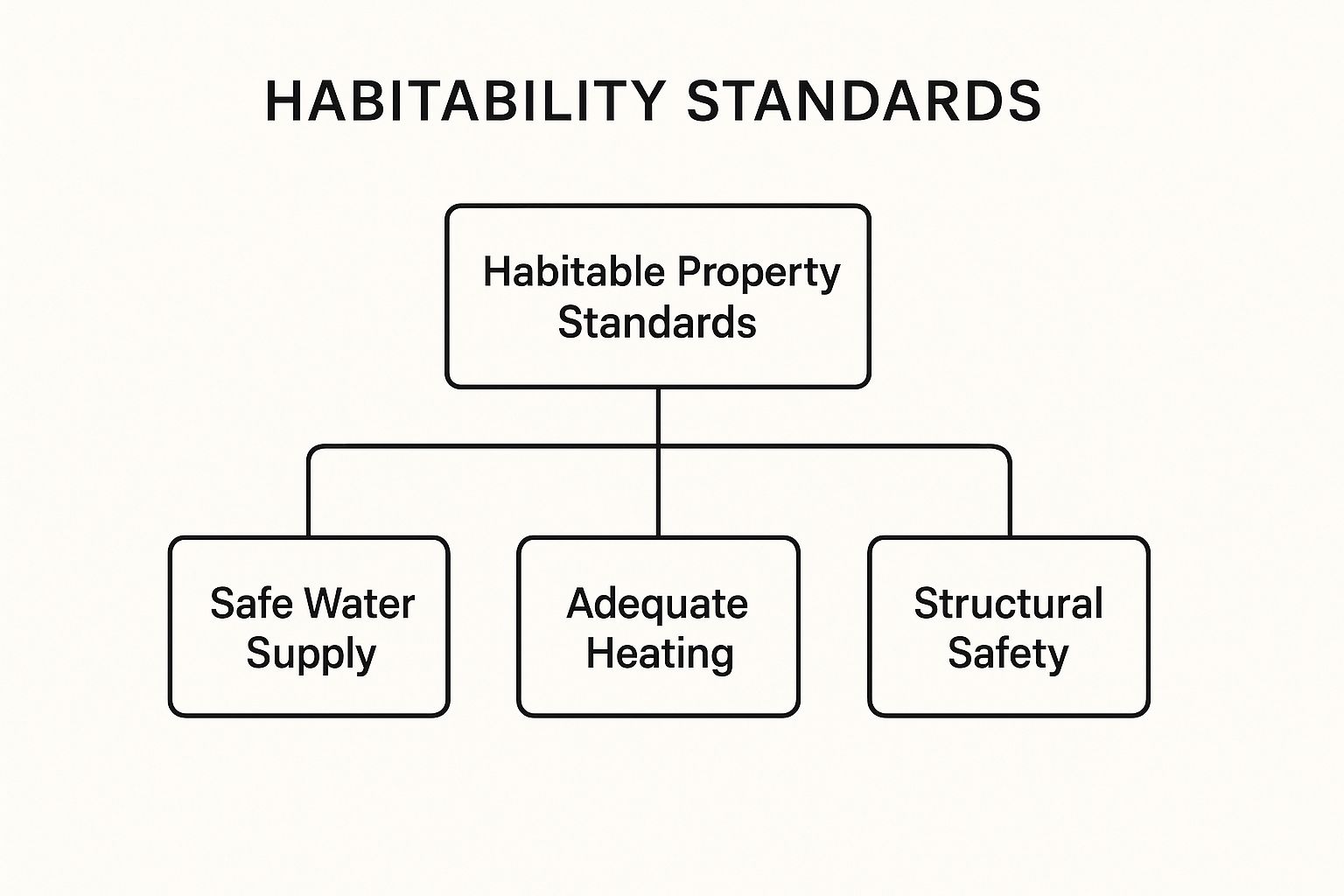
As you can see, maintaining a habitable property comes down to these three pillars: keeping it safe, providing essential services, and ensuring the structure itself is sound.
An Actionable Checklist for Monterey County Owners
The best way to ensure compliance and protect your investment is to be proactive. While a habitability issue generally must be "substantial" to trigger a legal breach, why risk getting close to that line? Conducting regular self-assessments isn't just good practice; it's smart asset management.
To put this into perspective, this table outlines the essential habitability requirements landlords must manage.
Essential Habitability Requirements for California Properties
| Category | Specific Requirement (Examples) | Relevance for Monterey County Owners |
|---|---|---|
| Utilities & Plumbing | Hot and cold running water, functional sewage disposal, working heating facilities, code-compliant electrical and gas systems. | Reliable heating is crucial for Salinas's colder winters. The coastal dampness in Monterey requires vigilant plumbing checks to prevent mold. |
| Structural Integrity | Effective weatherproofing (roof, windows, doors), floors, stairways, and railings in good repair, free from hazards. | Constant exposure to sea air and fog in Pacific Grove and Carmel demands proactive roof and window seal maintenance to protect your asset. |
| Safety & Sanitation | No lead paint hazards, functional smoke and carbon monoxide detectors, clean and sanitary building/grounds, pest-free. | In multi-unit properties in Salinas, keeping common areas immaculate is key. Regular pest control is a non-negotiable preventive measure. |
| Basic Amenities | Adequate number of trash receptacles, locking mail receptacles for each unit, secure doors and windows. | These details significantly impact a tenant's sense of security and well-being, reflecting on the quality of your management. |
This table provides a great starting point, but a hands-on approach is always best. A simple walkthrough can reveal issues before they become major problems for you and your tenants.
Here's a simple, actionable checklist for your next property visit:
- Test Water & Plumbing: Turn on all faucets. Do you have both hot and cold water? Is the pressure adequate? Check under sinks and around toilets for any signs of leaks or water damage.
- Inspect Structural Integrity: Walk the property. Are the floors, stairs, and railings sturdy and free from tripping hazards? Check for cracks in walls or ceilings.
- Verify Safety Measures: Press the test buttons on all smoke and carbon monoxide detectors. Are they installed where required by law, and are they functioning correctly?
Grasping these requirements is a fundamental part of successfully managing a rental property in this state. For a more comprehensive look at the legal landscape, our guide to California landlord-tenant laws offers crucial information for every property owner.
Your Duty to Repair and Maintain the Property

Knowing the definition of a habitable property is step one, but keeping it that way is the ongoing commitment that protects your investment. The warranty of habitability in California requires you to handle repair requests promptly and professionally. This duty is what preserves the value of your asset and the safety of your tenants.
This obligation isn't just about fixing what's broken—it’s about responding within a legally "reasonable" timeframe. What’s “reasonable” depends entirely on the urgency of the problem.
A broken heater during a cold snap in King City or Soledad is a high-priority emergency requiring attention within 24-48 hours. In contrast, a cosmetic issue like a cracked tile in a laundry room can be scheduled for a later date without violating your duty. The key is to communicate clearly with your tenant and act swiftly when it matters most.
Creating a Professional and Compliant Repair Process
For busy investors, especially those with multiple properties, juggling maintenance requests can quickly become overwhelming. This is where a systematic, professional approach is an essential safeguard that ensures every action is documented and every repair meets professional standards.
A first-class repair process includes these actionable steps:
- Acknowledge and Document Every Request: Immediately confirm receipt of the request and keep a clear, time-stamped log of every maintenance call, email, or portal submission from your tenant.
- Dispatch Vetted, Local Vendors: Utilize a trusted network of licensed and insured professionals who know the Monterey County area, from Salinas to the Peninsula.
- Ensure Code Compliance and Quality: After the work is done, verify that it meets all current building and safety codes and your own standards of quality.
- Communicate Clearly and Proactively: Keep your tenant informed about the repair schedule, who will be entering their home, and what to expect from start to finish.
Following a system like this doesn't just fulfill your legal obligations. It builds a powerful, documented history of your compliance, which is your best defense should a dispute arise.
"A landlord’s breach of the implied warranty of habitability exists whether or not he has had a ‘reasonable’ time to repair. The mutual dependence of a landlord’s obligation to maintain habitable premises, and of a tenant’s duty to pay rent, would make no sense otherwise." - Knight v. Hallsthammar, a key California legal decision.
Leveraging Systems for Efficiency and Peace of Mind
For property owners aiming to master the repair and maintenance cycle, implementing efficient systems is non-negotiable. Modern field service automation solutions can help manage work orders, dispatch professionals, and track progress, turning a potentially chaotic task into a smooth, manageable workflow.
At Coast & Valley, we take this entire process off your plate. Our team fields every tenant request, coordinates with our established network of Salinas and Monterey Bay Area professionals, and personally oversees every repair. We document each step in our secure online owner portal, giving you a transparent, 24/7 window into your property's maintenance history. This meticulous management style ensures your property remains a high-value asset, your tenants feel respected, and your legal obligations are always met. Understanding the balance of duties is crucial, as we detail in our guide to landlord responsibilities vs tenant duties.
How to Avoid Costly Tenant Disputes
Understanding a tenant's legal options is your most powerful tool for managing risk. When a landlord fails to keep a property in livable condition, California law gives tenants several powerful remedies.
Knowing these remedies helps you see why taking swift action on maintenance isn't just about good service—it's a critical business practice to protect your investment. This isn't meant to cause alarm; it's about empowering you with the knowledge to prevent a small problem from spiraling into a significant financial and legal issue.
Consider this real-world scenario: a minor leak under a kitchen sink in a Monterey condo. If ignored, it can lead to water damage and mold growth—a major habitability defect that can trigger serious consequences.
Tenant Remedies You Must Understand
When a habitability issue arises and isn't addressed in a reasonable time, tenants have potent options. As an investor, knowing them is key to protecting your asset.
- The "Repair and Deduct" Remedy: This allows a tenant to hire their own professional for necessary repairs and subtract the cost from their next rent payment. This remedy is capped at one month's rent and can only be used twice in any 12-month period.
- Rent Withholding: For more serious violations, a tenant may choose to stop paying rent entirely until the problem is fixed. This can severely disrupt your cash flow and almost always results in a complex legal battle.
- Legal Action: A tenant also has the right to sue their landlord for damages suffered due to the uninhabitable conditions, which could include rent reimbursement and other costs.
Imagine a tenant in your Salinas property calls about a leaking pipe. If you delay, they could use the "repair and deduct" rule, call a plumber, and take that cost right out of their rent payment. Worse, if that leak causes mold, they could withhold all rent, forcing you into a messy and expensive dispute.
For discerning property owners, the goal is to never let it reach that point. Proactive maintenance and crystal-clear communication are the best insurance policies against these escalations.
From Minor Leak to Major Liability
The path from a simple maintenance request to a costly legal dispute is usually paved with poor communication and delayed responses. Your best defense is a transparent, professional process for handling every single request.
Using a well-structured lease contract is an excellent first step, as it establishes clear responsibilities from day one. It sets the right expectations before an issue ever arises.
Beyond that, a rock-solid, documented system for managing repairs is priceless. It creates a clear paper trail demonstrating your commitment to upholding the warranty of habitability in California. How you handle these conversations is crucial, especially when you need to deal with tricky tenants.
At Coast & Valley, we are built to intercept these problems before they begin. Our system logs every communication, dispatches trusted local vendors, and follows up to ensure every repair is completed to the highest standard—protecting your Monterey County investment from preventable disputes.
Go Beyond Compliance to Protect Your ROI

For savvy property owners in premium communities like Pebble Beach or Carmel, merely checking legal boxes is not enough. That's the baseline. The real path to maximizing your returns is to transform legal duties into a powerful competitive advantage.
This means shifting your mindset from reactive repairs to a philosophy of proactive, preventive care. It’s the difference between simply owning a property and strategically managing a high-performing investment—one that attracts and retains premium tenants while ensuring a stable, predictable income stream.
Implement a Proactive Maintenance Schedule
A generic checklist won't suffice for a property in Monterey County. The unique local climate—from the salty coastal fog in Monterey to the warmer, drier summers in South County towns like King City—demands a tailored maintenance plan.
A smart, proactive plan for a high-end property should include:
- Seasonal Inspections: Schedule HVAC system checks before the Salinas winter chill sets in. Inspect roofs and window seals before the rainy season to prevent leaks and water intrusion.
- Appliance Longevity Checks: High-end appliances are a major draw for quality tenants. Servicing them regularly extends their lifespan and helps you avoid costly emergency replacement calls.
- Exterior Preservation: For coastal properties, the salty sea air is relentless. Consistently addressing exterior wear and tear preserves not only curb appeal but also the building's structural integrity, protecting your investment’s value.
This forward-thinking approach doesn't just reduce the odds of expensive emergency repairs. It sends a clear message about your commitment to quality—something high-caliber tenants notice and value.
A well-maintained property is a brand statement. It tells prospective tenants that you are a professional, conscientious owner who values quality, which in turn attracts tenants who will treat your property with respect.
The Power of Meticulous Record-Keeping
Here’s a piece of advice that can save you countless headaches: document everything. Thorough records are your best defense and a powerful management tool. Every inspection, repair, and piece of tenant communication should be carefully logged.
This diligence creates an indisputable history of your responsiveness, which is invaluable if a dispute ever arises. While the warranty of habitability in California gives tenants strong legal footing, procedural details and documentation often influence outcomes. For landlords, this highlights how critical it is to have a clean, documented history of compliance. You can learn more about the practical impacts of habitability laws to understand why organized management is so crucial.
At Coast & Valley, our secure online owner portal provides a complete, transparent maintenance history for your property. This isn't just for your peace of mind; it provides a clear, data-driven overview of your investment's health, turning compliance from a chore into a cornerstone of long-term profitability.
Partner with Experts for Total Peace of Mind
Let's be direct. Juggling the complexities of California's warranty of habitability is a full-time job. It demands constant attention, a deep understanding of evolving laws, and a significant time commitment—three things most busy property owners and investors in Monterey County lack.
For those with high-end properties in Salinas, Carmel, or Gonzales, leaving compliance to chance is not a viable strategy. Entrusting these responsibilities to a dedicated professional isn't a luxury; it's a core component of intelligent asset management. A partnership with local experts transforms this demanding legal duty from a potential liability into a smooth, seamless operation.
This is where a full-service property management team becomes an invaluable asset. Think of it as a protective shield around your investment, where every detail is handled with precision and professional care.
Your Hands-Off Compliance Solution
At Coast & Valley, we are structured to deliver one thing: complete peace of mind for our clients. We assume the daily operational burdens of compliance so you can focus on the rewards of ownership.
Our all-inclusive approach covers every base:
- Proactive Maintenance: We don't wait for things to break. We create and execute preventative maintenance schedules tailored to the Monterey Bay climate, catching small issues long before they can become tenant complaints.
- A-List Vendor Network: We have cultivated a trusted network of vetted, local professionals who get the job done right, ensuring all repairs meet the highest standards of quality and craftsmanship.
- Concierge-Level Communication: We act as the single point of contact for all tenant maintenance requests, carefully documenting every conversation and action in our secure portal for your review.
By systemizing compliance, we not only protect your return on investment but also insulate you from the day-to-day stress of property ownership. To explore the benefits of working with a full-service property management company, we invite you to connect with our team.
Contact Coast & Valley for a comprehensive evaluation of your property. Let our local expertise and commitment to excellence work for you.
Frequently Asked Questions
When managing high-end properties in Monterey County, absolute clarity on your responsibilities is paramount. Navigating California's warranty of habitability can bring up specific, and often tricky, questions. We hear them frequently from our clients in Salinas, Carmel, and throughout the region.
Here are direct, practical answers to the most common questions we encounter.
Can a Tenant Waive Their Right to a Habitable Property?
No. In California, the warranty of habitability is a non-negotiable right automatically implied in every residential lease. Regardless of what a rental agreement says, a tenant cannot legally sign away this fundamental protection.
Any lease clause attempting to waive this right is void and unenforceable in court. For owners of luxury homes from Pebble Beach to the Salinas Valley, this is a critical point: you are always responsible for meeting the state's habitability standards. This duty cannot be sidestepped, reinforcing the need for professional, proactive property care.
What Is a 'Reasonable' Time for Making Repairs?
"Reasonable" is a flexible legal term that depends entirely on the severity of the problem. Issues threatening a tenant's health and safety demand the most urgent response.
- Emergency Repairs (24-48 Hours): These are issues that make a home unsafe or unlivable. A failed furnace in winter, a major gas leak, no hot water, or a serious roof leak fall into this category. You are expected to act immediately, and a response within 24-48 hours is the standard.
- Non-Urgent Repairs (Up to 30 Days): For less critical problems like a dripping faucet, a cracked floor tile, or a sticky door, the law is more lenient. California generally allows landlords up to 30 days to address these non-threatening issues.
The key to navigating this is proactive communication. As soon as a tenant reports a problem, acknowledge it and provide a clear timeline for the repair. This demonstrates professionalism and maintains a positive landlord-tenant relationship.
At Coast & Valley, our client portal documents every maintenance request and our response, creating a transparent and unimpeachable record of our timely actions. This system protects our owners by demonstrating consistent, professional compliance with these timelines.
Am I Responsible for Damage Caused by a Tenant?
No, the landlord is not obligated to repair damage caused by a tenant, their guests, or their pets. Your responsibility under the warranty of habitability covers the property's condition and normal wear and tear—not damage resulting from negligence or abuse, such as holes in walls or pet-related destruction.
However, the burden of proof is on you. You must be able to demonstrate that the damage was the tenant's fault and not due to a pre-existing issue or the natural aging of the property.
This is precisely why thorough move-in and move-out inspections, complete with detailed photos and videos, are non-negotiable. This documentation is your single most effective tool for drawing a clear line between tenant-caused damage and your own maintenance obligations.
Managing these complex duties requires local expertise and constant vigilance. Coast & Valley Properties provides the professional oversight needed to protect your investment and give you total peace of mind. Contact us today for a comprehensive property evaluation.

Navigating Investment Property Tax Deductions in Monterey County: A Guide for Owners
For discerning property investors in Salinas, Monterey, and across the scenic Central Coast, maximizing your return on investment is paramount. While generating rental income is the primary goal, a sophisticated tax strategy can dramatically enhance your profitability and long-term wealth. Understanding and utilizing all available investment property tax deductions is not just an annual accounting task; it's a critical component of strategic asset management.
Many property owners, from those with luxury estates in Pebble Beach to multi-unit portfolios in King City, overlook significant savings simply because they aren't aware of the full scope of benefits available under California and federal tax codes. This guide moves beyond generic advice, offering actionable, localized insights to help you reduce your tax liability and preserve your capital. While this guide focuses on Monterey County, understanding broader tax strategies for real estate investors can provide a more holistic view of maximizing your savings nationwide.
We will explore the eight most impactful deductions that every high-end property owner and serious investor in our community should be leveraging. From depreciation and mortgage interest to the often-missed deductions for professional services and travel, each item is a key to unlocking greater financial efficiency. By the end of this article, you'll have a clear roadmap for transforming your tax obligations into a powerful tool for portfolio growth, ensuring your valuable Monterey Bay assets are working as effectively as possible for you.
1. Mortgage Interest Deduction
For nearly every real estate investor, from those managing a single luxury rental in Carmel to professionals with portfolios across Monterey County, the mortgage interest deduction is the single most substantial tax benefit available. This powerful tool allows you to deduct the interest paid on any loan used to acquire, construct, or substantially improve your investment property. This isn't just limited to your primary mortgage; it also includes interest on second mortgages, home equity loans (HELOCs), and refinanced loans, provided the funds are used specifically for the rental business.

The financial impact of this deduction is significant. Consider an investor with an $800,000 mortgage on a multi-unit property in Monterey at a 6% interest rate. They could potentially deduct up to $48,000 in interest payments in the first full year alone, directly reducing their taxable income and boosting their net return. This is a cornerstone of any effective investment property tax deductions strategy for a high-value real estate market like ours.
How to Implement This Deduction
Properly claiming this deduction requires meticulous record-keeping. The IRS needs a clear paper trail connecting the loan directly to your investment property.
- Maintain Impeccable Records: Diligently file every mortgage statement (Form 1098) you receive from your lender. These forms explicitly state the amount of mortgage interest you paid during the year. To properly claim the mortgage interest deduction, it is crucial to maintain organized records, including those outlined in a comprehensive mortgage document checklist.
- Segregate Funds: If using a HELOC or other credit line for both personal and investment purposes, use separate, dedicated bank accounts. This creates a clean financial trail proving the funds were used for business-related expenses like a new roof for your Salinas rental, not personal costs.
- Track Loan Points: Did you pay "points" to secure a lower interest rate when purchasing or refinancing your Monterey County property? These are a form of prepaid interest and are generally fully deductible in the year they are paid for an investment property loan, offering an immediate tax benefit.
Key Insight: Unlike the mortgage interest deduction on a primary residence, the deduction for investment properties is not capped. This allows high-net-worth investors with multiple properties in areas like Pebble Beach or Carmel to deduct the full amount of interest paid across their entire portfolio, significantly enhancing their ROI.
For property owners in the Monterey Bay area, effectively leveraging this deduction is fundamental to maximizing cash flow. Learn more about how to maximize your investment property tax deductions on CoastandValleyPM.com for more localized insights.
2. Depreciation Deduction
While mortgage interest is a direct cash expense, depreciation is a powerful "non-cash" deduction that makes real estate investing uniquely advantageous. It is one of the most significant investment property tax deductions available. The IRS allows investors to systematically deduct the cost of a property (the building, not the land) over its determined useful life. For residential properties like those in Salinas or Pacific Grove, this period is 27.5 years, and for commercial properties, it is 39 years. This deduction reduces your taxable income without requiring you to spend any actual money that year.

The benefit is substantial. Imagine you purchase a rental home in Salinas for $750,000. If a professional appraisal determines the land value is $200,000, your depreciable basis for the building is $550,000. Dividing this by 27.5 years gives you a $20,000 annual depreciation deduction. This $20,000 directly offsets your rental income, lowering your tax bill even while you collect rent checks. For an investor with multiple properties in Monterey County, this can shield tens of thousands in rental income from taxes each year.
How to Implement This Deduction
Maximizing your depreciation deduction requires careful planning and strategic asset valuation from the very beginning.
- Separate Land and Building Value: Since land does not wear out, it cannot be depreciated. It is critical to obtain a professional appraisal or use a reasonable method (like the Monterey County property tax assessor's valuation) to allocate the purchase price between the land and the building. A higher building value results in a larger annual deduction.
- Consider a Cost Segregation Study: For larger or higher-value properties, like a luxury rental in Pebble Beach, a cost segregation study can accelerate depreciation. This engineering-based study identifies property components (like carpeting, fixtures, and landscaping) with shorter useful lives (5, 7, or 15 years) instead of the standard 27.5. This front-loads your tax savings, boosting cash flow in the early years of ownership.
- Track Improvements Separately: Any capital improvements made to the property, such as a new HVAC system or a full kitchen remodel in your Carmel home, are also depreciable. These assets must be tracked and depreciated separately based on their own useful life, creating additional deductions on top of the main building's depreciation schedule.
Key Insight: While depreciation is a fantastic benefit, be aware of "depreciation recapture." When you sell the property, the total amount of depreciation you claimed during your ownership is taxed, typically at a maximum rate of 25%. However, savvy investors often use a 1031 exchange to defer both capital gains and depreciation recapture taxes indefinitely by rolling the proceeds into a new investment property in Monterey County or elsewhere.
For landlords in Monterey County, understanding the nuances of depreciation is non-negotiable for achieving the best possible financial outcomes. You can find more information about how this applies during tax season for Salinas landlords on CoastandValleyPM.com.
3. Repairs and Maintenance Deduction
For landlords managing properties from the agricultural heart of Salinas to the coastal towns of the Monterey Peninsula, the ability to deduct the costs of repairs and maintenance is a crucial, year-round benefit. This essential deduction allows you to write off the full cost of ordinary and necessary expenses incurred to keep your rental property in good operating condition. These are the routine tasks and fixes that don't add significant value but are vital for tenant satisfaction and asset preservation.

The financial upside is immediate and practical. Imagine a landlord with a small portfolio of single-family homes in Salinas who spends $5,000 over the year on various tasks: fixing a leaky faucet, patching a small roof leak after a winter storm, repainting a unit between tenants, and servicing an HVAC system. That entire $5,000 can be deducted from their rental income, directly lowering their tax liability for the year. This makes the repairs and maintenance deduction a powerful tool for improving annual cash flow.
How to Implement This Deduction
Maximizing this deduction hinges on understanding what qualifies as a "repair" versus a capital "improvement," which must be depreciated over time. A repair keeps the property in its current state, while an improvement enhances its value or restores it.
- Document Every Expense: Keep meticulous records, invoices, and receipts for every repair. Whether it's a $50 plumbing bill from a Salinas vendor or a $500 drywall patch, each expense contributes. Using a professional property manager like Coast & Valley, who provides detailed monthly and annual statements via a secure online portal, simplifies this process immensely.
- Use Visual Evidence: Take "before" and "after" photos of significant repairs. This provides clear, indisputable proof of the work done and helps substantiate the expense as a necessary repair rather than a major upgrade during an audit.
- Understand the Distinction: A repair is fixing a broken window; an improvement is replacing all windows with energy-efficient models. Painting a single room is a repair; repainting the entire exterior as part of a major facelift could be an improvement. Navigating this is key to compliance and one of the most important aspects of tracking investment property tax deductions.
Key Insight: For high-end or luxury properties in places like Pebble Beach, even seemingly minor repairs can be costly. The ability to fully deduct these expenses in the year they occur, rather than depreciating them, provides a significant and immediate boost to your net operating income, protecting your high-value asset without deferring the tax benefit.
Proactive upkeep is always more cost-effective than reactive fixes. For expert guidance on creating a budget and schedule for upkeep, learn more about our approach to rental property maintenance in Salinas on CoastandValleyPM.com to ensure your investment is always protected.
4. Professional Services Deduction
Smart real estate investing is a team sport, and the government recognizes this by allowing you to deduct the costs of your professional team. The professional services deduction is a crucial component of an effective tax strategy, enabling owners of properties from Salinas to Carmel to write off fees paid to experts who support their rental business. This isn't just about hiring an accountant; it covers a wide range of essential services that protect your investment, save you time, and streamline operations.

The financial benefit is direct and substantial. For example, if your multi-unit property in Monterey generates $120,000 in annual rent and you pay a 10% property management fee ($12,000), plus $1,500 for tax preparation and $2,000 in legal fees for lease updates, you can deduct the full $15,500. This directly lowers your taxable income, making professional support not just an operational expense but a strategic financial tool. Engaging experts is fundamental to maximizing your ROI.
How to Implement This Deduction
Claiming these expenses requires clear documentation proving the services were "ordinary and necessary" for managing your rental property. Precision is key.
- Maintain Detailed Invoices and Contracts: Keep every invoice, service agreement, and proof of payment from your professionals. This includes contracts with your property management firm, bills from your attorney for handling an eviction in Monterey County, or statements from your CPA.
- Clearly Segregate Services: If your accountant handles both your personal and rental property taxes, ask for a detailed, itemized bill that separates the fees. Only the portion related to your investment property is deductible as a rental expense.
- Document the Business Purpose: For any professional service, it should be clear how it benefits your rental activity. Attorney fees for drafting a lease are deductible; fees for personal estate planning are not. This distinction is critical for compliance.
Key Insight: Hiring a full-service property management company like Coast & Valley PM, led by local expert Amy Salmina, simplifies your tax reporting significantly. The management fee itself is a major deduction, and the firm provides consolidated, year-end financial statements that neatly categorize other deductible expenses, from maintenance coordination to vendor payments, making tax time far less stressful and ensuring trustworthiness.
For property owners across Monterey County, leveraging professional expertise is a cornerstone of successful, passive investment. Properly accounting for these costs ensures you are not leaving money on the table. To understand more about the operational benefits professionals provide, explore our home maintenance tips for landlords on CoastandValleyPM.com for a deeper look into proactive property care.
5. Travel and Transportation Deduction
For investors with properties spread across Salinas, Monterey, or even out-of-state, the travel and transportation deduction is a frequently overlooked but valuable tool. This essential part of your investment property tax deductions strategy allows you to write off the ordinary and necessary costs of traveling to manage your rental business. This includes everything from local mileage for tenant meetings and property inspections in South County towns to long-distance trips for overseeing significant renovations on your Carmel property.
The savings can accumulate quickly. An investor based in Salinas who drives 200 miles each month to check on properties in Soledad and King City could deduct over $1,500 annually based on the IRS standard mileage rate. For an absentee owner flying into Monterey Regional Airport to manage their high-end property, the costs of airfare, lodging, and meals can translate into thousands of dollars in deductions, directly reducing their overall tax liability and increasing ROI.
How to Implement This Deduction
The IRS requires clear proof that your travel was primarily for business. Vague claims are a red flag, so precision is paramount.
- Keep a Detailed Mileage Log: This is non-negotiable for local travel. Use a dedicated notebook or a smartphone app to log the date, starting and ending odometer readings, total miles, and the specific business purpose of each trip (e.g., "drive to Salinas property for biannual inspection" or "meet prospective tenant at Gonzales unit").
- Document Every Trip's Purpose: For overnight travel, maintain a diary or calendar that outlines your business activities each day. For example, note meetings with your property manager, interviews with contractors, or time spent performing repairs. This proves the trip's primary purpose was business, not a disguised vacation to the Monterey Bay.
- Save All Relevant Receipts: Meticulously file all receipts for flights, hotels, rental cars, and even 50% of your meal costs while on business travel. Digital copies are excellent, but ensure they are organized and clearly labeled by trip and property.
Key Insight: The "primary purpose" test is crucial for overnight travel. If you spend three days managing your Monterey property and two days vacationing in Big Sur, you can deduct the full cost of your travel to and from the area, plus all expenses for the three business days. However, the costs specific to the two vacation days are not deductible.
6. Insurance Premiums Deduction
Protecting your high-value real estate investment with robust insurance is a non-negotiable cost of doing business, and thankfully, the IRS recognizes it as a fully deductible expense. For investors with properties in Salinas or along the Monterey Bay coast, deducting insurance premiums is a straightforward yet powerful way to reduce taxable income. This deduction covers a wide range of policies necessary to safeguard your asset and your financial well-being.
The premiums you pay for landlord insurance, property (hazard) insurance, flood insurance, liability coverage, and even specialized rent-loss policies are all considered ordinary and necessary business expenses. This makes the insurance premiums deduction a fundamental component of any savvy investor's tax strategy. For instance, an owner of a luxury rental in Carmel might pay a significant premium for comprehensive coverage; being able to deduct this entire amount directly enhances their net operating income and ROI.
How to Implement This Deduction
Maximizing this deduction relies on clear documentation and ensuring your coverage is correctly allocated to your rental business activities.
- Document Every Premium Payment: Keep meticulous records of all insurance policy declarations and proof of payment. Whether you pay annually or monthly, each statement is a crucial piece of your tax puzzle. A professional property manager can handle this tracking for you, ensuring records are secure and accessible.
- Isolate Rental Policies: If you have an umbrella policy that covers both your primary residence and your rental properties in Monterey County, you must allocate the premium. Work with your insurance agent to determine the exact portion of the premium that applies to the investment properties and deduct only that amount.
- Review Coverage Annually: Your insurance needs can change based on property values and local risks. Annually review your policies to ensure you have adequate coverage without being over-insured. This not only optimizes your protection but also ensures your deductible expense is appropriate for the property's current value and risk profile.
Key Insight: This deduction isn't limited to a standard landlord policy. Premiums for specialized riders, such as rent loss or "rent guarantee" insurance, which protect you from tenant default, are also deductible. This allows you to protect your cash flow from your Monterey County rental while simultaneously lowering your tax liability—a key strategy for savvy investors.
7. Utilities and Operating Expenses Deduction
While large-ticket items like mortgage interest and depreciation often get the spotlight, savvy investors in Monterey County understand that consistent, smaller operating expenses add up to significant tax savings. The utilities and operating expenses deduction allows landlords to write off the costs of services necessary to keep their rental properties functional and attractive to tenants. This is a critical component of managing the day-to-day finances of any rental, from a single-family home in Salinas to a multi-unit apartment complex in Monterey.
These deductible expenses include any utility you pay on behalf of your tenant or for common areas, such as electricity, gas, water, sewer, and trash collection. It also covers essential services like landscaping for curb appeal in communities like Pacific Grove, pest control, and even the internet or cable if included in the lease agreement. For properties within a homeowners' association in places like Carmel Valley, those HOA dues are also fully deductible as a necessary operating cost.
Consider a landlord with a fourplex in Soledad who covers water and garbage services for all units, plus electricity for the common laundry room and outdoor lighting. These costs, which could easily amount to several thousand dollars annually, directly reduce their taxable rental income. Properly tracking these recurring expenses is a fundamental part of an effective investment property tax deductions strategy.
How to Implement This Deduction
Maximizing this deduction requires organized tracking and clear separation between business and personal costs. Diligence here ensures you capture every dollar you're entitled to.
- Maintain Scrupulous Records: Keep digital or physical copies of every utility bill, invoice for services like landscaping or pool maintenance, and bank statements showing payment. A dedicated folder for each property is a best practice, a task made simple with a professional property management system.
- Separate and Conquer: If you own a duplex in Monterey and live in one unit while renting out the other, you can only deduct the portion of utilities that pertains to the rental unit. Prorate shared bills (like water or trash) based on a reasonable method, such as square footage, and keep detailed records of your calculations.
- Review Leases and Service Agreements: Your lease should clearly state which utilities are the landlord's responsibility. This documentation is crucial proof for the IRS. Similarly, keep all contracts with vendors for services like gardening or pest control.
Key Insight: This deduction isn't limited to utilities alone. It extends to many other operational costs required to run your rental business, including landlord insurance premiums, HOA fees, and even routine cleaning services for common areas in multi-unit properties. Capturing all these costs is key to painting an accurate picture of your net operating income and maximizing your ROI.
Effectively managing these costs not only reduces your tax burden but also improves your property's overall cash flow. To discover more strategies for reducing these necessary expenditures, learn more about how landlords can save on utility costs at CoastandValleyPM.com.
8. Home Office Deduction for Rental Activity
For hands-on investors who actively manage their portfolios, the home office deduction is a frequently overlooked but valuable tool. If you dedicate a specific area of your home exclusively and regularly to managing your rental properties in Salinas or elsewhere in Monterey County, you can deduct a portion of your home’s operating costs. This transforms everyday household expenses like utilities, insurance, and repairs into legitimate business write-offs.
This deduction recognizes that managing a rental property is a legitimate business activity. Whether you're a busy professional coordinating maintenance for a single-family home in Monterey or an investor analyzing deals for a new multi-unit property in Soledad, the space you use for these tasks has a tangible business value. Properly claiming this deduction is a key part of a comprehensive investment property tax deductions strategy.
How to Implement This Deduction
Claiming the home office deduction requires proving that the space is used exclusively for your rental business. The IRS offers two methods for calculation, and careful documentation is non-negotiable.
- Ensure Exclusive Use: The area you claim must be used solely for your rental business. It cannot be a corner of the family room where you also watch TV. Take clear photos to document the space as a dedicated office, complete with your computer, files, and other business equipment.
- Choose Your Calculation Method: You can use the Simplified Method, which allows a standard deduction of $5 per square foot (up to 300 square feet, for a maximum deduction of $1,500). Alternatively, the Actual Expense Method requires you to calculate the percentage of your home used for business (e.g., a 200-square-foot office in a 2,000-square-foot home is 10%) and apply that percentage to your actual home expenses, including mortgage interest, property taxes, insurance, utilities, and depreciation. The actual expense method often yields a larger deduction but requires more detailed records.
- Keep Meticulous Records: If using the actual expense method, you must retain receipts and statements for all home-related costs you intend to prorate. This includes utility bills, homeowners' insurance policies, and records of repairs.
Key Insight: To qualify for this deduction, your rental activities must be considered a business, not just a passive investment. This generally means your involvement is regular, continuous, and substantial. For many of our clients who self-manage properties before engaging our services, their level of activity easily meets this threshold.
Investment Property Tax Deductions Comparison
| Deduction Type | Implementation Complexity 🔄 | Resource Requirements ⚡ | Expected Outcomes 📊 | Ideal Use Cases 💡 | Key Advantages ⭐ |
|---|---|---|---|---|---|
| Mortgage Interest Deduction | Moderate - requires documentation | Moderate - loan info, statements | High - reduces taxable rental income | Investors with one or multiple rental loans | Largest single deduction, no dollar limits |
| Depreciation Deduction | High - needs accurate basis, tracking | Moderate to High - appraisals, records | High - non-cash deduction, tax shelter | Long-term investors depreciating structures | Creates paper losses, reduces taxable income |
| Repairs and Maintenance Deduction | Low - routine tracking | Low - expense receipts needed | Immediate - fully deductible in year | Landlords performing minor repairs | Instant deduction, wide expense coverage |
| Professional Services Deduction | Low to Moderate - gather invoices | Low - documentation of fees | Moderate - offsets management costs | Owners using property managers, attorneys | No dollar limits, covers essential services |
| Travel and Transportation Deduction | Moderate - requires logs, receipts | Moderate - mileage/travel documentation | Moderate - deduction for business travel | Investors inspecting properties or attending meetings | Covers local & long-distance travel expenses |
| Insurance Premiums Deduction | Low - straightforward | Low - premium payment records | Moderate - deducts insurance costs | All rental property owners | Fully deductible, covers multiple insurance types |
| Utilities and Operating Expenses Deduction | Low - routine bills tracking | Low - utility and expense documentation | Immediate - reduces net rental income | Landlords paying utilities/HOA fees | Fully deductible, broad expense inclusion |
| Home Office Deduction for Rental Activity | High - must meet strict IRS rules | Moderate - expense tracking, space measurement | Moderate - partial home expense deduction | Investors managing rentals from home | Allows home expense deduction, two calculation methods |
Partner with Coast & Valley for Strategic Asset Management and Tax Optimization
Navigating the intricate landscape of investment property tax deductions is not a once-a-year task reserved for tax season. It is a continuous, year-round strategic endeavor that directly impacts your bottom line and the long-term profitability of your Monterey County portfolio. As we've detailed, mastering these deductions, from depreciation and mortgage interest to repairs and professional services, transforms your property from a passive asset into a high-performance investment engine.
For discerning property owners in Salinas and across Monterey County, the challenge isn't just knowing these rules exist. It's about implementing them flawlessly, documenting every expense meticulously, and strategically planning maintenance and capital improvements to maximize their tax advantages. This is where the true value of professional, localized management becomes undeniable.
From Theory to Profitable Reality: An Actionable Checklist
To truly harness the power of these financial tools, you must move beyond simple awareness to active implementation. The most successful investors in areas like Pebble Beach or the vineyard-adjacent communities of South County don’t just collect rent; they manage their assets with a keen eye on financial optimization.
Here is an actionable checklist to implement today:
- [ ] Audit Your Documentation: Set up a digital folder for each property. Scan and file every receipt, invoice, and mileage log immediately. A shoebox of crumpled receipts won’t withstand scrutiny.
- [ ] Schedule Proactive Maintenance: Don't wait for things to break. Plan biannual inspections for your Salinas or Monterey properties to address small issues before they become costly repairs.
- [ ] Verify Your Depreciation Schedule: Consult with your tax professional to ensure you are correctly depreciating your property's value and any capital improvements. Ask if a cost segregation study makes sense for your portfolio.
- [ ] Evaluate Your Professional Team: The fees you pay for property managers, accountants, and legal counsel are themselves deductible. More importantly, their expertise can uncover savings and prevent costly mistakes that far outweigh their fees.
Your Next Step for Tax-Efficient Property Ownership in Monterey County
Mastering investment property tax deductions requires a proactive, systemized approach. It's about building a framework that captures every opportunity for savings. This is particularly crucial for busy professionals and absentee landlords who cannot afford to let details slip through the cracks. The right partner ensures nothing is missed, from tracking a small repair in Gonzales to managing a major capital improvement in Monterey.
This strategic management extends to your financing structure as well. The interest on your mortgage is a significant deduction, and ensuring your loan is optimized for your investment goals is a key part of the overall financial picture. Effective asset management also involves securing the right financing. Explore various rental property loan options to support your investment goals.
At Coast & Valley, led by fourth-generation Salinas native Amy Salmina, we integrate tax-savvy practices into our everyday management. Our secure, 24/7 online owner portal provides transparent, real-time access to financial statements, invoices, and maintenance records, creating an impeccable, audit-ready paper trail. We don’t just manage properties; we manage assets with a concierge-level focus on preserving value and maximizing your return on investment. By partnering with us, you gain local, boots-on-the-ground expertise dedicated to turning tax complexities into financial opportunities.
Ready to transform your property management from a chore into a strategic advantage? Contact Coast & Valley to see how our full-service, tech-forward approach can help you maximize your investment property tax deductions and enhance your ROI. Let our local expertise and commitment to excellence work for you.

Top Tenant Retention Strategies for Monterey County Investors
For discerning property owners and investors in Salinas and the greater Monterey County, the true measure of success isn't just filling a vacancy—it's retaining a high-quality tenant. The revolving door of tenant turnover is costly, time-consuming, and detrimental to your property's long-term ROI. In a competitive market that stretches from the agricultural heart of the Salinas Valley to the luxury coastal homes of Pebble Beach, a proactive approach to tenant satisfaction is not just good service; it's a critical component of your investment strategy.
Effective tenant retention strategies are fundamentally about creating a premium experience where exceptional tenants choose to stay. This requires a shift in mindset from reactive problem-solving to proactive, concierge-level relationship management. For a deeper dive into the foundational principles, explore various effective customer retention strategies, as many of these concepts translate directly to managing a high-end property.
This article moves beyond generic advice to provide eight actionable, investment-focused tactics tailored for the high-end property owner in Monterey County. We will explore how to create an unparalleled living experience that protects your asset, maximizes your ROI, and transforms tenants into long-term residents. These insights, grounded in Coast & Valley’s deep local expertise, will equip you to foster loyalty and ensure your property remains a top-tier choice. From implementing proactive maintenance schedules in Pacific Grove to leveraging smart home technology in Soledad, you'll gain a clear roadmap for cultivating lasting value.
1. Proactive Property Preservation & Concierge-Level Maintenance
A cornerstone of elite tenant retention strategies is demonstrating an unwavering commitment to the property’s condition. This approach moves beyond simple repairs; it’s about proactive preservation and delivering a maintenance experience that feels like a white-glove service. For discerning tenants in premium areas like Monterey or Carmel, an impeccably maintained home is a baseline expectation, not a bonus.

By implementing a scheduled, preventive maintenance program and offering a highly responsive, streamlined system for service requests, you communicate a powerful message: their comfort and the property's long-term integrity are top priorities. This not only justifies premium rents but also builds immense trust, making tenants feel genuinely cared for and significantly less likely to explore other options. The goal is to shift from a reactive 'fix-it' model to a proactive 'preserve and protect' philosophy—a hallmark of superior property management that safeguards your investment.
Key Insight: Proactive maintenance prevents small issues from becoming costly emergencies, protecting your investment while demonstrating to tenants that their quality of life is a priority.
How to Implement Proactive Maintenance
1. Develop a Seasonal Maintenance Calendar: Create a schedule tailored to Monterey County’s unique climate.
* Winter Prep: Gutter cleaning, roof inspections, and drainage checks to handle seasonal rains, especially in areas like the Salinas hills.
* Summer Prep: Defensible space clearing for fire-risk mitigation, a critical task for inland areas like Salinas, Soledad, and King City, plus HVAC servicing.
* Coastal Care: Schedule bi-annual "Coastal Home Health Checks" for properties in Pacific Grove or Pebble Beach to address salt air corrosion on windows, metal fixtures, and paint.
2. Leverage a Modern Tenant Portal: Use a system, like the one offered by Coast & Valley, to provide a seamless maintenance experience. This allows tenants to submit requests 24/7, upload photos, and track the status of their repair in real-time. This transparency eliminates frustration and sets a professional, trustworthy tone.
3. Budget for Excellence: Allocate 1-3% of the property's value annually for maintenance. This ensures funds are always available for both preventative tasks and unexpected repairs, avoiding delays that can sour tenant relationships and jeopardize your asset.
4. Build a Vetted Vendor Network: As a firm founded by Salinas native Amy Salmina, we've spent years establishing partnerships with high-quality, insured local contractors serving the entire Monterey Bay Area. This guarantees prompt, professional work and reliable service when it matters most. For more information on building a solid operational foundation, explore our property management best practices on coastandvalleypm.com.
2. Competitive Pricing and Rent Optimization
Setting the right rental price is a delicate balance. Price too high, and you risk extended vacancies; price too low, and you leave significant revenue on the table. A data-driven approach to rent optimization is one of the most effective, yet often overlooked, tenant retention strategies. It ensures your pricing is competitive enough to attract and keep great tenants while maximizing your return on investment. This strategy moves beyond simply guessing a number and instead relies on continuous market analysis and strategic adjustments.

For savvy investors in Monterey County, from Salinas to Carmel, optimizing rent isn't a one-time task. It's an ongoing process that demonstrates fairness to tenants while protecting the asset's financial performance. When tenants perceive their rent as fair value for the market and the quality of the property, they are far more likely to renew their lease. This avoids the high costs and uncertainties associated with tenant turnover, creating a stable, profitable investment.
Key Insight: Strategic, gradual rent increases are far more effective for long-term retention than sudden, large hikes. Tenants are more likely to accept modest, predictable adjustments that align with local market trends and property improvements.
How to Implement Rent Optimization
1. Conduct Quarterly Market Rent Surveys: The rental markets in Salinas, Monterey, and the surrounding communities are dynamic. Regularly analyze comparable properties (comps) to understand current pricing trends. This data provides the justification for your rental rates, both for new leases and renewals, ensuring you remain competitive but not underpriced. For example, a 3-bedroom home in South Salinas will have different market pressures than a condo in Monterey.
2. Offer Early Renewal Incentives: Don't wait until the last minute. Contact tenants 90 days before their lease expires with a renewal offer. You can incentivize an early decision by offering a preferred rate, a small property upgrade (like installing a new smart thermostat), or locking in the rate for a longer term. This proactive approach gives tenants security and reduces your vacancy risk.
3. Implement Graduated Rent Increases: Avoid shocking good tenants with a large, unexpected rent hike. Instead, implement smaller, annual increases that align with local regulations and market conditions. This incremental approach is easier for tenants to budget for and feels more reasonable, significantly reducing the likelihood of them seeking a new home over a rent dispute.
4. Leverage Professional Expertise: For most investors, a professional property manager provides the most accurate rent analysis. They have access to real-time data and a deep understanding of neighborhood-specific trends, from Gonzales to Pacific Grove. For more guidance on this critical first step, see our advice on setting the right price for your rental property on coastandvalleypm.com.
3. Exceptional Customer Service and Communication
Beyond physical amenities, the single most powerful factor in tenant retention is the quality of the human connection. Exceptional customer service treats tenants not as line items in a ledger, but as valued clients whose experience directly impacts your investment's success. This hospitality-centric approach, common in luxury service industries, is one of the most effective tenant retention strategies for premium properties in communities from Salinas to Carmel.

Adopting a policy of proactive, professional, and empathetic communication fosters a relationship built on respect and trust. When tenants feel heard, valued, and professionally served, their sense of "home" deepens, drastically reducing their desire to move. As one of our long-term property owners noted, "The team at Coast & Valley treats my tenants with the same respect they show me. That trust is priceless and has led to zero turnover in my Salinas property for over three years."
Key Insight: Shifting from a transactional landlord-tenant dynamic to a service-oriented client relationship transforms a rental property into a preferred home, making tenants advocates for your property instead of passive occupants.
How to Implement Exceptional Communication
1. Set Clear Communication Standards: Establish and adhere to strict response time policies. A best practice is to acknowledge all non-emergency tenant inquiries within one business day. This simple commitment manages expectations and prevents minor issues from escalating due to perceived neglect.
2. Empower Tenants with Technology: Utilize a modern tenant portal for centralized, secure communication. This allows for documented, trackable conversations regarding maintenance, rent payments, and general inquiries, providing clarity and a professional record for both parties. This underscores efficiency and convenience for busy professionals.
3. Train for Professional Interactions: Invest in training for anyone who interacts with tenants, focusing on active listening, empathy, and conflict resolution. Staff should be equipped to handle difficult conversations with professionalism and a solutions-oriented mindset, a critical skill for managing high-value properties and discerning tenants across Monterey County.
4. Proactively Seek Feedback: Don’t wait for problems to arise. Implement regular, simple tenant satisfaction surveys (e.g., annually or after a maintenance call is completed). Asking for feedback shows you value their opinion and provides actionable data to improve their living experience, reinforcing your commitment to quality. For more guidance on this topic, you can learn more about how to provide your tenants with an excellent renting experience on coastandvalleypm.com.
4. Flexible Lease Terms and Renewal Options
A rigid, one-size-fits-all lease agreement is an outdated model that can push excellent tenants away. A modern, high-impact tenant retention strategy involves a strategic approach to lease agreements that accommodates tenant needs through various lease lengths, renewal incentives, and flexible terms. This recognizes that life is not static; tenant circumstances change, and adapting to these changes is key to retaining valuable renters who see your property as their long-term home.

By offering adaptable lease structures, you cater to a wider range of high-quality applicants, from relocating professionals needing short-term stability in Monterey to families seeking a multi-year foundation in communities like Salinas or Soledad. This flexibility signals that you are a reasonable and understanding landlord, building goodwill that translates directly into longer tenancies and reduced vacancy costs, which directly boosts your ROI.
Key Insight: Flexibility in lease terms isn't a concession; it’s a strategic advantage. It reduces turnover by aligning with a tenant’s life plans, making your property the most convenient and logical choice for them to stay.
How to Implement Flexible Leasing
1. Offer a Menu of Lease Lengths: Move beyond the standard 12-month lease.
* Provide options for 6, 12, and 18-month terms. This caters to tenants with different timelines, such as those on temporary work assignments in the Salinas ag-tech industry or military families stationed in Monterey.
* Price each term strategically. A shorter lease may command a slightly higher monthly rent to offset turnover risk, while a longer lease could offer a modest discount as a reward for commitment.
2. Incentivize Early Renewals: Don’t wait until the last minute to discuss renewals.
* Reach out 90 days before the lease expires with an attractive renewal offer, such as a rent credit, a small property upgrade (like a new ceiling fan), or a locked-in rate for the next term.
* This proactive approach gives tenants a compelling reason to stay and secures your occupancy well in advance, minimizing vacancy gaps.
3. Allow for Lease Modifications (with Clear Policies): Life events happen. Create a clear policy for handling requests for lease modifications.
* This could include adding a roommate, accommodating a long-term guest, or even exploring a lease-transfer option under specific, controlled conditions. Having a professional process shows you are prepared and reasonable.
* For an in-depth look at structuring these agreements, discover more about crafting effective lease terms for Salinas tenants on coastandvalleypm.com.
4. Use Modern Lease Management Technology: Manually tracking varied lease end-dates is inefficient. A professional property management system automates reminders, stores documents securely, and provides a clear overview of your entire rental portfolio, ensuring no renewal opportunity is missed and compliance is maintained.
5. Community Building and Social Engagement
Transforming a rental property from a simple living space into a genuine community is one of the most powerful tenant retention strategies available today. This approach focuses on fostering connections among residents, particularly in multi-unit properties. For tenants, feeling part of a community creates strong emotional ties to their home, making a move seem far less appealing.
By facilitating social interaction, you’re not just providing housing; you’re cultivating an environment where neighbors become friends and the property feels like a vibrant, welcoming place to live. This sense of belonging is a significant value-add that justifies competitive rents and drastically reduces turnover, protecting your investment from costly vacancies.
Key Insight: A strong sense of community makes a property "sticky." When tenants build personal relationships with neighbors, they are far more likely to renew their lease to maintain those social connections.
How to Implement Community Building
1. Survey Tenants for Activity Preferences: Don't guess what residents want. Use a simple digital survey to ask what types of events or activities they would enjoy.
* Offer Diverse Options: Suggest a mix of ideas, such as family-friendly picnics at a local Salinas park, professional networking happy hours, or wellness-focused activities like yoga in a common area.
* Gauge Interest: Ask about preferred times (weeknights vs. weekends) to maximize attendance.
2. Activate Common Areas: Your property's shared spaces are prime locations for building community. Regularly schedule low-effort, high-impact gatherings.
* Food Truck Fridays: Arrange for a popular local food truck from Salinas or Monterey to visit the property once a month.
* Seasonal Celebrations: Host a simple holiday-themed event, like a pumpkin carving station in the fall or a summer BBQ by the pool area.
3. Leverage Digital Platforms: Use technology to connect residents. A private, professionally managed online group or tenant portal feature can allow residents to share information, organize their own meetups, or ask for local recommendations. This keeps the community spirit alive 24/7.
4. Partner with Local Monterey County Businesses: Enhance your events and provide exclusive perks by collaborating with local companies. Negotiate resident-only discounts at nearby cafes in Gonzales, offer tickets to a King City Stampede event, or host a wine-tasting evening featuring a local Soledad vineyard. This strengthens community ties while supporting other local businesses and reinforcing your local expertise.
6. Technology Integration and Smart Home Features
In an increasingly connected world, one of the most effective tenant retention strategies is the thoughtful integration of modern technology. This approach elevates a property from a simple living space to a modern, convenient, and secure home. For tech-savvy tenants in markets like Salinas and across Monterey County, features like smart thermostats, keyless entry, and integrated security are no longer luxuries but compelling reasons to stay.
Implementing these technologies demonstrates that you are a forward-thinking property owner invested in the tenant's quality of life. This not only attracts a high-caliber tenant pool but also significantly boosts satisfaction and loyalty. By offering cutting-edge convenience, security, and efficiency through technology, you provide tangible daily value that makes a renewal decision much simpler.
Key Insight: Smart home technology offers a dual benefit: it enhances the tenant's daily living experience while providing owners with improved security, potential energy savings, and a significant competitive advantage in the rental market.
How to Implement Smart Home Technology
1. Start with High-Impact Basics: You don't need a complete home automation system from day one. Begin with features that offer the most immediate convenience and security.
* Smart Locks: Offer keyless entry via codes or smartphones. This eliminates tenant lockout issues, simplifies access for vetted vendors, and provides an audit trail for security.
* Smart Thermostats: (e.g., Nest, Ecobee) Provide tenants with remote climate control, enhancing comfort and potentially lowering their utility bills—a tangible financial benefit.
* Video Doorbells: (e.g., Ring, Arlo) Bolster security and peace of mind, a highly valued feature for any tenant, whether in a single-family home in South County or a condo in Monterey.
2. Ensure a Robust Digital Foundation: Smart technology is only as good as the network supporting it. Before installing devices, ensure the property has reliable, high-speed internet connectivity. This is a baseline amenity that is crucial for retaining today's tenants.
3. Prioritize Security and User-Friendliness: Choose scalable, intuitive technology solutions from established providers. Provide tenants with a simple guide upon move-in to ensure they can easily use and appreciate the features you've invested in. Emphasize the security protocols in place to protect their data and privacy.
4. Partner with PropTech Experts: Navigating property technology can be complex. Working with a property management firm like Coast & Valley, which understands how to vet, install, and manage these systems, is crucial. We help owners select technology that provides the best ROI and enhances the tenant experience, a key component of our modern tenant retention strategies.
7. Proactive Lease Renewal Programs
One of the most effective tenant retention strategies is to remove uncertainty from the lease renewal process. A proactive renewal program shifts the dynamic from a last-minute scramble to a structured, early-engagement process. Instead of waiting for tenants to decide their next move, this strategy involves reaching out 90-120 days before lease expiration, making them feel valued and securing their tenancy before they even start browsing Zillow for alternatives in Salinas or Monterey.
By initiating a thoughtful conversation early, you demonstrate that their continued residency is important. This approach, often paired with personalized incentives, transforms the renewal from a simple transaction into a moment of positive reinforcement. For property managers aiming to keep tenants long-term, understanding and implementing effective tactics, such as proven strategies to reduce churn rate, is paramount. This system not only boosts retention rates but also provides crucial lead time to market the property should a tenant decide to leave, minimizing costly vacancy periods and maximizing your ROI.
Key Insight: The renewal process shouldn't start when the lease is about to end. Starting the conversation 3-4 months early makes tenants feel wanted and significantly reduces the likelihood they will explore other housing options.
How to Implement a Proactive Renewal Program
1. Create a Renewal Timeline: Systemize your outreach with a clear, multi-step timeline.
* 120 Days Out: Conduct an internal review of the tenant's history and current market rents in their specific area—whether it's King City or Pacific Grove—to formulate a preliminary offer.
* 90 Days Out: Initiate the first contact. This should be a friendly, professional email or call checking in, expressing your hope that they will continue their tenancy, and asking if they have any needs or concerns.
* 75 Days Out: Present the formal renewal offer, clearly outlining any changes in terms and highlighting the benefits of renewing early.
* 60 Days Out: Send a follow-up reminder. If they decline to renew, this still provides ample time to begin marketing the property, preserving your cash flow.
2. Offer Meaningful, Personalized Incentives: Generic offers have less impact. Create compelling incentives that show you value their tenancy.
* Early-Bird Special: Offer a small rent credit or lock in the current rate if they sign the renewal within a specific timeframe (e.g., by the 75-day mark).
* Service Upgrade: For a long-term, high-quality tenant, consider offering a small property upgrade they’ve previously inquired about, such as new light fixtures or a professional carpet cleaning.
* Local Gift Cards: A gift card to a popular local restaurant in Salinas or Monterey can be a simple yet highly effective thank-you that also reinforces community ties.
3. Leverage Automation and Data: Use your property management software to streamline the process. Set up automated reminders for both your team and your tenants, ensuring no deadlines are missed. Track which renewal offers are most successful to refine your strategy over time.
4. Make it Easy to Say Yes: Digitize the entire process. Allow tenants to review and sign their new lease agreement electronically from any device. The less friction involved, the higher your chances of securing the renewal promptly.
8. Amenities and Value-Added Services
Modern tenant retention strategies extend far beyond the four walls of the rental unit. Today’s high-value tenants, especially in desirable markets like the Monterey Peninsula, seek a comprehensive lifestyle, not just a place to live. Offering a curated selection of amenities and value-added services transforms a property from a simple commodity into a premium experience, providing a compelling reason for residents to renew their leases year after year.
This approach focuses on enhancing convenience, wellness, and community engagement. By thoughtfully investing in features that improve a tenant’s daily life, you demonstrate a commitment to their well-being that justifies premium rents and builds powerful loyalty. From high-speed internet to pet-friendly facilities, these additions create an environment that tenants are reluctant to leave, significantly reducing costly turnover and protecting your bottom line.
Key Insight: Value-added amenities are not expenses; they are investments in resident satisfaction and loyalty. The right features can elevate the living experience, turning tenants into long-term community members and boosting your ROI.
How to Implement Value-Added Amenities
1. Survey Your Tenants: Don't guess what residents want. A simple digital survey can reveal high-demand amenities, whether it's a secure package delivery system for busy professionals in Salinas or bike storage for active residents in Monterey. This data-driven approach ensures your investment delivers maximum impact.
2. Focus on High-Impact, High-Value Services:
* Connectivity: Robust, high-speed internet is no longer a luxury; it's an essential utility. Offering reliable, pre-installed internet is a powerful differentiator that busy professionals value. For more insights, explore guides on modern hotel WiFi solutions.
* Pet-Friendly Features: In pet-loving Monterey County, dedicated amenities like a small, well-maintained dog run, waste stations, or even partnerships with local groomers in Salinas can be a major draw and retention tool.
* Community Spaces: A well-maintained BBQ area, a small community garden for residents in Soledad or Gonzales, or a clean, modern laundry room can foster a sense of community and add significant daily value.
3. Forge Local Partnerships: Enhance your offerings without major capital investment. Partner with local businesses in King City or Salinas to offer tenants exclusive discounts on services like gym memberships, house cleaning, or local food delivery. This supports the local economy while adding unique value for your residents.
4. Market and Maintain Your Amenities: Ensure all amenities are consistently clean, functional, and well-maintained. Promote these features during property tours and in your listings to attract quality tenants and remind current residents of the value they receive. To explore a wide range of features that encourage renewals, see our list of apartment amenities that incentivize residents to renew on coastandvalleypm.com.
Tenant Retention Strategies Comparison Matrix
| Strategy | 🔄 Implementation Complexity | 💡 Resource Requirements | ⭐ Expected Outcomes | 📊 Ideal Use Cases | ⚡ Key Advantages |
|---|---|---|---|---|---|
| Proactive Property Maintenance | Moderate to High (coordination, scheduling) | Significant upfront & ongoing maintenance costs | High tenant satisfaction & sustained property value | Properties needing long-term value preservation | Protects asset; reduces emergency costs |
| Competitive Pricing and Rent Optimization | Moderate (data analysis and monitoring) | Requires market data tools and analytics | Optimized revenue & high occupancy | Markets with variable demand & competitive pricing | Maximizes ROI; predictable revenue |
| Exceptional Customer Service | High (staff training and multi-channel support) | Significant operational & training costs | Strong tenant loyalty & reduced complaints | High-touch service focused properties | Builds trust; improves reputation |
| Flexible Lease Terms | Moderate to High (lease admin complexity) | Legal expertise; lease tracking systems | Broader tenant pool & reduced vacancies | Properties targeting diverse tenant needs | Attracts wider tenant base; higher ROI |
| Community Building | Moderate (event planning and engagement) | Staff/time for event planning and amenities | Increased tenant loyalty & positive marketing | Lifestyle-focused and community-driven properties | Enhances tenant attachment; differentiates property |
| Smart Home Technology | High (installation & tech management) | High initial investment; tech maintenance | Increased tenant convenience & premium appeal | Properties targeting tech-savvy tenants | Improves efficiency; enhances security |
| Proactive Lease Renewals | Moderate (early engagement & tracking) | Staff time; renewal tracking systems | Reduced turnover & better cash flow planning | Properties focusing on retention strategies | Secures renewals early; minimizes vacancy |
| Amenities & Value-Added Services | High (capital investment & ongoing operations) | High upfront and operational expenses | Higher retention & premium pricing | Properties competing on lifestyle offerings | Drives revenue streams; enhances property value |
Partner with the Local Experts in Tenant Retention
Mastering the art of tenant retention is not merely about reducing turnover; it's a fundamental shift in how you view and manage your real estate asset. As we've explored, effective tenant retention strategies are not a series of one-off tricks. They represent an integrated system of proactive care, strategic investment, and exceptional service designed to transform a rental unit into a genuine home. For busy property owners and discerning investors in Monterey County, this is the key to unlocking stable, long-term returns and preserving the value of your high-end property.
The strategies detailed in this guide—from proactive maintenance and competitive pricing to flexible leases and community engagement—form the pillars of a successful investment management philosophy. It's about moving beyond the reactive cycle of fixing what’s broken and into a proactive model of anticipating needs and exceeding expectations. This approach not only keeps your best tenants happy and in place but also solidifies your property's reputation in a competitive market, from the luxury coastal homes of Carmel to the family-oriented neighborhoods in Salinas.
Weaving Strategy into a Cohesive System
Implementing these concepts in isolation can yield modest results, but their true power is unleashed when they are woven together into a cohesive system. Imagine this: a smart home feature (Technology Integration) is made even more valuable by exceptional, responsive support when a tenant has a question (Exceptional Customer Service). A competitive rent analysis (Pricing Optimization) is reinforced by offering desirable amenities that justify the price point (Value-Added Services).
This synergy is what separates average property management from a premium, concierge-level experience. It’s the difference between a tenant who pays rent and a tenant who becomes a long-term advocate for your property. Building this system requires more than just good intentions. It demands:
- Local Market Acumen: Understanding what tenants in Soledad, Gonzales, or Pacific Grove truly value.
- Consistent Execution: Ensuring every communication, maintenance request, and lease renewal is handled with the same high standard of professionalism.
- Dedicated Resources: Having the time, technology, and vendor network to implement these strategies without cutting corners.
Key Takeaway: True tenant retention is an ongoing, holistic process, not a checklist. It's about creating an environment where tenants feel valued, secure, and understood, making the decision to renew their lease the easiest and most logical choice.
Your Actionable Next Steps to Enhance Tenant Retention
Transforming your approach from passive landlord to strategic asset manager begins today. Here are your immediate next steps to put these tenant retention strategies into action:
- Conduct a Property Audit: Walk through your property with a critical eye. Where are the opportunities for high-impact, low-cost upgrades? Assess curb appeal, common areas, and in-unit features to protect your asset's value.
- Review Your Communication Protocol: When was the last time you proactively communicated with your tenants about something other than a problem? Schedule a check-in or send a community update to build trust.
- Analyze Your Renewal Process: Don't wait until 30 days before the lease expires. Begin your proactive renewal program 90-120 days out to open a dialogue and demonstrate you value their tenancy.
- Seek Professional Expertise: Implementing these sophisticated strategies across a single-family home or a multi-unit portfolio is a full-time commitment. The most significant step you can take to save time and maximize your ROI is partnering with a local expert who already has these systems in place.
For discerning property owners in Salinas and across Monterey County, the demands of modern property management require a partner who combines deep local roots with a forward-thinking, service-first mindset. This is where professional management becomes an investment, not an expense. It frees you to focus on your broader goals while ensuring your property performs at its absolute peak, attracting and retaining the high-quality tenants you deserve.
Ready to elevate your property's performance with proven tenant retention strategies? The team at Coast and Valley Properties, led by Salinas native Amy Salmina, specializes in providing the concierge-level service that turns tenants into long-term residents. Contact Coast and Valley Properties today to discover how our local expertise and proactive management can maximize your ROI and give you peace of mind.

How to Find the Best Full-Service Property Managers in Salinas & Monterey County
For discerning property owners and investors in Salinas and the greater Monterey Bay area, choosing a management partner isn't just about collecting rent. It's about asset preservation, maximizing ROI, and securing peace of mind. The demands of managing high-end properties, from Pacific Grove's coastal homes to South County estates in King City or Soledad, require localized expertise and a concierge level of service.
This guide is designed for busy professionals and serious investors who value trust, transparency, and time-saving solutions. We move beyond generic advice to provide a curated roundup of the best full-service property managers equipped to handle the unique market dynamics of our region. Each profile includes an overview of their services, local focus, and direct links to help you begin your evaluation. When selecting a full-service property manager, it's crucial to consider their strategies for optimizing property management efficiency, as this directly impacts your investment's profitability and long-term value.
Our goal is to give you actionable criteria to select a firm that acts as a true steward for your valuable assets. Let's delve into the top-tier options that deliver not just management, but a strategic partnership for your real estate goals.
1. Coast and Valley Properties: The Gold Standard for Local, Concierge-Level Management
For discerning property owners in the Salinas and Monterey Bay areas, Coast and Valley Properties stands out as the definitive choice for premium, full-service property management. Led by Amy Salmina, a fourth-generation Salinas native, the firm operates on a philosophy of asset preservation and income maximization, delivering a white-glove service that feels more like a personal asset manager than a typical property manager. This deep-seated local expertise provides an invaluable advantage, particularly for high-net-worth individuals, busy professionals, and remote owners who demand absolute trust and proactive oversight for their properties in communities from Pebble Beach to Gonzales.
Their approach is uniquely tailored to the high-end market, combining personalized attention with a sophisticated technology platform. This blend ensures that while the service feels boutique, the operational efficiency is cutting-edge, making them one of the best full-service property managers in the region.
Why It Stands Out: A Concierge-Level, Full-Spectrum Service
Coast and Valley Properties excels by offering a truly comprehensive suite of services that covers every conceivable need for residential, commercial, and HOA clients. Unlike larger, more impersonal firms, their model is built on creating long-term, trust-based relationships.
- Proactive Asset Protection: They treat each property as if it were their own. This is most evident in their preventative maintenance strategies, which are crucial for coastal homes in areas like Monterey and Pacific Grove. They conduct scheduled inspections specifically for issues like salt air corrosion and moisture intrusion, mitigating costly future repairs and protecting the property's long-term value.
- Expert Tenant Placement: Their tenant acquisition process is meticulous. It includes professional-grade marketing, high-quality photography, and rigorous screening protocols designed to attract and secure reliable, high-quality tenants who will respect the property.
- Seamless Financial Management: Clients benefit from complete financial transparency. The firm handles everything from rent collection to paying mortgages, property taxes, insurance, and HOA dues. All financial statements are detailed, accurate, and accessible 24/7 through a secure online portal.
Actionable Insight for Owners: Before signing with any manager, ask for a detailed plan on how they handle preventative maintenance for coastal properties. Coast & Valley's proactive approach, for example, includes scheduled inspections for salt air corrosion and moisture intrusion, preventing costly future repairs. This 'treat it like our own' mindset is a tangible asset for preserving the value of your Monterey County investment.
User Experience and Technology
The client experience is streamlined through a secure, state-of-the-art online portal. This digital hub provides 24/7 access to everything an owner needs, reinforcing their commitment to transparency and communication.
- For Owners: View financial statements, access important documents like leases, approve work orders, and communicate directly with the management team.
- For Tenants: Pay rent online, submit maintenance requests with photos, and access their lease documents.
This seamless integration of technology ensures that even absentee landlords feel completely connected and in control of their investment. Combined with the team's renowned responsiveness and integrity, it solidifies their position as the premier choice for owners who prioritize peace of mind and operational excellence. If you're looking to understand the full scope of what this entails, you can learn more about the benefits of their full-service approach.
| Feature Breakdown | Coast and Valley Properties |
|---|---|
| Primary Focus | High-end residential, commercial, HOA |
| Key Differentiator | Concierge-level service, deep local expertise |
| Geographic Specialty | Salinas Valley & Monterey Bay Area |
| Best For | Remote owners, busy professionals, investors |
| Technology | 24/7 online portal for owners & tenants |
| Pricing Model | Premium service tier |
Pros:
- Personalized, luxury-level service with a hands-on approach from a local expert, Amy Salmina.
- Comprehensive management including residential, commercial, and HOA services.
- Advanced technology platform offering 24/7 access and transparent reporting.
- Exceptional reputation for integrity, responsiveness, and trust.
- Ideal for remote owners needing reliable oversight in Monterey County.
Cons:
- Premium service model corresponds to a higher price point, best for those prioritizing quality over cost.
- Hyper-focused service area may not be suitable for owners with properties outside Salinas or Monterey.
Website: https://coastandvalleypm.com
2. Greystar Real Estate Partners
For property investors with large-scale or diverse portfolios, Greystar Real Estate Partners represents the pinnacle of institutional-grade management. As the largest property manager in the United States, Greystar brings a level of operational sophistication, financial stability, and data-driven strategy that is unmatched in the industry. While they are a global powerhouse, their services are available to owners of significant multifamily, student, and senior housing assets in and around the Monterey Bay area.

Greystar stands out by integrating property management with development, construction, and investment services. This holistic approach ensures that every aspect of an asset’s lifecycle is optimized for performance and value preservation. For owners of large apartment complexes in Salinas or high-end senior living facilities in Monterey, this translates into a seamless, professionally executed management experience.
Why Greystar Makes the List
What makes Greystar one of the best full-service property managers is its sheer scale and the comprehensive nature of its offerings. Their extensive national presence provides access to unparalleled market intelligence, technology, and vendor networks.
- Deep Sector Expertise: Specialized management for multifamily, student, and active adult communities.
- Integrated Services: Beyond day-to-day management, Greystar offers investment, development, and construction management.
- Proven Track Record: Their vast portfolio and long-standing reputation offer a high degree of trust and financial security for institutional and high-net-worth investors.
Navigating Greystar's Services
While Greystar's website primarily serves its corporate and resident audiences, property owners can explore the "Our Expertise" section to understand the full spectrum of services. Because their solutions are highly customized for large assets, pricing is available only through direct consultation.
Key Insight: Greystar is best suited for owners of large, institutional-grade properties rather than single-family homes. Their structure is built for maximizing efficiency across extensive portfolios, which may feel less personal for smaller-scale landlords. Understanding if a large or a boutique firm is right for you is crucial; digging into the 5 questions to ask when choosing a property management company can provide clarity on what best fits your investment style and needs.
Visit the website: https://www.greystar.com/
3. Asset Living
For property owners who prioritize data-driven strategies and regional expertise, Asset Living offers a compelling alternative to traditional management firms. As one of the fastest-growing third-party property management companies in the nation, Asset Living combines the power of a large-scale operator with the focused attention of localized teams. They specialize in optimizing performance for multifamily, student, and affordable housing assets, making them a strong contender for investors in these sectors within the Salinas Valley and surrounding communities.

Asset Living’s core philosophy is built on leveraging technology and market analytics to inform every decision. For a multi-unit property owner in Salinas, this translates to dynamic pricing, targeted marketing, and predictive maintenance scheduling, all designed to maximize revenue and tenant satisfaction. Their commitment to customized client solutions ensures that management plans are tailored to the unique goals of each investor, not forced into a one-size-fits-all model.
Why Asset Living Makes the List
What positions Asset Living among the best full-service property managers is its forward-thinking, tech-centric approach. They excel at turning raw property data into actionable insights, helping owners stay ahead of market trends in competitive areas like Monterey County. Their rapid growth is a testament to their successful model of blending advanced technology with strong client relationships.
- Data-Driven Insights: Utilizes advanced analytics to optimize pricing, marketing, and operational efficiency. For a firm like Asset Living, which prides itself on being a 'Data-Driven Specialist,' efficiently managing and integrating vast amounts of information is key. Insights on overcoming data integration challenges highlight how crucial this capability is for modern property management.
- Regional Expertise: Deploys local teams who understand the specific nuances of regional markets.
- Sector Specialization: Deep experience in the multifamily, student, and affordable housing sectors.
Navigating Asset Living's Services
The Asset Living website is geared toward prospective clients and partners, with clear sections detailing their expertise across different housing types. The "Our Services" area provides a comprehensive overview of their management capabilities. Due to the customized nature of their partnerships, pricing and specific service packages are determined through direct consultation with their regional business development teams.
Key Insight: Asset Living is ideal for the modern investor who values transparency and data. Their reliance on technology may be a significant advantage, but owners must be comfortable with a digitally-focused management style. Understanding the role of software in today's landscape is essential; exploring why property management software is a necessity can help you appreciate the efficiency gains these platforms provide.
Visit the website: https://www.assetliving.com/
4. Cushman & Wakefield
For commercial property investors and owners of large-scale assets, Cushman & Wakefield offers a globally recognized standard of excellence. With over a century of experience, this commercial real estate powerhouse provides sophisticated property management, leasing, and investment advisory services. While a global entity, their market presence and expertise extend to key commercial hubs, offering owners in the Salinas and Monterey Bay areas access to world-class management grounded in deep local market understanding.
Cushman & Wakefield distinguishes itself through a strong commitment to innovation and sustainability. They leverage advanced property technologies to optimize building operations, enhance tenant experiences, and drive financial performance. This forward-thinking approach is ideal for owners of office buildings, retail centers, or industrial properties in Salinas Valley who are focused on long-term value and operational efficiency.
Why Cushman & Wakefield Makes the List
What solidifies Cushman & Wakefield as one of the best full-service property managers is its blend of global reach, technological prowess, and a comprehensive service suite. Their robust platform is built to handle the complexities of commercial real estate, from asset services to capital markets.
- Advanced Technology Solutions: Utilizes cutting-edge platforms for property management, analytics, and reporting.
- Sustainability Focus: Offers energy management and sustainability initiatives to reduce operating costs and enhance asset value.
- Global Reach, Local Insight: Combines a vast international network with specialized teams that understand regional market dynamics.
Navigating Cushman & Wakefield's Services
The Cushman & Wakefield website is a vast resource tailored to institutional clients and large-scale investors. Property owners should navigate to the "Services" section and explore "Asset Services" to learn about their management capabilities. Due to the bespoke nature of their commercial offerings, pricing and service packages are only available through direct consultation with their regional teams.
Key Insight: Cushman & Wakefield is an industry titan best suited for commercial and institutional-grade properties, not single-family rentals. Their structure is designed for maximizing the performance of significant commercial assets. For owners of office, retail, or industrial spaces, understanding the nuances of commercial property management in Salinas, CA is the first step toward leveraging the powerful solutions a firm like this can provide.
Visit the website: https://www.cushmanwakefield.com/
5. RPM Living
For property owners seeking a management partner with significant national scale and a proven model for growth, RPM Living presents a compelling option. Managing an impressive portfolio of over 226,000 units across 28 states, RPM brings extensive operational experience to the table. Their full-service approach integrates day-to-day property management with development, construction, and investment advisory services, offering a comprehensive solution for sophisticated investors.

RPM Living is built for rapid expansion and operational efficiency, making it an attractive choice for investors with growing portfolios in diverse markets. While their primary footprint may be in other regions, their systems and strategies are designed to be deployed anywhere, offering a standardized, professional framework for maximizing asset value and ensuring consistent performance across multiple properties.
Why RPM Living Makes the List
What solidifies RPM Living’s place among the best full-service property managers is its dynamic growth and integrated service model. This structure allows them to support the entire lifecycle of a real estate asset, from groundbreaking to disposition. For owners in the Monterey Bay area with assets in multiple states, this provides a single, cohesive management partner.
- Diverse Service Offerings: A true one-stop shop, offering management, development, and investment advisory.
- Rapid Growth and Scale: Their rapid expansion is a testament to their effective systems and ability to deliver results.
- Strong Regional Expertise: While a national firm, they build strong regional teams to apply their model with local market knowledge.
Navigating RPM Living's Services
Property owners can navigate to the "Services" section of the RPM Living website to explore their comprehensive management, development, and investment solutions. Their client-focused content outlines their approach to everything from marketing and leasing to financial reporting. Like other large-scale providers, pricing and specific service packages are customized and available upon direct consultation.
Key Insight: RPM Living is ideal for growth-oriented investors who value a standardized, scalable management system. However, their rapid expansion could present challenges in maintaining consistent, personalized service across all markets. It’s important to ensure your management partner not only has great systems but also focuses on the fundamentals, including how they attract and retain high-quality residents, which is key to long-term profitability.
Visit the website: https://rpmliving.com/
6. FPI Management, Inc.
For investors and developers with a focus on affordable housing, FPI Management, Inc. provides highly specialized, full-service property management solutions. With a robust presence throughout the Western United States, FPI has cultivated deep expertise in navigating the complexities of affordable housing compliance, community development, and resident services. Their approach is ideal for owners of subsidized or tax-credit multifamily properties in Salinas and the surrounding Monterey County communities who require a manager with proven experience in this specific niche.

FPI Management stands apart through its commitment to more than just property maintenance; it focuses on building and nurturing communities. This philosophy is embedded in their operational model, which integrates resident services and community engagement initiatives directly into their management strategy. For property owners, this means higher resident retention, a more stable asset, and a positive community impact.
Why FPI Management Makes the List
FPI’s inclusion as one of the best full-service property managers stems from its unparalleled expertise in the affordable housing sector. Their specialized knowledge ensures that properties remain in compliance with intricate regulations while maximizing operational efficiency and fostering a supportive environment for residents.
- Affordable Housing Specialization: Deep understanding of tax-credit, Section 8, and other subsidized housing programs.
- Community-Centric Model: Services are designed to enhance resident well-being and community engagement.
- Extensive Regional Experience: A strong track record managing large-scale affordable and market-rate communities across the Western U.S. provides significant operational advantages.
Navigating FPI Management's Services
The FPI Management website is geared toward both prospective clients and residents. The "Our Services" section details their comprehensive management capabilities, from financial reporting and compliance to marketing and maintenance. Because their services are tailored to large-scale multifamily assets, particularly within the affordable housing space, pricing and specific service packages are determined through direct consultation.
Key Insight: FPI Management is the go-to choice for owners of affordable housing complexes. Their structure is not designed for single-family homes or luxury market-rate rentals. For owners of those property types, a firm with a different focus may offer a more suitable, personalized service structure. Clarifying your specific investment goals is the first step in finding the right management partner.
Visit the website: https://www.fpimgt.com/
7. BH Management Services
For property investors who understand that tenant retention is the bedrock of profitability, BH Management Services offers a compelling, resident-centric approach. With a massive portfolio of over 107,000 units nationwide, BH has mastered the art of creating communities where tenants want to stay long-term. This philosophy directly benefits owners in competitive rental markets like Salinas and Monterey by reducing turnover costs, minimizing vacancies, and fostering a stable, positive environment for your asset.

BH Management stands out by prioritizing the residential experience through comprehensive support services and wellness initiatives. This focus on resident satisfaction and proactive community engagement translates into a well-maintained property and a more reliable income stream. For owners of multi-unit properties, this operational model makes BH one of the best full-service property managers for maximizing occupancy and asset value through superior tenant relations.
Why BH Management Makes the List
What earns BH a spot on this list is its deep commitment to the resident lifecycle, a strategy that pays dividends for property owners. By building a strong brand centered on community and well-being, they attract and retain high-quality tenants, which is a significant advantage for any investor.
- Focus on Resident Satisfaction: Their model is built around keeping tenants happy, which is a powerful tool for reducing costly vacancies and marketing efforts.
- Community Engagement: BH actively fosters a sense of community through events and wellness offerings, making properties more attractive to prospective renters.
- Comprehensive Online Resources: A robust digital presence provides residents with easy access to support, payments, and communication, improving efficiency.
Navigating BH Management's Services
BH Management’s website is primarily geared toward prospective and current residents, showcasing their attractive properties and community benefits. For property owners, the "Our Services" section provides an overview of their management philosophy and capabilities. As their services are tailored to larger residential properties, specific pricing and partnership details are available through direct consultation.
Key Insight: BH Management is an ideal partner for owners of multifamily residential properties who believe that a first-class tenant experience is the key to long-term investment success. Their approach might be less suited for single-family homes or commercial assets. The key is to match the manager’s philosophy to your goals; understanding the core principles of a firm will help you decide if they align with your vision for your property.
Visit the website: https://www.bhmanagement.com/
Top 7 Full-Service Property Managers Comparison
| Property Management Company | Implementation Complexity 🔄 | Resource Requirements ⚡ | Expected Outcomes 📊 | Ideal Use Cases 💡 | Key Advantages ⭐ |
|---|---|---|---|---|---|
| Coast and Valley Properties | Medium - personalized, hands-on approach requiring local expertise | Moderate - advanced technology platform and white-glove service | High - preserves property value and maximizes rental income | High-net-worth individuals, absentee owners, local market focus | Personalized luxury service, strong community roots, transparency |
| Greystar Real Estate Partners | High - large-scale, multi-service with national/international scope | High - extensive portfolio and comprehensive services | Very High - broad coverage including development and investment | Multifamily, student, senior housing on large scale | Industry leader, diverse portfolio, financial stability |
| Asset Living | Medium - data-driven with regional teams and tech focus | Moderate - emphasis on technology and customized solutions | High - optimized property performance via insights | Multifamily, student, affordable housing sectors | Data-driven, client transparency, technological adaptability |
| Cushman & Wakefield | High - global operations with advanced tech and sustainability focus | High - broad service offerings with innovation emphasis | Very High - diverse sector coverage with sustainable solutions | Commercial properties, global and local clients | Extensive experience, innovation, sustainability leadership |
| RPM Living | High - managing large portfolio with development and investment services | High - regional focus with full lifecycle property management | High - rapid growth with diverse property offerings | Multi-state residential with regional expertise | Rapid expansion, comprehensive service lifecycle, regional strength |
| FPI Management, Inc. | Medium - focused on affordable housing with community initiatives | Moderate - specialized services in Western U.S. regions | Moderate - strong affordable housing and community focus | Affordable and multifamily housing in Western U.S. | Affordable housing expertise, community development focus |
| BH Management Services | Medium - resident-focused management with wellness programs | Moderate - strong resident support and engagement resources | Moderate - enhanced resident satisfaction and community feeling | Residential properties emphasizing resident services | Resident satisfaction focus, wellness offerings, community engagement |
Making the Right Choice for Your Salinas & Monterey Property
Navigating the landscape of property management in Monterey County and the Salinas Valley requires careful consideration. We have explored several of the best full-service property managers, from large national firms with vast resources like Greystar and Cushman & Wakefield to specialized residential leaders such as RPM Living and BH Management. Each brings a distinct set of capabilities to the table, yet the optimal choice for your portfolio hinges on aligning a firm’s strengths with your specific goals as a high-end property owner or discerning investor.
The key takeaway is this: while national scale can be impressive, local expertise is irreplaceable. The unique dynamics of our region, from the seasonal rental demands in coastal towns like Pacific Grove and Carmel-by-the-Sea to the specific housing needs of the agricultural workforce in Soledad and King City, cannot be managed effectively with a generic, one-size-fits-all approach. Your investment deserves a partner who understands these nuances intimately.
Your Action Plan for Selecting the Right Partner
Choosing a property manager is a significant commitment. To move forward with confidence, use this actionable checklist to guide your decision-making process:
- Define Your Needs with Precision: Are you a busy professional needing a completely hands-off, "white-glove" experience? An investor focused purely on maximizing ROI through strategic leasing? Or an HOA board requiring meticulous financial reporting and community relations? Clearly articulating your primary objective will immediately narrow the field.
- Evaluate Local Market Acumen: During your interviews, ask pointed questions about local regulations, vendor relationships, and recent rental market trends in your specific area, whether it's a luxury property in Pebble Beach or a multi-unit complex in Salinas. Their answers will reveal the depth of their on-the-ground knowledge.
- Scrutinize Technology and Transparency: Request a demo of their owner portal. How accessible is your financial data? Can you view maintenance requests and inspection reports in real-time? The best full-service property managers leverage technology not to create distance, but to provide radical transparency and 24/7 peace of mind.
- Verify the Service Model: Confirm who your dedicated point of contact will be. For high-value portfolios, you need direct access to an experienced manager or firm principal, not a call center. A firm that prioritizes a concierge-level relationship, like Coast and Valley Properties, ensures your asset receives the focused attention it deserves.
Ultimately, your decision should be based on a combination of proven expertise, shared values, and trust. You are not just hiring a service provider; you are entrusting a fiduciary with one of your most valuable assets. Choose a partner who demonstrates an unwavering commitment to protecting and enhancing that value.
Ready to experience the peace of mind that comes with truly premium, localized management? Discover how Coast and Valley Properties combines concierge-level service with unparalleled local expertise to maximize the potential of your investment. Contact us today for a personalized property consultation and see why we are the trusted choice for discerning owners in the Salinas and Monterey Bay areas.

The Ultimate Rental Property Maintenance Checklist for Salinas & Monterey County Investors
Owning a high-end rental property in Salinas, Monterey, or the surrounding South County communities is a significant investment. Beyond market appreciation, the long-term value and profitability of your asset hinge on meticulous, proactive care. A reactive approach to maintenance, waiting for tenants to report problems, inevitably leads to higher costs, tenant dissatisfaction, and accelerated property decline. This is why a detailed rental property maintenance checklist is essential for preserving your asset's value and maximizing your return on investment.
This comprehensive guide is designed for discerning investors and homeowners in the Monterey Bay Area who understand that property preservation is not an expense, but a cornerstone of maximizing ROI. From the coastal fog in Pacific Grove that demands vigilant exterior care to the seasonal needs of properties in agricultural hubs like Gonzales and Soledad, this guide provides a strategic, year-round framework.
Led by the expertise of Coast & Valley Properties and its founder, fourth-generation Salinas native Amy Salmina, we will outline the concierge-level maintenance protocols that protect your investment. Following this schedule helps ensure tenant retention and provides the peace of mind you deserve. This isn't just a list; it's a blueprint for operational excellence, tailored specifically for the unique demands of our local market. You will learn the precise tasks needed to maintain your HVAC, plumbing, electrical systems, and more, all organized into a clear, actionable calendar.
1. HVAC System Maintenance: The Key to Tenant Comfort and Energy Efficiency
For high-end rental properties in Monterey County, where the climate ranges from the coastal coolness of Carmel to the inland heat of Salinas and King City, a high-functioning HVAC system is a non-negotiable amenity. It is the silent workhorse that ensures tenant comfort and significantly impacts your operational budget. A proactive maintenance schedule moves beyond simple filter changes to encompass a holistic system health check, which is a core component of any serious rental property maintenance checklist.
This approach prevents the kind of middle-of-the-night emergency calls that frustrate tenants and lead to costly, premium-rate repairs. At Coast & Valley, we view HVAC care as a critical component of asset preservation. Regular tune-ups not only extend the lifespan of this expensive equipment but also reduce energy consumption by up to 20%, directly boosting your net operating income. Implementing a documented maintenance plan also demonstrates a premium standard of care, which is essential for attracting and retaining the high-caliber tenants your investment property deserves.
The Strategic Advantage of Proactive HVAC Care
Adopting a preventive strategy for your HVAC system is a hallmark of sophisticated property management. It’s a shift from a reactive, problem-fixing model to a proactive, value-preserving one. For instance, a clogged condensate drain is a simple fix during a routine check but can cause significant water damage and a major tenant disruption if left to fail on a hot summer day in South County.
Key Insight: For luxury properties, particularly in diverse climates like the Monterey Bay Area, HVAC reliability is synonymous with tenant satisfaction. Proactive maintenance is not a cost center; it is an investment in asset protection, tenant retention, and long-term profitability.
Actionable Maintenance Schedule and Tips
To maintain peak performance and avoid unexpected failures, a structured approach is essential. This infographic breaks down the core components of an effective HVAC maintenance plan.
The data clearly shows that a modest annual investment in professional maintenance can yield substantial energy savings and prevent larger, more expensive failures. Here are specific steps to implement:
- Step 1: Schedule Seasonal Tune-Ups: Book professional inspections in the spring (for cooling) and fall (for heating). A technician should check refrigerant levels, clean coils, test electrical components, and lubricate moving parts. To ensure your HVAC system remains in top condition and prevents costly repairs, refer to a comprehensive HVAC preventative maintenance checklist.
- Step 2: Upgrade to High-Quality Filters: Use high-efficiency pleated filters (MERV 8-11) and change them quarterly. This improves indoor air quality, a key selling point for premium tenants in Salinas, where agricultural dust can be a concern.
- Step 3: Install Smart Thermostats: Upgrading to a Nest or Ecobee can reduce wear and tear by optimizing run times and cutting energy costs, directly improving your ROI.
- Step 4: Keep Detailed Logs: Maintain a log of all maintenance activities, including dates, services performed, and technician notes. This is invaluable for warranty claims and demonstrates a history of professional care to potential buyers or future tenants.
For a deeper dive into best practices, this video provides excellent visual guidance on the importance of routine checks.
By prioritizing HVAC maintenance, you are not just servicing a machine; you are protecting a significant asset, enhancing the tenant experience, and maximizing your return on investment. You can find more comprehensive strategies and home maintenance tips for landlords on CoastAndValleyPM.com to further protect your property.
2. Plumbing System Inspection and Maintenance
In the Monterey Bay Area, from upscale homes in Carmel to multi-unit complexes in Salinas, water is a precious resource, and water damage is a property owner's recurring nightmare. A comprehensive plumbing inspection is a cornerstone of any effective rental property maintenance checklist, moving far beyond simply fixing a dripping faucet. It involves a systematic review of the entire water supply, drainage, and sewage network to prevent catastrophic failures, conserve resources, and protect your investment from the inside out.

Neglecting your property's plumbing is a high-stakes gamble. A slow, undetected leak behind a wall can lead to thousands of dollars in mold remediation and structural repairs, while a sudden pipe burst can displace tenants and result in major insurance claims. At Coast & Valley, we treat plumbing maintenance as a proactive risk-management strategy. By identifying potential weak points before they fail, we safeguard your asset, ensure tenant safety, and maintain the high standard of living expected in premium Monterey County properties.
The Strategic Advantage of Proactive Plumbing Care
Shifting from a reactive "call when it breaks" model to a preventive maintenance schedule is a hallmark of sophisticated asset management. This approach directly reduces emergency call-outs and the associated high costs. For example, proactive drain cleaning in a multi-unit property near CSUMB can drastically cut down on clog-related service requests. Similarly, annual inspections can catch corroded pipes or failing water heaters before they cause widespread damage.
Key Insight: For high-value rental properties, proactive plumbing maintenance is not a discretionary expense; it is a critical investment in risk mitigation and asset preservation. A small investment in prevention yields immense returns by avoiding costly water damage, conserving water, and enhancing tenant satisfaction.
Actionable Maintenance Schedule and Tips
A structured, well-documented plumbing maintenance plan ensures nothing is overlooked, protecting both the property and your bottom line. Industry data supports this approach: leading firms report a 40% reduction in water damage claims simply by implementing annual inspections.
Here are the essential steps for your plumbing maintenance checklist:
- Step 1: Schedule Annual Professional Inspections: A licensed plumber should conduct a comprehensive annual review. This includes checking water pressure, inspecting the water heater for sediment buildup and corrosion, checking all fixtures for leaks, and assessing the condition of visible pipes.
- Step 2: Install Water Leak Detectors: Place smart water leak detectors in high-risk areas like laundry rooms, under sinks, and near water heaters. These devices send an alert to your phone at the first sign of moisture, preventing a small drip from becoming a major flood.
- Step 3: Educate Tenants: Provide tenants with a clear, concise guide on what not to flush down toilets or pour down drains (e.g., grease, "flushable" wipes). This simple step can significantly reduce clogs and service calls.
- Step 4: Document Everything: Keep a detailed digital log of all inspections, repairs, and maintenance work. This documentation is invaluable for demonstrating diligent care to insurers and can be a key selling point when you eventually decide to sell the property.
By implementing a rigorous plumbing maintenance plan, you are not just preventing leaks; you are actively protecting your property's value, controlling operational costs, and ensuring the long-term profitability of your real estate investment.
3. Electrical System Safety Checks: Protecting Tenants and Your Investment
Beyond the visible aspects of a luxury rental, the unseen electrical system forms the backbone of safety and functionality. In properties across Monterey County, from historic homes in Pacific Grove to modern residences in Salinas, a robust electrical system is a fundamental requirement. Regular inspections and preventative maintenance are critical components of a comprehensive rental property maintenance checklist, designed to prevent fires, protect tenants from harm, and ensure compliance with building codes.

Neglecting electrical upkeep can lead to catastrophic failures, significant liability, and costly emergency repairs. At Coast & Valley, we treat electrical safety as a non-negotiable priority. A proactive approach not only mitigates risk but also reinforces the premium standard of care that high-caliber tenants expect. For instance, proactive electrical maintenance has been shown to lower fire incident rates in older buildings, directly safeguarding both your asset and your occupants.
The Strategic Advantage of Proactive Electrical Care
Adopting a preventive strategy for your electrical systems is a hallmark of sophisticated asset management. It moves beyond simply reacting to a tripped breaker and instead focuses on identifying potential hazards before they become emergencies. This is especially crucial in older Monterey County properties, where outdated wiring or overloaded panels can pose hidden dangers.
Key Insight: Proactive electrical maintenance is a direct investment in risk mitigation and liability protection. Regular, documented inspections by licensed professionals reduce insurance risks and provide peace of mind, demonstrating a commitment to safety that is essential for tenant retention and asset preservation.
Actionable Maintenance Schedule and Tips
A structured, documented approach to electrical safety is essential for protecting your property and its residents. This ensures all components are regularly checked and maintained to the highest standards.
Here are specific, actionable steps for your maintenance plan:
- Step 1: Annual Professional Inspection: Schedule an annual inspection with a licensed Salinas or Monterey-based electrician. They should check the main electrical panel for signs of wear, test circuit breakers, inspect wiring for degradation, and ensure the system is not overloaded.
- Step 2: Monthly GFCI/AFCI Testing: Test all Ground Fault Circuit Interrupter (GFCI) and Arc Fault Circuit Interrupter (AFCI) outlets monthly. This simple push-button test is a life-saving function required in kitchens, bathrooms, and outdoor areas.
- Step 3: Seasonal Smoke & CO Detector Maintenance: During seasonal inspections, test all smoke and carbon monoxide detectors and replace their batteries. This is a critical life-safety task that should never be overlooked.
- Step 4: Maintain Clear Panel Access & Labeling: Ensure the area around the main electrical panel is always clear and accessible. Label all circuits clearly to help with quick identification during an emergency.
- Step 5: Document All Work: Keep meticulous records of all electrical inspections, repairs, and upgrades. This documentation is invaluable for demonstrating compliance, handling insurance claims, and proving a history of professional care during a property sale.
4. Roof and Gutter Maintenance: Your Property’s First Line of Defense
The roof is your property’s most critical shield against the elements, particularly in Monterey County where seasonal rains and coastal fog can be relentless. Neglecting roof and gutter maintenance is a high-stakes gamble that can lead to catastrophic water damage, compromised structural integrity, and extremely costly repairs. As a core component of a comprehensive rental property maintenance checklist, proactive roof care is essential for protecting the entire asset from the top down.
At Coast & Valley, we treat the roof not as a static feature but as a dynamic system requiring regular attention. For high-end properties, especially those in forested areas like Carmel Valley or exposed coastal zones like Pebble Beach, this isn't just about cleaning gutters. It’s a strategic defense that prevents water intrusion, mold growth, and pest infestations. Property managers report a significant reduction in water damage claims with just bi-annual roof inspections. This proactive stance preserves the property's value and ensures tenant safety and satisfaction.
The Strategic Advantage of Proactive Roof and Gutter Care
A systematic approach to roof maintenance shifts your strategy from expensive emergency repairs to affordable preventive care. A clogged gutter, for example, is a simple and inexpensive issue to resolve during a routine check. However, if ignored, it can cause water to back up under shingles, saturate the eaves, and lead to wood rot or even foundation damage, creating a major liability and a significant financial setback.
Key Insight: Proactive roof and gutter maintenance is an investment in risk mitigation. By preventing small issues from escalating, you protect the property’s structural health, avoid major repair bills, and uphold the premium standard expected by high-caliber tenants.
Actionable Maintenance Schedule and Tips
To ensure your property’s primary defense remains intact, a disciplined and documented maintenance schedule is crucial. This proactive plan will extend the lifespan of your roof and prevent the most common causes of premature failure.
- Step 1: Bi-Annual Gutter Cleaning: Schedule professional gutter cleaning in late spring and late fall. This timing is critical to clear debris after spring pollen and before the heavy winter rains arrive, ensuring proper water flow away from the foundation.
- Step 2: Post-Storm Inspections: After any significant storm, conduct a visual inspection from the ground. Look for missing shingles or damaged flashing. Documenting the roof's condition with photos provides a valuable record for insurance purposes.
- Step 3: Trim Overhanging Branches: Trees with branches extending over the roof can damage shingles during high winds and deposit leaves that clog gutters. Keep all branches trimmed back at least ten feet from the roofline.
- Step 4: Professional Roof Inspection: Annually, have a qualified local roofing professional inspect the entire system. They will check for granule loss on shingles, cracked seals around vents, and other signs of wear specific to our coastal climate. For a comprehensive approach to property preservation, consider these essential roofing maintenance tips that cover various aspects of roof care.
This disciplined approach is a cornerstone of protecting your investment. You can find more detailed guidance on seasonal upkeep with our spring cleaning and maintenance tips for property owners on CoastAndValleyPM.com.
5. Appliance Maintenance and Replacement
For premium rental properties across Monterey County, from Salinas to Carmel, the reliability of in-unit appliances is a cornerstone of the tenant experience. A malfunctioning refrigerator, stove, or dishwasher is more than an inconvenience; it is a disruption that can tarnish the reputation of a high-end property. A systematic approach to appliance maintenance and replacement is a vital part of any professional rental property maintenance checklist, ensuring both tenant satisfaction and operational efficiency.
This proactive strategy shifts appliance care from a reactive, costly repair model to a managed, predictable expense. At Coast & Valley, we recognize that appliances are key assets that contribute directly to your property's marketability and rental value. A scheduled maintenance program not only extends the life of these units but also improves energy efficiency, reducing utility costs. Documenting this diligent care elevates your property's standard, attracting discerning tenants who value a well-maintained living environment.
The Strategic Advantage of Proactive Appliance Care
Adopting a preventive strategy for your property’s appliances is a mark of sophisticated, forward-thinking management. It means anticipating issues before they become urgent tenant complaints. For example, regularly cleaning a dryer vent is a simple task that prevents a serious fire hazard and improves efficiency. Similarly, a leaking dishwasher hose caught during a routine check prevents the catastrophic water damage that would result from a sudden burst.
Key Insight: In the competitive Monterey County rental market, functional and modern appliances are a key differentiator. Proactive maintenance is not an expense but an investment in tenant retention, risk mitigation, and the long-term preservation of your property's value and appeal.
Actionable Maintenance Schedule and Tips
To ensure your appliances operate reliably and efficiently, a structured and documented approach is essential. A well-defined plan prevents unexpected failures and demonstrates a commitment to quality that premium tenants appreciate.
Here are specific steps to implement for a robust appliance maintenance program:
- Step 1: Create Appliance-Specific Schedules: Develop a maintenance checklist for each appliance. For example, refrigerators require annual coil cleaning, dishwashers need filter cleaning every few months, and washing machine hoses should be inspected for cracks or bulges twice a year.
- Step 2: Train Tenants on Proper Use: Provide tenants with a simple guide or a brief walkthrough on the correct operation and basic care of appliances. This prevents misuse that leads to unnecessary service calls and damage.
- Step 3: Document All Maintenance and Repairs: Keep a detailed log for each appliance, recording the purchase date, model number, warranty information, and a history of all maintenance and repairs. This is invaluable for making informed replace-or-repair decisions.
- Step 4: Plan for Energy-Efficient Replacements: When an appliance nears the end of its typical lifespan (e.g., 10-13 years for a refrigerator), proactively budget for an energy-efficient replacement. ENERGY STAR® models can reduce energy use by 10-50%, offering long-term savings and a strong selling point for new tenants. For seasonal properties, it is crucial to ensure appliances are properly prepared for periods of vacancy; you can find more guidance in our property maintenance tips to prepare for winter on CoastAndValleyPM.com.
6. Flooring and Carpet Care: Preserving Value from the Ground Up
The flooring in a rental property is more than just a surface; it's a foundational element of the tenant experience and a significant factor in your property's market value. From the elegant hardwoods in a Pacific Grove home to the plush carpeting in a Salinas family residence, flooring endures the most direct wear and tear. A comprehensive flooring and carpet care plan is a non-negotiable part of any high-level rental property maintenance checklist, directly impacting tenant satisfaction and preventing premature, costly replacements.
At Coast & Valley, we treat flooring not as a disposable asset but as a long-term investment. Proactive care moves beyond simple vacuuming to include scheduled deep cleanings, immediate stain treatments, and protective measures. This approach significantly extends the life of carpets and hardwoods, preserving the property's premium feel. A systematic carpet care program can reduce flooring replacement costs by a remarkable 40% across a portfolio, underscoring the financial power of preventive maintenance.
The Strategic Advantage of Proactive Flooring Care
A reactive approach to flooring means you are always behind, addressing damage after it has devalued the property. A proactive strategy, however, protects your asset and reinforces the high standard of living you provide. A minor red wine spill on a light-colored carpet can become a permanent eyesore and a point of contention over a security deposit if ignored. When addressed immediately with the correct professional techniques, it becomes a minor issue, demonstrating responsive and diligent management.
Key Insight: Well-maintained floors are a powerful, tangible signal of a well-cared-for property. A documented flooring care program not only minimizes expensive capital expenditures but also serves as a key differentiator that attracts and retains high-quality tenants who appreciate a pristine living environment.
Actionable Maintenance Schedule and Tips
To protect your investment and keep your property's floors in exceptional condition, a structured and consistent maintenance plan is crucial. This ensures longevity and helps avoid the significant expense of full replacement.
- Step 1: Professional Cleaning Between Tenancies: Mandate professional deep cleaning for all carpets and appropriate servicing for hard surfaces between every tenant. This ensures the next resident moves into a truly refreshed, high-end space.
- Step 2: Use Correct Cleaning Products: Ensure that any cleaning supplies provided or recommended are appropriate for the specific flooring type. Using the wrong chemical on luxury vinyl plank (LVP) or unsealed hardwood can cause irreversible damage.
- Step 3: Establish a Rapid Response Protocol: Provide clear instructions for tenants to report spills and damage immediately. A quick response can be the difference between a simple spot treatment and a full-room carpet replacement. Learn more about how to deep clean carpets to maintain their appearance and longevity.
- Step 4: Document Condition Thoroughly: Take detailed, high-resolution photos and videos of all flooring during move-in and move-out inspections. This documentation is invaluable for accurately assessing wear and tear versus tenant-caused damage.
- Step 5: Implement Protective Policies: In certain properties, providing high-quality entry mats at all doors can dramatically reduce the dirt and grit tracked inside, extending the life and appearance of all flooring surfaces.
By integrating these steps into your management routine, you protect a critical component of your property. For a deeper look at comprehensive upkeep, explore our guide to rental property maintenance in Salinas and see how we preserve asset value for our clients.
7. Safety and Security System Maintenance: Protecting Tenants and Your Investment
For premium rental properties throughout Monterey County, from the quiet neighborhoods of Salinas to exclusive estates in Carmel, a robust safety and security infrastructure is a fundamental expectation. This goes beyond mere compliance; it's about providing genuine peace of mind, a cornerstone of the luxury rental experience. A comprehensive rental property maintenance checklist must prioritize the regular inspection and testing of all safety and security systems, as their failure can lead to catastrophic liability and erode tenant trust.
At Coast & Valley, we treat safety system maintenance as a non-negotiable protocol. Proactive checks of smoke detectors, security systems, and locks are not just tasks on a list but critical actions that protect lives and your valuable asset. A well-documented safety program can lead to a significant reduction in insurance claims, demonstrating a clear financial return on diligent maintenance. This commitment to safety is a powerful differentiator that attracts and retains high-caliber tenants who value a secure living environment.
The Strategic Advantage of Documented Safety Protocols
Implementing a systematic approach to safety and security maintenance transforms it from a landlord's obligation into a strategic asset. A documented history of inspections and upkeep provides a powerful defense against liability claims and ensures compliance with ever-changing local and state regulations. Properties with modern smart security systems can experience a significant reduction in break-in incidents, directly enhancing the property's appeal and marketability.
Key Insight: In the high-end rental market, tenant safety is synonymous with property value. A rigorous, well-documented maintenance program for all safety and security equipment is not an expense but a critical investment in risk mitigation, tenant retention, and legal compliance.
Actionable Maintenance Schedule and Tips
A structured and consistent schedule is essential for ensuring all safety systems are fully operational when needed most. This framework outlines the key components of a professional-grade safety and security maintenance plan. Here are specific steps to implement:
- Step 1: Monthly Detector Testing: Manually test all smoke and carbon monoxide detectors every month. This simple, quick check ensures the alarm and sensor are functioning. Document each test in a maintenance log.
- Step 2: Bi-Annual Battery Replacement: Replace the batteries in all smoke and carbon monoxide detectors every six months, typically when changing clocks for daylight saving time.
- Step 3: Annual Professional Inspection: Schedule an annual inspection to check security system sensors, review access control logs, and test any integrated emergency lighting or fire suppression equipment.
- Step 4: Maintain a Master Key Inventory: Keep a secure and meticulously updated log of all keys. Re-key locks immediately upon tenant turnover to eliminate any risk from unreturned keys.
- Step 5: Tenant Education and Onboarding: During tenant onboarding, provide clear instructions on how to use all safety equipment, including the security alarm and fire extinguisher. This empowers tenants and reduces false alarms. Finding the right tenants who will respect these systems is paramount, a process we specialize in. Discover more about the benefits by exploring the advantages of using a tenant placement service with a trusted partner.
7-Item Rental Maintenance Checklist Comparison
| Maintenance Type | Implementation Complexity 🔄 | Resource Requirements ⚡ | Expected Outcomes 📊 | Ideal Use Cases 💡 | Key Advantages ⭐ |
|---|---|---|---|---|---|
| HVAC System Maintenance | Medium – requires scheduled service and some professional visits | Moderate – monthly filters, quarterly inspections | Improved energy efficiency, tenant comfort, system longevity | Large properties, multi-family units with HVAC systems | Energy cost reduction, fewer breakdowns, better air quality |
| Plumbing System Inspection and Maintenance | High – needs specialized tools and expertise | High – annual professional checks, emergency skills | Prevents water damage, reduces emergency calls | Properties with older plumbing, high tenant turnover | Avoids mold, maintains property value, code compliance |
| Electrical System Safety Checks | Medium to High – licensed electrician often required | Moderate – annual inspections, monthly device tests | Prevents fires, ensures safety, reduces liability | Properties requiring up-to-code electrical systems | Fire prevention, insurance compliance, tenant safety |
| Roof and Gutter Maintenance | Medium – seasonal and weather-dependent tasks | Moderate – bi-annual inspections, gutter cleaning | Prevents water damage, extends roof life | Multi-story, weather-exposed buildings | Structural protection, energy savings, pest prevention |
| Appliance Maintenance and Replacement | Medium – varied tasks per appliance, scheduling needed | Low to Moderate – quarterly cleaning, annual servicing | Longer appliance life, tenant satisfaction | Rentals with many appliances, furnished properties | Energy efficiency, fewer complaints, warranty preservation |
| Flooring and Carpet Care | Medium – regular scheduling, type-specific methods | Moderate – bi-annual professional cleaning | Maintains appearance, extends lifespan | Properties focused on tenant comfort and aesthetics | Reduced replacement costs, better air quality |
| Safety and Security System Maintenance | Medium – regular testing and updates | Low to Moderate – monthly tests, quarterly inspections | Tenant safety assured, liability reduced | All rental properties, especially with security systems | Legal compliance, security, peace of mind |
Partner with Coast & Valley for Proactive, Concierge-Level Property Care
Moving from a reactive to a proactive maintenance strategy is the single most impactful shift a property owner can make. This comprehensive rental property maintenance checklist has detailed the essential, non-negotiable tasks required to preserve the value, safety, and appeal of your high-end residential or commercial properties. From the seasonal demands of HVAC systems in Salinas to the coastal wear-and-tear on roofs in Monterey, each component of your property requires dedicated, scheduled attention.
Mastering this checklist is not just about ticking off tasks; it is about adopting an investment-first mindset. Consistent maintenance directly translates into tangible returns by preventing catastrophic failures, extending the lifespan of critical systems, and fostering long-term tenant satisfaction, which reduces costly vacancies. For busy professionals, absentee landlords, and serious investors across Monterey County, the time and expertise required to execute this level of care can be overwhelming.
The True Cost of Deferred Maintenance
The real expense is not found in a quarterly HVAC service or an annual plumbing inspection. The true cost lies in the emergency call for a burst pipe in the middle of a winter night, the premature replacement of a neglected HVAC unit, or the lost rental income from a property that has become undesirable due to deferred upkeep.
Every item on this checklist, from inspecting GFCI outlets to clearing gutters before the rainy season, is a strategic action designed to mitigate risk and protect your asset's long-term value. Proactive care ensures your property remains a competitive, premium offering in the local market, attracting and retaining high-caliber tenants who appreciate a well-maintained home.
Key Insight: Proactive maintenance is an investment, not an expense. It transforms your property from a source of unpredictable costs into a stable, appreciating asset that generates reliable returns.
Your Actionable Path to Effortless Property Ownership
Translating this knowledge into action is the next critical step. For property owners in Salinas, Pacific Grove, or the surrounding communities, the path forward involves a choice: dedicate significant personal time to managing these complex schedules or partner with a specialist who can execute them flawlessly on your behalf.
Here are your immediate next steps:
- Audit Your Current Process: Review your existing maintenance schedule against the detailed checklists provided in this guide. Identify gaps, particularly concerning local needs like coastal corrosion or seasonal pest control.
- Evaluate Your Resources: Honestly assess if you have the time, expertise, and network of trusted local vendors to manage these tasks effectively. For many of our clients, their most valuable resource is their time.
- Calculate the ROI of Professional Management: Consider the cost of professional management not as an expense, but as an investment in asset protection, time savings, and peace of mind. The prevention of just one major repair, like a roof leak, can often cover the management fees for an entire year.
Implementing a rigorous rental property maintenance checklist is the gold standard for sophisticated property management. It is the foundation upon which tenant loyalty is built, long-term profitability is secured, and your peace of mind is guaranteed. By entrusting your valuable Monterey County portfolio to a team with proven local expertise and a commitment to concierge-level service, you are not just hiring a manager; you are securing a partner dedicated to preserving and enhancing your investment for years to come.
Ready to transform your property management experience from a demanding chore into a seamless, profitable venture? Partner with Coast and Valley Properties to implement a proactive maintenance strategy tailored to your unique portfolio. Contact us today to discover how our expert team can protect your investment and maximize your returns.

Your Expert Rental Property Inspection Checklist for Salinas & Monterey County
For owners of high-end properties in Salinas, Monterey, and across Monterey County, a rental property is more than just a source of income; it's a significant asset demanding meticulous care. A routine inspection is not merely about ticking boxes. It is a critical strategy for preserving property value, ensuring tenant safety, and maximizing your return on investment.
Generic, national checklists often overlook the unique environmental factors of the Monterey Bay area, from the coastal air in Pacific Grove that can accelerate corrosion to the specific building codes governing historic properties in Monterey. This comprehensive rental property inspection checklist is designed specifically for the discerning local investor. It provides a detailed, actionable framework for evaluating every aspect of your property, ensuring it remains a premier asset in the competitive Salinas Valley market.
This guide moves beyond surface-level checks to offer a room-by-room and system-by-system protocol. We will cover critical areas including:
- Core Systems: In-depth checks for electrical, plumbing, and HVAC systems to prevent costly failures common in our coastal climate.
- Structural and Exterior Integrity: Assessing the building envelope, from the roof down to the foundation and landscaping, to protect against winter rains and summer heat.
- Interior and Appliance Functionality: A detailed review of every room, fixture, and appliance to ensure peak performance and tenant satisfaction.
- Safety and Compliance: Verifying all safety devices, security systems, and documentation to protect your liability and your tenants under California law.
By adopting this proactive, professional approach, you shift from reactive problem-solving to strategic asset preservation—a cornerstone of the Coast & Valley Properties philosophy for managing premier Central Coast investments.
1. Electrical System Inspection
A thorough electrical system inspection is a non-negotiable part of any professional rental property inspection checklist. It moves beyond simply flipping switches; it involves a systematic evaluation of your property's entire electrical infrastructure to guarantee safety, functionality, and compliance with local codes in communities like Salinas and Monterey. For high-end properties, where tenants expect flawless operation and owners demand asset protection, a proactive electrical review prevents catastrophic failures, mitigates fire risk, and protects your investment.

This inspection is critical before a new tenant moves in, during annual property reviews, and especially after any significant weather events, like the atmospheric rivers common to the Monterey Bay area. It ensures all components, from the main service panel to the smallest outlet, are in optimal condition.
Key Inspection Points
When evaluating the electrical system, focus on these specific, actionable steps:
- Electrical Panel: Open the main service panel to check for clear, accurate labeling for each circuit breaker. Look for signs of overheating, such as melted plastic, scorch marks, or a burning smell. Document the panel's age and total amperage capacity to ensure it can handle modern tenant demands.
- Outlets and Switches: Systematically test every outlet and light switch in the property. Use a simple plug-in outlet tester to quickly verify correct wiring, polarity, and grounding. Pay special attention to outlets that feel warm to the touch or appear discolored, as these are significant fire hazards.
- GFCI and AFCI Protection: Test all Ground Fault Circuit Interrupter (GFCI) outlets, typically found in kitchens, bathrooms, garages, and outdoor areas. Press the "TEST" button to ensure it trips the circuit and then "RESET" to restore power. Also, verify that Arc Fault Circuit Interrupter (AFCI) breakers are installed for circuits in living areas and bedrooms, as required by modern California codes.
- Fixtures and Wiring: Examine lighting fixtures for flickering, which could indicate a loose connection. Check for any exposed or frayed wiring throughout the property, including in basements, attics, and crawl spaces. Ensure all outdoor outlets have secure, weatherproof covers to prevent moisture intrusion from coastal fog.
Protecting Your Investment
Beyond the basic inspection, protecting sensitive electronics in a luxury rental is paramount. Understanding comprehensive electrical surge protection strategies is crucial for safeguarding both the property's infrastructure and the tenant's valuable devices. Installing a whole-house surge protector at the main panel provides a robust first line of defense. This proactive measure demonstrates a concierge-level standard of care that discerning tenants in areas like Pebble Beach and Carmel appreciate, ultimately protecting your long-term ROI.
2. Plumbing System Assessment
A meticulous plumbing system assessment is a cornerstone of a proactive rental property inspection checklist. This goes far beyond just checking for drips; it's a comprehensive review of your property's water delivery and drainage network to ensure tenant satisfaction, prevent catastrophic water damage, and protect your asset's value. For luxury properties in communities from Salinas to Carmel, where tenants expect uninterrupted service, identifying a potential plumbing failure before it happens is critical for maintaining your reputation and avoiding costly emergency repairs.

This inspection should be performed before move-in, as part of an annual review, and especially after any significant ground movement or change in water quality. It helps guarantee that everything from the main shut-off valve to the shower drains is functioning correctly, preventing issues that can escalate from a minor annoyance into a major liability.
Key Inspection Points
When evaluating the plumbing system, focus on these specific areas to catch problems early:
- Fixtures and Water Pressure: Run all faucets (hot and cold) in kitchens and bathrooms. Check for strong, consistent water pressure and look for any drips from the spout or base. Flush every toilet to confirm it refills properly and has a strong flush without running continuously.
- Leak and Corrosion Detection: Look under every sink and around the base of every toilet for signs of water damage, active leaks, or corrosion on pipes and supply lines. The salt in our coastal air can accelerate corrosion, so pay close attention. Check ceilings and walls below bathrooms and laundry rooms for any discoloration or water stains, which indicate a hidden leak.
- Water Heater Functionality: Visually inspect the water heater for any signs of rust or leaks, especially around the base. Document its age, as most have a lifespan of 8-12 years. Test the Temperature and Pressure Relief (T&P) valve to ensure it operates correctly and isn't seized.
- Drainage and Shut-Off Valves: Fill sinks and tubs with a few inches of water and then drain them, watching for slow drainage that could signal a clog. Locate and test all main and individual fixture shut-off valves (sinks, toilets) to ensure they are not frozen in place and can be operated in an emergency.
Protecting Your Investment
A proactive approach to plumbing maintenance is essential for preserving the long-term value of your investment property. Small, undetected leaks are one of the most common causes of significant structural damage, mold growth, and expensive remediation work in Monterey County. For a detailed breakdown of what to look for, consult an ultimate plumbing inspection checklist to ensure no critical components are overlooked. By systematically checking for issues, you demonstrate a higher standard of care that builds tenant trust and saves significant time and money on emergency calls.
3. HVAC System Evaluation
A diligent HVAC system evaluation is an essential component of any premium rental property inspection checklist. This goes far beyond just turning the thermostat on and off; it's a comprehensive assessment of the heating, ventilation, and air conditioning systems that directly impact tenant comfort, energy efficiency, and indoor air quality. For high-end rentals in communities from Salinas to Carmel, a fully functional and efficient HVAC system is a non-negotiable amenity. Proactively managing this system prevents costly emergency repairs, ensures a healthy living environment, and protects your asset's value.

This evaluation is crucial before a new tenant moves in, seasonally before peak heating or cooling periods, and as part of your annual property review. It guarantees that the property can handle the temperature swings of the Monterey Bay area—from cool, foggy mornings in Pacific Grove to hot afternoons in Soledad or King City—providing reliable comfort year-round.
Key Inspection Points
When reviewing the HVAC system, focus on these specific operational and physical checks:
- Filter and Airflow: The first and most simple check is the air filter. Remove and inspect it for dirt and debris. A clogged filter restricts airflow, reduces efficiency, and degrades air quality. Note the filter size and date of last replacement. Also, walk through the property to ensure all supply and return vents are open and unobstructed.
- System Operation Test: Test both the heating and cooling functions independently. Turn on the heat and verify that warm air is being distributed to all vents. Do the same for the air conditioning. Listen for any unusual noises like grinding, squealing, or banging, which can indicate mechanical problems.
- Thermostat and Controls: Check the thermostat for proper operation. Ensure it accurately reads the ambient temperature and communicates correctly with the HVAC unit. For smart or programmable thermostats, verify the settings are reset to a default schedule and that the battery is fresh.
- Visual Unit and Ductwork Inspection: Visually inspect the indoor and outdoor units. Look for rust, debris around the outdoor condenser, or water leaks near the indoor air handler. If accessible, check visible ductwork for leaks, loose connections, or damage that could lead to significant energy loss.
Protecting Your Investment
A well-maintained HVAC system not only ensures tenant satisfaction but also has a direct impact on your property's operating expenses. Regular professional servicing is the best way to extend the life of the equipment and maintain peak efficiency. This annual tune-up should include cleaning coils, checking refrigerant levels, and testing electrical components. For property owners looking to maximize their ROI, managing these utility expenses is critical. You can get more insights on how landlords can save on utility costs to further enhance your property's financial performance. A documented maintenance history is a valuable asset that demonstrates proactive care, appealing to discerning tenants and protecting your investment.
4. Structural Integrity and Safety
A fundamental component of any diligent rental property inspection checklist is the assessment of the property's structural integrity. This is a critical evaluation of the building's core components, including the foundation, walls, floors, and roof. For high-value properties in desirable communities like Carmel and Pebble Beach, confirming structural soundness is essential for ensuring tenant safety, preserving property value, and preventing minor issues from escalating into costly, catastrophic failures.

This inspection is crucial before leasing to a new tenant, as part of an annual maintenance review, and especially after seismic activity or the heavy winter rains that affect the Monterey Bay area. A proactive approach identifies potential hazards and maintenance needs that directly impact the habitability and long-term financial health of your investment property.
Key Inspection Points
When evaluating the property's structural health, concentrate on these specific areas to identify any signs of weakness or damage:
- Foundation and Basement/Crawl Space: Carefully inspect all visible foundation walls for cracks, especially horizontal or stair-step cracks, which can indicate serious pressure or settling. Look for any signs of water intrusion, moisture, or bowing walls. In crawl spaces, check support posts and beams for stability and signs of rot or pest damage.
- Walls, Floors, and Ceilings: Walk through every room and check for significant cracks in drywall, particularly above doorways and windows. Look for signs of sagging floors or ceilings, which could point to joist or framing issues. Test all floors for excessive squeaking or soft spots that may signal subfloor problems.
- Roof and Attic: From the exterior, check for missing, curled, or damaged shingles. Inside the attic, look for water stains on the underside of the roof sheathing—clear indicators of leaks. Examine the rafters and trusses for any cracked, broken, or sagging wood members.
- Stairs and Railings: Test all interior and exterior staircases, railings, and handrails for stability. Ensure they are securely fastened and meet local building code requirements for height and spacing. Wobbly railings are a significant liability and safety hazard that must be addressed immediately.
Protecting Your Investment
A key part of evaluating structural integrity is understanding load-bearing walls and how they connect to the property's foundation and overall stability. Any unauthorized modifications can compromise the entire structure. Documenting any new or changing cracks with dated photos provides a crucial record for monitoring movement over time. Addressing settling issues or water damage promptly is not just a repair; it is a strategic measure to prevent compounding damage and protect the core value of your real estate asset in Salinas or Monterey County.
5. Exterior and Landscaping Condition
The condition of a property's exterior and landscaping is the first impression a prospective tenant receives and a continuous reflection of its quality. A meticulous review of these elements is a fundamental part of any rental property inspection checklist. It extends far beyond simple "curb appeal"; it's about safeguarding the building's envelope, preventing costly water damage, ensuring safety, and upholding the prestigious standard expected in communities from Salinas to South County towns like Gonzales and Soledad. For luxury rentals, an immaculate exterior is a crucial component of asset preservation.
This inspection is vital before listing a property, after a tenant vacates, and seasonally—especially to prepare for Monterey Bay's winter rains and summer sun. A proactive approach to exterior maintenance prevents small issues like peeling paint or clogged gutters from escalating into significant structural problems.
Key Inspection Points
When evaluating the exterior and landscaping, focus on these specific areas for comprehensive coverage:
- Roof, Siding, and Gutters: Visually inspect the roof for any missing, loose, or damaged shingles. Examine siding for signs of warping, cracking, or pest intrusion. Crucially, check all gutters and downspouts for blockages from leaves or debris and ensure they direct water away from the foundation.
- Walkways, Patios, and Fences: Walk all paths, driveways, and patios to identify uneven surfaces, significant cracks, or tripping hazards. Inspect decks and porches for loose boards, wobbly railings, or signs of wood rot. Ensure all gates and fences are secure, functional, and in good repair.
- Landscaping and Irrigation: Assess the health of lawns, trees, and shrubbery. Trim any vegetation that is touching or overhanging the building to prevent moisture and pest problems. Test the sprinkler or irrigation system to confirm all zones and heads are functioning correctly and providing adequate coverage without wasting water.
- Paint and Outdoor Lighting: Examine all exterior painted surfaces, including trim and doors, for peeling, chipping, or fading, which can leave the underlying material vulnerable to our coastal climate. Test all outdoor lighting to ensure it provides adequate safety and is fully operational.
Protecting Your Investment
Maintaining a pristine exterior is non-negotiable for attracting and retaining high-caliber tenants in the competitive Monterey County market. Implementing a strategic approach to groundskeeping not only enhances the property's value but also mitigates potential liabilities. For property owners looking to optimize their approach, it's beneficial to explore expert landscaping resources for property managers to ensure best practices are consistently applied. This proactive care maintains the property's allure and solidifies its standing as a premium rental.
6. Appliances and Fixtures Functionality
For high-end rental properties in communities like Carmel and Salinas, the provided appliances and fixtures are not just functional items; they are a core part of the tenant experience. A detailed inspection of these amenities is a crucial step in any rental property inspection checklist. It ensures every convenience you offer operates flawlessly, meeting the high expectations of discerning tenants and preventing frustrating—and often costly—emergency service calls.
This inspection is essential before a new tenant moves in, during periodic property reviews, and at move-out to accurately assess condition. Proactively verifying the functionality of every appliance protects your asset, enhances tenant satisfaction, and solidifies your reputation as a premium landlord.
Key Inspection Points
When evaluating your property's appliances and fixtures, go beyond a simple on/off check. A comprehensive test involves these specific steps:
- Kitchen Appliances: Run the dishwasher through a full cycle, checking for proper drainage and leaks. Test every burner on the stove and use an oven thermometer to verify temperature accuracy. For the refrigerator, confirm that both the fridge and freezer sections maintain correct temperatures and that the ice maker and water dispenser function without leaks.
- Laundry Units: Operate both the washer and dryer through complete cycles. For the washer, listen for unusual noises and check for leaks. For the dryer, confirm it heats properly and that the exterior vent is clear of lint buildup—a critical fire safety check.
- Built-in Fixtures: Test garbage disposals, ensuring they run smoothly. Check any built-in microwaves for proper heating and turntable function. Also, inspect bathroom exhaust fans to ensure they effectively remove moisture from the space.
- Documentation and Safety: Keep an organized file containing all appliance manuals and warranty information. Regularly check for any safety recalls by noting the model and serial numbers and searching the manufacturer’s website or the Consumer Product Safety Commission database.
Protecting Your Investment
A proactive approach to appliance management demonstrates a superior level of care that tenants in the Monterey Bay area appreciate. Establishing a relationship with a reliable, vetted appliance repair service is a smart business decision. This ensures that if an issue does arise, you can provide a swift and professional resolution, minimizing tenant disruption. Documenting the condition of each appliance with time-stamped photos during every inspection provides a clear record, which is invaluable for security deposit dispositions and maintaining the long-term value of your rental property.
7. Safety and Security Systems
A comprehensive evaluation of safety and security systems is a fundamental component of any professional rental property inspection checklist. It involves a meticulous audit of all safety devices and security features to ensure they are functional, compliant, and provide genuine peace of mind. For high-end properties in communities like Pebble Beach and Carmel, where tenant safety and asset protection are paramount, a robust safety system is a non-negotiable standard that upholds the property's value and minimizes liability.
This critical inspection must be performed before tenant move-in, annually, and after any tenant turnover. It verifies that every safety measure, from smoke detectors to door locks, meets both legal requirements and the high expectations of discerning tenants. It's an essential process for safeguarding lives and your significant real estate investment.
Key Inspection Points
When reviewing your property's safety and security infrastructure, concentrate on these specific elements:
- Smoke and Carbon Monoxide Detectors: Manually test every detector by pressing the "TEST" button to confirm the alarm sounds correctly. Check the manufacturing date on each unit, as most should be replaced every 10 years. Ensure detectors are installed in all required locations per local Salinas and Monterey County codes.
- Fire Extinguishers: Confirm that at least one properly rated fire extinguisher is present, typically in the kitchen. Check the pressure gauge to ensure it is in the green "charged" zone. Verify the inspection tag is current and the unit is easily accessible.
- Locks and Access Control: Inspect every exterior door to ensure it has a functional deadbolt lock providing adequate security. Test all window locks to confirm they close and secure properly. For high-end rentals, verify that any keypad or smart lock codes have been reset from the previous tenant.
- Security Systems and Emergency Exits: If the property is equipped with a security system, test its core functions, including arming, disarming, and sensor activation. Ensure all emergency exits and escape routes, like bedroom windows, are unobstructed and fully operational.
Protecting Your Investment
Beyond basic compliance, a proactive approach to safety demonstrates a superior standard of care. This includes meticulous documentation of all tests and scheduled battery replacements for all detectors. Understanding the specific legal obligations for tenant safety is critical for any landlord in California. To ensure you're fully compliant, it's wise to learn more about California landlord-tenant laws. Upgrading to smart home security systems can offer an additional layer of protection, a feature highly valued by tenants in luxury markets and a testament to your commitment as a property owner.
8. Interior Condition and Cleanliness
A meticulous review of the interior condition is a cornerstone of any professional rental property inspection checklist. This is a detailed assessment of all interior surfaces to ensure the property meets the high standards expected by discerning tenants in communities like Salinas and Monterey. For luxury rentals, where ambiance and pristine condition directly impact rental value, this inspection provides a critical baseline for asset protection and upholds your reputation as a premium landlord.
This detailed interior audit is essential before a new tenant moves in and immediately after a tenant vacates. It creates a clear record of the property's condition, which is invaluable for security deposit dispositions and for scheduling necessary upkeep, ensuring the home remains in top-tier shape year-round.
Key Inspection Points
When evaluating the interior condition, focus on these specific areas to create a comprehensive report:
- Walls, Ceilings, and Trim: Methodically inspect all surfaces for damage beyond normal wear and tear. Document any large holes, deep scratches, unauthorized paint colors, or significant stains. Check baseboards and trim for scuffs or chips.
- Flooring: Examine all flooring types. For carpets, look for stains, odors, or burns. On hardwood or tile, check for deep gouges, cracked tiles, or damaged grout. Ensure the flooring is professionally cleaned between tenancies to present a fresh, inviting space.
- Doors and Windows: Test every interior door, closet door, and window. Ensure they open, close, and lock smoothly. Check that window seals are intact to prevent drafts and moisture, a key concern during the damp seasons along the Monterey Bay coast. Verify that all window screens are present and free of tears.
- Overall Cleanliness and Odors: Assess the property against a defined "rent-ready" standard. Kitchens and bathrooms require special attention; check for grime in ovens, mildew in showers, and residue on countertops. Address any lingering odors (e.g., smoke, pets) immediately, as they can indicate deeper issues and deter prospective tenants.
Protecting Your Investment
Establishing and documenting a clear standard of condition is vital for protecting your asset and ensuring smooth tenant turnovers. Using a standardized checklist with high-resolution photos and detailed notes before and after each tenancy creates an indisputable record. This documentation is your best defense against disputes over security deposits. Proactive interior maintenance preserves the property's value and appeal. Effective rental property maintenance in Salinas is not just about repairs; it is about upholding a standard of excellence that attracts and retains high-quality tenants, ultimately maximizing your long-term ROI.
8-Point Rental Inspection Checklist Comparison
| Inspection Type | Implementation Complexity 🔄 | Resource Requirements ⚡ | Expected Outcomes 📊 | Ideal Use Cases 💡 | Key Advantages ⭐ |
|---|---|---|---|---|---|
| Electrical System Inspection | Moderate - may need licensed electrician | Specialized tools and professional expertise | Ensures safety, code compliance, prevents fires | Properties with aging electrical systems or remodeling | Prevents hazards, reduces liability |
| Plumbing System Assessment | Moderate - possible plumber required | Leak detection tools, water pressure testers | Prevents water damage, tenant comfort | Properties with older plumbing or frequent tenant complaints | Early issue detection, maintains property value |
| HVAC System Evaluation | Moderate to high - professional tech advised | HVAC diagnostic tools, seasonal timing | Tenant comfort, energy efficiency, air quality | Properties requiring HVAC maintenance or energy improvements | Extends system life, improves efficiency |
| Structural Integrity and Safety | High - may need structural engineer | Inspection tools, possible engineering reports | Ensures safety, prevents major damage | Older buildings, properties with suspected damage | Protects value, legal compliance |
| Exterior and Landscaping Condition | Low to moderate - seasonal considerations | Basic inspection tools, seasonal timing | Maintains curb appeal, prevents weather damage | Properties with significant outdoor areas | Enhances marketability, prevents damage |
| Appliances and Fixtures Functionality | Low to moderate - mostly manual checks | Appliance manuals, basic testing equipment | Ensures appliance functionality, reduces complaints | Rentals with included appliances | Maintains amenities, plans upgrades |
| Safety and Security Systems | Low to moderate - routine testing needed | Testers, battery replacements, alarm systems | Tenant safety, compliance with laws | All rental properties | Legal compliance, reduced liability |
| Interior Condition and Cleanliness | Low - mostly visual and tactile assessment | Cleaning supplies, checklists | Habitability, cosmetic assessment | Between tenancies, routine inspections | Maintains appeal, documents condition |
Elevate Your Property Management with Local Expertise
Navigating the complexities of property maintenance, from the foundation to the rooftop, is a formidable task for any investor. This exhaustive rental property inspection checklist provides a robust framework for preserving the value and safety of your investment. It moves beyond a simple walkthrough, transforming the inspection process into a strategic asset management tool.
From verifying the GFCI outlets in a Monterey kitchen to assessing the HVAC system’s readiness for a Salinas summer, each point on this checklist is designed for action. The goal is not merely to find faults but to proactively identify opportunities for improvement, prevent costly emergency repairs, and ensure unwavering compliance with local and state regulations. For high-end properties, especially in sought-after areas like Pacific Grove or Pebble Beach, this level of diligence is not optional; it is the standard of care that protects your ROI.
From Checklist to Comprehensive Care
A checklist, no matter how detailed, is only as effective as the expertise behind its execution. The true value emerges when these inspection points are integrated into a continuous cycle of proactive management. This is where the gap between a DIY landlord and a professional property management partner becomes most apparent.
Consider these key takeaways from our deep dive:
- System Integrity is Paramount: The core systems—electrical, plumbing, and HVAC—are the lifeblood of your property. Regular, expert evaluation is non-negotiable to prevent tenant dissatisfaction and unexpected financial outlays.
- Safety is a Foundational Trust: Functional smoke detectors and secure locks are more than just line items. They represent a fundamental commitment to tenant safety and are critical for mitigating liability as a property owner in California.
- Curb Appeal Drives Demand: The exterior is the first impression. Meticulously maintained landscaping, a pristine building envelope, and clean common areas in a multi-unit property in Soledad or King City directly impact perceived value and your ability to command premium rental rates.
- Documentation is Your Shield: Meticulous record-keeping of every inspection and repair creates an invaluable historical log. This documentation is your strongest asset in the event of a dispute and demonstrates a professional, systematic approach to management.
The Coast & Valley Advantage: Your Boots on the Ground
For the busy professionals, absentee landlords, and discerning investors we serve across Monterey County, dedicating the necessary time to this level of detail is often impractical. Your focus should be on your portfolio's growth, not on coordinating plumber visits or verifying appliance warranties.
This is the core of our mission at Coast & Valley Properties. Led by Salinas native Amy Salmina, we transform this comprehensive rental property inspection checklist from a static document into a dynamic, ongoing management strategy. We are your local boots on the ground, leveraging our deep regional knowledge to anticipate seasonal maintenance needs and navigate specific municipal codes with ease. We don't just manage properties; we cultivate investments, ensuring every detail is handled with concierge-level care and professionalism. By partnering with us, you are not just outsourcing tasks. You are investing in peace of mind, asset protection, and the maximization of your return on investment.
Ready to elevate your property from a passive investment to a top-performing asset? Let Coast and Valley Properties implement this expert-level inspection protocol for you, ensuring your investment is protected and profitable. Discover the peace of mind that comes with premier, localized management by visiting Coast and Valley Properties to schedule a consultation.