

Salinas Tenant Placement Service That Protects Your ROI
What exactly is a tenant placement service? Think of it as a specialized partnership designed for busy property owners in Monterey County. The goal is simple: find, screen, and place a high-quality tenant in your property. Unlike full-service property management, this is a focused solution to fill your vacancy with a reliable person who will treat your investment with respect. Once they're in, you take back the reins for day-to-day management.
Your Expert Partner in Finding Qualified Tenants

You can think of a tenant placement service as a professional matchmaker for your rental property. For investors and owners of high-end homes here in Salinas and across Monterey County, finding the right tenant can feel like a risky, full-time job. This is where our dedicated service becomes a strategic asset, saving you time and protecting your investment.
Instead of you spending countless hours on marketing, showings, and sifting through dozens of applications, we handle every detail of the process. This isn't just about filling an empty unit as quickly as possible. It's about a careful, step-by-step system designed to protect your property and maximize your return on investment.
The Core Goal of Tenant Placement
The main objective is to trade the stress and uncertainty of DIY landlording for confidence and peace of mind. We take on the complex, front-end work so you don’t have to.
Our entire process is built on a foundation of local expertise and trust. As a firm led by Amy Salmina, a fourth-generation Salinas native, we have a deep understanding of the local market, from Salinas to coastal communities like Carmel and Pacific Grove.
This service is a perfect fit for owners who:
- Prefer handling day-to-day management but want expert help securing the right tenant from the start.
- Want to minimize vacancy periods with professional marketing that reaches qualified applicants fast.
- Need a robust, legally compliant screening process to reduce the risk of future problems.
By using a professional tenant placement service, you're not just hiring help; you're investing in a proven system that safeguards your property's value from day one.
Ultimately, our tenant placement service provides the perfect balance. You get professional, concierge-level support where it matters most, all while keeping direct control over your valuable Monterey County asset.
The Hidden Costs of a Vacant Monterey County Rental

A vacant rental property costs you more than just the missing rent check. For smart property owners across the Monterey Bay Area, from Salinas to South County towns like Soledad, an empty unit is a financial drain that never stops.
Even when there's no tenant, the bills keep coming. You are still responsible for utilities, landscaping, property taxes, and insurance—all coming out of your pocket with no income to offset them. Every week that passes, these costs add up, eating directly into your profits.
The Financial Drain of an Empty Property
Beyond the fixed monthly expenses, a vacant high-end property carries serious risks that can get expensive, fast. An empty home is an invitation for vandals, squatters, or a slow water leak that goes unnoticed until it becomes a major repair.
Here’s an actionable breakdown of what this looks like for a typical rental in the Salinas area:
- Lost Rent: For a property that rents for $3,500/month, you’re losing $115 every single day it sits empty.
- Carrying Costs: Utilities, insurance, and HOA fees can easily add another $300-$500 per month.
- Security Risks: One act of vandalism or a single emergency repair could cost thousands, wiping out months of future profits.
The numbers are clear. Every day your property is vacant, it works against your financial goals. Minimizing that downtime is essential for protecting your asset and its profitability.
Think of a proactive tenant placement service not as an expense, but as a critical investment in your property's financial health. It’s designed to shorten those costly vacancy periods and lock in a reliable income stream.
Protecting Your Net Operating Income
At the end of the day, your goal is to keep your property generating revenue. Every decision, from marketing the home to screening applicants, directly impacts your cash flow and net operating income. To get a better handle on this key metric, you can learn more about calculating your property's net operating income in our detailed guide.
This is exactly why a swift, professional tenant placement service is so vital. It’s a strategic move designed to stop the financial bleeding a vacancy causes. By getting your property marketed efficiently and screening applicants thoroughly, we turn a costly liability back into a high-performing asset. Your investment deserves consistent returns, not consistent costs.
Our Step-by-Step Process for Placing the Right Tenant
Finding a great tenant isn’t a game of chance—it's a detailed, deliberate process. For property owners across Salinas and Monterey County, trusting us with this task means you're investing in a proven system designed to protect your asset. We believe in total transparency, so here’s a step-by-step look at our tenant placement service. You'll see not just what we do, but why each stage is critical for your peace of mind and ROI.
Our method is systematic. Every action, from the first look at your property to the final lease signing, is done with purpose. This careful approach helps us attract high-caliber applicants for any property, whether it’s a luxury home in Pebble Beach or a charming house in Salinas.
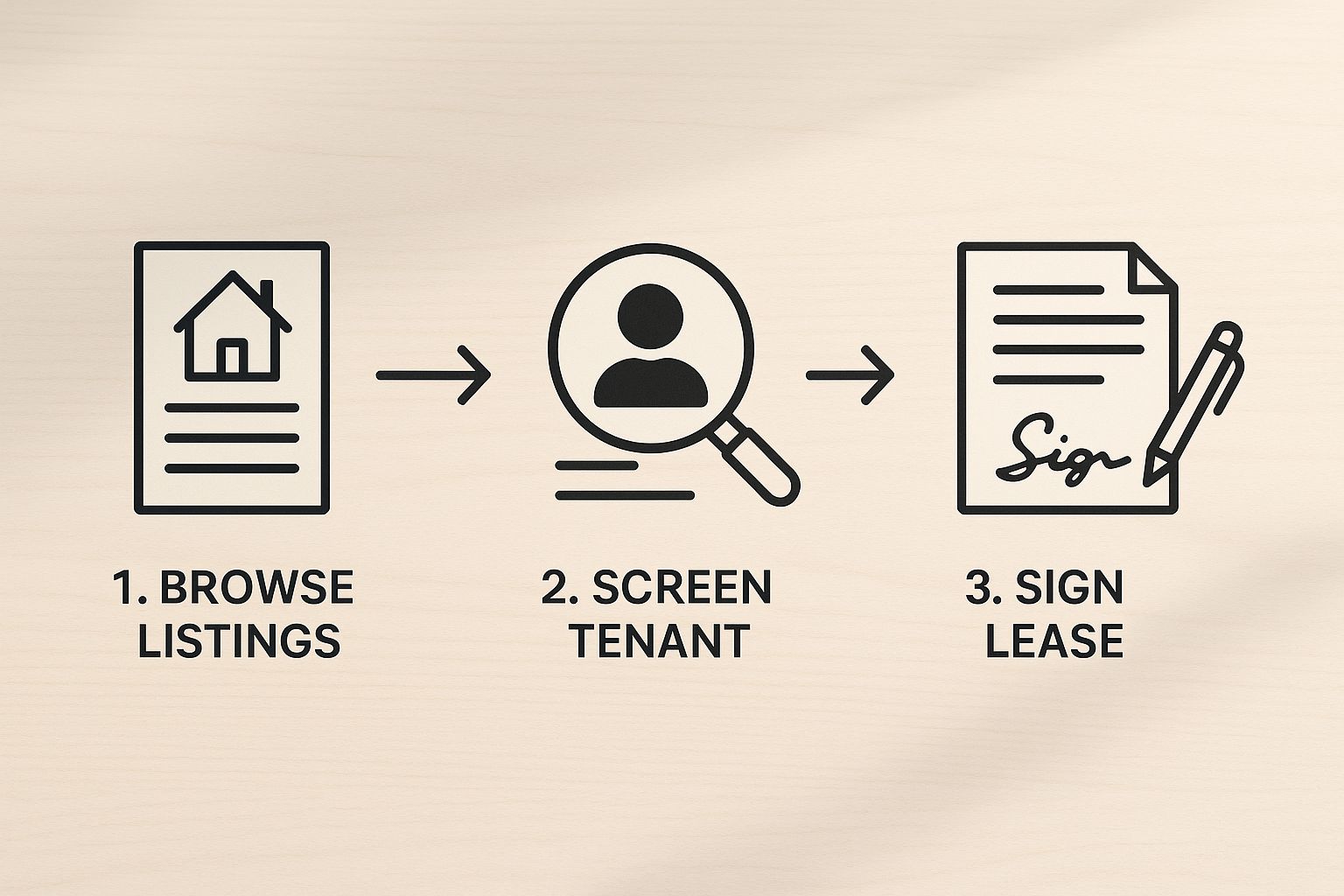
Think of each step as a critical checkpoint. It’s how we ensure a smooth, successful placement that ultimately safeguards your investment.
Stage 1: Rental Readiness and Strategic Marketing
Before your property hits the market, we conduct a thorough evaluation to ensure it’s in pristine, rent-ready condition. This helps attract the best possible tenants.
Actionable Tip: We might recommend minor repairs or small enhancements, like fresh paint or updated light fixtures, that can significantly boost its appeal and rental value.
Next, we determine a competitive rental rate. Our team performs a deep market analysis, comparing your property to similar ones in your specific neighborhood, from Gonzales to Monterey. This data-driven strategy ensures you aren't underpricing your asset or letting it sit vacant because the rent is too high. You can get a deeper understanding by exploring our guide on how fair market rent is determined.
With the price set, our marketing begins:
- Professional Photography: We use high-quality images to capture your property’s best features and make it stand out online.
- Compelling Descriptions: We write engaging descriptions that sell the unique lifestyle of your property and the local Monterey County area.
- Targeted Exposure: Your listing is posted across top rental platforms, reaching a large pool of qualified people looking for their next home in the Monterey Bay Area.
Stage 2: Comprehensive Applicant Screening
This is the most important part of the service. A simple online credit check isn't enough to protect your investment. Our screening is a deep dive into an applicant’s history, designed to verify their reliability and financial stability from every angle.
The tenant screening industry has evolved with technology, allowing for more detailed and immediate checks. This progress is essential for us to minimize risks and secure top-tier tenants for owners like you.
Our screening process always includes:
- Credit and Background Checks: We run a thorough credit check and a nationwide criminal background check on every adult applicant.
- Income and Employment Verification: We confirm that applicants have a stable income, typically requiring it to be at least three times the monthly rent.
- Rental History Review: We contact previous landlords to ask about payment history, property care, and their overall conduct as a tenant.
Stage 3: Lease Execution and Move-In Coordination
Once we've found the ideal tenant, we handle all the final details for a seamless transition. We start by preparing a legally sound lease agreement that complies with all California and local Monterey County regulations, protecting your rights as a property owner.
From there, we coordinate a smooth move-in. This includes collecting the security deposit and first month's rent, conducting a detailed move-in inspection with extensive photo documentation, and ensuring the tenant has everything they need. This final step sets a professional tone for the entire tenancy.
Our Tenant Placement Service Checklist
Here’s a quick summary of the key actions we take at each stage to ensure a successful tenant placement for your property.
| Stage | Key Actions for Your Property | Benefit to You |
|---|---|---|
| Stage 1: Prep & Marketing | Perform rent-ready evaluation, conduct detailed market analysis, hire professional photographers, write compelling listings, and syndicate to top rental sites. | Attract a larger pool of high-quality applicants and minimize vacancy time by pricing your property correctly from the start. |
| Stage 2: Screening | Run comprehensive credit, criminal, and eviction history checks. Verify income and employment. Contact previous landlords for references. | Reduce the risk of late payments, property damage, and costly evictions by placing a reliable and financially stable tenant. |
| Stage 3: Leasing & Move-In | Draft a legally compliant lease agreement, collect all initial funds (security deposit, first month's rent), and conduct a detailed, photo-documented move-in inspection. | Ensure legal protection, secure your funds upfront, and establish a clear baseline for property condition to prevent future disputes. |
This checklist is our roadmap for every property. By following this proven process, we not only fill your vacancy but also lay the groundwork for a successful and profitable long-term tenancy.
Why Comprehensive Tenant Screening Is Non-Negotiable
When you own a high-end property in Salinas or anywhere in Monterey County, your top priority is protecting that investment. A quick online credit check barely scratches the surface and won't give you the security your asset demands. Our tenant placement service is built on the belief that a detailed, multi-step screening process is the single most important action to safeguard your property, minimize risk, and ensure a stable return.
Placing the wrong tenant can cause a domino effect of problems: late payments, property damage, and the nightmare of a stressful, expensive eviction. A basic check often misses the red flags that signal future trouble. That’s why our approach goes much deeper to build a complete picture of an applicant's reliability before they ever get the keys.
Beyond the Credit Score
A credit score is just one piece of the puzzle. To truly vet an applicant and protect your interests, we conduct a detailed investigation that covers several key areas.
Our screening protocol is anything but standard. It includes:
- Direct Income and Employment Verification: We contact employers directly to confirm an applicant's stated income and job stability, ensuring they can comfortably afford the rent.
- Previous Landlord Interviews: We call past landlords to ask the important questions: Did they pay on time? How did they treat the property? Were they respectful and easy to communicate with?
- Comprehensive Background Checks: This covers a nationwide criminal history and eviction search, giving us a clear view of an applicant's track record.
A thorough screening process isn’t about being difficult; it’s about being diligent. It’s the best preventative measure a landlord can take to avoid headaches and protect their cash flow.
Upholding Fair Housing Laws
Navigating California’s complex fair housing laws is critical. Our team, led by local expert Amy Salmina, is rigorously trained to conduct every screening in full compliance with all state and federal regulations. This ensures the process is not only effective but also ethical and legally sound, protecting you from potential liability.
A well-executed screening finds the best possible tenant while treating every applicant fairly and respectfully.
The financial stakes are high. One recent report found that 16% of tenants pay late. This number alone shows why a robust screening process is essential for reducing financial risks from the start.
Want to learn more about our proven methods? Check out our guide on how to properly screen potential tenants. This comprehensive approach is simply non-negotiable for securing the peace of mind you deserve as a property owner.
How We Maximize Your Rental Income in the Salinas Market
Finding the right tenant isn't just about filling an empty space—it's a direct way to protect and grow your investment. Our entire tenant placement service is built to maximize your bottom line. We use our deep, local knowledge of the Salinas, Monterey, and South County markets to conduct a precise rental rate analysis. This sets a competitive price that attracts the best applicants without leaving money on the table.
Think of it as a strategic partnership. Our goal is to optimize your property's financial performance from day one. When you have a high-quality tenant who pays on time and cares for the property, you dramatically cut down on costly turnover and surprise maintenance bills. That stability is the foundation of long-term profitability and predictable cash flow. For a deeper dive into this metric, see our guide on understanding cash flow in real estate.
A Data-Driven Approach to Pricing
Setting the right rent is both an art and a science. We don’t guess. We rely on current, hyper-local data from neighborhoods across the Monterey Bay Area, from Gonzales to King City.
Here’s how our rental rate analysis works:
- Comparative Market Analysis (CMA): We pull real-time data to see what similar properties in your immediate area are currently renting for.
- Seasonal Trend Evaluation: Local demand changes with the seasons. We know the best time to list your property to get maximum interest, especially for homes in tourist-heavy areas like Pacific Grove or Carmel.
- Property Feature Assessment: We identify the unique features of your home—a great view in Monterey, a new kitchen in Salinas, an extra garage bay—that justify a premium rental rate.
This careful process ensures your property is priced to perform, attracting serious inquiries right away and locking in the best possible return on your investment.
The Long-Term Financial Benefits
A great tenant placement pays for itself many times over. By focusing on quality from the start, we help you avoid the hidden costs that can hurt your profits, like frequent repairs, messy evictions, and long, costly vacancies.
This proactive approach puts you in a stronger financial position and delivers invaluable peace of mind. To get the most out of your rental income, it's also smart to adopt efficient financial practices. This can include exploring tools for specialized invoice management for real estate to keep everything organized.
The property management industry is a huge part of the economy for a reason. Projections show its market value is set to climb from $81.52 billion in 2025 to nearly $99 billion by 2029. This growth shows how much owners value expert management to protect their assets. Partnering with us positions your investment to succeed in this dynamic market.
Partner With a Local Monterey County Expert
Choosing the right partner to place a tenant in your Monterey County property is one of the most important decisions you'll make as an investor. The right tenant placement service doesn't just fill a vacancy—it protects your asset, saves you valuable time, and delivers lasting peace of mind. Our entire approach is built around delivering those results for you.
As a firm led by Amy Salmina, a fourth-generation Salinas native, our roots in this community run deep. We understand the unique rhythm of the local market, from Salinas to Pebble Beach, in a way that national firms simply can't. That local knowledge is what positions your property to attract the best applicants.
Entrusting your high-end property to a local expert isn't an expense—it's a strategic investment in your property's long-term success and profitability.
For owners ready to hand off this critical task, the next step is clear. If you're still doing your homework, our guide on how to choose a property management company can offer more clarity.
Contact Coast & Valley Properties today to schedule a consultation and experience a stress-free, profitable rental journey.
Your Questions, Answered
As a property owner in Monterey County, you likely have questions. We believe in being completely transparent, so here are answers to the most common questions we get about our tenant placement services.
How Long Does It Take to Place a Tenant?
Every property is different, but thanks to our deep roots in Salinas and the surrounding communities, we typically find and place a high-quality tenant within 21 to 30 days. We move quickly but never rush. Our primary goal is always to find you the right tenant, not just the first one.
Who Approves the Final Applicant?
You do. It's your property, so you always have the final say. Our job is to do the heavy lifting—background checks, credit reports, landlord interviews—and present you with a short list of top-tier candidates. We will give you our professional recommendation, but you make the final decision.
What Happens If a Tenant Leaves Early?
It’s rare, given how thoroughly we screen, but life can be unpredictable. To give you total peace of mind, we back our work with a simple guarantee. If a tenant we place breaks their lease in the first six months, we will find you a new, fully-screened tenant at no additional placement fee.
We stand behind our process because we know it works. This guarantee is our commitment to protecting your investment and ensuring you have a stable, reliable tenancy.
Ready to find a great tenant without the stress and guesswork? Let the local experts at Coast & Valley Properties handle the details.
Explore our Tenant Placement Services and protect your investment today.

8 Essential Property Manager Interview Questions for Salinas & Monterey County Investors
Choosing a property manager is one of the most important decisions you'll make for your real estate investment. In a unique market like Monterey County, from the high-value agricultural lands of Salinas to the luxury coastal homes in Pebble Beach, the right partner does more than just collect rent. They protect your property, maximize your return on investment (ROI), and give you peace of mind.
For busy professionals and serious investors, this isn't just about filling a vacancy. It's about trusting a major asset to a skilled professional. A top property manager acts as your local expert, making sure your property is managed with a high level of care, whether you live down the street or across the country. Their skill directly affects your property's profit and long-term value.
To help you make a smart choice, we’ve put together the essential property manager interview questions you need to ask. These questions go beyond simple answers. They will help you see a candidate's real expertise, local knowledge of the Salinas and Monterey Bay markets, and their commitment to the full-service management your investment deserves. This guide will help you find the right professional to protect and grow your portfolio.
1. How do you handle tenant communications and conflict resolution, particularly with high-end or demanding residents?
This is one of the most critical property manager interview questions you can ask. It separates a standard manager from a high-caliber professional who can handle luxury assets in areas like Carmel or Pebble Beach. Their answer shows their approach to service and their ability to protect your investment while keeping a positive living environment.
You need more than someone who can handle a late rent payment. You need a manager who provides a concierge-level experience, making sure high-end tenants feel valued and heard. A vague response about "being professional" is a red flag. A great answer will describe a specific, proactive system.
What to Listen For
A strong candidate will describe a communication plan that uses modern technology with a personal touch. Their answer should include:
- Proactive Communication: Do they wait for problems, or do they set up clear communication from day one? Look for mentions of a detailed tenant welcome process, regular check-ins, and clear instructions for submitting maintenance requests.
- Modern Tools: A top-tier manager will use technology like a tenant portal for routine tasks. This makes rent payments and maintenance requests easy, providing 24/7 convenience and a clear record for you.
- De-escalation Tactics: When a conflict happens, what is their process? A skilled manager stays calm, listens to understand the issue, and finds a solution that is fair, firm, and follows the lease and California law. They should be able to share an example of turning a tough situation into a good outcome.
Key Insight: The goal isn't just to solve a problem; it's to build a professional, respectful relationship. This is key to keeping great tenants and avoiding the high costs of turnover in the competitive Monterey County rental market.
2. How do you handle difficult tenants or resolve tenant complaints?
This is another revealing property manager interview questions. The answer shows if a manager just collects rent or if they actively protect the value of your asset. How they respond shows their problem-solving skills and ability to handle complex situations while protecting your interests.
You don't want someone who avoids conflict; you need a manager who can face it with a clear, documented process. A vague answer about "talking to people" isn't enough. A great response will outline specific, proven steps for solving problems.

What to Listen For
A strong candidate will describe a system that is firm, fair, and consistent. Their answer should include:
- Documentation First: A top manager knows that every interaction, from a noise complaint in a Soledad apartment complex to a late payment, must be documented. Listen for mentions of written notices, emails, and notes logged in their software. This creates a clear record that is vital if a situation gets worse.
- A Balance of Empathy and Enforcement: Do they try to understand the tenant's side while still enforcing the lease? For example, with late rent, they might offer a one-time payment plan while still serving the required legal notices. This shows they can be both understanding and professional.
- Knowledge of Legal Procedures: An experienced manager will confidently explain the proper steps for lease violations, from sending a "Notice to Cure or Quit" to understanding the eviction process in Monterey County. They act legally and decisively, which avoids costly mistakes for you. For more insights, see our guide on how to deal with tricky tenants on coastandvalleypm.com.
Key Insight: The goal is not to "win" against a tenant. It is to solve issues in a way that follows the law, respects everyone, and brings the situation back in line with the lease agreement. A professional process reduces your risk and protects your investment.
3. Describe your approach to property maintenance and vendor management
This is a fundamental property manager interview questions that tests their practical skills. A property manager’s maintenance strategy directly affects your profit, tenant happiness, and the long-term value of your property. A manager who just waits for things to break is not a manager; they are reactive. You need a proactive strategist.
Their answer shows how they protect your property. For high-value properties in Salinas or along the Monterey Bay, delaying maintenance can lead to expensive damage. A vague answer about “calling a handyman” is a major red flag. A top-tier manager will have a clear system for both preventive care and emergency response.

What to Listen For
A strong candidate will describe a complete system built on prevention, quality, and good value. Their response should include:
- Proactive Maintenance Schedules: Do they mention a plan for regular inspections and preventive work? Look for specifics like scheduling annual HVAC servicing in the fall, gutter cleaning before our winter rains, and regular landscape checks. This proactive approach is detailed in our rental property maintenance checklist.
- Vetted Vendor Network: An experienced local manager will have a trusted network of licensed, insured, and reliable vendors for areas from King City to Marina. Ask how they choose them. A great answer involves checking their work, getting good rates, and making sure they meet the high standards your property deserves.
- Emergency Protocols: What happens when a pipe bursts at 2 a.m. in a Pacific Grove home? A professional manager will have a clear, 24/7 emergency plan. They should explain how they assess the issue, send the right vendor, and communicate with both you and the tenant to limit damage and stress.
Key Insight: Excellent maintenance isn't just about fixing things; it's about preserving your property's value and providing a great living experience. This builds tenant loyalty, protects your investment, and maximizes your long-term ROI.
4. How do you stay current with local landlord-tenant laws and fair housing regulations?
This is one of the most important property manager interview questions you can ask because the answer is about managing risk and protecting your property. A manager who doesn't know the rules can expose you to serious legal and financial trouble. In California, where tenant laws are strong and always changing, this knowledge is essential.
You are looking for a manager who sees legal education as a core part of their job. A vague answer like "I read articles online" is a major red flag. A top manager will have a specific system for staying informed about changes at the local, state, and federal levels.

What to Listen For
A strong candidate will show their commitment to ongoing professional education and name their sources for legal information. Their response should show a proactive, not reactive, approach to following the law.
- Professional Affiliations: Do they belong to industry groups like the California Apartment Association (CAA) or the National Association of Residential Property Managers (NARPM)? These groups provide vital legal updates and training. Amy Salmina, our founder, holds professional certifications that require continuous education on these topics.
- Specific Information Sources: A great manager will name their sources, like updates from real estate lawyers, fair housing seminars, or regular monitoring of news from housing authorities in Salinas or Monterey.
- Practical Implementation: Ask how they turn new information into action. They should be able to explain how a recent change in the law affected their leases, tenant screening, or eviction process. For instance, they should be able to discuss recent updates to California's landlord-tenant laws and how they've changed their operations.
Key Insight: A manager’s dedication to following the law shows their commitment to protecting your investment. Their answer should give you confidence that they are not just managing your property, but actively protecting it from legal problems.
5. What strategies do you use to minimize vacancy rates and attract quality tenants?
Vacancy is the biggest drain on a rental property's profit, so this is a crucial property manager interview questions to ask. A manager’s answer shows their marketing skills and understanding of the local Salinas Valley and Monterey Peninsula rental markets. It’s about more than just filling a unit; it’s about filling it quickly with a resident who will pay on time and care for the property.
An average manager will say something generic like "we post ads online." A top property manager will outline a complete strategy that is both fast and effective. They should show they understand that the right tenant is worth waiting for, but that every day a high-end property sits empty is lost income.
What to Listen For
A strong candidate will describe a proactive and data-driven leasing strategy. Their answer should be detailed and cover the entire process, not just placing an ad. Look for specific mentions of:
- Proactive Marketing: Do they start marketing before the current tenant moves out? A top-tier manager will mention professional photos, virtual tours, and great property descriptions designed to attract the perfect resident for a property in a town like Gonzales or Carmel.
- Strategic Pricing: How do they set the rent? Listen for mentions of doing a Comparative Market Analysis (CMA) for rentals, looking at local trends and the specific features of your property. They should aim to price it competitively to get a large pool of qualified applicants without losing money.
- Rigorous Screening Process: Attracting tenants is only half the job. A great manager will have a thorough, legal screening process that includes credit checks, criminal background checks, income verification, and past landlord references. For a deeper look at what this involves, you can learn more about finding good tenants.
Key Insight: Minimizing vacancy isn't just about speed; it's about attracting and keeping high-quality residents who are more likely to stay. This proactive approach reduces turnover costs and maximizes your long-term return on investment.
6. How do you handle rent collection and what steps do you take for late payments?
This is one of the most revealing property manager interview questions you can ask, as it directly affects your cash flow. A manager’s approach to rent collection shows their financial discipline, legal knowledge, and professionalism. The answer separates a passive manager from one who actively protects your investment.
You need a manager with a firm but fair system that encourages on-time payments and has a clear, legal process for late payments. A vague answer like "we just call them" is a major red flag. A great candidate will outline a detailed, tech-supported process that is easy for tenants and clear for you.
What to Listen For
A strong candidate will detail a system that starts with prevention and ends with legal enforcement. Their response should include:
- Proactive and Convenient Systems: Do they make it easy for tenants to pay on time? Look for mentions of a secure online tenant portal for automatic payments and clear payment reminders. Making payments simple is the first step to ensuring consistent cash flow. To learn more, explore the benefits of online rent collection.
- A Clear Late-Payment Protocol: A top-tier manager will describe a consistent, documented process. This includes automatic late fees, immediate communication to the tenant, and formal notices (like a Three-Day Notice to Pay Rent or Quit) sent promptly and in line with California law.
- Firmness with Professionalism: When a tenant is late, how do they handle it? A skilled manager enforces the lease but stays professional and respectful. They document everything and avoid informal deals that could weaken the lease. Advanced tools like AI chatbots for customer service can also help provide instant support to tenants and owners.
Key Insight: The goal is a "no-surprises" approach. Good tenants know when and how to pay. A clear, automated system for late payments removes confusion and emotion, ensuring your asset is managed like the business it is.
7. Describe a time when you had to handle an emergency situation at a property
This is one of the most revealing property manager interview questions because it tests real-world crisis management. An emergency, like a burst pipe in a Monterey home or a security issue at a Salinas property, is the ultimate test of a manager's skill and calm. Their answer shows how they protect your property and tenants when it matters most.
A vague answer about "calling the right people" isn't enough. You need to hear a clear story of their actions. The story they tell shows their ability to think fast, communicate under pressure, and act decisively to reduce damage.
What to Listen For
A prepared candidate will be able to recall a specific incident and walk you through what they did. Their answer should detail:
- A Clear Action Sequence: Look for a logical series of steps: immediate assessment, ensuring tenant safety, contacting emergency vendors, and communicating with you, the owner. Did they stabilize the situation first?
- Effective Communication: How did they keep tenants informed without causing panic? How and when did they update you? A top-tier manager gives calm, clear updates to everyone, managing expectations during the crisis.
- Post-Emergency Follow-Up: The job isn't done when the immediate threat is over. A great answer will include details about coordinating repairs, helping with insurance claims, and documenting the event. They should also mention what they learned from it.
Key Insight: Emergencies are a part of property ownership. A great manager not only solves the immediate problem but also uses the experience to make your property safer and improve their emergency plans, protecting your investment in the long run.
8. How do you prioritize multiple tasks and manage your time effectively?
Property management is a juggling act. This is a key property manager interview questions because it shows how organized they are. You need a manager who can handle an urgent plumbing leak at a property in Salinas while also managing lease renewals in Monterey.
A vague answer about "staying organized" is not enough. A great manager doesn't just react; they use a system to prioritize tasks based on what's urgent and what's important. Their response should show a clear method for preventing small issues from becoming big problems.
What to Listen For
A top-tier candidate will describe a proactive and technology-driven approach to time management. Their response should show they know the difference between urgent and important tasks.
- Systematized Prioritization: Do they use a specific system, like sorting tasks by urgency and importance? They should be able to explain how they decide what to do first, from an emergency call to a routine inspection.
- Leveraging Technology: A great manager uses property management software not just for rent collection but for managing tasks. Look for mentions of using software to track maintenance requests, set reminders for lease renewals, and schedule preventive work.
- Proactive Scheduling: Do they talk about "task batching"? For example, setting aside specific times for financial reports or property tours. This shows an efficient, strategic approach. They should also explain how they leave room in their schedule for unexpected issues.
Key Insight: Good time management directly impacts your property's profit. A manager with a strong system can schedule preventive maintenance, reduce tenant turnover with prompt service, and give you timely reports, maximizing your ROI.
Property Manager Interview Questions Comparison
| Question / Topic | Implementation Complexity 🔄 | Resource Requirements ⚡ | Expected Outcomes 📊 | Ideal Use Cases 💡 | Key Advantages ⭐ |
|---|---|---|---|---|---|
| What experience do you have in property management? | Low - Open-ended, conversational | Low - No special resources needed | Broad insight into candidate’s background | Initial screening to assess practical knowledge | Reveals depth & growth; easy to start conversation |
| How do you handle difficult tenants or resolve complaints? | Medium - Requires behavioral examples | Medium - May involve scenario probing | Shows conflict resolution & communication skills | Assess interpersonal skills & tenant relationship management | Predicts emotional intelligence; practical problem-solving |
| Describe your approach to property maintenance & vendors | Medium - Operational details required | Medium - May need examples of processes | Evaluates maintenance & vendor coordination | Daily operational management and cost control | Demonstrates budget & quality control awareness |
| How do you stay current with landlord-tenant laws? | Low - Knowledge-oriented | Low - Requires awareness of learning sources | Confirms legal compliance & risk management | Ensuring adherence to regulations and reducing liability | Shows professionalism & commitment to compliance |
| What strategies minimize vacancy & attract tenants? | Medium - Marketing & screening focused | Medium - Involves market analysis & creativity | Improves occupancy rates and tenant quality | Business development & property revenue optimization | Highlights market knowledge; revenue impact |
| How do you handle rent collection & late payments? | Medium - Process and policy enforcement | Medium - Legal and financial processes | Ensures cash flow and enforces payment policies | Financial management and tenant payment compliance | Balances firmness and empathy; improves cash flow |
| Describe handling an emergency situation | High - Crisis management and quick decisions | Medium - Scenario-based behavioral evaluation | Tests crisis response & tenant safety prioritization | Emergency preparedness and high-stress decision making | Reveals leadership & problem-solving under pressure |
| How do you prioritize tasks and manage time effectively? | Medium - Organizational skills required | Low - Tools & planning methods | Improved productivity and workload management | Managing multiple properties and diverse daily responsibilities | Shows efficiency and stress management skills |
Partner with a Local Expert to Protect Your Investment
Finding the right property manager is more than filling a role; it's about building a partnership to protect and grow your real estate investment. This list of property manager interview questions is your guide to a smart hiring process. Going beyond simple questions helps you understand a candidate's skills, ethics, and local market knowledge.
The answers you get should give you a clear picture. You'll understand their proactive approach to maintenance, their fair methods for tenant relations, and their commitment to following California's complex laws. For property owners in Salinas and across Monterey County, from Pebble Beach to South County towns like King City, this is non-negotiable. The right partner turns a property from a source of stress into a high-performing asset.
Key Takeaways for a Successful Interview
As you prepare for interviews, keep these goals in mind:
- Assess Local Expertise: A manager’s knowledge of Monterey County's rental market and vendor networks is priceless. It affects everything from setting rent in Pacific Grove to finding a good plumber in King City.
- Evaluate Problem-Solving Skills: Focus on real-world examples. How did they handle that emergency or that difficult tenant? Their past actions are the best sign of how they’ll protect your property in the future.
- Confirm a Proactive Mindset: The best property managers prevent problems. Listen for strategies on preventive maintenance, thorough tenant screening, and keeping vacancies low. This forward-thinking approach is the key to maximizing your long-term ROI.
Ultimately, using these property manager interview questions helps you choose a professional who shares your goals. The objective is not just to collect rent, but to make sure your property is well-cared for, legally compliant, and financially successful. This careful selection process is the most important step you can take to secure your investment and achieve true peace of mind.
Ready to partner with a local expert who already has the right answers? Coast and Valley Properties offers the high-level service and deep Salinas Valley expertise your portfolio deserves. Contact us to learn how our proactive, full-service management can protect your investment and maximize your returns.

Your Guide to a Real Estate Management Contract
A real estate management contract is the legal agreement that starts the professional partnership between you, the property owner, and a management company. Think of it as the official playbook for how your investment property will be taken care of. It clearly defines every responsibility, from collecting rent in Salinas to handling late-night maintenance calls.
This document is essential for creating a relationship that’s transparent, effective, and protective for everyone involved. For busy owners of high-end properties in Monterey County, it’s your guarantee of peace of mind.
Your Blueprint for a Successful Partnership
It's easy to see a contract as just another legal document, but it’s better to view your real estate management contract as the master plan for protecting and growing your investment. This agreement ensures you’re getting the concierge-level service you expect.
A well-crafted contract turns verbal promises into legally enforceable duties, making sure your asset is managed to your exact standards. It provides a clear roadmap for success from day one.
Defining Roles and Responsibilities
The contract acts as a shield, ensuring everything is done in compliance with local and state laws while spelling out who is responsible for what.
Here’s an actionable checklist of what it should cover:
- Financial Duties: Outlines exact procedures for rent collection, how security deposits are handled in line with California law, and the process for paying property-related bills.
- Maintenance Protocols: Specifies how routine upkeep and emergency repairs will be managed, whether it’s seasonal gutter cleaning in Carmel or a plumbing issue in a South County town like Soledad.
- Leasing and Tenant Relations: Details the manager's authority to market your property, screen potential tenants, and enforce the lease terms.
This infographic breaks down the foundational elements you'll typically find in a management agreement.
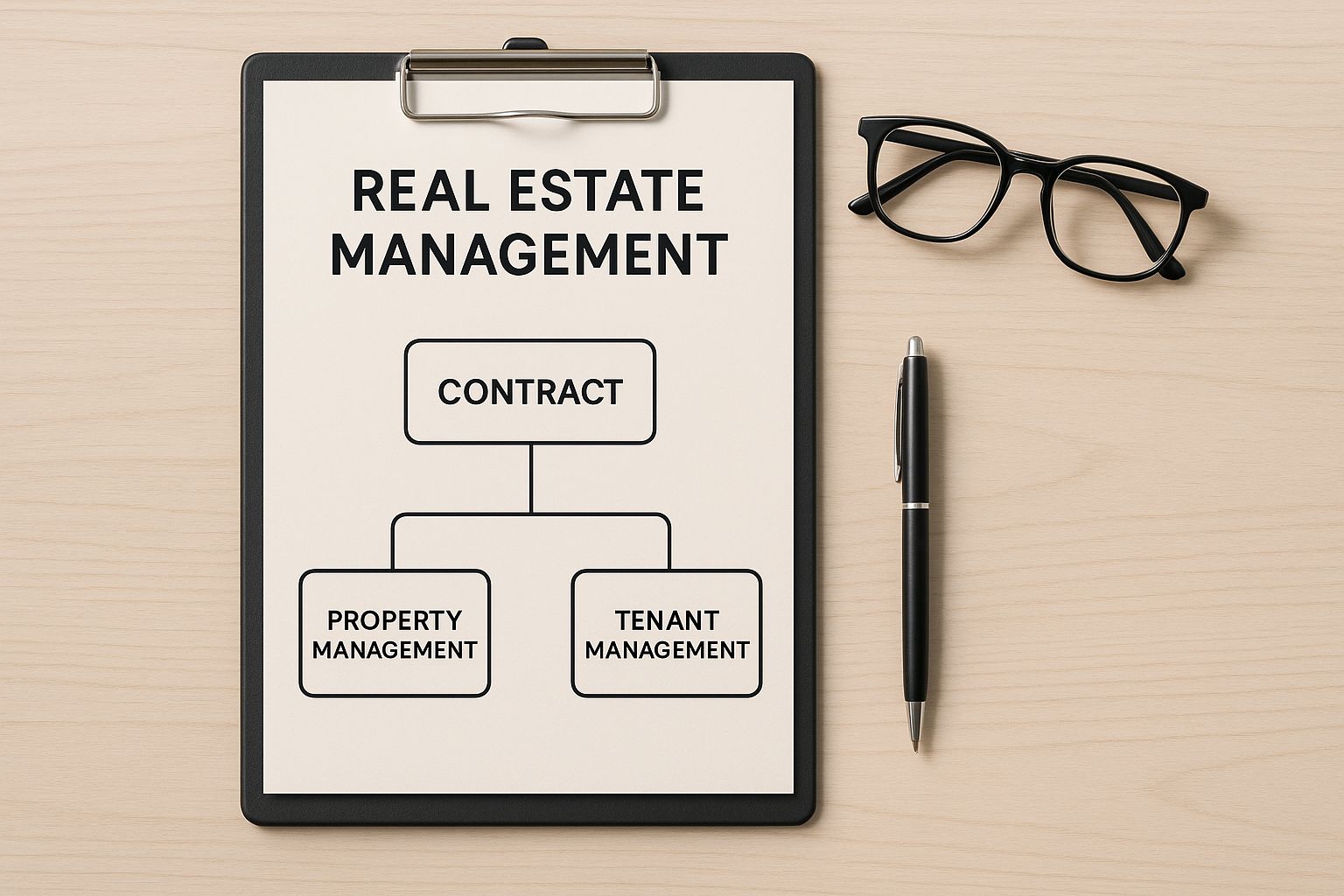
As you can see, each part of the contract builds upon the others to create a complete framework designed to protect your property and maximize its ROI.
Anatomy of a Real Estate Management Contract
Here's a quick look at the essential elements every Monterey County property owner should find in their management agreement.
| Key Section | What It Defines | Why It Protects Your Investment |
|---|---|---|
| Services & Fees | The specific duties of the manager and the matching fee structure. | Creates financial transparency and prevents surprise costs. |
| Term & Termination | The length of the agreement and the rules for ending the partnership. | Provides a clear exit strategy if the relationship isn't a good fit. |
| Owner's Responsibilities | Your obligations, such as funding a reserve account and keeping insurance. | Clarifies your role and ensures the manager has what they need to do their job. |
| Liability & Indemnification | Who is legally and financially responsible for issues or damages. | Limits your personal liability and defines the manager's accountability. |
| Financial Reporting | The schedule and format for financial statements and reports. | Guarantees you have a clear view of your property’s financial performance. |
Having these sections clearly defined in writing is a non-negotiable step toward a healthy, professional relationship.
Building Trust Through Clarity
Ultimately, the contract is a tool for building a transparent and profitable partnership. It sets clear expectations for communication, financial reporting, and performance metrics right from the start.
When every detail is in writing, it creates a relationship built on trust and mutual understanding. This legal framework isn't just a formality—it's your first and most important step toward maximizing your property’s ROI while minimizing your personal stress.
Actionable Tip: For a deeper look into the specifics required in our state, explore our guide to the property management contract in California. This resource covers state-specific clauses that every Monterey County investor should know.
The Non-Negotiable Clauses for High-Value Properties

When you own a luxury home in a place like Pebble Beach or Pacific Grove, using a generic, one-size-fits-all contract is a risk you can’t afford. Your investment is unique, and your real estate management contract should be too. The real power is in tailoring specific clauses to handle the demands of a high-value asset.
This isn't about making things more complicated; it's about creating absolute clarity to prevent expensive misunderstandings. Let's walk through the three most critical clauses every high-end property owner in Monterey County must get right.
Defining the Scope of Services
At the heart of the agreement is the "Scope of Services" clause. This is where you move past vague promises and spell out exactly what your property manager will do. For a high-end property in Carmel or anywhere along the coast, this section needs to be incredibly detailed.
Actionable Checklist for Your Services Clause:
- Elite Vendor Coordination: Specify the process for hiring vetted, insured contractors for everything from landscape architects to technicians servicing high-end appliances.
- Concierge-Level Tenant Relations: Detail how the manager will communicate with high-caliber tenants, ensuring their needs are handled professionally and quickly.
- Proactive Maintenance Schedules: Outline a preventive care plan, including seasonal tasks crucial for coastal properties, like checking for salt air corrosion or prepping for winter rains.
- Comprehensive Marketing Strategy: Describe how the property will be marketed to attract the right tenants, including professional photography and listings on premium platforms.
A weak services clause leaves too much gray area. A strong one acts as a clear checklist for every action your manager is expected to perform, protecting your investment.
Demystifying the Fee Structure
Financial transparency is non-negotiable. The "Fee Structure" clause needs to be crystal clear, leaving no room for misinterpretation. This section details how your manager gets paid and which services are included in their main fee.
Here's what to look for:
- The Management Fee: Usually a percentage of the monthly rent collected, covering day-to-day oversight.
- The Leasing Fee: A one-time fee for finding and placing a new tenant, covering marketing, showings, and screening.
- Project Management Fees: An extra fee for overseeing major renovations that fall outside of normal maintenance, often a percentage of the project cost.
- Miscellaneous Costs: The clause should clarify who pays for things like eviction proceedings or specific marketing expenses.
Actionable Tip: By clearly itemizing every potential cost, this clause prevents the "nickel-and-diming" that can sour a good relationship. For a more detailed breakdown, explore the typical property management fees in California to see how these structures work in our local market.
Clarifying the Term and Termination Clause
Even the best partnerships need an exit strategy. The "Term and Termination" clause defines how long the contract lasts and the exact steps for ending it.
This section must clearly state:
- Initial Term Length: Most contracts start with a one-year term.
- Renewal Process: How the contract renews, often automatically on a month-to-month basis unless one party gives notice.
- Termination Without Cause: The amount of written notice required to end the agreement for any reason, typically 30 to 60 days.
- Termination For Cause: The specific conditions that allow you to end the contract immediately if the manager fails to perform their duties.
This clause is your safety net. It protects you from being locked into an underperforming partnership and ensures you always have control over who manages your valuable Monterey County asset.
How Your Contract Ensures Financial Transparency

For any serious investor, trust is built on absolute financial transparency. Your real estate management contract is the foundation of that trust. It’s a legally binding promise, detailing exactly how every dollar related to your property is handled, reported, and protected.
This part of the contract must spell out every financial responsibility, making sure you always have a precise picture of your investment's performance, whether it's a luxury home in Monterey or a multi-unit complex in Soledad.
Handling of Funds and Trust Accounts
A critical job of the management agreement is to define how all money flows. Vague language here is a massive red flag.
California law is very clear: client funds, like rent and security deposits, must be held in a trust account. This is a separate bank account that keeps your money completely separate from the property management company's own operating funds.
Your contract must state:
- Use of a Trust Account: It needs to confirm a dedicated, federally insured trust account will be used for all your property-related funds.
- Deposit Timelines: The agreement should detail how quickly rent payments and other funds are deposited.
- Security Deposit Management: It must outline the process for holding and returning tenant security deposits in strict compliance with California law.
This legal separation of funds isn't optional; it's a fundamental safeguard that protects your money.
Detailed and Accessible Financial Reporting
How and when you get financial information is just as important as how the money is handled. A professional contract will set a clear schedule and format for financial reporting, guaranteeing you receive consistent, easy-to-understand updates.
Your monthly owner statement should be a comprehensive report. Here’s a checklist of what the contract should promise:
- Itemized Income Statements: Showing all rent collected.
- Detailed Expense Reports: Listing every expense, from routine landscaping in Pacific Grove to an emergency repair in King City, backed up with copies of invoices.
- Rent Roll: A current list showing the payment status of every tenant.
- Owner Disbursement Details: Clearly showing the net income transferred to you each month.
At Coast & Valley, our secure online owner portal provides 24/7 access to all this information. This technology puts you in control, allowing you to view real-time financials and download statements whenever it suits you. This focus on efficiency and owner convenience is a core part of our service.
Protecting Your Investment in Monterey County
Owning a high-value property in Monterey County involves navigating a complex web of state and local laws. From Salinas to the coast in Pacific Grove, your real estate management contract is the single most important document protecting you from legal trouble and unexpected costs.
Think of this agreement as your strategic legal shield. A professionally drafted contract ensures your property manager is legally bound to follow every regulation. This is where a manager with deep local roots, like Coast & Valley’s founder Amy Salmina, provides immense value—they know the specific ordinances in towns like Soledad or Gonzales and how they fit with broader state laws.
Compliance and Fair Housing Protections
One of the biggest financial risks for a landlord is a Fair Housing violation. Federal and California laws are incredibly strict, and one mistake in advertising or screening can lead to a costly lawsuit.
Your management contract must make it clear that your property manager is responsible for all legal compliance. The agreement should spell out their duties to:
- Follow all guidelines from the Federal Fair Housing Act and California's Fair Employment and Housing Act (FEHA).
- Use inclusive, non-discriminatory language in all marketing.
- Apply the same screening criteria to every single applicant.
- Correctly handle requests for reasonable accommodations from tenants with disabilities.
By contractually giving these duties to your manager, you shift a huge amount of legal burden off your shoulders. It’s the best way to ensure your property is run professionally and legally.
Getting Insurance and Indemnification Right
When something goes wrong, who pays? This is a critical question your management agreement must answer through insurance requirements and an indemnification clause.
What Is an Indemnification Clause? In simple terms, it's a promise where one party (your property manager) agrees to cover your losses if their mistake causes a problem. It’s designed to protect you from being financially responsible for something your manager did.
The contract must clearly state the insurance coverage both you and your manager need to carry.
Checklist for Insurance Requirements:
- For You (Property Owner):
- Liability Insurance: A solid landlord policy to cover things like a slip-and-fall accident.
- Property Insurance: Covers the physical building from damage like fire or storms.
- For Your Property Manager:
- Errors and Omissions (E&O) Insurance: Protects you if the manager makes a professional mistake, like a wrongful eviction.
- General Liability Insurance: Covers claims for injury or property damage from the manager's business operations.
By defining these duties and including a strong indemnification clause, your contract builds a financial firewall. It makes sure that if a legal issue arises from your manager’s actions, their insurance policy—not your personal bank account—is the first line of defense.
Actionable Tip: For more information, you can learn more about California's landlord-tenant laws in our detailed guide.
Defining Authority and Owner Responsibilities
A great partnership runs on clear boundaries. Your real estate management contract draws a distinct line between the authority you give your property manager and the core obligations that remain yours. Getting this balance right is crucial for a smooth relationship that protects your high-value asset in Monterey County.
This part of the contract is the rulebook for daily operations. It gives your manager the power to handle issues efficiently without calling you for every little thing. For a busy owner, this means fewer interruptions and more peace of mind.
Delegating Authority to Your Manager
For your property manager to be effective, they need the authority to act on your behalf in specific, pre-approved situations. This isn't about giving up control; it’s about delegating tasks to a trusted expert.
The contract should clearly give them the power to:
- Approve Qualified Tenants: Screen applicants based on agreed-upon criteria and sign lease agreements, getting great tenants into your property faster.
- Authorize Necessary Repairs: Set a spending limit (e.g., $500) for maintenance. This lets them fix a leaking pipe in a Carmel home or a broken appliance in a Salinas rental immediately, stopping small issues from becoming expensive disasters.
- Enforce Lease Terms: Issue notices for late rent or other lease violations, making sure the rules are consistently upheld.
This delegation is how you unlock the time-saving benefits of professional management. By defining these powers in writing, you create a system where your investment is managed efficiently, preserving its value and keeping tenants happy.
Clarifying Owner Responsibilities
While your manager handles the daily tasks, certain responsibilities always stay with you. Spelling these out in the contract prevents misunderstandings and ensures your manager has what they need to succeed.
Your main obligations typically include:
- Maintaining Adequate Insurance: You are responsible for carrying the proper landlord and liability insurance for the property.
- Funding the Reserve Account: You must provide and keep a minimum balance in a reserve fund for approved repairs and expenses.
- Making Major Decisions: Any decision that costs more than the pre-set spending limit, like a roof replacement or major renovation, will always require your direct approval.
This clear division of labor builds trust and makes everything run more smoothly, protecting your time and your investment.
Partnering with a Local Monterey County Expert
The property manager you choose is the single most important decision for your investment's success. This isn't just another vendor; this firm becomes the on-the-ground steward of your valuable asset. At Coast & Valley, we understand that. It’s why our approach to the real estate management contract is built on local expertise, transparency, and trust—all designed to protect your interests.
This is about forging a partnership to preserve your asset's value and maximize its return. We make sure our agreements are clear, fair, and customized to the unique needs of high-end properties right here in the Monterey Bay Area.
Local Insight Written into Every Clause
Drawing on founder Amy Salmina’s deep family roots in the Salinas Valley, our contracts are shaped by decades of local, hands-on experience. A generic agreement can’t account for the specifics of our market—from seasonal rental trends in Carmel to the unique maintenance needs of homes in South County towns like Soledad and King City.
We believe the best contract reflects a strong partnership—one where every term is understood, every fee is transparent, and every action is aligned with your goals. It’s the difference between simple management and true asset stewardship.
This commitment to local knowledge makes your contract a practical tool, not just a legal formality. It ensures your property is managed with an understanding of the community, from local vendor relationships to seasonal maintenance needs.
A Partnership Focused on Your ROI
Ultimately, your choice of a property manager comes down to trust and results. Our contracts are structured to give you both. We invite serious investors and high-end property owners to see the difference a dedicated local expert can make.
By aligning our services with your financial goals, we provide a level of service that goes beyond simple maintenance and rent collection. It's a comprehensive approach to asset protection and growth.
Actionable Next Step: To understand what makes a manager the right fit for you, check out our guide on how to choose a property management company.
Common Questions About Management Contracts
If you're a high-end property owner in Monterey County, you want absolute clarity before you sign. A real estate management contract is the foundation of our partnership, and it's essential to have all your questions answered. Here are straightforward answers to the most common questions we hear from busy investors and homeowners in our community.
What Is the Typical Length of a Management Contract?
Most professional management agreements start with a one-year term. This gives both of us time to establish a productive relationship and for you to see tangible results.
After that initial year, the contract often rolls over into a more flexible month-to-month arrangement. A crucial detail is the "Termination" clause; it should clearly state the required notice period to end the partnership, typically 30 to 90 days. For owners with properties in seasonal markets like Carmel, it’s smart to make sure this term aligns with your rental goals.
Are the Terms of a Management Contract Negotiable?
Yes, absolutely. A good management agreement should be the start of a conversation, not a rigid document. A reputable firm like Coast & Valley will be happy to walk you through the contract and discuss terms to ensure it serves your best interests.
Common areas for discussion include:
- Management Fee Percentage: This can sometimes be adjusted based on your property type or the size of your portfolio.
- Ancillary Service Costs: We can clarify fees for extra services, like overseeing a major renovation.
- Repair Authorization Limits: The spending limit a manager has for repairs without your direct approval is often negotiable.
Think of the contract as a collaborative roadmap. The goal is to build an agreement that feels fair and transparent, setting the stage for a long and successful partnership.
What Happens If I Am Unhappy with My Property Manager?
This is where a "Termination for Cause" clause comes in. This is your primary protection, giving you the right to end the agreement if the manager fails to uphold their duties—like neglecting critical maintenance or not collecting rent.
This clause will spell out the required steps, which usually involve giving written notice and allowing the manager a period to fix the problem. This is a non-negotiable safeguard that ensures accountability and protects your investment.
Who Handles Finding and Screening New Tenants?
That's one of our primary jobs, and it will be clearly defined in the "Scope of Services" section. The agreement should detail our entire process for marketing your home, running comprehensive background and credit checks, verifying employment, and signing the lease.
For luxury homes in the Monterey Bay Area, from Salinas to Pebble Beach, a rigorous screening process is essential. It’s how we place qualified tenants who will treat your property with the respect it deserves, protecting your asset for the long term.
Your property deserves more than just management; it deserves expert stewardship. Coast and Valley Properties provides the concierge-level service and local expertise necessary to protect and grow your investment.
Contact us today for a personalized consultation of your property management needs.

What Is Considered a Good Capitalization Rate? A Guide for Monterey County Investors
For savvy investors in Monterey County, a "good" capitalization rate isn't just one number—it’s a clear indicator of risk and potential reward. While a national range might be 4% to 10%, that figure changes dramatically based on a property's location, type, and the local market story.
A lower cap rate often points to a safer, more stable asset in a high-demand area like Carmel. Think of it as a blue-chip stock for your portfolio. A higher rate, on the other hand, can signal stronger immediate cash flow but usually comes with more risk, typical of faster-growing markets.
Decoding Cap Rates in the Monterey Bay Area

Think of a cap rate as a quick snapshot of your investment's earning potential if you bought it with cash. It's a simple calculation that measures the annual return from a property's income relative to its current market value. For serious investors focused on high-end properties in Monterey County, understanding the local context is crucial for maximizing ROI.
The numbers here tell a unique story about market stability, risk, and opportunity. In our premium coastal communities, expectations are different.
- Lower Cap Rates (3-5%): These are common in high-value areas like Carmel and Pebble Beach. A rate in this range shows strong investor confidence, high property values, and perceived safety. The return is steady, making the asset a stable, long-term hold for wealth preservation.
- Higher Cap Rates (6-8%+): You're more likely to see these numbers in growing areas like Salinas or South County towns such as Soledad and King City. A higher rate here compensates investors for different market dynamics, signaling greater potential for immediate cash flow.
This distinction is the key to building a successful portfolio strategy. An investor focused on preserving wealth might prefer the stability of a lower-cap-rate property in Pacific Grove. In contrast, an investor aiming for aggressive cash flow might target a higher-cap-rate multi-family unit in Salinas.
Monterey County Cap Rate Quick Guide
To give you a clearer picture, here’s a quick reference for what you can typically expect for different property types across our local market.
| Property Type | Typical Cap Rate Range | Key Investor Consideration |
|---|---|---|
| Luxury Single-Family | 3% - 4.5% | Stability and long-term appreciation are the primary goals, not immediate cash flow. |
| Multi-Family (4+ Units) | 5% - 7% | A balance of cash flow and growth, often seen as the workhorse of a portfolio. |
| Commercial Retail | 6% - 8% | Higher potential income but depends on tenant strength and the local economy. |
| Industrial/Warehouse | 5.5% - 7.5% | Growing demand but requires specialized management and tenant knowledge. |
This table illustrates the trade-offs. There's no single "best" option—only what's best for your specific financial goals and risk tolerance.
The Investor's Perspective on Risk and Reward
Ultimately, a "good" cap rate is one that aligns with your investment goals. It’s not just about chasing the highest number; it's about understanding the story behind that number. A high cap rate could be a fantastic opportunity, or it could be a red flag for a property with issues that demand significant time and management attention.
For the discerning property owner, the goal is to balance healthy returns with long-term asset preservation. The cap rate is a starting point—a diagnostic tool that helps us ask the right questions about a property's performance and potential.
Before we dive into the calculations, a solid grasp of the fundamentals is essential. For a complete primer, explore our detailed guide on what a cap rate is in real estate. This foundational knowledge allows you to make smarter, data-driven decisions that protect and grow your wealth in the unique Monterey County market.
A Practical Guide to Calculating Cap Rate
Figuring out your property's cap rate is a quick, powerful way to measure its performance. The formula is simple: Net Operating Income (NOI) divided by the Current Market Value. Think of this number as the potential rate of return you're getting from the investment, separate from any financing.
It’s like your property’s annual report card. It tells you exactly how well the asset generates income compared to what it’s worth today in the Monterey County market.
Breaking Down the Formula
The calculation boils down to two key numbers: what your property earns and what it’s worth.
- Net Operating Income (NOI): This is the total income your property brings in for the year (gross rent plus other income like parking fees) after you subtract all operating expenses. These expenses include property taxes, insurance, maintenance, and property management fees. Crucially, your mortgage payment is not included here.
- Current Market Value: This isn't what you paid five years ago. It’s the price a buyer would realistically pay for it in today's market, whether it's a luxury vacation home in Pacific Grove or a multi-unit building in Salinas.
To get your cap rate right, you first need a solid NOI figure. It's essential to understand how to properly calculate rental income because that number is the starting point.
The visual below shows how market trends, property condition, and location-based risk all play a role in this calculation.
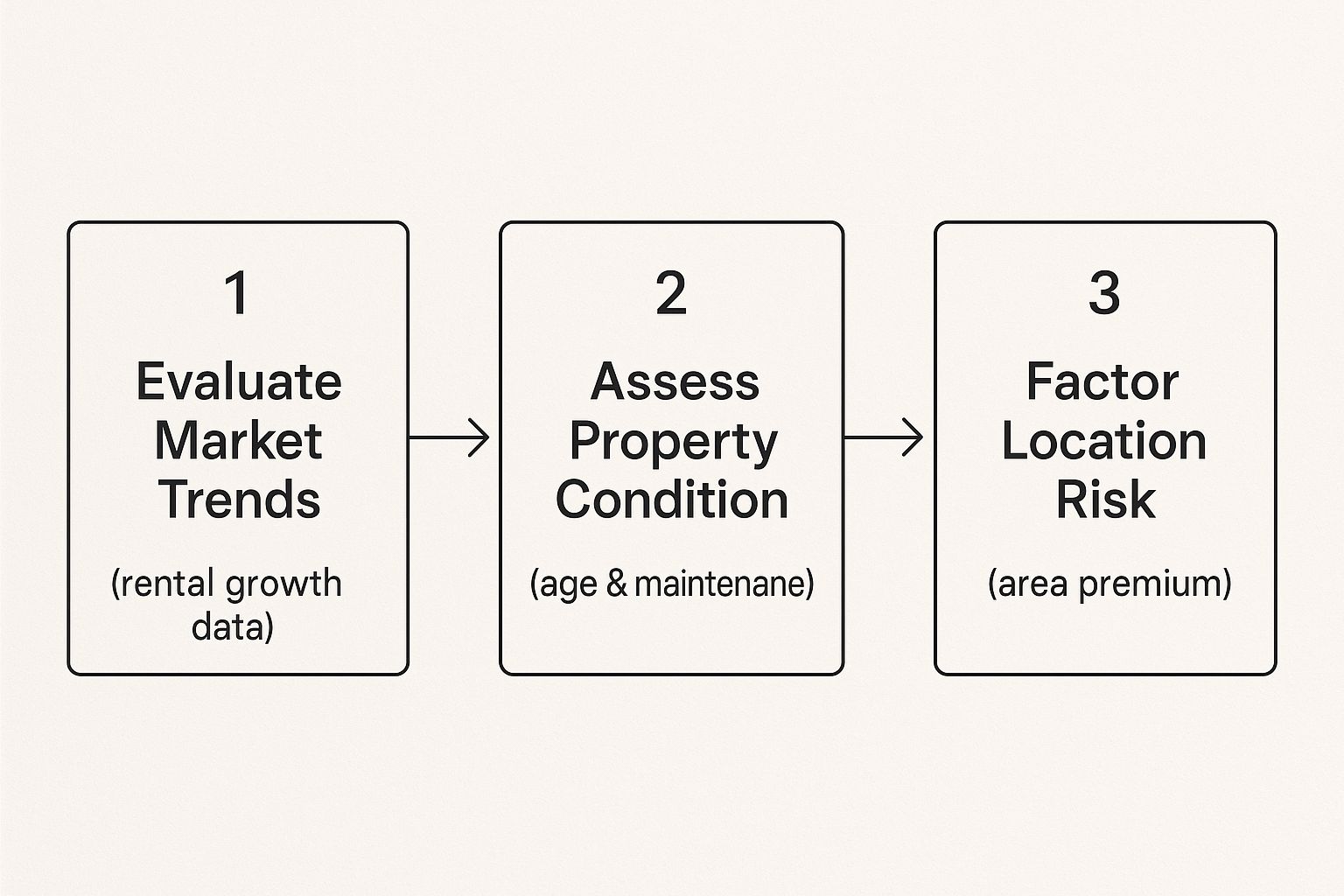
As you can see, a true cap rate analysis requires more than just plugging numbers into a formula; it demands a real feel for local market dynamics and your property's specifics.
A Real-World Salinas Example
Let's walk through this with a multi-family property in Salinas to see how it works in practice.
- Current Market Value: $1,200,000
- Annual Gross Rental Income: $90,000
- Annual Operating Expenses (taxes, insurance, maintenance): $30,000
Step 1: Find the Net Operating Income (NOI).
$90,000 (Gross Income) - $30,000 (Operating Expenses) = $60,000 (NOI)
Step 2: Calculate the Cap Rate.
$60,000 (NOI) / $1,200,000 (Market Value) = 0.05 or 5%
This 5% cap rate gives us a clean, standardized metric. We can now use it to compare this Salinas property against other investment opportunities, whether they're across town or across the country. It’s a vital tool for making smart portfolio decisions.
While cap rate is a fantastic indicator, it's always smart to look at it alongside other metrics. For another angle on your investment's health, check out our guide on how to calculate rental yield, which offers a slightly different perspective on performance.
Key Factors That Influence Local Cap Rates
Ever wonder why a property in King City can have a cap rate that looks completely different from one in Monterey? A savvy investor knows a cap rate isn't just a number—it’s a direct reflection of local market dynamics, the property's unique characteristics, and broader economic trends.
Understanding these influences is key to making smart decisions in our unique region. Several forces push and pull on property values and rental income, which in turn moves cap rates. For anyone investing in Monterey County, it’s critical to look past the basic formula and understand the story these factors tell about risk and opportunity.
Regional Economic Drivers
The economic health of our region plays a huge role. Monterey County's economy is a unique blend of agriculture and tourism, creating distinct patterns in rental demand and property values.
- Agricultural Strength: In Salinas and South County towns like Soledad and Gonzales, a strong agricultural sector provides a steady employment base. This consistency leads to stable rental demand for both multi-family and single-family homes, directly influencing their cap rates.
- Tourism Trends: Along the coast, from Monterey to Carmel, tourism is king. A strong tourist season boosts demand for short-term and luxury rentals, which can push property values up and lower cap rates, signaling what the market sees as a "safer" investment.
Property-Specific Details
No two properties are the same, and their individual traits are critical. Details about the asset itself have a direct impact on its Net Operating Income (NOI) and its perceived risk. A clear understanding of what goes into this figure is vital; for a deeper dive, check out our guide on what is net operating income.
Here are a few property-level factors to consider:
- Age and Condition: A recently renovated property in Pacific Grove with modern amenities will command higher rents and need less immediate maintenance. This justifies a lower cap rate. An older building with deferred maintenance will likely have a higher cap rate to compensate the new owner for the work ahead.
- Tenant Quality: A property with reliable, long-term tenants on solid leases is a less risky asset. That stability is attractive to buyers and often results in a lower, more stable cap rate.
What makes a "good" cap rate is closely tied to market conditions and risk. Back in the early 2000s, U.S. cap rates were commonly in the 8% to 10% range. But a long period of low interest rates led to "cap rate compression," pushing them down to 5% to 7% by 2006 as more money entered real estate. You can explore the history of real estate cycles to see how these trends evolve.
Comparing Cap Rates Across Property Types
Not all real estate is created equal, and neither are their cap rates. If you’re a serious investor in Monterey County, you know that what is considered a good capitalization rate depends on what you're buying. The risk and return profile of a multi-unit apartment building in Salinas is worlds away from a luxury single-family home in Carmel, and their cap rates tell that story.
Every property type has its own expectations for income stability, growth potential, and management needs. That's why comparing a commercial property to a residential one using the same cap rate lens can lead to poor decisions.
Risk and Stability Across Asset Classes
The main reason cap rates vary so much is the classic trade-off between risk and reward. Assets seen as safer and more stable—those with consistent tenant demand—usually have lower cap rates. Why? Because investors are willing to pay a premium for that peace of mind and long-term security.
- Multifamily Properties: These are often the workhorses of a real estate portfolio. Apartment buildings in places like Monterey or Salinas tend to have lower cap rates because the consistent demand for housing creates a reliable income stream, lowering the owner's risk. This stability is a huge reason why many choose to invest in income-producing properties.
- Retail and Commercial Spaces: You'll often see higher cap rates here to compensate investors for taking on more risk. A retail property's success is tied directly to the health of the economy and the tenant's business, making their income stream less predictable than an apartment rental.
- Single-Family Homes: High-end homes in premium spots like Pebble Beach typically have the lowest cap rates. For these properties, the investment strategy is not about immediate cash flow. It's about long-term appreciation and wealth preservation.
You can see these dynamics in the broader market. Rising borrowing costs have pushed cap rates up. In the U.S., multifamily housing cap rates climbed from a low of about 3.82% in 2021 to around 5.96% in 2023. Office properties, seen as riskier, jumped even higher, hitting an average of 6.54% by late 2023. You can dig into more data on how commercial property cap rates have changed to see these trends for yourself.
At the end of the day, this context is crucial for understanding how your investments are performing. By comparing your property’s cap rate to similar ones in the Monterey Bay Area, you get a much clearer, more honest picture of where it stands.
Making Smarter Investment Decisions with Cap Rate

Understanding your cap rate is one thing. Using it to drive your strategy is where the real value lies. For busy investors in Monterey County, this metric isn't just a number—it's a tool that helps you look forward, spot opportunities, and forecast returns with greater clarity. It’s about cutting through the noise and making decisions based on solid performance data.
For example, if you're looking at a property in Salinas with an unusually high cap rate compared to its neighbors, that could be a sign of an undervalued asset. On the flip side, a property with a cap rate far below the local average might be overvalued. This metric gives you a standardized way to compare an apartment building in Soledad to a commercial space in Monterey, helping you decide where your capital will work hardest.
A Holistic Approach to Investment Analysis
While powerful, the cap rate is just one piece of the puzzle. A sophisticated investment strategy always looks at the bigger picture. Cap rate is great for showing potential income relative to value, but it doesn't factor in financing or how much cash you actually invested.
For that reason, always consider it alongside other key metrics:
- Cash-on-Cash Return: This measures the annual pre-tax cash flow you receive relative to the actual cash you invested, giving you a clearer picture of your personal return.
- Total Return on Investment (ROI): This is the wide-angle lens. It looks at cash flow but also includes equity buildup from loan payments and the long-term appreciation of the property.
While cap rate shows potential return, the overall profitability of an investment property is heavily influenced by taxes. For a deeper look, check out this comprehensive Ultimate Guide to Taxes on Investment Property.
How Professional Management Boosts Your Bottom Line
So, what’s the most direct way to improve your property’s performance and long-term value? It all comes down to your Net Operating Income (NOI). When you increase your NOI, you don't just improve your cap rate—you directly increase the market value of your asset. This is where expert property management becomes a powerful lever for growth.
A key benchmark for understanding what is considered a good capitalization rate is comparing it to risk-free investments. Historically, multifamily real estate cap rates have averaged about 2.15% higher than the 10-year U.S. Treasury yield, rewarding investors for the added risks of property ownership.
At Coast & Valley, our entire focus is on optimizing your NOI to save you time and maximize your returns. We minimize vacancies, secure high-quality tenants at top market rates, and manage operating expenses with a professional eye. By improving NOI through strategic management and helping you understand all the available tax deductions for landlords, we enhance your property’s value and secure a stronger return on your investment.
Taking Your Property's ROI to the Next Level
Knowing your cap rate is one thing, but actively improving it is where you build real wealth. For property owners here in Monterey County, that number isn't just a static metric—it's a living indicator of your investment's health and a roadmap for what to do next. Boosting your property's performance takes a solid plan and local expertise.
There's no single "good" cap rate that fits every property. It's a balance between risk and reward. A property in a stable area like Pebble Beach will have a different profile than one in a growth market like King City. The most direct path to a better cap rate is to increase your Net Operating Income (NOI). When your NOI goes up, your property's value follows.
A Clear Path to a Stronger Portfolio
Getting a better cap rate and a healthier return requires a focused strategy. This is where professional management provides trust, transparency, and time-saving solutions.
Here’s our step-by-step approach to improving your property's performance:
- Step 1: Smart Rent Optimization. We conduct detailed market analyses to price your property for its maximum rental value without deterring quality tenants.
- Step 2: Proactive Expense Control. We keep costs in check by implementing preventive maintenance and using our network of trusted local vendors. This is about spending smart to protect your bottom line and preserve your asset.
- Step 3: Minimizing Vacancies. An empty unit is a liability. Our expert marketing and rigorous tenant screening find high-quality, long-term tenants who provide a steady, reliable income stream.
"Working with Amy Salmina and the Coast & Valley team completely changed how we viewed our investment. They didn't just manage the property; they found real opportunities to increase its value and boost our returns in ways we never would have seen on our own." – A Monterey County Property Investor
As a fourth-generation Salinas native with deep local roots, Amy Salmina offers an understanding of the Monterey County real estate landscape you can't get anywhere else. At Coast & Valley, we are your trusted advisors, dedicated to protecting your high-end assets and helping you achieve your financial goals.
Ready to see what your investment is truly capable of? Let our team provide a professional evaluation of your property. Contact Coast & Valley today for a comprehensive assessment and see how expert management can unlock your portfolio's true potential.
Answering Your Questions About Cap Rates
Even experienced investors have questions. Here are answers to some of the most common ones we hear about capitalization rates in the Monterey County market.
Is a Higher Cap Rate Always Better?
Not always. It's a classic risk vs. reward trade-off. While a higher cap rate suggests better immediate cash flow, it often signals higher risk.
For example, a lower cap rate in a stable market like Carmel might mean less cash flow each month, but it usually comes with greater long-term appreciation and security. A higher rate in an up-and-coming area could put more income in your pocket now, but you might face more market uncertainty or demanding management needs. The "better" rate is the one that fits your personal investment strategy and goals.
How Can a Property Manager Improve My Cap Rate?
A professional property manager is your key to boosting your cap rate because they directly influence your Net Operating Income (NOI). When your NOI goes up, your cap rate improves.
Here’s the action plan:
- Rent Optimization: We analyze local market data to set the highest possible rent that still attracts top-tier tenants for your property.
- Vacancy Minimization: An empty unit costs you money. We use expert marketing and a rigorous tenant screening process to keep your property filled with reliable renters who pay on time.
- Expense Control: We use our network of trusted local vendors and proactive maintenance to keep operational costs down without ever sacrificing quality or compliance.
Every dollar added to your NOI not only improves your cap rate but also directly increases your property's overall value, reinforcing trust in your investment's performance.
Can a Cap Rate Be Negative?
Yes, but it’s a major red flag. A negative cap rate means the property's annual operating expenses are higher than the gross income it brings in.
Essentially, the investment is losing money. This situation requires immediate attention, whether that means cutting costs, finding ways to boost revenue, or both. To truly understand your property's ROI, it's also critical to delve into investor loan interest rates and see how they impact your bottom line.
How Often Should I Recalculate My Cap Rate?
You should check your property's cap rate at least once a year. It's also smart to run the numbers again whenever something significant happens.
This could be a major change to your income or expenses, the completion of a large renovation, or a noticeable shift in property values in your specific Monterey County neighborhood. Staying on top of this metric keeps you in control and allows you to make timely, informed decisions.
Ready to unlock your property's full potential? The experts at Coast & Valley Properties can provide a comprehensive performance evaluation to identify opportunities for increasing your NOI and maximizing your return on investment. Contact us today to get started.

What Is Property Preservation for Your Monterey County Investment?
When a high-value property sits empty, it’s vulnerable. Property preservation is a set of services designed to actively protect that vacant property. For a busy owner or investor, it’s about stopping small issues from becoming expensive problems, securing the asset against vandalism, and making sure the property stays up to code.
This isn't just about mowing the lawn. For owners in Monterey County, this means proactively safeguarding a luxury Carmel home or a valuable Salinas agricultural property from predictable—and costly—risks. It's about having local experts on the ground, protecting your investment and your peace of mind.
Understanding Property Preservation for Your Investment

For a savvy investor, property preservation is more than a simple definition. Think of it as a comprehensive guardianship for your asset. It’s a hands-on approach to risk management that ensures an empty property doesn't slowly turn into a financial liability.
This is especially true in a place like Monterey County, where local environmental factors—from coastal fog in Pacific Grove to the dry heat in South County—and strict regulations can dramatically affect a property's condition.
So, what does this guardianship look like in practice? Here’s an actionable checklist of common services:
- Step 1: Routine Inspections: We regularly check the property to catch small problems, like a leaky faucet or a broken window, before they become expensive repairs.
- Step 2: Securing the Property: We immediately change the locks and ensure all windows and doors are secure to prevent unauthorized entry.
- Step 3: Seasonal Readiness: We prepare your property for Monterey County's wet winters by checking drainage and protecting pipes from freezing.
- Step 4: Groundskeeping: We handle lawn care and debris removal to maintain curb appeal and avoid fines from cities like Salinas or Monterey.
- Step 5: Pest Control: We take steps to prevent infestations that can cause serious structural damage.
The Goal is Proactive Guardianship
The key difference here is being proactive, not reactive. An undetected leak in an empty Pacific Grove home can easily escalate into thousands of dollars in water damage and mold remediation. Likewise, letting the landscaping get out of hand on a Salinas property can quickly lead to expensive code violations from the city.
A professional preservation plan anticipates these issues and deals with them head-on. The entire goal is to keep the property secure, stable, and compliant at all times, protecting its value and your return on investment.
For the busy professional or remote investor, this service provides invaluable peace of mind. Led by local experts like Amy Salmina, our team acts as your eyes and ears, ensuring your asset is cared for with the same diligence as if you were there yourself.
This proactive care has a direct, positive impact on your investment’s financial health. A well-preserved property holds its market value, attracts high-quality tenants or buyers, and helps you sidestep the massive costs that come with neglect. A huge part of this process comes down to regular, thorough evaluations. You can learn more about protecting your assets with a comprehensive rental property inspection checklist.
Key Preservation Services and Their Direct Value
To better understand how these services translate into real-world ROI, let's break down the core components of a professional preservation plan. Each action is directly tied to protecting your equity and saving you time and money.
| Preservation Service | Actionable Steps We Take | How It Protects Your Investment |
|---|---|---|
| Regular Property Inspections | Scheduled visits to check the interior and exterior for any signs of trouble—leaks, pests, vandalism, or wear and tear. | Prevents minor issues from becoming catastrophic repairs. A $50 plumbing fix caught early saves a $5,000 water damage bill later. |
| Securing and Lock Changes | Changing all locks upon vacancy, securing windows, and boarding up openings if the property will be vacant long-term. | Deters squatters, vandals, and thieves, protecting your property's interior and fixtures from damage and theft. |
| Debris and Trash Removal | Clearing out any trash, junk, or hazardous materials left behind by previous occupants or dumped on the property. | Improves curb appeal, eliminates health hazards, and helps you avoid municipal fines for property neglect in cities like Soledad or King City. |
| Landscaping & Lawn Care | Mowing the lawn, trimming shrubs, and managing the grounds to maintain a neat and occupied appearance. | Prevents overgrowth that can lead to pest infestations, city code violations, and a clear signal that the property is vacant. |
| Seasonal Winterization | Draining water lines, adding antifreeze to plumbing systems, and preparing the property for our winter rainy season. | Protects against burst pipes—one of the most destructive and expensive issues a vacant Monterey County property can face. |
Ultimately, each of these services is a small investment made to shield a much larger one. By maintaining the property's condition, you ensure it's always ready for the market, whether for rent or sale, without the delays and costs of extensive rehabilitation.
The Four Pillars of a Strong Preservation Plan
A successful preservation strategy isn’t a random checklist; it’s a structured approach built on four core components. For a high-value asset in Monterey County, each pillar works together to shield your property from risk, protect its value, and give you complete peace of mind.
1. Securing the Asset
The first and most critical pillar is securing the property. An empty home, whether it’s in a quiet Pebble Beach neighborhood or a more rural part of South County, is an open invitation to vandals, squatters, or thieves. This is your first line of defense.
Here are the immediate steps we take to protect your property:
- Change all locks the moment a property becomes vacant. You never know who might have a spare key from a previous tenant or contractor.
- Secure all points of entry, which means checking every window, garage door, and gate to prevent forced entry.
- Install temporary security measures like motion-activated lighting or monitored alarms for high-value properties.
2. Consistent Maintenance
Next is consistent maintenance, the heart of proactive preservation. Small, ignored issues are the number one cause of expensive damage down the road. A slow drip under a sink can quickly lead to thousands of dollars in mold remediation, especially in the damp coastal climate of the Monterey Bay Area.
This pillar is all about scheduled, preventive care to spot potential problems before they escalate.
The core idea is simple: it’s always cheaper and less disruptive to fix a small problem today than a huge disaster tomorrow. This consistent oversight is what separates professional management from passive ownership and saves our clients significant time and money.
The visual below breaks down some of the most common tasks handled during these routine maintenance checks.
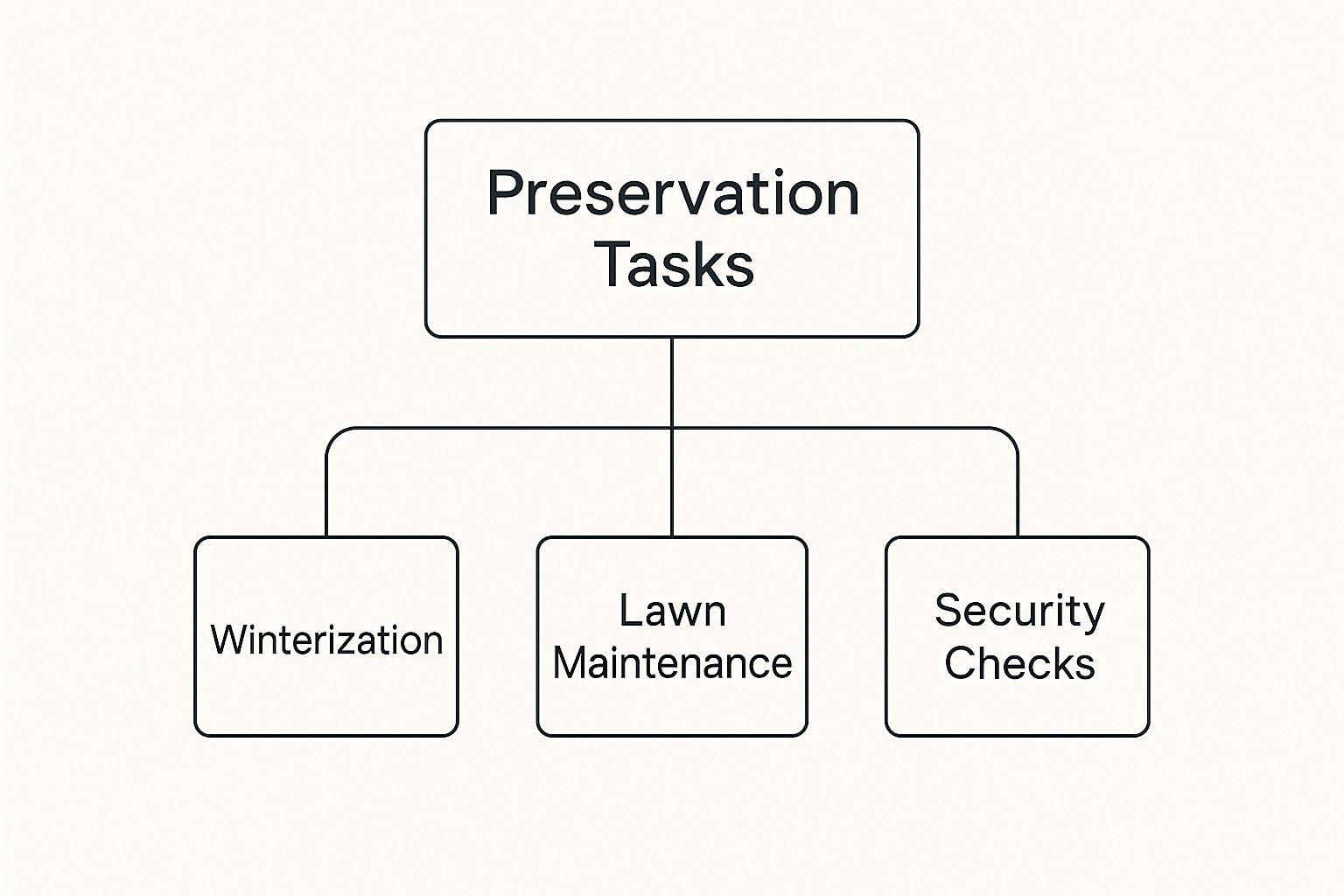
As you can see, these tasks work together, forming a comprehensive strategy that protects a property from every angle.
3. Seasonal Readiness
Monterey County’s unique climate demands the third pillar: seasonal readiness. What protects a home in the summer won't work during our wet, chilly winters. Likewise, the fire risk in inland areas like Carmel Valley requires a different set of preparations than managing salt air corrosion in Carmel-by-the-Sea.
Getting a property ready for the season involves these key actions:
- Winterization: This means protecting pipes from freezing, ensuring proper drainage to prevent water pooling, and checking roofs for potential leaks before the winter rains hit.
- Fire Season Preparation: For properties in high-risk zones, we clear defensible space to meet local fire codes. This is crucial for homes in Carmel Valley or the Santa Lucia Highlands.
- Coastal Care: Along the coast, we inspect for and treat salt air corrosion on metal fixtures and windows to keep them in top shape and protect your investment from the elements.
4. Local Code Compliance
Finally, the fourth pillar is ensuring strict local code compliance. Every city, from Salinas to Monterey to Gonzales, has its own set of ordinances governing property maintenance. A violation for something as simple as an overgrown lawn can lead to fines that quickly add up.
A professional preservation plan means staying current on all municipal codes and HOA regulations. This ensures your property never becomes a nuisance to neighbors or a target for city inspectors, protecting you from legal headaches and financial penalties.
How Preservation Protects Your Bottom Line
For the owner of a high-end property, property preservation isn't an expense—it's a direct investment in your ROI. Proactive care is the most effective way to guard against the costly threats that vacant properties face. Every dollar you put toward preservation defends your asset from much larger costs down the road.
Imagine a beautiful, empty home in Pacific Grove. A minor, undetected plumbing leak can quietly escalate into a five-figure nightmare of water damage, structural rot, and mold. A small monthly investment in regular inspections could have caught that leak early, saving you tens of thousands of dollars and months of stress.
Preventing Costly Damage and Fines
Here’s exactly how a preservation plan protects your finances:
- Avoiding Municipal Fines: Cities like Salinas and Monterey have strict codes for property upkeep. An overgrown lawn or piled-up debris can lead to hefty fines. Preservation keeps your property compliant, saving you from needless expenses.
- Maintaining Curb Appeal & Value: A well-maintained exterior protects your property's market value. It signals to the neighborhood and potential buyers that the asset is cared for, preventing the perception of neglect that can lower its price.
- Enhancing Marketability: A preserved property is always show-ready. This eliminates costly delays for last-minute repairs, allowing you to secure a high-quality tenant or buyer much faster and maximizing your rental income.
A Smart Financial Decision
Ultimately, property preservation is a strategic financial move. It's about acknowledging that consistent, professional oversight is far more cost-effective than dealing with emergency repairs and penalties.

It’s about making sure your property is always generating its maximum potential value. Industry reports show that specialized preservation vendors earn payments from $200 to over $1,000 for individual tasks like securing a property or winterizing it, which highlights just how valuable this preventive work truly is.
Of course, even with the best plan, unexpected things can happen. Knowing how to file a property damage claim effectively is a vital skill. This knowledge works hand-in-hand with preservation efforts, providing a complete shield for your valuable asset.
Investing in preservation isn't just about maintaining what you have; it’s about safeguarding its future value and ensuring your financial goals are met without costly surprises. It’s the smart, disciplined approach to protecting a premier Monterey County property.
Meeting Monterey County’s Unique Challenges
A property preservation plan that works in a dry, inland city won't work on the California coast. Monterey County has a unique mix of environmental and regulatory challenges that demand real, local expertise. A generic checklist is a recipe for disaster here.
Protecting an investment in this area means knowing the specific threats and local rules that change from one town to the next. From the corrosive salt air in Pebble Beach to the fire-prone hills of Carmel Valley, every community requires a tailored approach.
Coastal vs. Inland Environmental Factors
The climate around Monterey Bay is a huge factor in property preservation. Along the coast, properties are in a constant fight with moisture and salt.
That persistent coastal fog and salty air will speed up the corrosion of metal fixtures, damage window frames, and compromise exterior paint. Proactive preservation means regular, targeted inspections for the first signs of rust and decay, followed by specialized treatments.
Head inland to places like Salinas or the South County towns, and you're facing different challenges. The hot, dry summers increase fire risk, making defensible space management an absolute must. This isn't just about appearances; it's about clearing dry brush and trimming trees to meet strict local fire codes, protecting the property and keeping your insurance policy valid.
Navigating Local Rules and HOAs
Beyond the weather, Monterey County is known for its strict local regulations. Each city, from Soledad to Pacific Grove, has its own set of ordinances for property maintenance. A vacant property with an overgrown lawn can start racking up expensive fines fast.
On top of that, many of the area's most desirable communities are governed by Homeowners Associations (HOAs), each with its own detailed rules. Staying on the right side of these requirements demands a manager who knows the specific rules of each community, ensuring your property remains in perfect compliance.
This becomes especially critical when a property is vacant after a difficult situation, like an eviction. For a complete rundown of that legal process, you can check out our guide on the eviction process in California.
A Hyper-Local Preservation Checklist
An effective preservation strategy must be tailored to the property’s exact zip code. To show you what we mean, here’s how critical tasks differ across the county. This is where local knowledge from a firm like Coast & Valley makes a real difference in protecting your ROI.
| Regional Concern | Critical Preservation Task | Why It Matters for Your Monterey County Property |
|---|---|---|
| Coastal Corrosion (Pebble Beach, Carmel) | Inspect and treat metal fixtures, window frames, and hardware for salt air damage. | Prevents premature failure of expensive components and protects the home's luxury finish and structural integrity. |
| Wildfire Risk (Carmel Valley, inland areas) | Maintain defensible space by clearing dry vegetation and trimming trees per local fire codes. | Reduces the risk of property damage during fire season and ensures compliance with insurance and local laws. |
| Agricultural Properties (Salinas, King City) | Secure outbuildings, manage land to prevent overgrowth, and ensure water systems are properly maintained or winterized. | Protects valuable farm equipment and infrastructure, prevents code violations, and maintains the land’s value for future use or sale. |
| Strict HOA Rules (various communities) | Conduct regular exterior reviews to ensure landscaping, paint, and overall appearance meet specific HOA standards. | Avoids costly fines and legal disputes with the HOA board, maintaining the property’s good standing in the community. |
As you can see, what’s critical in Carmel Valley might be a low priority in Pacific Grove. Understanding these local nuances is the key to truly protecting your asset.
Our Approach to Guarding Your Property

Handing over the keys to a high-value property requires absolute trust. At Coast & Valley, we understand that. Our approach to property preservation is built on a foundation of transparency, professionalism, and deep local expertise.
We’re not just managing properties; we’re protecting your most valuable assets. This means clear, consistent communication and the kind of on-the-ground knowledge that only comes from being part of the Salinas and Monterey County community for generations.
For a busy owner, knowing your investment is secure without having to be there is everything. That’s why we provide detailed digital reports, complete with photos and notes, after every single inspection. It’s like having a direct, real-time window into your property’s condition, no matter where you are. Peace of mind delivered right to your inbox.
Communication and Transparency in Action
You should never have to guess what’s happening with your property. Our commitment to transparency is a system designed to keep you informed and in control.
- Owner Portal Access: You get secure, 24/7 access to all your property-related documents, from financial statements to inspection reports.
- Detailed Digital Reports: After each visit, we upload comprehensive reports filled with high-resolution photos. You see what we see, providing clear visual confirmation of your property's upkeep.
- Proactive Updates: We spot potential issues and notify you immediately with a clear, actionable plan to resolve them before they become bigger problems, saving you time and money.
This level of communication is non-negotiable for us. It’s a crucial factor to weigh as you explore how to choose a property management company that truly has your back.
Rapid Response and Vetted Professionals
Problems don’t follow a 9-to-5 schedule. A burst pipe during a winter storm in Salinas or a security issue at a vacant Carmel home requires immediate action. Our rapid-response protocols are built for these moments.
We have a trusted, on-call network of vetted local professionals right here in Monterey County. From plumbers to security specialists, they’re ready to go at a moment's notice.
This proactive stance is a global standard for protecting property value. Across the world, lenders and owners use preservation services to comply with local ordinances that require vacant properties to be maintained. This prevents safety hazards and upholds community standards.
Led by Amy Salmina’s fourth-generation Salinas roots and deep community ties, our team offers more than just management—we provide the dedicated guardianship your investment deserves.
We blend time-tested methods with modern tools to deliver an unmatched level of care. Staying informed about innovative solutions like those from Top Drone Inspection Services allows us to bring a modern, proactive approach to property oversight.
Your property is a significant asset. Let us show you how our professional, transparent approach can protect its value. Contact us to evaluate your property management needs.
Common Questions About Property Preservation
Investing in high-end real estate in Monterey County comes with questions. When it comes to protecting a vacant property, owners deserve clarity and confidence. Here are straightforward answers to the questions we hear most often from investors.
How Much Do Preservation Services Cost?
The honest answer is: it depends. The cost is always tailored to the specific needs of your property. A preservation plan for a sprawling agricultural property in King City will be different from one for a luxury vacation home in Pebble Beach.
The final price is tied to the scope of work required. The main factors that influence cost include:
- Property Size and Type: A large estate requires more oversight than a single-family home.
- Frequency of Inspections: Whether we’re on-site weekly or bi-weekly will affect the cost.
- Specific Tasks Needed: Add-on services like seasonal winterization, extensive landscaping, or pool maintenance will be itemized in your plan.
It’s crucial to see these costs not as an expense, but as an investment in protecting your asset’s value. Proactive care is always more affordable than emergency repairs, damages, or city fines. Plus, many preservation expenses can be written off. You can learn more by reading our overview of common tax deductions for landlords.
Is This Only for Foreclosed Properties?
Not at all. While "property preservation" is a common term in the foreclosure industry, the services are essential for any vacant high-value property. Smart investors use these services to protect their assets during transitional periods.
A property is most vulnerable when it's empty, no matter the reason. This could be:
- Between long-term tenants.
- While waiting for a sale to close.
- During a renovation project.
- For a second home in Carmel that is only used seasonally.
The goal is always the same: to maintain the property's condition, security, and value until it’s occupied again.
What Happens in an Emergency?
A solid preservation plan always includes a clear protocol for emergencies. Whether it’s a burst pipe during a winter storm in Salinas or a security alarm triggered in Monterey, a fast, professional response is what matters most.
Our professional management team acts as your 24/7 on-call representative. With our network of vetted local vendors, we can dispatch the right expert—a plumber, an electrician, a security team—immediately to contain the situation and prevent further damage.
This rapid-response system is a core part of the peace of mind that professional preservation provides. You have a local team ready to act on your behalf, protecting your investment at a moment’s notice. Every step is documented with photos and detailed reports, so you’re always kept in the loop.
Protecting a valuable asset requires proactive, professional guardianship. Coast and Valley Properties offers the local expertise and transparent communication you need to ensure your Monterey County property is always secure and maintained to the highest standard. Contact us today to discuss a personalized preservation plan for your investment.

Mastering Vendor Management: Best Practices for High-Value Monterey County Properties
For owners of high-end properties in Salinas, Monterey, and across the Bay Area, maximizing returns is not just about collecting rent. It's about preserving asset value through meticulous, proactive care. A crucial, yet often overlooked, component of this strategy is sophisticated vendor management. The quality of your landscapers, plumbers, roofers, and electricians directly impacts tenant satisfaction, long-term maintenance costs, and ultimately, your property's prestige and market value. Poor vendor selection can lead to subpar work, safety liabilities, and costly rework, eroding your investment from the inside out.
This guide moves beyond generic advice to offer actionable vendor management best practices tailored specifically for the discerning property investor in communities from Pebble Beach to King City. We'll detail the precise strategies required to build and maintain a network of elite, reliable, and professional service providers. To gain a broader perspective and delve deeper into established frameworks, you might find valuable insights in a comprehensive guide to vendor management best practices which complements our localized approach.
Below, we will explore nine critical pillars of effective vendor oversight, from strategic selection and robust contract governance to risk mitigation and technology integration. You will learn how Coast & Valley Properties, led by local expert Amy Salmina, leverages these principles to provide a concierge-level experience, ensuring every service partner who steps onto your property meets the highest standards. Our goal is simple: to transform vendor management from a reactive necessity into a proactive strategy that safeguards your valuable asset, enhances tenant relations, and maximizes your return on investment for years to come.
1. Strategic Vendor Assessment and Selection: Building a Roster of Excellence for Your Monterey County Property
The foundation of exceptional property management rests upon the quality of its partners. One of the most critical vendor management best practices is moving beyond reactive hiring and implementing a rigorous, strategic selection process. For a luxury property in Carmel or a multi-unit complex in Salinas, you cannot afford to base a decision on a quick online search. This foundational step is about proactively building a roster of pre-vetted, elite local professionals.
This process involves creating a detailed scope of work for any potential job, conducting thorough due diligence that extends far beyond online reviews, and verifying credentials specific to Monterey County regulations. We treat this as assembling a trusted team, evaluating potential partners on criteria like their local reputation, proof of adequate insurance coverage, proper licensing, and specific experience with the high-end finishes and materials common in premier local properties. When strategically assessing and selecting vendors, a deep understanding of services like Contact Center Outsourcing can be crucial for building a roster of excellence.
Actionable Steps for a Strategic Vetting Process
A proactive approach minimizes risk and guarantees a level of service that aligns with the expectations of discerning tenants and protects the integrity of your investment.
- Step 1: Define Your Needs. For a Pebble Beach property, specify the need for a landscape architect specializing in drought-tolerant, coastal-native plants to enhance curb appeal while adhering to local water conservation mandates.
- Step 2: Conduct Due Diligence. For a Salinas HVAC technician, verify certifications for high-efficiency systems common in newer luxury constructions to ensure optimal performance and energy savings.
- Step 3: Check Local Expertise. When onboarding a King City roofing contractor, confirm they have a proven track record of working with historic tile materials, ensuring compliance and historic preservation.
The following infographic illustrates our disciplined, three-step process for vendor assessment.
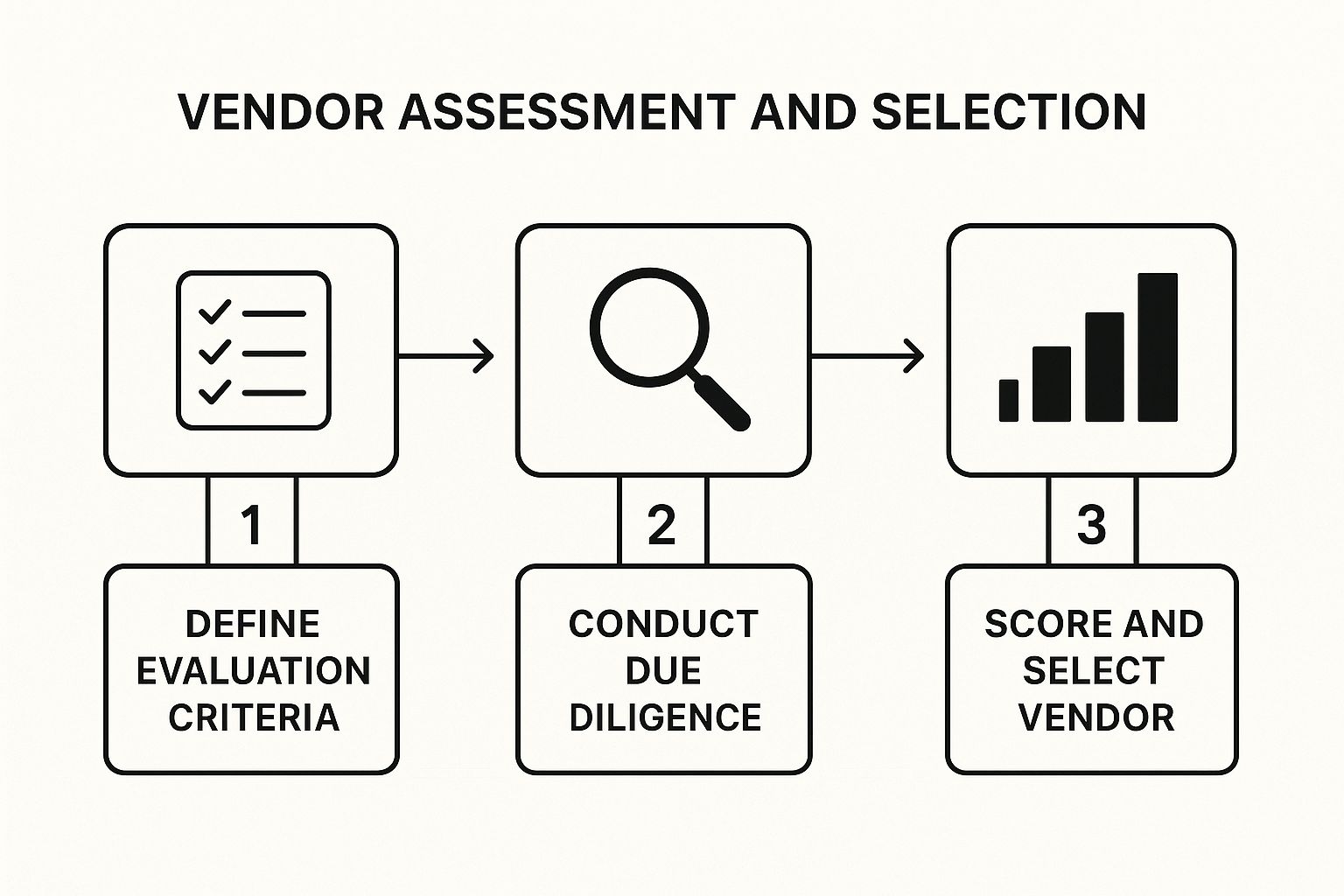
This structured workflow ensures that every vendor is evaluated objectively against consistent standards, removing guesswork and guaranteeing quality. By establishing a pre-vetted list of top-tier local vendors, from Soledad to Pacific Grove, we ensure that when a need arises, we dispatch a proven professional, not a gamble.
2. Robust Contract Management and Governance
Once an elite vendor is selected, the relationship must be defined and protected through meticulous contract management. A handshake agreement or a basic invoice is insufficient for protecting high-value assets in Monterey County. One of the most critical vendor management best practices is implementing a systematic approach to managing vendor contracts throughout their entire lifecycle. This process ensures clarity, enforces accountability, and mitigates risk for everything from routine maintenance in Salinas to a major renovation in Pebble Beach.
This practice involves establishing crystal-clear terms, detailed Service Level Agreements (SLAs), compliance requirements, and governance structures. It ensures both parties fully understand and meet their obligations. A well-structured contract, designed to be both firm and flexible, is the operational blueprint for a successful partnership. It protects your investment by defining expectations around quality, timelines, and costs, preventing misunderstandings before they can begin. For a deeper understanding of the legal frameworks involved, our guide on the property management contract in California offers valuable insights.

A Checklist for a Structured Contract Lifecycle
A proactive and organized approach to contract governance minimizes disputes and ensures that the services delivered consistently meet the high standards expected for premier local properties.
- Monterey Example: A janitorial services contract for a commercial building includes an SLA specifying cleaning frequencies, approved chemical usage, and a 2-hour response time for emergency cleanups, with financial penalties for non-compliance.
- Soledad Example: A contract with a security provider for a multi-unit complex clearly outlines patrol schedules, incident reporting protocols, and data privacy clauses related to surveillance footage, ensuring full legal and tenant compliance.
- Carmel-by-the-Sea Example: An agreement for a historic property renovation includes clauses for regular review checkpoints, allowing for adjustments based on unforeseen structural discoveries while keeping the project on budget and timeline.
By managing vendor relationships through robust and detailed contracts, we transform a simple service agreement into a powerful tool for quality control and risk management. This disciplined governance ensures every dollar spent enhances your property's value and protects your long-term ROI.
3. Continuous Performance Monitoring and KPI Tracking
The initial vetting process is only the beginning of a successful partnership. A core component of modern vendor management best practices is the ongoing measurement and evaluation of vendor performance against predefined metrics. For high-value properties from Marina to Gonzales, simply trusting that a job was done is not enough; you need data-driven assurance that it was done to the highest standard, on time, and within budget. This is where continuous performance monitoring and Key Performance Indicator (KPI) tracking become indispensable.
This proactive approach involves implementing clear dashboards, regular reporting, and structured performance reviews to ensure vendors consistently meet or exceed expectations. It transforms the vendor relationship from a transactional one into a strategic partnership focused on mutual improvement and accountability. For premium property owners, this means every dollar spent on maintenance or repairs is maximized, protecting both the asset's integrity and its return on investment. This data-driven oversight is crucial, and it's a cornerstone of the transparent service Coast & Valley provides.
Actionable KPIs for Your Vendor Framework
An effective monitoring system eliminates ambiguity and empowers data-backed decisions, ensuring that only the top-performing local vendors are retained for your property.
- KPI for a Monterey Multi-Unit: Track a plumbing vendor's average response time for emergency calls, ensuring it stays below the 60-minute KPI to minimize tenant disruption and potential water damage.
- KPI for a Carmel-by-the-Sea Luxury Rental: Monitor a high-end cleaning service's tenant satisfaction scores after each turnover, ensuring they consistently achieve a 95% or higher rating to maintain the property’s luxury appeal and drive positive reviews.
- KPI for a Soledad Commercial Property: Review a landscaping contractor's quarterly performance against budget and work completion timelines, identifying efficiency gains and ensuring adherence to the agreed-upon maintenance schedule.
By establishing and tracking these key performance indicators, we ensure every vendor servicing your Monterey County property is held to the same exacting standards of excellence we set for ourselves. This continuous feedback loop not only guarantees consistent quality but also fosters a culture of accountability and continuous improvement among our partners.
4. Risk Assessment and Mitigation Planning: Protecting Your Monterey County Asset
Engaging a third-party vendor, whether a plumber in Pacific Grove or a security firm in Salinas, introduces inherent risks to your property. A crucial component of vendor management best practices is moving from a reactive to a proactive risk management stance. This involves a systematic approach to identifying, evaluating, and mitigating potential liabilities associated with every vendor relationship, safeguarding your investment and ensuring operational continuity.
This process is about more than just checking for insurance; it’s a comprehensive evaluation of financial, operational, and reputational risks. For high-value properties in Monterey County, this means analyzing a vendor's financial stability to prevent project abandonment, assessing their operational protocols to ensure they align with your standards, and developing contingency plans for any potential service disruption. This disciplined approach protects your asset from vendor-related failures and demonstrates a commitment to professional oversight that busy investors value.
A Proactive Risk Mitigation Checklist
A structured risk assessment process minimizes unforeseen disruptions and protects the value and safety of your Monterey County property, ensuring every partner enhances, rather than endangers, your investment.
- Financial Risk (Carmel): For a high-end renovation, conduct a financial health check on the primary contractor to ensure they have the stability to complete the project, preventing costly delays and liens against the property.
- Operational Risk (Soledad): Establish a relationship with a pre-vetted secondary HVAC vendor as a backup for a multi-unit apartment complex, ensuring that a primary vendor’s scheduling issue doesn't leave tenants without heat or air conditioning during a cold snap.
- Compliance Risk (Monterey): Require a cybersecurity assessment for a new smart-home technology installer to ensure their systems and protocols protect resident data and prevent unauthorized access to integrated building controls.
By systematically identifying potential points of failure before they occur, we transform vendor management from a simple administrative task into a strategic asset protection function. This foresight ensures that from King City to Pebble Beach, your property is managed with an uncompromising commitment to security and operational excellence.
5. Strategic Relationship Building and Communication
Beyond transactional interactions, one of the most impactful vendor management best practices is to cultivate strategic, long-term partnerships. For a high-value portfolio spanning from Carmel Valley to Gonzales, treating vendors as mere suppliers is a missed opportunity. Instead, we view our key partners, from master plumbers to specialized landscapers, as extensions of our team. This approach transforms a simple service call into a collaborative effort aimed at preserving and enhancing your property's value.
This philosophy involves moving beyond operational check-ins to foster genuine professional relationships built on mutual trust and open dialogue. It’s about understanding their business just as they understand the unique demands of your luxury property. Our approach to vendor relationships aligns closely with the broader principles of strategic partnership management, emphasizing long-term value over transactional exchanges. This proactive communication ensures our partners are aligned with our high standards and your investment goals.

Actionable Steps to Foster Collaborative Vendor Partnerships
By investing in these relationships, we create a network of allies dedicated to the success of your Monterey County property, leading to better service, innovative solutions, and priority scheduling. Effective property management communication is the cornerstone of this strategy.
- Hold Quarterly Reviews (Carmel-by-the-Sea): We conduct quarterly reviews with a preferred high-end appliance technician to discuss preventative maintenance schedules for Sub-Zero and Wolf appliances, preventing costly failures in luxury rental properties and saving owners time and money.
- Involve in Planning (Soledad): By involving a trusted local roofer in our annual property planning, we proactively identified a minor issue on a multi-unit building that, if left unaddressed, would have led to major water damage during the winter rainy season. This preventive care protects the property's structure and value.
- Recognize Excellence (Monterey): We publicly recognize an exceptional cleaning service that consistently receives five-star reviews from tenants, reinforcing their value and motivating continued excellence. This builds loyalty and ensures your property is always presented in the best light.
This collaborative approach ensures that every professional who sets foot on your property is not just qualified but also deeply invested in its long-term success. It replaces a reactive, transactional model with a proactive partnership that protects and elevates your real estate asset.
6. Centralized Vendor Management Office (VMO): Scaling Excellence Across Your Portfolio
As your property portfolio grows from a single luxury home in Monterey to multiple units across South County, managing vendor relationships can become fragmented and inefficient. One of the most sophisticated vendor management best practices is to implement a Centralized Vendor Management Office (VMO) model. This dedicated function acts as a command center, overseeing all vendor relationships, standardizing processes, and ensuring consistent, high-quality service delivery across every property, from Salinas to Soledad.
A VMO structure moves beyond individual vendor selection to create a strategic, portfolio-wide ecosystem of partners. It provides a single point of governance, coordination, and expertise, ensuring that every vendor meets our stringent standards for insurance, licensing, and performance. This centralized approach is crucial for maintaining brand consistency, mitigating risks, and leveraging economies of scale for our clients' benefit. For high-net-worth investors, a VMO guarantees that the same level of white-glove service is applied whether we are coordinating a plumbing repair in King City or a landscape redesign in Carmel.
Real-World Benefits of a Centralized VMO Model
This strategic function ensures that every decision is data-driven, compliant, and aligned with your long-term investment goals, providing unparalleled peace of mind and operational excellence.
- For the Multi-Unit Investor: A VMO negotiates a master service agreement with a preferred plumbing company for a portfolio of 15 properties in Salinas, securing priority service and a 10% volume discount on all work orders, directly increasing ROI.
- For the Absentee Owner in Pebble Beach: The VMO team manages the annual contract renewals for landscaping, pool maintenance, and security services, ensuring all providers maintain up-to-date insurance and local certifications, protecting the owner from liability.
- For the Commercial Property in Monterey: A VMO coordinates a complex roof replacement by managing the bidding process with three pre-vetted, VMO-approved roofing contractors, ensuring transparent pricing and adherence to a strict project timeline.
By establishing a VMO, we ensure that every vendor interaction is managed with the same level of professionalism and diligence. This structure transforms vendor management from a series of individual transactions into a cohesive, strategic asset that protects and enhances the value of your Monterey County properties.
7. Technology-Enabled Vendor Management Platforms
In today's fast-paced property management environment, relying on manual spreadsheets and disconnected communication channels is no longer sufficient. One of the most impactful vendor management best practices is leveraging technology through dedicated platforms. For managing a high-value portfolio, whether in Salinas or along the Monterey Bay coast, these integrated software solutions automate everything from onboarding and compliance tracking to work order dispatch and payment processing. This approach replaces administrative burdens with streamlined efficiency and data-driven oversight.
These platforms provide a single source of truth, offering unparalleled visibility into vendor performance, spending, and compliance status. By centralizing contracts, insurance documents, and communication logs, we create a transparent and auditable system that protects our clients' investments. For busy property owners in Monterey County, this means faster response times for maintenance issues, meticulous record-keeping, and the convenience of making informed decisions based on real-time performance data. We offer further insights in our detailed property management software comparison for those looking to understand the technology landscape better.
Actionable Uses of a Centralized Vendor Platform
A centralized platform transforms vendor management from a reactive, administrative task into a strategic, value-adding function, ensuring every interaction is efficient, compliant, and documented.
- Automated Compliance (Monterey): Utilize the platform to automatically flag a plumber whose liability insurance is set to expire, preventing a non-compliant vendor from being dispatched to a luxury condominium complex.
- Efficient Dispatch (Carmel-by-the-Sea): Dispatch an emergency repair request to three pre-vetted electricians simultaneously through a mobile app. The first to accept is automatically assigned the work order, dramatically reducing tenant wait times and protecting your property.
- Data-Driven Negotiations (Soledad): Generate a quarterly performance report from the platform to analyze a landscaping company's average response time and job completion ratings, providing concrete data for contract renewal negotiations.
By integrating robust technology, we ensure that managing vendors for properties across the region, from Pacific Grove to King City, is executed with precision, accountability, and the professional oversight our clients expect. This digital framework is fundamental to delivering a seamless, concierge-level management experience.
8. Vendor Diversity and Inclusion Programs: Strengthening Community and Expanding Excellence
A modern, forward-thinking approach to property management acknowledges that a strong business is built on a diverse foundation. Implementing a vendor diversity and inclusion program is a critical component of today's vendor management best practices. This strategic initiative involves intentionally creating procurement opportunities for diverse local suppliers, including businesses owned by minorities, women, veterans, and other underrepresented groups in Monterey County. For luxury properties from Carmel to Soledad, this is not just about social responsibility; it's about driving innovation and building a resilient, high-quality network of partners.
This practice enriches our local economy and brings fresh perspectives and competitive advantages. By actively seeking out and partnering with a broader range of certified local businesses, we tap into a wider pool of talent, ideas, and specialized skills. A diverse supply chain is inherently more robust, reducing risks associated with over-reliance on a few vendors. This approach aligns with the values of discerning property owners and tenants who appreciate community engagement and often results in finding highly dedicated partners who deliver exceptional service and ROI.
Actionable Ways to Implement a Vendor Diversity Initiative
A commitment to diversity expands our capabilities and ensures we are partnering with the very best professionals our region has to offer, regardless of their background.
- Partner with a Woman-Owned Marketing Firm (Monterey): Engage a local firm to create sophisticated leasing materials that resonate with the luxury rental market, bringing a unique and effective perspective to attract high-quality tenants.
- Engage a Veteran-Owned Security Company (Salinas): Contract a firm to provide services for a multi-unit complex, leveraging their specialized training and commitment to excellence to protect your asset and residents.
- Contract a Minority-Owned Landscaper (Gonzales): Choose a landscaping business known for innovative, sustainable agricultural-themed designs that reflect the heritage of the Salinas Valley, enhancing your property's unique appeal.
By setting measurable goals and partnering with organizations like the National Minority Supplier Development Council (NMSDC), we formalize our commitment to inclusion. Including diversity as a key criterion in our vendor selection process ensures we build a network that is not only highly skilled but also truly representative of the vibrant communities we serve throughout Monterey County.
9. Vendor Exit and Transition Management: Ensuring Seamless Continuity for Your Property
The end of a vendor relationship, whether planned or unexpected, is as critical to manage as its beginning. A poorly handled exit can lead to service disruptions, data loss, and operational chaos, directly impacting your property's value and tenant satisfaction. One of the most overlooked yet vital vendor management best practices is implementing a formal, structured process for vendor offboarding and service transition. For a luxury estate in Pebble Beach or a commercial property in Salinas, this proactive strategy ensures business continuity and protects your investment from preventable setbacks.
This process involves establishing clear exit protocols within the initial contract and executing a detailed transition plan as the relationship concludes. We manage every step, from the final service handover to knowledge transfer and data security, ensuring nothing falls through the cracks. This systematic approach transforms a potentially disruptive event into a smooth, controlled, and professional transition, whether migrating services to a new provider or bringing them in-house. It is about safeguarding the operational integrity of your Monterey County property at all times.
A 3-Step Checklist for a Structured Offboarding Process
A disciplined exit strategy mitigates risks associated with vendor changes and preserves institutional knowledge, protecting the long-term health of your asset.
- Step 1: Knowledge Transfer (Monterey): When transitioning from a long-term landscaping contractor, execute a plan to transfer all irrigation schedules, plant-specific care notes, and seasonal treatment plans to the new vendor, ensuring the grounds remain pristine without a single lapse in service.
- Step 2: Security Handoff (Soledad): For a multi-unit apartment complex changing its security patrol provider, oversee a coordinated transition that includes transferring site-specific protocols, revoking old access codes, and sharing incident history to guarantee uninterrupted security coverage for residents.
- Step 3: Asset Collection (Carmel-by-the-Sea): Upon completing a major renovation, our process ensures the formal handover of all warranties, architectural plans, and a comprehensive list of subcontractors, protecting the owner's long-term investment.
By formalizing the end of a vendor lifecycle, we ensure that every transition is a strategic step forward, not a logistical scramble. This meticulous approach maintains the high standards of service your tenants expect and provides the seamless operational excellence that high-value Monterey County properties demand.
Vendor Management Best Practices Comparison
| Practice | Implementation Complexity 🔄 | Resource Requirements ⚡ | Expected Outcomes 📊 | Ideal Use Cases 💡 | Key Advantages ⭐ |
|---|---|---|---|---|---|
| Strategic Vendor Assessment and Selection | High | Significant upfront investment | Reduced vendor risk, strategic alignment | Selecting optimal long-term vendors | Minimizes costly switches, improves partnerships |
| Robust Contract Management and Governance | Medium to High | Ongoing legal & admin resources | Legal protection, clear SLAs, cost control | Managing contract lifecycle, compliance | Facilitates dispute resolution, enforces SLAs |
| Continuous Performance Monitoring and KPI Tracking | Medium | Data collection & analysis | Proactive issue detection, data-driven decisions | Ongoing vendor performance management | Supports continuous improvement, negotiation leverage |
| Risk Assessment and Mitigation Planning | High | Specialized risk expertise | Reduced disruption, financial protection | Managing vendor-related financial, operational, cyber risks | Ensures business continuity, stakeholder confidence |
| Strategic Relationship Building and Communication | Medium | Time investment from leadership | Innovation, responsiveness, partnership value | Developing strategic vendor partnerships | Drives innovation, improves problem resolution |
| Centralized Vendor Management Office (VMO) | High | Significant organizational investment | Consistent management, optimized vendor portfolio | Enterprise-wide vendor governance | Provides expert oversight, improves compliance |
| Technology-Enabled Vendor Management Platforms | Medium to High | Upfront implementation & change mgmt | Process efficiency, visibility, data-driven decisions | Automating vendor lifecycle management | Reduces manual tasks, enhances control |
| Vendor Diversity and Inclusion Programs | Medium | Additional supplier development | Social responsibility, innovation, supply diversity | Expanding procurement to diverse suppliers | Reduces concentration risk, competitive pricing |
| Vendor Exit and Transition Management | Medium to High | Planning and coordination resources | Smooth transitions, asset protection | Terminating and transitioning vendor relationships | Minimizes disruption, captures lessons learned |
Elevate Your Property's Potential with Professional Vendor Management
Mastering the art and science of vendor management is not just an operational task; it's a strategic imperative that directly impacts your property's value, tenant satisfaction, and long-term return on investment. For discerning property owners in Salinas, Monterey, and across the Central Coast, the difference between an average and an exceptional asset often lies in the quality and oversight of its service partners. The journey from reactive problem-solving to proactive, strategic oversight requires a commitment to the vendor management best practices we've detailed, transforming your property into a well-oiled, high-performing investment.
Navigating this complex landscape involves a dynamic, continuous cycle. It begins with Strategic Vendor Assessment and Selection, ensuring every plumber, landscaper, and technician meets the exacting standards required for luxury properties in communities like Pebble Beach or Carmel. It extends through Robust Contract Management, where clear expectations and legal protections are codified, and is maintained via Continuous Performance Monitoring, using data-driven KPIs to guarantee excellence. This framework is the bedrock of professional property management.
Actionable Takeaways for High-End Property Owners
To truly elevate your property management strategy and protect your time, focus on these critical pillars:
- Proactive, Not Reactive: Shift from calling a vendor when something breaks to building a roster of vetted partners who perform preventative maintenance. For a high-end home in Pacific Grove, this means proactively servicing the HVAC system before the first heatwave, not reacting to a tenant's complaint.
- Relationships are ROI: A strong, communicative relationship with your vendors fosters loyalty and priority service. In a tight labor market like Monterey County, having a reliable contractor who will prioritize your call is invaluable and saves you from costly delays.
- Technology is Your Ally: Leverage platforms for centralized communication and risk mitigation. For busy professionals and absentee landlords, this digital access provides unparalleled transparency and peace of mind, ensuring you're always informed.
- Risk Management is Non-Negotiable: A single lapse in a vendor's insurance or a failure to adhere to safety protocols can create significant liability. A rigorous Risk Assessment and Mitigation plan protects your asset and your financial future.
Ultimately, implementing these vendor management best practices is an ongoing commitment. It requires local expertise, technological savvy, and a relentless dedication to quality. For investors with portfolios spanning from South County towns like King City to the coastal estates of the Monterey Bay, this level of detailed oversight is what separates a passive income stream from a source of constant stress.
By embracing a structured, professional approach to selecting, managing, and optimizing your vendor partnerships, you are not merely maintaining your property. You are actively enhancing its appeal, safeguarding its physical integrity, and maximizing its financial potential. This is the standard of care that every premium property deserves and the level of service that defines true white-glove management.
Ready to implement these vendor management best practices without adding to your workload? The team at Coast and Valley Properties has built a rigorously vetted network of top-tier local vendors and a technology-driven system to manage them, ensuring your Monterey County property receives the concierge-level care it deserves. Contact us today to learn how our proactive management approach can protect your investment and maximize your peace of mind.

What Is Cash Flow in Real Estate? A Guide for Monterey County Investors
For discerning real estate investors in Monterey County—whether you own a high-end home in Carmel or a portfolio of rentals in Salinas—long-term success is measured by more than just property appreciation. The true financial pulse of your investment is its cash flow.
In simplest terms, cash flow is the net amount of money moving into and out of your real estate investment. For property owners, it’s the cash left in your bank account after collecting all income and paying all expenses, including the mortgage. A positive cash flow is the foundation of a healthy, profitable asset.
The True Measure of Your Investment's Success

Think of cash flow as the lifeblood of your property. It’s the consistent, predictable income that builds sustainable wealth, covers an unexpected HVAC repair without causing panic, and provides the capital needed to acquire your next property. Mastering this metric is essential for achieving financial stability and genuine peace of mind as a property owner.
This isn't just a local concept; it's fundamental to sophisticated real estate investing globally. When you see transaction volumes rise, it's often a sign that investors are hunting for stable cash flow streams. In Q2 2025 alone, global commercial real estate deals reached $179 billion. The Americas accounted for $99 billion of that—an 18% jump from the previous year. You can explore more of these global investment trends at JLL.com.
Why Cash Flow Is Critical for Salinas & Monterey County Investors
For owners of premium properties in places like Pebble Beach, Pacific Grove, or the growing communities in South County like Soledad or King City, a firm grasp of cash flow translates directly to:
- Financial Stability & ROI: Your asset isn't just an entry on a balance sheet; it's actively paying for itself and generating returns you can use today.
- Portfolio Growth: Positive cash flow is the engine that funds your next acquisition, allowing you to expand your portfolio with confidence.
- Risk Mitigation: It serves as a crucial financial buffer against market downturns, seasonal vacancies common in our tourist-driven areas, or unexpected major repairs.
Here at Coast & Valley, our mission is to help you do more than just understand this metric. Our team, led by Salinas native Amy Salmina, provides the hands-on management and strategic insights needed to actively boost your property’s performance, transforming it from a passive asset into a dependable, high-performing income generator.
Calculating Cash Flow: A Step-By-Step Breakdown for Local Properties
Let's break down the numbers. Calculating cash flow for your Monterey County real estate investment isn't as intimidating as it sounds once you have a clear, repeatable process. For a high-end property in Carmel or a multi-family unit in Salinas, this calculation provides an unvarnished look at its financial health.
At its core, the formula is simple: total income minus total expenses. What’s left over is your cash flow.

This image illustrates the concept perfectly: rental income is your starting point. After you cover operating expenses and debt service, you discover if your investment is truly profitable on a monthly basis.
The Cash Flow Formula in Action
To get an accurate figure, you must account for every dollar. Here’s the detailed breakdown that savvy investors across the Monterey Bay Area use to analyze their properties.
Actionable Checklist for Calculating Your Cash Flow:
- Calculate Gross Potential Income (GPI): Determine the maximum potential annual rent if your property were 100% occupied.
- Example: $4,200/month x 12 months = $50,400
- Determine Effective Gross Income (EGI): Get realistic. Subtract an allowance for vacancy (we recommend a conservative 5-8% for the Salinas Valley market) and credit loss. Then, add any other income (e.g., pet fees, laundry, parking). This is your EGI.
- Calculate Net Operating Income (NOI): From your EGI, subtract all Operating Expenses. This is a critical category that includes property taxes, insurance, maintenance, repairs, utilities, landscaping, and professional property management fees. The result is your NOI, which shows the property’s profitability before loan payments. To dig deeper, explore our complete guide on what is Net Operating Income.
- Subtract Debt Service: The final step is what separates NOI from true cash flow. You must subtract your total debt service—the principal and interest you pay on your mortgage each month.
Cash Flow Before Tax (CFBT) = Net Operating Income (NOI) – Debt Service
This final number, your CFBT, is the actual cash that lands in your bank account from the investment. Confidently analyzing this metric is a non-negotiable skill for any owner looking to protect and grow their assets in our unique local market.
Real-World Example: A Single-Family Rental in Monterey County
To make this crystal clear, let's walk through an example for a hypothetical single-family rental property in Monterey County.
| Item | Monthly Amount | Annual Amount | Notes for Local Owners |
|---|---|---|---|
| Gross Potential Rent | $4,200 | $50,400 | Based on current market rates in desirable neighborhoods. |
| Less: Vacancy (5%) | ($210) | ($2,520) | A conservative estimate for a well-managed property. |
| Effective Gross Income (EGI) | $3,990 | $47,880 | Your realistic total income. |
| Less: Operating Expenses | |||
| Property Taxes | ($450) | ($5,400) | Varies by location (e.g., Mello-Roos in newer areas). |
| Insurance | ($125) | ($1,500) | Premiums can be higher in coastal or high-fire-risk zones. |
| Repairs & Maintenance (8%) | ($336) | ($4,032) | A realistic budget for preserving a high-end property. |
| Property Management (8%) | ($319) | ($3,830) | Fee for professional oversight, marketing, and tenant management. |
| Total Operating Expenses | ($1,230) | ($14,762) | |
| Net Operating Income (NOI) | $2,760 | $33,118 | The property's profit before the mortgage. |
| Less: Debt Service (Mortgage) | ($2,200) | ($26,400) | Your principal and interest payment. |
| Cash Flow Before Tax (CFBT) | $560 | $6,718 | The actual cash deposited into your account. |
As you can see, even after all expenses and the mortgage payment, this property generates $560 in positive cash flow each month. This is the real return that you, the owner, get to keep, save, or reinvest.
Why Positive Cash Flow Is Your Financial Foundation

We've just walked through how to calculate your cash flow. Now, let's focus on why achieving a positive result is the bedrock of a sophisticated investment strategy. For discerning property owners across Monterey County—from the agricultural heart of Gonzales to the coastal elegance of Pebble Beach—positive cash flow is far more than just profit. It's about building financial resilience and independence.
It is the ultimate safety net for your property. It's the reliable stream of income that covers your mortgage, property taxes, and operating expenses, even during seasonal lulls in tourism-heavy areas like Monterey or unexpected vacancies. This makes the difference between effortlessly funding a new roof for your Salinas rental and scrambling to cover the cost.
Building Wealth and Peace of Mind
Ultimately, consistent positive cash flow is the engine that drives true financial independence. It provides the stability and peace of mind every high-end property owner deserves, ensuring your investment is truly working for you.
This monthly surplus delivers three core benefits for a serious investor:
- A Financial Cushion: It acts as a shock absorber for large, unexpected repairs, protecting your personal finances from taking a hit.
- The Seed for Growth: This is the capital you will use to confidently acquire your next property and expand your portfolio.
- The Mark of a Healthy Asset: It is definitive proof that your property is self-sustaining and profitable—a key indicator of a sound, well-managed investment.
Positive cash flow transforms a property from a static asset into a dynamic income generator. It's the most direct path to reducing risk and building sustainable wealth in real estate.
Securing this foundation always begins with placing high-quality tenants. Learning how to find good tenants is a non-negotiable first step to minimizing vacancies and ensuring rent is collected on time. From there, professional oversight ensures all pieces work in harmony to achieve lasting success.
What Really Drives Your Property's Cash Flow?
Your property’s cash flow isn’t a number you calculate once and forget. It’s a dynamic metric, constantly influenced by a mix of local and macroeconomic forces. For any serious investor in Monterey County, understanding what makes those numbers move is as important as the calculation itself.
This is where local expertise provides a distinct advantage. In coastal communities like Monterey and Pacific Grove, the rhythm of seasonal tourism and the academic calendar can significantly impact rental income. In the agricultural hubs of South County, like Soledad or King City, the health of the ag industry directly affects tenant stability and rental demand.
Local and Economic Pressures You Can't Ignore
While the location and condition of your property are foundational, external pressures can reshape your financial outlook.
Here are the key drivers to watch:
- Property Condition and Location: A meticulously maintained home in a desirable Salinas neighborhood like Maple Park will command higher rent and lower vacancy than a neglected property in a less sought-after area.
- Rental Market Demand: The robust job market in agriculture and hospitality, coupled with the high quality of life, continually draws people to the Monterey Bay Area, bolstering rental demand.
- Operating Expenses: These are the silent killers of cash flow. Unforeseen jumps in property taxes, insurance premiums (especially in high-fire-risk zones), or utility costs can erode your net income if not managed vigilantly.
- Financing Conditions: Interest rates have a direct impact on your bottom line. A shift in rates can alter your mortgage payment—almost always your largest single expense.
The interplay between these factors is critical. A single change—like a sudden spike in insurance rates after a wildfire season or a new major employer opening in Gonzales—can dramatically alter your property's profitability.
Historically, real estate cash flow has been tied to the world of finance. As traditional banks have recently become more cautious, private lenders have stepped in to fill a massive financing gap—an estimated $150 billion annually. For investors, this shift can mean stricter loan terms and higher interest rates, which directly squeezes cash flow.
You can explore these trends in a recent global private markets report. This underscores the importance of having expert guidance to navigate both hyper-local market dynamics and broader economic shifts to protect your ROI.
Proven Strategies to Increase Your Real Estate Cash Flow
Understanding cash flow is one thing; actively improving it is where savvy investors create wealth. At Coast & Valley, we implement a playbook of practical, localized strategies to boost your net income and enhance your property's long-term value.
Optimizing cash flow boils down to two core actions: increasing revenue and decreasing expenses. Executing this effectively requires a deep understanding of the Monterey County market and a proactive management approach.
Actionable Tip #1: Boost Revenue and Minimize Vacancy
The most direct path to better cash flow is increasing your property's gross income. This is about more than just raising the rent; it's about creating value that justifies a premium price and keeps your property occupied.
- Strategic Upgrades with High ROI: Focus on renovations that tenants in Monterey County value, such as modern kitchens, updated bathrooms, energy-efficient appliances, or drought-tolerant landscaping. We help you pinpoint investments that deliver the best rental income boost.
- Proactive Tenant Retention: A vacant property is a cash flow killer. Our concierge-level service and rapid responsiveness to maintenance requests make good tenants feel valued and want to stay, drastically reducing turnover costs.
- Hyper-Local Rent Optimization: We conduct detailed market analyses to implement small, regular rent increases that align with real-time local demand, maximizing your income without alienating quality tenants. For more ideas, explore our guide on strategies for higher rental income.
Actionable Tip #2: Intelligently Reduce Operating Expenses
On the other side of the ledger, diligent cost control is essential. One powerful move is to periodically review and explore strategies to lower your mortgage payment, as it is typically your largest expense. Broader financial trends also matter. A recent industry survey found that 69% of participants expect capital to be more accessible in 2025. This could lead to better refinancing opportunities and lower debt service costs, directly improving your cash flow. You can delve deeper into this in the latest commercial real estate outlook from Deloitte.com.
At Coast & Valley, our professional oversight focuses on trimming expenses without compromising quality. We leverage our network of vetted local vendors for competitive pricing and implement preventive maintenance plans to stop small issues from becoming budget-breaking emergencies.
Partner With Coast & Valley to Maximize Your Returns
Knowing what is cash flow in real estate is the first step, but optimizing it is where true value is created. For serious investors with high-end properties in the Monterey Bay Area, achieving peak performance requires genuine local insight, proactive management, and uncompromising professionalism. It's about strategic financial stewardship that protects and grows your investment for the long term.
At Coast & Valley, we treat your portfolio with the care and diligence as if it were our own. Led by fourth-generation Salinas native Amy Salmina, our team’s deep community roots and professional certifications give us an undeniable edge. We combine that local expertise with industry-leading technology to safeguard your asset and maximize its return.
We analyze every detail that impacts your bottom line, from negotiating superior vendor contracts to identifying smart, tax-efficient property improvements. In fact, understanding the complete financial picture is so vital that we always encourage owners to explore our guide on key tax deductions for landlords.
Our concierge-level service is built on a foundation of trust and transparency, ensuring you always have a clear, honest view of your property’s performance.
If you’re ready to unlock the full potential of your real estate investments, we invite you to contact our team. We can provide a professional evaluation of your property's cash flow potential and demonstrate the peace of mind that comes with having true local experts in your corner.
Got Questions About Real Estate Cash Flow?
It's one of the most important concepts for any investor to master. Here are a few of the most common questions we hear from property owners around the Monterey Bay area, along with our straightforward answers.
Is Negative Cash Flow Always a Bad Sign?
Not necessarily, but it is a high-risk strategy that requires significant capital reserves. Some investors in high-appreciation markets like Carmel or Pebble Beach might tolerate temporary negative cash flow. They are betting that rapid property value appreciation will deliver a large return upon selling.
For most investors, especially those focused on building long-term wealth in areas like Salinas or Gonzales, this is a dangerous path. Consistent positive cash flow is the primary goal because it provides reliable income and significantly lowers financial risk.
How Does a Property Manager Directly Increase Cash Flow?
A premier property manager acts as your ROI-optimization partner. Our team directly increases your cash flow by:
- Minimizing vacancy through sophisticated marketing and an efficient leasing process.
- Securing top-tier tenants who pay on time and care for your property, using our rigorous screening process.
- Reducing maintenance costs by leveraging our network of trusted, competitively priced local vendors.
- Setting optimal rental rates based on detailed, street-by-street analysis of your specific neighborhood, from South Salinas to the Monterey coast.
Each of these actions is a direct investment in your bottom line, increasing your returns while saving you time.
Key Takeaway: Profit is an accounting term that often includes non-cash deductions like depreciation. Cash flow is the actual money left in your bank account after all real-world expenses, including mortgage payments, are paid. Cash flow is the ultimate test of your property's financial viability.
For more in-depth answers, please explore our full list of frequently asked questions from local property owners.
Ready to transform your property’s performance? The team at Coast and Valley Properties provides the expert oversight and local knowledge needed to maximize your cash flow and protect your investment. Contact us today for a professional evaluation of your portfolio. https://coastandvalleypm.com

What Is Cap Rate in Real Estate? A Guide for Monterey County Investors
For any serious real estate investor eyeing opportunities in Monterey County, understanding key performance metrics isn't just helpful—it's essential for making smart, profitable decisions that protect and grow your portfolio. Among the most important of these is the Capitalization Rate, or as it's more commonly known, the Cap Rate.
Put simply, cap rate is a powerful tool for quickly gauging a property's potential profitability. It gives you a clear snapshot of its unleveraged annual return, allowing you to compare different assets on an even playing field. For the busy professional or serious investor, this metric cuts through the noise and gets straight to the heart of an asset's performance.
What Is Cap Rate, Really?

Think of a property's cap rate as its financial "miles per gallon." Just as MPG gives you a straightforward look at a car's fuel efficiency, a cap rate answers one crucial question for a high-end property owner: "What is my potential annual return on this property before my loan payments are factored in?"
It’s the expected rate of return based purely on the income a property is projected to generate. This single number is powerful because it lets you compare vastly different investment opportunities. Whether you're evaluating a luxury single-family rental in Pacific Grove, a multi-unit apartment building in Salinas, or a commercial space in Soledad, the cap rate standardizes your analysis and helps you compare apples to apples.
The Formula at Its Core
At its heart, the cap rate calculation is beautifully simple. It's the property's Net Operating Income (NOI) divided by its current market value or purchase price.
For example, if you're analyzing a commercial property in Salinas that generates $75,000 in Net Operating Income (NOI) and has a market value of $1,000,000, your cap rate would be 7.5% ($75,000 / $1,000,000). This figure is a cornerstone of any income-based approach to valuing property.
For the experienced investor, cap rate cuts right through the noise. It strips away financing details and focuses purely on the asset's operational performance. This helps you quickly see if a property, whether in a South County town like Soledad or King City, truly aligns with your portfolio goals and delivers the ROI you expect.
To break it down, here are the two main ingredients you'll need.
Cap Rate At A Glance: Key Components
| Component | What It Is | Why It Matters for Monterey Investors |
|---|---|---|
| Net Operating Income (NOI) | This is your total income from the property (like rent) minus all necessary operating expenses (property taxes, insurance, maintenance, management fees). It does not include mortgage payments. | NOI reflects the property's day-to-day profitability. A strong NOI in a market like Monterey shows the property can cover its own costs and generate positive cash flow—a key sign of a healthy asset. |
| Current Market Value | This is the price the property would likely sell for on the open market today, or the price you're paying for it. | This number is your denominator. A lower purchase price for the same NOI results in a higher, more attractive cap rate, signaling a better potential return on your capital. |
Understanding both pieces is key to using the cap rate formula effectively.
Mastering cap rate is fundamental for any effective property value analysis. It moves you past gut feelings and guides you toward a strategy built on solid data. By focusing on this core metric, you can better pinpoint assets that promise strong, sustainable returns in the unique and competitive Monterey Bay Area market. At Coast & Valley, we help our clients master these tools to make confident investment decisions that preserve their time and capital.
How To Calculate Cap Rate For Your Property
We've covered the theory. Now, let's get practical. For any Monterey County investor, the real power of cap rate is in its application. Calculating it is a straightforward process that will empower you to analyze any property’s performance with clarity and confidence.
The entire formula boils down to one critical number: your property’s Net Operating Income (NOI).
An accurate cap rate hinges entirely on precise financial data. This is where professional property management provides immense value. Meticulous record-keeping ensures every variable is accounted for, giving you the clarity needed for smart, strategic decisions that maximize your ROI.
A Step-by-Step Guide for Monterey County Investors
Follow these two actionable steps to calculate your property's cap rate:
-
Calculate Your Net Operating Income (NOI)
This is the engine of the entire formula. Start with your property's total potential annual income (all rent and other revenue). From that, subtract all annual operating expenses—property taxes, insurance, maintenance costs, vacancy loss, and professional management fees. Crucially, do not include mortgage payments (principal and interest). Cap rate is designed to measure the property's performance independently from your financing. For a deeper dive, explore our guide on what is Net Operating Income. -
Divide NOI by Property Value
Once you have your annual NOI, simply divide that number by the property’s current market value (or your purchase price). The result, expressed as a percentage, is your cap rate.
Cap Rate = Net Operating Income (NOI) ÷ Current Market Value
This is a great visual of the simple, three-part process for calculating your property's cap rate.
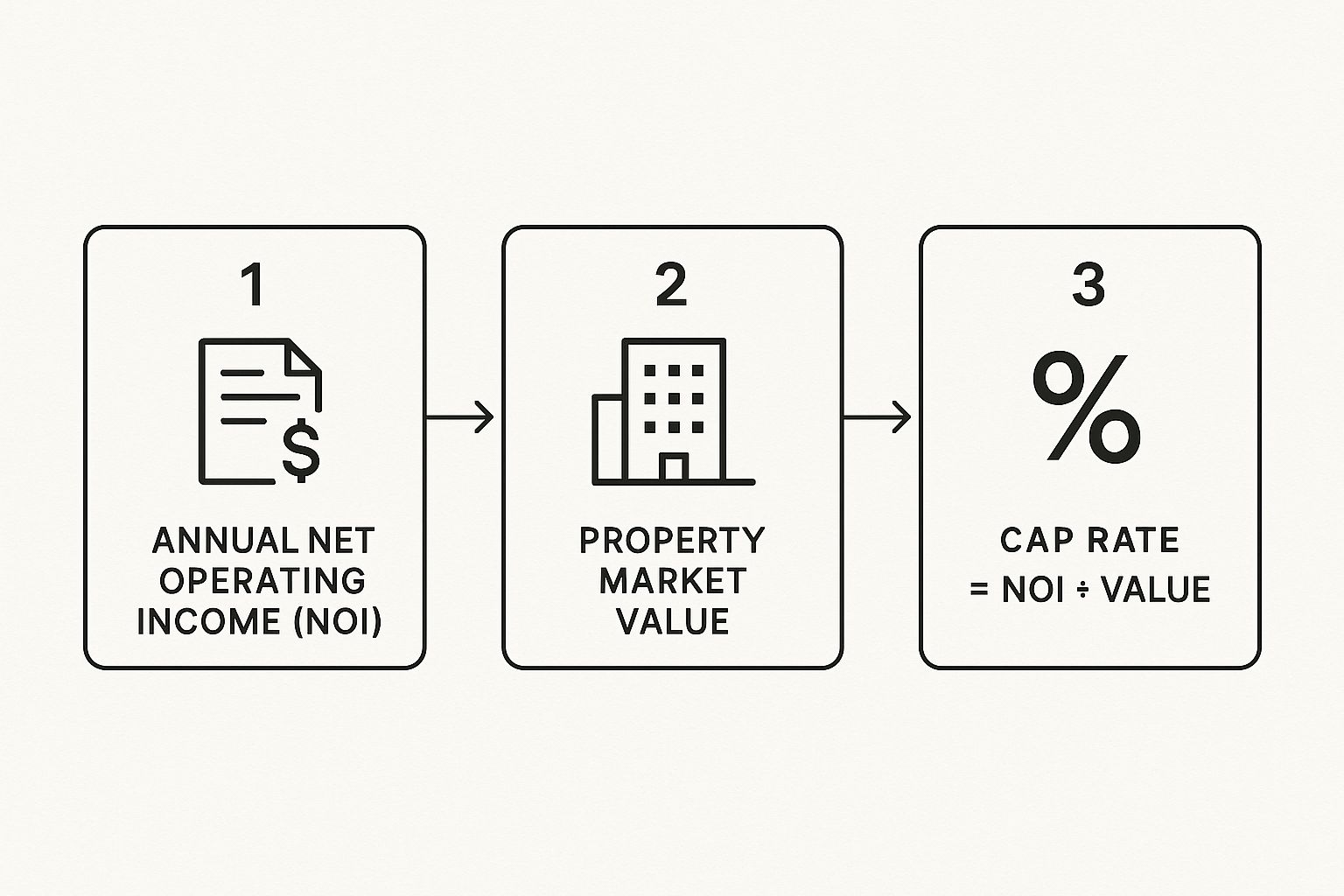
As the infographic shows, it all comes down to a precise NOI and an accurate property value. Nail those two inputs, and you've got this key performance metric locked down.
A Real-World South County Example
Let’s put this into action with a local scenario. Imagine you're considering a duplex in a South County community like Gonzales or Soledad.
- Property Value: $800,000
- Annual Gross Rent: $60,000 ($2,500/month for each unit)
- Annual Operating Expenses: $20,000 (covering taxes, insurance, maintenance, etc.)
First, we find the NOI:
$60,000 (Gross Rent) - $20,000 (Expenses) = $40,000 (NOI)
Now, we calculate the cap rate:
$40,000 (NOI) ÷ $800,000 (Value) = 0.05, or a 5.0% Cap Rate
That 5.0% figure provides a clean, unleveraged return metric. You can now use it to compare this property against other potential investments across the Monterey Bay Area, from Salinas to Pebble Beach.
To cement your understanding, it’s worth exploring this comprehensive guide on the Capitalization Rate Formula Real Estate: A Clear Guide For Investors. Mastering this calculation is a massive step toward making data-driven investment choices that build long-term wealth.
What Is A Good Cap Rate In The Monterey Bay Area?

It’s a question every investor asks: "What's a good cap rate?" The honest answer from a professional standpoint is that there's no single magic number. A "good" cap rate is determined by your investment strategy, risk tolerance, and the specific goals for your portfolio.
Think of cap rate as a barometer for market perception. A lower cap rate typically signifies a lower-risk, high-demand asset. These properties are often in premium locations and are valued for their stability and long-term appreciation potential.
Conversely, a higher cap rate often points to stronger immediate cash flow but may come with more perceived risk. You might find these in emerging neighborhoods or with properties requiring more hands-on management.
The Monterey County Spectrum: From Carmel to King City
This risk-versus-reward dynamic is on full display in our local market. Each community across Monterey County has its own unique investment profile, reflected in its typical cap rates.
- Lower Cap Rates (Higher Value, Lower Risk): In prime areas like Carmel-by-the-Sea or Pebble Beach, properties command top dollar. High demand and market stability compress cap rates. These locations appeal to discerning investors focused on wealth preservation and long-term appreciation over maximizing monthly cash flow.
- Higher Cap Rates (Stronger Cash Flow, Higher Risk): In contrast, an apartment building in an emerging Salinas neighborhood or a commercial asset in a South County town like King City will likely offer a higher cap rate. This signals a greater potential return relative to the purchase price, which is attractive for investors who prioritize maximizing immediate income.
This local trend reflects global market dynamics. In highly competitive markets like San Francisco or New York, intense demand drives property values up and cap rates down, often into the 3% to 5% range. In developing markets, cap rates might exceed 8% to compensate investors for taking on more risk. It’s a classic inverse relationship: as property values climb, cap rates tend to fall.
Aligning Cap Rate With Your Portfolio Goals
Deciding what constitutes a "good" cap rate starts with your personal objectives. Are you building a portfolio for steady, long-term growth, or do you need to generate strong monthly income immediately? Your answer will point you to the right cap rate for your situation.
Other factors also play a critical role. For instance, the type of lease on a commercial property can dramatically alter its risk and return profile. You can learn more about how lease structures impact finances in our guide on what is a triple net lease.
For the sophisticated investor, the question isn't "What's a good cap rate?" but rather, "What's the right cap rate for my portfolio?" This requires a nuanced understanding of local market trends—from Salinas to Monterey—that goes beyond simple numbers.
This is where having local expertise on your side pays dividends. At Coast & Valley, we help our clients look past raw data to see what it means for their unique financial goals, turning numbers into a clear, actionable investment strategy.
Putting Cap Rate to Work in Monterey County
Theory is one thing, but seeing how cap rate plays out in the real world is where the rubber meets the road. For savvy investors in Monterey County, practical application is what truly drives results.
Let's put this metric to work. We'll walk through two distinct, local scenarios to show how cap rate reveals the unique character and potential of an investment, from the prestigious shores of the Monterey Peninsula to the agricultural heart of the Salinas Valley.
Scenario A: The Pebble Beach Luxury Rental
Picture a stunning single-family home in a world-renowned location like Pebble Beach. This isn't just any rental; it's a premium asset that attracts high-net-worth tenants and sits in a stable, high-demand market.
Here’s a breakdown of the numbers:
- Property Value: $3,500,000
- Annual Gross Rent: $180,000 ($15,000/month)
- Annual Operating Expenses: $45,000 (covering property taxes, insurance, and the high-end maintenance a luxury property demands)
- Net Operating Income (NOI): $135,000
Now, we plug those numbers into our formula:
$135,000 (NOI) ÷ $3,500,000 (Value) = 3.86% Cap Rate
A cap rate of 3.86% might seem low, but it doesn't signal a bad investment. It points to a stable, blue-chip asset. Investors in this bracket prioritize long-term appreciation and wealth preservation over immediate, high-volume cash flow. The market places a premium on the security and prestige of owning property in such a coveted location.
Scenario B: The Salinas Apartment Complex
Next, let's shift our focus to a well-maintained apartment complex in a bustling part of Salinas. This type of property serves a consistent community need for reliable housing.
Let's look at the financials:
- Property Value: $2,000,000
- Annual Gross Rent: $216,000 (generated from multiple units)
- Annual Operating Expenses: $76,000 (higher due to more frequent turnover, management, and utilities)
- Net Operating Income (NOI): $140,000
Running the calculation here gives a very different picture:
$140,000 (NOI) ÷ $2,000,000 (Value) = 7.0% Cap Rate
A 7.0% cap rate is significantly higher. This signals a much stronger potential for immediate cash flow relative to the initial investment, making it ideal for an investor whose primary goal is to maximize income returns.
To see these two investment styles side-by-side, let's compare them directly.
Monterey County Cap Rate Scenario Comparison
The table below offers a snapshot that clearly illustrates how the numbers tell a story about an investment's purpose, risk profile, and potential returns.
| Metric | Scenario A: Pebble Beach Luxury Home | Scenario B: Salinas Apartment Complex |
|---|---|---|
| Property Value | $3,500,000 | $2,000,000 |
| Net Operating Income (NOI) | $135,000 | $140,000 |
| Calculated Cap Rate | 3.86% | 7.0% |
| Investment Profile | Lower risk, wealth preservation, long-term appreciation | Higher cash flow, income-focused, active management |
| Ideal Investor | One prioritizing asset security and prestige over immediate income. | An investor focused on maximizing monthly returns and building a cash-positive portfolio. |
The Pebble Beach property offers stability and appreciation (lower cap rate), while the Salinas complex is geared for robust cash flow (higher cap rate).
The takeaway is clear: neither investment is inherently "better." The right choice depends entirely on your personal portfolio strategy and financial goals.
This local comparison reflects broader real estate trends. Cap rates vary dramatically between markets based on local economic health. Prime properties in Los Angeles might average a 5.5% cap rate, while assets in smaller, growing cities could offer rates closer to 8% to attract investment. For more examples, see this overview of rental property cap rates.
Making an informed decision always comes down to this kind of granular, localized insight. At Coast & Valley, we help investors decode what these numbers mean for their specific ambitions, whether they’re eyeing properties in South County towns like Gonzales and King City or legacy estates in Carmel.
Why Cap Rate Is Only Part Of The Story

While cap rate provides a powerful first look, a savvy investor knows it’s a snapshot, not the whole film. Relying solely on this metric is like judging a home by its front door—it tells you something, but it doesn't reveal the full story.
Cap rate is a brilliant tool for quick comparisons, but it has significant blind spots. Anyone serious about building long-term wealth in Monterey County must look beyond this initial figure to see the complete financial picture.
What Cap Rate Doesn't Tell You
The limitations of cap rate are where true due diligence begins. It is an essential starting point, but it deliberately ignores several critical factors that directly impact your actual return on investment.
Here are crucial puzzle pieces that cap rate leaves out:
- Financing and Leverage: The formula completely ignores your mortgage. Two investors could buy identical properties in Salinas, but if one pays cash and the other finances, their real-world returns and cash-on-cash returns will be worlds apart.
- Future Capital Expenditures: A great cap rate today means little if the property needs a new roof next year. Major expenses aren't part of the NOI calculation but can devastate your bottom line.
- Market Dynamics and Appreciation: Cap rate is about current income, not future growth. It says nothing about potential appreciation—a key part of building wealth with high-value assets in sought-after areas like Carmel or Pacific Grove.
- Tax Implications: The financial benefits of real estate extend beyond rental income. Our guide on tax deductions for landlords in Salinas & Monterey County explains how depreciation and other write-offs can significantly boost your net return—a nuance cap rate completely misses.
A high cap rate might catch your eye, but it’s the underlying factors—property condition, tenant quality, and local market trends—that determine long-term success. True expertise lies in analyzing the full context.
To build a resilient portfolio, you must evaluate investment opportunities with a wider lens. This means performing thorough property condition assessments, projecting future rent growth based on local demand, and staying ahead of regulatory changes across Monterey County. At Coast & Valley, our concierge-level approach is built on this comprehensive analysis, providing the detailed reporting you need to make strategic, forward-thinking decisions that protect and grow your assets.
Partner With Experts To Master Your Investment Strategy
This guide has laid out why cap rate is a fundamental tool for assessing a property's performance. But like any tool, its effectiveness depends on the expertise of the person using it.
Calculating a precise cap rate requires pristine financial data. Interpreting it correctly demands a deep, on-the-ground understanding of the local Salinas and Monterey County markets. This is where professional property management becomes an investor's greatest advantage.
A precise cap rate hinges on a flawless Net Operating Income (NOI), which we deliver through meticulous, transparent financial reporting. Our team has the boots-on-the-ground expertise to interpret cap rates across diverse communities—from the heart of Salinas to coastal Monterey. We provide the strategic guidance to not just understand your property's performance, but to actively improve it for better long-term value and ROI.
Knowing the right questions to ask property management companies is the critical first step in finding a true partner who prioritizes your goals.
As a fourth-generation Salinas native, Amy Salmina’s proven experience is rooted in this community. We don’t just manage properties; we preserve and enhance high-value assets with a concierge-level approach focused on trust, transparency, and results.
Let our deep local knowledge turn complex data into clear, confident decisions for you. We invite you to contact Coast & Valley for a professional evaluation of your property’s investment potential.
Still Have Questions About Cap Rate?
Even after grasping the basics, specific questions about cap rate often arise. Here are some of the most common ones we hear from property owners and serious investors across the Monterey Bay Area.
Is a Higher Cap Rate Always a Better Investment?
Not necessarily. A higher cap rate often indicates higher perceived risk or a lower-value property relative to its income. While it can signal stronger cash flow, it might also be tied to a property in a less desirable neighborhood, an older building needing significant work, or less stable tenancy.
Conversely, a lower cap rate—often seen in premium locations like Carmel or Pacific Grove—usually signifies a safer, more stable investment with strong potential for long-term appreciation. The "better" investment depends entirely on your personal strategy and risk tolerance. A key part of our service is helping clients analyze this risk-reward balance to find properties that perfectly align with their goals.
How Do Interest Rates Affect Cap Rates?
Think of them like two ends of a seesaw: interest rates and cap rates typically move in opposite directions. When interest rates rise, borrowing becomes more expensive, which can cool buyer demand. Investors then expect a higher return (and thus a higher cap rate) to justify a purchase.
When interest rates drop, financing becomes cheaper, often igniting demand and driving property prices higher. If the property's income remains stable, this rise in value causes cap rates to compress, or go down. Understanding this relationship is key for timing investments, whether you're looking in Salinas or on the Monterey coast.
Key Takeaway: A property’s cap rate is a living number, not a static figure. It breathes with the market, reflecting current economic conditions and investor sentiment.
Actionable Checklist: How to Improve Your Property's Cap Rate
Yes, you can actively improve your property's cap rate by increasing its Net Operating Income (NOI). Here is a checklist of actionable steps:
-
Increase Revenue:
- Strategic Upgrades: Modernize kitchens or bathrooms in your Salinas rentals to justify higher rents.
- Add Amenities: Consider adding in-demand amenities like in-unit laundry or improved outdoor spaces.
- Reduce Vacancy: Secure reliable, long-term tenants to minimize costly turnover. Knowing how to find good tenants is critical.
- Review and Adjust Rents: Regularly analyze the local market to ensure your rents are competitive but fair.
-
Decrease Expenses:
- Proactive Maintenance: Implement a preventive care schedule to avoid expensive emergency repairs.
- Energy Efficiency: Install energy-efficient appliances, lighting, or windows to lower utility costs.
- Review Service Contracts: Periodically renegotiate contracts with vendors for landscaping, trash removal, etc.
- Appeal Property Taxes: If you believe your assessment is too high, consider an appeal.
Professional property management excels at identifying and executing these opportunities to boost NOI, which not only increases your monthly cash flow but also directly enhances your property's overall value.
At Coast & Valley Properties, we specialize in the strategic oversight and meticulous management that optimizes your investment's performance. Contact us today for a professional evaluation of your property.

How to Calculate Rental Yield for Your Monterey County Investment
Calculating your rental yield is the essential first step to understanding your property's financial performance. As a high-end property owner or serious investor in Monterey County, this simple percentage reveals how much income your asset generates relative to its value.
Think of it as your investment’s annual report card. It cuts through the noise and provides a powerful number that tells you how well your property is performing financially, empowering you to make strategic decisions that protect and grow your wealth.
What Rental Yield Reveals About Your Investment

For any property owner in Salinas, Monterey, or the surrounding coastal communities, mastering rental yield is fundamental to maximizing returns. It's a core metric that answers the most important question: Is my property delivering the return on investment I expect?
However, not all yield calculations provide the same level of insight. For busy professionals and discerning investors, looking beyond a single, simplistic number is critical. This is why we, at Coast & Valley, always focus on two distinct types of yield to provide a complete financial picture.
The Two Essential Yield Calculations
First is the gross yield. This calculation offers a quick, high-level overview of your property's earning potential. It’s an invaluable tool for making rapid comparisons between different investment opportunities, whether you're evaluating a luxury condo in Monterey or a single-family home in a South County town like Gonzales or King City.
The second, and more critical, calculation is the net yield. This is where you uncover your true profitability. Net yield meticulously factors in all the real-world operating expenses tied to your property—from local property taxes and insurance to routine maintenance and professional management fees. It delivers the most accurate and actionable measure of your investment’s financial health.
For our clients, we emphasize that focusing on net yield is non-negotiable. It’s the metric that separates a property that looks good on paper from one that is genuinely profitable, providing the clarity needed to preserve capital and avoid costly surprises.
To clarify the difference, let's break down what goes into each calculation. The table below shows why net yield provides a much clearer financial snapshot for a high-end investor.
Gross Yield vs. Net Yield At a Glance
| Metric | Gross Rental Yield | Net Rental Yield |
|---|---|---|
| Annual Rent | Included | Included |
| Property Purchase Price | Included | Included |
| Property Taxes | Not Included | Included |
| Insurance | Not Included | Included |
| Maintenance & Repairs | Not Included | Included |
| Management Fees | Not Included | Included |
| Vacancy Costs | Not Included | Included |
| HOA Fees | Not Included | Included |
As you can see, net yield accounts for the true costs of ownership, giving you a transparent measure of your return on investment.
Understanding both metrics is fundamental, as is keeping meticulous records of all expenses. Our guide on how to master property management reporting provides the framework you need for tracking the very expenses that define your net yield, reinforcing the trust and transparency we believe in.
Calculating Gross Yield for a Quick Comparison
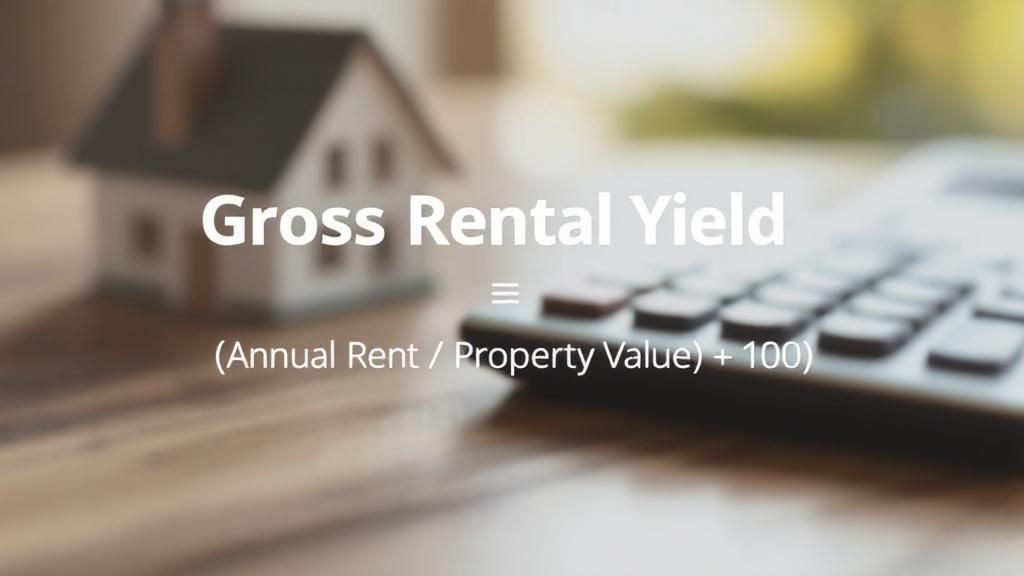
When evaluating a new investment in Monterey County, efficiency is key. Gross rental yield serves as the perfect "back-of-the-napkin" assessment of a property's income potential before diving into the granular details. Think of it as your initial filter for identifying promising opportunities.
The calculation is refreshingly simple. It only considers two key figures: the property's total purchase price and the annual rental income. By temporarily ignoring operating costs, you can quickly compare the raw earning power of a single-family home in a South County town like Soledad against a luxury condo overlooking the bay in Monterey.
The Gross Yield Formula
So, how do you calculate rental yield on a gross basis? The formula is a straightforward percentage that shows the relationship between annual rent and property price. For example, a property purchased for $800,000 that generates $48,000 in annual rent has a gross yield of 6%. This is the first number any serious investor crunches.
To see how your property measures up, it can be helpful to review benchmarks like the average rental yields in the U.S., though local context is always paramount.
The formula is:
(Annual Rental Income / Property Purchase Price) x 100 = Gross Rental Yield (%)
Let's apply this with a practical, local example.
A Salinas Duplex Example
Imagine you are considering a duplex in a desirable Salinas neighborhood with a purchase price of $700,000. After conducting thorough market research, you determine each unit can command a rent of $2,000 per month, for a total of $4,000 in monthly income.
Here is the step-by-step calculation:
- Step 1: Calculate Annual Rental Income: $4,000/month x 12 months = $48,000
- Step 2: Divide by the Purchase Price: $48,000 / $700,000 = 0.0685
- Step 3: Convert to a Percentage: 0.0685 x 100 = 6.85%
For this Salinas duplex, your gross rental yield is 6.85%. You now have a concrete baseline figure to compare this property against other potential investments in your portfolio.
Actionable Takeaway: Gross yield is an excellent starting point for quick evaluations. However, its primary weakness is its failure to account for real-world expenses that directly impact your actual profit. It is a tool for initial comparison, not final decision-making.
Calculating Net Yield To Uncover True Profitability
While gross yield offers a useful snapshot, it's only the first chapter for a discerning investor in Monterey County. The true measure of an investment’s health—the number that truly matters for your portfolio’s performance—is the net rental yield. This is where we provide a concierge-level analysis by accounting for all property ownership costs.
This calculation moves beyond a simple income-to-value ratio to reveal what a property is actually earning. It represents the funds remaining after all bills are paid, giving you a transparent view of your cash flow and ROI. For a busy professional, this clarity is essential for making sound financial decisions.
Pinpointing Your Annual Operating Expenses
To calculate net yield, you must efficiently track costs for every aspect of your property. The difference between a high-performing asset and an underperforming one often lies in these details. Every investor in our region must account for a specific set of local expenses.
These are the real-world costs that define your annual profits:
- Property Taxes: Monterey County has specific tax rates that represent a significant and non-negotiable expense.
- Insurance: Coastal properties, particularly in areas like Pacific Grove or the Monterey Peninsula, often necessitate specialized—and more costly—insurance policies.
- HOA Fees: For properties in planned communities, such as those in Pebble Beach or parts of Salinas, HOA dues are a major recurring cost to factor in.
- Maintenance & Repairs: We advise clients to budget 1-2% of the property’s value annually for maintenance. This proactive approach preserves the asset’s value and prevents minor issues from escalating into expensive problems.
- Vacancy Allowance: Realistically, no property remains occupied 100% of the time. We recommend a conservative vacancy allowance (typically 5-8% of gross rent) to ensure a more accurate income forecast.
- Property Management Fees: For owners who value their time and seek professional oversight, our management fees are a key part of the equation—an investment in peace of mind, property preservation, and optimized returns.
Subtracting these operating costs from your gross income yields your Net Operating Income (NOI). Our guide explaining what Net Operating Income is offers a deeper dive into this crucial metric.
This infographic breaks down the clear, three-step process for calculating net rental yield.
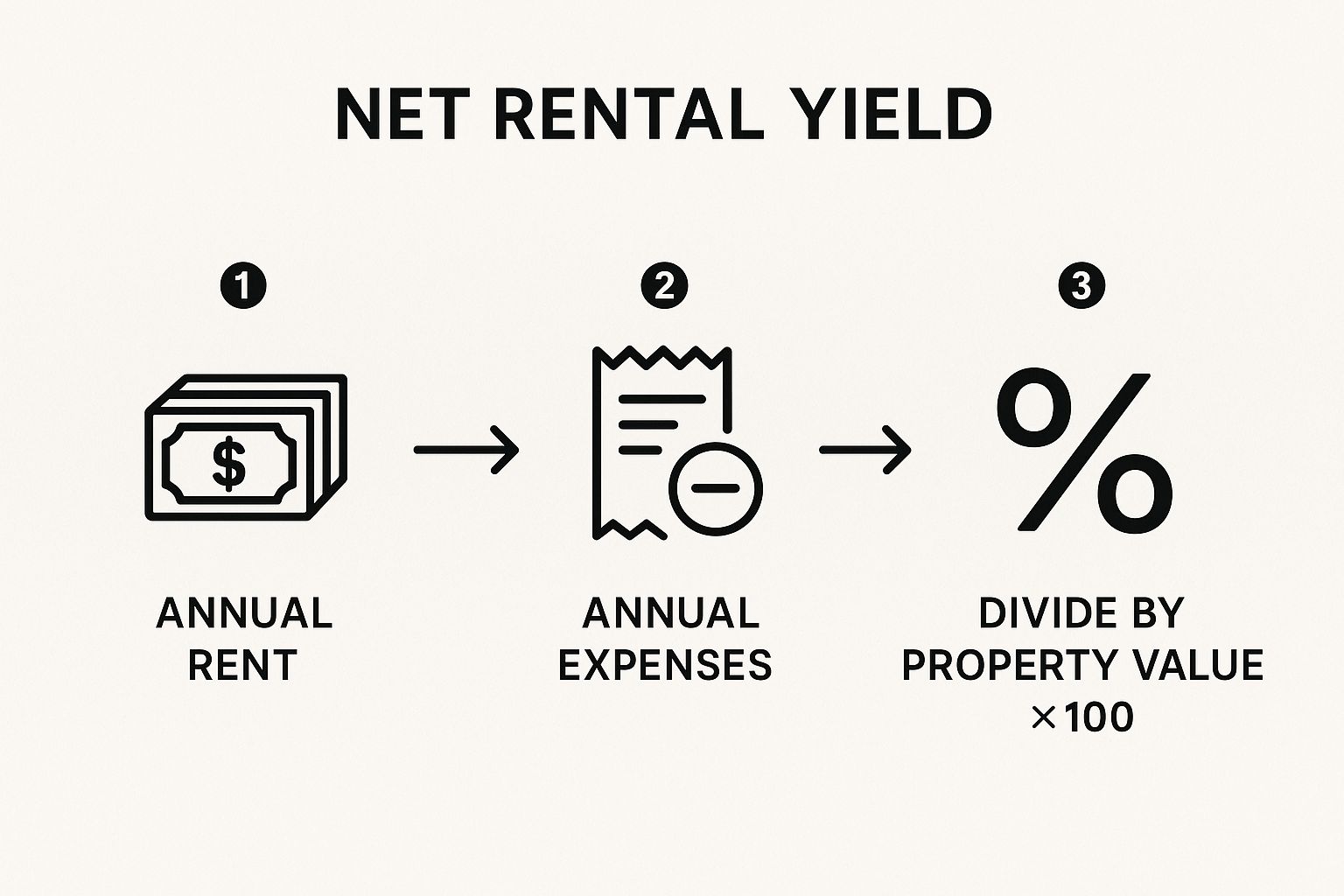
As you can see, you subtract the annual expenses from the rent before dividing by the property's value. This gives you a much more precise profitability metric.
Putting The Net Yield Formula To Work
The formula is straightforward, but ensuring accurate inputs requires more diligence than the gross calculation.
((Annual Rental Income – Annual Operating Expenses) / Property Purchase Price) x 100 = Net Rental Yield (%)
Let's return to our $700,000 Salinas duplex that generates $48,000 in gross annual rent. Now, let’s factor in realistic annual operating expenses.
- Property Taxes (approx. 1.25%): $8,750
- Insurance: $1,800
- Maintenance (1% of value): $7,000
- Vacancy Allowance (5% of gross rent): $2,400
- Property Management (8% of gross rent): $3,840
This brings our Total Annual Expenses to $23,790.
Now, let's execute the formula:
- Step 1: Calculate Net Income: $48,000 (Gross Rent) – $23,790 (Expenses) = $24,210
- Step 2: Divide by Purchase Price: $24,210 / $700,000 = 0.0345
- Step 3: Convert to a Percentage: 0.0345 x 100 = 3.46%
The True Bottom Line: The duplex’s promising 6.85% gross yield is refined to a 3.46% net yield. This isn't a disappointment; it's a reality check. It is the actual return on your investment—the number that truly matters for building long-term wealth and making informed decisions.
A Pacific Grove Case Study in Action

While formulas provide the framework, applying them to a real-world local property is where their value becomes clear. Let's walk through a realistic scenario for a high-end, single-family home in Pacific Grove—a premium market on the Monterey Peninsula where meticulous financial analysis is essential for success.
This example illustrates the critical importance of moving beyond surface-level numbers to understand the true bottom line. It’s a perfect demonstration of why precise financial forecasting is non-negotiable for investors in our unique coastal region.
Setting the Scene: The Property Details
Imagine you are acquiring a beautifully updated home in Pacific Grove with desirable ocean views. The initial investment details are as follows:
- Purchase Price: $1,800,000
- Estimated Closing Costs: $25,000
- Total Initial Investment: $1,825,000
- Competitive Market Rent: Based on our in-depth analysis of local comparables, the property can command a monthly rent of $7,500.
First, let's calculate the gross yield for a high-level assessment.
- Annual Rental Income: $7,500 x 12 = $90,000
- Gross Yield Calculation: ($90,000 / $1,825,000) x 100 = 4.93%
A gross yield approaching 5% is a solid starting point for a luxury coastal property. But as any experienced investor knows, this figure doesn't reflect the true financial story. Now, we must analyze the real-world expenses inherent to owning a high-end property in Monterey County.
Uncovering the True Return: The Net Yield Calculation
To understand how this Pacific Grove investment will truly perform, we must subtract all ongoing costs. This is where professional oversight prevents costly projection errors.
Here is a realistic breakdown of annual expenses:
- Monterey County Property Taxes (approx. 1.2%): $21,600
- Coastal Zone Insurance Policy: $4,500
- Higher Maintenance Budget (1.5% of value for a luxury home): $27,000
- Professional Property Management (8% of collected rent): $7,200
- Vacancy Allowance (5% of gross rent): $4,500
- Annual Landscaping & Pest Control: $2,400
This brings our Total Annual Operating Expenses to $67,200. Now we can calculate the net yield.
- Net Annual Income: $90,000 (Gross Rent) - $67,200 (Expenses) = $22,800
- Net Yield Calculation: ($22,800 / $1,825,000) x 100 = 1.25%
The net yield of 1.25% provides a transparent, realistic expectation of cash-on-cash return. While this figure is lower than the gross yield, it accounts for property preservation costs and professional management, ensuring the long-term health and appreciation of your asset. This is the number that informs a truly sound investment strategy.
Actionable Strategies to Boost Your Rental Yield
Calculating your property's yield is the starting point; actively improving it is where strategic management creates value. For discerning investors in Monterey County, enhancing net profit requires targeted actions that grow income while diligently controlling expenses.
These are the strategies that transform a solid investment into a high-performing one, whether you own a luxury home in Carmel-by-the-Sea or a multi-family building in King City.
High-Impact Tactics for Monterey County Owners
The following are proven strategies we implement for our clients to maximize their returns:
- Implement Strategic Renovations: Focus on high-ROI upgrades that justify higher rents. Modernizing a kitchen in a classic Monterey home, adding smart home technology, or installing high-end, durable flooring can attract premium tenants and increase rental income significantly.
- Optimize Rental Rates with Market Data: The rental market across the Monterey Bay Area, from Salinas to Pacific Grove, is dynamic. We continually analyze local trends to ensure your rental rates are optimized—maximizing income without increasing vacancy risk. This data-driven approach prevents you from leaving money on the table.
- Prioritize Proactive Tenant Retention: Vacancy is the biggest threat to your yield. A robust tenant retention strategy is your best defense. This includes providing exceptional service, responding swiftly to maintenance requests, and fostering a professional landlord-tenant relationship. A happy, long-term tenant saves you the significant costs associated with turnover. Our guide on how to find and keep good tenants details this crucial process.
Reducing Expenses and Protecting Your Bottom Line
Growing income is only half the equation; stringent cost control is equally vital.
A preventive maintenance program is essential. By addressing minor issues before they become major, costly repairs, you directly protect your net operating income and preserve your property's long-term value. This is a cornerstone of our property preservation philosophy.
Securing favorable financing is another powerful lever. The right terms on your investment property loans can dramatically improve your yield from day one, setting a strong foundation for profitability.
Expert Insight from Amy Salmina: "Focusing solely on yield can be misleading. The true performance of a real estate investment is a blend of rental income, income growth, and property appreciation. A sophisticated strategy, tailored to the Monterey County market, balances all three pillars to achieve long-term wealth creation."
Ultimately, boosting your rental yield requires a dual focus: maximizing revenue and minimizing expenses. Professional management is not a cost but a strategic investment in achieving that optimal balance.
Partner With The Right Experts To Maximize Your ROI
Let's be clear: understanding, calculating, and optimizing your rental yield is a detailed process that demands expertise. While it's a fundamental skill for any serious investor, turning raw data into profitable decisions is where deep local knowledge becomes indispensable.
This is precisely where partnering with Coast & Valley Property Management provides a distinct advantage. Our team's expertise is deeply rooted in the local market, from the agricultural heart of the Salinas Valley to the exclusive coastal enclaves of the Monterey Peninsula. This on-the-ground insight ensures our rental rate analysis is precise and our cost management strategies are effective.
We are committed to helping you maximize ROI with the transparency and trust that high-end investors expect. We meticulously analyze every line item—from local property taxes to specialized insurance policies—to provide a clear, honest assessment of your investment's performance.
With Amy Salmina's proven local leadership and commitment to excellence, we deliver the strategic oversight necessary to protect and grow your assets. Our mission is to manage the complexities of ownership, allowing you to focus on your returns.
To further enhance your strategy, consider collaborating with specialists who offer expert financial optimization services. A comprehensive approach also includes savvy tax planning; our guide on tax deductions for landlords in Salinas & Monterey County is an excellent resource for protecting your bottom line.
Ready to unlock your property's true potential? We invite you to contact us for a personalized analysis.
Common Questions About Calculating Rental Yield
Even after mastering the formulas, practical questions often arise when applying them to properties here in Monterey County. Here are answers to some of the most common inquiries we receive from sophisticated owners and investors.
What Is a Good Rental Yield in Monterey County?
There is no single "good" number, as expectations must be calibrated to the specific market. The high property values in premium coastal areas like Carmel or Pebble Beach naturally result in lower percentage yields compared to more affordable inland markets like Salinas or Soledad.
While a national gross yield target might be 5-8%, what truly matters is your net yield. Once all of our region’s unique costs are factored in, a "good" net yield is one that generates positive cash flow and aligns with your personal investment objectives.
Key Insight: Avoid fixating on a universal percentage. The most accurate way to judge your property's performance is to benchmark it against similar local investments—a core component of the analysis we provide for our clients.
How Does Vacancy Rate Affect My Rental Yield?
Vacancy is a direct drain on an investor's profit margin. It reduces your annual income, which is the numerator in both the gross and net yield formulas.
Consider this: just one month of vacancy per year reduces your actual annual income by over 8%. In Monterey County, factors like seasonal demand near agricultural centers or the Naval Postgraduate School can influence vacancy rates. The most effective way to protect your yield is through proactive, professional management that keeps high-quality tenants satisfied and in place.
Should I Use Purchase Price or Market Value to Calculate Yield?
This is an excellent question, and the answer depends entirely on your objective.
- To measure your original ROI: Use the purchase price. This is often called "yield on cost" and tells you precisely how your initial capital is performing.
- To assess current performance: Use the current market value. This calculation is vital for making strategic decisions, such as whether to hold the asset or execute a 1031 exchange to reinvest the equity elsewhere.
For new investors, always use the total acquisition cost (purchase price plus closing costs). For long-term owners, we recommend calculating yield annually using the current market value as part of a proactive portfolio review. For more guidance on selecting the right team, review our guide on the 7 essential questions to ask property management companies.
At Coast & Valley Property Management, we provide the in-depth analysis and strategic oversight you need to maximize your property's performance. As local leaders with deep roots in the community, we are committed to delivering the trust, transparency, and results you deserve.
Contact Coast & Valley Property Management for a Personalized Property Analysis

Navigating the Eviction Process in California: A Guide for Monterey County Investors
Successfully navigating an eviction in California isn't just a process; it's a precise legal procedure that demands perfection. As a property owner, you must have a valid "just cause" reason to remove a tenant. The entire process begins with a legally flawless written notice. If the tenant fails to comply, the next step is filing an Unlawful Detainer lawsuit, and only a Sheriff's lockout can officially complete the eviction.
Even a minor procedural mistake can result in the entire case being dismissed. This forces you back to square one, costing you significant rent revenue and valuable time—a risk no serious investor can afford.
Understanding California's Complex Eviction Landscape

For investors and owners of high-end properties in premier locations like Salinas, Carmel, or Pebble Beach, mastering California’s eviction laws is not merely an administrative task—it's a critical component of asset protection. This isn't just about removing a tenant; it’s about professionally and efficiently reclaiming your valuable property while minimizing financial exposure.
The legal landscape is constantly shifting. Success in this arena is built on genuine local expertise, not on a generic form downloaded from the internet. A single misstep can expose your investment to significant financial and legal liability.
The Post-Moratorium Environment and Its Impact
The legal complexity intensified after California's statewide COVID-19 eviction moratoriums expired. Once these protections ended in 2023, eviction filings surged, with many counties seeing numbers that far surpassed pre-pandemic levels. For example, Alameda County recorded nearly 800 eviction cases in June 2023 alone, a stark contrast to the monthly average of 324 in 2019.
This spike reflects a pent-up need for property owners to act. For you, this means the courts are congested, and the margin for error is nonexistent. Whether you own a portfolio of homes in South County towns like King City and Soledad or a luxury property in Pacific Grove, this new reality demands a flawless, professional approach.
Key Takeaway for Investors: The current eviction climate in Monterey County is unforgiving. To protect your ROI, the process must be treated as a structured business procedure. Every document, deadline, and communication must be managed with absolute precision to safeguard your investment.
Turning a Legal Challenge Into a Business Process
This is where professional property management provides immense value. We transform this intricate legal challenge into a predictable, managed system. Rather than reacting to problems, a proactive strategy anticipates them. This involves maintaining meticulous records, ensuring all communications are compliant, and leveraging a deep understanding of both state laws and local Monterey County court procedures.
A foundational step is understanding these laws. You can begin by exploring our detailed guide on landlord-tenant laws in California to build your knowledge base.
Adopting modern tools for efficiency and compliance is also a smart strategy. For example, understanding legal document automation can transform how you handle legal paperwork, ensuring accuracy while saving valuable time. This level of professional oversight is what separates a well-protected asset from a high-risk liability.
At Coast & Valley, we bring this concierge-level professionalism to every property we manage. Led by Salinas native Amy Salmina, our team’s local roots and commitment to excellence provide the trust and transparency high-end property owners expect. We manage the entire process, allowing you to focus on your investment portfolio with confidence.
Serving The Correct Eviction Notice
The entire California eviction process hinges on this first, critical step. Serving the correct notice is not a mere formality; it is the legal foundation of your entire case. For property owners and investors, a minor error here can derail the process, forcing you to start over while losing months of rent and incurring unnecessary legal fees.
This is, unequivocally, the most common pitfall for DIY landlords and a risk no serious investor should take.
Success requires absolute precision in selecting the legally appropriate notice, completing it perfectly, and serving it exactly as the law mandates. This is not a step to be taken lightly, especially when managing valuable assets in Monterey County.
Differentiating Key Eviction Notices
California law provides several notice types, each designed for a specific violation. Choosing the wrong one is an immediate and costly error. The most common are the 3-Day, 30-Day, and 60-Day notices, but even within the 3-day category, there are crucial distinctions.
- 3-Day Notice to Pay Rent or Quit: This notice is used exclusively for non-payment of rent. It must state the exact amount of rent due, the name and address of the person who can accept payment, and their hours of availability. Any mistake, such as overstating the rent owed, can invalidate the notice.
- 3-Day Notice to Cure or Quit: This is for a correctable lease violation other than rent. Common examples include an unauthorized pet in a Carmel rental or unapproved alterations to a Pacific Grove property. The tenant has three days to "cure" the violation (e.g., remove the pet) or vacate.
- 3-Day Unconditional Quit Notice: This is reserved for the most serious violations, such as illegal activity on the premises or causing substantial damage to the property. The tenant has no option to fix the issue; they must vacate within three days.
Real-World Scenarios in Monterey County
The appropriate notice is always dictated by the specific context. Let’s say you own a luxury property in Pebble Beach with a strict "no pets" clause. If the tenant acquires a dog, you would serve a 3-Day Notice to Cure or Quit. This gives them a clear, actionable opportunity to rehome the animal and restore compliance with their lease agreement.
Now, consider a tenant in a Soledad single-family home who is two weeks late on rent. In this instance, a 3-Day Notice to Pay Rent or Quit is the only correct instrument. Using a Notice to Cure for unpaid rent would be legally incorrect, and your case would likely be dismissed if challenged in court.
Investor Insight: The precision required for these notices is non-negotiable. At Coast & Valley, we treat notice preparation as a primary risk mitigation step. Our process, overseen by Amy Salmina's experienced team, ensures every notice is meticulously prepared, compliant, and served correctly, protecting your investment from the very first step.
The workflow for a standard non-payment issue is straightforward but incredibly rigid, as this infographic shows.
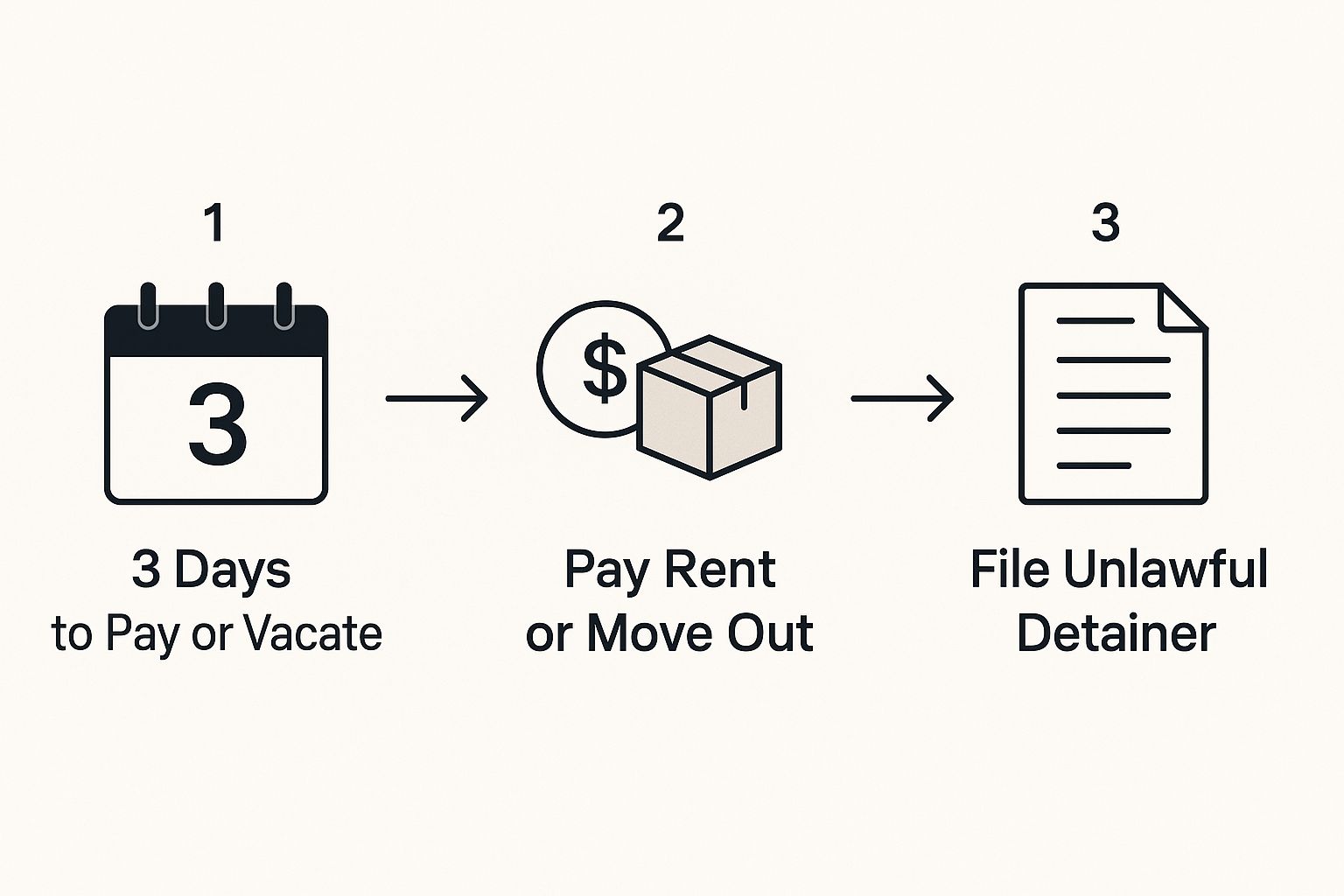
This visual highlights how that simple three-day window is the first legal trigger, leading directly to court action if the tenant doesn't comply.
Beyond the 3-Day: The 30/60-Day Notices
When you need a tenant to vacate for reasons that are not their fault—such as ending a month-to-month tenancy—different timelines apply.
- A 30-Day Notice to Quit is used if the tenant has resided in the property for less than one year.
- A 60-Day Notice to Quit is required if the tenant has resided there for one year or more.
These "no-fault" notices are often used when you plan to sell the property, move in yourself, or undertake substantial renovations. However, under the California Tenant Protection Act (AB 1482), you may be required to state a "just cause" and even provide relocation assistance. This adds another layer of complexity that demands professional guidance to ensure compliance and avoid liability.
To help clarify which notice applies when, here's a quick summary of the common types.
California Eviction Notices at a Glance
| Notice Type | Primary Use Case | Typical Timeframe | Key Consideration for Owners |
|---|---|---|---|
| 3-Day Notice to Pay or Quit | Tenant has failed to pay rent. | 3 business days | Must state the exact rent amount due; any overstatement can invalidate it. |
| 3-Day Notice to Cure or Quit | Tenant has violated a lease term (e.g., unauthorized pet, subletting). | 3 business days | The violation must be "curable." The notice must specify the exact violation. |
| 3-Day Unconditional Quit | Severe violations (e.g., illegal activity, major property damage). | 3 business days | No option for the tenant to fix the issue. Reserved for the most serious cases. |
| 30-Day Notice to Quit | Terminating a month-to-month tenancy for a tenant of less than 1 year. | 30 calendar days | Often requires a "just cause" and may involve relocation assistance under AB 1482. |
| 60-Day Notice to Quit | Terminating a month-to-month tenancy for a tenant of 1 year or more. | 60 calendar days | Subject to the same "just cause" and relocation rules as the 30-Day Notice. |
Understanding these distinctions is crucial for a legally sound eviction process.
Finally, remember that how you serve the notice is just as important as which notice you choose. California law dictates strict rules for "service," including personal delivery, substituted service, or "posting and mailing." Failure to follow these rules to the letter renders your notice legally void. This is precisely the kind of detail-oriented work where professional management from a team with deep local expertise in the Salinas and Monterey Bay Area becomes invaluable, protecting your ROI and saving you significant time and stress.
Filing The Unlawful Detainer Lawsuit

You have served a legally sound eviction notice, but your tenant in Monterey County has not complied. What's next? This is the point where the process transitions from landlord-tenant communication to formal legal action: filing an Unlawful Detainer lawsuit.
For owners of high-end properties, the word "lawsuit" can be intimidating. It's best viewed as a necessary business procedure to reclaim control of your valuable asset. This is not about personal conflict; it is a structured legal process governed by strict rules. The objective is to obtain a court judgment that officially terminates the tenancy, allowing you to regain possession.
Navigating the Monterey County Superior Court system requires absolute precision. This is where professional property management, working in concert with legal counsel, becomes indispensable.
Preparing The Summons And Complaint
The Unlawful Detainer lawsuit begins when you file two critical documents with the court: the Summons (Form SUM-130) and the Complaint—Unlawful Detainer (Form UD-100). These are not just forms; they are the legal backbone of your case.
- The Complaint: This document details exactly why you are legally entitled to evict the tenant. It must accurately list the property address, the tenants, reference the lease, and state the specific grounds for eviction—be it non-payment of rent or another lease violation.
- The Summons: This is the court's official notice to the tenant. It informs them that a lawsuit has been filed and provides a strict deadline—just five business days—to file a formal response with the court.
Accuracy here is non-negotiable. A minor mistake, like a misspelled name or an incorrect rent amount, can provide the tenant with a legal loophole to challenge the suit. This could lead to frustrating delays or, in a worst-case scenario, a full dismissal of your case. For our clients with properties from Pacific Grove to King City, we ensure every detail is meticulously reviewed by legal experts before filing.
The Local Filing and Service Process
Once the paperwork is perfected, it must be filed at the appropriate courthouse—for properties in our region, this is typically the Superior Court of California, County of Monterey. After filing and paying the court fees, you will receive court-stamped copies of the Summons and Complaint.
The next crucial step is service of process. California law is unequivocal: you, the owner, cannot personally serve these documents. Service must be performed by a registered process server or another adult not party to the lawsuit. They will attempt to deliver the documents directly to the tenant. If personal delivery is not possible, alternative methods like "substituted service" can be used, but each has its own strict legal requirements.
Investor Insight: The timeline from filing to service is critical. Delays in properly serving the tenant postpone the entire court schedule. Our role is to coordinate seamlessly with trusted local process servers to ensure this step is executed swiftly and in full legal compliance, keeping your case moving forward without preventable setbacks.
While the eviction process in California is known for its complexity, the state historically maintained lower eviction filing rates than other large states. Before the pandemic, California averaged 2.2 eviction filings per 100 rental households, a fraction of states like Michigan (16 per 100). The average rent owed at filing was $3,987.85, a figure that highlights our region's high rental values and underscores the significant financial impact of a non-paying tenant. You can find more data on California eviction filing rates at AAGLA.org.
This financial reality reinforces why a precise, legally compliant approach is essential from day one. Mastering this phase is fundamental to protecting your investment. For a more detailed overview, read our comprehensive guide on how to evict a tenant in California.
Navigating Court Responses and Tenant Defenses
Once you have filed the Unlawful Detainer and served the tenant, the process enters a new phase. The ball is now in the tenant's court, and they have a legal right to respond. Their next action—or inaction—will determine the timeline, cost, and ultimate outcome of your eviction. For any property owner, preparing for this stage is not just about a legal fight; it's about making a sound business decision under pressure.
After being served, a tenant has only five business days to file a formal response, typically an "Answer," with the court. If they miss this deadline, you can move for a default judgment—the quickest path to resolution. However, a savvy tenant, particularly one with legal aid, will likely file an Answer, signaling the start of a potential court battle.
Common Tenant Defenses And How To Counter Them
When a tenant files their Answer, they must list their defenses—the legal reasons they believe the eviction is invalid. Your ability to refute these claims depends almost entirely on the quality of your documentation and your adherence to the law up to this point. This is where proactive, professional management becomes your most powerful defense.
A few common defenses appear repeatedly:
- Improper Notice: The tenant argues the eviction notice contained errors (e.g., incorrect rent amount, wrong dates) or was not served according to California's strict rules. This is the most frequent defense and the most preventable with meticulous oversight.
- Breach of the Warranty of Habitability: A serious claim that the property was unlivable due to major, unaddressed maintenance issues like a broken heater, a leaking roof, or a severe pest infestation.
- Retaliatory Eviction: The tenant claims the eviction is punishment for them exercising a legal right, such as requesting a major repair or reporting a code violation to the city of Salinas.
- Waiver: This defense applies if you accept rent for a period after the notice to quit has expired. By accepting payment, a tenant can argue you have "waived" your right to proceed with that specific eviction.
The Power Of Proactive Documentation
Imagine a scenario: You are evicting a tenant from a high-end Pacific Grove rental for non-payment of rent. They file an Answer claiming the eviction is invalid because an unresolved plumbing issue has rendered the unit uninhabitable. A DIY landlord with poor records is immediately on the defensive.
For a Coast & Valley client, our response is immediate and evidence-based. We access our secure online portal and retrieve the complete, time-stamped record: the tenant's initial maintenance request, proof of our prompt response, dispatch of a licensed plumber within 24 hours, and the signed work order confirming the repair was completed to their satisfaction. This meticulous documentation neutralizes the claim and demonstrates to the court that you have acted professionally and in good faith.
A firm grasp of the clear lines between landlord responsibilities vs. tenant duties is critical to preventing these claims from gaining traction.
It's also wise to know what tenants can and cannot legally do. For instance, understanding the tenant's rights regarding changing locks provides important context if a dispute becomes complex. Ultimately, robust documentation and legal expertise transform potential liabilities into proof of your professionalism.
Settlement Vs Trial: A Cost-Benefit Analysis
When a tenant contests the eviction, you face a critical decision: negotiate a settlement or proceed to trial? This must be a business calculation, not an emotional one.
| Factor | Negotiating a Settlement | Proceeding to Trial |
|---|---|---|
| Timeline | Faster. Typically resolves in days or weeks, allowing you to re-lease the property quickly. | Slower. Securing a court date in busy Monterey County courts can take weeks or months. |
| Cost | Lower. Avoids significant attorney and court fees. May involve a "cash for keys" offer. | Higher. Incurs substantial legal fees, court costs, and possible jury fees. |
| Certainty | Guaranteed outcome. You control the terms of the tenant's departure and move-out date. | Uncertain outcome. A judge or jury could rule against you, regardless of your case's strength. |
| Risk | Minimal. The primary risk is the cost of the settlement payment itself. | High. If you lose, the tenant stays, and you could be ordered to pay their legal fees. |
A settlement often takes the form of a "cash for keys" agreement, where you offer the tenant a sum of money to vacate the property by a firm deadline, leaving it in good condition.
While paying a tenant who has not paid you can feel unfair, it is often the most prudent financial decision. It eliminates the risk of losing in court and, most importantly, stops the financial drain from lost rent. This allows you to regain possession, prepare the unit, and place a new, qualified tenant to restore your cash flow. Our team at Coast & Valley can help you analyze the specific ROI of this critical decision for your property.
Securing and Executing the Writ of Possession

You have successfully navigated the court process and obtained a judgment in your favor. This is a significant milestone in the eviction process in California, but the task is not yet complete. A common misconception is that this court order grants you the immediate right to change the locks. It does not.
The judgment authorizes you to obtain a Writ of Possession. This is the official court order directing the county Sheriff to physically remove the tenant. It is the final, crucial step, and proper execution is essential to avoid last-minute legal complications.
The Sheriff's Role and the Lockout Timeline
Once the court clerk issues the Writ of Possession, it is sent to the local Sheriff's office, such as the Monterey County Sheriff's Department. From this point forward, the Sheriff, not you, controls the timeline.
A Sheriff's deputy will visit the property and post a Notice to Vacate on the front door. This notice serves as a final warning, giving the tenant five calendar days to leave voluntarily. If they remain after this period, the Sheriff will schedule a date and time to meet you (or your property manager) at the property to perform the final lockout.
This waiting period can be stressful for property owners. Before the pandemic, eviction lockouts were common, with the San Francisco Bay Area alone exceeding 6,000 per year. When moratoriums took effect in March 2020, that number dropped to nearly zero, demonstrating how quickly legal shifts can halt the process. Now, with moratoriums lifted, these actions are increasing as owners work to reclaim their properties.
Professional Tip: Be prepared for lockout day. The moment the Sheriff grants you possession, a locksmith should be on standby to change all locks. This is the official act that restores possession to you and secures your valuable asset.
Handling Abandoned Personal Property
It is common for evicted tenants to leave personal items behind. California has incredibly specific and strict laws governing how you must handle this abandoned property. A single misstep can result in significant financial penalties, even after you have won the eviction.
Here is the required actionable checklist:
- Inventory Everything: Create a detailed list of all items left behind. Documenting items and their condition with photos or video provides a clear record.
- Assess the Value: Make a good-faith estimate of the total resale value of the items. This is a critical step, as the value dictates the subsequent legal requirements.
- Provide Formal Notice: Send a written "Notice of Belief of Abandonment" to the tenant's last known address. This notice must describe the property, state its storage location, and provide a deadline for the tenant to claim it (at least 15-18 days, depending on the delivery method).
If the property's total value is less than $700, you may dispose of it if it is not claimed by the deadline. However, if the value exceeds $700, you are legally required to hold a public auction, following a highly specific sale process. You can use the proceeds to cover storage and sale costs, but any remaining funds must be turned over to the county. This is a common and expensive error for DIY landlords.
Navigating this final stage requires meticulous attention to detail and a thorough understanding of the law. It is another reason why having an experienced team like Coast & Valley is so valuable—we ensure the process concludes cleanly, restoring your property to your control so you can focus on what matters: preparing the unit for a new, qualified tenant and getting your investment back on track. This also reinforces the importance of a professional tenant-landlord relationship from the outset.
Common Questions About California Evictions
The California eviction process can feel like a labyrinth, especially for owners managing high-value properties in the Monterey Bay Area. Even with a clear understanding of the steps, specific questions often arise. Here are some of the most frequent inquiries from property owners and investors.
How Long Does The Eviction Process In California Typically Take?
For an uncontested eviction—the best-case scenario—the timeline is generally 30 to 45 days from serving the initial notice to the Sheriff's final lockout.
This timeline changes significantly if a tenant contests the eviction. If they file an Answer with the court or demand a jury trial, the process can easily extend to 60-90 days or longer. The duration depends heavily on the Monterey County Superior Court's caseload and the complexity of the tenant's legal arguments. This is precisely why flawless execution from day one is critical to avoiding costly, preventable delays.
Can I Evict A Tenant Without Giving A Reason?
In most situations, no. The California Tenant Protection Act (AB 1482) requires a "just cause" to terminate most residential tenancies. You must provide either an "at-fault" reason (like non-payment of rent or a lease breach) or a specific "no-fault" reason (such as intending to move into the property yourself).
For luxury rentals in communities like Carmel or Pacific Grove, navigating the interplay of state and local ordinances can be complex. Attempting to terminate a tenancy without a legally sound "just cause" is one of the quickest routes to facing a wrongful eviction lawsuit.
What Are The Most Common Mistakes Owners Make?
The costliest mistakes are almost always procedural. It's surprisingly easy for well-intentioned landlords to undermine their own case. Common missteps include:
- Serving a faulty notice: This is a frequent error, ranging from miscalculating rent owed to failing to deliver the notice in the exact manner prescribed by law.
- Accepting partial rent: Taking any amount of rent after a notice has expired can legally void that notice, forcing you to restart the entire process.
- Attempting "self-help" evictions: Illegally changing locks, shutting off utilities, or removing a tenant's belongings will backfire dramatically, exposing you to severe legal and financial penalties.
- Poor documentation: In court, a weak paper trail of communications, lease violations, and repair records makes it significantly harder to prove your case.
Professional management is your shield against these preventable setbacks. As Amy Salmina and our team know, strict compliance is not optional; it is the cornerstone of protecting your investment and its ROI.
What Happens To The Security Deposit After An Eviction?
Once you have legally regained possession of your property, a 21-day clock starts on the security deposit. You have exactly 21 days to either return the full deposit or provide the former tenant with an itemized statement explaining all deductions.
You can deduct for unpaid rent, necessary cleaning, and repairs for damages beyond normal wear and tear. You must include copies of receipts for any work performed. Meticulous records, including photos and invoices, are essential for justifying every deduction, especially following a contentious eviction. You can familiarize yourself with these and other landlord responsibilities by reviewing these essential California landlord-tenant laws.
Navigating the eviction process successfully requires more than just knowledge—it demands precision, hands-on local experience, and an unwavering commitment to legal compliance. At Coast & Valley Properties, we provide the professional oversight necessary to protect your assets and your peace of mind.